1939: Robert Nixon, Richard Wright inspiration

On this date in 1939, Illinois electrocuted Robert Nixon for bashing Florence Johnson to death with a brick as he burgled her Chicago home.*


The Chicago Tribune‘s Family Circus-esque May 28, 1938 illustration of the crime scene.

Nixon’s fingerprints would also link him to three previous rape-murders in California; separately, he admitted raping and killing Illinois nursing student Anna Kuchta in 1937, although he would also argue that Chicago police tortured the confessions from his lips.

Crudely nicknamed the “Brick Moron”, Nixon was vilified in shockingly racist terms by a hostile press.

This Chicago Tribune article is one of the worst exemplars and is only the start of a much longer piece in the same vein but even straight-news bulletins routinely went with a casual “savage colored rapist” label. His possible developmental disability (“moron” …) was generally cast not as any sort of mitigating consideration but as the indicator of a superpredator: “It has been demonstrated here that nothing can be done with Robert Nixon,” the sheriff of the Louisiana town where he grew up wrote to Chicago. “Only death can cure him.”

Richard Wright allegedly mined the commentary on Nixon to inform his classic novel Native Son, which hit print the next year … and sees its lead character Bigger Thomas die in the Illinois electric chair.

* It was supposed to be a triple execution but late reprieves spared Steve Cygan and Charles Price, both murderers in unrelated cases.

On this day..

Feast Day of Saint Eskil

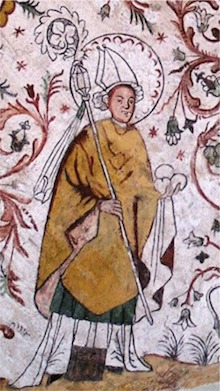
June 12 is the feast date* of Saint Eskil, a martyr to the slow Christianization of Scandinavia.

Ol’ “God-kettle” was one of several missionaries known to have been dispatched in the 11th and 12th century from England to Sweden, a traffic in religious conversion across the North Sea crossroads to invert the centuries-past course of Vikingers who put so many British sanctuaries to the sack.

The Northmen realms were ripe to join Christendom but sagas touching the time describe an uneven transitional period where the new and old faiths jostled for primacy.

“Ingi was king for a long time, well-liked and a good Christian; he put down [pagan] sacrificing in Sweden and ordered all the people of the land to become Christian,” runs The Saga of King Heidrek the Wise** (available in pdf translation here), about King Inge the Elder.

But the Swedes had too strong a belief in the heathen gods and held to their ancient ways … the Swedes thought that King Ingi had infringed their rights under the ancient law of the land, when he found fault with many things that Steinkel his [Christian] father had let be; and at a certain assembly which the Swedes held with King Ingi they gave him the choice of two things, either to observe the ancient laws or else to give up his throne. Then King Ingi spoke, and said that he would not leave the true faith; whereat the Swedes cried out, and pelted him with stones, and drove him from the law-assembly.

Svein, the king’s kinsman, remained behind at that assembly, and he offered to make sacrifice for the Swedes if they would grant him the kingdom; all agreed to Svein’s offer, and he was accepted as king over all the Swedish realm. Then a horse was led forth to the assembly, hewn in pieces, and divided up for eating, and the sacrificial tree was reddened with its blood. Thereafter all the Swedes cast off the Christian faith, and sacrifices were instituted, and they drove King Ingi away; he departed into western Gautland. For three years Svein the Sacrificer was king over the Swedes.

King Ingi went with his own bodyguard and some followers, though it was only a small force … into Sweden; he rode by day and night and came upon Svein unawares in the early morning. They seized the house over their heads and set it on fire, and burnt all the company who were inside … Svein came out and was cut down. And so Ingi took the kingship of the Swedes anew, and restored the Christian faith; he ruled the realm till the day of his death.

The “Svein” referred to here is a gentleman whom the historians recall as Blot-Sweyn — “Sweyn the Sacrificer” — and this Norse answer to Julian the Apostate apparently enjoyed his interregnum authority in about the 1080s thanks to Inge’s disrespect of the old rites still honored at the ancient Temple at Uppsala.

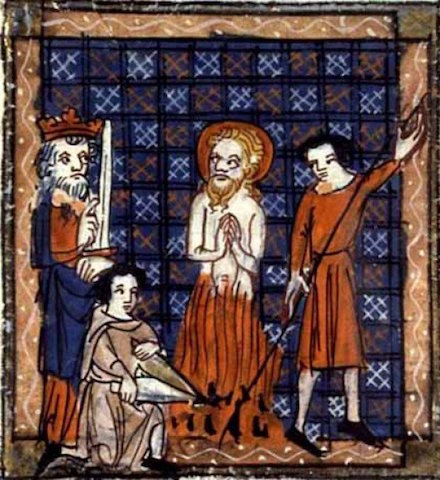
The timeline of high statecraft is extremely sketchy, and Saint Eskil’s relationship to events doubly so. Commonly recalled as a victim of the Blot-Sweyn period, Eskil is first marked in the 1120s annals of another Anglo-Saxon monk abroad in Scandinavia, Aelnoth from Canterbury — “Eschillus of sacred memory” who succumbed evangelizing to the “barbarorum feritate.” That’s the whole of it, with nothing like a year or a regnal era to hang one’s hat upon. In the 13th century, with Christianity truly triumphant, a hagiography of Eskil greatly embroidered the martyrdom story and tied it to the land’s most notorious rearguard ruling unbeliever, featuring a cast of heathens so nonplussed at the monk’s interruption of their feast that, notwithstanding his show of divine miracles, Blood-Sweyn has him sentenced to immediate stoning.

The town of Eskilstuna bears his name (it used to just be “Tuna”).

* Though it’s been bumped to June 12 everywhere else, the feast is still marked on its original June 11 date in the diocese Strängnäs, where the saint was supposed to have attained his martyr’s crown. (Strängnäs Cathedral is supposed to mark the very spot of his fatal confrontation with the Aesir followers.)

** This saga’s narrative stretches from an outright legendary prehistory to the Middle Ages. The Ingi-Svein affair is its last episode, but its first locates a more Wagnerian milieu: “Sigrlami was the name of a king who ruled over Gardariki; his daughter was Eyfura, most beautiful of all women. This king had obtained from dwarves the sword called Tyrfing, the keenest of all blades; every time it was drawn a light shone from it like a ray of the sun. It could never be held unsheathed without being the death of a man, and it had always to be sheathed with blood still warm upon it. There was no living thing, neither man nor beast, that could live to see another day if it were wounded by Tyrfing, whether the wound were big or little …”

On this day..

Feast Day of St. Barnabas

June 11 is the feast date of St. Barnabas, St. Paul‘s New Testament wingman.

A Cypriot Jew named Joseph, “Barnabas” (“Son of Encouragement”) was so christened in the fourth chapter of the New Testament’s Acts of the Apostles because upon his conversion he sold his land for a donative to the Galileans.

After that, Barnabas reappears throughout Acts as one of the most important of the early Christian missionaries, usually joining St. Paul — whom Barnabas himself introduced to the Christians after Paul got religion — as emissary to the non-Jews, for which purpose the Holy Spirit itself demanded him by name. (Acts 13:2: “Set apart for me Barnabas and Saul for the work to which I have called them.”)

They’re frequently paired thereafter in the narrative although it’s invariably Saint Paul’s honeyed tongue that does the confounding before the companions flee this city or that ahead of a furious mob.* Evidently the Holy Spirit’s labor policies could have used some updating: Barnabas also features in a whinge by Paul in 1 Corinthians 9 against the excess sacrifices the Jesus sect is exacting from its most successful envoys, who get no wages and no sex and (so it seems) have to hustle side jobs to keep up their proselytizing.

Don’t we have the right to food and drink? Don’t we have the right to take a believing wife along with us, as do the other apostles and the Lord’s brothers and Cephas [St. Peter]? Or is it only I and Barnabas who lack the right to not work for a living?

Who serves as a soldier at his own expense? Who plants a vineyard and does not eat its grapes? Who tends a flock and does not drink the milk? … whoever plows and threshes should be able to do so in the hope of sharing in the harvest. If we have sown spiritual seed among you, is it too much if we reap a material harvest from you? If others have this right of support from you, shouldn’t we have it all the more?

But we did not use this right. On the contrary, we put up with anything rather than hinder the gospel of Christ.

Barnabas eventually parted ways with Paul, proceeding to Cyprus with the mysterious John Mark (possibly Mark the evangelist, author of the Gospel, or possibly a different guy) where hagiography holds that Jews angered by his preaching fell on Barnabas and stoned him to death, perhaps around the year 61.

Although obviously a consequential figure in early Christianity, Barnabas’s many Biblical appearances do not capture his voice. The apocrypha preserves at least two tracts** further animating this important character: the Epistle of Barnabas dating to the late first century or early second century; and, the Acts of Barnabas, a 5th century creation which purports to arise from the hand of John Mark and describes a martyrdom by fire, not stone:

And Barjesus, having arrived after two days, after not a few Jews had been instructed, was enraged, and brought together all the multitude of the Jews; and they having laid hold of Barnabas, wished to hand him over to Hypatius, the governor of Salamis. And having bound him to take him away to the governor, and a pious Jebusite, a kinsman of Nero, having count to Cyprus, the Jews, learning this, took Barnabas by night, and bound him with a rope by the neck; and having dragged him to the hippodrome from the synagogue, and having gone out of the city, standing round him, they burned him with fire, so that even his bones became dust. And straightway that night, having taken his dust, they cast it into a cloth; and having se cured it with lead. they intended to throw it into the sea. But I, finding an opportunity in the night, and being able along with Timon and Rhodon to carry it, we came to a certain place, and having found a cave, put it down there, where the nation of the Jebusites formerly dwelt. And having found a secret place in it, we put it away, with the documents which he had received from Matthew. And it was the fourth hour of the night of the second of the week.

Because June 11 formerly fell on/near Midsummer, ere the Gregorian reforms skipped the calendar 10-11 days forward, St. Barnabas’s Day has a festive agrarian history commemorated by the proverb, “Barnaby bright, Barnaby bright, the longest day and the shortest night.” The saint is also the patron of Cyprus, and may be invoked to protect against hailstorms or in service of peacemaking. Numerous schools, churches, and monasteries around the world bear his name.

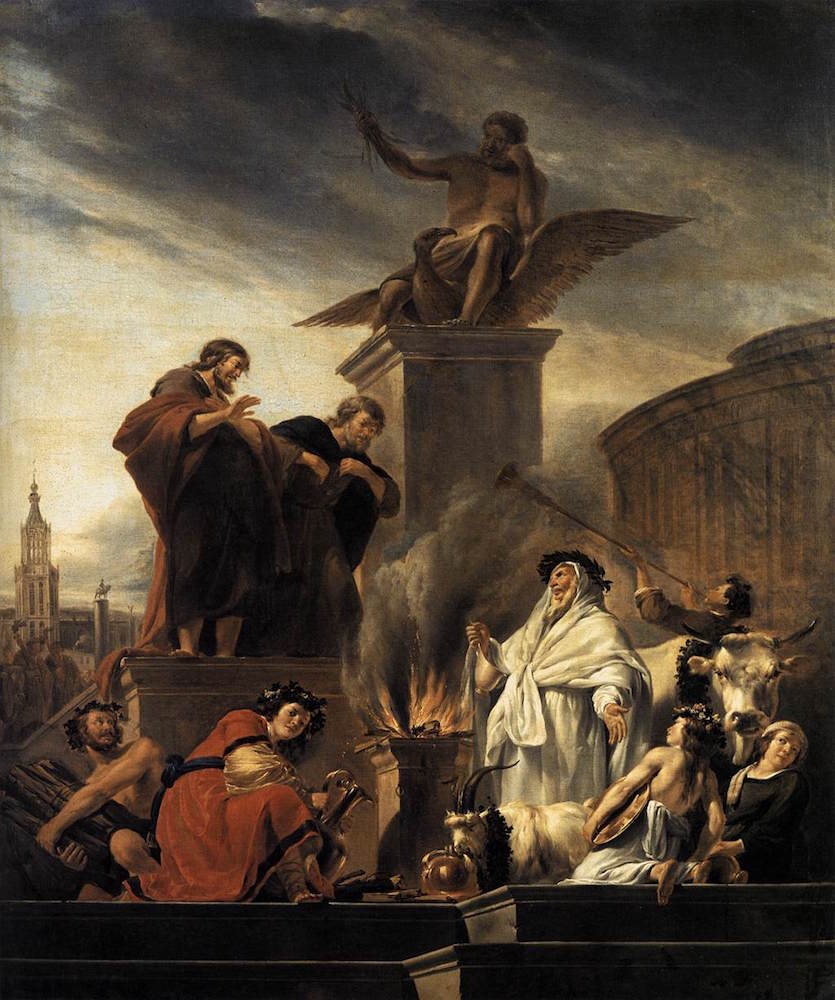
* There’s a comic touch to their preaching travails, too: in one exciting episode (Acts 14), Paul (of course) heals a cripple while the dynamic duo preaches in Lystra, leading excited witnesses to take them for Hermes and Zeus and start sacrificing to them.


No tips, please: Paul and Barnabas refusing the sacrifices of Lystrans in this detail (click for the full image) of a 1650 painting by Nicolaes Berchem.

** Beyond the Epistle and the Acts, there is also a very much later Gospel of Barnabas.

On this day..

1730: Sally Bassett, Bermuda slave

(Thanks to Meaghan Good of the Charley Project for the guest post. -ed.)

Perhaps on this day in 1730,* an elderly mulatto slave named Sarah or Sally Bassett was burned at the stake for attempted murder in the British Caribbean colony of Bermuda.

Sally was the property of Thomas Forster, as was her granddaughter, Beck. (Thomas Forster was the grandson of Josias Forster, who was governor of Bermuda from 1642 to 1643.) The Forster family lived in Sandys Parish.

Being so old, Sally wasn’t worth much: her value was appraised at one pound, four shillings and sixpence, or about $160 in modern U.S. currency. She also had the reputation of a troublemaker: in 1713, for example, she was whipped the length of Southampton Parish after being accused of threats, property damage and killing livestock.

On December 18, 1729, Sally allegedly gave two bags of poison, said to be “white toade”** and “manchineel root”, to her granddaughter, Beck, and told her to poison Thomas, his wife Sarah, and Nancey, another slave in the Forster household.

Beck slipped a dose into the master and mistress’s food, “where if her Mistress did but smell on’t twould poison her.” She put the rest of the poison in the kitchen door, where Nancey found it and “by only looking at it ye said. Nancey was poyson’d.” (Quotes are as cited in Slaves and Slaveholders in Bermuda, 1616-1782.)

Sally was not arrested and charged with the crime until June 2, nearly six months later. The victims were all still “sick and Lye in a very Languishing and dangerous Condition,” but Sarah Forster was at least well enough to drag herself out of her sickbed and testify against her slaves.

Beck was acquitted but Sally, “not having the fear of God before her Eyes, Butt being moved and seduced by ye Instigation of the Devil,” was convicted of petit treason for her attempt on her master and mistress’s lives.

Although she maintained her innocence, she was sentenced to death.

Barefoot, wearing only pants and a loose blouse, on the way to the place of execution Sally is said to have looked at the crowds rushing to see the show and quipped, “No use you hurrying folks, there’ll be no fun ’til I get there!” When she looked at the logs waiting to fuel the fire she supposedly said, “Ain’t they darlin’?”

She was burned alive on an unusually hot day, in public, either on an island off Southampton Parish or at Crow Lane at the east end of Hamilton Harbor. After her death a purple Bermudiana, Bermuda’s official flower, is reputed to have grown in the ashes. Days later, Bermuda enacted new laws to tighten control of the “many heinous and grievous Crimes as of that Secret and barbarous way of Murdering by Poison and other Murders … many times Committed by negroes and other Slaves and many times malitiously attempted by them.”

Sally’s death has passed on into legend and is considered part of Bermuda’s cultural heritage. Even today, nearly three hundred years later, a very hot day in Bermuda is sometimes called a Sally Basset day. In 2009, a ten-foot statue of Sally was dedicated at the Cabinet Office grounds in Hamilton, the first time in Bermuda that a slave was so memorialized.

* There are some shouts for June 21, 1730. If there is an authoritative primary document establishing the execution date with certainty, we have not been able to unearth it.

** The involvement of white toad, as historian Justin Pope observes, points — alarmingly for 18th century white Bermudians; intriguingly for posterity — to transatlantic black (in multiple senses) economies.

There were no indigenous white toads in Bermuda. However, as noted by the Bermudian historian Clarence Maxwell, poisonous toads were used in ceremonies among Akan speaking peoples in the tropical forests of West Africa and carried into the voudou traditions of San Domingue.

… If there really was a white toad used in the Bermuda poisoning conspiracy, then it was almost certainly brought to the colony by a slave mariner who believed he was arming a spiritual practitioner against her enemies. It was not something that Sarah Bassett could have asked for lightly. The person who purchased the item would have easily been able to discover, or at least suspect, its usage. Whoever carried it had to be trusted. The toad would have had to been captured or cultivated in the tropical forests of West Africa or northern South America, purchased in the slave markets of towns like Paramaraibo, on the Surinam River of Dutch Guyana, or in the markets of Elmina, on the southern coast of West Africa. We can only surmise the origins of the poisonous toad, yet its very presence on the island of Bermuda suggests a trade in poisons, betweens slave societies and through the hands of black mariners.

On this day..

1886: A day in the death penalty around the U.S. South

From the New Orleans Times-Picayune, June 5, 1886.


Execution of Alfred Taylor at Opelousas.

Opelousas, La., June 4. — [Special.] — In accordance with Gov. McEnery‘s proclamation, Alfred Taylor, colored, was executed at 1:30 o’clock, P.M., to-day, by Sheriff Duson, the condemned man dying of strangulation about fifteen minutes after the springing of the trap.

He preserved a very firm and unconcerned mien until he saw the gallows, not seeming to realize or to believe that he would be hanged. He protested his innocence of the crime to the last. Once when the supreme moment arrived, he lost his usual stolidity and called on God to have mercy upon him and begging [sic] the Sheriff not to hang him.

Taylor was 23 years years old, griff in color, of medium height and weighing about 145 pounds. He was tried at the March term of our District Court, and the jury was composed of nine white and three colored men. He was defended by able counsel, and after an impartial trial was found guilty as charged on the indictment.

On Monday, Feb. 8, 1886, at about 11 o’clock in the morning, Taylor called at the residence of Mrs. Latreuille, a white lady, residing on the old Dr. Moore place, near Moundville, some four miles above Washington, and asked if her husband was at home. Not suspecting anything wrong, she replied that he was not. The negro then told her that some one was trying to steal her chickens in the woods near by and that she had better see about it.

The unfortunate woman went to the place to look after her fowls, when the negro followed her, and drawing a pistol threatened to shoot her if she made any outcry. She fainted away through fright, when he accomplished his diabolical purpose. He fled, and a posse was immediately organized and began searching for him. Had he been caught then he would undoubtedly have been lynched. He evaded arrest, however, until the week before his trial and conviction. The evidence adduced at the trial was crushing, and the jury promptly returned a verdict as above.

Since his conviction he has manifested no sighs of contrition, but, on the contrary, has always affected the most stoical indifference, and constantly indulged in the most revolting profanity.


A Double Execution.

Winchester, Va., June 4. — Wes Honesty and Tabby Banks were hanged at 9:22 A.M., for the murder on the night of Nov. 14, 1884, of Joseph McFaul, a youth of 18 years. A large Democratic procession took place here on that night, and the prisoners walked through the streets making threats that they would crack the skull of some Democrat before morning.

McFaul was a slightly built, peaceable young man, while Honesty and Banks were powerfully grown negroes.

They waylaid McFaul at the mouth of an ally on Main street. He had nothing with which to protect himself but a light walking stick. The negroes pressed upon him and he ran from them, ordering them to keep away. They then rushed upon him. Honesty collared him and pushed him against a house at the mouth of the alley, and Banks cried out, “stick it to him.”

McFaul defended himself as best he could with his walking-stick. Honesty was facing McFaul, and Banks got behind him. Honesty drew back and hurled a rock at McFaul, striking him in the left temple. As he reeled and staggered across the street Banks struck him with some weapon he held in his hands. McFaul went to his boarding-house, and was found dead in his bed next morning, with his skull crushed.

As the criminals marched to the scaffold Banks began to tremble violently, but Honesty stood firm on the trap. The Moody hymn, “There is a Light in the Valley,” was sung by request, both joining in loudly.

Honesty said: “I thank God I am converted. I am going to heaven. No man’s blood rests on my soul. I have not to answer for it. I thank all the officers and ministers for their kindness.”

Banks said I am not guilty of what is put on me. I want to meet all my friends in heaven.

Their arms were then pinioned, the black cap drawn over their heads, and in a loud voice, both cried out “good-bye,” “good-bye.” The trap was then sprung.


John Davis Hanged in Assumption.

Napoleonville, La. — [Special.] — At 12:30 o’clock to-day a colored man, named John Davis, was hung at Napoleonville for the murder of his wife, two years ago, on the Jones plantation, three miles above the town. He confessed the crime, and said he was willing to die for what he had done. The execution was without incident.


Launched from Lebanon.

Lebanon, Tenn., June 4. — Jim Baxter, colored, was hanged at 11:32 this morning. His last utterances were: “I did not kill Mrs. Lane. Dat’s the God’s truth.” His neck was not broken. He was dead in fifteen minutes.

On this day..

1660: Mary Dyer, Quaker

Mary Dyer was hanged in Boston on this date in 1660 — the most famous of that city’s four “Quaker martyrs”.

Monument in Boston to Mary Dyer as “witness for religious freedom”. (cc) image by Andrea Schwartz.

By the time of her last ordeal, Dyer already had a quarter century-old reputation for religious misbehavior in the New World.

She’d ditched England with her husband in 1635, part of that decade’s great outmigration of Puritan dissidents — “A Comely Grave Woman, and of a goodly Personage, and one of a good Report, having a husband of an Estate, fearing the Lord, and a Mother of Children,” according to an admiring account. Opinions varied: the colony’s governor found her “very censorious and troublesome, (she being of a very proud spirit, and much addicted to revelations).”

She brought with her a proclivity for the heretical: in Massachusetts, where the Puritan majority delivered the persecuting, Mary quickly fell foul of right-thinking folk by backing Anne Hutchinson in a theological controversy.* When Hutchinson was convicted by a church trial and banished, Mary Dyer cinematically walked hand-in-hand with her out of church. On top of everything else, she was known to have stillborne a deformed monstrosity (“a woman, a fish, a bird, & a beast all woven together”) which was the kind of thing these people understood as deadly serious.

Mary and her husband went to exile with Hutchinson, and were among the first English settlers of Rhode Island, before returning to spend most of the 1650s back in England. There, Mary Dyer converted to one of the new entrants to the Commonwealth’s welter of novel sects, Quakerism.

This new faith’s emphasis on egalitarian personal religious experience ungoverned by ordained clergymen met an instant ban once Massachusetts caught wind of it, with a statute imposing mutilated tongues and trips to the pillory for expounding the outlaw doctrine. To these would be added the threat of the gallows for repeat offenders with the temerity to return from banishment … and Mary Dyer is only the most famous of four Quakers who actually suffered this penalty.


The Heart of N-England Rent at the Blasphemies of the Present Generation: Boston Rev. John Norton‘s 1659 anti-Quaker tract advocates their execution.

Dyer’s defiance of the law was straightforward, keeping with the bold tradition of martyrdom in witness. Jailed in Boston in 1657, her husband (who had not yet followed his wife’s conversion) managed to arrange her release; she returned in 1659 to visit other imprisoned Quakers and they were all banished for their trouble. Shortly after, she returned to Boston with William Robinson and Marmaduke Stevenson: these were the first two Quakers put to death by the Puritans, but Mary Dyer was spared at the foot of the gallows and again expelled, finding temporary refuge in Rhode Island.

Edward Burrough’s A Declaration of the Sad and Great Persecution and Martyrdom of the People of God, called Quakers, in New-England, for the Worshipping of God, which also catalogues the many brutal punishments inflicted on Quakers up until 1661, preserves an account of Mary’s final return to Boston in May 1660 and her immediate arrest for same: it was enough for her to acknowledge her identity to reinstate her former sentence.

“I came in Obedience to the Will of God the last General Court, desiring you to Repeal your unrighteous Lawes of Banishment upon pain of Death; and that same is my work now, and earnest Request,” she told the court that doomed her. “If ye refused to Repeal them, the Lord will send others of his Servants to Witness against them.”

The very next day, she was drummed — to prevent her preaching — on a mile-long walk a gallows on Boston Common. This time there was no reprieve waiting: only immortality.

* This controversy drove the short-term governor Henry Vane back to England, and martyrdom during the interregnum.

On this day..

1878: A day in the death penalty around the U.S.

From the Jackson (Mich.) Weekly Citizen:

A WOMAN’S DEATH AVENGED

NEW ORLEANS, May 24. — To-day, between the hours of 1 and 2 o’clock p.m., at the parish seat of Union parish, Louisiana, Jesse Walker, a colored man, was executed for the murder of Violet Simmons.

On the 12th of April last he was convicted. The evidence against him was circumstantial. At the time of his arrest, however, he made a confession of the crime, which he afterward claimed was forced from him.

A reporter, in company with Sheriff Pleasant, Rev. Mr. Parvin, Judge Ruthland and Capt. Raburn, visited the doomed man on yesterday evening. Walker was 22 years old, weighed 175 pounds, was very black, rather sullen and stupid. He appeared perfectly composed.

After visitors had expressed their sympathy and informed him of their mission, he made a

STATEMENT.

I know I must die to-morrow. They are punishing me for something I did not do. God knows I am as innocent as the angels of heaven, and I do not know who killed Violet.

About three years ago I drew my gun on Mr. John Simmons for trying to shoot my father. He has been mad at me ever since. I think that is the reason he swore so hard against me.

On the night Violet was killed, at the request of my brother and Noah Gandes, I started over to Aunt Wine’s to tell the girls that there would be a party that night.

It was about dark. I had gone two hundred yards when I saw Violet lying in the road.

We lived in the same yard, were cousins, and as we were often playing with each other, I went up to her and called her. She did not answer. I then ran back to the house, and called her mother. I was arrested.

At an early hour this morning

THE CROWD

began to gather from this and adjoining parishes, and by noon 3,000 people, the majority of whom were colored, assembled to witness the execution.

The sheriff had taken every precaution to preserve the peace and order. All of the saloons were closed and forty deputies were sworn in.

On Friday, at 12 m., the writer entered the jail in company with the parties named, and a sister of the prisoner. The meeting between

THE DOOMED MAN AND HIS SISTER

was very sad. She told him how often she had talked to him and prayed for him. He still protested his innocence, and said he was going to meet his mother in heaven. He inquired after his kinsfolks, and gave instructions with reference to his burial.

After giving his ring to his sister he bade her good bye, and was conducted to the debtor’s room and there very quietly dressed.

He then stated that he had evidence that he was

AT PEACE WITH GOD.

He appeared perfectly cool and collected. At 10 minutes to 1 o’clock p.m., the prisoner ascended the platform, which was erected about two hundred yards from the jail.

Rev. Mr. Britt offered up an earnest prayer, and the sobs and groans of women and children were heard from every direction.

The sheriff addressed the audience, appealing to them to keep order. The prisoner then came to the front of the platform and said:

None but me and my God knows that I am innocent. If the man who prosecuted me would have told the truth, I think he would have known something about the killing of Violet. I do not blame my lawyer. I do not blame the jury; they believe the prosecution, and have murdered me. I tried to get Lawyer Ellis to defend me. If he had defended me I would have been acquitted, but I do not blame him. I do not blame the sheriff or jailor, or the men who built the gallows. I have been wrecked, but have been praying for one week. I expect to be in heaven in less than a half hour. I want all my friends to pray for me as I have prayed for myself. I advise all young people to

QUIT GOING TO PARTIES, AND SERVE THE LORD.

I have never killed any one, but if I had my pistol when Simmons accused me of killing Violet and arrested me I would have killed him; but I thank God I did not, for then I would have never entered the kingdom of heaven.

Prince Jones (colored) then ascended the platform, and prayed fervently for the doomed man. The lips of the prisoner moved as in prayer, and tears come in his eyes.

The Sheriff then read the death warrant, during which time the prisoner retained his self-possession. At twenty minutes to 2, the rope was cut, the drop fell, and Jessie Walker was no more on earth.


Henry Roberts.

A PUBLIC EXECUTION.

SHELBY, N.C., May 24. — Henry Roberts (colored) was hanged here, publicly, to-day, at 1 p.m. There were four thousand persons present. The drop fell three feet, and his neck was unbroken. He hung thirty minutes.

Roberts reiterated his innocence, and said: “Jesus will gather me in his arms, and heaven will be my home. Chris died; so must I. I love all the world, and forgive all my enemies.”

He said all of the witnesses swore falsely, and that they have to answer for it hereafter. Roberts spoke ten minutes. His last words were: “I bid you all farewell.”

HIS CRIME.

On Feb. 1, 1877, the body of Gus Ware, a well-to-do colored farmer, living near King’s Hill, in Cleveland county, was found on the Charlotte and Atlanta Air-Line railroad, near htat point, mutilated in a horrible manner.

The deceased was in the habit of drinking too freely, and it was at first supposed that while drunk he had fallen on the track and thus met his fate, but subsequent developments did not sustain this theory.

Suspicion at once pointed Henry Roberts, another negro, who had been intimate with the murdered man, and, as was afterwards discovered, of whom the accused had become

MADLY JEALOUS,

although he had taken every pains to conceal it.

For several months prior to the murder Roberts had been living with a white woman in South Carolina [obscure] miles from King’s mill. About January he carried Ware over to the house of his mistress and introduced him. The man, it seems, conceived a passion for the woman, and determined to possess himself of her at the earliest opportunity.

Roberts visited the woman almost every night, affording no opportunity for his rival to make an appointment with her. About a month after Ware met Roberts’ mistress, he was called away to work in the upper part of Cleveland county.

His rival seized this opportunity to make love to the white charmer, which he did with such success that he was allowed all the privileges of his predecessor.

One night, about a fortnight before the murder, Roberts came to King’s mill unexpectedly. Hearing that his victim was away from home, and doubtless gessing [sic] his whereabouts he went to the woman’s house.

Creeping upon the back porch of the building, he was enabled to see at a glance all that transpired in her chamber, the night was a bright moonlight one, and the hour about 11 o’clock. A glance through the window confirmed Robert’s suspicion as to the

INFIDELITY OF HIS FRIEND AND THE WOMAN.

Ware occupied her bed and she sat near by. He crept down from his post of observation, and returned to his home at King’s mill without allowing anyone to know of the discovery that he had made.

A few days after this occurred, while under the influence of liquor, Roberts became garrulous and related to some of his friends the position in which he had detected his rival, and swore that he intended to be revenged if it took him a life time. No one regarded his drunken threats, and he was allowed to go unmolested.

On the 1st of January the body of Ware was

FOUND ON THE RAILROAD,

as related.

The supposition was that Roberts and Ware had met near that point the night before, and the jealous negro caught his rival and threw him on the railroad track, or, it might have been, tied him down to the rail, as bits of rope were found near the body when it was discovered next day, the ravellings of hemp, showing very clearly that rope had been used for some purpose connected with the murder of the deceased.

Two trains had passed over the body before it was discovered.

Henry Roberts was arrested[,] charged with the crime, committed to jail and tried before the April term of the superior court of Cleveland.

The evidence was entirely circumstantial, but the chain presented itself to the mind of the jury so complete that after a short absence they returned a verdict of guilty of murder in the first degree, and the court sentenced Roberts to be hanged on Friday the 24th of May.


Simon Robinson.

EXECUTION OF A NEGRO BRUTE.

PENSACOLA, Fla., May 25. — On the night of the 11th of last March, a negro named Simon Robinson, alias Simon Johnson, alias John Simons, entered the house of Mrs. Amanda Dawson (colored), during her absence, and outraged the person of her child, aged 5 years, using a knife to accomplish his purpose.

The following day he was arrested, and at his examination was identified by the child, which died that night, and Robinson was committed to await his trial at the April term of court, March 13.

Handbills were circulated, calling upon colored people to remember and avenge Amanda Dawson’s child, and asking what white people would do under similar circumstances.

That night the jail was attacked by a crowd, who were warned away by the sheriff, but soon returned with an increased force and demanded Robinson.

Upon the sheriff’s refusal to give him up the mob began firing upon the sheriff, and in the melee, two colored men were killed outright, another mortally wounded, and several others slightly.

At the April term of the circuit Robinson was found guilty of rape and murder, either crime of which is punishable in Florida by death, and sentenced by Judge Maxwell to be hanged.

The Governor fixed the date for May 24th. On yesterday the scaffold in the jail-yard was completed, and at half-past 11 this morning Sheriff Hutchinson led the prisoner onto the scaffold, where he was asked if he had anything to say.

He talked for about twenty minutes, his remarks consisting chiefly of supplications for mercy from heaven, and declarations that he was ready and glad to go home, etc. Upon being asked if he was guilty of the crime, he steadfastly maintained his innocence to the last.

At 12:04 p.m. the black cap was placed over his head, and at 12:08 the trap was sprung and the body of Robinson shot downward, having a fall of seven and a half feet. His neck was instantly broken, and at 12:15 he was pronounced dead.

The gallows was high enough above the jail-yard fence to allow a full view of the proceeding to the crowd, numbering from fifteen hundred to two thousand people present.

Robinson was a negro of no character whatever, his wife having left him about four years ago, after detecting him in an unmentionable crime. Since his execution it is reported he made a full confession last night, immediately after being baptized by his attending clergymen.

On this day..

Feast Day of St. Victor and St. Corona

May 14 is the feast date of St. Victor, a Christian Roman soldier and his co-religionist and possible spouse Corona. Both the city and the century (and therefore the reality) of their passion are uncertain.

For the believer, what these martyrs lack in firm historicity they make up for in practical effect.

Corona chanced to become associated by medieval times with money — possibly the coincidence of her name, meaning crown,* with the sigils on coins — and thus she got wrapped up into a variety of pecuniary prayers and incantations. Strictly unofficial stuff from Rome’s standpoint, you understand: treasure-hunting, lotteries, wagering, and other fond fantasies of unearned windfalls.

The solemn devout might laugh, but “dear god, give me some stuff” comprises an underrated share of popular theology. J. Dillinger cites this charmer in Magical Treasure Hunting in Europe and North America: A History, dating to 1794 Austria:

Virgin and martyr Corona, I, a poor sinner, ask you to remember your great mercy and honour and your control over the treasures of the world and whoever asks you in the name of Jesus Christ your dear bridegroom, in his name you have power to give worldly goods to me, a poor and needy person, so I beg you with all of my humble heart, oh virgin and martyr Corona relief [sic] me from my needs and my poverty by giving me 50000 florins of good gold for the salvation of my soul through the redemption of my need body.

This enchantment needs to be added to the web’s supply of money-drawing rituals.

Because engaging such supernatural entities was a frightful venture for the petitioner, be he ever so humble, the prayer amusingly contains an equally elaborate chant for dismissing Saint Moneybags after she has paid up.

Now go away in the peace of God, which shall be between you and me, go back to the place where you came from, the eternal peace of God shall be and shall stay forever between you and me, and you will come again, when I wish to see you. Now go away and be blessed, through God and his holy five wounds, and go away in the peace of God, and the blessing be between you and me and the mine. Amen.

* Her legend can be found attributed to St. Stephanie: like “Corona”, the name Stephanie means “crown”.

On this day..

1920: Rickey Harrison, Hudson Duster

On this date in 1920, Rickey Harrison of the Greenwich Village “Hudson Dusters” went to the electric chair for a murder committed in the course of an armed robbery.

As befits a gaggle of old time New York hoodlums this crowd was rife with colorful nicknames — Goo Goo Knox, Circular Jack, Ding Dong — and hired out its thrashings in service of Tammany Hall‘s rude electoral manipulations. Their signal achievement was earning a popular doggerel tribute that rang in the streets in its day, by beating senseless a beat cop who’d had the temerity to arrest some of their number.

Says Dinny [patrolman Dennis Sullivan], “Here’s me only chance
To gain meself a name;
I’ll clean up the Hudson Dusters,
And reach the hall of fame.”*
He lost his stick and cannon,
and his shield they took away.
It was then he remembered,
Every dog had his day.

At their peak the Hudson Dusters could rank as one of the brighter stars in the dizzying constellation of Big Apple crooks. Herbert Asbury’s classic The Gangs of New York notes that “perhaps fifty small groups … operated south of Forty-second street [and] owed allegiance to the Gophers, Eastmans, Five Pointers, Gas Housers, and Hudson Dusters … Each of these small gangs was supreme in its own territory, which other gangs under the same sovereighty might not invade, but its leader was always responsible to the chieftain of the larger gang, just as a prince is responsible to his king.” Allegedly future Catholic social justice activist Dorothy Day, then a teenage radical journalist just moved to New York City, enjoyed carousing with the Dusters in the 1910s.

Despite political pull through Tammany (and heavenly pull through Dorothy) arrests and gang wars dusted the Dusters over the first two decades of the 20th century.

Our man Rickey Harrison, a pipsqueak Irishman with a substandard nickname (“Greenwich Village Terror” … lame), led a gangland raid on a high-stakes poker game at the Knickerbocker Waiters Club on September 7, 1918, and shot dead a Canadian soldier who refused to give up his boodle. Harrison would go to his grave insisting that it was not he who fired the fatal shot, although he was markedly less scrupulous about accounting the undetected and unprosecuted crimes of his career.

As a last indignity, Harrison and another murderer named Chester Cantine — who preceded the gangster to the electric chair — had to brace themselves for eternity within earshot of a raucous Sing Sing vandeville show where prisoners and 800 visitors were “applauding and roaring with laughter in an improvised theatre a few feet away … comic sketches [and] jazz music resounded throughout the prison.” (New York Times, May 14, 1920)

Harrison’s last sentiment — “Let us hope and pray they will never do this thing to another man, innocent or guilty” — still awaits fulfillment a century later.

* The apparent allusion is to the Hall of Fame for Great Americas, a civic pantheon opened in 1900 that is now part of Bronx Community College. This outdoor colonnade, still extant but largely forgotten, imported its busts-of-great-men concept from Bavaria; the Hall’s popularity in its time makes it the ancestor of the innumerable Halls of Fame that have since come to litter the North American civic landscape.

On this day..

1887: Charles Smith

(Thanks to Meaghan Good of the Charley Project for the guest post. -ed.)

On this date in 1887, 63-year-old Charles Smith was judicially hanged at Oxford Castle Prison by James Berry. He’d brutally murdered his wife in front of their children that February.

The Smith family were Gypsies: Charles, his wife Lucy, their 17-year-old daughter Oceana (known as Oshey) and their 11-year-old son Prince Albert. As Nicola Sly notes in her book Oxfordshire Murders,

The lifestyle of Gypsy families in 1887 was not one to be envied. The traveling people were at the mercy of the weather all year round, whether the heat of summer or the bitter cold of winter. Forced to scratch a living any way they could, many supplemented their meager income with a little poaching or petty theft. Thus they were very rarely welcomed in any area and were always in fear of the local police who almost invariably moved them on wherever they tried to settle.

According to this account, Lucy had borne many children, but only four lived long. By the time of the murder, one of the children had died and one, a daughter named Elizabeth, had grown up and left home.

Charles’s siblings regularly got in trouble with the law, and at least one of his siblings was transported for sheep theft. He and Lucy, however, were somewhat more fortunate: Lucy possessed a valid peddler’s license. In the 1881 censuses, both had their occupations listed as “hawker.” Charles made baskets, skewers, roasting forks, meat stands and pegs which his wife sold.

Throughout their lives Charles and his family traveled around Oxfordshire, pitching a tent wherever they could find a place, and in February 1887, they were camped on public land near Headlington. They’d been there before and were friendly with some of the local residents, including a couple coincidentally also named Smith.

Charles was a violent man who regularly beat his wife and children; Oshey stated he beat his wife every day, and Prince Albert would later testify, “He has been knocking my mother about nearly all his life.”

At one point the domestic violence had gotten so bad that Lucy had gone so far as to take out a formal complaint against her husband for cruelty. She never followed up on it, though.

On the 18th of February, Kate and George Smith, who lived in a nearby cottage, visited the tent and noted Lucy was visibly bruised. They asked Charles why he’d beaten her and he wouldn’t give a reason, but said it was over something that happened thirty years before.

The visitors advised him to forgive and forget, but Charles acted surly and hostile for the rest of the day. Lucy was so frightened of him that for a long time she stayed outside the tent in the bitter cold, and only partially dressed, rather than go inside where her husband was. At bedtime she finally came in.

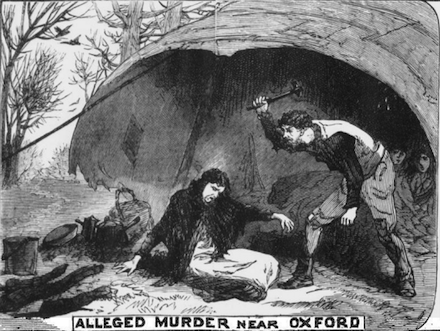
In the early hours of the next morning, Charles began shouting at his wife, waking the children. As Oshey and Prince Albert watched in horror, their father picked up a hammer and attacked Lucy, beating her on her head, back and legs until he was too tired to do it anymore. Then he laid down and went peacefully asleep.

Mortally wounded, Lucy crawled out of the tent to get some water from a nearby stream. She never returned, and eventually Oshey went out to check on her and found her dead.

When Charles realized what he’d done, he sank to his knees beside Lucy’s battered corpse and sobbed, crying, “My wench, my wench!”

Oshey and Prince Albert ran for help, going to the same neighbors who’d visited the night before. When Kate Smith answered the door, Oshey blurted, “My Mammy’s dead. He’s been and killed her with the hammer.”

Kate and George rushed to the scene of the crime. Charles had dragged Lucy’s body into the tent and lain it out on some straw. He told them Lucy had “fallen down” and died. George told everyone he was going to fetch a doctor, but instead he went to the police, returning with two constables. By then Charles had calmed down and said casually, “Good morning. I have got a dead ‘un this morning.”

One of the constables searched the tent and found the bloodstained hammer concealed under some straw. Charles, whose coat was also bloodstained, was placed under arrest for the willful murder of his wife. The autopsy showed she’d died of a fractured skull; Charles had hit her head with the hammer three or four times.

At the ensuing trial in April, Oshey was the star witness against her father, although Charles kept shouting that she was telling lies and was a “nasty, wicked wretch.” Prince Albert testified also, as did Kate and George Smith.

The defense argued that Charles had no intention of killing his wife and there was no motive, and so it was a case of manslaughter. However, the jury returned a verdict of murder.

After he was condemned to die, Charles turned to religion for solace, praying with the prison chaplain. Some of his relatives came to visit, although Oshey and Prince Albert stayed away. His eldest daughter Elizabeth made the strange observation that “when he was a drunkard there was not a kinder man living, that something or somebody turned him into a teetotaler, and from that time he had been a cruel wretch.”

While walking to the scaffold, Charles fainted on the trapdoor just before James Berry drew the bolt. The hanging went smoothly and it was judged he died quickly and painlessly.

As for the orphaned Oshey and Prince Albert, it was recorded that “through the noble hearted philanthropy, of Miss Skene, of this City, the girl Oceana has been placed in a Home in York, and boy the Prince Albert, through the same thoughtfulness, will also be brought up to acquire the means of earning an honest livelihood.”

On this day..