1805: Not Bartlett Ambler, possible buggerer

From “Buggery and the British Navy”, in History of Homosexuality in Europe and America

Unlike modern military law, which tends to distinguish in some way between homosexual acts between consenting adults and what is often the equivalent of rape of a shipmate, the navy during this period made no such distinctions. A boy who had been seduced or forced to commit buggery, therefore, was under great pressure to turn in his partner or attacker, for if they were caught and it appeared he had consented, the “victim” might well be as severely punished as the aggressor. Needless to say, there were serious problems in determining whether or not the boys called to testify were telling the truth, or simply using the buggery charge as a means of destroying a shipmate or officer they particularly disliked.

The courts were often acutely conscious of that possibility and there was even some objection to allowing young boys to testify in buggery trials. In 1772, the defense protested the testimony of John Ellis, a twelve year old boy who had accused one John Palmer of buggery. Despite the protest, however, it was decided that he could legally testify and Palmer was convicted of attempted buggery.

The problem of boys testifying against men in buggery cases are clearly revealed in the Bartlett Ambler case. Ambler was accused by four boys of sodomitic practices. Each testified that Ambler threatened to have them flogged if they told what had occurred. One of the boys, John Davy, said, “…and I had scarce buttoned up my breeches when he said be sure don’t tell no person of it. I’ll be very good to you, but if you tell any person of it I’ll get you flogged.” Ambler based his defense on the alleged wickedness of his accusers. Joseph Dorman, the ship’s corporal, was called upon to discuss the character of three of the witnesses.

Q. Do you know if the boys who have been examined in support of the charge against me are notorious liars?

A. Two of them Hopkins and Willcott have been several times punished for lying.

Court. What is the character of the boy Davy?

A. He bears a very bad character by the whole ship’s company.

Ambler also called upon Midshipman Robert Baker who told the court:

Davy is a very wicked boy indeed as ever lived everyone in the ship will say that if it was in his power he would hang his own father — I hear Hooper’s mother say that her son had denied to her all that had been said against the prisoner.

The court had to weigh the testimony of the four boys who accused Ambler of buggery against the evidence of Ambler’s witnesses, who denigrated the character of the boys and testified to his good reputation. The judges sentenced Ambler to be hanged, but as a sign of their unease, sent the following letter to the Admiralty Secretary, along with the minutes of the trial:

By desire of the members of a Court Martial assembled by me this day to try Mr. Bartlett Ambler, I have to request you will call their lordship’s consideration to the hardship the Court have labored under in being obliged to condemn a man to death, upon the evidence of four boys, the eldest not more than thirteen years of age, and therefore recommend him to mercy.

The recommendation was endorsed by His Majesty on May 8, 1805, and Ambler was pardoned.

It is clear that boys could be intimidated into testifying against innocent men. In one disturbing case, a boy was caught under the blanket of Edward Martin. Evidently, the boy did not have a bed or blanket of his own, and Martin took him in as an act of kindness. The captain of the ship had the boy flogged and threatened him with another whipping if he refused to testify. Under the threat of further punishment, the boy confessed that Martin had buggered him. The trial record reads:

Prosecutor. Did you inform me that the Prisoner had committed that unnatural crime on you twice?

James. Yes, but I was afraid that the Captain would flog me.

In this case, the prisoner was acquitted, but the case does suggest the many possible abuses in buggery trials: that the testimony of boys was suspect, that fear of punishment or promise of reward might be used to intimidate them into giving false evidence against a shipmate, that the boy could be motivated by dislike or a desire for vengeance.

Trial transcripts of the testimony offered against Bartlett Ambler — and summoned by Ambler in his defense, who averred the “wicked” and “very bad” character of the childish witnesses — are available in Gay Warriors: A Documentary History from the Ancient World to the Present.

On this day..

1900: James Nettles

From the St. Louis Republic, July 9, 1898

James Nettle has Partly Confessed.

Suspect in the Mann Murder Case Admits All but the Shooting.
Caused the Arrest of His Double in Order to Confuse the Several Witnesses.

James Nettle, the negro who is accused of the murder of Conductor Edward Mann of the Suburban Railway, on the night of July 4, after emphatically declaring his innocence and even going so far as to bring about the arrest of his “double,” Esbree Manley, a negro ventriloquist, as a suspect in the case, yesterday began to show signs of weakening, and at a late hour last night had confessed everything but the firing of the three shots which proved fatal to Mann.

The arrest of Manley on Nettle’s statement that he had overheard a conversation in the calaboose that a ventriloquist had a hand in the shooting, proved to be Nettle’s undoing. When confronted by Manley, Nettle was unable to carry out his well-laid plans. The striking similarity in the physique of the two negroes would have rendered it almost impossible to pick out the real culprit, but Manley met Nettle and the police with such a straight story of his whereabouts at the time of the tragedy that the former burst into tears and admitted after a little coaxing that he was in the street car fight in which Conductor Mann was slain.

He told his story between sobs, for he broke down completely under the strain. He declared that Mann had ordered him off the car and had returned his fare, in order to hasten his departure, when the fight started. He did not recall how they began fighting, but he said the conductor and motorman tackled him and forced him off the platform, threatening to do him violence.

Even after he had left the car, he said, the conductor followed him several steps. At this point the shooting was done, but all efforts to make the negro Nettle relate these further details have proven futile. In order to avoid the cross-fire of questions from Chief Desmond, the negro complained of being ill and had to be given medicine by the Dispensary physicians. Afterward he said he would not talk further on the murder until to-day.

The negro Manley was released last night after he had established an alibi.


From the St. Louis Republic, Dec. 16, 1898

Testimony Finished.

James Nettles’ Fate Will Be Decided To-Day.

To-day the fate of James Nettles, colored, charged with murder in the first degree, probably will be decided in Judge Tally’s court, after 10 hours’ argument by the attorneys for the State and the prosecution. At 11 a.m. yesterday the State rested and the defense was through at 6 p.m., having tried to establish an alibi.

Thomas L. Brown, the motorman of the car on which Conductor Samuel W. Mann was mortally wounded on the night of July 4 last, was the first witness for the State. He told how the negro boarded the St. Louis and Suburban car at Jefferson avenue, quarreled over car fare, and at Garrison avenue shot the conductor as he retreated from the car. He identified Nettles. Others testified that they were sure Nettles was the assassin.

For the defense, Michael White, a negro, with whom Nettles lived at No. 1321 Linden street, was the main witness. His testimony was that he and the defendant were together all day on July 4, and that Nettles was not at any time near the scene of the murder. He testified that they went to Kirkwood in the morning, returning to their home about 7 p.m., where there was an entertainment, at which both Nettles and White were present until 11:30 p.m. In corroboration of this testimony many witnesses were introduced.

In rebuttal, the State introduced Frederick Brunesman of No. 2641 East Prairie avenue, the motorman of the car which immediately preceded Conductor Mann’s car on the night of the killing. Brunesman identified Nettles as the negro who tried to board his car that night at Jefferson avenue, but was so drunk he fell off. Detective John Gallagher and Policeman Thomas Mahon told of an interview they had with Nettles on the day following his arrest. On that occasion, they testified, Nettles said he assaulted Conductor Mann because Mann rebuked him for misconduct.


From the St. Louis Republic, Dec. 17, 1898

Nettles Found Guilty

Jury Decides That the Negro Murderer Must Hang.

Had James Nettles, a negro, been informed that his dinner was ready, he could not have displayed less concern than when told the jury had found him guilty of murder in the first degree and that he must be hanged. Death seems to have no terrors for him and he smiled at his fate in the same indifferent manner with which he greeted the onslaught of the State’s witnesses. Never through the long trial has he ever manifested even a moderate interest in the proceedings. If he is guilty of the foul murder of Conductor Mann before his wife and children on July 4, he did not show it yesterday.

The cases on both sides were rested on Thursday evening and for four hours yesterday the attorneys for the State and the defense fought an oratorical battle before the jury. Finally, a few minutes before 2 o’clock, the case was given to the jury.

Then, for three hours the jurors debated the case, finally coming to a decision at 5 o’clock. Several of the jurors, it was learned, stood for a life sentence, but were converted to capital punishment on the ground that executive clemency might intervene to cut short the term.

The State had many witnesses who were on the car and identified Nettles as the assassin; while, on the other hand, the defense had nearly a score of negroes to establish an alibi. The State’s attorneys held that it was an alibi for the occasion and made efforts to break it down. One of the defense’s witnesses, who said he was with Nettles at a dance on the night of July 4, testified that there was a roaring fire in the parlor. Other similar statements served to weaken the alibi.

When the verdict had been rendered, Attorneys Van Patten and Morroll, for the defense, declared they would ask for a new trial, and in case it were refused, would appeal.


From the St. Louis Republic, April 5, 1900

Respite for Nettles

Governor Grants the Condemned Man Another Thirty Days

Governor Stephens last night granted a thirty day’s respite to James Nettles, the negro who has been condemned to be hanged for the murder of Conductor Samuel W. Mann on a St. Louis and Suburban car, near Leffingwell avenue, on the night of July 4, 1898. He was to have been hanged a month ago, but a reprieve of thirty days was granted in order to give the Governor time to examine into the merits of the appeals for clemency.

The death watch was placed on Nettles yesterday morning at 6 o’clock and has not yet been removed, as Sheriff Pohlmann has not received official notification of the respite. He expects a letter from the Governor to-day.

Nettles was not in the least perturbed yesterday. When the Reverend Mr. Hurzburger of the German Evangelical Church called at the jail last night with Sheriff Pohlmann and notified the condemned man that the Governor had granted a respite of thirty days, the negro, without any apparent emotion, thanked him for what he had done in the matter and reiterated his assertion of innocence.


From the St. Louis Republic, April 26, 1900

A QUESTION OF WHISKERS — Another attempt is being made to get Governor Stephens to commute the death sentence of James Nettles, the negro who was convicted of the murder of Conductor Sam W. Mann on the night of July 4, 1898. Governor Stephens has granted two stays of execution to allow himself time to investigate the application and petitions. At the trial some of the witnesses testified that Mann’s assailant wore side whiskers. Attorney Maurer had several barbers examine Nettles’s face, and he says that they will make affidavit that he could not raise side whiskers.


From the St. Louis Republic, May 6, 1900

To Be Hanged To-Morrow

Death Watch Placed on the Negro James nettles.

Chief Deputy Sheriff Pohlman yesterday for the third time placed the death watch on James Nettles, the negro who is under sentence of death for the murder of Conductor Samuel W. Mann. Nettles will be hanged at 6 o’clock to-morrow morning unless Governor Stephens stays the execution. Twice Nettles has been within the shadow of the gallows, with the death watch set, when each time the Governor granted reprieves that he might look further into the applications for clemency.

Nettles has all but lost hope. When Deputy Sheriffs Parcel and Hoefer escorted him from his cell on the second tier to cell No. 46 on the round floor, he said he guessed this was the last time. The cell to which he was transferred is the one occupied by all St Louis murderers during the last hours before their execution. Nettles was restless Friday night, alternately reading the Scriptures, praying and singing. When the deputies came in he seemed somewhat relieved. He walked between them up and down the exercise yard until 7 o’clock, when he went into his new cell, where he ate a hearty breakfast. At dinner and supper it was the same way; he seemed to take a last pleasure in ordering what he wanted to eat. He still protests his innocence.

He was convicted of the murder of Conductor Sam W. Mann on the night of July 4, 1898. Nettles got on Mann’s car at Jefferson and Franklin avenues. He refused to pay his fare and Mann ordered him from the car. A scuffle followed and Nettles fired a shot which struck Mann in the abdomen, causing his death a few hours afterwards. Mrs. Mann and two little daughters of the conductor were on the car at the time and witnessed the killing.


From the St. Louis Republic, May 8, 1900

James Nettles, the negro convicted of the murder of Conductor Samuel W. Mann of the Suburban Street railway, was hanged yesterday morning. The drop fell at 6:07 o’clock, and nineteen minutes afterwards the doctors pronounced him dead. Nettles met his death bravely and declared his innocence with almost his last breath.

The execution was conducted with precision and dispatch, but without unnecessary haste. About 250 spectators were present, but they were more orderly than those present at previous hangings.

Nettles was restless throughout the night preceding his execution, and did not sleep any. A number of friends called to bid him good-by early in the night. The Reverend Mr. Sachs, Nettles’s spiritual adviser, the Deputy Sheriffs on the “death watch,” and a few newspaper men remained with him throughout the night. At 3 o’clock in the morning the Century Quartet called at the jail and sang several favorite hymns.

Early in the morning Nettles retired to his cell with the Reverend Mr. Sachs, where they read the Scriptures and prayed until the arrival of Sheriff Pohlman.

At 6 o’clock Sheriff Pohlman read the death warrant to Nettles. The prisoner’s arms were then bound and he was led to the scaffold. Nettles did not falter, although he was a trifle nervous. After his legs and arms had been securely bound Sheriff Pohlman asked him if he had anything to say before he died. In a clear, resonant voice he said,

I am about to die for another man’s crime. The Lord knows I am innocent, and I go to meet him with a clear conscience. I love you and I hope to meet you above. I am innocent!

Then the black cap was pulled down over his head, the noose adjusted and Chief Deputy Sheriff Pohlman sprung the lever. Nettles’s body, after the drop, hung perfectly still. Nineteen minutes later the physicians pronounced him dead and his body was cut down and taken into the morgue. An examination revealed that his neck was broken.

Nettles shot and killed Conductor Mann on his car in Franklin avenue near Leffingwell avenue on the night of July 4, 1898. The negro got on the car and refused to pay his fare. While Mann was ejecting him he pulled a revolver and fired. Mrs. Mann and two little children were on the car and witnessed the murder.

On this day..

1691: William Macqueen, the Irish Teague

On this date in 1691, 11 hanged publicly at Tyburn.

From the Ordinary’s Account they make a fairly typical, if voluminous, assortment: an infanticide, a drunken murderer, and thieves and highwaymen of various descriptions.

Two of these rude knights of the road were “William Selwood alias Jenkins, condemned with William Mackquean a Papist,” the latter also called “Bayley, alias the Irish Teague.” Condemned for robbery on the road, Macqueen confessed to having previously murdered a soldier in a similar encounter; they were “Old Offenders” who had previously “been Reprieved, but would not take warning.”

For the veteran robber Macqueen we have a fine instance of the facts-be-damned mythmaking characteristic of the early Newgate Calendar: his entry credits him with stealing the mace of the Lord Chancellor, an outrageous caper that different criminals really did pull off many years before. Not accidentally, our rewrite version from the Whig ascendancy also edits the identity of the Lord Chancellor involved, who perforce must seem ridiculous to have lost the emblem of his station in this manner — replacing the true victim, the moderate and forgettable Earl of Nottingham, with that hated late-Stuart bete noir (and notorious hanging judge), Lord Jeffreys.

The implicit parable of the Glorious Revolution is reinforced by what must surely be a fanciful vignette in which Macqueen mugs the Lady Auverquerque, the wife of one of the Dutch commanders who invaded England with William of Orange in 1688. Both parties involved are foreigners on English soil, and their awkwardness in that most naked transaction of gunpoint robbery has comedic effect. Presented with a confusingly veiled demand for a “loan,” the mistress seeks clarification: “I believe you had as good tell me at once you are come to rob me; for this is an odd way of borrowing.” Macqueen/Teague apologizes and manages crudely but effectively to the convey the point: “I am a stranger in this country, and so if I don’t know the difference between robbing and borrowing, you must excuse me; for all I mean is, to have your money.”

On this day..

1896: Carl Feigenbaum, the Ripper abroad?

On this date in 1896, New York City electrocuted Carl Feigenbaum.

He’d been convicted of slaying the widow from whom he rented a room at eight cents per day … but many at the time suspected his homicidal exploits might also have traced to Whitechapel, under the dread sobriquet Jack.

We can only really be sure of the one murder: on September 1, 1894, he attacked 56-year-old Julianna Hoffman in her room on East Sixth Street, for the possible reason of robbing her. One ferocious slash with his long bread knife nearly decapitated the landlady; the disturbance roused Hoffman’s 16-year-old son who burst in on the assailant — reportedly just as Feigenbaum had his blade poised to begin horribly gouging the corpse. Both killer and witness grappled briefly and then fled from each other; Feigenbaum was arrested before the day was out.

Today you’d call the part of town East Village but back in the 1890s it was Klein Deutschland, with one of the world’s largest concentrations of Germans abroad.

Probing his client for material to use for an insanity defense,* Feigenbaum’s attorney elicited his client’s self-diagnosis that “I have for years suffered from a singular disease, which induces an all-absorbing passion; this passion manifests itself in a desire to kill and mutilate the woman who falls in my way. At such times I am unable to control myself.” That seems interesting.

It emerged that Feigenbaum had left Germany as a merchant mariner, and that profession had possibly seen his boats tied up in the Thames during the pivotal months when the Whitechapel murders took place.

In the Big Apple, the idea of modern crime’s great bogeyman throwing his demonic shadow across their very own dungeons appealed irresistibly, to nobody moreso than Fiegenbaum’s own attorney William Lawton, who reveled in his hypothesis of proximity to evil and made a silly bid for celebrity on that basis. Lawton claimed to have hit upon the Ripper idea as he pondered the meaning of Feigenbaum’s professed impulse to mutilate women.


From the St. Albans (Vt.) Daily Messenger, April 28, 1896.

The very day after his client’s electrocution, Lawton explicated the suspected connection to the press, “stak[ing] my professional reputation that if the police will trace this man’s movements carefully for the last few years their investigations will lead them to Whitechapel.” (Lawton is also the sole source of Feigenbaum’s alleged self-incrimination, quoted above: to everybody else Feigenbaum insisted on his innocence far past any possible stretch of plausibility, and even carried that insistence to the electric chair.)

Regrettably, Feigenbaum’s pre-Hoffman movements are obscure to the point where Lawton’s theory is essentially immune to corroboration (or refutation). Even when Lawton dropped his intended bombshell did his hypothesis come in for some public ribbing; the New York Tribune scoffed on April 29 of that year that Feigenbaum now being indisposed to object, all the city’s most troublesome unresolved homicides ought to be attributed to this empty cipher.

Despite the surface similarities of his aborted disemboweling to the infamous London crime spree, Feigenbaum’s case for Ripper immortality doesn’t enjoy much of a constituency today. (Trevor Marriott’s 2005 Jack the Ripper: The 21st Century Investigation is a notable exception to the skepticism.)

* Feigenbaum, who had been literally caught red-handed, ultimately did not pursue the insanity defense that was probably his only hope of avoiding the chair because he did not have enough money to hire the expert alienists who would be required to present such a case to the jury. But for a guy supposedly resource-constrained, Lawton does seem to have gone to some trouble to research the possible Ripper connection.

On this day..

1943: The massacre of Janowa Dolina

On or very near this date in 1943, a Ukrainian militia massacred the Poles of the village of Janowa Dolina (Yanova Dolina).


Janowa Dolina in the 1930s. The village was a model settlement for workers at the nearby basalt quarry, jobs given at that time by official preferences to Poles. It was created in the 1920s, and featured an orderly plot with running water and electricity throughout.

In World War II, each theater of the war was unhappy in its own way. For the beautiful region of Volhynia long straddling the blood-soaked marches between Poland and Ukraine, it meant a ghastly local war under the umbrella of German occupation.

Mostly Polish in the interwar years, when Ukrainian residents chafed under “Polonization” policies, Volhynia had come fully under Soviet control when Berlin and Moscow carved up Poland in 1939, and then, of course, fully under German control in 1941. In these years of ash and bone, ethnic compositions in Volhynia were redrawn with every desperate ferocity nationalism could muster: pogroms visited neighbor upon neighbor, or ethnic cleansing visited state upon subject. It would be Ukrainian ultras positioned in the end to fantasize about ethnic purity by dint of their collaboration with the conquering Reich.

Come 1943, Poles comprised a shrinking minority in Volhynia. The prospect of purging this borderlands to cinch its place in a Ukrainian homeland made those Poles an inviting target for a campaign of ethnic slaughter that’s remembered now as the Volhynia or Volyn Massacres. And with the German defeat at Stalingrad and the Red Army’s advance on eastern Ukraine, Reich administration further west had become sufficiently distracted by more urgent priorities that genocidaires* perceived their moment to strike.

“We should undertake a great action of extermination of the Polish element,” thundered Dmytro Klyachkivsky, a commander of the Ukrainian Insurgent Army (UPA), military organ of the Organization of Ukrainian Nationalists (OUN-B).** “As the German armies withdraw, we should take advantage of this convenient moment for liquidating the entire male population from the age of 16 up to 60 years. We cannot lose this battle, and it is necessary to diminish Polish forces at all costs. Forest villages and those near forests, should disappear from the face of the earth.”

Many specific atrocities, beginning in February 1943 and continuing well into 1944, comprise this liquidation drive.

The one of interest for this post is the invasion on the night of April 22-23 — the eve and morning of Good Friday — of Janowa Dolina, a predominantly Polish village where 600 were massacred by the UPA and the village put to the torch.†

This horror is commemorated by a monument at the site …


The 1990 monument commemorating Poles murdered by UPA. Here’s a closer view of the stone marker, and here’s the inscription on the adjacent cross.

… but there seems to be a slight difference of opinion: the event is also memorialized by a rival stone erected by Ukrainian nationalists which “gives glory to the Ukrainian heroes” of the UPA for “destroying the fortifications of the Polish-German occupiers.”‡


(Thanks to Sonechka for translation help.)

As anyone holding even passing familiarity with events in present-day Ukraine will surely know this is no mere historiographical quibble; the legacy of the OUN from World War II and of its descendants on the modern far right remain deeply contentious in and out of Ukraine.

* Poland officially (and to the dismay of Ukraine) considers this campaign a genocide. There’s also a Polish film on the horrors of Wolyn.

** The OUN split factionally; the “-B” suffix in this case stands for Stepan Bandera, leader of the most militant faction; his surname is still today a byword and/or slur (“Banderists”) for Ukrainian fascism. Its rival faction was the more moderate OUN-M, led by Andriy Melnyk.

† The territory became Ukrainian — which at the time meant Soviet — after World War II and remains so today, so Janowa Dolina is now the Ukrainian town of Bazaltove. There’s a Flickr album tour of the muddy mining village, including photos of the Polish monument and a separate marker for Soviet POWs, but not the UPA monument, here.

‡ The UPA stone also cites April 21-22 as the date. It appears to me, a distant non-specialist, that the Ukrainian construction on what adherents prefer to more neutrally describe as the “tragedy” of Janowa Valley spreads action over two days and emphasizes alleged guerrilla actions by the UPA against German occupation targets prior to destroying the village.

On this day..

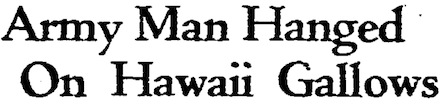
1947: Garlon Mickles, the last hanged in Hawaii


Seattle Times, April 22, 1947.

On this date in 1947, U.S. Army Private Garlon Mickles was hanged at a place called “execution gulch” in Honolulu’s Schofield Barracks.

Mickles had enlisted three years before, the 16-year-old son of a St. Louis laundress. (“Tell my mother I died like a man,” were his reported words to the chaplain.)

According to Associated Press reports, army engineers frustrated peeping eyes by “put[ting] up a smoke screen to shield the gallows from the view of the curious.”

He was convicted of raping and robbing a female War Department employee on Guam, where he was stationed with the Twentieth Air Force — from which staging-point the unit conducted bombing raids on mainland Japan. (The Enola Gay, which dropped the atomic bomb on Hiroshima, was part of the 20th.)

Mickles appears to be the last person ever executed on the Hawaiian islands, and also an unusual overlook by the Espy File of U.S. executions, from which he’s totally absent.

On this day..

2017: Ledell Lee

Moments before his death warrant expired at midnight U.S. Central Time, after a last meal consisting only of communion, Ledell Lee was executed by the U.S. state of Arkansas.

Lee spent 24 years awaiting execution for the bludgeon murder of Debra Reese on February 9, 1993, but he was done to death in a rush that left unanswered some of the most fundamental questions in the case.

Trial is the forum designated for contesting this question, of course. At Lee’s, he was represented by an unwilling defense team that repeatedly sought its own removal from the case, citing an “intolerable conflict” with their client, a conflict that paled in comparison to that of the judge, who was having an affair with a prosecuting attorney. (Multiple separate rape cases were pending against Lee at the same time, and those same conflicting attorneys were removed from those cases.)

A quarter-century on death row suggests claims litigated to the point of exhaustion, but this is not how the death penalty game is played in America. The art of execution lies in expediting a conviction and then fighting hammer and tong to maintain that verdict as a fait accompli against any attempt on appeal to litigate issues that the jury never heard. Mostly, the clocks runs for years on useless waiting or epicycles of procedural do-overs that never reach the most salient topics. The Innocence Project reports that outright exonerees (not limited to condemned prisoners) serve an average of 14 years before winning release on their various evidentiary trump cards. (Arkansas’s most famous death row exoneree,* Damien Echols, waited 17 years.)

By the time one reaches the end of the glacial death penalty process, the very refusal of the law to probe the questions it never bothered asking will have become the fault of a prisoner’s own dilatory appeals, leading — in this instance — to victim’s kin at Lee’s clemency hearing “asking you and begging you to please let us have some closure.”

In the name of closure, end-state cases must also insist on renouncing one of the potential benefits of all that time-wasting, the perspective of passing years. DNA tests that were not available when Lee stood trial for his life — and the discredited “forensic evidence” of matching hair samples was invoked against him — could have been used to examine blood spots on Lee’s shoes.** Because the prisoner maintained his innocence in the case from the time he was arrested until the very end, one of his late appeals vainly implored Arkansas to test that DNA sample. There are many cases, death penalty and otherwise, meeting this description, and most U.S. jurisdictions compulsively resist any calls to revisit testable tissue in the light of emerging DNA science as so many affronts to the majesty of law.

So what has everyone been up to while not testing DNA all those years? The Fair Punishment Project report on Lee’s post-conviction road makes depressing reading.

Lee’s first state post-conviction attorney had substance abuse problems that left him “impaired to the point of unavailability on one or more days of the Rule 37 hearing.” The Arkansas Supreme Court noted several examples of his lawyer’s “troubling behavior,” including “being unable to locate the witness room;” “repeatedly being unable to understand questions posed by the trial court or objections raised by the prosecution;” “not being familiar with his own witnesses;” and “rambling incoherently, repeatedly interjecting ‘blah, blah, blah,’ into his statements.” Unsurprisingly, Ledell lost his state-post conviction petition. Eventually, the Arkansas Supreme Court recognized that Lee received grossly inadequate representation and withdrew its opinion, giving him new counsel.

Unfortunately, his new counsel were not much better. First, they missed the filing deadline for the appeal. Then, the Arkansas Supreme Court twice, sua sponte, ordered the attorneys to submit a new brief because their filings failed to comply with Court rules — the second time, the Court referred the attorneys to the Committee on Professional Conduct. The attorneys also appear to have refused to accept their client’s phone calls and ignored his letters.

At one point, Ledell received a glimmer of hope when the Arkansas court appointed the Arkansas Federal Defender to his case. They tried to litigate a claim that Ledell is intellectually disabled. In response, the state argued that Ledell — with all of his competent representation — had procedurally defaulted this claim by not raising it before.† But before the parties could complete litigation on the claim, the Federal Defender was removed due to a conflict.

In 2016, Ledell’s local habeas attorney moved to withdraw from the case because she was retiring. She made clear that in ten years, she had done little work on the case. “I have no file on [Ledell],” she stated, despite having argued at least one of Ledell’s appeals before the Eighth Circuit. “I have no working relationship with [Ledell]. I have not seen [him] for several years. I have no relationship with [his] present counsel and have not had any working relationship with them for some time.”

In June of 2016, one of Lee’s federal habeas lawyers, Gary Brotherton, voluntarily surrendered his legal license “to prevent possible harm to clients” because he was suffering from bipolar disorder with psychotic features and anxiety. One month later, the Missouri Supreme Court suspended him from the practice of law. So, just seven months ago, in the eleventh hour of his case, Ledell received yet another lawyer on his case.

All in all, a shambolic proceedings crowned by the indignity of Arkansas’s cramming Lee into a raft of eight proposed executions — many of them now stumbling on late appeals — slated together for the last days of April for the tawdry expedient of using up the state’s lethal injection drugs before their imminent expiry. It’s a very not normal situation, and yet, it is also all too normal.

Ledell Lee was the first person executed by Arkansas since 2005.

* As we’ve previously noted, Arkansas forced Echols to make an Alford plea as the price of his release, allowing it to claim on a technicality that it had not wrongfully imprisoned an innocent man for two decades.

** The crime scene was a bloodbath, so the supposition is that the murderer would certainly have imbrued his clothes with Reese’s blood.

† Reese’s alleged intellectual disability ought to have been raised by his unwilling defenders at the trial’s mitigation stage; it appears they barely investigated it.

On this day..

2015: Siti Zainab

On this date in 2015, in the Islamic holy city of Medina, Saudi Arabia beheaded Indonesian domestic worker Siti Zainab after a very long wait.

Zainab, a maid, was condemned to death in 1999 for stabbing to death her cruel* employer. Her execution went on pause for more than 15 years until all of the victim’s children could reach adulthood and exercise their right to enforce or mitigate the death sentence; still, for all that lead time, Saudi Arabia irked Jakarta by failing to notify consular offices of her impending beheading.

In addition to the usual controversies Saudi Arabia’s aggressive headsmen engender when dispatching the kingdom’s widely abused migrant workers, Zainab’s case raised hackles over the condemned woman’s alleged “suspected mental illness.”

* Cruel according to Zainab and her defenders. Indonesian NGO Migrant Care argued that the murder was outright self-defense.

On this day..

1730: A Natchez woman tortured to death at New Orleans

On this date in 1730, French-allied Tunica Indians put a captured Natchez woman to grisly public death under the walls of New Orleans.

This is the English translation of Marc-Antoine Caillot’s Relation du voyage de la Louisianne ou Nouvelle France fait par le Sr. Caillot en l’année 1730, a key firsthand source for the incident in this post.

Months earlier the Natchez had risen in rebellion against the colonists in Louisiana — a bloody settling of accounts the that answered a French push to colonize more land with an attack meant to drive them out of Louisiana altogether. The initial, surprise attacks slew 237 French subjects, many in stomach-turning fashion. Friend of the site Dr. Beachcombing details a particularly atrocious murder in his post on the affair at Beachcombing’s Bizarre History Blog.

So the French were in a state of rage and fright on April 10 — the day after Easter — when an allied tribe, the Tunica, showed up at the Big Easy with six Natchez captives in tow, three women and three children. Chief among them was a woman readily recognized by the French as the wife of a once-friendly Natchez chief now “known for being an enemy of the French.” Indeed, escapees from Natchez captivity slated her with having given the go-ahead for the torture-murder of three of their countrymen.

And this hated foe the Tunica proceeded to offer to the French, as a gesture of goodwill.

As Sophie White explains in her “Massacre, Mardi Gras, and Torture in Early New Orleans” (The William and Mary Quarterly, July 2013),* Louisiana territory governor Etienne Perier in slyly declining the prisoner intentionally condemned her to a speedy and spectacular death. Rather than taking her into official custody for disposal by the French judiciary or diplomatic organs, Perier put her up for a night in the French jail while her captors prepared a performance for the morrow calculated to slake the bloodlust of French and native alike.

White’s narrative is worth excerpting at length here; all the parentheticals come from White’s original text.

Officially, Governor Perier could claim that he had maintained French notions of justice by rejecting the Tunica offer of the prisoner of war (even though at a later date he would openly write of another four male and two female Natchez having “been burnt here”). Yet he allotted a space for the Tunica to torture her and arranged for her to be kept in jail overnight while the Tunica danced the black “calumet of death” in preparation for her execution. In the morning, after gathering firewood, erecting a frame, and painting their faces and bodies, the Tunica “began to run as if possessed by the devil and, while yelling (it is their custom), they ran to the jail where she was in chains”; she was engaged in a final assertion of sartorial self-preservation, “fixing a ribbon to her braided hair,” hair that she knew would soon be scalped.

Like Perier, the colonial populace also became involved in exacting revenge on this member of the Natchez nation. Not only were “all the Sauvages who were in New Orleans” present at the torture ritual but colonists also attended the performance as spectators, as they might in France attend a public execution. They watched as the Tunica tied her to a frame and as a Natchez man who had abandoned his kin and been adopted by the Tunica stepped forward to burn her, starting with “the hair [poil, or body hair] of her … then one breast, then the buttocks, then the left breast” (the ellipses represent a deliberate authorial omission on the part of Caillot). Commentators described the methodical burning of torture victims as a form of slow-cooking (“a petit feu”). For Caillot, the ritual burning of the victim’s genitals, breasts, and buttocks was marked by the carefully observed but gruesome sight of “the abundance of grease mixed with blood that ran onto the ground.” His description evoked the cooking of meat basted in fat, with the frame simulating a spit on which the victim was roasted; if this frame/spit did not physically turn its meat, the torturers made sure that she was evenly roasted on all sides by their methodical movement across her body. This food preparation imagery was followed by other cooking analogies. As they were about to kill her (in contrast to the procedure in France, where spectators waited for the execution to be complete before grabbing souvenir pieces of the criminal’s body), “the French women who had suffered at her hands at the Natchez [settlement] each took a sharpened cane and larded her,” just as French culinary techniques called for piercing meat with a sharp stick prior to the insertion of thin strips of lard.

The Natchez woman was not impressed, but “during that long and cruel torture never shed a tear. On the contrary, she seemed to deride the unskilfulness of her tormenters, insulting them, and threatening that her death would soon be avenged by her tribe.”


Detail view (click for the full image) of a generic depiction of the torture frame, from Jean-Francois-Benjamin Dumont de Montigny’s memoir. Sophie White notes that this figure is identifiably female based on her genitalia and the long scalped hair mounted on the adjacent pole.

Over the next several years, the French not only turned back the attack but largely shattered and Natchez peoples, dispersing their remnants to fragmented communities throughout the U.S. South. Today only a few thousand Natchez souls remain, and their interesting language has died out entirely.

* Though it’s a bit tangential to the subject of this post, readers interested in this milieu might cotton to White’s Wild Frenchmen and Frenchified Indians: Material Culture and Race in Colonial Louisiana.

On this day..

1863: The servile murderers of Isaac Strowd and John Lockhart

Scant appetite as North Carolinians showed for the Civil War, the alarm when two eminent white men of Orange County were murdered by their slaves within days of each other (and just days after the Emancipation Proclamation in 1863 stoked such alarm that, according to Unruly Women: The Politics of Social and Sexual Control in the Old South, several eminent white citizens sent personal appeals to governor Zebulon Vance to fast-track their condign judicial punishment lest lynch mobs handle them in more summary fashion.

Although the press clippings excerpted here imply five hangings, the Espy File registry records only four, omitting the man convicted not of murder but of accessory before the fact.


Thursday, February 26, 1863 N. C. ARGUS (Wadesborough, Anson County, NC)
-Hillsboro Recorder, 18th – Murder: On Thursday morning last, Mr. Isaac STROWD, living southwest of this place, near the Chatham lines, was killed by some negroes working with him who afterwards carried him about half a mile and buried him in an old field. His body was not found until Sunday morning. We understand one of the negroes has confessed that he killed him, but says that it was by accident. The negroes, four in number, two men and two women, were brought to this place on Monday, and lodged in jail.

Thursday, March 5, 1863 N. C. ARGUS (Wadesborough, Anson County, NC)
-Hillsboro Recorder – Another murder – Mr. John LOCKHART, a respectable citizen residing in the northeastern section of this county, was murdered on Tuesday of last week by three negroes in his employ – one belonging to him and two hired. The negroes have been lodged in jail in this place, to await their trial.

Thursday, March 26, 1863 N.C. ARGUS (Wadesborough, Anson County, NC)
-Hillsborough Recorder – Judge GILLIAM’S first Court was a Court of Oyer and Terminer held in this place. The first case brought on was the trial of America, Daniel and Solomon, three slaves, for the murder of Mr. John LOCKHART. America and Daniel were convicted of the murder. Solomon was an accessory before the fact … The next arraignment was Lucian and Allen, for the murder of Mr. Isaac STROWD … On Saturday night about 12 o’clock the Jury returned a verdict of guilty as to both. On Monday, the five criminals were brought to court for sentence. The judgment of the Court was that they be hung on Friday, the 10th day of April next.

On this day..