Feast Day of St. Eupsychius, anti-Apostate

April 9 is the (Roman) feast date of the minor Cappadocian saint Eupsychius.

As martyr to the hated-of-Christians pagan throwback emperor Julian the Apostate, Eupsychius could perhaps be accounted an ironical late victim of the fratricidal family politics that consumed the heirs of the great Christianizer Constantine the Great.

When Constantine kicked off in 337, he left three sons of a disgraced empress whom he optimistically hoped would share rulership. What happened instead was that, inside of a generation, practically the entire Constantinian line laid one another in the earth by dint of bloodthirsty dynastic rivalries, leaving only two men standing.

And it so happened that those two kinsmen faced one another across late antiquity’s gaping spiritual chasm: one a Christian, the other a pagan.

Constantius was the surviving son of Constantine, and regardless his Christian affiliation had secured his initial control of his father’s new eastern capital by unsentimentally butchering the bulk of his extended family including his own uncle Julius Constantius, and Julius’s firstborn son. Two other sons of Julius Constantine, too young for the abbatoir, escaped their brother’s fate and so our future Julian the Apostate grew up under a perpetually dancing Damoclean sword, a bookish philosophizing type enchanted by classical learning — so enchanted that he would eventually, and at first very quietly, apostatize from his substantial Christian education and adhere instead to the old gods.

In the fullness of time, the remainder of Constantius’s family succumbed to various civil wars — including Julian’s only surviving brother, Gallus, executed for treachery in 354 in an incident that could very well have claimed Julian as well if for no other reason than proximity. A prolific writer, Julian would later recall that “if some God, to inure my safety, had not ingratiated me with his [Constantius’s] beautiful and excellent wife, Eusebia, I could not have escaped his resentment.” Perhaps the childless Constantius could foresee well enough that, resentment or no, his last relation would be required for imperial policy soon enough.

And indeed the very next year, having spent many months mulling over whether to kill him, Constantius instead elevated Julian as his junior co-emperor. The young scholar soon distinguished himself as a surprisingly competent leader and battlefield commander, pacifying Germania and Gaul before, almost inevitably, the two emperors turned on one another in civil war. Julian must have been well-favored of goddess Fortuna whom he will defend in this post, for he won that war before the first spear was chucked when Constantius took ill and died as the rivals steered their armies towards one another.

So suddenly, 40 years after the empire had officially gone Christian, it had a pagan ruler — the last pagan ruler it would ever know.

Julian was an intelligent and idealistic young man. Taking power before the age of 30, he set a bold course to massively remake the empire in the image of its most admirable anachronisms: living modestly, paring the bureaucracy, debating Senators as their equal instead of their overlord, and — the attempted rollback that would mark his nickname and his reputation — restoring a pre-Christian cosmology to philosophical preeminence.

A few books about Julian the Apostate

This could have been Julian the Apostate‘s life’s work, twenty or thirty of forty years dislodging Christianity from the official foothold it had only recently attained and creating the groundwork for a pagan-dominated middle ages: fine grist for speculative alternative history, since Julian actually died in 363 in war against the Persians.

Having learned from the failure of previous rulers’ persecutions, he deployed instead the devious and modern mechanic of liberal religious toleration, starving the “Galileans” of the galvanizing force of either state backing or state oppression while perhaps setting their orthodox edifice up to splinter over time as various heretical movements began freely venting their rival doctrines on one another.


Julian the Apostate presiding at a conference of sectarians, by Edward Armitage (1875).

His uniqueness and his erudition have made him an attractive character for modern interlocutors, especially those of the Christ-skeptic variety; Gore Vidal sympathetically centered Julian in an engrossing historical novel, and Gibbon warmly admired him:

The Christians, who had now possessed above forty years the civil and ecclesiastical government of the empire, had contracted the insolent vices of prosperity, and the habit of believing that the saints alone were entitled to reign over the earth. As soon as the enmity of Julian deprived the clergy of the privileges which had been conferred by the favour of Constantine, they complained of the most cruel oppression; and the free toleration of idolaters and heretics was a subject of grief and scandal to the orthodox party. The acts of violence, which were no longer countenanced by the magistrates, were still committed by the zeal of the people. At Pessinus the altar of Cybele was overturned almost in the presence of the emperor, and in the city of Caesarea, in Cappadocia, the temple of Fortune, the sole place of worship which had been left to the Pagans, was destroyed by the rage of a popular tumult. On these occasions, a Prince who felt for the honour of the gods was not disposed to interrupt the course of justice; and his mind was still more deeply exasperated when he found that the fanatics, who had deserved and suffered the punishment of incendiaries, were rewarded with the honours of martyrdom.

It is the last named of these incidents that finally brings us round to our date’s principal.

Like Julian himself, St. Eupsychius had no way of knowing that the new, old order would be a transient epoch. In his zeal to resist a rejuvenated paganism, Eupsychius led a riotous sack of a temple to Fortuna (Tyche). The church historian Sozomen gives us the primary-est historical record, and although it dates to several decades after Eupsychius’s martyrdom we can’t be picky when it comes to antiquity.

It is said that at this time were martyred Basilius, a presbyter of the church of Ancyra, and Eupsychius, a nobleman of Caesarea in Cappadocia, newly wed and in a manner of speaking still a bridegroom. As regards Eupsychius, I conjecture that he was executed because of the temple of Tyche, then destroyed, on account of which destruction, as has been said above, all citizens of Caesarea collectively experienced the emperor’s wrath, while those who personally took part in it were punished, some with death, some with banishment.

Later iterations would expand predictably on Eupsychius’s sufferings — tortures, miracle-making, blood and milk springing from his wound, and even eventually eliding the precipitating riot or arson — all of which conspires to pull a discernibly historical figure behind the dark glass of hagiography.*

Little more than a year later, Julian suffered a mortal wound in battle against the Sassanids. The Constantinian dynasty died with Julian, as did his signature project of Apostasy — a sudden volte-face of that fickle Fortuna whose memory and reputation would persist well beyond the twilight of paganism.

The History of Rome podcast deals with Julian in episodes 143, 144, 145, and 146. Lars Brownworth also covers Julian in episode 5 of the 12 Byzantine Rulers podcast.

* See L.G. Westerink, “The Two Faces of St. Eupsychius,” Harvard Ukrainian Studies, Vol. 7, Okeanos: Essays presented to Ihor Shevchenko on his Sixtieth Birthday by his Colleagues and Students (1983).

On this day..

1724: Sister Geltruda and Fra Romualdo, at a Palermo auto de fe

(Thanks to Henry Charles Lea for the guest post, which first appeared in his The Inquisition in the Spanish Dependencies: Sicily – Naples – Sardinia – Milan – The Canaries – Mexico – Peru – New Granada. The Inquisition was abolished in Sicily in 1782, but an interesting Palermo museum preserves its artifacts. -ed.)

When, in 1718, Savoy exchanged Sicily with Austria for Sardinia, the Emperor Charles VI would not endure this dependence of the [Inquisition] tribunal upon a foreign power and procured, in 1720, from Clement XI a brief transferring the supremacy to Vienna. In accordance, however, with the persistent Hapsburg claims on the crown of Spain, the Inquisition remained Spanish. A supreme council for it was created in Vienna, with Juan Navarro, Bishop of Albarracin as chief who, although resident there gratified himself with the title of Inquisidor-general de Espana, but in 1723 he was succeeded by Cardinal Emeric, Archbishop of Kolocz.

Apparently it was deemed necessary to justify this elaborate machinery with a demonstration and, on April 6, 1724, an auto de fe was celebrated at Palermo with great splendor, the expenses being defrayed by the emperor.


Detail view (click for the full image) of a French print of the auto de fe.

Twenty-six delinquents were penanced, consisting as usual mostly of cases of blasphemy, bigamy and sorcery, but the spectacle would have been incomplete without concremation and two unfortunates, who had languished in prison since 1699, were brought out for that purpose. They were Geltruda, a beguine, and Fra Romualdo, a friar, accused of Quietism and Molinism, with the accompanying heresies of illuminism and impeccability. Their long imprisonment, with torture and ill-usage, seems to have turned their brains, and they had been condemned to relaxation as impenitent in 1705 and 1709, but the sentences had never been carried out and they were now brought from their dungeons and burnt alive.


Detail view (click for the full image) of an engraving, The Great Auto De Fe At Palermo Italy 6 April 1724

Less notable was an auto de fe of March 22, 1732, in which Antonio Canzoneri was burnt alive as a contumacious and relapsed heretic.

On this day..

1945: Eliyahu Bet-Zuri and Eliyahu Hakim, Lord Moyne’s assassins

British-occupied Egypt on this date in 1945 hanged two young Jewish assassins for slaying the British plenipotentiary to the Middle East.

Walter Edward Guinness was heir to the barley beer fortune and a Tory politician of near 40 years’ standing. “Lord Moyne”, to call him (as history does, and as we will henceforward) by his aristocratic honorific, allied with his former rival Winston Churchill in the 1930s as a staunch foe of placating Hitler, eventually serving several roles in Churchill’s wartime government.*

The last and perforce most famous was Resident Minister of State in Cairo from January 1944, where he directed British affairs in North Africa, Persia, and the Middle East, crucially including Mandatory Palestine.

Such a figure must necessarily represent many things to different subjects, but to Zionists he represented the hostility to their project of both his own person and (more importantly) of London. While there is endless nitpicking about the man’s precise degree of disfavor for Jewish people or interests, “Lord Moyne was the highest British official in the Middle East,” in the words of Yitzhak Shamir, the emigre terrorist who orchestrated the hit and would one day become Prime Minister of Israel. “Because we fought against the British in this area, we took him for a target. This was the main reason for his assassination.” Nothing personal. (Maybe a little personal.)

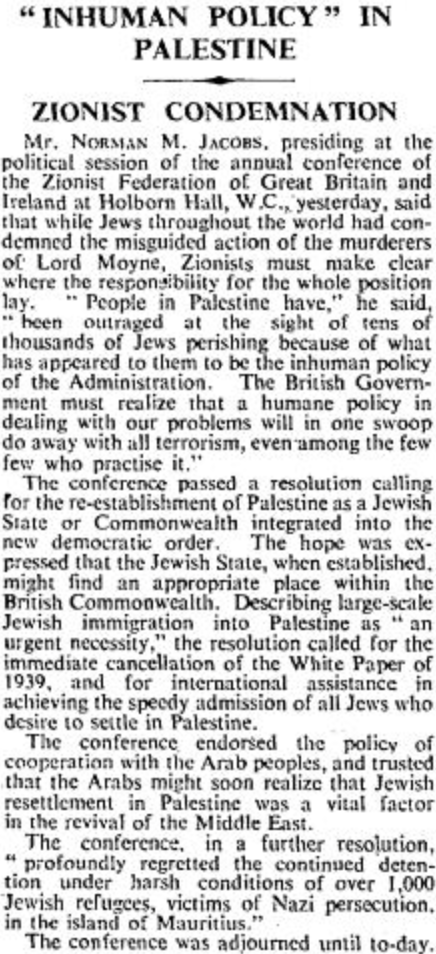
On November 6, 1944, two of Shamir’s young cadres in the late Avraham Stern‘s militantly anti-British Lehi network, Eliyahu Bet-Zuri (Ben Suri) and Eliyahu Hakim, ambushed Moyne as his limousine pulled up at his villa, and shot him dead with pistols. (They also killed Moyne’s driver, a Lance Corporal named Arthur Fuller.) Once their affiliations became apparent it was Jewry’s turn to bask in the collective censorious scowl that minorities everywhere can anticipate given any perceived ethnic affinity to the latest atrocity’s author. These sortings-out from the London Times would do almost word for word for whatever horror tomorrow’s news might bring.


London Times, Nov. 10, 1944


London Times, Jan. 29, 1945

Similarly, Lord Moyne’s killers took every pain to link their martyrdom to Jewish/Zionist patriotism, no matter any moderate rabbi’s attempt to wash his hands of it.

Raised in Mandatory Palestine, both Bet-Zuri and Hakim spoke Arabic but insisted on speaking only Hebrew in the Cairo court. They went to the gallows singing the hymn “Hatikvah” — later to become Israel’s national anthem.

In the near term, their deed hardened hearts: “If our dreams for Zionism are to end in the smoke of an assassin’s pistol, and the labors for its future produce a new set of gangsters worthy of Nazi Germany, then many like myself will have to reconsider the position we have maintained so consistently and so long in the past,” Churchill snarled to Parliament.

But in fact the British reconsideration was soon seen to run counter to the dangerous meddling policing these “gangsters” would have demanded. Within only a few years London struck its colors in the Levant. Bet-Zuri’s and Hakim’s cause triumphed, and they too with it: as Prime Minister, Yitzhak Shamir arranged for the hanged men’s remains to be repatriated from Egypt; today, both rest in honor at Mount Herzl.

* There was a personal side to Lord Moyne’s anti-Naziism: his son, Bryan, had been abandoned by his socialite wife Diana Mitford … who became Diana Mosley in 1936 when she married British Union of Fascists chief Oswald Mosley, in a ceremony held at Joseph Goebbels‘ home no less.

On this day..

1563: Jean de Poltrot, assassin of the Duke of Guise

On this date in 1563, Jean de Poltrot de Méré was ripped apart in the streets of Paris for assassinating the Duke of Guise.

The opening act of the civil war between Catholics and Huguenots that would devour France in the late 16th century was but a year old at this moment, and Guise was the very man who had set off the powderkeg with a notorious massacre of Huguenots the previous March that had sent agitated confessional armies into the fields.

During the ensuing months, Guise stood at the fore of Catholic forces, opposite the Huguenot commander Conde.

Come early 1563, Guise was besieging the Huguenot-held city of Orleans when Poltrot (English Wikipedia page | French) contrived to ambush him on a nearby road. Poltrot shot Guise with a pistol* and fled; he’d be arrested a day later.

In the Wars of Religion, each previous atrocity justified the revenge that followed it; Guise’s death — and Poltrot’s confession under torture** that it was the Huguenot Admiral Coligny who directed his hand — would help to set the scene for the St. Bartholomew’s Day Massacre visited by Catholics on the Huguenots nine years later. (In fairness we ought also to add that this was not Guise’s first brush with Protestant assassins.) And heavily Catholic Paris was even before the Guise murder violently agitated against Huguenots. During the fighting in 1562,

Reputed Huguenots were struck down in the streets. Sometimes mock trials were held; the attackers grilled the captives on their religious beliefs and, when not satisfied with the answers, killed them on the spot. Officials who tried to intervene were themselves in danger, and edicts against violence were bitterly protested. As one anonymous memoirist described it, “The people wanted nothing less than permission to kill and exterminate the Huguenots without any form of trial; but the consequences were too dangerous.” He implied that permission might have been given, had it been possible to contain the violence.†

All this rage, when focused on the assassin of the Catholic party’s champion, was enough to tear a man limb from limb.

Poltrot’s sentence was to be publicly ripped apart by horses straining his limbs to the four points of the compass. It didn’t quite work: sinew and muscle is too dense and tough to shred by main force, even for a horse; it was only by dint of the the executioner’s helpful hacking that the beasts could dismember their prey.


Here’s a similar take in color.

Quartering by horses is a punishment so preposterously horrific that it could only belong to an age of intentional spectacle.

Indeed, Florike Egmond and Peter Mason argue‡ that until the 16th century such a theatrical execution “was a purely fictional punishment in Europe, which ever since Roman times emerged occasionally in literature, legend and folk-tales as an outrageous form of retribution for (high) treason and related offences” — such as Livy’s mythic rendering of the end given faithless ex-ally Mettius Fufetius, the supposed treatment of St. Hippolytus, and foggy distant Frankish legends

Although the concept might have existed in imaginations for centuries before, equine execution was at best a vanishingly rare event in reality; certainly when Poltrot was butchered, nobody present had ever before beheld such a sight. For Egmond and Mason, this was an innovation of his judges who “jumped the gap between fiction and historical records” in pursuit of ever “more expressive forms of punishment in order to emphasize the outrageousness of the offense.”

It was an outrage whose time had come, however, for quartering by horses was employed several times more for regicidal offenses in the ensuing decades — including for the Catholic militant who assassinated the Huguenot King Henri IV.

* This event would appear to dislodge the 1570 murder of Scotland’s Regent Moray from its popular acclamation as history’s earliest firearm assassination. As Guise lingered for six days and finally succumbed to effects of his doctor’s own bloodletting, perhaps the view is that Poltrot’s pistol only earned half-credit.

** Poltrot would later retract the claim, when not under torture.

† Barbara Diefendorf, “Prologue to a Massacre: Popular Unrest in Paris, 1557-1572,” The American Historical Review, Dec. 1985.

‡ “Domestic and Exotic Cruelties: Extravagance and Punishment,” The Irish Review, Autumn 1999

§ The chronicler Matthew Paris records a thirteenth century would-be regicide condemned “to be torn limb from limb by horses, at Coventry, a terrible example, and lamentable sight to all who dared to plot such crimes. In the first place, he was dragged asunder, then beheaded, and his body divided into three parts; each part was then dragged through one of the principal cities of England, and was afterwards hung on a gibbet used for robbers.”

On this day..

295: Saint Maximilian, conscientious objector

March 12 is the martyrdom date (in 295) and annual feast date of Saint Maximilian of Tebessa, Christianity’s protomartyr of conscientious objectors.

A Christian from Numidia (the Mediterranean coast of present-day Algeria), Maximilian presented himself to the African proconsul for mandatory conscription and refused in the name of Christ to bear arms.

The proconsul remonstrated with him, and in their interaction Maximilian espoused a vindication of pacifism so clear and timeless that a Vietnam War-era Catholic antiwar organization would take the name Order of Maximilian. “I will not be a soldier of this world, for I am a soldier of Christ.”

The translation below is via Peace Be With You: Justified Warfare or the Way of Nonviolence.

Cassius Dion You must serve or die.

Maximilian I will never serve you. You can cut off my head, but I will not be a soldier of this world, for I am a soldier of Christ.

Cassius Dion What has put these ideas into your head?

Maximilian My conscience and He who has called me.

Cassius Dion (to Maximilian’s father) Put your son right.

Maximilian’s Father He knows what he believes, and he will not change.

Cassius Dion Be a soldier and accept the emperor’s badge.

Maximilian Not at all. I carry the mark of Christ my God already.

Cassius Dion I shall send you to your Christ at once.

Maximilian I ask nothing better. Do it quickly, for there is my glory.

Cassius Dion There are Christian soldiers serving our rulers Diocletian* and Maximian, Constantius and Galerius.

Maximilian That is their business. I also am a Christian, and I cannot serve.

Cassius Dion But what harm do soldiers do?

Maximilian You know well enough.

Cassius Dion If you do not do your service I shall condemn you to death for contempt of the army.

Maximilian I shall not die. If I go from this earth my soul will live in Christ my Lord.

Cassius Dion Write his name down … Your impetiy makes you refuse military service and you shall be punished accordingly as a warning to others. (Reading the sentence) “Maximilian has refused the military oath through impiety. He is to be beheaded.”

Maximilian God lives.

Unfortunately but unsurprisingly Maximilian’s historicity is quite questionable. He’s not to be confused with the remarkable and certainly real World War II martyr St. Maximilian Kolbe.

* 295 was a few years before Diocletian launched his great persecution of Christians.

On this day..

1942: The massacre at the Pit

On this date in 1942, the start of Purim,* Nazi forces occupying Minsk massacred approximately 5,000 Jews from the Minsk Ghetto at a site known simply as Yama, “the Pit”.

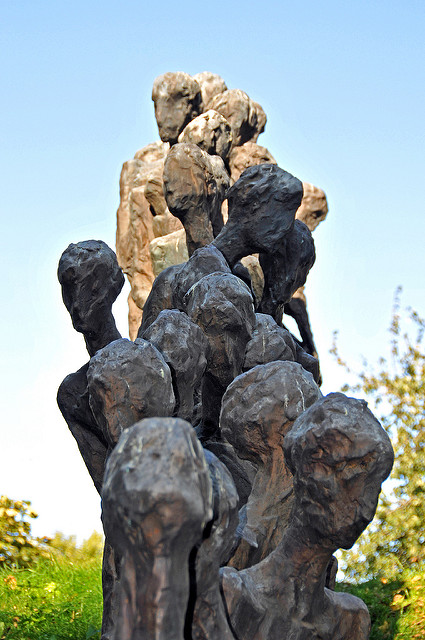
The site, which hosts memorial events every March 2, was marked with a somber obelisk in the immediate postwar years; unusually for a Stalin-era monument, it is overt about the Jewish character of the victims — for Soviet propaganda often obfuscated this with a technically-correct formulation such as “Russian citizens”. In this case, the 1940s memorial obelisk remarkably had a Yiddish inscription to mirror its Russian one. (The sculpture of a column of faceless people tragically descending the slope into the pit was added in the post-Soviet period.)


All images (cc) Dennis Jarvis.

Minsk’s pre-war Jewish population of more than 50,000 was almost entirely annihilated during World War II.

* It was not the only place in the Reich’s occupation to mark Purim with blood.

On this day..

1902: Joe Higginbotham, criminal assailant

On this date in 1902, Joe Higginbotham was hanged for raping and slashing the throat of a Mrs. Ralph Webber.

The State (Columbia, S.C.), Jan. 24, 1902

This headline-making outrage occurred in Lynchburg, Virginia, and the town was on the verge of living up to its name before officers spirited the black janitor away to Roanoke for safekeeping; in Roanoke, military guardsmen were scrambled for security against a rumor that Higginbotham’s life would be attempted even there.

One might well wonder why the bother, as the formal proceedings against the culprit blessed by the law entailed very little deliberation beyond Judge Lynch. Mrs. Webber survived her injury and once her condition stabilized, she was brought to the jail on January 21 to make an identification. “She at once identified him as the man who assaulted her. The negro broke down and confessed to the crime with which he is charged, and further stated that he had attempted some months ago to assault a white girl who was a patient in a Lynchburg hospital.” (Charlotte Observer, Jan. 22, 1902)

Two days after that meeting, Higginbotham pleaded guilty at a short trial under heavy guard back in Lynchburg. The sentence was imposed for exactly one month out — plus one more day so as not to fall on a Sunday — and it went off as scheduled, undisturbed by any appeal or reprieve.

The Higginbotham name will be distinctive to students of 20th century American law, as it was borne by Judge A. Leon Higginbotham, one of the greatest jurists never to reach the Supreme Court.* (Higginbotham was reportedly considered for the seat Thurgood Marshall eventually received.) Since it appears from this message board that Higginbotham descendants in the Lynchburg and Amherst County part of Virginia count the judge among their kin, we couldn’t help but wonder whether, like radio host Tom Joyner discovered, there might be an execution hidden in the family tree.

Resident genealogist and occasional guest poster Golde Singer did some research on this proposition.

Judge Higginbotham grew up in New Jersey but census records confirm that his father Aloysius was in fact born in Virginia to a family with deep roots in Amherst County. Aloysius’s move to the Trenton, N.J. area in the first decade of the 20th century would have put him on the leading edge of the Great Migration of southern blacks to northern industrial cities.

Suggestive as that might be, Golde’s search through Aloysius’s family did not appear to turn up any clear link to a Joseph Higginbotham; indeed, Higginbotham the criminal assailant was reportedly himself an adopted or foster child whose lineage appears obscure. The trail from this point dissipates in history’s marshes. The Higginbotham name is quite widespread in the Lynchburg area; family ancestries for the African-American Higginbothams appear to trace back to slavery among the white family of Captain John Higginbotham, a Revolutionary War officer whose own father relocated to Amherst, Va. from Barbados. (Different English Higginbothams made good in India.)

A generalist site such as ours leaves off short of the close reading of archival records or research into family lore that would required here. (Perhaps there are some readers prepared to shed some light?) In the end, of course, any hypothetical family connection between these two very different men would count as little more than historical curiosity.

* Full disclosure: this author never had the privilege of meeting Judge Higginbotham, but counts as a mentor to his death penalty interest one of the judge’s proteges.

On this day..

1944: Missak Manouchian and 21 French Resistance members, l’Affiche Rouge

On this date in 1944, 22 members of the anti-Nazi French Resistance’s “immigrant movement” Francs-tireurs et partisans – main-d’Å“uvre immigrée (FTP-MOI) were executed by firing squad on the outskirts of Paris.

Comprised of foreign communists whose backgrounds amply motivated them to desperate resistance, FTP-MOI was a notably aggressive partisan unit; a few months before this date’s executions, it had stunningly assassinated SS Col. Julius Ritter on the streets of Paris. Risky tactics, including larger-scale operations like the one that claimed Ritter (these required more partisans to know each other) entailed greater risk of penetration, and the November 1943 arrest of the Armenian commander Missak Manouchian and his group devastated FTP-MOI. After the customary interlude of torture, these were subjected to a show trial with 23 condemned to execution.*

As a gaggle of foreign terrorists, heavily Semitic, this clique looked to the occupation like a marvelous tar with which to blacken the Resistance. To that end the Germans produced a scarlet poster denouncing the Resistance as an “Army of Crime,” its soldiery labeled with strange names and alien nationalities converging on the swarthy Manouchian.**

Soon known as l’Affiche Rouge, the poster instead apotheosized its subjects. In the postwar period it became an emblem of the best of the Resistance — its multinational unity, France as an idea powerful enough that men and women of distant birth would give their lives for her. (Not to mention the postwar French Communists’ claim on le parti des fusillés.)

To this day in France, the backfiring propaganda sheet is one of the best-recognized artifacts of the Resistance.

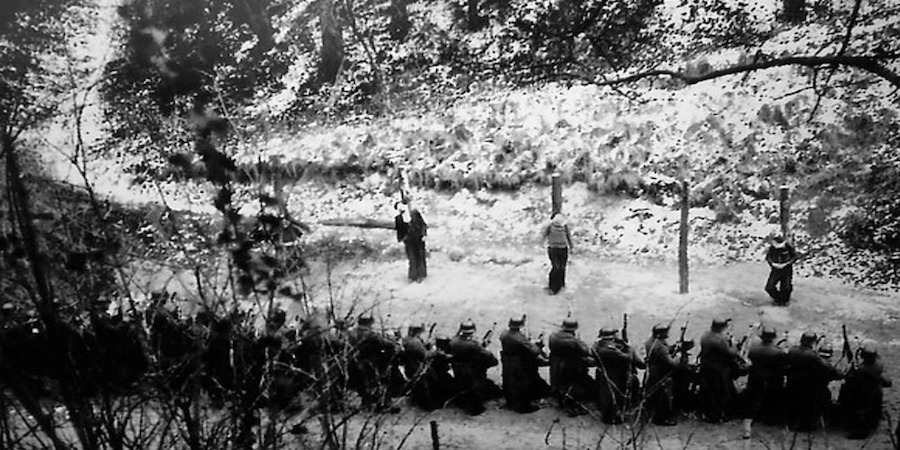
The executions were naturally conducted quietly; the Germans strictly forbade public access to or photography of Resistance heroes in their martyrdoms for obvious reasons.

That made it especially surprising when a few pictures of this execution surfaced recently, surreptitiously snapped from an overlooking vantage by German motorbike officer Clemens Rüter, who kept them hidden for decades. They are to date the only known World War II photos of French Resistance members being executed.

* The 23rd, and the only woman in the group, was Romanian Olga Bancic, also known by the nom de guerre Pierrette; she was not shot on this date but deported to Stuttgart and beheaded there on May 10, 1944. There was also a 24th, a man named Migatulski, who was initially part of the same trial; he was instead remanded to French custody. (See coverage in the collaborationist La Matin from Feb. 19, 1944 and Feb. 22, 1944.)

** We’ve noted before that a Polish Jew named Joseph Epstein who was part of the same cell (and a prime candidate for racist demagoguing) avoided a place on l’Affiche Rouge thanks to his preternatural talent for remaining mum under interrogation.

On this day..

1592: Thomas Pormort, prey of Richard Topcliffe

Thomas Pormort (or Pormant) was hanged on this date in 1592 on a gibbet erected adjacent to a Paul’s Churchyard haberdashery whose proprietor had once entrusted the condemned Catholic priest with his confession.

Pormort was a priest trained on the continent who returned to native soil about the beginning of 1591 to brave the Elizabethan persecution, but managed only a few months in the field before his arrest.

He had the misfortune to face the personal interrogation of the vindictive inquisitor Richard Topcliffe, notorious even in his own day for his gleeful sadism. Topcliffe seems not to have even feigned a politic distaste for the breaking of bones and and of men and made a point to attend the executions his offices effected, including Pormort’s.

Now, back in the day such grim ministers of state could be empowered to toy with their prey in their very own lairs. Even the sainted Thomas More had kept a personal torture chamber at his own home.

So it was with Topcliffe, who inflicted his hospitality on Pormort in the intimacy of his own place, where he apparently had the facilities necessary to put a prisoner to the rack. According to Portmort, the torturer had another intimacy besides during their pain-wracked discourse, taunting or boasting to his victim of carnal indulgences he enjoyed from the queen herself. Pormort would allege at the bar that

Topcliffe told [Pormort] that he was so familiar with her Majesty that he many times putteth [his hands] between her breasts and paps and in her neck.

That he hath not only seen her legs and knees [but feeleth them] with his hands above her knees.

That he hath felt her belly, and said unto her Majesty that she had the softest belly of any woman kind.

That she said unto him, ‘be not these the arms, legs and body of King Henry?’ To which he answered: ‘Yea.’

That she gave him for a favour a white linen hose wrought with white silk, etc.

That he is so familiar with her that, when he pleaseth to speak with her, he may take her away from any company; and that she is as pleasant with everyone that she doth love.

This Penthouse letter for the queen has no factual plausibility, and nobody thought so in 1592. Whether the priest’s report of its utterance is an actual glimpse into a seditious perversion of the torturer, or a desperate attempt by a doomed man to smear his persecutor, Topcliffe took the matter seriously enough that he made Pormort stand on the ladder under his noose in freezing cold for two hours on execution day while Topcliffe browbeat him to withdraw the allegation. (Pormort didn’t budge.)

On this day..

1906: Robert E. Newcomb and John Mueller

(Thanks to Meaghan Good of the Charley Project for the guest post. -ed.)

On this day in 1906, Robert E. Newcomb and John Mueller were hanged together in Chicago, Illinois. Both were multiple murderers, with six deaths between them.

Newcomb, who was, described as “crazed” and “maddened,” hanged for the murder of Chicago police sergeant John Peter Shine.

On October 10 the previous year, Shine heard reports of a gunman terrorizing people on the streets of Englewood. Newcomb had already shot three people and one, a woman named Florence Poore who was the wife of Newcomb’s friend, was dead. Shine found out the gunman had barricaded himself in his apartment. Although he was off duty, he decided to make the arrest himself.

When he knocked on the apartment door and demanded entry, however, Newcomb simply fired through the closed door, hitting Shine in the abdomen and mortally wounding him. The officer died two hours later at Englewood Union Hospital, at the age of 42. Walter Blue, one of the others Newcomb had shot, also died of his wounds.

After Shine was shot, over 100 police officers surrounded Newcomb’s apartment and fired into it, hoping to apprehend or kill the gunman. After a long siege, Newcomb surrendered to an equally certain death in the judiciary.

Little is known about John Mueller or his crimes. Daniel Allen Hearn, in his book Legal Executions in Illinois, Indiana, Iowa, Kentucky and Missouri: A Comprehensive Registry, 1866-1965, describes Mueller as “a drunk and a loser who went berserk when refused money with which to buy liquor.” The 32-year-old slaughtered his wife, Annie, and their two daughters, two-year-old Martha and 18-month-old Mary, by shooting them and slashing them repeatedly with a razor.

The two killers were executed in the Cook County Jail. It was an integrated execution: Newcomb was black and Mueller was white.

On this day..