1943: Dora Gerson, cabaret singer

Jewish cabaret singer and silent film actress Dora Gerson was gassed with her family at Auschwitz on this date in 1943.

IMDB credits the Berlin entertainer (English Wikipedia entry | the more detailed German) with two silver screen roles,* both in 1920 and both now believed lost.**

Gerson’s cabaret career was the more robust through the roaring twenties but with benefit of retrospection we admit with Liza Minelli that from cradle to tomb, it isn’t that long a stay.

And the ominous next act would not belong to Weimar Jews.

After being elbowed off German stages by Reich race laws, Gerson recorded several songs in German and Yiddish; her “Vorbei” (“Beyond Recall”) hauntingly commemorates the lost world before fascism — “They’re gone beyond recall / A final glance, a last kiss / And then it’s all over.”

Gerson fled Nazi Germany to the Netherlands; once that country fell under its own harrowing wartime occupation, she tried to escape with her family to neutral Switzerland but was seized transiting Vichy France. Gerson, her second husband Max Sluizer, and their two young children Miriam (age 5) and Abel (age 2) were all deported to Auschwitz and gassed on arrival on Valentine’s Day 1943.

* Her first marriage was to film director Veit Harlan, who would later direct the notorious anti-Semitic propaganda film Jud Süß — based on an executed Jewish financier. From the German-occupied Netherlands, Gerson unsuccessfully appealed to this powerful ex for protection.

** Future horror maven Bela Lugosi also appeared in both Gerson films, Caravan of Death and On the Brink of Paradise. Gerson’s German Wikipedia page also identifies her as the voice of the evil queen in the 1938 German-language dub of Disney’s Snow White and the Seven Dwarves.

On this day..

1940: Peter Barnes and James McCormack, the last IRA men hanged

“The two that swung in Birmingham, with ordered step
From off the gallows floor.”

Brendan Behan

On February 7, 1940 — Ash Wednesday, as it happened to be — Peter Barnes and James McCormack became the last Irish Republican Army men executed by the British

They were condemned by the outraged British after a then-shocking terrorist bombing that has largely vanished from the historical memory, subsumed by the simultaneous outbreak of World War II.

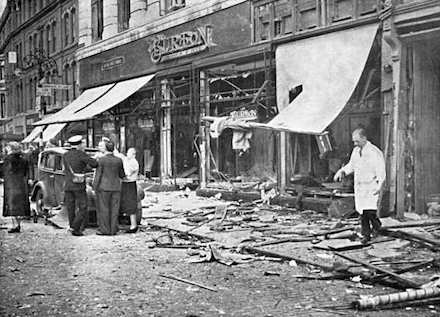
Although it was neither the first nor the last strike in the 1939-1940 campaign of Irish Republican attacks on English soil aimed at forcing London to relinquish control of Northern Ireland, the five-pound bicycle-mounted bomb that ripped apart Broadgate on August 25, 1939, might have been the one that most hardened British hearts against the authors.* Five people were killed in the explosion and some 70 injured; the scene resembled a war zone.**

The resulting investigation — explored in great detail here — never laid hands on the man who actually planted this bomb, eventually revealed to be Joby O’Sullivan.

Many years later and near his death, O’Sullivan claimed that the bomb was supposed to be parked at the Coventry police station; other reports have it destined for an electrical station, and the decision to abandon the ticking bicycle in a crowded street a freelance cock-up by O’Sullivan. Maybe. What is known is that on August 24, London police had busted an IRA plot to place explosives at Westminster Abbey, Scotland Yard, and the Bank of England — all timed to explode at the very same moment as the Coventry package, 2:30 the next afternoon. Had that coordinated fourfold bombing occurred, it would have rated one of the bloodiest and most spectacular terrorist events in history.

But the single blast that did take place was more than enough to bring down the crown’s fury.

Five faced trial for their lives, even though no hand among them had actually set the Coventry bomb. In Ireland and many other places, this latter stipulation made the entire affair an outrageous injustice, especially if one takes as a given that the bomb was not meant to hit civilians. We leave that interesting question of justice to the reader’s consideration, but it must be understood that our hanged men were certainly party to the IRA’s bombing project. The accused, for a trial that December, were:

  • Barnes, an IRA operative in London who had delivered bomb components to Coventry
  • McCormack, part of an IRA cell in Coventry who had rented the house where the bomb was constructed
  • Joseph and Mary Hewitt, and Mary’s mother Brigid O’Hara, Irish immigrants who had taken on McCormack as a lodger

Little evidence could be produced against Hewitt family, who appeared to be quite innocent of their tenant’s intentions. The latter three were cleared of all charges, and then vengefully deported.

McCormack kept stoically silent during the trial, rising only at his sentencing to announce “that the part I took in these explosions since I came to England I have done for a just cause. As a soldier of the Irish Republican Army I am not afraid to die, as I am doing it for a just cause. I say in conclusion, God bless Ireland and God bless the men who have fought and died for her.”

Barnes, whose role on the far end of the supply was even more remote from the final detonation, said as he would maintain to the end, “I am innocent and later I am sure it will all come out that I had neither hand, act or part in it.”

The pair hanged together in Birmingham’s Winson Green Prison. The return of Barnes and McCormack’s remains from that gaol’s unmourned yards to Irish soil soon became a running national demand; the remains were finally repatriated (to great fanfare) in 1969.

Amid the patriotic encomia, civil war veteran Jimmy Steele gave an address on the occasion of the republicans’ reburial critical of the Sinn Fein leadership — an address that is often considered a milepost en route to the imminent (December 1969) splitting-away of the Provisional IRA.

* And in a less justifiable expression, against the Irish generally; Coventry’s Irish immigrant populace faced an immediate racist backlash.

** A chilling preview, for the next year Coventry was devastated by German planes — one of the cities hardest hit by the Reich’s bombing campaign.

On this day..

1939: Maurice Pilorge, Le Condamné à mort

On this date in 1939, the murderer Maurice Pilorge dropped his beautiful head under the blade.

This strange execution by retrospect almost marks the pivot between eras of crime and culture. Public executions were about to disappear entirely; the Third Republic that ordered them would not long outlive them.

And Pilorge’s death specifically would prove to be the last performance of the guillotine in Rennes. It was also to have been the 396th in the legendary career of 75-year-old headsman Anatole Deibler … except that Deibler dropped dead on a Paris metro platform two days before, as he set out for the lethal rendezvous.

So too did Pilorge’s crime belong to that interwar moment of cosmopolitan decadence. He fatally slashed the throat of a Mexican visitor named Escudero after what Pilorge claimed, in an unsuccessful attempt to leverage the “gay panic” defense, was an indecent proposition. The facts of the case appear better to fit the hypothesis that indecent propositions were Pilorge’s stock in trade: a black book full of dates and initials whose owners he would not identify, a short late-night visit to Escudero’s hotel room, and a total refusal to explain his activities.

Pilorge, who maintained a wry and mirthful attitude throughout his trial, could not but laugh at the judge’s speculation — inspired by the swarthiness of his victim in the case at hand? — that his prisoner was involved in traite des blanches, the white slave trade: “I was never cut out for that. I assure you that I have never fallen so low.”

If Pilorge’s character entered the public gaze awash in same-sex eros, he was fixed in the firmament as such by the pen of Villonesque criminal/writer Jean Genet after the war years.

Claiming (falsely) to have had a prison intimacy with this doomed “Apollo”, Genet dedicated to Pilorge, “assasin de vingt ans,” one of his breakthrough works. Written in prison in 1942, Le Condamné à mort is a homoerotic hallucination of lovemaking ahead of a gathering doom and it helped to launch the theretofore Genet into literary superstardom. I’ve found the lengthy poem available online only in the original French, but here’s a translated excerpt via The Columbia Anthology of Gay Literature:

O come my beautiful sun, o come my night of Spain,
Arrive in my eyes which will be dead tomorrow.
Arrive, open my door, bring me your hand,
Lead me far from here to scour the battleground.

Heaven may awaken, the stars may blossom,
Nor flowers sigh, and from the meadows the black grass
Gather the dew where morning is about to drink,
The bell may ring: I alone am about to die.

O come my heaven of rose, o my blond basket!
Visit in his night your condemned-to-death.
Tear away your own flesh, kill, climb, bite,
But come! Place your cheek against my round head.

We had not finished speaking to each other of love.
We had not finished smoking our gitanes.
Well we might ask why the Courts condemn
A murderer so beautiful he makes the day to pale.

Love come to my mouth! Love open your doors!
Run through the hallways, come down, step lightly,
Fly down the stairs more supple than a shepherd,
More borne up by the air than a flight of dead leaves.

O cross the walls; so it must be walk on the brink
Of roofs, of oceans; cover yourself with light,
Use menace, use prayer,
But come, o my frigate, an hour before my death.

The poem was one of several that Genet wrote later set to music by herhis friend, Helene Martin. (It’s also been covered and reinterpreted by several others.)

On this day..

1731: Alejo Calatayud, Mestizo

On this date in 1731, rebel Alejo Calatayud was beheaded in present-day Bolivia.

A silversmith of mixed Spanish and native lineage, Calatayud (English Wikipedia entry | Spanish) was all of 25 years old when he came to the fore of an indigenous-Mestizo rising in the Andean Cochabamba valley.

What began as a tax revolt against fresh impositions being mooted for the province soon gathered grievances of both class and caste and frightened the empire with a massacre of 39 Spaniards when the rebels overran the city of Cochabamba.

Ultimately, it was more rebellion than revolution — one among a sporadic series of resistance movements in the Andes — and was quelled within weeks by the intervention of a Spanish viceroy for whom the quick dispatch of the insurrectionary leader was no more than natural.

Today, Cochabamba remembers its very brief master Calatayud with an excitingly kinetic equestrian monument.

On this day..

2015: Robert Ladd, “let’s ride”

(Thanks to Rev. Dr. Jeff Hood — “pastor, theologian, activist, writer” — for the guest post, which originally appeared on his own site as part of his 2015 “Lenten Reflections from the Executed” series. -ed.)

“Let’s ride.”

We stop. We are afraid. We don’t want to move an inch. Danger is a paralyzing force. In the face of certain death, Robert Ladd looked danger in the eye and shrugged. If we place our trust in God, we too can have such confidence.

Staring down whatever danger you face, I invite you to pray the last words of Robert Ladd:

“Let’s ride.”

Amen.

(Ladd also wrote two letters to Gawker concerning his case and the mental disability that was at issue in his final appeals: 1 | 2)

On this day..

1820: The slaves Ephraim and Sam, “awful dispensation of justice”

From the Savannah Daily Gazette, Feb. 5, 1820:


From the August Chronicle 2d inst.

EXECUTION:

On Friday last two negro men, named Ephraim and Sam, were executed in conformity to their sentence, for the murder of their master Mr. Thomas Hancock, of Edgefield District S.C.

Sam was burnt and Ephraim hung, and his head severed from his body and publicly exposed. The circumstances attending the crime for which these miserable beings have suffered, were of a nature so aggravated, as imperiously demanded the terrible punishment which has been inflicted upon them.

The burning of malefactors is a punishment only resorted to, when absolute necessity demands a signal example. It must be a horrid and appealing sight to see a human being consigned to the flames.

Let even fancy picture the scene — the pile — the stake — the victim — and the mind sickens, and sinks under the oppression of its own feelings — what then must be the dread reality!

From some of the spectators we learn, that it was a scene which transfixed in breathless horror almost every one who witnessed it. As the flames approached, the piercing shrieks of the unfortunate victim struck upon the heart with a fearful, painful vibration — but when the devouring element seized upon his body, all was hushed — yet the cry of agony still thrilled in the ear, and an involuntary and sympathetic shudder ran thro’ the crowd.

We hope that this awful dispensation of justice may be attended with such salutary effects as to forever preclude the necessity of its repetition.

On this day..

2017: Seven in Kuwait, including a sheikh

A sheikh, and six others much less exalted hanged this morning in Kuwait.

Garnering most of the headlines, Sheikh Faisal Abdullah al-Jaber al-Sabah — the first Kuwaiti royal ever put to death — shot an equally royal nephew dead in 2010.

He was one of only two actual Kuwaitis among the seven hanged; the population of the oil-rich Gulf emirate is more than half comprised of foreign nationals at any given time. The other Kuwaiti was a woman, Nasra al-Enezi, who vengefully set fire to a wedding tent when her husband took a second wife. More than 50 people reportedly died in the blaze.

The Philippines was exercised over the fate of its national, Jakatia Pawa — a domestic worker condemned for stabbing her employer’s adult daughter to death. Kuwait is the sixth-largest destination for the vast expatriate labor sector known as Overseas Filipino/a Workers (OFWs).

An Ethiopian maid, unnamed in the press reports that I have been able to find, was also convicted of murder, as were two Egyptians. The seventh to go to the scaffold today was a Bangladeshi man condemned for a non-fatal kidnapping and rape.

Human rights organizations were naturally aghast, with Human Rights Watch denouncing the mass hanging — on the heels of capital punishment resumptions in Jordan and Bahrain — as part of an “alarming trend in the region for countries to return to or increasingly use the death penalty.”

On this day..

1641: Not Manuel de Gerrit de Reus, chosen by lot, saved by hemp

Dutch New Amsterdam’s council minutes give us today’s remarkable story, of the chance condemnation and chance deliverance of an Angolan

Our Manuel — his “de Reus” surname came from his Dutch owner — appears to have been among the very earliest slaves imported into New Amsterdam when the Dutch West India Company first introduced this institution in 1626.

By every indication apart from this brush with the scaffold he was a respected man who prospered about as well as his situation permitted. Manuel received (partial) freedom in 1644 along with nine other slaves, prominently including several others charged in this same fracas. These freedmen and their families would thereafter form the nucleus of Manhattan’s first black community by settling (post-manumission) neighboring farming plots north of Fresh Water Pond.*

We can continue to track Manuel, fleetingly, through colonial records as late as 1674 — by which time his place was no longer New Amsterdam at all, but New York.


Anno 1641. In the Name of God

On Thursday, being the 17th of January, Cornelio vander Hoykens, fiscal, plaintiff, vs. little Antonio Paulo d’Angola, Gracia d’Angola, Jan of Fort Orange, Manuel of Gerrit de Reus, Anthony the Portuguese, Manuel Minuit, Simon Conge and big Manuel, all Negroes, defendants, charged with homicide of Jan Premero, also a Negro. The plaintiff charges the defendants with manslaughter committed in killing Jan Premero and demands that Justice be administered in the case, as this is directly contrary to the laws of God and man, since they have committed a crime of lese majesty against God, their prince and their masters by robbing the same of their subject and servant.

The defendants appeared in court and without torture or shackles voluntarily declared and confessed that they jointly committed the murder, whereupon we examined the defendants, asking them who was the leader in perpetrating this deed and who gave Jan Premero the death blow. The defendants said that they did not know, except that they committed the deed together.

The aforesaid case having been duly considered, it is after mature deliberation resolved, inasmuch as the actual murderer can not be discovered, the defendants acknowledging only that they jointly committed the murder and that one is as guilty as another, to have them draw lots as to who shall be punished by hanging until death do ensue, praying Almighty God, creator of heaven and earth, to designate the culprit by lot.

The defendants having drawn lots in court, the lot, by the providence of God, fell upon Manuel of Gerrit de Reus, who shall be kept in prison until the next court day, when sentence shall be pronounced and he be executed.

On the 24th of January, being Thursday The governor and council, residing in New Netherland in the name of the High and Mighty Lords the States General of the United Netherlands, his highness of Orange and the honorable directors of the Chartered West India Company, having seen the criminal proceedings of Cornelio vander Hoykens, fiscal, against little Antonio, Paulo d’Angola, Gracia d’Angola, Jan of Fort Orange, Manuel of Gerrit de Reus, Antony the Portuguese, Manuel Minuit, Simon Conge and big Manuel, all Negroes and slaves of the aforesaid Company, in which criminal proceedings by the fiscal the said Negroes are charged with the murder of Jan Premero, also a slave, committed on the 6th of January 1641, which said defendants on Monday last, being the 21st of this month, without torture or irons, jointly acknowledged in court at Fort Amsterdam that they had committed the ugly deed against the slain Premero in the woods near their houses; therefore, wishing to provide herein and to do justice, as we do hereby, in accordance with the Holy Scriptures and secular ordinances, we have, after due deliberation and consideration of the matter, condemned the delinquents to draw lots which of them shall be hanged until death ensue. And after we had called upon God to designate the culprit by lot, finally, through the providence of God, the lot fell upon Manuel of Gerrit de Reus, who therefore is thereby debarred from any exceptions, pleas and defenses which in the aforesaid matter he might in any wise set up, inasmuch as the ugly murderous deed is committed against the highest majesty of God and His supreme rulers, whom he has deliberately robbed of their servant, whose blood calls for vengence before God; all of which can in no wise be tolerated or suffered in countries where it is customary to maintain justice and should be punished as an example to others; therefore, we have condemned, as we do hereby condemn, the afore­said Manuel of Gerrlt de Reus (inasmuch as he drew the lot) to be punished by hanging until death follows, as an example to all such malefactors.

Thus done and sentenced in our council and put into execution on the 24th of January of this year of our Lord and Savior Jesus Christ anno 1641.

On the 24th of January 1641 Manuel of Gerrit de Reus having been condemned to be executed with the rope so that death would follow, standing on the ladder, was pushed off by the executioner, being a Negro, having around his neck two good ropes, both of which broke, whereupon the inhabitants and bystanders called for mercy and very earnestly solicited the same.

We, therefore, having taken into consideration the request of the community, as also that the said Manuel had partly under­gone his sentence, have graciously granted him his life and pardoned him and all the other Negroes, on promise of good behavior and willing service. Thus done the day and year above written, in Fort Amsterdam in New Netherland.

* Also (and better) known as Collect Pond. Although the body of water itself has long since gone the way of urban infill, we touched on its interesting proximity to Gotham’s criminal history in a footnote to this post.

On this day..

1639: The auto de fe of Lima, Peru

Lima, Peru on this date in 1639 celebrated a huge auto de fe featuring 72 prisoners. Of these, 12 were executed at the stake, one of whom had the consolation of being already dead by his own hand. (He was punished in effigy.)

Their crime, per the Inquisition, was Judaizing — but we might better consider it today in the vein of terrorism, an idee fixe crawling from a swamp of public insecurities both real and projected: race, religion, geopolitics, and crass opportunism all vying for precedence under the Inquisitor’s cowl.

This post will speak of “Jews” but it’s important to remember that the Spanish empire at this point officially had no Jews: it had forced its Jewish population into exile or conversion. That latter set, Jews who had converted to Christianity under that very Catholic realm’s pressure, thereafter became suspected down the generations of sustaining their Hebraic rites in secret, sapping the Church from within while looking for the odd opportunity to sacrifice a Christian child.

It is uncertain in the end in what proportions these forced converts and their descendants did maintain Jewish devotions versus absorbing themselves into Christianity. But by whatever opinion, these are our “Jews”, conflating as the word often does both faith and race; the terms “New Christians” or “conversos” or “crypto-Jews” are also widely used in the literature and all refer to the same universe of suspected and former (at least somewhere up the family tree) Jews who presented themselves publicly as Christians.

No matter the loyalty of individual converso, the suspicion each was born under placed them in an obvious practical difficulty, and it was compounded in the 17th century as Jewry, that eternal bugbear, also came to stand in for a host of other worries dogging the Spanish state.

To begin with, many Jews had in their day fled from Spanish conversion to Portugal, but had recently become re-absorbed when the Spanish crown added Portugal as an unwilling bride to its imperial conquests in 1580. So, the Portuguese, and the tensions thereto, became equated with the Jew in the Spanish imagination.*

In the New World, the already onion-layered specter of the secret Jew further aligned with the menaces of an unknown frontier, where unfamiliar opportunities abounded and dangers too.**

Spain’s rival on the Caribbean coast was its very own disobedient former possession, the Netherlands, and the latter offered Jews a liberal grant of toleration. Spanish conversos’ loyalty to their own crown, already doubted on principle, was doubly suspect for the proximity of rival settlements with unconcealed synagogues — no mere paranoid fantasy, as Jews on Spanish soil were prominent among the collaborators who aided Dutch incursions in the 17th century.

Jews also came to be credited more generally with a scary affinity for the subject populations of conquered Indians and imported African slaves — their pagan magicks, their inscrutable tongues, and their frightful potential for revolt. And of course, there was all that odious money-handling.

“For the past six to eight years, a great number of Portuguese [read: Jews] have entered the kingdom of Peru and there were a great number already there,” Don Leon de Alcayaga wrote of Lima in 1636. “They came to rule over all commerce, which from the brocade to the sackcloth, and from the diamond to the cony, all run through their hands. The Castilian without a Portuguese partner could expect no success in trade.”

Commerce is cutthroat, and the evident power of Jews among the colonies’ emerging mercantile elites — and not just in Lima, but in Cartagena, Buenos Aires, and elsewhere — seems to have co-evolved with appeals from New World Castilians for the Inquisition’s scrutiny of this potentially disloyal element. Strictly out of piety and patriotism, you understand.

Juan de Manozca became Archbishop of Mexico in 1643.

The arrival from Cartagena of Inquisitor Juan de Manozca, who had prosecuted crypto-Jews in that city as well as native “witches”, set the scene for one of the Spanish colonies’ bloodiest purges.

In 1635, a great wave of arrests seized upwards of 100 of these “Portuguese” for La Complidad Grande, a supposed grand conspiracy among the heretics whose contours are little described in the documentation that survives for us. Was the “conspiracy” essentially Judaism itself? Or did Inquisitors perceive a more daring and tangible plot?

“Apropos of the famous auto de fe of the Portuguese, Pelliza y Tovar, the famous chronicler of Aragon, says that on the day the Spanish authorities took possession of the letters and correspondence of the resident Portuguese they found keys and letters in code and they discovered that the synagogues of America were in intimate relations with the Jews of Holland.”† Manozca apparently communicated to the mother country that the Hebrews were stockpiling munitions.

They were bound ultimately for the auto this day — years afterwards — via the Inquisition’s cumbersome judicial machinery. The two most famous of them mark the entire futile spectrum of choices available to the New Christian whom the Old Christian was sufficiently motivated to destroy:

  • Francisco Maldonado da Silva, a Jewish physician who had been imprisoned since 1627 for returning to Judaism, and been completely unapologetic about it, even evangelizing other prisoners held near him. “This is the doing of the Lord God of Israel, so that I may now look upon Him face to face,” he said at the stake.
  • Manuel Bautista Perez, a powerful merchant reputed to be the wealthiest man in Lima — his fortune built on mining, shipping, and the slave trade.‡ Perez hailed from a New Christian family but unlike da Silva he insisted on his fidelity to the Church and refused to admit any heresy. Indeed, he had always been conspicuous in his devotions, and (his words) “never let it be known, either to persons from his household or outside it, that he was a New Christian … because he always tried to be taken for an Old Christian.”

This purge devastated not only New Spain’s Jewish populace but her economy too; with many of the wealthiest magnates clapped in irons from 1635 and their assets suddenly demobilized, other operators be they ever so devout immediately faced an epidemic of financial reversals and bankruptcies.

* Even though a Portuguese Inquisition also existed, predating the 1580 union of the two realms.

** See Irene Silverblatt, “New Christians and New World Fears in Seventeenth-Century Peru,” Comparative Studies in Society and History, July 2000, who notes that

The colony’s take on the Jewish menace, then, elaborated a familiar but divergent set of charges: New Christians had usurped trade and merchandising to the detriment of Castilians; New Christians, with international ties, were not loyal to the Spanish empire; New Christians — merchants and traitors — aligned themselves with potentially subversive groups within the Colony (namely, indios and negros) …

† The comment is that of Peruvian historian Ricardo Palma, quoted by Seymour Liebman in “The Great Conspiracy in Peru,” The Americas, October 1971.

‡ For a detailed exposition of Perez’s career in slaving, see From Capture to Sale: The Portuguese Slave Trade to Spanish South America in the Early Seveacnteenth Century.

On this day..

1905: John Johnson

(Thanks to Meaghan Good of the Charley Project for the guest post. -ed.)

On this date in 1905, John Johnson was hanged for the murder of Patrolman Dennis Fitzgerald of the Chicago Police Department.

On September 26, 1903, Johnson and another man, Louis Tedford, were being drunk and disorderly near the corner of 44th Street and Indiana Avenue. Fitzgerald told them to move along. In response, the two men beat him to a pulp and shot him with his own gun.

Fitzgerald was a strong man and he lingered for four months before he died on January 20, 1904. Authorities determined his death was a direct result of his wounds. He was buried in Mount Olivet Catholic Cemetery.

As for the two offenders, both were convicted of murder, but Tedford got off relatively easily with a fourteen-year sentence. The jury determined Johnson was the one most responsible for the officer’s death, and so he paid for it with his life, a year to the day after Fitzgerald died. “Please hurry things along,” were his last words.

It was a busy day with the rope around North America.


Macon (Ga.) Telegraph, Jan 21, 1905


Grand Forks (N.D.) Herald, Jan. 21, 1905

On this day..