2014: Thirteen Xinjiang terrorists

One year ago today, China executed as terrorists 13 separatist militants.

According to Xinhua, the 13 were condemned in 7 different cases from Aksu, Turpan and Hotan — all prefectures of the western Xinjiang region.


Xinjiang. By TUBS [CC BY-SA 3.0], via Wikimedia Commons

Muslim Uighurs comprise a near-majority of that province’s population, and although Xinjiang is formally an “autonomous region” many Uighurs find it not nearly autonomous enough. Going tension has fomented a separatist movement that has appeared to gain strength — or at least visibility — during the past decade, including multiple spectacular and deadly terrorist attacks as well as several riots.

“The execution of criminals involved in terrorist attacks and violent crimes answers the calls of all ethnic groups, deters criminal activities, and demonstrates the resolve of the Communist Party of China and the government in cracking down on terrorism,” a Chinese court spokesman said, speaking of three of this date’s condemned who were sentenced together for a series of attacks in Lukqun (Turpan prefecture) that slew 24 police officers.

The executions on this day were surely coordinated for their demonstrative effect, days after Chinese authorities announced a “one-year crackdown” in Xinjiang one day after two SUVs bombed a market in Ürümqi, killing 43 people and injuring over 90 others.

Notwithstanding China’s strenuous attempt to frame the “crackdown” as one targeting only terrorists, security measures have bled insensibly into a crackdown on Muslims, targeting conservative Islamic cultural markers like veiled faces. It’s a sure bet that we haven’t heard the last of this flashpoint.

On this day..

1561: 88 Calabrian Waldensians, like the slaughter of so many sheep

A horrible intra-Christian auto de fe in the Calabrian town Montalto marred this date in 1561.

The pre-Reformation Waldensian sect, dating back to the 12th century, managed to survive Catholic persecution in the hills and valleys of northwest Italy’s Piedmont — but not only there. Waldensians partook of the spiritual movements that emerged throughout Europe in this period challenging Church domination.

The Waldensians are named for Peter Waldo, a Lyons merchant who translated the Bible into the vernacular so that common people could better adhere to it; one of their first appellations, alluding to their creed of voluntary poverty, was “the Poor of Lyons”. Others professed like notions, and Rome viewed them as part of a common heresy — as Pope Lucius III decreed in anathematizing the whole lot in 1184:

In order to eradicate the wickedness of various heresies that have begun to manifest themselves in many countries throughout the whole world, the power of ecclesiastical discipline must be called into requisition. Therefore … [we] set ourselves against the heretics, who from various errors have received various names, and by apostolical authority, through this our constitution, have condemned all heresies by whatever name they may be called. First, the Catharists, and the Patarini, and those who falsely and fictitiously call themselves Humiliati or Poor Men of Lyons; as well as the Passaginians, Josephists, Arnoldists; all these we lay under an everlasting curse.

As heavily as these movements and their cousins, offshoots, imitators, and successors were pressed by the authorities in the subsequent years, they were never fully extirpated. The Waldensians, in the end, survived by keeping their heads down: in their defensible mountainous haven in the Piedmont, and in an offshoot community of Piedmont refugees that settled in Calabria, the rural toe of Italy’s boot where towns like Guardia Piemontese still reflect in their names the cross-regional influence.* For generations before Luther, these exiles made their way with security by obscurity, participating superficially as Catholics while privately maintaining their outlaw doctrine.

With the onset of the Protestant Reformation, these heretical enclaves could no longer be ignored and drew renewed persecution. Conversely (and this surely cemented the end of the look-the-other-way policy) reformers and Waldensians recognized common identity and common interests between the dissident communities; the Calabrian Waldenses sought and received missionaries from Calvinist Geneva.

Taking a very dim view of a hellbound heresiarch establising a toehold in its very own boot, Rome — and specifically the cardinal who would soon become the Counter-Reformation stalwart Pope Pius V — dispatched inquisitors backed by armed men to uproot these Poor of Lyons. As their targets were isolated from any store of aid or support, Rome’s agents had a wide latitude to treat them all with heedless brutality. After all, how many divisions did the Calabrian Waldensians have?

In June of 1561, after the heretics had defied an order to start attending mass daily, troops began invading the Waldensian villages. Guardia Piemontese, mentioned earlier, was assaled on June 5; one of the town’s entrances is still named Porta del Sangue, Gate of Blood, for the gore that was supposed to have flowed through it on this infamous day.

Waldensian prisoners from Guardia and elsewhere were hauled to nearby Montalto Uffugo to undergo the rough hospitality of the Inquisition. A Catholic servant to one of the lords tasked with effecting this persecution wrote with horror about watching the culmination of that Passion for 88 Waldensians on June 11.

Most illustrious sir, I have now to inform you of the dreadful justice which began to be executed on these Lutherans early this morning, being the 11th of June.

And, to tell you the truth, I can compare it to nothing but the slaughter of so many sheep. They were all shut up in one house as in a sheep-fold.

The executioner went, and bringing out one of them, covered his face with a napkin, or benda, as we call it, led him out to a field near the house, and causing him to kneel down, cut his throat with a knife. Then, taking off the bloody napkin, he went and brought out another, whom he put to death after the same manner.

In this way the whole number, amounting to eighty-eight men, were butchered. I leave you to figure to yourself the lamentable spectacle, for I can scarcely refrain from tears while I write; nor was there any person, after witnessing the execution of one, could stand to look on a second.

The meekness and patience with which they went to martyrdom and death are incredible.

Some of them at their death professed themselves of the same faith with us, but the greater part died in their cursed obstinacy. All the old met their death with cheerfulness, but the young exhibited symptoms of fear.

I still shudder while I think of the executioner with the bloody knife in his teeth, the dripping napkin in his hand, and his arms besmeared with gore, going to the house, and taking out one victim after another, just as a butcher does the sheep which he means to kill.

This was not the end of it. The Archbishop of Reggio reported deploying the hacked-up remains like Spartacus’s crucified followers, “hanged on the road from Murano to Cosenza, along 46 miles, to make a frightening spectacle to all who pass by.” (Source) Over the months to come, numerous others would go to the stake, or if “lucky” the galleys.

Whatever remnant survived was laid under heavy communal punishment: “that all should wear the yellow habitello with the red cross; that all should hear mass every day … that for twenty-five years there should be no intermarriage between [Waldensians]; that all communication with Piedmont and Geneva should cease.” One can still find in Guardia the inward-looking spioncini, peepholes, that Waldensians were forced to install on their doors for the more convenient monitoring of their behavior behind closed doors.

* The emigre Waldensians brought their tongue, Occitan, with them, and a linguistic enclave of Occitan still perseveres in Calabria. (The language primarily persists in the belt from Catalonia through southern France to northwest Italy, known as Occitania.)

Here’s a Guardia Piemontese Occitan speaker describing the slaughter of the Waldensians:

On this day..

1688: Constantine Gerachi, the Siamese Falcon

On this date in 1688, the astonishing Constantine Gerachi — the Greek cabin-boy turned virtual prince of Siam — plummeted to earth.

The son of a Cephalonian innkeeper, Gerachi ran away to sea in 1660 and soon caught on with the English East India Company ships who plied the Mediterranean and all the Seven Seas. Though little-educated, Gerachi proved himself frightfully clever and picked up his crewmates’ English. In time he also mastered French, Portuguese, Malay, and of course Siamese.

The word gerachi is Greek for falcon, and no name was ever more aptly conferred. From the humblest beginnings, Constantine Phaulkon soared higher than all.

By the late 1670s, Constantine had segued from hauling East Indies cargo to trading it, and this brought him to the attention of the Siamese king Narai. For Siam, the growing influence of European traders, diplomats, and arms was the prevailing issue of the late 17th century; Narai engaged fully with those interlopers and most especially with the French, who provided architects, mathematicians,* missionaries, and military engineers to the Siamese kingdom and received lucrative commercial concessions in return.

The king appreciated our polyglot adventurer’s many talents and attracted him to the Siamese court, where the pro-French Constantine quickly rose to become Narai’s indispensable chief counselor — basically the equivalent of the Siamese Prime Minister, the power in the kingdom.

But Gerachi’s close association with Narai, and with a French relationship that Siamese grandees increasingly feared might convert insensibly into domination, finally felled the Falcon.

In 1688, the ailing king tried to arrange for the succession of his daughter. Instead, he triggered a revolt by his foster brother Phetracha, backed by a “broad coalition of anti-foreigners, including Buddhist monks, the nobility and low-ranking officers.”**

This Chief of the Royal Elephant Corps seized power, murdering a number of royal relatives (and possibly hastening along the dying Narai himself). Monsieur Constantine of such discreditable familiarity to the French naturally went in his own turn, unsuccessfully trying to rally the realm’s French garrisons to defense of the mutual benefits of the ancien regime.

Nor was this merely a palace coup: Petracha’s takeover became the Siamese Revolution of 1688, “one of the most famous events of our times, whether it is considered from the point of view of politics or religion” in the judgment of a European contemporary. Thais who had resented the growing prominence of the farang now expelled most Europeans, or worse: though not a Japan-like closure (Siam maintained active intercourse with its neighbors), the country would remain essentially dark to Europeans until the 19th century.

Historical Fiction Series by Axel Aylwen

* The relationship gave to European mathematics the “Siamese method”.

** Thanet Aphornsuvan, “The West and Siam’s quest for modernity: Siamese responses to nineteenth century American missionaries”, East Asia Research, vol. 17, no. 3. (Nov. 2009)

On this day..

1886: Tabby Banks and Tom Honesty, for election rejection

This date in 1886 gives us the double execution of two men named Banks and Honesty — words we don’t hear in the same sentence every day, amirite?


Baltimore Sun, June 5, 1886: the source of all newspaper quotes in this post.

That’s Tabby Banks and Tom Honesty, to be exact, “two full-grown and powerful negroes” who to nobody’s satisfaction denied all the way to the gallows that they had murdered a white 18-year-old, Joseph McFaul, outside the (still-extant) Taylor Hotel on November 14, 1884. The sources I have located do not explicate any beef specifically known to have existed between these individuals; they do, however, situate the conflict squarely within America’s political environment in that electoral year. It is not only in passing that we have noted the parties’ racial identities.

Days before McFaul died, former hangman Grover Cleveland was elected President — the first Democrat to win the office since before the Civil War.

It might be better to say that Cleveland was the first Democrat to hold the office. The tossup 1876 presidential election was more-or-less won by New York Democrat Samuel Tilden, but he was bilked of the prize in an electoral college bargain that exchanged another Republican presidency for the end of Reconstruction.

In the 1870s and 1880s, northern whites were steadily coming around towards Southern whites’ distaste for the ongoing rigor necessary to enforce the putative equality of ex-slaves with their former masters.

Recognizing that such lethargy among white elites in effect amounted to abandoning the field to the violent reassertion of white supremacy, blacks were deeply apprehensive about 1884. Some even feared that chattel slavery might be restored outright. For all the growing indifference of the Republicans, the potential election of the Democrat Cleveland, T. Thomas Fortune wrote during the campaign, “would be a cold afternoon for this country and especially for the Negro and the laboring classes.” (Via)

This is presumably why McFaul, a Democrat taking part in a celebratory parade for Cleveland’s election, would have been hateful to Banks and Honesty. According to the Baltimore Sun, those latter two had previously “traversed the [march] route, threatening to kill some democrat.” Later, McFaul chanced to nominate himself their target by stepping into an alley, where the two churls “immediately attacked him.” Some passing Samaritan saw what was happening and managed to pull McFaul out of the alley and onto the street; still, his assailants did not disdain to press the assault in public view and clobbered the young man with a rock.

Everyone parted and went their separate ways, but young McFaul was a dead man walking. His skull fractured by the stone, he died that night in his sleep.

President Cleveland, of course, did not restore slavery. He took little interest in the situation of black Americans and did nothing to check the onset of Jim Crow, but in this he was not so different from his Republican contemporaries. Nobody among the nation’s white elite had a belly for the fight any longer.

Frederick Douglass had to concede in a Washington, D.C. speech of 1886 that “as far as the colored people of the country are concerned, their condition seems no better and not much worse than under previous administrations.”

Lynch law, violence, and murder have gone on about the same as formerly, and without the least show of Federal interference or popular rebuke. The Constitution has been openly violated with the usual impunity, and the colored vote has been as completely nullified, suppressed, and scouted as if the fifteenth amendment formed no part of the Constitution, and as if every colored citizen of the South had been struck dead by lightning or blown to atoms by dynamite. There have also been the usual number of outrages committed against the civil rights of colored citizens on highways and by-ways, by land and by water, and the courts of the country, under the decision of the Supreme Court of the United States, have shown the same disposition to punish the innocent and shield the guilty, as during the presidency of Mr. Arthur.

On this day..

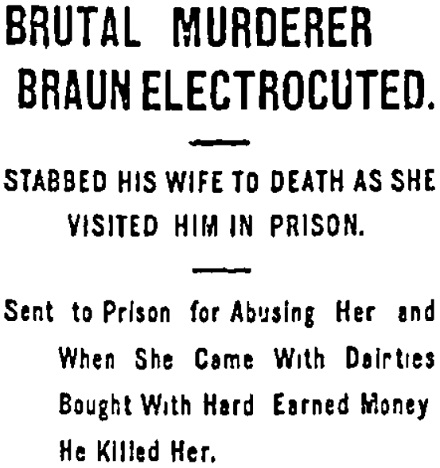
1899: Adrian Braun, who murdered his wife in Sing Sing


Wilkes-Barre Times, May 29, 1899.

On this date in 1899, Adrian Braun was electrcuted at Sing Sing.

Braun was a hulking German cigar-maker with a reputation for habitually thrashing his wife. Authorities got involved when he bashed a neighbor who intervened in a beating so hard that it fractured the man’s skull.

In August 1897, Braun caught a two-year sentence for assault. With her batterer put away, Kate Braun now had to shift for herself; struggling to make ends meet as a washer-woman, she had to give up two of her five children to the St. Joseph’s Roman Catholic Orphan Asylum. Still, she scraped together enough money to buy her incarcerated husband some sweets on a prison visit.

Mr. Braun was at work peeling potatoes in the prison kitchen when he was summoned for the arrival of his spouse in March 1898. After using up their visiting time on a conversation that appeared entirely mutually affectionate, the two were about to part when Adrian Braun suddenly whipped out the potato-knife he had recently been employing and daggered the poor woman’s throat — with lethal effect.

Braun never explained his shocking crime and pursued only a half-hearted insanity defense at his ensuing trial.

“No man was ever executed at the prison who had less sympathy than was felt for Braun,” the Wilkes-Barre Times reported on the day of the man’s execution.

On this day..

1868: Michael Barrett, the last public hanging in England

England held its last-ever public execution on this date in 1868, and made it big game indeed: Fenian Michael Barrett, whose Clerkenwell Prison bombing long remained one of the most infamous atrocities of the Irish nationalist cause.

The bill certifying the end of that distinctive institution, the public hanging, would be finalized three days hence, so the occasion’s milestone was anticipated in advance. Elites increasingly disdained the boorish carnivals that unfolded under the gallows, like Dickens who complained that “no sorrow, no salutary terror, no abhorrence, no seriousness; nothing but ribaldry, debauchery, levity, drunkenness, and flaunting vice in fifty other shapes” redeemed the 1840 hanging of Courvoisier.


“The Great Moral Lesson at Horsemonger Lane Gaol”, Punch magazine’s view of the notoriously rowdy mob at Frederick and Marie Manning execution.

“The crowd was most unusually orderly,” ran the Times‘ report of Barrett’s death — a sort of dual eulogy — “but it was not a crowd in which one would like to trust.”

It is said that one sees on the road to the Derby such animals as are never seen elsewhere; so on an execution morning one see faces that are never seen save round the gallows or near a great fire. Some laughed, some fought, some preached, some gave tracts, and some sang hymns; but what may be called the general good-humoured disorder of the crowd remained the same, and there was laughter at the preacher or silence when an open robbery was going on. None could look on the scene, with all its exceptional quietness, without a thankful feeling that this was to be the last public execution in England. Towards 7 o’clock the mass of people was immense. A very wide open space was kept round the gallows by the police, but beyond this the concourse was dense, stretching up beyond St. Sepulchre’s Church, and far back almost, into Smithfield — a great surging mass of people which, in spite of the barriers, kept swaying to and from like waving corn. Now and then there was a great laughter as a girl fainted, and was passed out hand over hand above the heads of the mob, and then there came a scuffle and a fight, and then a hymn, and then a sermon, and then a comic song, and so on from hour to hour, the crowd thickening as the day brightened, and the sun shone out with such a glare as to extinguish the very feeble light which showed itself faintly through the glass roof above where the culprit lay. It was a wild, rough crowd, not so numerous nor nearly so violent as that which thronged to see Muller or the pirates die. In one way they showed their feeling by loudly hooting a magnificently-attired woman, who, accompanied by two gentlemen, swept down the avenue kept open by the police, and occupied a window afterwards right in front of the gallows. This temporary exhibition of feeling was, however, soon allayed by coppers being thrown from the window for the roughs to scramble for. It is not right, perhaps, that a murderer’s death should be surrounded by all the pious and tender accessories which accompany the departure of a good man to a better world, but most assuredly the sight of public executions to those who have to witness them is as disgusting as it must be demoralizing even to all the hordes of thieves and prostitutes it draws together. Yesterday the assembly was of its kind an orderly one, yet it was such as we feel grateful to think will under the new law never be drawn together again in England.

Michael Barrett’s ticket to this last assembly was punched by a different execution six months previous — the hanging of the Manchester Martyrs. This trio of Irish patriots were part of a mob who liberated some comrades from a police van, shooting a policeman in the process — though it was far from certain that any of these three actually fired shots.

Of importance for our purposes today was the crackdown on other Fenians occasioned by the Manchester affair. In November of 1867, a Fenian agent named Richard O’Sullivan Burke was arrested with his companion Joseph Casey in London purchasing weapons for the movement. They were clapped in Clerkenwell Prison pending trial.

The bombing that brought Michael Barrett to the gallows was a bid to liberate these men … and it did not pause for subtlety. The conspirators simply wheeled a barrel of gunpowder up to the wall of the facility when they expected the inmates to be at exercise in the adjacent yard. The explosion blasted a 60-foot gap in the wall; the inward-collapsing rubble might easily have been the death rather than the salvation of the prospective beneficiaries, except that they weren’t actually in the yard at all — nobody was there, and nobody escaped Clerkenwell.

But numerous working-class families lived in little tenements opposite the prison and were there, and in fact Clerkenwell had a reputation for political radicalism and Fenian sympathy. This monstrous new “infernal machine” tore through Clerkenwell homes, leaving 12 people dead and numerous buildings near to collapse, while windows and chimneys shivered to pieces all up and down the block.


Improvised struts shore up damaged buildings opposite the wall of Clerkenwell Prison reduced to rubble by the December 13, 1867 Fenian bombing.

Karl Marx, a strong supporter of the Irish cause, despaired this counterproductive turn towards terrorism: “The London masses, who have shown great sympathy towards Ireland, will be made wild and driven into the arms of a reactionary government. One cannot expect the London proletarians to allow themselves to be blown up in honour of Fenian emissaries.”

English reformer Charles Bradlaugh agreed. “The worst enemy of the Irish people could not have devised a scheme better calculated to destroy all sympathy,” he wrote.


Punch magazine depicts the Clerkenwell bomber(s) as the “Fenian Guy Fawkes“.

Considering the magnitude of the crime, someone would have to pay for it. That Barrett was that someone did not sit well for many.

Five men and a woman stood trial at the Old Bailey in April for the Clerkenwell outrage, but Barrett was the only one of them convicted, a terribly inadequate investigation/prosecution outcome given the infamy of the crime.

That conviction stood on the basis of disputed eyewitness identifications: Barrett produced witnesses who said he was in Glasgow when the bomb went off, while the crown found others who would swear he was actually in London. (The length of Barrett’s whiskers on specific dates in late November and early December forms a running subplot of the dueling testimonies.)

The reliability and even the good faith of all such winesses might well be impugned. A highly questionable stool pigeon named Patrick Mullany who ducked prosecution by turning crown’s evidence, charged that Barrett personally set off the ordnance.

Despite his certain doom, Barrett eloquently vindicated himself at his sentencing

To give me credit for such an undertaking is utterly absurd; being, as I am, a total stranger to acts of daring, and without any experience which would in any way fit me for engaging in such an enterprise. Is it not ridiculous to suppose that in the City of London, where … there are ten thousand armed Fenians, they would have sent to Glasgow for a party to do this work, and then select a person of no higher standing and no greater abilities than the humble individual who now stands convicted before you? To suppose such a thing is a stretch of imagination that the disordered minds of the frightened officials of this country could alone be capable of entertaining.

If it is murder to love Ireland more dearly than life, then indeed I am a murderer. If I could in any way remove the miseries or redress the grievances of that land by the sacrifice of my own life I would willingly, nay, gladly, do so. if it should please the God of Justice to turn to some account, for the benefit of my suffering country, the sacrifice of my poor, worthless life, I could, by the grace of God, ascend the scaffold with firmness, strengthened by the consoling reflection that the stain of murder did not rest upon me, and mingling my prayers for the salvation of my immortal soul with those for the regeneration of my native land.

Benjamin Disraeli’s government could not in the end realistically entertain the agitation from liberal and radical circles for sparing Barrett, because that would mean that nobody would hang for Clerkenwell. But as the next day’s edition of Reynold’s News noted, “Millions will continue to doubt that a guilty man has been hanged at all; and the future historian of the Fenian panic may declare that Michael Barrett was sacrificed to the exigencies of the police, and the vindication of the good Tory principle, that there is nothing like blood.”

Three months after Barrett made that expiation, England officially began its era of fully private hangings behind prison walls.

* James Joyce hung out with a (much-older) Joseph Casey in Paris in the early 20th century. Yes, that’s in Ulysses too: “He prowled with Colonel Richard Burk, tanist of his sept, under the walls of Clerkenwell and crouching saw a flame of vengeance hurl them upward in the fog. Shattered glass and toppling masonry. In gay Paree he hides, Egan of Paris, unsought by any save by me.”

Part of the Themed Set: Terrorism.

On this day..

1945: Sudeten Germans, known but to God

Jirí Chmelnicek shot this footage in just-liberated Prague on May 10, 1945 of Czechs celebrating the end of World War II by doling out mistreatment — including a chilling mass-execution — to Sudeten Germans. It was the presence of that population, the reader will recall, that Berlin invoked to justify its occupation of Czechoslovakia.

Chmelnicek’s video only surfaced publicly in 2010: its images were far too sensitive to air closer to the Great War, especially while Czechoslovakia was under communist control. As Der Spiegel reported.

Chmelnicek’s film shows how the Germans were rounded up in a nearby movie theater, also called the Borislavka. The camera then pans to the side of the street, where 40 men and at least one woman stand with their backs to the lens. A meadow can be seen in the background. Shots ring out and, one after another, each person in the line slumps and falls forward over a low embankment. The injured lying on the ground beg for mercy. Then a Red Army truck rolls up, its tires crushing dead and wounded alike. Later other Germans can be seen, forced to dig a mass grave in the meadow.

We do not know who these people are. Considering the indiscriminate revenge visited on Sudeten Germans after the war, it is not likely that these several dozen souls were selected for their fate with care.

On this day..

1859: Baltimore’s Plug Uglies

This date in 1859 saw the joint hanging of youths from a notorious Baltimore gang, and in honor of the occasion thousands upon thousands of curiosity-seekers packed Charm City from “all parts of the State, the District of Columbia, Virginia and Pennsylvania, and even New York city and Buffalo” to throng the hills and high points overlooking the Baltimore City Jail, where a fine view could be had of the nominally private gallows.

“The housetops, windows, trees and all other places from whence a more enlarged view could be obtained, were crowded with human beings,” reported the Baltimore Sun (Apr. 9, 1859). “A sea of faces met the eye far and near — men, women and children — old age and infancy — white and black — swelled up the vast multitude, drawn to witness the horrible spectacle.”

The doomed quartet were four men named Henry Gambrill, Marion Crop, Peter Corrie, and John Cryphus. Cryphus was a black man condemned for a knife murder committed under the name John Stephens, and he vainly protested all the way to the gallows that Stephens was not he.

The other three who hanged with him — our principal focus today — were entirely unconnected to him. Gambrill, Crop, and Corrie were all stalwarts of the “Plug Uglies”, who were at once a street gang and a political goon squad, involved (with several similar entities) in a number of election day poll riots in the 1850s. Baltimore was at this point America’s third-largest city, having boomed to 200,000 souls rather faster than its civic institutions could cope.

The city veered near to mob rule (for which it earned the sobriquet “Mobtown”): rival gangs of toughs like the Plug Uglies regularly fought deadly street battles involving hundreds of participants — especially around municipal elections which they shamelessly rigged with armed bullying and prodigious vote-stuffing.* The anti-Know Nothing mayoral candidate in 1858 simply conceded the election rather than invite “loss of life and the general disorder of the city.”


Plug Ugly ruffians boss a ward. (Via)

Affiliated with the nativist, anti-Catholic “Know-Nothing” movement,** the Plug Uglies’ nickname underscores the brutal tenor of their times:

[Baltimore’s gangs] carried pugnacious and frequently obscene banners and often brandished weapons. The awl was seen as a workingman’s weapon, and many were made and handed out at rallies. They were used to “plug” Democrats “ugly” and to prevent them from voting. (Source)

Not long before that peacekeeping 1858 mayoral concession, alliterative policemen Benjamin Benton and Robert Rigdon had arrested a Plug Ugly crony for disorderly conduct, when Henry Gambrill raced up to the grappling trio and shot Officer Benton in the head.

Officer Rigdon, who knew Gambrill well, testified against the goon in the resulting murder trial. So incensed were Gambrill’s pals that they contrived to assassinate Officer Rigdon in revenge: covered by a lookout, Marion Crop in the dark of night shot Rigdon through a window as the cop stood at his mantelpiece chatting with his wife. Both Crop and the lookout, Peter Corrie, were chased down and condemned for first degree murder at separate, and sensational, trials in January 1859.

Despite the power of the Know-Nothings, this outrage proved to fall well outside the range of the Plug Uglies’ impunity. If they could do this, then what institutional pillar of the city would remain standing?

No small sentiment went abroad to skip the assassins’ trials and proceed directly to the hanging — perhaps a problematic means by which to stave off anarchy. In a more promising vein, the affair catalyzed some long-sought political reform measures from the legislature to rein in political violence. And on a chilly, overcast morning in April, Marion Crop stood on the gallows and belted out a hymn for the nation’s gawkers, joined with varying enthusiasms by the other three doomed men.

Former friends, we now must leave you
All our earthly hopes are o’er
But in heaven we hope to greet you
There to meet to part no more.

When a few more moments wasted
And this dying scene is o’er
When this last dread grief we’ve tasted
We shall rise to fall no more.

Fast our sun of life’s declining
Soon it will set in endless night
But our hopes pure and reviving
Rise to fairer worlds of light.

Cease this mourning, trembling, sighing,
Death shall burst this sudden gloom
Then our spirits fluttering, flying
Shall be borne beyond the tomb.

Corrie and Crop were buried privately. Gambrill enjoyed a solem public funeral with a procession of a hundred or so carriages through the center of town. An estimated eight to ten thousand Know-Nothing sympathizers attended it.

* Full marks for period color to the gangs of that time, which included the Rip Raps, Black Snakes, Blood Tub, Regulators, Rough Skins, Double Pumps, and Calithumpians. The successful Plug Uglies, who spread to other cities than Baltimore, were the ones destined to give their name to the language as a synonym for a an urban rowdy. (It’s also the name of some bars.)

** Shortly after the events in this post, Baltimore would be distinguished by a massive, and deadly, riot against a column of federal troops being dispatched to Virginia in the immediate aftermath of Fort Sumter. Since the Battle of Fort Sumter itself had not resulted in any combat fatalities, it was this riot that laid in the ground the first bodies of America’s bloody Civil War.

† While the Know-Nothings’ national impact was limited, they essentially took over Maryland’s political apparatus in the 1850s and made it the party bastion. Know-Nothing nominee (and former U.S. President) Millard Fillmore carried only one state in the 1856 presidential election won by James Buchanan: Maryland.

On this day..

1889: Mark Francis and James Turney

LEBANON, Tenn., March 27. — Mack Francis and James Turney, negroes, were hanged at 12.23 this afternoon for the murder of Lew Martin last summer. They showed a great deal of bravado and confessed their guilt after ascending the scaffold. Francis struggled much, but Turney died instantly, his neck being broken. The execution was private, but a large number of people stood around the gallows.

Lew Martin was a half-witted, inoffensive negro. On the evening of the murder he went to church, having $7* in his possession. This he imprudently displayed, and the two men who were to-day hanged saw it. They planned the murder while sitting behind the church, and shot their victim as he was on his way home. In his confession Francis said:

We waited outside the door of the church till the crowd came out, and when Martin was about one hundred yards down the road we followed him. When we caught up with him he was walking with some of the people from the church and we fell back and waited till he got by himself. Then we caught up with him again and walked along, one of us on each side of him. Then Jim drew his pistol and shot him twice. Lew’s head fell forward and he said ‘Jim.’ Jim then turned to me and said threateningly, ‘Shoot; why don’t you shoot.’ I then shot twice, and hit Lew in the body, and Jim shot three more times, when Lew fell. We went through his pockets and found seven dollars, and Jim took four dollars and I took three. When we killed him we thought he had more money, but when we left the church I had no idea of killing him.

Philadelphia Inquirer, March 28, 1889.

* The equivalent of about $175 in 2014 dollars. (via)

On this day..

1943: David Cobb, the first U.S. serviceman hanged in World War II Britain

David Cobb, Private, Company C, 827th Engineer Battalion (Aviation), on March 12, 1943 achieved the milestone distinction of becoming the first U.S. soldier executed in Great Britain.

On December 27, 1942 — a mere 11 days after arriving in Britain — Cobb was ordered by a Lt. Robert Cobner to surrender his weapon when the private popped off to him during a routine inspection. Instead, Cobb shot Cobner dead.

He was hanged by the British executioner Thomas Pierrepoint at Shepton Mallet prison — a fortress dating to 1610 and still in use to the present day. The U.S. Army employed part of the prison during World War II to carry out 18 military executions; over half of these men were, like Cobb, black.

On this day..