On this date in 1884, a Louisiana man named Noah Jackson was hanged at Lake Providence for beating in the brains of his 15-year-old wife during a fit of jealousy. (She’d been only 13 years old when they married.)
Meanwhile, in Corsicana, Tx., Harrison Williams hanged for murdering his sister-in-law Ada Sallard.
“The particulars in the murder case,” reported the Dallas Weekly Herald on June 28, 1883, “are as follows:”
Munroe Sallard and Harrison Williams, two colored men living on adjoining farms about five miles from town, married sisters. Williams has been abusing his wife ever since their marriage; on Monday morning Williams beat his wife in a brutal manner, and on being remonstrated with by her sister, Mrs. Sallard, told her that if she said a word he would kill her. Mrs. Sallard started for town on horseback to have him arrested, and when near the fairgrounds on her way home was way-laid by Williams, who took her from her horse, tied a handkerchief around her throat and then mashed her head to a shapeless mass with his boot heel. He then secreted her body in the woods, and went to her house and occupied the same bed with her husband, leaving yesterday morning [meaning June 26]. Since then he has not been seen. Her body was discovered in the woods yesterday evening, and last night an armed posse of negroes went in search of the murderer. If caught he will certainly dangle.
In extending [Cesare] Beccaria‘s views on capital punishment to the history of lynching in the West, one begins to see that the “violent passions” of the mob were regularly invoked to justify their actions, but as Beccaria predicted, these passions were often little more than a ruse to justify the cold-blooded — and often premeditated — lynching of an accused criminal. Taken as a whole, the case list demonstrates that by and large, lynching had as much to do with vengeance as with the pursuit of justice.
The frequent invocation of San Francisco’s vigilance committees in many of the case records is clearly intended to link extrajudicial execution to “tradition,” an essential element found in the Tuskegee definition of lynching.* On a formal level, well over 50 percent of lynching cases that give a time, record that the lynching took place between midnight and 2 a.m. when the accused was usually encouraged to confess his or her crimes before being strung up. Sometimes they were allowed to make a statement, to smoke a cigarette, or confess to a priest, and after it was over, the bodies would usually be left to hang through the night. This public display of the body can be found in every case, with the shortest times usually lasting around thirty minutes, and the longest, until the bodies decayed.
In one instance, in the small village of Newtown, an African American man known only as “Brown” was apprehended for stealing money. The evidence was completely circumstantial but he was found guilty and sentenced to be hung by the mob on March 4, 1852. Unfortunately for Brown, the rope was a little too long, and once he was hanged to the tree, the branch slowly gave way — until his legs dangled to the ground. Struggilng in agony, the poor man was cut down in order to be properly hanged. Once he was fully revived, he was tied to a higher branch and the whole process was repeated. When he was finally cut down, a physician was asked to examine the body, at which point he annunced that if Brown’s body was left above ground for five minutes that he would regain consciousness. As a result, “he was therefore hastily dumped into a grave that had been dug and was half full of water, and quickly covered from sight.” Whether completely true or not, it’s hard to imagine that anyone could argue that this killing really served the greatest good.
* The Tuskegee lynching definition: “there must be legal evidence that a person has been killed, and that he met his death illegally at the hands of a group acting under the pretext of service to justice, race, or tradition,” where “a group” connotes three or more persons.
Bob Jones and Billy Miller were hanged together on this date in 1882 for the murder of three sons of Judge J.P. Walker.
The Walker boys had been traveling together for an Arkansas plantation to which their prosperous Alabama father was relocating the family. They “encamped three miles west of Aberdeen [Mississippi], and on Sunday evening some persons passing by found them lying on mattresses, covered with quilts, each with his head split open as though with an axe.”
Miller, a black man, was picked up “under suspicious circumstances” and at the point of lynching he was forced to confess the crime. When he later attempted to disavow it, Judge Walker visited him in his cell, and (per the New Orleans Times-Picayune of Dec. 8, 1881) made the following chilling-but-practical appeal:
I am the father of these murdered boys. I can assure you that you will certainly be hung, if you don’t meet a worse death. It will do you no good to die with a lie on your lips about this matter. I came to get the truth, and you can gain nothing by telling me a lie, for your doom is sealed. Tell me all about the murder of my sons.
According to to the newsmen, Miller then proceeded to tell all. There’s just something persuasive about the grief of a father with a lynch mob at his back.
Per Miller’s confession, he happened by the camp of the Walkers, whose party was actually a foursome. The other white man with them, also just a chance fellow-traveler, pulled Miller aside as he rested by the campfire and indicated that the Walkers, schlepping a wagon full of effects from the Alabama plantation to the Arkansas one, were worth the trouble to put out of the way: “There’s big money in this.” They then axed the trio as they slept.
Miller said that the white man took all the money they could find, giving Miller only a bogus promise to meet him to divide it, and then absconded. The two would next lay eyes on each other in late December, when Jones was apprehended. It had been a job to get him; descriptions of him were shaky and Miller himself didn’t know anything about his accomplice — so random tramps, strangers, and solo sojourners were grabbed and interrogated willy-nilly for some weeks until Jones’s own brothers finally supplied the tip that he had met the Walkers and come back with a gold watch.
Once located, Jones too confessed — in his case, we are assured, “without a semblance of violence and by kind argument.” Surely there was some semblance of violence, since both men were reportedly “in great fear of lynching” even by that time, a month after the murders.
Columbus (Ga.) Daily Enquirer, Dec. 29, 1881.
Four thousand people were reported to have turned up in Aberdeen to witness these accidental confederates hang for their opportunistic crime. Jones fainted away as he was being arranged on the scaffold; Miller bore it better and swung off with a sad dirge on his lips.
The retaliatory executions a U.S. Army lieutenant carried out on this date in 1861 helped set in motion a decade-long war with the Apaches.
Three years out of West Point and brand new to Arizona’s Fort Buchanan, George Bascom in retrospect was probably not the ideal ambassador to send out with orders to retrieve a young half-Apache boy kidnapped from a ranch by an Indian raid. (Along with all the cattle.)
Since nobody was present at the time, the identity of the raiders just wasn’t known — but someone’s suspicions affixed on the wily and dangerous* Chiricahua warrior Cochise. The Chiriachuas were just one group among the Apache peoples; they ranged from Mexico to southeastern New Mexico and southwestern Arizona, and were divided into many small local groups each with their own leader — like Cochise.
Lt. Bascom would be killed in a Civil War engagement a year after the events in this post without leaving posterity his memoirs, so his understanding of Apache society can only be guessed at. But his on-the-make bullheadedness is universal to every time and place where young men can be found. “Bascom was a fine-looking fellow, a Kentuckian, a West Pointer, and of course a gentleman,” Arizona frontiersman Charles Poston later remembered. “But he was unfortunately a fool.”
Lt. Bascom and Cochise.
The greenhorn lieutenant rode out with 54 cavalrymen to Apache Pass and lured Cochise to a confabulation. Cochise showed up with his brother, wife, and children — clearly expecting some sort of social call.
Cochise was entirely unaware of the kidnapping, and unaware that Bascom considered him the kidnapper. He offered to find out about it and retrieve the boy from whomever had him.
Bascom, whose troops had surrounded the tent during the parley, accused Cochise of lying to him. Cochise had twice the impertinent lieutnant’s years and at least that multiple of Bascom’s sense, and must have been affronted by his opposite number’s behavior — but when Bascom announced that he would be taking Cochise and his companions as prisoners pending the return of the raiders’ spoils, the Apache commander whipped a knife out of its sheath and instantly slashed his escape route through the wall of the tent. Bursting past the shocked troops (they were as inexperienced as their officer), Cochise escaped into the twilight. This “Bascom Affair” (to Anglos) is remembered more evocatively by Apaches as “Cut Through The Tent”.
But the tent-knifing was only the start of it.
Cochise’s party did not manage to follow his escape, so Bascom now held Cochise’s brother, wife, son, and two other warriors. The Apache tried to put himself in a negotiating position by seizing hostages of his own — first a Butterfield stagecoach stationmaster named Wallace, and later three white men seized from a passing wagon train.
Nor were the hostages’ the only lives at stake. Cochise’s band, including the soon-to-be-legendary Geronimo, had assembled and their campfires burned menacingly in the hills around the little stage station where Bascom’s force fortified themselves. Bascom could have defused it all with a hostage swap, but the kid had his orders and stubbornly refused to make the trade unless it included the one hostage Cochise didn’t have: that little boy from the ranch.
At length, reinforcements for the beleaguered cavalry began arriving, one such party bringing three other Apaches captured en route and entirely unrelated to Cochise. “Troops were sent out to search for us,” a much older Geronimo recalled in his memoirs. “But as we had disbanded, it was, of course, impossible for them to locate any hostile camp … while they searched we watched them from our hiding places and laughed at their failures.”
Despairing now of seeing his family again, Cochise had his hostages killed and dispersed, leaving the mutilated remains to be discovered by his antagonists with the help of circling buzzards. When they did so, they retaliated in fury — releasing only Cochise’s wife and child, but hanging the six other hostages, including Cochise’s brother. In the narration of Sgt. Daniel Robinson,
After witnessing the fiendish acts committed by the Apaches, the minds of our officers and men were filled with horror, and in retaliation, it was decided in Council, that the captive Indians should die. On the 19th we broke camp to return to our respective posts leaving a Sergeant and eight men to take charge of the station until relieved. We halted about half a mile from the station where there was a little grove of Cedar trees. The Indians were brought to the front with their hands tied behind their backs, and led up to the trees. Noosed picket ropes were placed around their necks, the ends thrown over the limbs of the trees and manned by an equal number of willing hands. A signal was given and away flew the spirits of the unfortunate Indians — not to the happy hunting grounds of Indian tradition. According to their ideas or belief in a hereafter, those who die by hanging can never reach that region of bliss. I was in an ambulance with the other Sergeant, and must confess it was a sad spectacle to look upon. An illustration of the Indians sense of Justice: “That the innocent must suffer for the guilty.” And the white man’s notion — “That the only good Indians are dead ones.” Whatever it may be, I do not think it was much worse than the present policy of penning them up on Reservations and starving them to death. (See Cochise: Firsthand Accounts of the Chiricahua Apache Chief.)
A devastating decade-long war against Cochise and his equally able father-in-law Mangas Coloradas ensued, and right when the army most needed its military resources for the Civil War. The conflict claimed hundreds or thousands of lives, crippled mining and ranching, and depopulated fearful white settlements around Apache country in favor of “gravestones … by the road-side like sentinels, bearing the invariable description ‘Killed by the Apaches'”.
A fort near the Texas border was later named for Bascom. The kidnapped boy was never recovered and grew up in a different Apache tribe.
Tom Jeffords (Jimmy Stewart): “Cochise didn’t start this war! A snooty little lieutenant fresh out of the east started it. He flew a flag of truce which Cochise honored, and then he hanged Cochise’s brother and five others under the flag.”
* Cochise was officially at peace with the Americans at this point and hostile to Mexicans. In “Cochise: Apache War Leader, 1858-1861,” in the Journal of Arizona History (Spring 1965), Barbara Ann Tyler argues that the reality of the situation was that his warband flexibly shifted between temporary peace and opportunistic small raids, moving north and south of the Mexican border as convenient.
On this date in 1745, Orange County, Virginia was darkened by the smoke from a stake where a slave named Eve died for poisoning her master, Peter Montague.
As accused, Eve, “not having God before her eyes nor considering the obedience to the said Peter Montague, her master, but led and seduced by the instigation of the Devil … with force of arms and her malice forethought, feloniously and traitorously did mingle and poison milk … did give it to the said Peter Montague, which he did taste, eat, drink and swallow down … and did languish until the 27th day of December. Eve falsely, traitorously and feloniously of her malice forethought with the poison … did kill, poison and murder.” (Quoted here.)
Eve asserted her innocence to no avail at her trial on January 23. The court condemned her to “be drawn upon a hurdle to the place of execution and there to be burnt.”
Upon the execution of that sentence — “the smoke of the burning of Eve was visible over a large extent of the country” — the Montague estate was compensated £50 by the Commonwealth of Virginia for the destruction of its human property.
The last-ever hanging in El Paso, Texas, on this date in 1900* was distinguished by an astonishing attempted fight to the finish by the two doomed men.
Despite what Hollywood would have one believe, the dramatic bodily escape from the executioner is really never a thing. (Well, hardlyever.) Yet even if Geronimo Parra and Antonio Flores could not effect their escape that day, they would have been content, as Flores bellowed while brandishing his shank, if “You shall all go to hell with me!”
Parra, by far the more notable character in this drama, was long an infamous desperado in the borderlands. Though known for all manner of outlawry, he was specifically hunted by the Texas Rangers for slaying one of their number, John Fusselman, in a mountain ambush way back in 1890.
Parra was in jail in New Mexico for an unrelated robbery under an assumed name when he was recognized as the wanted murderer. Texas Ranger John R. Hughescut a deal with the Sheriff of Dona Ana County, New Mexico — a lawman you might have heard of by the name of Pat Garrett.** Garrett wanted a fugitive hiding out in Texas, and arranged to extradite Parra in return if Hughes could find the man for him.
The second man doomed to die with Parra, Antonio Flores, was an altogether more everyday criminal: an avidity for a Smeltertown woman who would not have him led him to stab her to death, crying — as if he had not already done enough to poor Ramona Vizcaya without sending her to the next world with an eye-rolling banality — “If I cannot have you then no other man shall!”
Flores’s, shall we say, passion would prove an asset for the desperate duo on their final day.
The gallows had only a single trap, so the two men were to hang consecutively. When guards came to retrieve Antonio Flores, however, both he and Parra raced out of the open cell door wielding homemade blades — steel wire twisted and sharpened into makeshift daggers.
Dallas Morning News, January 6, 1900.
With the certainty of immediate death upon them, the prisoners made a desperate melee in the little hall.
Flores planted his cruel dirk into the stomach of a deputy named Ed Bryant, while Parra scored glancing blows on two men before he was shoved back into the cell. While the rustler looked on helplessly from behind bars, the available toughs piled onto Parra and subdued him.
Parra was trussed hand and foot and dragged straight to the scaffold for instant execution. On pain of prospective death by the constables’ revolvers, Parra too submitted when his turn came, and satisfied himself with declaring his innocence on the gallows — after which the noose nearly ripped the man’s head clean away.
San Antonio Express, January 6, 1900.
Spare a thought for these long-lost frontiersmen when next visiting the gorge where Ranger Fusselman caught that fatal bullet from Parra’s gang of cattle rustlers: Fusselman Canyon.
* Some sites give January 6 for the execution date. The primary sources here unambiguously show this is incorrect.
** Famous for shooting Billy the Kid. Pat Garrett served only a single term as sheriff of Lincoln County; his reputation for excessive violence and shady associations helped to give his career in New Mexico and Texas a somewhat vagabond quality.
In contemporary America, it would be next to unthinkable to schedule an execution for New Year’s Day — and asking the associated team of wardens, guards, executioners, witnesses, lawyers, and journalists to ditch New Year’s Rockin’ Eve and do a ball drop to a lethal chemical injection would be a complete nonstarter.
But the First of January, especially prior to the age of widespread telecommunication, was not always so sentimentally held. The Espy File of historical American executions records none whatsoever for Christmas Day, but several have occurred on New Year’s. We’ve previously profiled some of them in these grim annals, like Sylvester Henry Bell and Archilla Smith.
January 1 of 1926, “just 15 minutes after the arrival of the New Year” in the words of the Associated Press report, was the occasion in Huntsville, Texas for electrocuting African-American Melton Carr for raping a white woman in Walker County.
I have found hardly any information pertaining to this case online, but the detail that Carr was reprieved from an earlier execution date “on a petition from officials and citizens of Walker county” — implicitly, white citizens — might be a suggestive indicator for a crime so incendiary under other circumstances. We have seen that detail before in the case of Tom Joyner’s ancestors, who had broad clemency support because the racial politics of the time made an open judicial exploration of their actual innocence impossible.
Executions — Two Indians,* Ketaukah and Kewahiskin [elsewhere given as Kewaubis -ed.] were hanged at Detroit on the 27th ult. the former for the murder of Dr. W.S. Madison, the latter for the murder of Charles Ulrick.
The criminals (says the account) often acknowledged the justice of their sentence,** and in their way they had prepared themselves to meet its execution.
For several weeks past they appeared very anxious to obtain presents of tobacco, pipes, &c. none of which they used, but carefully laid them aside as an offering to the Great Spirit on the day of their death.
They had contrived a sort of drum, by drawing a piece of leather over the vessel that contained their drink, and often engaged in their solemn death dance. On the night previous to their execution, they continued their death dance to a very late hour, and commenced it again early in the morning.
They had been presented, among other things, with some red paint — with this they painted on the wall of their cell numerous figures of men, quadrupeds, reptiles, &c. — on their blankets were also painted many figures — among the rest, an Indian, hanging by the neck, was observed.
From the jail they were taken to the Protestant Church, where an appropriate discourse was delivered to the assemblage by Mr. J.S. Hudson (one of the gentlemen belonging to the Mission family).
They appeared throughout the whole of the solemn preparatory steps to be perfectly collected — they walked firmly to the gallows, and previously to ascending to the drop, shook hands with the Rev. Mr. Juvier, Mr. Hudson, the Sheriff and Marshal, and several other gentlemen who stood near them.
They ascended the steps of the drop in a manner peculiarly firm — after which, they asked, through the interpreter, the pardon of the surrounding spectators, for the crime they had committed.
They then shook hands and gazed for a few minutes on the assemblage and on the heavens, when their caps were drawn over their faces, and they were launched into eternity.
* Ketaukah was of the Ojibwe (Chippewa) people, while Kewahiskin was a Menominee. (Source) The two men were not associates of each other prior to their shared condemnation, and their crimes were completely unrelated.
** Be that as it may, Ketaukah tested the jurisdiction of the Territorial Court (Michigan had not yet been admitted to statehood). He argued (like Tommy Jemmy in New York) that Anglo juries had no jurisdiction over his crime, which had been committed against a white doctor on Winnebago land. He also demanded the inclusion of Indians on the jury; complications of a potential language barrier within the jury pool, and the matter of whether an interpreter’s presence at jury deliberations would vitiate the verdict, defeated that motion. (For the jurisdictional question, see American Indians and State Law: Sovereignty, Race, and Citizenship, 1790-1880. For the jury composition, see the footnote on page 123 of this masters thesis.)
The first legal hanging in Alberta, Canada, took place on this date in 1879. Generations later, it’s still remembered as one of the province’s worst, and strangest, crimes.
The hanged man was a native Cree known as Swift Runner (Ka-Ki-Si-Kutchin) — a tall and muscular character with “as ugly and evil-looking a face as I have ever seen,” in the words of an Anglo Fort Saskatchewan officer. Whatever his comeliness, Swift Runner was on good terms with the frontier authorities, who trusted him as a guide for the North West Mounted Police. That is, until the Cree’s violent whiskey benders unbalanced him so much that the police sent him back to his tribe … and then his tribe kicked him out, too.
He took to the wilderness to shift as he could with his family in the winter of 1878-79: a wife, mother, brother, and six children.
But only Swift Runner himself would return from that camp.
When police were alerted to the suspicious absence of Swift Runner’s party, the former guide himself escorted investigators to the scene.
One child had died of natural causes, and was buried there.
The eight other humans had been reduced to bones, strewn around the camp like the set of a slasher film.*
They had all been gobbled up by a wendigo.
The wendigo (various alternate spellings, such as windigo and witiko, are also available) is a frightful supernatural half-beast of Algonquin mythology, so ravenous it is said to devour its own lips — and human flesh too. For some quick nightmare fuel,* try an image search.
The revolting wendigo was mythically associated with cannibalism, so closely that humans who resort to anthropophagy could also be called wendigos. According to Swift Runner, the ferocious spirit entered into him and bid him slaughter and eat all his relations.
Swift Runner is the poster child for the “Wendigo Psychosis”, a mental disorder particular to the Northern Algonquin peoples. In the psychosis, diagnosed by the early 1900s but hotly disputed in psychological literature, people are said to have experienced themselves possessed by the wendigo and wracked by violent dreams and a compulsion to cannibalism. It’s importantly distinguished from famine cannibalism: though it was the wilderness during winter, Swift Runner had access to other food when he turned wendigo. The author of a 1916 report on the phenomenon said he had “known a few instances of this deplorable turn of mind, and not one instance could plead hunger, much less famine as an excuse of it.”**
The disorder, whatever it was, was nevertheless surely bound to the precariousness of life in the bush; wendigo cases vanish in the 20th century as grows afflicted populations’ contact with the encroaching sedentary civilization.
For Canadian authorities in 1879, however, there was no X-File case or philosophical puzzle: there was a man who had shot, bludgeoned, and/or throttled his whole family and snapped open long bones to suckle on their marrow.
But if the verdict and sentence were clear, the logistics were less so: hangings were virgin territory for the Fort Saskatchewan bugler put in charge of orchestrating the event. Swift Runner, by this time repentant, had to wait in the cold on the frigid morning of his hanging while the old pensioner hired to hang him retrieved the straps he’d forgotten, to pinion his man, and fixed the gallows trap. “I could kill myself with a tomahawk, and save the hangman further trouble,” Swift Runner joked
* In the Stephen King novel Pet Sematary (but not in its cinematic adaptation) the master adversary behind the reanimation of murderous household pets is a wendigo. For a classical horror-lit interpretation, Algernon Blackwood’s 1910 The Wendigo is freely available in the public domain.
** Cited by Robert A. Brightman in “On Windigo Psychosis,” Current Anthropology, February 1983.
On this date in 1888, Tsimequor, a member of the Snuneymuxw First Nation, was executed in Nanaimo, British Columbia for a bizarre murder that clashed Aboriginal and white Canadian cultures.
The matter that brought Tsimequor to public attention arose out of a tribal custom designed to help members of the community better deal with grief following the death of a child. The custom dictated that when a child died, it was the practice for all other persons in the tribe who bore the same name to immediately change their names. In this way, relatives of the deceased child would be less likely to be reminded of their loss.
Tsimequor’s son Moses died in 1888 and, as per custom, all the Snuneymuxw who were named “Moses” changed their names to something else.
But there was one little boy in the community whose name was Moïse — “Moses” in French — and Tsimequor demanded that he change his name as well. The four-year-old’s parents refused, and days later somebody killed their son.
Had it been solely in the hands of the Snuneymuxw, the crime might have been forgiven. But to the Canadian legal authorities killing a four-year-old because of his name was unambiguously capital murder, and so Tsimequor was arrested and brought to trial. He maintained his innocence, but was convicted on November 7, 1888 and sentenced to death.
Pfeifer and Leyton-Brown record:
Surprisingly, there was considerable sympathy for Tsimequor expressed in the local newspaper, which pointed out that the crime had been committed “through superstition” and noting that Tsimequor had had no legal counsel to defend him at the trial. According to one newspaper report, “a sentence designed to educate Aboriginal people would be more appropriate.” There was however no doubt which tradition would be followed in this case.
Tsimequor was hanged in the Nanaimo Gaol five weeks after his trial.
Privy Council minutes determining that ‘law should be allowed to take its course’ with the hanging of the indigenous man Tsimequor in 1888


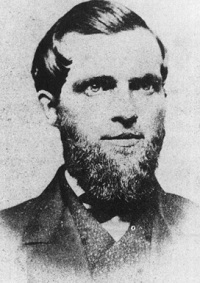


 The hanged man was a native Cree known as
