1891: The Namoa pirates

On this date in 1891, Chinese authorities beheaded 15 at Kowloon, including the leaders of the then-notorious Namoa pirates.

They were nicknamed for the steamer they had infamously commandeered six months before. The tale is related by an English maritime official’s orientalist (and now public-domain) memoir, The Mystic Flowery Land:

The most daring and disastrously successful piracy of late years … was the “Namoa” piracy in 1890. The startling news of this outrage created a general feeling of unsafety and consternation among the foreign communities in China, mingled with grief and just resentment for the cold-blooded murder of Captain Pocock and Mr. Petersen, both most popular and respected men, the latter being a member of the Customs Service.

On Sunday, the 3rd of December, 1890, the Douglas, Lapraik, and Co‘s coasting steamer, “Namoa,” commanded by my late most esteemed friend Capt. Pocock,* left Hongkong at noon, bound on her usual trip up the coast to Swatow, Amoy, and Foochow with several European and a large number of Chinese passengers, most of the latter being Fuhkien people returning to their native homes after many years absence in the United States and California, each with his little hoard of hard-earned dollars, gained by a small lifetime of frugal toil and self-denial in a distant land. These poor men were nearing their well-remembered haunts of earlier days, to once more spend among the relations and friends of their youth the fast-approaching New Year.

Several Chinese passengers [during the voyage] came up out of the main between-decks and walked about for some minutes in a seemingly aimless manner; then others emerged from the hatch, until there were between forty and fifty on deck — some forward near the hatchway leading down to the junior officers’ mess, others near the bridge ladder and entrance to engine-room and stokehole, and the rest at the main hatchway, saloon entrances and after skylight.

Suddenly, at a given signal, off came their loose outer garments, and these harmless-looking passengers were armed men; each with a cutlass and two revolvers in hand, and at their appointed stations.

The ship was now entirely in the hands of the pirates, whose leader placed one of the gang at the helm, with directions to steer a certain course.

The attack had been planned and carried out with consummate tact and forethought, for the pirates were old hands — desperate scoundrels … two or three ventured below … among their terror-stricken countrymen, and ransacked their luggage, robbing them of their treasured packets of dollars, saved during long and lonesome years of comparative exile and drudgery. Every cent was taken from these poor fellows, who wept in vain, and heart-rending scenes ensued. But the wretches took all.

Then [the European passengers] were all driven into the captain’s little berth, which was barely large enough to hold them all, where they were nearly suffocated.

At this point, the pirates steam off to rendezvous with their confederates, transfer their persons and their booty to the getaway ships, and — after debating whether to burn the Namoa — instead abandon the ship unsunk and the hostages unkilled.

These put the ship to rights and got it back to Hong Kong.

Public indignation was great, and considerable pressure was brought to bear on the Chinese Government to bring the pirates to justice. Skilled foreign and Chinese detectives were sent out on their track, doggedly determined to run these criminals to earth and make them pay the full penalty of their dastardly deeds.

… most, if not all, of these notorious crime-hardened criminals were eventually brought to justice, suffering decapitation outside Kowloon city, the majority of them being executed on Monday, April 17th, 1891, and the remaining nineteen on Thursday, 11th May, of the same year.**

The pirates were such big news that posed photos were taken of their public executions. (Both images are detail views; click for the full picture.)

For some time great precautions were taken by the captains and officers of coasting steamers to search the luggage of all native passengers, and thus guard against a similar catastrophe.

* Captain Thomas Guy Pocock was killed by the pirates, and has a private memorial in Hong Kong Cemetery (aka Happy Valley Cemetery). He left a one-year-old son who died in World War I.

** According to a tome on legal administration in Hong Kong, the pirates were beheaded in batches mixed in with other criminals.

A wholesale execution took place at Kowloon City on the 17th April, 1891, when nineteen pirates were decapitated, thirteen of them for participating in the Namoa and other piracies, and six others for various offences in Chinese territory … on the 11th May fifteen more prisoners were beheaded at Kowloon by the Chinese authorities, amongst the number being six Namoa pirates, including the three leaders of the gang, one of the men being the captain of the junks on board which the pirates put their plunder … One of the leaders decapitated, named Lai A Tsat, was a man whose boldness and cunning in carrying out piracies had long made him a terror both at sea and on shore.

On this day..

1618: Walter Raleigh, age of exploration adventurer

On this date in 1618, schemer, explorer, and lover Walter Raleigh fell permanently out of favor.

One of the biggest wheels of Elizabethan England, Raleigh (who also rendered his name Rawleigh, Rawley, and most commonly, Ralegh) charmed his way into the Queen’s inner circle, and possibly her pants, and was even thought to be a contender for her hand.

In between gorging on royal monopolies, scribbling poetry, popularizing tobacco, and introducing the potato to Ireland [allegedly], Raleigh got his New World on by attempting to colonize Virginia,* helping fund it with privateering operations against England’s rivals in the land-grab game. The city of Raleigh, North Carolina — present-day North Carolina was part of the Virginia Colony back in the day — is named for him.

Proud, powerful, and the queenie’s pet. Just the sort of courtier other noble suckups loved to hate.

When the palace fave secretly dallied with one of the Queen’s ladies-in-waiting, he went on the royal outs and got real familiar with the Tower of London. Though he managed to patch up with Elizabeth, things were never quite the same for Sir Walter. Elizabeth’s successor James I put him back in prison (suspending a death sentence) for supposedly participating in the Main Plot.

Raleigh passed the time under lock and key burnishing his Renaissance man rep by writing various poetry and treatises, including an account of his voyage to Guyana. Convinced the legendary city of El Dorado was in the vicinity, Raleigh eventually prevailed upon James to release him to make another run at it.

But a dust-up with a Spanish outpost in South America left his son dead, and the Spanish ambassador hopping mad. Raleigh was arrested upon his return, and the death sentence reinstated.

At 66 years of age or so, Walter Raleigh had had a pretty good run.

He took his punishment with equanimity, writing tenderly to his wife, and examining the blade that would take off his head on the scaffold with the observation,

“This is a sharp Medicine, but it is a Physician for all Diseases.”

His wife creepily kept the severed head for the remaining 29 years of her life.

There’s a more detailed tour of Raleigh’s life here, and a site linking many works by and about Raleigh here.

* As Governor of Virginia, Raleigh forbade injuring Indians on pain of death, according to Giles Milton’s Big Chief Elizabeth. Raleigh’s “imperialism with a human face” policy had exchange programs of Indians visiting England, most notably Pocahontas.

On this day..

1407: Chen Zuyi, Zheng He’s prisoner

On an uncertain date this month in 1407, a Sumatran pirate was put to death in Nanking (or Nanjing) to the glory of the Yongle Emperor.

The day’s subject is not the corpse, but Zheng He (also known as Cheng Ho or Ma Sanbao), the Muslim Chinese eunuch-mariner whose early 15th century expeditions to the South China Sea, the Indian Ocean and beyond* pointed the way to a sea-striding colonial future that his country turned its back upon.

On the first of Zheng’s seven expeditions, his enormous fleet did battle with Chen Zuyi, whose own substantial armada based in Palembang controlled the strategic Strait of Malacca.

Five thousand pirates are said to have gone to Davy Jones’ locker in Zheng’s victory; his captured enemy got a ride back to the Chinese capital to be made an example of.

But Zheng’s heroics in this adventure and others did not long outlive the emperor Zhu Di.

He had rivals at court. Enormous treasure ships don’t come cheap, and though they brought back curiosities like giraffes, they didn’t earn back their investment in new tribute; the state budget had competing priorities, while China’s concern with the sea was so overwhelmingly fear of piracy that it all but shut down maritime activity for a time.

Though the pat story of Chinese isolationism might be a tad overstated, hindsight from New World locales with Spanish or English or French names rather than Chinese ones still can’t help but see the aborted age of discovery as a turning point.

An enormous, wealthy, centralized state on the rim of the Pacific Ocean, with the baddest seafaring flotilla around. If you had to pick the world’s probable leading colonial power of the coming centuries, you’d probably have put your money on China in October 1407.

Chen Zuyi sure would have.

* To America ahead of Christopher Columbus? To Italy to launch the Renaissance? To 1955 to inspire Chuck Berry? Hey, whatever pays the bills.

Point. Counterpoint.

On this day..

1860: (William) Walker, Nicaragua Ranger

On this date in 1860, a kid from Tennessee who had made himself President of Nicaragua got his grateful subjects’ comeuppance in the form of a fusillade.

It was westward the wagons that first bestirred the pioneering blood of William Walker, a scion of privilege with an Ivy League medical degree, who uprooted for San Francisco in 1849.

But the “grey-eyed man of destiny” had an altogether grander gold rush in mind, as he stared pensively into the middle distance.

The air was fervid with Manifest Destiny, and most Americans reckoned that the entire hemisphere was its rightful Manifestation. In a time when private settlers effected the statecraft of conquering the Great Plains, was it really any crazier for Walker to fancy privately conquering some distracted European power’s American colonies?

Walker was one of — soon to be the most famous of — a whole class of such characters: filibusters, a word etymologically rooted in piracy but now claimed by the bustling ranks of soldiers of fortune with private militias bent on detaching some parcel of land from south of the border, for money or glory or what have you.*

Oh, and “what have you”? That means slavery.

Nicely dovetailing the individual spur to derring-do, the South’s structural impulsion to expand slaveholding territories to maintain political parity encouraged — and often bankrolled — filibuster adventuring.

It is to these unwholesome fellows that the United States likely owes its sovereignty over Texas, which was pelted with Anglo filibustering expeditions in the early 19th century, helping set the table for the revolution that severed the Lone Star state from Mexico; arguably, the Texas Revolution itself was a (fantastically successful) filibuster.

So Walker had the glittering destinies manifest before his grey eyes when he put off the white collar career to play soldier. After an abortive 1853 attempt to set up his own country in Mexico’s Baja California — a jury instantly acquitted him of waging war on a neutral power; filibustering, and damn near anything that promised America more Manifestly Destined land, was as popular as it was illegal — Walker moved on war-torn Nicaragua under the guise of a “colony”. With a few hundred men, he was able to conquer the capital and set himself up as head of state.

Who knows whether he could have had a future if he’d done it differently. In the actual fact, he wasn’t as hot an administrator as his ego might then have been telling him. He revoked Nicaragua’s anti-slavery edicts, of course; though this sparked resistance, more damaging may have been revoking a Vanderbilt trade concession and bringing a tycoon into the private warfare game on the opposite team.

Cornelius Vanderbilt-backed opponents drove Walker out of Nicaragua in 1857. Not knowing when he was beat, the ex-Presidente kept knocking around stateside piecing together several expeditions, each sadder than the last … until in 1860, when a landing at Honduras collapsed, and he surrendered himself to a British (rather than American) officer. Europeans with colonies to exploit didn’t have much use for filibustering, and Walker had made everyone nervous by openly aspiring to conquer Nicaragua’s neighbors — including British assets. Rather than return him home where he could continue scheming to meddle in the future canal zone, the Brits handed him over to the Hondurans, who stood him in a court-martial, then stood him up against a wall.

Alex Cox (Repo Man) turned this bizarre biography into a film, back when Ronald Reagan’s filibusters narco-terrorists “moral equals of our founding fathers” were having their own unofficial way with the country Walker once governed:

And for a corner of Americana little-known to most in the U.S. — well, the colorful, nigh-unbelievable quality of the action has overridden its obscurity when it comes to the written word.

Various books about William Walker and Filibustering

* More familiar for most Americans is “filibuster” as a legislative maneuver — refusing to yield the floor during debate to forestall the passage of a bill. Not surprisingly, this usage came online at the same time mercenary filibusters were active, and proceeds from the word’s original sense of “piracy”.

On this day..

1726: William Fly, unrepentant pirate

On this date in 1726, an obscure boatswain who had mutinied for the liberty of piracy succumbed but did not submit on the gallows in Boston.

Fly overthrew (figuratively and literally — they both ended up in the drink) a tyrannous captain and first mate on a British slave ship in May, reconstituting it Fame’s Revenge, and in a northward journey from North Carolina to New England captured a few less-than-lucrative ships in a month and change.

A minor character in the annals of seaborne pillage. So why should historian Marcus Rediker devote the opening chapter to his Villains of All Nations: Atlantic Pirates in the Golden Age (review) to this man?

[T]he early-eighteenth-century pirate ship was a world turned upside down, made so by the articles of agreement that established the rules and customs of the pirates’ alternative social order. Pirates “distributed justice,” elected their officers, divided their loot equally, and established a different discipline. They limited the authority of the captain, resisted many of the practices of capitalist merchant shipping industry, and maintained a multicultural, multiracial, and multinational social order. They demonstrated quite clearly — and subversively — that ships did not have to be run in the brutal and oppressive ways of the merchant service and the Royal Navy.

Rediker’s sympathetic but unromantic work treats the radical, doomed sphere of resistance pirates offered to the enormous cruelty of the developing Atlantic economy: grinding exploitation of white sailors in the service of the black slave trade under the iron hand of the empire (British, in this case, but hardly exclusive to Old Blighty.)

It bears the trace of Hakim Bey‘s treatment of Temporary Autonomous Zones:

Fleeing from hideous “benefits” of Imperialism such as slavery, serfdom, racism and intolerance, from the tortures of impressment and the living death of the plantations, the Buccaneers adopted Indian ways, intermarried with Caribs, accepted blacks and Spaniards as equals, rejected all nationality, elected their captains democratically, and reverted to the “state of Nature.” Having declared themselves “at war with all the world,” they sailed forth to plunder under mutual contracts called “Articles” which were so egalitarian that every member received a full share and the Captain usually only 1 1/4 or 1 1/2 shares. Flogging and punishments were forbidden — quarrels were settled by vote or by the code duello.

Certainly many men (and women) turned to piracy for many different reasons. Rediker’s work on the systematic brutality in the guts of the imperial economy and the pressures of resistance and coercion they spawned finds an outstanding individual exponent in this day’s victim.

Fly walked indifferently to the gallows; to the astonishment of the spectators, he upbraided the hangman’s poor knot and remade with his own hands the instrument for his own neck — one last use of his seaman’s proficiency with ropes.

On Fly’s turn upon that fatal stage, he would not read from the classics — not cower before his executioners, not salute the majesty of the crown that hung him, not enjoin the mob to straighten up and sail right, and certainly not be cowed on the cusp of the eternal by officious colonial holy roller Cotton Mather’s vain personal bid to convert the corsair:

When the time came for last words on that awful occasion, Mather wanted Fly and his fellow pirates to act as preachers — that is, he wanted them to provide examples and warnings to those who were assembled to watch the execution. They all complied. Samuel Cole, Henry Greenville, and George Condick [three of Fly’s crew], perhaps hoping for a last-minute pardon, stood penitently before the crowd and warned all to obey their parents and superiors and not to curse, drink, whore, or profane the Lord’s day. These three pirates acknowledged the justice of the proceedings against them, and they thanked the ministers for their assistance. Fly, however, did not ask for forgiveness, did not praise the authorities, and did not affirm the values of Christianity, as he was supposed to do, but he did issue a warning. Addressing the port-city crowd thick with ship captains and sailors, he proclaimed his final, fondest wish: that “all Masters of Vessels might take Warning by the Fate of the Captain (meaning Captain Green) that he had murder’d, and to pay Sailors their Wages when due, and to treat them better; saying, that their Barbarity to them made so many turn Pyrates.” Fly thus used his last breath to protest the conditions of work at sea, what he called “Bad Usage.” He would be launched into eternity with the brash threat of mutiny on his lips.

“Bad Usage.” Rediker later defines it as “the violent disciplinary regime of the eighteenth-century deep-sea sailing ship, the ordinary and pervasive violence of labor discipline as practiced by the ship captain as he moved the commodities that were the lifeblood of the capitalist world economy.”

The resistance to a pattern of savage floggings, cheated wages, and the whole spectrum of rough and arbitrary authority on a shipboard dictatorship might be spontaneous and individual in the instant … but it was thick with the stuff of solidarity, and the fraternity of outlawry could make people equal across the boundaries of national rivalry and institutional racism — “Villains of all Nations,” as the title goes.

And the obdurate, like Fly, could every now and then move the pastors who were sent to thunder hellfire at them rather than the other way around.

As it happened, the “stupid” and “impenitent” pirate [Mather uses these words to describe Fly elsewhere] was able to convince the self-righteous minister of at least one primary cause of piracy. During his execution sermon, Mather made it a point to address the ship captains in the crowd, telling them in no uncertain terms that they must hereafter avoid being “too like the Devil in their Barbarous Usage of the Men that are under them and lay them under Tempations to do Desperate Things.”

After the hanging, William Fly’s body was gibbeted as a warning on Nixes Mate, a barely-there speck of an island at the mouth of Boston Harbor. For Rediker, this date marks the end of the Golden Age of Piracy.

Although the full book is worth the buy, a paper Rediker wrote on the subject prior the book’s publication is available free online.

Part of the Themed Set: Embarrassed Executioners.

On this day..

1720: Charles Vane, an unsinkable pirate

On this date in 1720, Charles Vane’s resilient pirate career finally came to the end of a noose.

Like his onetime lieutenant Calico Jack Rackham, Vane plundered the American coast and the Caribbean during the twilight heyday of the buccaneer.

The man had a gift. From 1716 to late in 1718, Vane looted dextrously, even boldly spurning a royal pardon the better to keep his loot and mounting a flamboyant escape from the armada subsequent sent to detain him.

If he had a weakness, it was not as a mariner but as a manager. A notoriously tyrannous captain, Vane saw one aide turn on him and escape with a ship and a second — the aforementioned Rackham — mount a seaborne coup after Vane judiciously refused to engage a larger French man-o-war.

Nothing daunted by the loss of his command, Vane set about rebuilding his fortunes by resuming the conquest of prizes. Little could he see that the day of piracy was fast drawing to a close, and his own hourglass running faster still.

For all the catastrophes visited on him by his confederates, it required the connivance of nature to do him in. Early in 1720, a hurricane obliterated his ship (and most of his crew); tough old Vane managed to wash up on a deserted island* … but was recognized by his “rescuers” and delivered up to the British governor of Jamaica, who strung him up within the week.

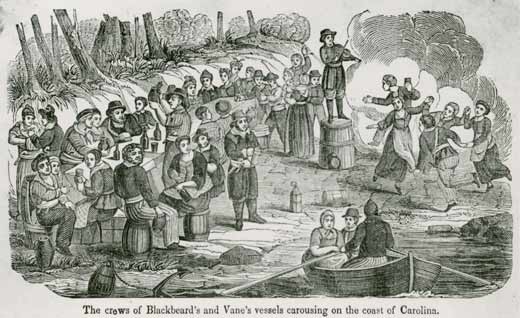
* Straight out of piracy central casting, no? Would you also believe his crew had a renowned “pirate party” rendezvous with Blackbeard’s?

On this day..

1720: Captain John “Calico Jack” Rackham

On this date in 1720Nov. 18, 1720, the pirate captain “Calico Jack” Rackham was hanged together with his crew by the British governor of Jamaica.

Nicknamed for his flamboyant clothing, the Bristol-born buccaneer plundered the West Indies during the “Golden Age of Piracy”, having ousted his former captain Charles Vane. Rackham is chiefly remembered to history for two who were not hanged with the rest of his crew: Anne Bonny and Mary Read, rare female pirates who served aboard Rackham’s ship.

Immortalized by Daniel Defoe in his pseudonymous A General History of the Pyrates, Bonny and Read came to piracy by different paths but were both every bit the part and leaders aboard their ship — “very profligate, cursing, and swearing much, and very ready and willing to do any Thing on board.” Bonny, at least, was Rackham’s lover — having eloped with him from her husband.

Upon capture, both women “pleaded their bellies” to escape the gallows, and though it’s unclear whether either really was pregnant, it seems the gambit spared both from execution.

Read died in prison shortly after, while Bonny vanished from history — prompting speculation that she had escaped, secured a pardon, been ransomed by her wealthy father, and/or returned again to piracy under a different guise. Reportedly, she castigated Rackham at their last meeting in prison for lying drunk below decks while only the women resisted the capture of their ship: “I am sorry to see you here Jack, but if you had fought like a man, you need not be hanged like a dog.”

As the world’s best-known women pirates, Bonny and Read are recalled as anything from sexualized historical curios to action heroines to proto-feminists.

They feature in Disneyland’s “Pirates of the Caribbean” ride, the Witchblade comic book series, utopian theorizing, popular history … and the occasional action figure.

Update: A much more detailed foray into the lives of these daring women is at Scandalous Women.

Also, I posted this under the wrong date: it should be Nov. 18. Balls.

On this day..