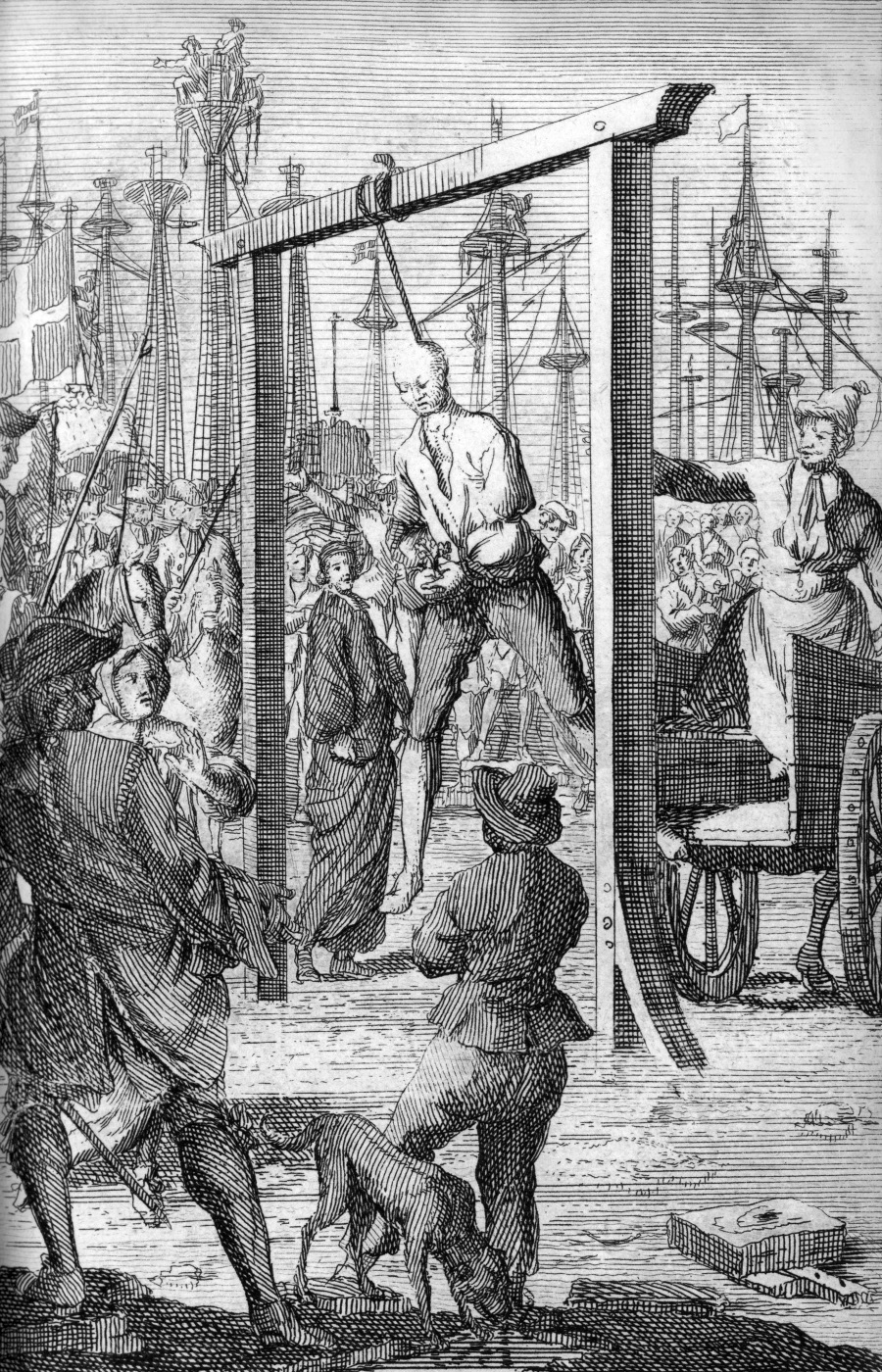
1721: John Stewart, pirate

THE LAST SPEECH AND DYING WORDS,

Of John Stewart, who was executed within the Flood-
Mark at Leith, upon the 4th January 1721, for
the Crime of Piracy and Robbery.

UPON the 28 Day of March, one Thousand seven Hundred and Ninteen Years ; I Sailed from Dartmouth in England, in the Ship, called, the Mark de Campo, belonging to Ostend, Captain Mathias Garribrae Commander, in Order to make a Voyage to Guinea, and Mosambequie in the East-Indies; and having in some short Time thereafter arrived upon the Cost of Guinea; We hapned to our sad Misfortune upon the 2d Day of June next, thereafter, to be taken by a Pirate Ship, commanded by Captain Davies;* after we had made what Resistance we could, they compelled me and several others out of our Ship to go along with them; and upon our Refusal threatned to puts us immediatly to Death, or leave us upon some Desolate Island, which was nothing better than Death; and I refer it to every ode to Judge, whither or not any Man would have preferred immediat Death to go along with them, while there remained some Hopes of making an Escape, which I and those that were taken with me still endeavoured, and made several Attemps to Effectuat.

And I do solemnly Declare as a dying Man, that whatever I did while I was Aboard of the Pirate Ship, was by Force, and upon the Peril of my Life; and that I and these taken With me, are not only Innocent of What is laid to our Charge, but during the Time We Was Aboard of them, I never seed them wrong Man, Woman or Child; and I with several others having at last made our Escape, We Sailed for Britain, with no other Design but to free and clear our selves from the Tyranny of those Pirates, that had detained so fair contrary to our Inclinations; and having landed in the West of Scotland, every Body knew how we have been treated since that Time, and I might have purchast my Life, had my Conscience allowed me to Comply with the Sollicitation of them, who would have had me appear as an Evidence against those that were as Innocent as my self, but I never could think of Saving my Life at so dear a Rate.

And for the Judge and Jury I shall not Reflect on them, but do declare that I am Innocently put to Death, as to the Crimes for which I am condemned; And beg GOD Almighty that he may not lay this Innocent Blood to their Charge, but forgive them as I do. And begs GOD may forgive my other Sins, (through the Merits of JESUS CHRIST my only Redeemer) which has been the Cause of this Dismal Death.

Into thy Hands, O GOD, I recommend my Spirit.

EDINBURGH, Printed by Robert Brown in Forrester’s-Wynd, 1721.

(From the National Library of Scotland’s Digital Library here.)

Okay, couldn’t pass on that name.

The Daily Show With Jon Stewart Mon – Thurs 11p / 10c
The Buccaneer Stops Here
www.thedailyshow.com
Daily Show Full Episodes Political Humor & Satire Blog The Daily Show on Facebook

* Stewart apparently refers to the Welsh buccaneer Hywel Davies, aka Howell Davis, and this story of hijacking would put Stewart in some pretty august company: it was approximately this time and area that the Davies crew captured the slave ship Princess carrying third mate Bartholomew Roberts, who was pressed into navigational service for the freebooters.

Davies was killed in another pirate adventure later that same month of June 1719, and Roberts was elected to succeed him despite being only a few weeks aboard the ship. The latter went on to one of the most illustrious raiding careers in the Golden Age of Piracy … the original Dread Pirate Roberts.

On this day..

1718: Stede Bonnet, gentleman pirate

On this date in 1718, the Barbados buccaneer Stede Bonnet was hanged for piracy in Charleston, S.C.

Bonnet had few of the typical swashbuckler’s resume-builders during this Golden Age of Piracy: he was neither a mariner by trade nor a desperate outlaw by circumstance, but a wealthy English landowner in Bermuda.

“He had the least Temptation of any Man to follow such a Course of Life, from the Condition of his Circumstances,” wrote the pseudonymous author (alleged to be Daniel Defoe) of A General History of the Pyrates. But as age thirty hove into view and the seven-year itch demanded scratching, Bonnet undertook an abrupt career change “said to have been occasioned by some Discomforts he found in a married State.”

Bonnet’s version of a cherry-red convertible was a six-gun sloop named Revenge,* which he tricked out from his ample inherited fortune and took cruising for action on the North American coast.

Or, just get this Victorian satire free from Google books.

He raided from New England to the Carolinas, fell in with Blackbeard (which more credible cutthroat charismatic promptly appropriated Bonnet’s hireling** crew), lost his ship, got it back, turned himself in, got a pardon … the rich guy packed plenty of adventure into little more than a year of raiding, but he never seems to have advanced his freebooting skills past the “gentleman hobbyist” level.

South Carolina ships captured Bonnet near Cape Fear, which is actually North Carolina, but never mind: South Carolinians well remembered this character from his involvement with Blackbeard’s recent blockade of Charleston.

Bonnet got gentleman’s quarters upon detention, and his elite education enabled him to favor the colony’s governor with a simpering plea for clemency.

Honoured Sir,

I have presumed, on the Confidence of your eminent Goodness, to throw my self, after this manner, at your Feet, to implore you’ll graciously be pleased to look upon me with tender Bowels of Pity and Compassion; and believe me to be the most miserable Man this Day breathing: That the Tears proceeding from my most sorrowful Soul may soften your Heart, and encline you to consider my dismal State …

if I had the Happiness of a longer life in this World … I’ll voluntarily put [wickedness] ever out of my Power, by separating all my Limbs from my Body, only reserving the Use of my Tongue, to call continually on, and pray to the Lord, my God, and mourn all my Days in Sackcloth and Ashes to work out confident Hopes of my Salvation …

Good grief.

All of which pathos was unwisely belied by an escape attempt which made pardon completely untenable.

Most of Bonnet’s captured crew was hanged en masse on Nov. 8; Bonnet managed to drag on several stays of execution before he followed them from his comfortable digs to the common gallows. A stone monument marks the spot.

* There were many pirate ships Revenge, including that of famous women pirates Anne Bonny and Mary Read and that of the Dread Pirate Roberts. There’s also a band “The Pirateship Revenge”.

** Bonnet paid his crew out of his own pocket, a practice at odds with the more egalitarian pirate norm of crews taking like shares and choosing (or demoting) their own captains.

On this day..

1401: Klaus Stortebeker, Victual Brother pirate

On this date in 1401,* “Victual Brother” Klaus Störtebeker was beheaded in Hamburg.

Statue of Klaus Stortebeker. (cc) image from blariog

This legendary freebooter terrorized the Hanseatic League‘s trading channels from Novgorod to London in the 1390s.

He was the most famous of a company of privateers who’d been hired out in 1392 to place their thumb on the scale of Scandinavian dynastic politics** — notably, supplying Stockholm during a siege, from which service they obtained† the nickname Victual Brothers. It stuck, even when operations had moved far beyond the larder.

In the mid-1390s, the “brothers” turned against Danes and Hanse alike, raiding coasts and plundering sea trade from their base in the shattered port of Visby.

Klaus, the most famous of them, is still remembered today “like Che Guevara, a freedom fighter, but also like Robin Hood, because he fights the rich in the name of the poor”:‡ folk hero-outlaws, men of the pirate utopia.

Whatever debunking that legend might invite, its existence speaks to that timeless romance of the road. And then there’s that kernel of truth, or so one hopes: after Stortebeker’s death, the remnants would persist as the Likedeelers, “those who share equally.”

The buccaneer’s end, after capture by Simon of Utrecht, was equally legendary: he’s supposed to have made a scaffold pact with the headsman to spare any of his mates he could walk past once decapitated.

Rising from the chop like St. Denis, the headless trunk of Stortebeker lurched past 11 of them before the executioner himself tripped it up. (In the most embroidered version of this story, Hamburg not only didn’t honor the promise, it executed the executioner when all was said and done. But we’re pretty comfortable saying that once we reach the headless zombie pirate part of the story, the reader has carte blanche to rewrite anything not to liking.)

Drink up me hearties yo ho! “Stortebeker” itself just means, “quaff the mug.”

Klaus Störtebecker is our master
advised by Godeke Michels!
Shoot through the waves like storm, just faster
The Flying Dutchman’s godfather
Gaffer is the ships goblin
Let’s tackle, crew!
Life is bauble!
We are the hell of Helgoland

Our bloody flag is cracking the mast
Rats scurrying on the floor
A skeleton is our guest
On the sail there are strange shadows
The mermaid is swimming in our wake
Laugh, crew!
Life is bauble!
Still ruling is the hell of Helgoland

And when our ship makes its last run
Laugh while like a coffin she goes down
We die an ancient pirate’s way
Today we fight, tomorrow we drown
In green algae and white sand
Land ho, crew, land!
Life is bauble!
Such dies the hell of Helgoland

-Folk song honoring Klaus Stortebeker
(translated here)

* As often for events at this distance of time, the dates are a little bit shaky; 1400, rather than 1401, has been proposed for the actual year of Stortebeker’s execution; October 21 rather than October 20 is also given on some sites. Folklore more so than almanac blogs has the luxury of indifference to such particulars.

** The Victual Brothers were initially retained to oppose the adroit Danish Queen Margaret. She would face (and brush aside) even weirder challenges to her rule en route to lashing together the Kalmar Union under Danish regional hegemony.

Alternate explanation: food-based euphemisms for piracy trace to armies’ victual officers, and their unscrupulous methods of filling the mess hall.

‡ In a continuing spirit of democratic larceny — or as a gang symbol for the local Hell’s Angels, whatever — our man’s alleged skull was stolen from a Hamburg museum earlier this year.

On this day..

1582: Philippe Strozzi, corsair

On this date in 1582, Philippe Strozzi, the Florentine-born commander of a French naval expedition against the Spanish was summarily executed as a pirate.

The Strozzi were long one of Florence’s wealthy and powerful families, as evidenced by, say, the Strozzi Palace, or the Strozzi coat of arms on Michelangelo’s Doni Tondo.

That made the Strozzi sometime-allies, sometime-rivals* of Florence’s more famous powerbrokers, the Medici. It is in both capacities that we meet Philippe (English Wikipedia entry | Italian | French).

To cut a centuries-long story short, the Strozzi had basically come out on the wrong side of the power struggle in the 16th century.

Philippe’s father, Piero Strozzi, was the child of a Strozzi-Medici union, and Piero too married a Medici. He also fought the Medici for power and ended up in exile whereupon he gravitated to the French court of … Catherine de’ Medici. (Catherine had been educated at the home of Philippe’s grandfather, Filippo Strozzi.) Catherine then turned around and used Piero as a French Marshal, including sending him to back Tuscan city-state Siena in opposition to its (and France’s) rival, Florence.**

Your basic tangled geopolitical-genealogical web.

Bottom line, Piero’s son Philippe was born in Florence but grew up Gallic, and fought in the French army all over the continent from the time he was a teenager.

When France got involved in the War of Portuguese Succession, they put this warlike fellow aboard a boat and sent him to dispute Spanish King Philip II‘s attempt to claim the Portuguese throne and unify the Iberian peninsula.

Strozzi’s armada got its clock cleaned at the naval Battle of Ponta Delgada near the Azores, with devastating loss of life.


The Spanish galleon San Mateo, which did yeoman service at this battle.

Since Spain and France were putatively at peace, Spain treated its captives not as prisoners of war but as pirates, and proceeded to execute several hundred in Vila Franca do Campo. Strozzi didn’t even get that much ceremony, however; the day after the battle, he was mortally stabbed, then tossed into the waves.

Happily, the name and the fame of the Strozzi outlived Spanish justice. In the next century, a distant relative by the handle of Barbara Strozzi became one of the most renowned composers of Baroque vocal music. (As befits wealthy Italians of the Renaissance, the Strozzi were big on the arts; Philippe was supposed to be a fine musician himself.)

* The Strozzi-Medici conflict frames the action in the play Lorenzaccio, in which the titular Brutus-like character mulls assassinating the Medici dictator in order to restore the Republic, only to find no such restoration in the offing once he actually does the deed; the father and grandfather of our day’s protagonists are both principal characters.

** That didn’t work. Strozzi was trounced at the Battle of Marciano, which signaled the permanent demise of the ancient city-state‘s independence.

On this day..

1704: John Quelch, pirate

On this date in 1704, John Quelch was hanged on a Boston wharf for piracy.

Quelch had re-appeared in New England less than a year after hastily absconding with a new privateering vessel while the owners tried to sort out the captain’s sickness.

(The captain suspected his crew were up to no good, but the mutineers locked him in his cabin and set sail before the investors could act on the information. The ill captain died at sea and was pitched overboard — in what order, no one can say.)

The privateer Charles had been tricked out and licensed to raid French shipping off Newfoundland, but the avaricious mutineers saw much better buccaneering prospects preying on the gold-laden Portuguese possessions in South America.

One small problem: Portugal had formed an alliance with England.

So when the Charles re-appeared, heavy with the sort of mineral wealth not to be found in North America, authorities could not fail to notice that its crew

Have lately Imported a considerable Quantity of Gold dust, and some Bar and coin’d Gold, which they are Violently Suspected to have gotten & obtained by Felony and Piracy, from some of Her Majesties Friends and Allies …*

This all looks very neat on the legal docket (and it certainly did to the jury-less Admiralty court, the first time this instrument had been used outside of England), except that pirates and piracy were far more integrated into the fabric of the colonial frontiers than their desperado reputation might suggest. Pirates shifted in and out of their outlaw careers; even the strictly law-abiding colonists traded knowingly with these freebooters. Certainly some momentary mutual convenience between London and Lisbon for reasons of continental politics was very far from most colonists’ scope of care.

John Quelch seems to be among those operating in the grey economy, and in this case bringing “gold and silver to specie-starved colonial economies.”**

Hunger for hard currency in an environment of wartime depreciation of various sketchy paper notes helps explain why Quelch’s trial raised hackles in New England. Here were men who had by dint of enterprise and adventure plucked nearly 1,000 pounds of gold from faraway Brazil and hauled it back home to New England, honestly paid out the shares to the crew and gone to settle up with the privateering syndicate’s financiers.

And the high-handed English governor Joseph Dudley responded by clapping them in irons and trying them for their lives, using a dubiously legal and heretofore unprecedent drumhead military tribunal at which Dudley himself presided while his son† prosecuted.

It’s a nice setup for winning convictions, which is exactly what happened.

In the process, Dudley blew through a good portion of the pirates’ confiscated booty, making it rain for “Stephen North, who kept the Star Tavern in which the trial was held, for entertainment of the Commissioners during the sitting of the Court of Admiralty” and that sort of thing. If a later denunciation circulated by Cotton Mather is to be believed, the Dudleys did not scruple to wet their own beaks, either.

There have been odd Collusions with the Pyrates of Quelch’s Company, of which one instance is, That there was extorted the sum of about Thirty Pounds from some of the crew for liberty to walk at certain times in the prison yard. And this liberty having been allowed for two or three days unto them, they, were again confined to their former wretched circumstances.

(The rest of the cash went neither to the privateer’s investors nor back to the aggrieved Portuguese, but was shipped to English mints under the capable administration of Isaac Newton.)

Little wonder at the unrepentant Quelch’s parting shot on this date.

Sarcastically interrupting one of his five fellow-sufferers’ bog-standard scaffold injunction against running with a bad crowd, Quelch urged the throng of onlookers to better “take care how they brought Money into New-England, to be Hanged for it!”

Their bodies remained gibbeted in the harbor.

In Quelch’s Gold: Piracy, Greed, and Betrayal in Colonial New England, Clifford Beal argues that Quelch’s trial marked the onset of an official crackdown on pirates that would drive these formerly semi-legitimate operators further underground and therefore into greater violence. He even suggests, at a bit more of a stretch, that Quelch’s case presaged the colonial resistance to the mother country’s political and economic dictates that would later blossom into the American Revolution.

As for the gold, much of it was not recovered in 1704. Legends to the effect that it remains stashed on New Hampshire’s Star Island continue to attract treasure hunters.

* From the proclamation of Quelch and his crew‘s arrest, quoted in Pirates of the New England Coast, 1630-1730.

** Villains of All Nations: Atlantic Pirates in the Golden Age, by Marcus Rediker.

† That son, Paul Dudley, later endowed a still-extant lecture series at Harvard University — the oldest endowed lectureship, even though (or rather because) the donor’s intention that it be directed “for the purpose of detecting and convicting and exposing the Idolatry of the Romish church” was eventually neglected.

On this day..

1865: John Yates Beall, well-connected Confederate

On this date in 1865, Confederate John Yates Beall was hanged at Governors Island, New York, as a spy and saboteur.

This Virginian was knocked out of regular service through injuries early in the Civil War, but proceeded to a privateering career harassing Union shipping.

The pinpricks inflicted by Beall’s couple of ships was hardly calamitous for the North, but what he lacked in resources he made up in persistence.

Captured and exchanged midway through the war, he returned to his swashbuckling ways. But sneaking into New York from Canada in a bid to free rebel prisoners, Beall was caught again trying to derail trains — and secretly condemned by a military tribunal.

When the news of his impending execution got out, six Senators and 85 other members of Congress* appealed for leniency.

Despite Lincoln’s reputation for clemency, he did not grant it in this case.

“For days before the execution,” it was said, “the President closed the doors of the executive palace against all suppliants, male or female, and his ears against all appeals, whether with the tongue of men or angels in behalf of the unfortunate prisoner. From the first Mr. Lincoln had responded to all applications for his interposition — ‘Gen. Dix may dispose of the case as he pleases — I will not interfere.’ Gen. Dix on his part replied, ‘All now rests with the President — as far as my action rests there is not a gleam of hope.’ Thus they stood as the pillars of the gallows, on which Beall’s fate was suspended and between them he died.” (Source)

Here’s the capture-trial-and-execution portions of a homemade documentary on Beall (also check the preceding parts 1, 2, and 3)

There’s a strange tradition that the hanged man was a personal friend of John Wilkes Booth, and that the actor’s assassination of Honest Abe seven weeks after Beall’s hanging was partly motivated by personal revenge.

* One of Beall’s clemency supporters was future assassinated U.S. President James Garfield.

On this day..

1461: Owen Tudor, sire of sires

A Welsh courtier with the boldness to bed the queen lost his head this date in 1461 … but his career in usurpation was just getting started.

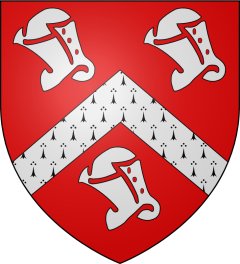
Owen Tudor’s coat of arms.

The House of Tudor that would come to rule England counted Owen its sire; the four-year-old grandson he left at his death grew up to become the first Tudor monarch, Henry VII.

Owen produced the root of this august line with Dowager Queen Catherine of Valois, the French princess Henry V had extracted as part of the price of peace after Agincourt.

That union was supposed to join the two great realms, but Henry V unexpectedly kicked the bucket in 1422, leaving an infant son who was not only unable to hold the French throne … he was too unstable to hold the English throne, either.

Unless he was a seer, suave Owen must not have been thinking dynasties when he took the Queen as his lover (and eventually his wife via a secret marriage in the early 1430s).

They produced six children, but it wasn’t the bedroom politics that did our prolific father in, at least not directly. Only decades later, when ownership of the crown was up for grabs in the War of the Roses and Owen loyally led Lancastrian forces at a battle he was unwise enough to lose, did he give up his head for the pedestrian crime of backing the wrong horse.

Owen reportedly thought he had stature enough to expect a reprieve until the very last moment, when the executioner’s ripping his collar caused him to sigh,

The head which used to lie in Queen Catherine’s lap, would now lie in the executioner’s basket.

In time, Owen’s descendants would get to pull the same trick, because the doomed cause in whose service Owen Tudor lost his life swept clear England’s political chessboard and made possible his own line’s accession.

Elizabethan poet Michael Drayton later versified Owen’s prodigious conquest in “Owen Tudor to Queen Catherine”.

When first mine eyes beheld your princely name,
And found from whence this friendly letter came;
Is in excess of joy, I bad forgot.
Whether I saw it, or I saw it not:

My panting heart doth bid mine eyes proceed,
My dazzled eyes invite my tongue to read,
Which wanting their direction, dully mist it:
My lips, which should have spoke, were dumb, and kist it,

And left the paper in my trembling hand,
When all my senses did amazed stand :
Even as a mother coming to her child,
Which from her presence hath been long exil’d,

With gentle arms his tender neck doth strain,
Now kissing it, now clipping it again;
And yet excessive joy deludes her so,
As still she doubts, if this be hers, or no.

At length, awaken’d from this pleasing dream,
When passion somewhat left to be extreme,
My longing eyes with their fair object meet,
Where ev’ry letter’s pleasing, each word sweet.

It was not Henry’s conquests, nor his court,
That had the power to win me by report;
Nor was his dreadful terrour-striking name,
The cause that I from Wales to England came:

For Christian Rhodes, and our religion’s truth,
To great achievement first had won my youth:
Th’ brave adventure did my valour prove,
Before I e’er knew what it was to love.

Nor came I hither by some poor event,
But by th’ eternal destinies’ consent;
Whose uncomprised wisdom did foresee,
That you in marriage should be link’d to me.

By our great Merlin was it not foretold,
(Amongst his holy prophesies enroll’d)
When first he did of Tndor’s name divine,
That kings and queens should follow in our line?

And that the helm (the Tudors ancient crest)
Should with the golden flow’r-de-luce be drest ?
As that the leek (our country’s! chief renown!)
Should grow with roses in the English crown –

As Charles his daughter, you the lilly wear;
As Henry’s queen, the blushing rose you bear;
By France’s conquest, and by England’s oath,
You are the true-made dowager of both :

Both in your crown, both in your cheek together,
Join Tether’s love to yours, and yours to Tether.
Then cast no future doubts, nor fear no hate,
When it so long hath been fore-told by fate ;

And by the all-disposing doom of Heav’n,
Before our births, we to one bed were giv’n.
No Pallas here, nor Juno is at all,
When I to Venus yield the golden ball:

Nor when the Grecians wonder I enjoy,
None in revenge to kindle fire in Troy.
And have not strange events divin’d to us,
That in our love we should be prosperous ?

When in your presence I was call’d to dance,
In lofty tricks whilst I myself advance,
And in a turn my footing fail’d by hap,
Was’t not my chance to light into your lap ?

Who would not judge it fortune’s greatest grace,
Sith he must fall, to fall in such a place ?
His birth from Heav’n, your Tudor not derives,
Nor stands on tip-toes in superlatives,

Although the envious English do devise
A thousand jests of our hyperbolies;
Nor do I claim that plot by ancient deeds,
Where Phoebus pasture his fire-breathing steeds:

Nor do I boast my god-made grandsire’s scars,
Nor giants trophies in the Titans wars:
Nor feign my birth (your princely ears to please)
By three nights getting, as was Hercules:

Nor do I forge my long descent to rim
From aged Neptune, or the glorious Sun:
And yet in Wales, with them that famous be,
Our learned bards do sing my pedigree

And boast my birth from great Cadwallader,
From old Caer-Septon, in mount Palador:
And from Eneon’s line, the South-Wales king,
By Theodor, the Tudors’ name do bring.

My royal mother’s princely stock began
From her great grandame, fair Gwenellian,
By true descent from Leolin the great,
As well from North-Wales, as fair Powsland’s seal.

Though for our princely genealogy
I do not stand to make apology:
Yet who with judgment’s true impartial eyes,
Shall look from whence our name at did first rise,

Shall find, that fortune is to us in debt
And why not Tudor, as Plantagenet?

Nor that term Croggen, nick name of disgrace
Us’d as a by-word now in ev’ry place,
Shall blot our blood, or wrong a Welshman’s name,
Which was at first begot with England’s shame.

Our valiant swords our right did still maintain,
Against that cruel, proud, usurping Dane,
Buckling besides in many dang’rous fights,
With Norway, Swethens, and with Muscovites;

And kept our native language now thus long,
And to this day yet never chang’d our tungue:
When they which now our nation fain would tame,
Subdu’d, have lost their country and their name.

Nor ever could the Saxons’ swords provoke
Our British necks to hear their servile yoke:
Where Cambria’s pleasant countries bounded be
With swelling Severn, and the holy Dee:

And since great Brutus first arrived, have stood
The only remnant of the Trojan blood.
To every man is not allotted chance,
To boast with Henry, to have conquer’d France:

Yet if my fortune be thus rais’d by thee,
This may presage a further good to me;
And our Saint David, in the Britons’ right,
May join with George, the sainted English knight:

And old Caer-merdin, Merlin’s famous town,
Not scorn’d by London, though of such renown.

Ah, would to God that hour my hopes attend,
Were with my wish brought to desired end !
Blame me not, madam, though I thus desire,
Many there be, that after you inquire;

Till now your beauty in night’s bosom slept,
What eye durst stir, where awful Henry kept ?
Who durst attempt to sail but near the bay,
Where that all-conqu’ring great, Alcides lay ?

Your beauty now is set a royal prize,
And kings repair to cheapen merchandise.
If you but walk to take the breathing air,
Orithia makes me that I Boreas fear:

If to the fire, Jove once in light’ning came.
And fair Egina makes me fear the flame:
If in the Sun, then sad suspicion dreams
Phoebus should spread Lucothoe in his beams:

If in a fountain you do cool your blood,
Neptune, I fear, which once came in a flood:
If with your maids, I dread Apollo’s rape,
Who cous’ned Chion in an old wife’s shape :

If you do banquet, Bacchus makes me dread,
Who in a grape Erigone did feed :
And if myself your chamber-door should keep,
Yet fear I Hermes coming in a sleep.

Pardon (sweet queen) if I offend in this,
In these delays love most impatient is:
And youth wants pow’r his hot spleen to suppress,
When hope already banquets in excess.

Though Henry’d fame in me you shall not find,
Yet that which better shall content your mind;
But only in the title of a king
Was his advantage, in no other thing:

If in his love more pleasure you did take,
Never let queen trust Briton for my sake.
Yet judge me not from modesty exempt,
That I another Phaeton’s charge attempt;

My mind, that thus your favours dare aspire,
Shows, that ’tis touch’d with a celestial fire:
If I do fault, the more is beauty’s blame,
When she herself is author of the same;

“All men to some one quality incline,”
Only to love is naturally mine.

Thou art by beauty famous, as by birth,
Ordain’d by Heav’n to cheer the drooping Earth :
Add faithful love unto your greater state,
And be alike in all things fortunate.

A king might promise more, I not deny,
But yet (by Heav’n) he lov’d not more than I.
And thus I leave, till time my faith approve,
I cease to write, but never cease to love.

Aficionados of old tyme history novelizations can also kick back with Owen Tudor: An Historical Romance.

On this day..

1326: Hugh Despenser the Younger, King Edward II’s lover?

On this date in 1326, the power behind Edward II’s throne — and the presumed lover in his bed — was hanged, drawn and quartered and pointedly emasculated in a grisly public execution as the Queen and her lover took control of England.

(Wince.)

The younger Despenser, being carved up in an illustration from Froissart.

Poor King Edward — that’s the swishy princeling gay-baited in Braveheart — would suffer a horrid demise of his own a few weeks later. He’s the one most conveniently read as a gay martyr.

Hugh Despenser the Younger (or Hugh le Despenser) has his fans, but he’s much more likely to be taken for a villain.

An upstart knight who unexpectedly lucked into a jackpot inheritance when his wife’s brother died at Bannockburn — that’s the rumble Robert the Bruce starts at the end of Braveheart — Hugh the younger parlayed his newfound position of feudal magnate into the still better gig of royal favorite.

That job was open because its occupants had a distressing tendency to get dead, a fate obviously ordained for Hugh Despenser as well.

But whereas Edward’s childhood pal Piers Gaveston, the murdered former fave, aroused mostly personal pique among rival nobles, Hugh Despenser meant to use his favor to rule.

Despenser exploited his position to build up his wealth and control the king; with his father (you’ll never guess that he went by “the elder”), he became the de facto if never the de jure ruler of the realm.

At one point, his rivals in the nobility turned the tables and got him exiled. Hugh became a pirate in the English Channel while he maneuvered his way back onto dry land in his customary most-favored-consigliere position.

So although the British barons who wanted Despenser’s head were undoubtedly a distasteful lot themselves, and certainly capable of all manner of depravity in pursuit of their own crass self-interest, it doesn’t take a backwards view of human sexuality to get why Hugh Despenser would raise an early 14th century Briton’s hackles.

But you have to give England this: its politics back then were a damn sight more interesting than you get today. Anyone who uses the term “bloodsport” for the modern electoral charade ought to cross cutlasses with the likes of the dread pirate Despenser.

And it gets better. Meaning, for Hugh Despenser the Younger, worse. Much.

Queen Isabella — that’s Sophie Marceau’s hot-for-barbarian imported princess in Braveheart — became estranged from her Hugh-lovin’ husband,* and established herself back in France with her lover Roger Mortimer.

Then, the lovebirds invaded England.

Edward and Hugh were so unpopular at this point that “their” nobles who should have repelled the incursion went in a landslide for the invading adulterers.

Hugh Despenser’s father had already been hanged for his trouble by the time The Younger was taken; the latter tried to cheat the executioner by refusing all food and drink for days, truly a spartan image of desperate self-mortification in a rough day and age.

When you get a load of the death his royal captors had worked out for him — and which they were obliged to deliver to their starving captive hurriedly in Hereford rather than more ceremoniously back in London — you can understand why. After a perfunctory trial that same morning, they tore the former favorite apart.

Froissart’s rendering:

When the feast was over sir Hugh, who was not beloved in those parts, was brought before the queen and knights assembled; the charges were read to him – to which he made no reply; the barons and knights then passed the following sentence on him: first, that he should be drawn on a hurdle, attended by trumpets and clarions, through all the streets in the city of Hereford, and then conducted to the market-place, where all the people were assembled; at that place he was to be bound on a high scaffold, in order that he might be more easily seen by the people. First, his privates were cut off, because he was deemed a heretic, and guilty of unnatural practices, even with the king, whose affections he had alienated from the queen by his wicked suggestions. His private parts were cast into a large fire kindled close to him; Afterwards, his heart was thrown into the same fire, because it had been false and traitorous, since he had by his treasonable counsels so advised the king, as to bring shame and mischief on the land, and had caused some of the greatest lords to be beheaded, by whom the kingdom ought to have been supported and defended; and had so seduced the king, that he could not or would not see the queen, or his eldest son, who was to be their future sovereign, both of whom had, to preserve their lives, been forced to quit the kingdom. The other parts of sir Hugh thus disposed of, his head was cut off and sent to London.**

It’s reported that Isabella and Mortimer feasted and made merry as they beheld this hideous spectacle. Now that’s bloodsport politics.

Hugh the younger Despenser and his life and times are covered in amazing detail by a couple of active-posting enthusiasts of this particular period who have already been linked elsewhere in this post: the aptly-named Edward II blog (dig his biography of Hugh Despenser, among many other such dramatis personae; also his account of the execution, already cited); and, Lady Despenser’s Scribery (whose entire sidebar is pretty much all about our day’s principal; for the quick tour, see her biography and posts on the “trial” and execution).

* The reason for said estrangement can be situated anywhere one likes along the personal-political spectrum; one recent historical novel speculates (upon no authority but dramatic license) that Hugh raped the queen.

** Remains reportedly discovered last year were speculatively identified as Hugh Despenser’s; the litany of injuries to the body testify to the ghastly death-ritual its owner underwent.

On this day..

1789: Rachel Wall, female pirate

(Thanks to Jonathan Shipley of A Writer’s Desk for the guest post. -ed.)

“Into the hands of the Almighty God I commit my soul, relying on his mercy … and die an unworthy member of the Presbyterian Church, in the 29th year of my age.”

These were the last words of Rachel Wall, on this date in 1789. It was she, whom the Presbyterians must have frowned upon mightily, who was the last woman hanged in Massachusetts and, further, the first noted American-born female pirate.

No walking the plank for her. She was hanged, proven guilty of robbery, by Sheriff Joe Robinson on a beautiful fall day. Her downfall after a brief career with her husband of piracy, thievery and murder? A pretty bonnet.

Rachel, around the age of 16, loved the water. The boats and dockyards always spoke to her. Born on a farm outside of Carlisle, Pennsylvania, it bored her; so, while in Harrisburg, she went to the docks. She was harassed, harangued and attacked by a group of girls. Enter George Wall –- a fisherman and former privateer who served in the Revolutionary War. He saved Rachel from the girls and Rachel, against her devout Presbyterian parents, eloped with him.

They went to Boston where she stayed on as a servant girl while George plundered. He convinced her to join him and his cohorts in piracy. It proved successful, for a time.

Their plan was this: anchor near an island during a storm. When it passed, make their boat appear damaged. When another boat came, Rachel would shout for help. Help would come. They’d then murder the would-be rescuers, steal their valuables, and sink their ship. Those awaiting the unfortunate sailors would think simply that the storm had taken them away, not Mr. and Mrs. Wall. Between 1781 and 1782 they captured 12 boats, murdered 24 sailors and kept around $6,000 in booty for themselves.

Another Brick in the Wall

This plan worked quite well, until September of 1782 when one storm proved too powerful. George Wall and his motley crew drowned. The only survivor was Rachel. She returned to Boston and in the remaining years of her life she became a maid, a petty thief, and possibly a prostitute, stealing from johns as they slept.

Then, the bonnet incident.

One day Margaret Bender, a 17-year-old Bostonian, was minding her own business, walking down the street, a pretty bonnet affixed to her head. Wall, seeing said bonnet, pushed Bender down, stole the bonnet and then tried to rip out the girl’s tongue. Wall ran from the police when they were summoned. She was caught, put in jail and tried on September 10, 1789 for robbery (she copped to her piratical career, but claimed she had never killed anyone). Less than a month later, she hung from the gallows.

Part of the Themed Set: Women Who Kill.

On this day..

1725: John Gow and his pirate crew

On this date in 1725, John Gow and seven comrade raiders hanged for piracy.

Having mutinied to commandeer a merchant vessel in November 1724, Gow managed merely a three-month career of seaboard outlawry* in European waters before an ill-fated landward raid in his native Scotland saw the ship run aground.

Captured, Gow and confederates were hailed to London to stand trial, the captain delaying matters by refusing to plead before the threat of being pressed forced his hand. The inevitable sentence came off a little … unevenly. During the hanging,

[Gow’s] friends, anxious to put him out of his pain, pulled his legs so forcibly that the rope broke and he dropped down; on which he was again taken up to the gibbet, and when he was dead was hanged in chains on the banks of the Thames.

Scottish scribbler Sir Walter Scott mined the local lore of “the Orkney pirate” heavily for his novel The Pirate.

* Exhaustingly catalogued in the Newgate calendar.

On this day..