1695: Zumbi dos Palmares

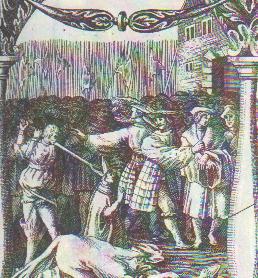
On this date in 1695, Zumbi dos Palmares, the last leader of Brazil’s most famous free colony of fugitive slaves, was captured by the Portuguese and summarily beheaded.

From the very beginning of European settlement in the New Wold, Maroon communities of escaped slaves, free-born blacks, Indians, poor whites, and mixed-race outcasts formed at the fringes of slave states.

Colonial power did not welcome their presence.

Consequently, the community of Palmares faced repeated harassment from the Portuguese and the Dutch West Indies Company from the time of its establishment around 1600 — even as it burgeoned into a kingdom of over 30,000 inhabitants.

Zumbi, a black free-born in Palmares, was kidnapped by such a sortie and raised with a missionary priest who taught him Portuguese and Latin. At 15, he escaped and returned to Palmares, quickly rising to prominence and in 1678 overthrowing his adoptive uncle King Ganga Zumba when the latter attempted to accept peace under Portuguese rule.

Zumbi’s skepticism was vindicated when the followers of Zumba who had defected to Portugal were re-enslaved, but free Palmares soon faced intensified Portuguese pressure. In 1694, artillery finally battered its largest settlement into submission — forcing its ruler into the bush, where he long eluded capture.

In Zumbi’s honor, November 20 is a Brazilian celebration of national pride and especially pride for those of African descent … while the king who would not be a slave has lent his name, somewhat paradoxically, to an international airport.

On this day..

1520: Stockholm Bloodbath

On this date in 1520, four days after the Danish King Christian II gained the Swedish throne, nearly 100 prominent supporters of Swedish independence were executed en masse as a civil war’s apparent victors purged their enemies.

The Stockholm Bloodbath followed years of conflict between supporters of the Danish-dominated Kalmar Union and independence advocates under the banner of Sten Sture the Younger. With Sture’s death in battle earlier in 1520, the unionists had gained the upper hand. Stockholm, the last outpost of resistance, had held against four months’ siege before accepting a general amnesty in exchange for capitulation.

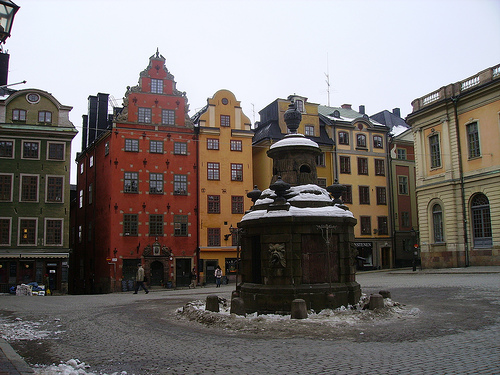
But with the city in hand, Christian — known to Swedish history as “Christian the Tyrant” — had its leaders charged for having deposed during the conflict the pro-union Archbishop Gustav Trolle, construed as an offense against the Church not in the temporal authority’s power to reprieve. Less than 24 hours after this legal maneuver was sprung, public beheadings of prelates, merchants and burgomasters were underway at Stortorget* — and Sture’s remains were exhumed and posthumously burnt at the stake.

Stortorget

It proved a Pyrrhic victory for the Danish party.

Inside of three years, Christian himself had been deposed with multiple lands and factions throughout his realm in open revolt. Gustav Vasa, whose father had been one of the Stockholm Bloodbath’s victims, would not only decisively break Denmark’s hold on Sweden but found the Vasa Dynasty under which Sweden would burgeon into one of Europe’s great powers.

*One Hans Brask survived the purge despite having endorsed the removal of Archbishop Trolle. Brask supposedly placed a note under his seal on this document saying “To this I am forced and compelled.” This cunning device gave the Swedish tongue the word Brasklapp — a secret reservation.

On this day..

1936: Edgar André

On this date in 1936, communist politician Edgar Andre was beheaded in Fuhlsbüttel Prison for treasonous complicity in the Reichstag Fire.

This 1936 German pamphlet denouncing Andre’s execution concludes: “Edgar André lives. In his spirit, we march: Despite all.”

A politician raised in Belgium, Andre had bolted the Socialist Party of Germany for the Communist Party in the early 1920’s, becoming a major labor leader in Hamburg. Andre was arrested within days of the 1933 Reichstag Fire as Adolf Hitler crushed official leftist opposition.

But Andre was not brought to trial for over three years — by which time torture had crippled and deafened him, and the political climate made the doubtful nature of the evidence against him scant protection in the courts. His conviction and sentence were a foregone conclusion.

The Spanish Civil War, which erupted over the summer of 1936 between Andre’s trial and execution, saw the service of a battalion in the International Brigades named for Edgar Andre.

Just days after Andre was beheaded, that battalion entered its first action — with German volunteers helping stave off fascist capture of Madrid. The unit’s hymn commemorated their namesake:

[audio:Das_Batallion_Edgar_Andre.mp3]

On this day..

1963: Ngo Dinh Diem

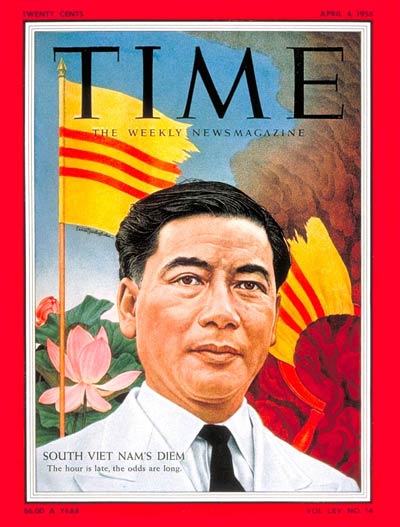
On this date in 1963, Ngo Dinh Diem, the first president of South Vietnam, was executed in the back of an armored personnel carrier along with his younger brother and secret police chief, Ngo Dinh Nhu, the day after their government had been overthrown in a military coup.

Born into the Buddhist country’s Catholic elite, Diem was brought up as a French colonial administrator but fled Vietnam in 1950 under a death sentence from Ho Chi Minh’s nascent Vietminh. Over several years living and lecturing in the United States, he established his anti-communist bona fides with influential conservatives and was returned to his native country as Prime Minister when the U.S. inherited the foundering French war against nationalist guerrillas.

Fearing communist victory at the polls, Diem blocked scheduled 1956 elections to unify North and South Vietnam, making an interim division permanent. But Diem made an inconsistent American client, often spurning Washington’s advice and alienating the Buddhist majority with heavy-handed authoritarianism that eventually prompted Buddhist monks to begin public self-immolation as a form of protest.

The government responded by arresting monks.

By now more a liability than an asset, Diem was ousted with the blessing of a fellow Catholic head of state, John F. Kennedy.

This first successful coup — Diem had already quashed attempted putsches in 1960 and 1962 — began a cycle of internecine revolts in which weak South Vietnamese governments were toppled in rapid succession … leaving Saigon ever more visibly the puppet of Washington, and dragging the United States ever more deeply into the Vietnam War.

On this day..