1765: Andrew Oliver lynched in effigy to the Liberty Tree

On this date in 1765, Boston patriots lynched the merchant designated as the imperial taxman. They only did so in effigy, but the “execution” scared him permanently off the job while also making a gallows-tree into one of the earliest symbols of American independence.

One of the key pre-revolution irritants for the future United States, the 1765 Stamp Act imposed taxes in the form of stamp duties on a variety of printed products, for the purpose of funding the British army deployed to North America. It was a levy long familiar to London lawmakers but it sent the colonies right around the bend, and since the colonies sat no Member of Parliament who could flip an official wig it also popularized the classic revolutionary slogan about “taxation without representation.”*

Enacted in the spring of 1765 and due to take effect in November, the Stamp Act drew immediate outrage in the colonies and especially in that hotbed of subversion, Boston.

There, Andrew Oliver, scion of a shipping magnate clan, was tapped to collect the levy. It figured to be just the latest in a series of lucrative state appointments. How was he to know in advance that this particular legislation would unleash the crazies? Perhaps he should have given more heed to the publication of ominous warnings over the roster of tax collector names.


Boston Post-Boy, August 5, 1765

On the morning of Wednesday, August 14, a crowd of irate Bostonians mobbed the corner of Essex Street and Orange Street (present-day Washington Street) and upon a large elm tree strung up an effigy of Oliver alongside a boot — the footwear comprising a second, punny, effigy of the Stamp Act’s sponsor the Earl of Bute.

“What greater Joy can NEW-ENGLAND see,” ran the menacing note pinned to the mannequin, “Than STAMPMEN hanging on a Tree!” As is clear from the following newspaper account, versions of which circulated widely in New England, these were no mere theatrics but a very proximate physical threat; even the elm’s property owner dared not take down the provocative display for fear that the crowd would pull down his house. Likewise taking the better part of valor, Oliver pledged to anti-tax colonists that he would not take the office, and he kept his word.**


Providence Gazette, August 24, 1765

After this triumphant debut, the elm in question became a common rallying-point for the hotheaded set, a frequent stage for speechifying, rabble-rousing, and fresh instances of popular justice all further to the patriot cause until, as Nathaniel Hawthorne put it, “after a while, it seemed as if the liberty of the country was connected with Liberty Tree.” Of course, it’s all a question of whose liberty; a Tory gloss on this deciduous republican made it “an Idol for the Mob to Worship; it was properly the Tree ordeal, where those, whom the Rioters pitched upon as State delinquents, were carried to for Trial, or brought to as the Test of political Orthodoxy.” When besieged in Boston in 1775-1776, British Tories cut the damned thing down, so for subsequent generations it was only the Liberty Stump.
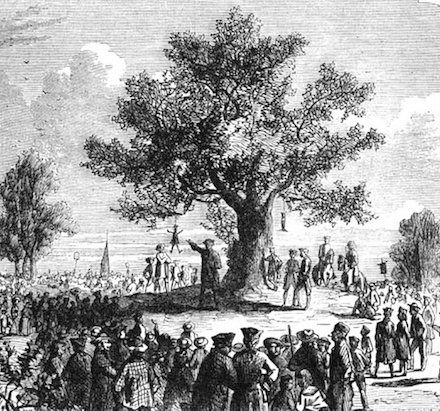

“The Colonists Under Liberty Tree,” illustration from Cassell’s Illustrated History of England, Volume 5, page 109 (1865)

The Liberty Tree is commemorated today at its former site, and forever in verse by revolutionary firebrand Thomas Paine.

In a chariot of light from the regions of day,
The Goddess of Liberty came;
Ten thousand celestials directed the way,
And hither conducted the dame.

A fair budding branch from the gardens above,
Where millions with millions agree,
She brought in her hand as a pledge of her love,
And the plant she named Liberty Tree.

The celestial exotic struck deep in the ground,
Like a native it flourished and bore;
The fame of its fruit drew the nations around,
To seek out this peaceable shore.

Unmindful of names or distinctions they came,
For freemen like brothers agree;
With one spirit endued, they one friendship pursued,
And their temple was Liberty Tree.

Beneath this fair tree, like the patriarchs of old,
Their bread in contentment they ate
Unvexed with the troubles of silver and gold,
The cares of the grand and the great.

With timber and tar they Old England supplied,
And supported her power on the sea;
Her battles they fought, without getting a groat,
For the honor of Liberty Tree.

But hear, O ye swains, ’tis a tale most profane,
How all the tyrannical powers,
Kings, Commons and Lords, are uniting amain,
To cut down this guardian of ours;

From the east to the west blow the trumpet to arms,
Through the land let the sound of it flee,
Let the far and the near, all unite with a cheer,
In defence of our Liberty Tree.

* Visitors to the U.S. capital of Washington D.C., whose 700,000 residents cast no votes in the Congress they live cheek by jowl with, can find this familiar grievance right on the city’s license plates.

** How far this surly bunch was prepared to go on August 14, 1765, one can only guess at; however, in later years, there would be several instances of Bostonians tarring and feathering various tax collectors. These guys did not do civility politics.

On this day..

1872: Charles Marlow, brewer

Immigrant brewmeister Charles Marlow was hanged in Mayville, New York on this date in 1872 for

Deeply in debt, Marlow improved his asset balance when he lured the more solvent William Bachmann to his place (he also lived at his brewery), then took him to the cellar where he poisoned his guest’s drink and finished him off with an iron bar.

You could take our word for it, but better still is friends of the site Murder By Gaslight. Those archives have the full details on this momentary crime sensation — including the Clue-like charge sheet catching 11 different possible means of the mysterious murder, the hung jury, the hanging’s-eve confession, and the “Polander” boarder who overheard the murder and blew the whistle on the whole thing.

On this day..

1913: August Sternickel, terror

Arsonist-murderer August Sternickel was executed by Prussia on this date in 1913.

Sternickel was a miller by training and a thief by inclination, having launched his career in malefaction by stealing from dormitories and swindling on the marriage market.

In 1905, now a released convict nearing 40, Sternickel found work at a Silesian mill and crossed the criminal Rubicon by murdering the owner in order to rob him. He burned down the mill in an (unsuccessful) attempt to conceal the crime and fled Silesia in a (successful) attempt to evade the authorities.

These were still formative years for the bureaucratic state’s capacity to fix and monitor the identities of its subjects, and Sternickel was able — despite the evidence given against him by his confederates — to vanish into the shapeless agricultural workforce, where farmers starved for manpower were little inclined to question a capable hand. From this fluid obscurity, he inflicted during free hours here and there what one contemporary described as his “Sternickel-Schrecken” (“Sternickel-Terror”) on isolated farms. There he could rob and assault with impunity; in 1909, he murdered a hay dealer in the course of a scam, again torching the scene; in 1912, he killed an employer who got too nosy about his missing identification papers, and his wife as well, and even strangled the estate’s luckless 16-year-old milkmaid when she happened upon the murder scene.

It was this last affair that finally resulted in his capture and prosecution, with a sure verdict that Sternickel declined to appeal. The Royal Prussian executioner Lorenz Schwietz cut his head off in Frankfurt an der Oder on July 30, 1913.

On this day..

1961: Rokotov and Faibishenko, black marketeers

On this date in 1961,* two 22-year-old Soviet men were — very much to their surprise — shot as black market currency speculators.

Ian Timofeyevich Rokotov and Vladik Petrovich Faibishenko were leaders of a small ring of illicit currency traders who made their bones swapping Soviet rubles with foreign visitors at a handsome markup, earning “wealth” on the scale of moderate personal ease that seems laughable compared to their homeland’s present-day oligarchy. Among this nine-person ring, authorities recovered 344,000 Russian rubles plus about $19,000 in gold coins and a few thousands each of various western European currencies.

These deeds augmented the inherently parasitic act of profiteering by the inherently subversive act of making unchaperoned contact with foreign visitors, at a moment when the Soviet state was particularly sensitive to both infractions. This was nearly the exact apex of the Cold War, in the tense months between the U-2 Crisis and the Cuban Missile Crisis.** “Peaceful coexistence,” Soviet premier Nikita Khrushchev said in a 1961 address, means “intense economic, political, and ideological struggle between the proletariat and the aggressive forces of imperialism in the world arena.”

In a 13-day trial concluding on June 15, Rokotov and Faibishenko were sentenced along with another of their circle, Nadia Edlis, to 15 years in prison. You might think that’s a stern message sent, but the excitable Khrushchev took an almost personal offense to their behavior and on viewing the intentionally nettlesome exhibition of the black marketeers’ banknote heaps, exclaimed, “They need to be shot for this!”

The minor matter of having no capital statute on the books for the occasion was resolved on July 1 by the Presidium of the Supreme Soviet, which introduced the death penalty for major economic crimes; the statute was then immediately deployed to retroactive effect in a new trial before the Russian Republic Supreme Court.

Many people more would face capital punishment for economic crimes under that 1961 law.

* The official execution date is elusive but press reports indicate that the Soviet news agency TASS announced it on July 26. Given that their final condemnation had occurred only five days previous, we fall at worst within a narrow margin of error.

** Also of note: the USSR had just revalued the ruble as of January 1, 1961.

On this day..

1828: William Rice but not John Montgomery, who cheated the hangman with prussic acid

(Thanks to Meaghan Good of the Charley Project for the guest post. -ed.)

Just before 6:00 a.m. on July 4, 1828, prison officers arrived at the cell of disgraced ensign John Burgh Montgomery in Newgate Prison‘s condemned hold.

They were there to escort Montgomery to his hanging. The 33­-year-­old would have been one of the last in England executed for for the crime of uttering forged notes — except that his wardens instead found him lying stone dead. With the aid of prussic acid, the counterfeiter had cheated the hangman of half his day’s prey, leaving his prospective gallows partner, thief William Rice, to face the hemp alone.

Although his guards had confiscated his razor and penknife as a routine precaution against suicide, no one had expected Montgomery to take his own life. He had pleaded guilty before the court and seemed resigned to his fate. In custody he was a model prisoner, spent his last days writing to his loved ones, and “addressed himself with great anxiety to his religious offices.”

Nobody was able to figure out how the condemned man came by enough poison to kill thirty people and how he kept it hidden, given that he and his cell were regularly searched.

The Irish-­born Montgomery, Nicola Sly records in her book Goodbye, Cruel World… A Compendium of Suicide,

was said to be a very respectable, well­-educated man, who had once held a commission in the Army. However, after inheriting a considerable fortune, he frittered it away and resorted to passing phony banknotes to support his rather dissipated lifestyle. Given his pleasing looks, gentlemanly appearance and good manners, he was very successful, since nobody thought him capable of any wrongdoing. However, he was caught after becoming careless and making the mistake of committing frequent repeated offense in a small geographical area of London.

Montgomery left behind several letters, marked by expansive tragic romanticism but no hint of suicidal intent. One letter was for the prison surgeon, asking that his body be used for dissection. He said that by this he wanted to provide some positive contribution to the public to make up for his crimes. He asked that his heart be preserved in spirits and given to his girlfriend.

To the girlfriend he wrote,

My dear idolized L.,

One more last farewell, one more last adieu to a being so much attached to the unhappy Montgomery. Oh, my dearest girl. If it had been in the power of anyone to avert my dreadful doom, your kind exertions would have been attended with such success. Oh, God, so poor Montgomery is to die on the scaffold. Oh, how dreadful have been my hours of reflection, whilst in this dreary cell.

Oh, how tottering were all my hopes; the bitterness of my reflection is bitter in the extreme. This will be forwarded to you by my kind friend Mrs. D. I should wish you to possess my writing portmanteau. Oh, I wished to have disappointed the horrid multitude who will be assembled to witness my ignominious exit. Farewell forever,

P.S. Here I kiss fervently.

The jury on the inquest into Montgomery’s death recorded a verdict of felo de se, meaning that Montgomery had willfully and knowingly taken his own life whilst of sound mind. As such, his body was buried in the graveyard of St. Sepulchre­-without-Newgate at night, and without any memorial service.

On this day..

1890: Elizabeth and Josiah Potts, wife and husband

On this date in 1890, an affectionate married couple hanged together in Elko, Nevada, for a murder they insisted they had not authored.

We obtain this headline and the associated (nationally circulated) story from the San Diego Union of June 26, 1890.

[Associated Press Dispatches.]

ELKO, Nev., June 20. — Elko is in a ferment of excitement, many parties pouring in to witness the execution of the Potts family for the murder of Miles Fawcett in January, 1888. Over sixteen women have already applied for permits to witness the execution, which were refused.

The conduct of Mrs. Potts during the past five days has been an alternation of hysterical crying, screaming and swearing at her husband, who mopes the time away in solitude. Yesterday morning at 5 o’clock she attempted to commit suicide, gashing her wrists and trying to smother herself. The vigilance of the death watch prevented further injury but she fainted from loss of blood. Both the Potts retired early last night in a nervous condition.

At 10:30 o’clock the Sheriff read the death-warrants to Josiah and Elizabeth Potts. The reading of the warrant took place in the doorway of the latticed cell, which Josiah has occupied for so long a period.

He stood in a despondent attitude, with his head bowed down against the iron bars, and not once during the reading of the warrant did he lift his head. His wife stood erect, clad in a neat muslin suit draped in black, with a red rose in her bodice. She was pale, but with a most determined aspect in every feature. During the reading of her own warrant only once did she show any emotion whatever, and she convulsively clutched her throat when her husband’s was being read, and when the words “hanged by the neck till you are dead” were reached, she gave a hysterical gasp and seemed to exhibit much feeling.

The reading of the warrants was finished at 10:30, and both the condemned people emerged from the jail, where they had been confined for eighteen months, and proceeded outside the door to the yard between the Courthouse and jail, in which the scaffold had been erected. The sunshine relieved in a measure the gruesome surroundings. During the readings of the warrants, and evidently owing to the intense nervous strain on every one, a Deputy Sheriff was so overcome that he had to call for a glass of water.

At the conclusion of the reading Mrs. Potts earnestly ejaculated:

I AM INNOCENT AND GOD KNOWS IT,

and Josiah Potts reiterated, “God knows we are innocent.” The gloomy procession led the way through a side door and with a bravery unexpected by the sixty-odd spectators, the condemned couple seated themselves on stools provided on the scaffold, while the deputies speedily proceeded to bind them with leather straps, Mrs. Potts helping to adjust them herself while Potts sat through it all in stolidity.

When everything had been properly adjusted, they were directed to rise and all of the attendants shook hands with the condemned unfortunates. The attendants held the strap attached to Mrs. Potts’ manacled wrists and Potts made several most earnest endeavors to clasp the hands of his wife but without accomplishing it. Finally a touch on her wrist caused her to turn her eyes toward his and a mute appeal of love caused their lips to meet. As the rope was stretched around Mrs. Potts’ neck she clasped her hands together, and lifting her eyes towards the sky, exclaimed “God help me; I am innocent.”

Her husband reiterated in a hollow tone, “God knows we are innocent,” as the black caps were drawn over their heads.

The words of the clergyman who had remained with them to the last broke the silence by saying: “Put your trust in God and He will see you righted,” and then the drop fell. Instantaneously,

MRS. POTTS WAS A CORPSE,

owing to her heavy weight. Her flacid [sic] flesh caused a rupture of the carotid artery and a stream of blood burst forth from under the chin of the dead woman, staining her white raiment. To the great surprise of all who had seen Potts’ emaciated condition his vitality was great, it being a fraction over fourteen minutes, as counted by the Associated Press reporter, before life was pronounced extinct by Drs. Meiggs and Petty.

At 11:08 the body of Mrs. Potts was cut down when it was seen that her excessive weight on the five foot and a half drop had almost dissevered her head from the trunk, the muscles in the back of her neck alone supporting the connection.

About nine minutes later Josiah Potts’ body was cut down and the body of himself and wife, in the absence of any claiming friends, were deposited in the potter’s field of the Elko grave yard half an hour later.

After the interment of the bodies of Mr. and Mrs. Potts, District Attorney Love, accompanied by an Associated Press reporter, placed in the potter’s field all the remains of the murdered Fawcett known to exist above the earth. The box of bones had been in the District Attorney’s office at the Courthouse from the time when he first started to search for the criminals.

THE CRIME

for which the couple was executed was the murder of Miles Fawcett, 70 years of age, at Carlin, January 1st, 1888, because he insisted on being paid some money due from Potts. He visited Potts and this was the last seen of him until his dead body was discovered some months after by a person who rented the house formerly occupied by Potts.


That’s the end of the Union article.

Despite the incriminating circumstances of Mr. Fawcett’s disappearance, many people found the Potts’s insistence upon their innocence persuasive … especially after a last message from Elizabeth Potts reached public ears.


Laramie (Wyoming) Daily Boomerang, June 24, 1624.

Innocent or guilty, Elizabeth Potts remains the first, last, and only woman ever legally executed in Nevada. As of this writing (mid-2018) the Silver State has not had any woman on death row since Priscilla Joyce Ford died in 2005.

On this day..

1748: Arthur Gray and William Rowland, Hawkhurst Gang smugglers

On this date in 1748, Arthur Gray and William Rowland — two desperadoes of the Hawkhurst Gang smuggling syndicate — were hanged at Tyburn.

We have in these pages formerly detailed the muscle of this fearsome gang, which having established a lucrative commercial enterprise evading tea duties and distributing its discount leaf did not shrink from brutalizing and murdering the king’s own agents to preserve it.*

Britain by the late 1740s was pressing hard to suppress the shocking violence of the smuggling trade. To that end, she had armed herself with legislation permitting the capital prosecution of people for carrying smuggled goods while armed — the attainble bar which was cleared for both of the prosecutions at issue in today’s post.

However, as the Newgate Ordinary described, there were much more shocking atrocities to be attributed:

There are numerous Instances might be given of the Barbarity of Smugglers, but I shall confine myself to one or two very remarkable, in which Gray was principally concerned, in Decem. 1744. The Commissioners of the Customs being informed that two noted Smugglers, Chiefs of a Gang who infested the Coast, were skulking at a House in Shoreham in Sussex, they granted a Warrant to Messieurs Quaff, Bolton, Jones, and James, four of his Majesty’s Officers of the Customs, to go in Search of them. The Officers found them according to the Information, seized them, and committed them to Goal. But the rest of the Gang, of which Gray was one, being informed of the Disaster of their Friends, convened in a Body the Monday following, and in open Day Light entered the Town with Hangers drawn, arm’d with Pistols and Blunderbusses; they fired several Shot to intimidate the Neighbourhood, and went to a House where the Officers were Drinking; dragg’d them out, tied three of them Neck and Heels (the fourth, named Quaff, making his Escape as they got out of the House) and carried them off in Triumph to Hawkhurst in Kent, treating them all the Way with the utmost Scurrility, and promising to broil them alive. However, upon a Council held among them, they let Mr. Jones go, after they had carried him about five Miles from Shoreham, telling him, they had nothing to object to him, but advised him not to be over busy in troubling them or their Brethren, left he might one Day meet the Fate reserved for his two Companions. They carried the unfortunate Mr. Bolton and James, to a Wood near Hawkhurst, stripped them naked, tyed them to two different Trees near one another, and whipped them in the most barbarous Manner, till the unhappy Men begg’d they would knock them on the Head to put them out of their Miseries; but these barbarous Wretches told them, it was time enough to think of Death when they had gone through all their Exercise that they had for them to suffer before they would permit them to go to the D – l. They then kindled a Fire between the two Trees, which almost scorch’d them to Death, and continued them in this Agony for some Hours, till the Wretches were wearied with torturing them; they then releas’d them from the Trees, and carried them quite speechless and almost dead, on Board one of their Ships, from whence they never return’d.

That’s all about Arthur Gray, a butcher by training who had advanced to a leadership role in the Hawkhurst Gang. Juridically, this entire story is nothing but the Ordinary’s gossip; the whole of Gray’s trial consists not of torturing and disappearing lawmen but an anodyne description of Gray’s having formed a convoy of about eight men, armed with blunderbusses and carbines, to carry uncustomed tea and brandy. It’s the get Capone on tax evasion school of using whatever tool is available; in fact, the very crime here for Gray is “tax offences”.

It’s the same for William Rowland, who was a person of much less consequence in the gang; the Ordinary has no scandal of interest to share with the reader, and by his telling Rowland awaiting the gallows seems preoccupied mostly with annoyance at his naivete in surrendering himself upon hearing of the warrant, thinking his involvement in the racket too trivial to have possibly come to hemp.

The Hawkhurst Gang would be broken up by 1749.

* On the lighter side of moral panics, we find philanthropist-noodge Jonas Hanway (who thought a proper Briton ought to fortify himself with robust beer instead of strained leaf-water) amusingly fretting in the 1750s that thanks to the 18th century’s tea craze

men were losing their stature, women their beauty, and the very chambermaids their bloom … Will the sons and daughters of this happy isle for ever submit to the bondage of so tyrannical a custom as drinking tea? … Were they the sons of tea-sippers who won the fields of Crécy and Agincourt or dyed the Danube’s shores with Gallic blood?

On this day..

1708: William Gregg, spy of slob

William Gregg was hanged and quartered on this date in 1708 as a French spy.

Given a recent near-miss prosecution for counterfeiting — his pregnant wife saved Gregg’s bacon by taking the blame, and had her hand branded for the trouble — Gregg wasn’t the type who would get a security waiver in the diplomatic corps nowadays.

But the job market is all about who you know, and Gregg’s father knew the previous Home Secretary.* The young man therefore pulled an impecunious appointment to an underclerkship for that same office under the management of Robert Harley.

Harley was a powerful minister who among other things consummated the tricky union of England and Scotland. He was also — according to the writer Daniel Defoe, whose able quill Harley had obtained by relieving the writer’s debts when they were so heavy as to land him in prison — an inveterate slob. Defoe claims that he reprimanded his boss for the “most complete disorder” in his office, in which strewn everywhere “papers of the gravest import were open to the inspection of every clerk, doorkeeper, or laundress in the establishment.”

Gregg was the man who would succumb to the temptation.

Getting by on Bob Cratchit wages, Gregg realized that he was essentially working in a gold mine … and he started selling the bullion to France, by copying interesting documents and sending them abroad.

The treason was detected by a Brussels postmaster late in 1707: evidently Gregg sent his copies to the French ministry with a helpful cover letter identifying himself by name.

This crime had deep political ramifications; Whigs who had within living memory suffered the indignity of seeing their greatest leaders sent to the block by the Tories after the Monmouth rebellion entertained some vivid plans for the Tory Harley once Gregg was arrested.

But the man who would sell his country for gold would not sell his boss for his life. Condemned to die a traitor’s death on January 9, Gregg languished more than three months while Whig lords inveigled him with promises of mercy if he should condescend to expose a wider Tory plot. Gregg staunchly stuck to his story: that it was he alone who committed espionage, and the means was nothing but Harley’s untidiness. The scandal was sufficient to force Harley’s resignation, but Gregg’s failure to cooperate denied Harley’s enemies a wider and bloodier purge.

Gregg was convicted on the statute of Edward III, which declares it high treason ‘to adhere to the king’s enemies, or to give them aid either within or without the realm.’

Immediately after his conviction, both houses of Parliament petitioned the queen that he might be executed; and he accordingly hanged at Tyburn, with Morgridge, on the 28th April, 1708.

Gregg, at the place of execution, delivered a paper to the sheriff of London and Middlesex, in which he acknowledged the justice of his sentence, declared his sincere repentance of all his sins, particularly that lately committed against the queen, whose forgiveness he devoutly implored.

He likewise expressed his wish to make all possible reparation for the injuries he had done; begged pardon in a particular manner of Mr Secretary Harley, and testified the perfect innocence of that gentleman, declaring that he was no way privy, directly or indirectly, to his writing to France. He professed that he died an unworthy member of the Protestant church, and that the want of money to supply his extravagances had tempted him to commit the fatal crime which cost him his life.

Newgate Calendar

* The Home Office technically only dates to 1782. Its predecessor post as it existed in the first years of the eighteenth century was actually Secretary of State for the Northern Department.

On this day..

1620: Thomas Dempster condemned

On this date in 1620, Thomas Dempster was condemned by a Scottish assize to execution for counterfeiting. No documentation specifying the execution date appears to be available but such sentences were commonly implemented almost immediately — either directly from the courtroom or within a couple of days.

The Dempster family of Muresk were baronial landowners who owed both privilege and surname to the hereditary rank of dempster. This curious office of “dooms-man” connects etymologically with judging (“deem”), the successor to a Gaelic position called the judex that once projected royal authority into the courtroom.

Over the centuries-long term, this pre-Norman holdover was on a downward trend towards obsolence; the dempster transitioned to being the pronouncer of the court’s sentences and “ultimately became the common hangman.”* (Source)

Nevertheless, in our man’s time the Muresk Dempsters had estate enough to squander, and the quarrelsome Thomas did yeoman work in that respect, blowing the family fortune on clan feuding that extended even to a violent rivalry with his own son, James.** The assize record would note him “altogidder sensles of that his miserable cairage, nawayis being movet thairwith, bot rather resolveing to rwn heidlongis in all godles and cruiket courses.”

Having been found in this degraded state guilty of forgery, he was condemned by the court “to be tane to the Castell-hill of Edinburgh, and thair his heid to be strukin frome his body; and all his moveable guidis and geir pertening to him to be escheit to his Maiesteis use, &c.”

* The office of the dempster was abolished in 1773.

** James and his team ambushed and injured the father in a rivalry over a woman, driving James to a life of banditry. Another son — James’s younger brother, confusingly also named Thomas Dempster — was snatched away from this noxious family atmosphere by a kindly uncle who gave him a continental education; this other better-favored Thomas Dempster grew up to become a noted ecclesiastical historian.

On this day..

1818: Five from the Lancaster Assizes, “most dangerous to society”

On this date in 1818, four hanged at Lancaster Castle for uttering forged notes, along with a fifth hanged for burglary and horse theft — all casualties of the latest Lancaster Assizes. For the account, we excerpt Jackson’s Oxford Journal of May 9, 1818; the footnotes are from that source as well.

LANCASTER ASSIZES, April 13.

Address of Chief Baron Richards, on passing sentence of Death upon the prisoners capitally convicted of forgery, and of uttering forged Bank of England notes.

Wm. Oxenham*, convicted of uttering a forged Bill of Exchange, was first placed at the bar.

Chief Baron — “William Oxenham, you have been convicted of uttering a forged Bill of Exchange, well knowing at the time you uttered it that it was forged. The crime of which you have been convicted, on the most satisfactory evidence, by a most intelligent Jury, is a crime the most dangerous to society, and which loudly calls for the highest punishment the law can inflict; for no man, in a commercial country like this, can, by any care, effectually protect himself from such attempts. If there should be any disposition at the foot of the Throne to extend its mercy towards you, I shall rejoice: but of this I can offer no assurance; and if there should be any mitigation of your sentence, it will only be on condition of your being forever removed from this country.” — His Lordship then passed upon him the last sentence of the law in the usual terms.

The following prisoners were then placed at the bar: — Wm. Steward†, Thomas Curry†, Margaret M’Dowd†, R. Wardlaw†, R. Moss, Hannah Mayor, and J. Vaughan, convicted of uttering forged Bank of England notes; and G. Heskett†, convicted of burglary and horse-stealing.

The Chief Baron, addressing by name the first seven prisoners, thus proceeded, —

You have been severally convicted of uttering forged Bank of England notes, knowing them to be forged: the law has affixed to this crime the punishment of death, and it is an offence which, on account of its injurious consequences to society at large, requires the infliction of the highest punishment.

It is a practice which must be repressed; and if this cannot be effected by other means, it must be done by visiting it with the utmost severity of the law; for the negotiation of forged notes is the strongest and most extensive mode of plundering the public which can be resorted to, and it is one against which no care or prudence can be an effectual protection. I had, the last Assizes, the very melancholy duty, in this place, of passing the sentence I am now about to pass upon you, upon a number of persons convicted of this offence, and which sentence was carried into effect with respect to most of them: but I do not perceive that this sad example has been attended with any advantage, or that it has produced any diminution in the number of offenders of this description; you have not taken warning from it; for I observe that your offences are all subsequent to the last Assizes. It is, therefore, necessary that examples should still continue to be made; and it is my duty to tell you that some of you, nay, that most of you, beyond all question, must suffer the full sentence of the law.


* This prisoner was so unwell, that he was obliged to be supported into Court, and placed in a chair, until sentence was passed upon him.

† The prisoners thus marked were left for execution, and suffered the sentence of the law on Saturday se’nnight [i.e., Saturday, 18 April 1818], at Lancaster.

On this day..