1892: Two Georgian bandits, witnessed by Stalin

On this date in 1892, two outlaws were hanged (and a third spared at the last moment) in Gori, Georgia — part of the tsarist Russian Empire.

Josef Djughashvili, the future Stalin, was a teenager when he saw an 1892 public hanging in Gori.

The most noteworthy executioner present on this occasion was not on the scaffold, but in the audience: a 14-year-old student at an orthodox church school named Joseph Djugashvili. You know him by his later, steely revolutionist alias: Stalin.

This precocious, ferocious youth attended the public hanging with school mates to whom he was already a natural leader.

He and his friends sympathized with the doomed Caucasians, so insouciant at being strung up by the tsarist oppressor: conversing after the gruesome spectacle, Djugashvili would maintain that the men had not been consigned to hell, for they had suffered enough in the present.

But this boy was not made for theologizing; though he proceeded to seminary school in Tiflis — the best education prospect for an impoverished family — he disappeared thence into the life of professional revolutionary outlawry.

The recent (and well-received) biography Young Stalin recaptures this scene from Joseph Djugashvili’s youth.

The condemned men had stolen a cow and, in the ensuing pursuit, had killed a policeman. But the boys learned that the criminals were actually just three “peasants who had been so oppressed by landowners that they escaped into the forest,” petty Robin Hoods, attacking only local squires and helping other peasants …

The boys were fascinated. “Soso Djugashvili, me and four other schoolboys climbed a tree and watched the terrifying show from there,” remembers one of the group, Grigory Razmadze … Another spectator whom Stalin would later befriend and promote was Maxim Gorky, then a journalist, soon to be Russia’s most celebrated writer.

The Gorelis sympathized with these brave Caucasian bandits … The crowd became menacing; double ranks of Russian soldiers encircled the square. The drums began to beat. “The authorities in uniforms lingered around the scaffold,” wrote Gorky in his article. “Their dreary and severe faces looked strange and hostile.” They had reason to be nervous.

The three bandits in leg irons were marched onto the scaffold. One was separated from the others — he had been reprieved. The priest offered the two condemned men his blessings; one accepted and one refused. Both asked for a smoke and a sip of water. Sandro Khubuluri was silent, but the handsome and strong “ringleader,” Tato Jioshvili, smiled and joked valiantly before the admiring crowd. He leaned on the railings of the gallows and, noticed Gorky, “chatted to people who had come to see hi die.” The crowd threw stones at the hangman, who was masked and clad completely in scarlet. He placed the condemned on stools and tightened the nooses around their necks. Sandro just twirled his moustache and readjusted the noose. The time had come.

The hangman kicked away the stools. As so often with Tsarist repression, it was inept: Sandro’s rope broke. The crowd gasped. The scarlet hangman replaced him on the stool, placed a new noose round his neck and hanged him again. Tato also took a while to die.


Even Joseph Stalin was a child once.

One would have to really like the difficult-to-prove notion that executions have a brutalizing effect encouraging violence in others in order to see in this hanging the germ of the incomprehensible suffering young master Djugashvili would eventually unleash.

It’s not like this was Stalin’s only childhood exposure to brutality, and not too many of those buddies who watched this date’s hanging grew up to kill 20 million people.

Gori was one of the last towns to practise the ‘picturesque and savage custom’ of free-for-all town brawls with special rules but no-holds-barred violence. The boozing, praying and fighting were all interconnected, with drunken priests acting as referees… [At festivals during Stalin’s youth] the males in each family, from children upwards, also paraded, drinking wine and singing until night fell, when the real fun began. This ‘assault of free boxing’—the sport of krivi—was a ‘mass duel with rules’; boys of three wrestled other three-year-olds, then children fought together, then teenagers and finally the men threw themselves into ‘an incredible battle,’ by which time the town was completely out of control, a state that lasted into the following day—even at school, where classes fought classes.


This is Russia, not Georgia: festive Maslenitsa fisticuffs.

The small Georgian town that spawned the first name in Soviet terror actually maintained a public statue to its most famous son until 2010 — when it was finally removed in an apparent anti-Russian gesture in the wake of the South Ossetia war.

On this day..

1892: Ruggles brothers lynched

On this date in 1892, highway robbers John and Charles Ruggles were shanghaied from a Redding, Calif. jail and lynched.


John and Charles Ruggles, lynched in Redding, Calif.

These two charmers knocked over the Redding & Weaverville stage on May 14, 1892, killing the coach’s guard when he fired back.

Charles Ruggles was wounded in the exchange and soon captured, but John Ruggles got away with the lockbox.

With a price on his head, John secreted the stolen loot somewhere and was not arrested until June 19.

Reunited in jail, the handsome outlaws were evidently a big hit with the ladies. As the Los Angeles Times reported on July 25, 1892,

The recent sentimental attitude of a number of women toward the prisoners as well as the line of defense adopted by their counsel, who has been evidently endeavoring to implicate Messenger [Amos “Buck”] Montgomery [the dead victim] as a party to the crime, had been denounced by a number of persons in the county and it is believed the lynching was due to those causes.

When the vigilantes came for him, John tried to buy the boys’ way out of trouble — or at least, buy Charley’s way out — by offering to reveal the location of his treasure.

The mob wasn’t interested, and the cache has never been found since. On the other hand …

The lynching of a brace of stage-robbers at Redding a few nights ago was not at all in accordance with law and order; but that it will have a discouraging effect on the “hold-up” industry, there is little question. It will be perfectly safe to indulge in stage rides in Shasta county, no doubt, for some time to come.

Los Angeles Times, July 27, 1892

On this day..

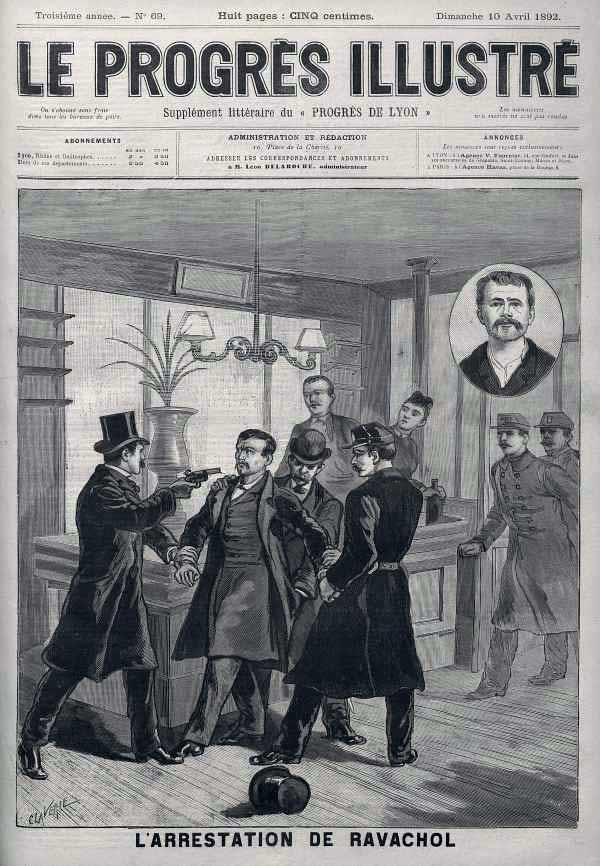
1892: Ravachol, anarchist terrorist

On this date in 1892, French anarchist François Claudius Koenigstein — better known as Ravachol — was guillotined at Montbrison for a series of bomb attacks on right-wing judges.

He took the name “Ravachol”, his mother’s, after his Dutch father ditched his mom, leaving the family in poverty.

Young Ravachol supported himself as best he could in proletarian labor and crime, as he attempted to observe* at his trial.

Ravachol, as painted by Charles Maurin.

There are many people who will feel sorry for the victims, but who’ll tell you they can’t do anything about it. Let everyone scrape by as he can! What can he who lacks the necessities when he’s working do when he loses his job? He has only to let himself die of hunger. Then they’ll throw a few pious words on his corpse. This is what I wanted to leave to others. I preferred to make of myself a trafficker in contraband, a counterfeiter, a murderer and assassin. I could have begged, but it’s degrading and cowardly and even punished by your laws, which make poverty a crime. If all those in need, instead of waiting took, wherever and by whatever means, the self-satisfied would understand perhaps a bit more quickly that it’s dangerous to want to consecrate the existing social state, where worry is permanent and life threatened at every moment.

Personal want segued into political conviction for Ravachol, whose crimes were justified by the principle of reprise individuelle.

And the political led him to reprisals of a less individual nature, when French state violence against radicals caused him to dynamite several magistrates’ homes.

He was caught in a restaurant,** brought to trial, and let off with penal servitude for life. Then another jury, intimidated by public outcry, reversed the decision and sent him to the guillotine.

The Banquet Years: The Origins of the Avant-Garde in France 1885 to World War I, which argues that anarchists “unsettle[d] the political smugness of the Third Republic … [and] challenge[d] any formulated aesthetic. The dynamism of prewar artistic activity ran a close parallel to anarchism; postwar Dada and surrealism look like its artistic parodies†.”

Anarchism, that revolutionary specter stalking fin-de-siecle Europe, burnt its fuse at both ends, but Ravachol’s falling head‡ left a legacy for his fellow-travelers. The next year, Auguste Vaillant tossed a bomb into the French Chamber of Deputies to avenge Ravachol. (Vaillant was himself guillotined, and himself avenged by Emile Henry and Sante Geronimo Caserio.)

Ravachol was also honored in a song, La Ravachole — set to the jauntily menacing tune of La Carmagnole, it cheers, “Long live the sound of the explosion!”

* This incendiary speech was cut off by the court.

** The table where the terrorist was nabbed got its own inscription: “Here ate Ravachol the day of his arrest.”

† e.g., Dadaist Marcel Janco‘s recollection:

We had lost confidence in our culture. Everything had to be demolished. We would begin again after the ‘tabula rasa’. At the Cabaret Voltaire we began by shocking common sense, public opinion, education, institutions, museums, good taste, in short, the whole prevailing order.

‡ Ravachol was guillotined midway through a parting exclamation, “Vive la Re-“. Initial newspaper reports implausibly rendered this as the patriotic classic “Vive la Republique!” rather than a much more in-character word like, oh, “Revolution”.

Weeks of controversy ensued over some witnesses’ claims that the head post-severing had actually completed the word “-publique”, a notion of a piece with the idea that the severed head survives decapitation by a few seconds. Scienticians countered that obviously excited witnesses were maybe hearing air escaping from the headless trunk and filling in the rest of the scene in their heads.

On this day..

1892: Sylvester Henry Bell

The state of Vermont has long since dispensed with the death penalty; it hasn’t had a death penalty law on the books since 1964, and its last execution was a decade before that. (Source)

But back when the traps were dropping on Green Mountain State scaffolds, no consideration of sentiment (or holiday pay) barred hanging a man on New Year’s Day, as occurred in 1892.

You could call Sylvester Bell a ladykiller.

According to family genealogists familiar with the case, the Canadian-born farmer used two of his wife’s relatives as character witnesses in his naturalization proceedings … and eight months later, shot said wife, the mother of his five children. Not only did Sylvester win acquittal for this non-fatal attack, Marcia Farnsworth Bell actually had to fight to get a divorce on the grounds of “intolerable severity”.

Marcia and her unmarried children moved to Randolph, Vt., where the kids opened a major department store.

Nothing daunted, a then-54-year-old Sylvester remarried the decades-younger Emma Lock (or Locke) in 1887.


‘Til death do us part: Sylvester and Emma’s marriage certificate.

We may imagine an ensuing union not altogether free of discord,* as we rejoin the public record of their lives with the Jan. 2, 1890 Burlington Clipper.

It appears that Mrs. Bell had left her husband and applied for a divorce. Thursday she, in company with Deputy Sheriff Hall, went to the house to remove her things. Bell met them very pleasantly and permitted her to pick up her goods. As she was about ready to leave she went up stairs and he followed her. Soon afterward a pistol shot was heard and Officer Hall rushed up, and Bell met him at the door of the room into which Mrs. Bell had gone and handed him the pistol, saying, “Take this. I have done the deed.” The ball entered the head of the unfortunate woman, just back of the ear, and she lived about thirty minutes, unconscious.

Bell was put under arrest and for a time the excitement, and sympathy was so strong for the murdered woman that it looked as if Bell would be lynched, but the law will now be allowed to take its course.

The article understatedly observed, “Bell’s reputation with his wives is bad.”

The course of the law will not hold much suspense for readers of this blog.

The novelty of the eventual New Year’s execution attracted the New York Times which (botching the hanged man’s name and the date of his crime) reported the scene from the scaffold, where “Stephen” Bell bought himself an extra 34 minutes in this vale of tears with the verbosity of his last statement.

WINDSOR, Vt., Jan. 1. — Stephen H. Bell was hanged here this afternoon for the murder of his wife, in the town of Fairfax, Dec. 26, 1880. At 1:40 the door of the west wing of the prison was closed and at 1:44 the prisoner was taken from his cell, where he was holding an earnest conversation with Chaplain Wassall.

The prisoner was somewhat pale from long confinement. He boldly ascended the steps and, although assisted, appeared to be nerved up for the occasion. Chaplain Wassall offered a fervent prayer, during which Bell bowed and covered his face with his hand. Sheriff Lovell, as soon as the Chaplain had finished, stepped forward and said: “Stephen H. Bell, have you anything to say why the penalty of the law should not be executed on you?”

Bell, rather pale and tremulous, stood erect, and after addressing the Sheriff and officers in charge, asking for all the time he wanted in which to speak, began a talk which lasted thirty-four minutes. It was a rambling statement, in which he declared his innocence. When he had finished, Bell stepped back to his chair.

Sheriff Lovell took him by the arm, and the condemned man stood up bravely. When Deputies How and Randall had pinioned his wrists, arms, and legs Bell stepped on the drop and said: “Gentlemen, I am a dying man; good-bye.” Instantly the Sheriff touched the spring and the drop fell. In fourteen minutes he was pronounced dead. The body was buried in Windsor Cemetery.

Interestingly, Bell was the only person executed in his state during a 22-year period from 1883 to 1905. That span is bookended in Vermont’s death penalty annals by the first woman hanged in Vermont and the last woman hanged in Vermont.

Bell’s descendants continue to seek information on Sylvester; anyone who may know more can get in contact via this author.

* Another report of the murder describes Emma fleeing to live with her parents on account of Sylvester’s repeatedly menacing her with a butcher knife and a gun, until the “overseer of the poor, after a time succeeded in getting them together again, he giving up his pistol and agreeing to behave himself.” Clearly, it was a different time for domestic violence victims.

On this day..

1892: Jens Nielsen, the last in Denmark

On this date in 1892, serial arsonist Jens Nielsen was beheaded with an axe in the courtyard of Horsens prison — the last civil execution ever conducted in Denmark.

According to this Danish biography, Nielsen had incurred a long prison sentence for burning several farms in July 1883.

(He’d just returned from a fruitless stint in the New World, torching a warehouse in England on the return voyage.)

Apprehended immediately and sentenced to a long prison term, Jens confronted an age-old dilemma which was evidently noticeably acute among melancholy Danes: effecting state-assisted suicide on the scaffold.

These cases must have once been fairly frequent because Denmark, by an ordinance of December 18, 1767, deliberately abandoned the death penalty in cases where “melancholy and other dismal persons [committed murder] for the exclusive purpose of losing their lives.” The background for the provision was, in the words of Orste, “the thinking that was then current among the unenlightened that by murdering another person and thereby being sentenced to death, one might still attain salvation, whereas if one were to take one’s own life, one would be plunged into eternal damnation.”

The ordinance was ineffective in one case, at least, that of Jens Nielsen, who was born in 1862 and spent a most unhappy and unfortunate childhood. In 1884 he was sentenced to 16 years of hard labor for theft and arson. The following year he tried to kill a prison guard. He was tried, sentenced to death and received a commutation to life. He was then placed in solitary confinement. A year later he tried again to kill a guard, “realizing that he could not stand solitary confinement, did not have the nerve to commit suicide and wanted to force his execution.” He was again tried, sentenced to death and the sentence commuted. In 1892, having remained in solitary confinement all that time, he tried again to kill a guard. This time he got his wish, was sentenced to death and executed. (Source.)

He even managed to crack wise, “Thank you!” to the mayor who wished him God’s help on the way to the scaffold — envoy of the powers both temporal and ethereal that would finally loose his shackles.

Denmark’s death penalty law lingered into the 1930’s, but even the occasional death sentences were no longer carried out. Apart from a brief revival after World War II to punish war crimes committed during the Nazi occupation, nobody has been put to death in Denmark in — as of today — 116 years.

On this day..