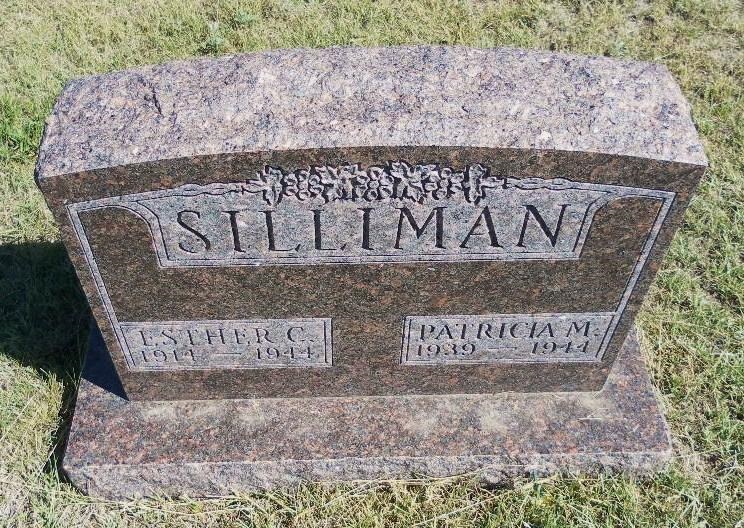
1945: Charles Ford Silliman, suicide pact?

(Thanks to Meaghan Good of the Charley Project for the guest post. -ed.)

On this date in 1945, stripped down to his socks and underwear, 35-year-old truck driver and double murderer Charles Silliman was gassed in Colorado’s death chamber. He died for the murder of his wife, Esther Corrine Silliman, and their four-year-old daughter.

Charles and Esther had been married for nine years and didn’t have any relationship problems that anybody knew about. After dinner on January 22, 1944, he poured her nightly glass of brandy. He also gave a small amount to little Patricia Mae. Both mother and child became violently ill and quickly expired.

Charles said he had no idea what had caused their deaths, and suggested food poisoning as a possible answer. When the cops arrived on the scene, they found the grieving husband and father studying his wife and daughter’s life insurance policies.

The police were suspicious, especially after Charles began weeping and pulled out a handkerchief marked with lipstick. He said the lipstick was his wife’s, but … she never wore makeup.

Chemical analysis showed the brandy had been laced with strychnine, and a bottle of the poison turned up hidden in the tire kit in Silliman’s car. The police theorized he had committed the murders to collect on the insurance and be with “a woman whom he met in a beer tavern in Denver and later … while his wife was absent, he rather frequently visited.”

Charged with murder, Silliman admitted to the poisonings and said he and his wife, plagued by poor health and debt, had jointly decided to commit suicide and take both their children with them — but that he chickened out and was unable to go through with it. (Son Charles Jr. was not harmed, as he was living with his grandparents at the time of the murders.)

Silliman was tried for his wife’s murder only, and he told the jury about the unfinished suicide pact. The prosecution pointed out that, even if his story was true, the deaths of Esther and Patricia still constituted first-degree murder.

His insanity plea didn’t go anywhere either. “We are convinced from the record,” ruled the appellate court, “as the jury must have been from the evidence, that defendant’s insanity was an afterthought and conceived by him as a means of escaping the penalty which, under the evidence, he merited.”

Silliman did, however, gain an extra two hours of life: executions at the Colorado prison normally took place at 8:00 p.m., but at that time there was a Chamber of Commerce banquet going on and 550 guests were chowing down on turkey. The warden delayed the execution until 10:00 p.m., after dinner was over and everyone had left the prison.

His last words were, “I do not fear. I am going to a better world.”

(An aside: elsewhere in the United States on that same November 9, 1945, Jesse Craiton and Noah Collins were electrocuted in Georgia for robbery-homicide, and Cliff Norman died for rape in Oklahoma’s electric chair.)

On this day..

1899: Cordelia Poirier and Samuel Parslow

On this date in 1899, Cordelia Poirier was hanged in Ste. Scholastique, Quebec with her lover Samuel Parslow.*

Cordelia Viau by her maiden name, the femme fatale in this transaction found that in her marriage to one Isidore Poirier she was much the sturdier spirit.

“She was a masterful woman,” this old public-domain text on insurance crimes muses, “and Poirier seems to have been a man of very common mould. He was not great or strong enough to make his wife admire or respect him, yet was too obstinate to yield to her domination.”

Cordelia soon turned this gap in magnetism to good effect on Mr. Parslow, a local carpenter, to the considerable scandal of their village, Saint-Canut.

An intolerable domestic situation drove Isidore Poirier to the bottle, and Cordelia Poirier to the insurance underwriters — from whom she obtained two separate $1,000 policies on the life of her spouse. Much to the discredit of her agents (and, one must suspect, to the commission wage model), the wife’s blunt inquiries as to whether a death by assassination woud void the policies were met with simple affirmations rather than a summons to the constable.

Sure enough, Isidore Poirier suffered just such a death on November 21, 1897: after vespers (Cordelia was an organist at the church), she and Parslow barged in on the intoxicated Isidore at his home and Parslow slashed him to death with a butcher knife. The body was discovered the next day, and it wasn’t hard to put means to motive and clap the adulterers in gaol.

Having perhaps not thought this venture through, Samuel Parslow and Cordelia Poirier promptly began informing on one another in hopes of avoiding the rope. Their confessions would only cinch one another’s fates. By the time of trial, Parslow had to feebly accuse Mrs. Poirier of hypnotizing him.**

Her cynical domestic crime and vampish reputation earned her an extreme level of disapprobation: her behavior obviously inverted and betrayed the model of domestic virtue whose penumbra of sentimentality has often been counted on to save female murderers from the gallows. Cordelia Poirier was actively hated.

“The crowd inside the jail jeered [Cordelia Poirier],” it was reported — “but even then her nerve did not desert her, and at the suggestion of the executioner she turned and faced the Jeerers, and stood erect and prayed to the last.”

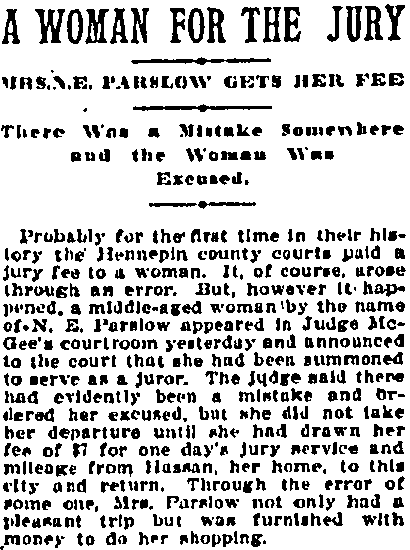
* Thanks to the wonders of database searches, research for this post also revealed a completely different legal drama off the same era related to a competely different Parslow. This story is from the Feb. 4, 1898 Minneapolis Journal.

** All reports do paint Cordelia Poirier as the stronger will in her adulterous relationship, as well as her marital one, and the instigator of the murder.

On this day..

1679: Robert Foulkes, adulterous minister

From the Newgate Calendar:

This unhappy gentleman was a divine of the Church of England, and had been very much esteemed for his learning and abilities. Few men were more capable of shining in a church, or had a greater share of that sacred eloquence so requisite in a preacher. He was minister of Stanton-Lacy, in the county of Salop, where he was exceedingly followed and admired till his crimes came to be known, and where he might have been beloved till death in a natural way had taken him hence, and then universally lamented, if his heart had been as well furnished with grace as his head was with knowledge and his tongue with expressions.

A young gentlewoman of a considerable fortune, who had been left an infant by her parents, was committed to his care by her executors, as to a man who, they trusted, would not only deal justly by her, but also instruct her betimes in the principles of religion, and her several duties as a Christian. But, alas! how weak is human nature, and how soon are we tempted aside from the ways of piety! Mr. Foulkes, instead of answering the purpose of the young woman’s friends, was soon smitten with her charms, and took an opportunity of discovering a criminal passion for her, though he had at that time a virtuous wife and two children living. The young lady too easily consented to gratify his lust, and they continued their conversation together till she became pregnant.

All the means he could think of to procure abortion were now tried, and they all proved ineffectual; so that they must be both exposed to scandal, unless she could be removed to some convenient place, remote from the eyes of the world, and from the jealousies of Mrs. Foulkes, where she might be delivered of her burden, which was not yet perceived. A plausible excuse for his going up to London was soon formed, and for his taking Miss along with him, who at that time was under twenty years of age. When they arrived in town they took a lodging in York Buildings in the Strand, where she lay in, and where (shocking to think of!) the child was privately murdered, to prevent the infamy that might follow.

But divine vengeance would not suffer this horrible deed to remain long concealed, for before Mr. Foulkes went out of town the girl was examined upon the suspicion of some women, when she confessed the whole, and charged Mr. Foulkes with the murder, who was thereupon apprehended and committed to Newgate; in a short time after which he was condemned at the sessions house in the Old Bailey, upon the evidence of the young woman. On the 31st of January, 1679, he was executed at Tyburn.

On this day..

1418: Beatrice di Tenda

On this date in 1418, the Duke of Milan annulled his marriage at the headsman’s block.

Beatrice (English Wikipedia entry | Italian) was initially the wife of the condottiero Facino Cane, a brutal but successful warrior who gained de facto control of the Duchy of Milan when it was inherited by a teenage Duke.

That teen’s younger brother, Filippo Visconti, spent the early 1400s packed away in Pavia, sickly and marginal, wondering which of the deadly machinations of state playing out above him might unexpectedly come crashing down on his own head. It seems doubtful that Beatrice ever had reason to give the little twerp a thought.

Delivery for Filippo came in May 1412. Big brother was assassinated while Facino Cane lay dying and suddenly the 19-year-old called the shots in Milan. In his day, he would become known as a cunning and cruel tyrant, and would make Milan the dominant power in northern Italy.

And it all was possible because of May 1412, which not only elevated Filippo but widowed our principal Beatrice. From her puissant late husband she inherited 400,000 ducats and huge … tracts of land. Her virtues could hardly fail to appeal to the whelp of a Duke, even at twenty years his senior; indeed, it was Cane himself who sketched out this succession plan from his deathbed.

It seems, however, that having taking possession of the wealth and legitimacy that came with Beatrice’s hand, Filippo soon grew irritated with the rest of her — enough so that he at last determined to put her aside. His paranoid Excellency wasn’t the quietly-retire-you-to-a-monastery type; instead, he went for the full Anne Boleyn.

Accusing his consort of consorting with a young troubadour in her court, Michele Orombelli, Filippo had the accused cuckolder and two of Beatrice’s handmaidens tortured until they produced the requisite confession/accusation of faithlnessness. Upon that basis he had Orombelli and Beatrice di Tenda both beheaded at the castle of Binasco. A plaque placed there to commemorate the spurned wife is still to be seen today.


(cc) image from Jk4u59.

Bellini’s second-last opera was based on this tragic story. Beatrice di Tenda premiered in 1833; it’s noteworthy in Bellini’s biography because deadline disputes in its composition ruined the composer’s longstanding collaboration with librettist Felice Romani.

On this day..

1860: Ann Bilansky

On this date in 1860, Ann Bilansky was hanged in St. Paul, Minnesota.

Bilansky — her Christian name is given as Ann, Anne, or Anna in various reports — was condemned for poisoning her husband, an immigrant Polish saloonkeeper named Stanislaus, so that she could get with her bit on the side.

Just a couple of weeks before Stanislaus’s unexpected March 1860 demise, Ann had gone with a friend to a local drug store and picked up a bit of the deadly powder, allegedly to deal with vermin. (This was arsenic’s very common, legitimate use.) She suspiciously tried to get her friend to put the purchase in her name.

The community suspected Ann a murderess as soon as Stanislaus dropped dead. She showed far less evident grief about her spouse than could possibly suffice for decency, and one local snoop peeped on her being a very merry widow indeed with her suspected paramour … on the very day after the funeral. Call it one for the road: the late husband’s stomach, when autopsied, had revealed that suspicious rat poison. She was soon behind bars, and would be convicted with ease.

(In July 1859, she escaped through a window of the barely-secure jail, rendezvoused with her old lover, and fled to the countryside. It was a week before the law collared her.)

Ann Bilansky continued to maintain her innocence at trial, in jail, and all the way to the scaffold. She reveled in the attention her case garnered and plied numerous visitors with claims of innocence and minute supposed errors in her trial. “She was a complete pettifogger,” said a newspaperman, “and had imbibed an opinion, which is common among better informed people, that technicalities could defeat justice in every case.”

But the versions of events she pushed on her many callers stood so starkly at odds with the evidence and the popular sense of her guilt that she even found her way into the local idiom for a time: a St. Paul resident could drolly call b.s. on someone by remarking, “You have been to see Mrs. Bilansky.”

Still, she was a condemned woman — and from the sound of it a rather appealing one — who asserted her innocence, and this meant she did not want for supporters. Legislators were among her jailhouse social circle, and she had enough sympathetic lawmakers that both the House and Senate actually passed a private bill for commutation of her sentence. Gov. Alexander Ramsey vetoed it.

Other visitors arrived bearing more forceful means of liberation: one slipped her chloroform, to disable the guards; a female visitor got caught in the act of trying to swap clothes with the doomed woman. Ann Bilansky even copped to having a specific family that she had arranged to hide out with if she could get out.

She just never quite managed the trick.

Ann Bilansky’s death was accounted a good one by the metrics of gallows-conduct: she did not faint or quail at the sight of the rope, or beg unbecomingly for mercy. But her last words plainly indicate that although she may have reconciled herself to death, she was not in the end at peace with the events that had brought about her end. (Many observers thought she entertained hope for the dramatic arrival of a last-second pardon.)

I die without having had any mercy shown me, or justice. I die for the good of my soul, and not for murder. May you all profit by my death. Your courts of justice are not courts of justice — but I will yet get justice in Heaven. I am a guilty woman I know, but not of this murder, which was committed by another. I forgive everybody who did me wrong. I die a sacrifice to the law. I hope you all may be judged better than I have been, and by a more righteous judge. I die prepared to meet my God.

Bilansky was the first woman executed in the state of Minnesota. (Minnesota had just become a state in 1858.) She remains to this date the last, and since Minnesota has no death penalty at present, she figures to keep the distinction for the foreseeable future.

Source: April 3, 1860 New York Herald

Part of the Themed Set: Arsenic.

On this day..

1698: Guido Franceschini, The Ring and the Book inspiration

Robert Browning‘s long narrative poem The Ring and the Book concerns the murder trial of the nobleman Guido Franceschini — a real-life case that saw the defendant in question executed in Rome on this date in 1698 for murdering his wife Pompilia as a suspected adultress. (And her parents just because.)

The 21,000-line work was Browning’s greatest success in life, though many particulars of Browning’s spin on events have been challenged by the 2001 study Roman Murder Mystery.

We’ll be content this day to take Browning’s audience’s-eye view of the jealous husband’s scaffold comeuppance on execution-day.

To mount the scaffold-steps, Guido was last
Here also, as atriciousest in crime.
We hardly noticed how the peasants died,
They dangled somehow soon to right and left,
And we remained all ears and eyes, could give
Ourselves to Guido undividedly,
As he harangued the multitude beneath.
He begged forgiveness on the part of God,
And fair construction of his act from men,
Whose suffrage he entreated for his soul,
Suggesting that we should forthwith repeat
A Pater and an Ave with the hymn
Salve Regina Coeli, for his sake.
Which said, he turned to the confessor, crossed
And reconciled himself, with decency,
Oft glancing at Saint Mary’s opposite,
Where they possess, and showed in shrine to-day,
The blessed Umbilicus of our Lord,
(A relic ’tis believed no other church
In Rome can boast of) — then rose up, as brisk
Knelt down again, bent head, adapted neck,
And, with the name of Jesus on his lips,
Received the fatal blow.

The headsman showed
The head to the populace. Must I avouch
We strangers own to disappointment here?
Report pronounced him fully six feet high,
Youngish, considering his fifty years,
And, if not handsome, dignified at least.
Indeed, it was no face to please a wife!

The “old yellow book” of original case notes that Browning found at a Florentine market and subsequently served as his reference source is available here. The poem itself is, of course, in the public domain; read it in its entirety here, or get hours of free audio reading here.

On this day..

1584: Anna Peihelsteinin, beheaded by Franz Schmidt

On this date in 1584, Nuremberg executioner Franz Schmidt beheaded Anna Peihelsteinin (Peyelstainin) for “lewdness and harlotry.” (Despite the image above, Schmidt notes that she was beheaded standing, not sitting.)

The married woman had been intimate with 21 other men, even including a father and a son. But Anna’s own husband was more understanding of her than the cruel law of the time; as the executioner recorded in his diary, the lonely widower Jerome — whipped out of town for countenancing her whoredom — left behind a miserable reproach scrawled on the wall of a church:

Father and son should have been treated as she was, and the panderers also. In the other world I shall summon and appeal to emperor and king because justice has not been done. I, poor man, suffer though innocent. Farewell and good night.

On this day..

1825: Peggy Facto, Plattsburgh infanticide

On this date in 1825, a woman named Peggy Facto was hung on Plattsburgh, N.Y.‘s Broad Street Arsenal Lot.

Facto — or “Facteau,” which variant recalls the French influence here on the shores of Lake Champlain — started her way to the gallows the previous autumn when some neighborhood dogs unearthed the remains of a human infant. It had been partially burned in a fireplace, and when found it still had fast about its throat the cord used to choke it to death. (Plus, of course, the dogs had done their own damage.)

This hideous discovery led back to our day’s principal character, the local mother of two [living] children whose husband had abandoned her due to her affair with a guy named Francis LaBare. Both Peggy and Francis were indicted for “being moved and seduced by the instigation of the devil” to murder their inconvenient bastard immediately after birth.

They faced separate trials for the crime, just hours apart on January 19, 1825, on very similar evidence. Witnesses established the discovery of the body, and an acquaintance named Mary Chandreau testified that she had seen Peggy Facto in an obvious late stage of pregnancy that August. This woman also visited Peggy Facto in jail before trial, and testified that Peggy admitted to having taken a string from one of her gowns to furnish the strangulation-cord.

While this evidence was sufficient to condemn Peggy Facto upon mere minutes of juror deliberation, the same case against Francis LaBare resulted in an acquittal. The mother, who did not testify at her own trial, did take the stand at LaBare’s trial, claiming (according to the notes of the judge), that immediately after she delivered the child, Facto

asked [LaBare] to go find her mother & he refused. She then asked him to go find Mrs. Chandreau & he refused, and next asked him if he meant to let her die there & he said the damned old bitch, I can do better than she can. She then requested him to help her & he did & then the child was born & he took it out and went off & was gone an hour, and when he returned … he came towards her with a knife & threatened her life if she said anything about it.

This quote, and much of what is known about Peggy Facto generally, comes via the research of Plattsburgh judge Penelope Clute. See here and here for HTML versions of the article, or here for a pdf.

It’s difficult to account, on the face of it, for the wildly differential outcomes of these trials; the all-male juries might have something to do with it.

At any rate, while LaBare walked, judge Reuben Walworth* pronounced Facto’s fate with enough fury for two … and a distinct disbelief in Facto’s attempt to blame LaBare:

there are very strong reasons for the belief that your own wicked hands have perpetrated the horrid deed. And if there was any other guilty participator in the murder, that your own wickedness and depravity instigated and persuaded him to participate in your crime. To the crime of murder, you have added the crime of perjury, and that in the face of Heaven, and even on the very threshhold of eternity. I am also constrained to say, it is much to be feared, that you will meet more than one murdered child, as an accusing spirit at the bar of Heaven.

Wretched and deluded woman! In vain was the foul and unnatural murder committed under the protecting shade of night, in your lone and sequestered dwelling, where no human eye was near to witness your guilt.

Facto’s only “appeal” after her half-day trial was the clemency consideration of Gov. DeWitt Clinton, a petition that ended up garnering a great deal of popular support, on three stated grounds:

  1. doubts with many as to the guilt of the convict
  2. as to this being a case that requires a public example
  3. As to the policy of executing any person for the crime of murder when the public opinion is much divided on this subject

Even Judge Walworth ultimately supported this appeal, despite his confidence “that the woman was perfectly abandoned and depraved and that she had destroyed this child and probably the one the year previous, not for the purpose of hiding her shame which was open and apparent to everybody that saw her but for the purpose of ridding herself of the trouble of taking care of them and providing for their support.”

The governor disagreed, arguing that the sort of enlightened people who signed on to death penalty appeals were out of touch with the rank terror necessary to keep the criminal orders cowed.**

So on March 18, 1825, an enormous crowd (fretfully many of them women) summoned from all the nearby towns slogged through spring-muddied roads to be duly cowed by the execution of the infanticide. The condemned, visibly terrified, barely made it through her death-ritual without fainting away, but she managed to re-assert her innocence from the gallows. (Some of the firsthand newspapering is here.)

After execution, Peggy Facto’s remains were turned over to the Medical Society for dissection. “A great many went to see her body, although it had been agreed that it should not be seen,” one woman later recollected in her memoirs. “Many young men went. So much talk was made of this that they said that no other body should ever be given to the doctors.”

* Walworth was a man of illustrious descent; one ancestor, William Walworth, was the Lord Mayor of London who killed Wat Tyler.

Judge Walworth would later become, for two decades, New York’s highest-ranking judicial officer; Walworth, N.Y. and Walworth County, Wisc. are named for him. But the American Walworths were bound for a tragic end … including a scandalous murder.

** “Their excellent character elevates them above those feelings which govern the conduct of the depraved … if terror loses its influence with them then indeed the life of no man will be secure.” For more on the evolution of the idea of “exemplary deterrence” as the death penalty’s raison d’etre, see Paul Friedland.

On this day..

1724: Willem Mons, head grafter

On this date in 1724, Willem Mons was beheaded in St. Petersburg for peculation.

Mons was the brother of the German commoner Anna Mons, a beautiful young woman who segued from being the May-December lover of Peter the Great‘s trusted admiral Franz Lefort to the mistress of the teenage emperor himself. Peter and Anna had a famous (famously scandalous) romance through her twenties, but as she entered her thirties and heard the clock ticking, her bid to make Peter put a ring on it by flirting with a Prussian diplomat came to grief and got her briefly tossed in prison.

Willem Mons was still a minor when his big sister fell from Peter’s graces. He would prove to have an equally adroit instinct for imperial bedchamber politics.

“One of the best-made and most handsome men that I have ever seen,” in the French ambassador’s estimation, Mons hustled his way into the train of the woman Peter had married instead of Anna — Catherine.

There Willem Mons and his other sister Matryona Balk monopolized the access routes to the empress and lucratively tolled all petitioners who traveled them. Wealth and status accumulated; the immigrant bourgeois’s son even stopped going by William in favor of the more impressive “Moens de la Croix”.

Not surprisingly, the emperor himself was the last to discover the open secret of his wife’s household’s river of graft.* Peter, who could be quite the moralist, was incensed; he interrogated the chamberlain so terribly that the young man fainted dead away.

“Moens de la Croix” was no longer. In both senses.

Having issued the confessions to condemn himself under the very credible threat of torture, Mons was socked away in Peter and Paul Fortress. Catherine made bold to defy Peter’s edict that nobody petition him for Mons’s life; in response, the enraged tsar smashed a Venetian mirror with his bare hand and roared, “thus I can annihilate the most beautiful adornment of my palace!” Court observers reported that marital relations between the two were visibly strained well after the scandal.

These weren’t happy days for the oft-sickly Peter; indeed, they were the last months of his life. Early the next year, he would succumb to a gangrenous bladder and leave the throne to this very Catherine. Perhaps his decrepit state accounts for the likely scurrilous rumor that the handsome chamberlain’s real offense wasn’t so much corruption as cuckoldry. It’s fair to say that such an affair would have been an extraordinarily reckless thing for Catherine.

On November 16, 1724, William Mons and Matrena Balk were taken in sledges to the execution site. Mons behaved courageously, nodding and bowing to friends he saw in the crowd. Mounting the scaffold, he calmly took off his heavy fur coat, listened to the reading of the sentence of death and laid his head on the block. After his death, his sister received eleven blows of the knout, very lightly administered so that not much harm was done, and was exiled for life to Tobolsk in Siberia. Her husband, General Balk, was given permission to marry again if he wished. (Source)

The late courtier’s severed head was preserved in alcohol (legend says that the fuming Peter made Catherine contemplate it). It was eventually deposited in the Kunstkamera museum, famous for housing Peter’s gross horde of collected pickled fetuses, dwarves, and other medical curios. Mons’s head still resides there today.

On this day..

1881: Po’olua, “darkened in my mind”

This date in 1881 saw the hanging of a native Hawaiian named Po’olua for a homicide of domestic jealousy tinged by almost tragic remorse.

This case is described in the 1991 essay “A Short History of Hawaiian Executions, 1826-1947” by Joseph Theroux.

In 1881, the Hawaiian [Po’olua] grew enraged when his when his common-law wife, according to the papers, “paraded her infidelity” before him and slaughtered her with a “big butcher knife.” Then, in a fit of remorse, he draped his house in mourning with black crepe paper.

… The experts of the day — family doctors and preachers — were conducted in to interview the bewildered man. They questioned him and concluded that he was not insane. Po’olua himsel agreed that he was sane but “darkened in my mind.” … the Reverend H.H. Parker explained the man’s actions this way: “A Hawaiian would do many things which a white man would not.”

When it as found that Po’olua had a heart abnormality and that he would likely die soon anyway, letters of clemency were circulated on his behalf. But he was hanged on May 20, 1881. Permission was sought for a post mortem to investigate the state of his heart, but officials denied the request. The Advertiser remarked that it “should have been done. Being attended to, might have laid him quiet in his grave; but being forbidden, his spirit will rise up Banquo-like for many a day to come.”

On this day..