1724: Willem Mons, head grafter

On this date in 1724, Willem Mons was beheaded in St. Petersburg for peculation.

Mons was the brother of the German commoner Anna Mons, a beautiful young woman who segued from being the May-December lover of Peter the Great‘s trusted admiral Franz Lefort to the mistress of the teenage emperor himself. Peter and Anna had a famous (famously scandalous) romance through her twenties, but as she entered her thirties and heard the clock ticking, her bid to make Peter put a ring on it by flirting with a Prussian diplomat came to grief and got her briefly tossed in prison.

Willem Mons was still a minor when his big sister fell from Peter’s graces. He would prove to have an equally adroit instinct for imperial bedchamber politics.

“One of the best-made and most handsome men that I have ever seen,” in the French ambassador’s estimation, Mons hustled his way into the train of the woman Peter had married instead of Anna — Catherine.

There Willem Mons and his other sister Matryona Balk monopolized the access routes to the empress and lucratively tolled all petitioners who traveled them. Wealth and status accumulated; the immigrant bourgeois’s son even stopped going by William in favor of the more impressive “Moens de la Croix”.

Not surprisingly, the emperor himself was the last to discover the open secret of his wife’s household’s river of graft.* Peter, who could be quite the moralist, was incensed; he interrogated the chamberlain so terribly that the young man fainted dead away.

“Moens de la Croix” was no longer. In both senses.

Having issued the confessions to condemn himself under the very credible threat of torture, Mons was socked away in Peter and Paul Fortress. Catherine made bold to defy Peter’s edict that nobody petition him for Mons’s life; in response, the enraged tsar smashed a Venetian mirror with his bare hand and roared, “thus I can annihilate the most beautiful adornment of my palace!” Court observers reported that marital relations between the two were visibly strained well after the scandal.

These weren’t happy days for the oft-sickly Peter; indeed, they were the last months of his life. Early the next year, he would succumb to a gangrenous bladder and leave the throne to this very Catherine. Perhaps his decrepit state accounts for the likely scurrilous rumor that the handsome chamberlain’s real offense wasn’t so much corruption as cuckoldry. It’s fair to say that such an affair would have been an extraordinarily reckless thing for Catherine.

On November 16, 1724, William Mons and Matrena Balk were taken in sledges to the execution site. Mons behaved courageously, nodding and bowing to friends he saw in the crowd. Mounting the scaffold, he calmly took off his heavy fur coat, listened to the reading of the sentence of death and laid his head on the block. After his death, his sister received eleven blows of the knout, very lightly administered so that not much harm was done, and was exiled for life to Tobolsk in Siberia. Her husband, General Balk, was given permission to marry again if he wished. (Source)

The late courtier’s severed head was preserved in alcohol (legend says that the fuming Peter made Catherine contemplate it). It was eventually deposited in the Kunstkamera museum, famous for housing Peter’s gross horde of collected pickled fetuses, dwarves, and other medical curios. Mons’s head still resides there today.

On this day..

1561: Sehzade Beyazit, inevitably

On this date in 1561, the Persian Shah abandoned Ottoman prince Sehzade Beyazit to the vengeance of his “magnificent” father.

A late and sad casualty of Istanbul’s pivotal family tragedy, Beyazit was actually a son of Suleiman the Magnificent‘s favorite wife, the freed Ukrainian slave Hurrem Sultan or Roxelana.

Unfortunately, he wasn’t the first son.

After Roxelana engineered the execution of heir apparent Mustafa on spurious grounds, Beyazit and his brother Selim were the last princes standing.

The natural rivalry between the two for eventual power was surely colored by the clear portent Mustafa’s execution had sent that the succession game was rigged for Selim. After several years of growing estrangement, Beyazit finally revolted outright only to be defeated in battle by Selim in 1559.

The loser found refuge in Persia, but only long enough for the Safavids to negotiate the price of his surrender to the hands of Suleiman … whose executioner went on the road to the Persian city of Qazvin to strangle not only Sehzade Beyazit but his four sons, too.

Extirpating the treasonable branch of the family tree cleared the succession for Selim, whose eight-year turn in power would be remembered as moment the hitherto-all-vanquishing Ottomans began their long, slow slide to Sick Man of Europe status. Particularly given that coda, Suleiman’s own

long reign is flawed by tragedy more subtle than the hubris which had overcome his ancestor Bayezit the Thunderbolt; more consequential than the gilded misery reserved for later sultans. The higher men rose in the empire, the closer they got to the bowstring; and the reign of Suleyman seems in retrospect coiled round with a silken garotte …

When the Austrian ambassador took leave of Suleyman in his old age, it was scarcely a living being he described, but a sort of metaphor of empire, rotting and majestic, fat, made up, and suffering from an ulcerous leg.

There’s more about this misfortunate lesser son in Turkish here, and a Turkish poem he wrote beseeching his father’s forgiveness here.

On this day..

1895: The Vegetarian perpetrators of the Kucheng Massacre

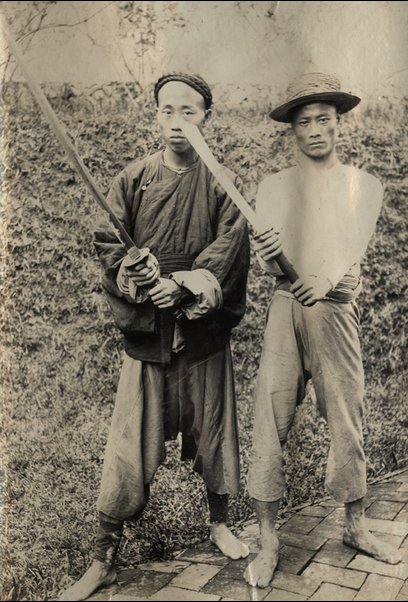
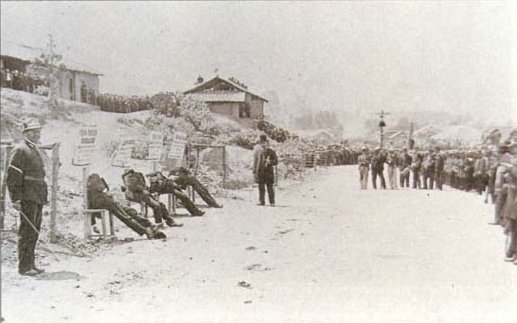
On the morning of September 17, 1895, in the presence of the British and American consuls, seven perpetrators of a Chinese massacre of western Christian missionaries were beheaded at Foochow.

Anticipating the better-known Boxer Rebellion by four years, the Kucheng Massacre (there are many other transliterations of “Kucheng”) was likewise a response to the Celestial Empire’s frustrating second-class status as against European interlopers.

Christian missionaries had been a point of friction in China for decades. Though their rights to proselytize had been guaranteed in a hated treaty dictated to China by force of arms, they often met resentment or worse on the ground.

“You bring incense in one hand, a spear in the other;” one evangelist reported being told: that is, however honorable the immediate intentions of many individual missionaries, their presence looked like a stalking horse for less reputable western interventions like the opium trade. (That’s how it looked to many Chinese. Professional western diplomats themselves found the impolitic preachers a hindrance to their statecraft, according to Ian Welch’s 2006 paper “Missionaries, Murder and Diplomacy in Late 19th Century China: A Case Study” (pdf).*)

On August 1, 1895, these frustrations unleashed a river of blood at the village of Huashan in Gutian County, where a Buddhist secret society — known as “Vegetarians” in the western press for their characteristic dietary vow — fell upon a group of vacationing British Anglican missionaries still abed at dawn and ruthlessly slaughtered eleven of them. (There are some 1890s books paying tribute to the fallen available online: Robert and Louisa Stewart: In Life and in Death, and The sister martyrs of Ku Cheng : Memoir and Letters of Eleanor and Elizabeth Saunders (“Nellie” and “Topsie”) of Melbourne.)

“The attack came,” said a physician from a nearby town who was summoned to the bloody scene, “like a thunderbolt from a clear sky, not one of the victims having received the slightest intimation of the intended assault.”

Word of the carnage struck western powers with similar force.

Incensed newspaper-readers literally demanded** gunboat diplomacy, and literally got it, especially when Chinese authorities drug their feet on the condign punishment the missionaries’ countrymen were clamoring for.

All this put British diplomacy on a sticky wicket, which Welch (pdf) deals with in detail. To satisfy the domestic audience, the government had to be seen to be taking a hard line on avenging the outrages; at the same time, London was wise to the Chinese state’s shakiness and wary that a “barbarous holocaust” perpetrated against the Vegetarians would trigger a mass backlash and bring the whole thing down.

An obdurate Chinese viceroy impeded the quick resolution everyone was after by making inflammatory public proclamations against Christians, and releasing without explanation six of the thirteen men who had initially been condemned to death in the month of August. The seven who were executed on this date were therefore only the vanguard of 26 humans ultimately put to death for their involvement in the atrocity.

Some of the execution photographs that follow are Mature Content. They’re obtained via Visual Cultures in East Asia; some also available at USC Digital Library.


Raids and investigations to bring the Vegetarian movement to heel continued for several months thereafter, and the whole affair ultimately was quelled without doing any of the wider damage that might have been feared — not even to missionaries who continued pouring into China.

And that, effectively, kicked the can down the road on the anti-foreigner sentiments afoot in the land … sentiments that would find much costlier expression a few years later when another secret society kicked off the Boxer Rebellion.

* I’ve relied heavily on Welch for this post. He’s also collected a massive trove (over 1,200 pages) of primary documents from this incident available in a series of pdfs (some quite large) from the Australian National University website:

** This was not universally so. The wife of missionary Stephen Livingston Baldwin, who knew some of the victims of the attack, urged a “charitable” response and sensitivity that “the Chinese feel that all the world is against them, and they are not far from right.” (New York Times, Aug. 10, 1895) In letters responding to intemperate coverage elsewhere, she acidly compared (pdf) western editorialists’ high dudgeon to their look-forward-not-back dismissal of recent stateside anti-Chinese violence.

It was ten years yesterday since more Chinese were killed, and burned alive and left to die wounded, in one hour, at Rock Springs, Wyoming (the very same Territory in which the recent massacre occurred) than have been Americans and English in China in the thirty-four years I have personally known that land, being a resident there twenty years and closely connected with it ever since. Ten years yesterday since that awful Rock Springs massacre, and up to date no one arrested, much less punished! The anti-Chinese papers of the town and neighbourhood gloating over the awful details and assuring all that there would be “no Congressional investigation,” and no waste of “enterprising newspaper eloquence” over the woes of the Chinese, “though their blood flow like rivers, as they had no votes and no friends.” In less than four weeks after the Ku-Cheng massacre, arrest, investigation and execution have all taken place for the Ku-Cheng massacre. Would that our colored, red and yellow brethren, so helpless in our so-called civilized and Christian land, had some power behind them to bestir Ministers Plenipotentiary, wave flags, and run gunboats to the front, to bully, if necessary, our pusillanimous Government into some sort of civilization — I will not say Christian justice!

On this day..

1469: Richard Woodville, father of the queen

On this date in 1469, Richard Woodville, the father of the queen, lost his head.

Though he died as Earl Rivers, Woodville started life as a commoner.

As a retainer to the Duke of Bedford, Woodville drew escort duty for the mistress of the house when the master died suddenly. Not one to waste an opportunity, Woodville soon made the merry widow his merry wife: at the time, he was around 30 and she around 20, while the late husband had kicked off at age 46.

For this impertinent and unauthorized union, the couple paid a fine … and their descendants enjoyed royal power. Well-behaved women and knights-errant seldom make history, right?

Marrying nobility put Woodville into the War of Roses game of throne, where he again proved a deft hand with sneaky conjugation.

In 1464, he secretly married his widowed daughter Elizabeth to the young king Edward IV. Elizabeth Woodville became thereby the first commoner in history to marry an English king.

She also became a lightning-rod.

The Earl of Warwick, so powerful that he was known in this era of uneasy-resting crowns as “The Kingmaker”, was embarrassingly undercut by the Woodville match in his own machinations to pair Edward with a French princess. A stunned Privy Council castigated Edward when it found out — “however good and however fair she might be,” they grumbled “she was no wife for a prince such as himself; for she was not the daughter of a duke or earl” — but the young king stood by his lady.

A love match? We leave that question for the poets and the novelists.

From left to right, Philippa Gregory‘s books about Richard Woodville’s wife, daughter, and granddaughter. Gregory also wrote a nonfiction companion to this bestselling series, The Women of the Cousins’ War: The Duchess, the Queen, and the King’s Mother.

But politically, the Woodville marriage certainly upset the game board. Richard Woodville got promoted to Earl Rivers and others of the tribe profited likewise: this made good sense for Edward because these people would owe their positions, and loyalty, to him.

Contrast with the independent, arrogant aristocrat set like Warwick, who soon proceeded — and what part l’affaire Woodville plazed in his defection is up for speculation, although it was part of his own publicly asserted justification — to desert Edward’s Yorkist cause for the Lancastrian claimant.

Warwick’s rebellion succeeded in overthrowing Edward in 1469, and it was in the glow of this victory that Warwick had the obnoxious arriviste Richard Woodville beheaded as a traitor, together with the man’s son John.

Unfortunately for Warwick, it was but a moment.

Unable to govern, Warwick had to release his royal prisoner, and the sides slid back into open conflict. Edward decisively crushed the Lancastrians at the Battle of Tewkesbury, conveniently killing Warwick in the process.

Duly returned to her station, Elizabeth Woodville produced two sons for her husband, the boys history remembers as the Princes in the Tower — which is where the last LancastrianYorkist king Richard III is thought to have murdered them. In Shakespeare’s Richard III, Queen Elizabeth is quite the bummer.

Ay me, I see the ruin of my house!
The tiger now hath seiz’d the gentle hind;
Insulting tyranny begins to jet
Upon the innocent and aweless throne.
Welcome, destruction, blood, and massacre!
I see, as in a map, the end of all.

But her house wasn’t quite ruined after all: Elizabeth Woodville also produced a daughter, also named Elizabeth. This latter “Elizabeth of York” married another descendant of a commoner, who carried the Lancaster standard: this fellow of doubtful lineage would finally resolve the War of the Roses and reign as Henry VII. (Father, namesake, and predecessor, of course, to this site’s patron head-chopping monarch Henry VIII: Richard Woodville’s great-grandson.)

On this day..

1318: John Deydras, aka John of Powderham

(Thanks to Meaghan Good of the Charley Project for the guest post. -ed.)

On some day in June 1318, a cat and a one-eared man called John Deydras or Dydras, also known as John of Powderham, were hung in Oxford for challenging the right of Edward II to rule; indeed, John had claimed he was Edward II himself.

It had all started earlier that year when he walked into the King’s Hall in Oxford and announced before everyone that he was the rightful king of England. It was true that he resembled King Edward’s father, Edward I, except that he was missing an ear.

According to Powderham, when he was a baby and playing in the castle yard, a pig bit his ear off. His nanny, fearing the wrath of his royal parents, substituted him for a changeling. Now he was back and wanted to claim his kingdom. He even offered to fight King Edward in single combat for the right to rule.

Historian Helen Castor records the incident in her book She-Wolves: The Women Who Ruled England Before Elizabeth:

Edward’s first response was to laugh. He welcomed the pretender, the Chronicle of Lanercost records, with a derisive cry of “Welcome, my brother!” But for the queen, struggling to maintain her husband’s dignity (and, with it, her own), and acutely conscious of the threatening consequences of Edward’s failings, jokes did not come so easily. Proud Isabella was “unspeakably annoyed.”

Proud Isabella had a reason for being so displeased, for her husband was nothing like his father, who had been an accomplished soldier and a good king. Indeed, Edward was widely despised not only for his inept leadership but his unseemly relationships with other men.

After his arrest, Deydras confessed that the story had been a lie. He blamed his pet cat, a servant of the devil, for putting him up to it.

Modern readers can only conclude that the man was crazy. Royal pretenders had remarkably short lifespans, and to become one was effectively to commit suicide. (And at the urgings of a cat! Cats are not, after all, noted for their political acumen.)

Deydras’s contemporaries probably also knew he was mad, and Edward wanted to keep him as a court jester, but according to well-established precedent he was hung — and the cat too.

On this day..

1312: Pierre Vigier de la Rouselle, Gascon

“It is unjust that that which is rightly judged should result in prejudice to us and bring damage to others …”

-Edward II, letter concerning the Pierre Vigier case

One is like to reckon the phenomenon of the interminable death penalty appeal a modern construct, product of the present day’s moral confusion or juridical inefficiency.

It’s been right about 700 years exactly since Pierre Vigier was hanged in the February-April neighborhood, in the year of our Lord 1312, for his impolitic sentiments on the governance of his native province. This medieval execution went with a very modern-sounding 12 years of indeteminate appeals.

Still, it is true what they say — “The past is a foreign country: they do things differently there.” In this foreign country, Gascony by name, they did the hanging first … and then did the appeals.

Our source here (virtually the only source short of plumbing the archives) is Joseph Kicklighter’s “English Bordeaux in conflict: the execution of Pierre Vigier de la Rousselle and its aftermath, 1312-24” from the Journal of Medieval History, no. 9 (1983).

And the source of all the judicial chaos was the bizarre situation of one king as a rival king’s vassal.

Gascony at this time was a sort of feudal leftover of the Angevin Empire whose Plantagenet descendants were still kings of England. This remaining Plantagenet patrimony* in southwestern France was a going source of conflict between the realms, the most recent of which had been expediently settled by making the English king also Duke of Gascony … and (with respect to Gascony) the French king his liege lord.


Seated French king Philip IV accepts the homage of his “vassal” Edward I.

The territory was worth the “submission”: ducal Gascony’s fertile land gave England a bounty in crops and wine. And the inevitable rivalry over sway in Gascony easily knocked on to the courts. As Barbara Tuchman put it in A Distant Mirror,

[t]he King of France still retained superior sovereignty under the formula of superioritas et resortum, which gave the inhabitants the right of appeal to the ultimate sovereign. Since his decisions were more than likely to go in their favor against their English overlord, and since the citizens, knowing this, exercised the right frequently, the situation was an endless source of conflict.

It was during such a conflict, when the rival factions of the Gascon capital of Bordeaux had the city in virtual anarchy as they jockeyed for power under the nominal lordship of English king Edward II, that the onetime royal castellan Pierre Vigier de la Rouselle apparently dumped on one of the new officials in conversation with a couple of informants.

The municipal government arrested Vigier and had him hanged — quickly, before Vigier’s inevitable attempted appeal to Parlement could save him.

(This all went down just a couple months before Edward II suffered a Gascon humiliation closer to home, when the Gascon nobleman Piers Gaveston, Edward’s dear friend and suspected lover, was executed by rival English lords.)**

Vigier’s aggrieved sons did pursue the appeal (it is they who provide posterity the circumstances of Pierre’s condemnation, so handle the story with care: one latter-day hypothesis is that Vigier was an outright rebel against the new appointees). Inevitably, the French backed their claim, allowing them undercut Edward’s ducal authority.


Productive relationship.

From there, the matter sank into an intractable mire of feudal Europe’s overlapping political authorities and factional rivalries. Parlement decreed some penalties. King Philip remitted some of them as a diplomatic gesture. The sons renewed their complaint. Bordeaux authorities tried to put the matter to bed by persecuting Vigier’s persecutors, only to be slapped down by an indignant King Edward. Persons were seized only to be ordered released, and estates likewise. Just as there was no single unambiguous authority to adjudicate it, there was no single wrongdoer to investigate, no single injury to repair (besides the matter of honor, there was the dead man’s property, and the fact that he was buried in unconsecrated ground), and no single arrangement of interested parties between the Vigier sons on the one side and the Plantagenet king on the other.

Edward seems to have taken particular affront at this imposition on his routine authority, and one must bear in mind that at this stage even the concept of sovereignty as we think of it today was simply not on the map. In some ways, the French appeals policy was pioneering it.

But as the suit bumped up and down or got kicked down the road by a Parlement that was probably enjoying its sport, Edward tried to dispose of it through such expedients as harassing its supporters and attempting to bankrupt the Vigiers. All this, naturally, just got rolled into the messy ol’ case.

Kicklighter:

Only time itself finally ended the appeal … in March 1324, King Charles IV announced the indefinite postponement of all ducal litigation at the Parlement of Paris becase of a mounting Anglo-French crisis which would soon lead to the brief War of Saint-Sardos. But even during the war, the court continued to deal with some aspects of the case; and the appeal was still under judgment when the Anglo-French feudal relationship was resumed with the accession of Edward III to the English throne.† It seems likely … Parlement had dropped the case by the 1330’s … in all probability, the Vigier case had lost the critical importance with which the king-duke and his officials had regarded it for so long. One might, with some justification, wonder why the appeal had ever enjoyed such attention.‡


In 1337, King Philip VI of France attempted to seize Gascony. In response, Edward III declared himself (not without at least some theoretical validity) the rightful King of France. The ensuing hostilities proved to be the opening act of the Hundred Years’ War.

“It was not the dynastic question that brought about the war,” wrote the historian T.F. Tout. “The fundamental difference between the two countries lay in the impossible position of Edward in Gascony.”

* Here’s a lovely free book about the preceding century’s backstory of English rule in Gascony.

** Potentially topical to this digressive connection: Edward’s loyal aide in Bordeaux, a gentleman by the name of Arnaud Caillau, may have been a cousin of Piers Gaveston. Edward certainly had a supportive Gascon faction that his own resentful alleged vassals were frequently keen to harass; maybe the whole Vigier intervention just struck a little too close to home.

† The reader will recall that Edward III’s route to power involved his French mother and her lover invading England and overthrowing Edward II. So there was a good deal of more interesting politics going on around this time than Pierre Vigier’s endless procedural appeal.

‡ Lest we misrepresent Kicklighter, he does go on to attempt to explain this hypothetical wonder as “a certain indication of the limited power of the English in Gascony.” I prefer my own stopping-point.

On this day..

1997: The last execution in Ukraine

The last execution in Ukraine apparently took place on this date in 1997 — and bizarrely, nobody even seems sure of exactly who enjoyed this unwelcome distinction.

This was post-Soviet Ukraine under Leonid Kuchma, a man in no way renowned for his excessive regard for human dignity.

But Kuchma was keen on integrating with Europe, and that meant appeasing western Europe’s human rights sensibilities.

Ukraine joined the Council of Europe in 1995, a move that required it to abolish the death penalty. But executions — by means of the old Soviet method, a single gunshot to the back of the head — were ragingly popular during a decade of economic collapse and spiraling crime.

According to When the State No Longer Kills, which has an entire chapter devoted to the Ukrainian abolition experience, Ukraine’s annual count of reported murders shot up from 2,016 in 1988 to 4,896 by 1996, with 4,000-plus per annum every year from 1993 on.

“The country’s crime rate does not allow for cancelling the death penalty,” Ukraine’s Parliamentary chair told COE observers in November 1996.

He was in for a surprise.

To Europe’s chagrin, some 167 people were indeed put to death in 1996 alone. The Council Of Europe pointedly threatened sanctions against the Ukrainian delegation in January 1997 … and Kiev chickened out.

Its last executions were thirteen conducted in the first 70 days of 1997 — executions which were not announced publicly beforehand or even afterwards, and only wrung as admissions out of the government months afterward when the prisoners’ respective contacts realized they hadn’t heard from them in a suspiciously long period of time. Between this up-front secrecy and Ukraine’s practice of dumping its executed bodies in unmarked graves, nobody ever seems to have been able to document who exactly died when, and who really was last. (We assume the incriminating paper does exist somewhere in the bowels of the bureaucracy.)

By the same token, there was no public indication when the sun came up on March 12 that anything had changed. Ukraine kept information about its death row prisoners close to the vest; the Council of Europe continued to press it for a moratorium until very late in 1997, when Kiev announced that it had in fact been observing a de facto moratorium since March 11. I guess we have no choice but to take their word for it.

Just like that, this impossible dream had been accomplished.

Two years later, the country’s high court barred the death penalty, followed quickly by parliamentary action to remove it from the statutes full stop.

The nameless dead man or woman of this date is actually not only the last executed in Ukraine, but the last in the entire 47 countries of the Council of Europe — a zone that still excludes Ukraine’s neighbor Belarus, which as of writing is the last redoubt of capital punishment in Europe.

On this day..

1906: The would-be assassins of General Rafael Reyes

BOGOTA, Colombia, Tuesday, March 6. — The three men who on Feb. 10 attempted to assassinate Gen. Reyes, the President of the Republic of Colombia, were shot to-day at the spot where the attack took place.

-New York Times, March 8

Reyes had parlayed a successful military career into politics (Spanish link), and was the elected-ish but also dictatorial president of Colombia.

He had the misfortune to ascend to this illustrious post on the heels of a bitter civil war that had seen its Panama department break clean away. To Reyes’ administration would fall a variety of civil society infrastructure projects (more Spanish): constitutional reform, military modernization, a central bank, reconciliation with the Liberal party.

Marco Salgar (left) and Roberto Gonzalez, two of the failed assassins.

He couldn’t make these omelets without breaking a few eggs and his authoritarian power was challenged with at least two coup attempts and multiple assassination plots, as well as a bid by other Colombian territories to break away and join up with Panama.

But the most notorious angry-with-Reyes event was the 10th of February 1906 — also the title (Spanish again) of a book of photographs documenting the incident — when three gunmen ambushed Reyes on the outskirts of Bogota and somehow all managed to miss both the president and his daughter.

Reyes’ vengeance was extrajudicially old-school: the executions he arranged were not permitted under Colombian law at all, and by having them publicly shot at the scene of the crime, he added a downright medieval twist of lese-majeste.


Images from here. These are the three shooters mentioned by the Times, as well as a fourth accomplice.

However rough his methods, Reyes did accomplish some important reforms for his country, and he did have the grace to resign his position in 1909 under fire for financial and diplomatic mismangement. (The man’s five-year administration has its own periodization in Colombian historiography: the quinquenio.) There have been worse entries in the annals of dictatorship.

On this day..

1934: Augusto Cesar Sandino, national hero

“The sovereignty of a people cannot be argued about, it is defended with a gun in the hand.”

-Sandino

On this date in 1934, the first name in Nicaraguan anti-colonial resistance was abducted and summarily executed by the Nicaraguan National Guard.

From 1927 until his death, Sandino led an armed peasant insurgency from the Nicaraguan mountains against the Yankee imperialists and the domestic dictatorship they backed.

Washington had had its nose (and its marines) in Managua’s business for decades, continuously occupying the Central American country since 1912. The Marine Corps saw this country’s people as

Densely ignorant … little interested in principles … naturally brave and inured to hardships, of phlegmatic temperament, tough, capable of being aroused to acts of extreme violence, they have fought for one party or the other without considering causes since time immemorial … a state of war is to them a normal condition.*

All this was the time of Sandino’s own coming-of-age. The son of a wealthy landowner and his domestic servant, Sandino grew up with the unprivileged and the working classes, eventually asorbing an eclectic mix of that period’s revolutionary ideologies.

From 1927 he took to the Segovia and began writing the playbook for the 20th century guerrilla: mobile infantry irregulars, striking from familiar-to-them forest cover, melting away among sympathetic campesinos.

The “Colossus of the North” — Sandino made no bones about his foe; his personal seal showed an American marine being killed — invariably described him as a “bandit” because he also raided towns to commandeer food, clothing, and medicine.

“Washington is called the father of his country; the same may be said of Bolivar and Hidalgo; but I am only a bandit, according to the yardstick by which the strong and the weak are measured.”

-Sandino

The strong, in this case, found little public appetite for the steady attrition of servicemen, and the U.S. employed a familiar strategy of its own: “Nicaraguanizing” the conflict by building up a National Guard to do the dirty work domestically.

That Guard’s head was headed by Anastasio Somoza — the very son of a bitch of whom FDR said, “but he’s our son of a bitch.”

While it’s hardly the only country to have been favored with an American son of a bitch, you could say that Nicaragua has been the American empire’s very own heart of darkness. Washington’s initial interest in the place after the Spanish-American War concerned preventing a canal project to compete with Panama. It invented dive-bombing to hunt Sandino. And it ranged around the world and outside the law to battle Sandino’s successors under the aegis of a modern imperial presidency.

Small wonder that an official anthem of the movement denounces “The Yankee / The enemy of all humankind.”

In the immediate aftermath of the American departure in January 1933, Sandino began coming to terms with the the country’s new president: the Sandinistas disarmed in exchange for amnesty and land. But Somoza, who at this point was “only” the head of the National Guard, was building up his own power … and he meant to have done with this inconvenient insurgent.

After Sandino left a presidential meeting on this date, at which the erstwhile rebel negotiated for his continuing demand to disband Somoza’s Guardia, Sandino was stopped at the gates by Guardsmen. They took Sandino, his brother, and two of his generals and marched them off to be shot. Then the Guard forcibly broke up the Sandinista remnants. Somoza soon seized official power for himself; his family ruled, and plundered, Nicaragua until 1979. Washington never called them bandits.

While Sandino vanished (the whereabouts of his remains are unknown), his revolutionary vision and praxis also persist down to the present day.

Sandinismo (aging much better than Somocismo) would influence Fidel Castro and Che Guevara during the Cuban Revolution.

And in 1979, the Sandinista National Liberation Front finally succeeded in overthrowing the last loathsome scion of the Somoza dictatorship.

The United States, of course, went right back to war against its long-dead “bandit” foe.

* From Julian C Smith’s officially commissioned History of the Guardia Nacional de Nicaragua (1933), as quoted in Michael J. Schroeder’s “Bandits and Blanket Thieves, Communists and Terrorists: The Politics of Naming Sandinistasin Nicaragua, 1927-36 and 1979-90,” Third World Quarterly, Vol. 26, No. 1 (2005).

Schroeder runs the definitive English-language website on Sandino and the original Sandinistas, with a truly vast collection of documents and resources.

On this day..

1524: Not Jean de Poitiers, father of the mistress

On this date in 1524, the French aristocrat Jean de Poitiers, Seigneur de Saint Vallier lay his head on a chopping-block.

He kept it there for a full hour, but the headsman never swung the blade — and Jean de Poitiers walked away with a royal clemency.

This lucky Seigneur had been caught up in an English- and Habsburg-backed plot by the Constable of France to break off a chunk of France. (Said Constable fled to Charles V.)

Jean de Poitiers skated on noblesse oblige and lesser culpability, but there’s a scurrilous story that he was heard thanking God as he was led back from the scaffold for his daughter’s many charms.

Diane de Poitiers

The aforesaid beguiler, then-24-year-old Diane de Poitiers, had gone to King Francis to plead for her father’s life. Apparently she made an impression. (Or the king was planning to pardon Jean anyway.)

The implication of having gone the extra mile derives not from any particular fact known about that meeting, but from Diane’s subsequent, and rather illustrious, career as mistress to the monarch — not to Francis, but to his son Henri II.

In the 1530s, when Diane was a cougar-aged widow,* she became the mistress of the teenaged prince — and the rival of his teenaged bride, Catherine de’ Medici.

Diane was anything but the other woman in this arrangement: the brilliant, forceful personality whom Henri trusted as no other, it was Diane de Poitiers who wielded queen-like power during her lover’s reign. (They even had an H-D monogram.) She made calls in statecraft and in the royal household, and one can fancy the fury Queen Catherine conceived for having her husband’s older mistress decide how to raise the kids.

Diane’s career ought to have ended in a state funeral, but the hale and hearty Henri suffered a freak jousting accident in 1559 that reordered female influence in the Valois dynasty. Catherine wouldn’t even let Diane near the deathbed of the king as he painfully expired — and the queen exiled the former royal favorite to a distant estate as soon as possible.

* Diane de Poitiers was on either end of May-December arrangements in her time, and the monument that she put up for her much-older husband Louis de Breze can be seen at the cathedral in Rouen.

On this day..