1936: Bruno Richard Hauptmann, The Most Hated Man in the World

On this date in 1936, a German immigrant went to New Jersey’s electric chair for kidnapping and murdering the infant son of famed aviator Charles Lindbergh.

Snatched

The kidnapping of the Lindbergh boy in 1932 had touched off an outpouring of public compassion matched only by the clumsiness of the investigation. The circus that formed around a father desperate to retrieve his boy — and prone to rash decision-making thereto — pulled in underworld figures, military intelligence officers (including the founder of the CIA’s forerunner and the father of Gulf War General Norman Schwartzkopf), a meddlesome schoolteacher, and queer characters like “Cemetery John,” who somehow managed two meetings with Lindbergh’s intermediaries, making off with a box full of ransom cash without anyone so much as tailing him, much less having to fork over the hostage.

The boy, in fact, was dead, and would be discovered weeks later, a few miles from the Lindbergh house, in such a state of decomposition as to suggest that, by accident or intention, he had suffered a fatal head injury almost at the moment of his abduction.

Two years’ fruitless investigation ensued, with leads that frustratingly faded away and at least two suspects who committed suicide. The police job had been a hash from the start, between amateurish cock-ups like failing to measure footprints found on the scene and security breaches in the chaotic weeks following the kidnapping. Most damagingly, a newspaper laid hands on an early ransom note and printed it, making it impossible subsequently to positively discern the kidnapper’s real notes from hoaxes.
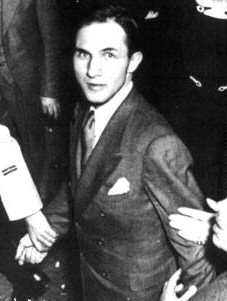
But John Law had done one thing right: paid the ransom in soon-to-be-obsolete gold certificate. As they’d hoped, someone was finally caught spending this distinctive currency: Bruno Hauptmann.

Hauptmann actually went by “Richard”, but with its unerring sense of the Zeitgeist, the press played up his menacing alien moniker. After two and a half years, the public was ready to hate someone, and an illegal immigrant with a criminal record* from the late war’s great enemy was pretty much made to order.

Trial of the Century

The one thing Hauptmann didn’t do was confess — and that necessitated the “Trial of the Century,” or in Mencken’s coinage, “the greatest story since the Resurrection.”

It was O.J. before 24-hour cable. Journalists packed the small-town courtroom of Flemington, N.J.; for six weeks early in 1935, an aggressive prosecutor vied with a flamboyant (but cripplingly dissolute) defense attorney hired for the penurious defendant by the Hearst newspaper empire in exchange for inside information.

This newsreel footage of the trial consists mostly of Hauptmann’s own testimony, and even at seventy-plus years’ distance it crackles with drama — and with the persecutorial atmosphere that sealed Hauptmann’s fate, guilty or not. (The defendant often sounds uncertain and evasive in these clips — it cannot have helped his standing with the jury, but it is worth recalling that English was not his native language.)

History’s Verdict

The case was circumstantial, the most powerful circumstance, of course, being Hauptmann’s possession of ransom money — thousands of dollars worth, as it turned out, stashed in his garage. Hauptmann said a friend had left it when returning to Germany; the alibi didn’t convince many, but Hauptmann stuck to it to the end, even refusing to accept a commutation in exchange for a confession. This audio of a convicted Hauptmann still maintaining his innocence comes from the New Jersey Star-Ledger blog.

[audio:Bruno_Hauptmann.mp3]

Much other evidence against him — shaky eyewitness testimony, doubtful courtroom forensics — seems less damning, especially from the perspective of time. Unexplored problems — why would a professional carpenter build such a shoddy ladder? How could he have known the (rare) night the Lindberghs would actually be home? — gesture emptily towards other suspects never pursued, though they are very far from authoritatively exonerating Hauptmann. Ultimately, it’s a case with many unclear data points, whose importance and configuration invite dispute. (Here‘s a site dedicated to Hauptmann’s innocence, including this article (.pdf) outlining the main arguments his partisans make.)

Even the verdict’s defenders, and there are many, concede that portions at trial were exaggerated or outright perjured in an atmosphere hardly conducive to dispassionate review. Whether that makes Hauptmann “guilty but framed” or plausibly innocent (of the kidnapping, if not of opportunistic extortion) has been the subject of far more rumination than this blog can hope to assay.

A few of the many books about the Lindbergh case

An enigmatic criminal tied to an enigmatic icon in a painfully public four-year drama that transfixed the nation and still inspires debate: that “Trial of the Century” marquee holds up pretty well.

* In Germany; Hauptmann’s record was clean stateside — apart, that is, from Charles Lindbergh, Jr.

On this day..

1582: John Payne, snitched out

On this date in 1582, the Jesuit priest John Payne suffered drawing and quartering at Chelmsford for his forbidden faith.

This blog tips its cap to any fellow who prefers that awful punishment to a timely change of doctrine. Payne (or Paine) is accordingly one of the Forty Martyrs of England and Wales recognized by the Catholic church.

But at our present distance, Payne hardly stands out from the slew of 16th century Catholic martyrs in the way an Edmund Campion does.

We pause instead to take note of a small continuity between Payne and Campion, a secondary character whose shadow we observe but fleetingly, but whose presence suggests the condition of a community under siege — and whose character seems not unknown to our time.

Campion was apprehended by a police informant named George Eliot (“Judas Eliot”, Protestants as well as Catholics would call him).* A Catholic himself, Eliot took to collecting bounties on fugitive priests — to relieve himself, the Catholics said, of a murder charge pending against him. Eliot attended Campion’s last service, excused himself, and returned with a posse.

Later, he would meet his prize in prison:

“If I had thought that you would have had to suffer aught but imprisonment through my accusing of you, I would never have done it,” [Eliot] said, “however I might have lost by it.”

“If that is the case,” replied Campion, “I beseech you, in God’s name, to do penance, and confess your crime, to God’s glory and your own salvation.”

But it was fear for his life rather than for his soul that had brought the informer to the Tower; ever since the journey from Lyford,** when the people had called him “Judas,” he had been haunted by the specter of Catholic reprisal.

“You are much deceived,” said Campion, “if you think the Catholics push their detestation and wrath as far as revenge; yet to make you quite safe, I will, if you please, recommend you to a Catholic duke in Germany, where you may live in perfect security.”

But it was another man who was saved by the offer. Eliot went back to his trade of spy; Delahays, Campion’s jailer, who was present at the interview, was so moved by Campion’s generosity that he became a Catholic.

In fact, not long after Campion met his death, Eliot testified against Payne:

The said priest Payne went about once to persuade me to kill (Jesus preserve her) the Queen’s Majesty, and said that there were divers matters from the Pope published against her, that it was lawful to kill her Highness without any offence to Godward … the Pope would yield as much allowance of money as would fully furnish fifty men, to every man a good horse, an arming sword, a privy coat, and a pocket-dagge.

Which Payne answered:

For Eliot I forgive his monstrous wickedness and defy his malicious inventions; wishing that his former behaviour towards others being well known, as hereafter it will, were not a sufficient reproof of these devised slanders.

Reviled to posterity — to the extent he is not utterly obscure — Eliot enjoyed the material rewards of his labors. The Catholic source we have been citing reports that “he had been made a yeoman of her Majesty’s guard, and had come flaunting into court with his red coat.”

On this date, when John Payne was hanged, drawn and quartered still professing his innocence of treason and adherence to the Roman church, Eliot pocketed £4 for his service.

* The informants themselves became public figures who not only had to defend their integrity from the impeachments of their victims but contend with one another for pride of place. Eliot and fellow-informant Anthony Munday, later to make himself a name less blackened as a minor playwright, wrote competing pamphlets each asserting (and justifying) their own contributions to Campion’s arrest. (Source)

** Eliot arrested Campion at Lyford; on the journey to prison, Catholic tradition has it that Campion was supported by the crowd and Eliot openly jeered.

On this day..

325: Licinius, Constantine’s last obstacle

On an uncertain date in the spring of 325, the Roman Emperor Constantine the Great had his onetime co-emperor — and now prisoner — Licinius executed for a purportedly treasonable plot.

In the system of tetrarchy whereby the Roman world was divided in two, each half governed by an Augustus with a lieutenant Caesar, Constantine and Licinius had established themselves as masters of the west and the east, respectively.

History, which records Constantine as the vessel of Christianity’s political triumph, recommends religious faction as the cause of the strife between them: the two had jointly promulgated the Edict of Milan establishing religious toleration, but their realms had become poles of the two hostile religions — rising Christendom gathering under Constantine’s banner; the pagan world it would supplant dominant under Licinius. The latter is said to have reneged his toleration, though not necessarily to the extent of a full persecution.

Whether we can accept religious policy as a cause sufficient to throw the Roman world into civil war, or suspect more prosaic rivalries over land and power, the two were at one another’s throats before long. Conflicts, invariably won by Constantine, and truces stabilizing an increasingly one-sided balance of power, punctuated the fraying relationship during the decade before Licinius’ decisive defeat.

Upon his deposition, Licinius was allowed to live, courtesy of the offices of his wife, Constantine’s half-sister — legacy of bygone imperial marital politics — but his confinement in Thessalonica didn’t last long.

Fifth-century Greek historian Socrates Scholasticus describes the former emperor’s allegedly treasonable end:

Accordingly he having taken him alive, treated him with the utmost humanity, and would by no means put him to death, but ordered him to take up his abode and live in tranquillity at Thessalonica. He having, however, remained quiet a short time, managed afterwards to collect some barbarian mercenaries and made an effort to repair his late disaster by a fresh appeal to arms. The emperor being made acquainted with his proceedings, directed that he should be slain, which was carried into effect. Constantine thus became possessed of the sole dominion, and was accordingly proclaimed sovereign Autocrat.

Writing much later, Gibbon had a more skeptical interpretation of this convenient execution:

[Licinius’] confinement was soon terminated by death, and it is doubtful whether a tumult of the soldiers, or a decree of the senate, was suggested as the motive for his execution. According to the rules of tyranny, he was accused of forming a conspiracy, and of holding a treasonable correspondence with the barbarians; but as he was never convicted, either by his own conduct or by any legal evidence, we may perhaps be allowed, from his weakness, to presume his innocence. The memory of Licinius was branded with infamy, his statues were thrown down, and by a hasty edict, of such mischievous tendency that it was almost immediately corrected, all his laws, and all the judicial proceedings of his reign, were at once abolished. By this victory of Constantine, the Roman world was again united under the authority of one emperor, thirty-seven years after Diocletian had divided his power and provinces with his associate Maximian.

It was upon Licinius’ tomb that Constantine built that legacy so fundamental to the western world down to the present day. That same pregnant year of 325, he would summon the Council of Nicea, establishing Christian orthodoxy in a pact with temporal power; soon after, he built up Constantinople, to which he then relocated his court and transferred to the future Byzantine Empire such brio as still persisted in the listing hulk of Rome.

On this day..

1947: Qazi Muhammed, father of Kurdistan

On this date* in 1947, the only president of the world’s only Kurdish state was hanged with two aides in Mahabad, the Iranian city that had been the capital of his nascent country.

Ground between the maneuvers of much more powerful states — the stereotypical fate of the Kurds — Qazi Muhammed‘s endgame begins not in mountainous northwest Iran where he declared the short-lived Republic of Mahabad (alternatively, Mehabad), but in Berlin, where a distant dictator had hurled Europe’s great powers into war.

The contest for influence in Middle East and its lifeblood of oil for the modern mechanized army forms a crucial sidebar to World War II’s European chessboard, and the unpredictable collisions between rival empires and competing anticolonial interests made many strange bedfellows.

Two months after Germany invaded the Soviet Union, British and Soviet troops jointly seized Iran from its potentially pro-German ruler — securing both oil resources** and a precious route for sending American supplies to Russia’s desperately pressed defenders.

Kurds were very far from Stalin or Churchill’s calculation, but the moment also offered a power vacuum permitting de facto Kurdish self-rule in a narrow band straddling Soviet and British occupation zones.

As the war drew to a close, erstwhile allies began girding for the Cold War — and the disposition of Iran was a dress rehearsal. Moscow was keen to maintain influence in that country’s north, and to that end encouraged Iran’s Azerbaijani region to break away as an independent state — which it did in December 1945. The Kurdish Republic of Mahabad followed suit on January 22, 1946 (a date still commemorated by Kurdish activists) with Qazi Muhammed as president. Although the Mahabad Republic is sometimes characterized as “Soviet-backed,” or even a Soviet puppet, that might be a better description of its hopes than its reality.

Mahabad may have represented the national dream for Kurds, but it was a small pawn to the Soviets, easily sacrificed when its position became untenable. Moscow’s priorities were elsewhere, and this was the brief window when America was the only nuclear power: the Red Army was (diplomatically) forced out of Iran and the breakaway Republics reoccupied by the western-backed Iranian government. And Mahabad, a statelet founded by a middle class party with only limited backing from tribal chiefs, required Soviet support to have any hope of holding up.

Seeing where the wind was blowing, the Kurds submitted in December 1946 to the advancing Iranian army without a hopeless fight, but Muhammed refused on his honor to flee, hoping to placate the Iranians.

For all its inadequacies, Mahabad was the only Kurdish state of the 20th century, and Qazi Muhammed its founder and only president. That has earned him a place of honor in the crowded pantheon of Kurdish martyrs.

After a military court had him hanged, leadership of the Kurdish struggle passed to Mustafa Barzani, whose refugee guerrillas had made declaration of the Kurdish state a possibility in the first place.

In a biography of Barzani written by Barzani’s son, the Kurdish captain describes his last meeting with the president — and if the manifest interest of the reporting parties colors our presumption of its literal authenticity (journalist Jonathan Randal, for instance, reports that Barzani never held Mohammed in high regard), it likewise underscores the place of this day’s victim in the Kurdish mythology.

I went to Qazi Mohammed and asked him what he personally intended to do. He said that he intended to sacrifice his life to prevent bloodshed in Mahabad, that he would surrender to the Iranian forces, and that he had sent an emissary to General Hamayoni in Miyandoab informing him of his decision. He broke down in tears as he continued: “Never rely on anyone but your own group. All those who took the oath of allegiance have betrayed us and are rushing to prove their loyalty to the Iranian forces. Beware of the tribal chiefs who would target you if they could. I hope that you will leave Mahabad as soon as youc an to avoid confronting the Iranian forces.”

…

I insisted that he go with us [to Iraq], and pledged my word of honor that I would sacrifice my life and the lives of all who were with me to defend him, because he was the symbol of our nation. I told him that my advice to him was not to trust Iranian promises. It would be painful to see the first president of the Republic of Kurdistan fall into enemy hands.

In tears, Qazi Mohammed rose and hugged me, saying, “I pray God will give you strength and protect you. May my sacrifice spare the citizens some of their affliction and mitigate the terror and vengeance.” Then, he pulled a flag of Kurdistan from his pocket and gave it to me and said: “This is the symbol of Kurdistan. I give it to you as a token of trust in your honor, for I think you are the bes man to keep it.”

The Encyclopedia of Kurdistan has an excellent entry on Mahabad’s straitened political situation, as well as a good article on the background of tribal politics in the years prior to World War II.

* Some sources report March 30; the small hours in the morning of the 31st seems to have the plurality of scholarship.

** Although Baku was a much more important source of oil for the USSR.

On this day..

1689: Kazimierz Lyszczynski, the first Polish atheist

On this date in 1689, in a Warsaw marketplace, Kazimierz Lyszczynski had his tongue torn out, his head struck off and his body burned to ashes which were shot from a cannon — all for scratching a few words with the whiff of atheism.

Lyszczynski — less dauntingly rendered “Cazimir Liszinski” — was convicted of holding such heretical doctrines as:

God is not the creator of man; but man is the creator of a God gathered together from nothing.

His actual writings are not known directly — his books were burned along with his flesh — but only from the transcripts of his rather hysterical trial, so it’s uncertain what he actually believed; for that matter, he vigorously (albeit unsuccessfully) abjured atheism. Some sources say that he was nailed for as little as irreverent marginal notations in a theological tract he found unconvincing; others report that he actually wrote a heretical text.

According to Valerian Krasinski’s Historical Sketch Of The Rise, Progress And Decline Of The Reformation In Poland V1 (available free from Google books)

Cazimir Lyszczynski, a noble and landowner of Lithuania, a man of a very respectable character, was perusing a book entitled Theologia Naturalis, by Henry Aldsted, a Protestant divine, and finding that the arguments which the author employed in order to prove the existence of divinity, were so confused that it was possible to deduce from them quite contrary consequences, he added on the margin the following words — “ergo non est Deus,” evidently ridiculing the arguments of the author. This circumstance was found out by Brzoska, nuncio of Brest in Lithuania, a debtor of Lyszczynski, who denouned him as an atheist, delivering, as evidence of his accusation, a copy of the work with the above-mentioned annotation to Witwicki, bishop of Posnania, who took up this affair with the greatest violence … nothing could shelter the unfortunate man against the fanatical rage of the clergy … On the simple accusation of his debtor, supported by the bishops, the affair was brought before the diet of 1689, before which the clergy, and particularly the bishop Zaluski, accused Lyszczynski of having denied the existence of God, and uttered blasphemies against the blessed Virgin and the saints. The unfortunate victim, terrified by his perilous situation, acknowledged all that was imputed to him, made a full recantation of all he might have said and written against the doctrine of the Roman Catholic church, and declared his entire submission to its authority. This was, however, of no avail to him, and his accusers were even scandalized that the diet permitted him to make a defence, and granted the term of three days for collecting evidence of his innocence, as the accusation of the clergy ought, in their judgment, to be sufficient evidence on which to condemn the culprit.

Pope Innocent XI at least salvaged the performance of the Catholic hierarchy in the affair by condemning, rather than promoting, the ambitious bishops.

Whatever the doomed man’s actual doctrines and writings, it is likely not coincidence that one finds this atrocious affair during at the moment of his country’s political collapse. The heretical knight’s 55 years corresponded to Poland’s fall from central Europe’s dominant power into the plaything of neighboring hegemons. The Polish-Lithuanian Empire stood at its maximum extent at his birth; during Lyszczynski’s boyhood, the Zaporozhian Cossacks broke free of Warsaw; as a young man, he saw the Swedes, the Russians, and Poland’s former vassal Prussia strip the empire of peoples and land.

By the time of Lyszczynski’s misfortunate death, Poland was a second-rate power on the brink of irrelevance — an abyss into which it would plunge in the century to come. Corwin’s Political History of Poland (another Google Books freebie) lays the scene:

The constant internal dissensions caused and nourished by foreign intrigues were in no mean measure responsible for the King’s failures in his final campaigns and in his diplomacy. They resulted in the loss of territory and the decline of Poland’s position as a great European power. French and Austrian money supported Polish anarchy. Diets were constantly torn up some even before the presiding officer could be elected. No law could be enacted. Corruption was rampant. Several attempts were made to depose the King. Religious intolerance became intensified and the first and last auto da fe in Poland was executed in 1689, on one Casimir Lyszczynski for his atheistic proclivities. The country became a theatre of constant strife between the various magnate families. At times the clashes resulted in formal civil wars.

It might be small consolation for having one’s head chopped off, but Lyszczynski’s reputation has far outrun his persecutors’, and in the lands of the old Polish-Lithuanian Empire, he cuts a pathbreaking figure for secularists and freethinkers.

There’s a substantial article about Lyszczynski on a Polish freethinkers’ site. As his hometown Brest lies in modern Belarus, he also enjoys a monumental biography on a Belarussian atheism site (and even favorite-son treatment on the city of Brest’s own page).

Lyszczynski’s gravestone — image (c) Irina Shvets and used with permission. The inscription reads, “Oh, travelers! Do not pass these stones. You will not stumble upon them if you don’t stumble upon the truth. Recognize the truth: for even those who know that it is the truth teach that it is a lie. The teachings of the wise are bound by deceit.”

On this day..

1720: Charles Vane, an unsinkable pirate

On this date in 1720, Charles Vane’s resilient pirate career finally came to the end of a noose.

Like his onetime lieutenant Calico Jack Rackham, Vane plundered the American coast and the Caribbean during the twilight heyday of the buccaneer.

The man had a gift. From 1716 to late in 1718, Vane looted dextrously, even boldly spurning a royal pardon the better to keep his loot and mounting a flamboyant escape from the armada subsequent sent to detain him.

If he had a weakness, it was not as a mariner but as a manager. A notoriously tyrannous captain, Vane saw one aide turn on him and escape with a ship and a second — the aforementioned Rackham — mount a seaborne coup after Vane judiciously refused to engage a larger French man-o-war.

Nothing daunted by the loss of his command, Vane set about rebuilding his fortunes by resuming the conquest of prizes. Little could he see that the day of piracy was fast drawing to a close, and his own hourglass running faster still.

For all the catastrophes visited on him by his confederates, it required the connivance of nature to do him in. Early in 1720, a hurricane obliterated his ship (and most of his crew); tough old Vane managed to wash up on a deserted island* … but was recognized by his “rescuers” and delivered up to the British governor of Jamaica, who strung him up within the week.

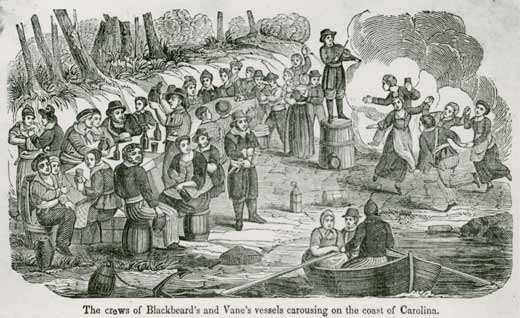
* Straight out of piracy central casting, no? Would you also believe his crew had a renowned “pirate party” rendezvous with Blackbeard’s?

On this day..

1757: Robert-Francois Damiens, disciplined and punished

On this date in 1757, Robert-Francois Damiens became the last Frenchman to suffer the dreadful punishment of drawing and quartering.

Damiens attempted to assassinate King Louis XV, inflicting, however, only a slight dagger wound.

He may be best-known today as the subject of the jarring opening passage of Foucault’s Discipline and Punish, in which the full flower of this medieval torture* is described in detail by way of contrasting it with the regimented penal institutions that would sprout up in a few decades’ time. Here’s Foucault’s rendering of the scene:

On 1 March 1757 Damiens the regicide was condemned “to make the amende honorable before the main door of the Church of Paris”, where he was to be “taken and conveyed in a cart, wearing nothing but a shirt, holding a torch of burning wax weighing two pounds”; then, “in the said cart, to the Place de Grève, where, on a scaffold that will be erected there, the flesh will be torn from his breasts, arms, thighs and claves with red-hot pincers, his right hand, holding the knife with which he committed the said parricide, burnt with sulphur, and, on those places where the flesh will be torn away, poured molten lead, boiling oil, burning resin, wax and sulphur melted together and then his body drawn and quartered by four horses and his limbs and body consumed by fire, reduced to ashes and his ashes thrown to the winds” (Pièces originales…, 372-4).

“Finally, he was quartered,” recounts the Gazette d’Amsterdam of 1 April 1757. “This last operation was very long, because the horses used were not accustomed to drawing; consequently, instead of four, six were needed; and when that did not suffice, they were forced, in order to cut off the wretch’s thighs, to sever the sinews and hack at the joints…

“It is said that, though he was always a great swearer, no blashemy escaped his lips; but the excessive pain made him utter horrible cries, and he often repeated: ‘My God, have pity on me! Jesus, help me!’ The spectators were all edified by the solicitude of the parish priest of St Paul’s who despite his great age did not spare himself in offering consolation to the patient.”

Bouton, an officer of the watch, left us his account: “The sulphur was lit, but the flame was so poor that only the top skin of the hand was burnt, and that only slightly. Then the executioner, his sleeves rolled up, took the steel pincers, which had been especially made for the occasion, and which were about a foot and a half long, and pulled first at the calf of the right leg, then at the thigh, and from there at the two fleshy parts of the right arm; then at the breasts. Though a strong, sturdy fellow, this executioner found it so difficult to tear away the pieces of flesh that he set about the same spot two or three times, twisting the pincers as he did so, and what he took away formed at each part a wound about the size of a six-pound crown piece.

“After these tearings with the pincers, Damiens, who cried out profusely, though without swearing, raised his head and looked at himself; the same executioner dipped an iron spoon in the pot containing the boiling potion, which he poured liberally over each wound. Then the ropes that were to be harnessed to the horses were attached with cords to the patient’s body; the horses were then harnessed and placed alongside the arms and legs, one at each limb.

“Monsieur Le Breton, the clerk of the court, went up to the patient several times and asked him if he had anything to say. He said he had not; at each torment, he cried out, as the damned in hell are supposed to cry out, ‘Pardon, my God! Pardon, my Lord.’ Despite all this pain, he raised his head from time to time and looked at himself boldly. The cords had been tied so tightly by the men who pulled the ends that they caused him indescribable pain. Monsieur le [sic] Breton went up to him again and asked him if he had anything to say; he said no. Several confessors went up to him and spoke to him at length; he willingly kissed the crucifix that was held out to him; he opened his lips and repeated: ‘Pardon, Lord.’

“The horses tugged hard, each pulling straight on a limb, each horse held by an executioner. After a quarter of an hour, the same ceremony was repeated and finally, after several attempts, the direction of the horses had to be changed, thus: those at the arms were made to pull towards the head, those at the thighs towards the arms, which broke the arms at the joints. This was repeated several times without success. He raised his head and looked at himself. Two more horses had to be added to those harnessed to the thighs, which made six horses in all. Without success.

“Finally, the executioner, Samson, said to Monsieur Le Breton that there was no way or hope of succeeding, and told him to ask their Lordships if they wished him to have the prisoner cut into pieces. Monsieur Le Breton, who had come down from the town, ordered that renewed efforts be made, and this was done; but the horses gave up and one of those harnessed to the thighs fell to the ground. The confessors returned and spoke to him again. He said to them (I heard him): ‘Kiss me, gentlemen.’ The parish priest of St Paul’s did not dare to, so Monsieur de Marsilly slipped under the rope holding the left arm and kissed him on the forehead. The executioners gathered round and Damiens told them not to swear, to carry out their task and that he did not think ill of them; he begged them to pray to God for him, and asked the parish priest of St Paul’s to pray for him at the first mass.

“After two or three attempts, the executioner Samson and he who had used the pincers each drew out a knife from his pocket and cut the body at the thighs instead of severing the legs at the joints; the four horses gave a tug and carried off the two thighs after them, namely, that of the right side first, the other following; then the same was done to the arms, the shoulders, the arm-pits and the four limbs; the flesh had to be cut almost to the bone, the horses pulling hard carried off the right arm first and the other afterwards.

“When the four limbs had been pulled away, the confessors came to speak to him; but his executioner told them that he was dead, though the truth was that I saw the man move, his lower jaw moving from side to side as if he were talking. One of the executioners even said shortly afterwards that when they had lifted the trunk to throw it on the stake, he was still alive. The four limbs were untied from the ropes and thrown on the stake set up in the enclosure in line with the scaffold, then the trunk and the rest were covered with logs and faggots, and fire was put to the straw mixed with this wood.

“…In accordance with the decree, the whole was reduced to ashes. The last piece to be found in the embers was still burning at half-past ten in the evening. The pieces of flesh and the trunk had taken about four hours to burn. The officers of whom I was one, as also was my son, and a detachment of archers remained in the square until nearly eleven o’clock.

“There were those who made something of the fact that a dog had lain the day before on the grass where the fire had been, had been chased away several times, and had always returned. But it is not difficult to understand that an animal found this place warmer than elsewhere” (quoted in Zevaes, 201-14).

Among the throngs in attendance that day was Casanova who, according to his memoirs, rented out a windowed flat to watch that stomach-churning torture for four hours with some male friends and female companions.

One of the legendary libertine’s friends found this moment, serenaded by the prisoner’s “piercing shrieks”, opportune for an altogether different adventure of the flesh:

The three ladies packing themselves together as tightly as possible took up their positions at the window, leaning forward on their elbows, so as to prevent us seeing from behind. The window had two steps to it, and they stood on the second; and in order to see we had to stand on the same step, for if we had stood on the first we should not have been able to see over their heads. I have my reasons for giving these minutiae, as otherwise the reader would have some difficulty in guessing at the details which I am obliged to pass over in silence.

…

Tiretta kept the pious aunt curiously engaged during the whole time of the execution, and this, perhaps, was what prevented the virtuous lady from moving or even turning her head round.

Finding himself behind her, he had taken the precaution to lift up her dress to avoid treading on it. That, no doubt, was according to the rule; but soon after, on giving an involuntary glance in their direction, I found that Tiretta had carried his precautions rather far, and, not wishing to interrupt my friend or to make the lady feel awkward, I turned my head and stood in such a way that my sweetheart could see nothing of what was going on; this put the good lady at her ease. For two hours after I heard a continuous rustling, and relishing the joke I kept quiet the whole time. I admired Tiretta’s hearty appetite still more than his courage, but what pleased me most was the touching resignation with which the pious aunt bore it all.

Casanova’s Complete Memoires are available free online; this episode is recounted in the first chapter of “Paris and Holland”.

* Damiens’ punishment was in fact already archaic at the point when it was inflicted. Somewhat unsure of itself, the court sought precedent in the last regicide executed — Francois Ravaillac, who in 1610 was also the most recent person to suffer this horrific penalty. The clumsiness of the Damiens’ execution can surely be attributed to the art being a century and a half out of practice.

On this day..

2001: Robert Lee Massie, who spent a lifetime dying

On January 7, 1965, 23-year-old Robert Lee Massie shot and killed Mildred Weiss during a botched robbery near her home. He pleaded guilty and, sentenced to die by the state of California, came within 16 hours of execution in 1967, when then-Governor Ronald Reagan temporarily halted his execution so that he could testify at the trial of his alleged co-conspirator. By this time, Massie had begun complaining to anybody who would listen about the conditions on death row, and greeting the prospect of an execution date as a welcome deliverance, was dubbed “the prisoner who wants to die” by the press.

However, Reagan’s reprieve bought him just enough time to live to see a California Supreme Court decision temporarily halting executions, which was followed by the US Supreme Court Furman v. Georgia decision of 1972 banning the death penalty as then being enforced as unconstitutionally arbitrary and capricious.

With Furman, death rows across the country were summarily cleared, and Massie, a model prisoner, was paroled for good behavior in 1978. By this time, the US Supreme Court had handed down the Gregg v. Georgia decision holding that states had revised their death penalty statutes sufficiently to allow executions to resume.

Only months after his release, Massie killed Boris Naumoff in his liquor store and wounded a clerk in another botched robbery. Again pleading guilty, this time over the objections of his court-appointed lawyer, Massie was again sentenced to die.

As before, Massie welcomed his sentence and, acting on a own novel interpretation of the Sixth Amendment guarantee of self-representation, argued that he had a constitutional right to bypass the appeals process usually automatic in capital cases and that there “is no meaningful difference between forcing an automatic appeal upon a defendant and forcing unwanted counsel upon him.” The appeals court disagreed, ruling that “while a litigant may waive the advantage of a law intended solely for his benefit, he may not waive a law established for a public reason.”

Appeals in capital cases were never intended to allow the prisoner to “choose his own sentence,” the Court wrote, and were in fact in place for just such a reason of ensuring full investigation into the “real issue [of] the propriety of allowing the state to conduct an illegal execution of a citizen.” The state was obliged to proceed with Massie’s appeals against his stated wishes, a charge unique to capital cases, because of the singular obligations imposed by the death sentence on the legal machinery of the state — and in fact imposed by the Furman and Gregg decisions that years earlier had ushered Massie unwillingly off death row.

His appeals continuing against his wishes, Massie’s conviction was ultimately overturned in a 1985 California Supreme Court decision holding that the sentence was invalid because his lawyer had not consented to the guilty plea.

Convicted again in a retrial in 1989, Massie was, once again, sentenced to death. Though he was briefly heartened enough to pursue appeals in earnest, those, too, foundered; increasingly convinced that corrupt judges were violating their oath to uphold the Constitution and greasing the machinery of death, he determined once again to pursue his own death.

As his appeals ran out, lawyers and advocates of all stripes stepped in to try to prevent Massie’s execution. A lifetime of abuse in foster care and juvenile detention centers and evidence of clinical depression and mental disorder were all presented at the last minute in a last-ditch attempt to save a man who didn’t want saving.

All were denied, and Robert Lee Massie was executed at the age of 59 on March 27, 2001. He was just the ninth prisoner executed in California in the post-Furman era and the 703rd nationwide.

Massie is one of a growing trend of death row volunteers, prisoners who voluntarily seek to run through their appeals and bring their lives on death row to an end. His frequent visitor in his last years in prison and “next friend,” Michael Kroll,* writes:

My friend, Bob Massie, maneuvered the state of California into assisting in his suicide. He had his own lawyer doing the dance of death with the attorney general and managed to avoid being declared incompetent.

And in the words of a relative of one of Massie’s victims:

I know he wants to die. It makes me think, if he wants out of the suffering, well, maybe we shouldn’t be killing him. Maybe he should just be left there to suffer.

Tossed hither and yon with the shifting legal tides of death penalty law spanning eight presidential administrations, Massie had to aid his executioners to the very last breath: when finally strapped to a gurney 36 years since that young man had murdered Mildred Weiss, he obligingly flexed his arm to help the technician find a suitable vein.

* Kroll tried to prevent Massie’s execution on the grounds that he was mentally ill, incurring his friend’s wrath.

On this day..

922: Mansur al-Hallaj, Sufi mystic

On this date in 922, Sufi Mansur al-Hallaj was put to a torturous end in Baghdad — either crucifixion, dismembering, or both — for “theological error threatening the security of the state.”

Born in Persia, al-Hallaj traveled widely from India to Mecca, eventually settling in Baghdad, the capital of the Abassid Empire.

Ana al-Haqq

Al-Hallaj espoused the mystical Islamic school of Sufism and produced gorgeous poetry.

But he ran afoul of the authorities for his unusual willingness to speak publicly about Sufi concepts which were held to require mystic initiation in order to grasp.

Most particularly, saying “ana al-Haqq” — “I am God” — and poems directly identifying himself with divinity were thought by the state theologians to have mystical wisdom for initiates, but to be exceedingly dangerous sentiments to set loose among the hoi polloi, especially given popular devotion to the Abassid government that was less than ironclad.

In truth, al-Hallaj’s condemnation seems to have been rooted in contemporary imperial politics, his demise representing the (momentary) upper hand of the more autocratic elements against potentially more sympathetic parties.

He spent eleven years in a Baghdad jail, reportedly enduring torture with placidity. Accounts of his execution speak of him greeting a horrific death with joy.

Mansur al-Hallaj remains revered today among mystically inclined followers of many faiths and admired by many westerners, factors which do not quite resolve the dispute over his place within Islam. Ultimately, the rightness of his choices remains very much in the eye of the beholder.

On this day..

1977: Alphonse Massamba-Débat, Congolese Communist

On this date in 1977, the former president of the Congo, Alphonse Massamba-Debat, was summarily shot after his successor was assassinated.

A teacher by training and a member of the country’s powerful namesake tribe, Massamba-Debat (the link is to his French wikipedia page, which has considerably more information than the English entry) was a government minister who took power in a 1963 military coup that overthrew the former French territory’s first post-colonial government.

In a revolutionary age, Massamba-Debat swung with a Marxist-Leninist ideology. He ran a one-party state — winning a post-coup 1963 election by the comfortable margin of 100-0 — and met with Che Guevara during the latter’s African mission, while also setting up the first stirrings of industrialization.

The mix of true belief and opportunism in that formula is anyone’s guess; the brutality of his militias steadily eroded his “unanimous” popular support, and in 1968 he was toppled by another leftist, Marien Ngouabi.

That marked the end of Massamba-Debat’s meaningful political career.

Oddly, he was tried immediately after his overthrow for some of his regime’s notable political murders, but was acquitted and allowed to retire to his village: the new government plainly didn’t consider him much of a threat.

But when Ngouabi was assassinated in his turn on March 18, 1977 — for causes that remain unclear but that may have had to do with French energy interests in the region — the army seized control and purged numerous officials for supposed participation in the plot. Massamba-Debat, notwithstanding a dearth of evidence actually implicating him, was by virtue of being an overthrown former ruler far enough under the shadow of official distrust to find his name on that deadly list.

Massamba-Debat was officially rehabilitated in 1991, and is now far enough clear from the taint of treachery against his still-popular successor to have a stadium named after him. (the link is in French)

On this day..