1998: Gerald Eugene Stano, misogynist psychopath

(Thanks to the tireless Lilo of Lost In Lima Ohio and Perverted Primates for the guest post.)

On this date in 1998, the story of a boy named Paul ended in Florida’s electric chair.

Paul was born in 1951, in Schenectady, New York. He was the fifth child born to his mother, and would be the third she put up for adoption. At thirteen months old, Paul was malnourished and neglected both physically and emotionally to the point that county officials found him unfit to be adopted. But out of the slightest bit of luck, the small child caught the attention of Eugene and Norma Stano, who fought for six months to adopt the severely delayed child. And it was out of that luck that Paul became Gerald Eugene Stano.

Gerald Eugene Stano’s problems didn’t end with his new life with his adoptive parents; instead, he continued to develop a series of problems that would follow him, shaping his outlook on the world forever, and likely providing him with the excuses he needed to justify his actions later in life.

Gerald still wet the bed at ten, was the target for bullies and regularly laughed at by girls. Late in his life he would claim that women used to pull his hair, and even threw beer bottles at him, all without any provocation. He lagged behind in school, failing to graduate high school until he was 21 years old, and except for music class never achieved a grade higher than a C or D.

Yes, Gerald had a sad and difficult life, one that most people would find it easy to sympathize with. Despite his claims of being an outcast, Gerald flaunted his high opinion of himself, often going as far as to refer to himself as a “real Italian stallion”.

It seems that few really paid attention to Stano — not until March 25, 1980, when a woman by the name of Donna Hensley stumbled away from him, and walked into a police station.

Hensley would tell police that she was a prostitute, and had been approached by a man requesting her services. Once at her motel room, the two began to argue and the man ended up slicing her with a knife before insulting her and fleeing. Hensley was adamant that the man be found and charged.

An officer investigating the incident went looking for the prospective suspect, but ended the search with only a license plate for a car that matched the description. Following up with the plate number, the officer found the vehicle was registered to Gerald Eugene Stano, a 28-year-old man with a long arrest record but no convictions. Hensley gave a positive identification from Stano’s mug shot, and thus began investigation into a series of grisly murders.

On February 17, 1980 two college students had stumbled onto the decomposing remains of a young woman, and police had begun investigating the gruesome murder. The victim, 20-year-old Mary Carol Maher, was found in a remote area lying on her back, her arms at her side. Police believed she had been there for weeks, and upon moving the body discovered that she’d been repeatedly stabbed in the back, legs and chest.

During questioning for the assault on the prostitute, Stano, who fit the profile of the person sought for Maher’s slaying, was asked about the murder victim. Despite having confessed to the assault, Stano would only provide enough information to confirm that he’d previously seen Maher. But with more questioning, Stano broke and began replaying the scene out with the detective, even accompany the detective to the murder scene, and confirming the position of the body.

After returning to the police station, another detective suggested questioning Stano on a missing persons case, that of Toni Van Haddocks, a 26-year-old prostitute who had not been seen for some time. Stano denied any involvement in that case.

On April 15, 1980 a human skull was found in a garden by a Daytona resident, and a search of the area lead to clothing and more bones. Police would determine that these were the remains of Haddocks. Stano was again questioned and despite his first denials, later confessed to the murder, and would soon begin confessing to many more.

In the end, Stano admitted the gruesome murders of over 40 women, and was sentenced to death. After many failed appeals, his execution took place on March 23, 1998.

The death penalty has always been a very touchy subject. Many of its opponents believe that nothing justifies the taking of another person’s life, even if done by the state as a means of punishment. I agree that every life has value, but am personally compelled to ask whose life had more value — the victims that Stano murdered, or Stano himself?

My answer would favor the victims, and therefore I am resolved to believe that giving him any punishment less than what he received — death — would be an injustice to those who were killed by his hands.

On this day..

1796: Mastro Titta’s first execution of many

A Catholic man with the name Giovanni Battiste (“John the Baptist”) Bugatti could hardly have had a more ironic role in church history than the man who, on this date in 1796, dispatched his first victim as official executioner of the Papal State. Nicholas Gentilucci was hanged for killing a clergyman and his coachman, then robbing two friars while on the lam; Gentilucci’s corpse was subsequently quartered.

Little is known about Gentilucci, but much is known of his then-17-year-old executioner, for Bugatti, who would become known simply as Mastro Titta, turned out to be the most individually prolific taker of life in turn-of-the-19th century Rome.

Bugatti was born in Rome in 1779 and, even while putting criminals of the state to death, lived and worked on the west side of the Tiber River as an umbrella painter. Executions were a side job, and these ghastly deeds were recognized as such by the church, which compensated him a paltry three cents of a Roman lira for each body.

“Minister of Justice”

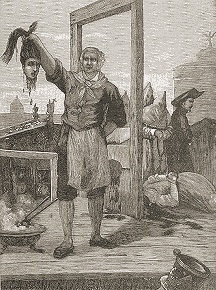
Mastro Titta brandishes an executed woman’s head.

The original Mastro Titta — the titular corruption of the “Minister of Justice” — took responsibility for each of his “patients” (as he called them, and as they were notoriously referred to by others), dutifully noting each of the 516 in his memoir. He stood for 69 years as the primary administrator of the death penalty in papal Rome, killing variously by beheading, hanging, and use of the mallet. Some were charged with murder, others with conspiracy, others with more petty crimes, but all were found guilty by the court of judges chosen by the Church’s bishops and cardinals.

The Minister’s performances were not without an (increasingly practiced) flair, heavy on the religious symbolism. Bugatti’s residence on the west side of the river meant that, when he was to carry out a punishment, he had first to cross the river.

Initially, the executions were carried out in the Piazza del Popolo, but that location was retired in the 1820’s; it’s not clear how consistent the location was after this, but at least one later execution occurred near San Giovanni decollato, home to the group of monks dedicated to comforting the condemned even when the final blow didn’t occur at its doorstep. Regardless of the locale, a spectacle soon arose surrounding that crossing and the parade which followed, as documented by Italian dialect poet G.G. Belli in 1835 (presumably for the execution of Giovanni Orioli di Lugo on July 11 of that year):

The Dilettante at the Bridge

They approach: Attention: the ceremony is brief.
Behold the condemned, neck bare and stretched.
He is the first man of the opera, the Patient,
The Ace of Spades, lord of the fesitval.

And behold the professor that will soon be
The surgeon acting for the people
For three pence, the community,
He will cure the ills of their pained head!

But not the man on the left: the other, to the right.
He in the second place is the Assistant.
The proceedings wait for Mastro Titta.

Do you want the usual from me, who takes the head?
I who never miss it: I am consistent;
And I know him as well as I know the Pope.

The translation is largely mine, with help on some difficult sections from a well-written and complete description of Mastro Titta’s life and work here and here.

Just a Job

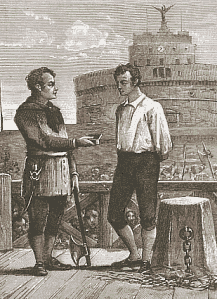
A pinch of snuff before I snuff you?

Bugatti was known for playing the role of executioner in a manner which left no doubt as to his feelings towards the act: it was his job, his service to the Church itself, undisturbed by any personal animus towards the condemned — particularly early in his career.

He often offered snuff to his victims and spoke briefly and quietly with them prior to the execution, likely ploys to ease the victim into his role in the spectacle. Dickens viewed one of Mastro Titta’s beheadings on 8 March 1845*, and, in his Pictures From Italy, he remarked on the callousness of the event.

In keeping with this attitude, most of the entries in Mastro Titta’s memoir are fewer than 20 words. They reflect a man who seeks to distance himself from the crowd’s bloodlust. A selection:

  • “Tommaso Tintori, guilty of homicide, 28 February 1810″ (The first using the “new edifice for beheading from the French government” — that is, the guillotine)
  • “Pecorari Angel, of Poli, aged 29. Peasant guilty of premeditated homicide of one woman, condemned to «death as an example» in Poland on 21 January 1847.” (There were a number of prisoners sentenced in other Catholic parts of Europe sent to Rome for Titta’s ministrations.)
  • “Sabbatino Proietti, aged 25, «decapitated» in Rieti for petty theft and highway robbery and murder on 20 August 1853, died converted, executed through administration of justice at the public square at the Bridge.”
  • “Angelo Lisi di Alatri, found guilty of premeditated highway robbery and murder in Frosinone, «dead» on 30 April 1862.”

An Anomalous Man

Bugatti was born just seven years prior to the Grand Duchy of Tuscany becoming the first of the Italian states to abolish the death penalty. There, Leopold II barred torture and punishment of death, a decision heavily influenced by Cesare Beccaria’s On Crimes and Punishments and a desire to distance his nation from Rome.

In the neighboring Papal State, however, the practice continued, the embodiment of the church’s power over its people in matters earthly and spiritual. Executions of the time performed for various reasons, but with a handful of exceptions, they were almost exclusively performed on persons in the lower class. Many relied on the use of torture or testimony from confessionals. Papal executions were carried out until the 1870s and only declared unnecessary (though not banned by the Church) by Pope John Paul II in the 1990s.

A complete discussion of the role of executions in the Catholic Church is too much for this space,** but a man like Bugatti serves usefully to exemplify the absurdity endowed in these killings by the Catholic Church. Where the half-dozen popes who served over Bugatti thought such executions to be necessary for the control of the masses, they had no such ideas about nobles who committed crimes.

The execution itself consisted of a parade with masked priests, banners, scriptural readings, and sermonizing, culminating in the death of the condemned. John L Allen of the National Catholic Reporter described the treatment of these executions in that day as “a liturgy”, and descriptions from writers such as Lord Byron show a scene which could only be described as a mix of Catholic Mass and town festival.

Such ritualized killing came to contrast starkly with the Italian celebration of an anti-death penalty position, and the two stood at odds for over a century. In 1909, the topic was hot enough that a plaque glorifying two Italians executed by Bugatti in 1825 was erected; a dozen years later, its contents were concealed out of deference to Rome until after the Second Vatican Council. The commemorated, Angiolo Targhini and Leonida Montanari (here’s their Italian Wikipedia page), were convicted essentially of riling the people, and they were summarily beheaded; their story was the inspiration for Luigi Magni’s 1969 classic Nell’anno del Signore:

“So ends the long list of Bugatti.”

Mastro Titta was given an official residence, and at the end of his term, he was handsomely rewarded with a pension for his service — 30 scudi per year. His final executions were carried out on 17 August 1864, wearing his traditional red cloak (now on display at the Criminology Museum of Rome): Antonio Olietti of Rome and Domenico Antonio Demartini were beheaded for homicide.

The Minister of Justice was 85, four and some years from the end of his life, and the final line in his memoir reads, “So ends the long list of Bugatti. May that of his successor be shorter.”

Indeed it was.

The final executions in Rome occurred on 24 November 1868 at the hands of Antonio Balducci, Bugatti’s long-time apprentice; the event was marked by Pope Pius IX famously intoning in response to calls for a stay, “I can’t, and I don’t want to.” The last execution in the Papal State was of Agatino Bellomo on 9 July 1870, in Palestrina, shortly before the nascent unified Italy absorbed Rome.

Mastro Titta is still known in Italy,† but, adrift amid a particularly violent period of revolution, his legacy as papal executioner is largely lost to the rest of the world.

* The day’s guillotinee was Giovanni Vagnarelli, 26, from Augustine; he killed Bavarian Anna Cotten and robbed her, and her wife’s statement at confessional was used to convict Vagnarelli. Such confessional convictions were not uncommon, as Bugatti’s own memoir confirms.

** There’s surprisingly little reading out there about this topic, though it would seem ripe for a book or two. Here’s what I can find:

  • “Fear and Loathing in Bologna and Rome: The Papal Police in Perspective”, Steven Hughes, Journal of Social History, 1987.
  • “Capital Punishment: The Curious History of its Privileged Place in Christendom”, James J. Megivern, Proceedings of the American Philosophical Society, 2003.
  • For a discussion of current discourse in Catholic teachings, this is rather interesting: “To Kill or Not to Kill: The Catholic Church and the Problem of the Death Penalty”, lecture by E. Christian Brugger, Asst. Prof. of Ethics, Dept. of Religious Studies, Loyola University, 2001.

† A half dozen kilometers from the bridge that Mastro Titta crossed on his way to carry out Papal justice now stands the Mastro Titta Pub. It is reportedly “tastefully done” and serves mostly Belgian beers.

On this day..

1556: Thomas Cranmer, architect of Anglicanism

[audio:John_Merbecke_Creed.mp3]
(Part of John Merbecke‘s plainsong rendition of the Book of Common Prayer, as performed by the Virginia Theological Seminary motet choir. Via.)

Good Friday falls early this year, and gives pause to recollect the burning this date of Thomas Cranmer, Henry VIII’s Archbishop of Canterbury, author of this gentle prayer for Holy Week:

Almighty and everliving God, who, of thy tender love towards mankind, hast sent thy Son our Savior Jesus Christ to take upon him our flesh, and to suffer death upon the cross, that all mankind should follow the example of his great humility: Mercifully grant that we may both follow the example of his patience, and also be make partakers of his resurrection; through the same Jesus Christ our Lord, who liveth and reigneth with thee and the Holy Spirit, one God,for ever and ever. Amen.

Thomas Cranmer was an obscure middle-aged priest when happenstance acquainted him with the circle then endeavoring to engineer Anne Boleyn‘s elevation from Henry VIII‘s enamored to Queen of England.

Cranmer enthusiastically supported Henry’s position that his first marriage to Catherine of Aragon should be annulled, and the perspicacity of the doctrinal case he developed to that effect saw him admitted into the inner circle of royal theologians.

The papal case foundered because Catherine’s kinsman Charles V happened, in the course of politics on the Italian peninsula, to be holding the pope a virtual hostage in Rome. On such accidents of history do faiths arise — and the faithful burn.

The Break With Rome

The 16th century, yeasty with religious disputation widely circulated by the printing press, is thick with folk who are one sect’s martyrs and the other sect’s villains.

Cranmer is just such a character.

One could charge him — and Catholic partisans have, many times — with blowing with the wind, granting theological license to the whims of his sovereign. Henry pressed through Cranmer’s appointment as Archbishop of Canterbury in 1533, just in time for Cranmer to annul Henry’s marriage to Catherine and validate the secret vows he had taken with Anne, earning both bishop and king excommunication.

That Cranmer rose with Anne but was ready to hold against her when she fell from favor, that he authorized the king’s famous pattern of discarding his past wives, that he signed off on the crown’s seizure of monasteries — that, in the end, he navigated Henry’s bloody reign with his position intact and even enhanced puts the whiff of opportunism about him. As Cranmer expert Ashley Null says (the link is a .pdf):

Like his first royal master, Cranmer did not make himself easy to love. In an era noted for the fervent courage of many martyrs for faith, Cranmer’s very survival under a king as unprincipled, or at least unpredictable, as Henry VIII has made him suspect. His late vacillation under Mary has only seemed to confirm the image of a man ruled more by the grip of fear than the assurance of the faith.

Whatever kernel of truth one might discern in such a charge, the fact remains that the church Cranmer built has by the test of centuries proven itself far more spiritually significant than mere opportunism could have admitted.

The Archbishop truly came into his own after Henry’s death.

For six years during the regency of Henry’s sickly, doomed son Edward VI, Cranmer hammered together the Anglican liturgy, wrote prolifically and beautifully, and assembled the Book of Common Prayer, a text which still guides Anglican services to this day.

His words still retain their power, and in some cases, their recognizability:

One can read Cranmer, especially in this mature stage, through many prisms — the competing threads of Catholicism, Lutheranism and Calvinism in his developing thought; the attempt to steer his institutional church towards his vision of the Reformation; and certainly as an inconstant individual — for his recantation when the Catholic Mary Tudor took the throne shows us a man as prone as any to folly and weakness.*

It is not the headsman’s purpose, and certainly not on this day, to render judgment on Cranmer’s soul; still less to unpack his theology. If we find him a man of flaws to compensate his genius, we must do him the justice of remembering also his firmness at the last hour, dramatically abjuring the recantation that had been forced upon him and thrusting the offending right hand that had signed it first into the flames.

* Cranmer had endorsed Mary’s rival Lady Jane Grey in the contentious succession that followed Edward VI; for this, he was convicted of treason in a trial managed by his old friend and fellow-survivor Thomas Howard. (Source) The Queen spared him execution on this charge in order to have him up on heresy instead, and it was this that Cranmer attempted to avoid by submission to the pope.

On this day..

1933: Giuseppe Zangara, who is not on Sons of Italy posters

On this date in 1933, Giuseppe Zangara went to Florida’s electric chair for the murder of Chicago mayor Anton Cermak — the man he had accidentally shot while attempting to assassinate President-elect Franklin Delano Roosevelt.

Zangara had to stand on a chair to take the shot: he was only five feet tall. This image is from Miami Police of Yesterday, a site by a descendant of one of the officers who arrested Zangara.

A strange and strangely forgotten man, the Italian immigrant came within inches of dramatically altering American history.

On February 15, 1933, at a Roosevelt speech in Miami’s Bayfront Park, Zangara perched himself on a metal folding chair within ten meters of the man who was then President-elect, but somehow managed to miss him. A bystander, Lillian Cross, grabbed his arm, and others in the crowd wrestled him down.

Certainly Zangara would be better remembered if he had shot Roosevelt (and Roosevelt would be very much less remembered), but his head-scratching persona accounts for at least some of his obscurity.

He’s sometimes called an anarchist — the early 20th-century equivalent of calling him a terrorist — and he talked the talk. Here, his last words:

You give me electric chair. I no afraid of that chair! You one of capitalists. You is crook man too. Put me in electric chair. I no care! Get to hell out of here, you son of a bitch [said to the chaplain] … I go sit down all by myself… Viva Italia! Goodbye to all poor peoples everywhere!… Lousy capitalists! No picture! Capitalists! No one here to take my picture. All capitalists lousy bunch of crooks. Go ahead. Pusha da button!

Zangara was a working-class immigrant. But his specific motivation for murdering Roosevelt seems murky at best — there’s no clear subversive organization or cause with which Zangara seemed a dedicated fellow-traveler. The wikipedia page about him describes his lifelong stomach pains as the cause of his act, which seems a queer thing to make a fellow shoot a president.

The major conspiracy proposal, that the anti-mob mayor Cermak was the real target all along of a mafia-engineered hit (here (.doc) is a version) is highly speculative, to put it generously. (Update: More on this here, via Chicagoland) Certainly Zangara might have been, as he claimed and most believe, a lone nut — many have done worse for less cause.

The world didn’t have long to unravel this man’s mysteries; justice moved with a rapidity terrifying even by the standards of the time — as reflected in the title of one of the books about him, The Five Weeks of Giuseppe Zangara.

Zangara had already been sentenced to a long prison term for the several bystanders his errant shots had struck when Anton Cermak finally succumbed — after 19 painful days — to a gut shot. Two weeks after that, his killer was dead, too.

During his first trial, the judge pressed him on his motivation, as reported in a press clipping that became part of Zangara’s FBI file:

Q. Have you ever been in jail before? Ever been in any trouble?

A. No, this is the first time.

Q. Did you ever hurt anyone before?

A. No, me no hurt anyone.

…

Q. Did you plan this shooting?

A. No.

Q. When did you decide to do it?

A. I got it in my mind capitalist hurt people. They are to blame for my stomach hurting. My stomach was hurting bad. It was like I was on fire. It burns my mind, I act like a drunken man. It came in my mind when I was suffering.

At this trial — the one before Cermak died — he pled unsuccessfully for execution: “I am sorry only because I did not kill. I am sorry about nothing. Put me in the electric chair.” It reads like “suicide by cop”.

Zangara might not be a name of Oswaldesque dimensions among the assassinariat, but he comes in for a scene in Stephen Sondheim’s strange musical theater, Assassins.

Officially, Zangara was punished for the man he killed, not the soon-to-be-President he was (presumably) aiming at. But such a close scrape for such a transformative American leader, a man sometimes credited with saving capitalism from itself in an age of crisis, has made Zangara’s one famous act fodder for alternative history that asks the question “what might have been?”

On this day..

1600: Linköping Bloodbath, the dawn of Sweden’s glory

On this date in 1600, five former supporters of King Sigismund were beheaded at Linköping, as Sweden broke free of Poland and of Catholicism.

Eighty years before, the Swedish Vasa dynasty had established itself by surviving one bloodbath. Now, it would set its greatest scion in line for the throne by inflicting another.

Sigismund was Sweden’s legitimate heir; he was also a characteristic product of dynastic intermarriage whose loyalties were splintered between fiefdoms. But most crucially of all, he had been raised Catholic in a realm turning decisively towards Protestantism.

Born of a Polish-Italian mother, he had secured the Polish-Lithuanian throne by election in 1589; when succession added suzerainty of Sweden, his realm was a personal union stretching across central Europe from the Arctic Circle to the Black Sea.

Which looked better on paper than it would work in practice.

The persecutory stage of the Catholic counter-reformation had been in full throat this past half-century, and the accession of a Catholic prince raised a Scandinavian alarm.

Busy governing Poland, Sigismund left his Protestant uncle Duke Charles to administer Sweden; within five years, civil war had erupted between the two and in short order the victorious soon-to-be King Charles IX had occasion to make example of the nobles who had backed Sigismund’s cause.

Charles himself would be a transitional figure in Sweden, but what a transition: his victory made possible the the subsequent scintillating reign of his son, Gustavus Adolphus — the able commander who would raise Sweden into a true European power.*

There would be an interesting coda in that reign to this day’s doings. Gustavus’ greatest general, Johan Banér, was the son of one of those put to death in Linköping. In another time, between other men, that one fellow’s father had seen the other fellow’s butchered might have put a blood feud between them. But as young men — the king was just 18 months his senior — they formed a permanent friendship, upon which they founded the military collaboration that shook northern Europe.

“My dad beheaded your dad”
“Let’s play!”

* Among Gustavus Adolphus’ numerous exploits was war with his father’s old rival — that is, with his cousin Sigismund — in the 1620s. Foreign relations between Sweden and Poland had turned understandably frosty, with Sigismund spending the rest of his long life eyeballing the lost crown.

On this day..

1741: Jenny Diver, a Bobby Darin lyric?

On this date in 1741,* at Tyburn‘s largest mass-execution of the mid-18th century, renowned cutpurse Jenny Diver was hanged along with 19 others.

Born Mary Young in Ireland around 1700, the girl was abandoned as a child but deserted a benefactor’s household to take passage to London where she meant to work as a seamstress.

What the Newgate Calendar reads as ingratitude, the modern reader might more sympathetically see as the allure of a burgeoning city for a teenager full of dreams.

Dreams may nurture the spirit, but flesh must have bread. Like countless others through time — indeed, like countless other clients of Tyburn — Jenny found metropolis less than convivial to aspirations of honest labor.

Unable to live on her stitching, Jenny found more lucrative employment for her manual dexterity in a sizable gang of thieves — of which her uncovered criminal puissance gave her mastery.

The Newgate Chronicle bursts with almost doting memoirs of her agile fingers, like this one:

[S]he procured a pair of false hands and arms to be made, and concealing her real ones under her clothes she repaired on a Sunday evening to the place of worship above mentioned in a sedan-chair, one of the gang going before to procure a seat among the more genteel part of the congregation, and another attending in the character of a footman.

Jenny being seated between two elderly ladies, each of whom had a gold watch by her side, she conducted herself with seeming great devotion; but when the service was nearly concluded she seized the opportunity, when the ladies were standing up, of stealing their watches, which she delivered to an accomplice in an adjoining pew.

Not neglecting also to celebrate the gang’s more Sting-like ruses, like this hilarious turn of the tables on a credulous cuckolder:

Jenny dressed herself in an elegant manner, and went to the theatre one evening when the king was to be present; and during the performance she attracted the particular attention of a young gentleman of fortune from Yorkshire, who declared, in the most passionate terms, that she had made an absolute conquest of his heart, and earnestly solicited the favour of attending her home. She at first declined a compliance, saying she was newly married, and that the appearance of a stranger might alarm her husband. At length she yielded to his entreaty, and they went together in a hackney-coach, which set the young gentleman down in the neighbourhood where Jenny lodged, after he had obtained an appointment to visit her in a few days, when she said her husband would be out of town.

…

The day of appointment being arrived, two of the gang appeared equipped in elegant liveries, and Anne Murphy [another thief] appeared as waiting-maid. The gentleman came in the evening, having a gold-headed cane in his hand, a sword with a gold hilt by his side, and wearing a gold watch in his pocket, and a diamond ring on his finger.

Being introduced to her bed-chamber, she contrived to steal her lover’s ring; and he had not been many minutes undressed before Anne Murphy rapped at the door, which being opened, she said, with an appearance of the utmost consternation, that her master was returned from the country. Jenny, affecting to be under a violent agitation of spirits, desired the gentleman to cover himself entirely with the bed-clothes, saying she would convey his apparel into another room, so that if her husband came there, nothing would appear to awaken his suspicion: adding that, under pretence of indisposition, she would prevail upon her husband to sleep in another bed, and then return to the arms of her lover.

The clothes being removed, a consultation was held, when it was agreed by the gang that they should immediately pack up all their moveables, and decamp with their booty, which, exclusive of the cane, watch, sword, and ring, amounted to an hundred guineas.

The amorous youth waited in a state of the utmost impatience till the morning, when he rang the bell, and brought the people of the house to the chamber-door, but they could not gain admittance, as the fair fugitive had turned the lock, and taken away the key; when the door was forced open the gentleman represented in what manner he had been treated; but the people of the house were deaf to his expostulations, and threatened to circulate the adventure throughout the town, unless he would indemnify them for the loss they had sustained. Rather than hazard the exposure of his character, he agreed to discharge the debt Jenny had contracted; and dispatched a messenger for clothes and money, that he might take leave of a house of which he had sufficient reason to regret having been an inhabitant.

Alas to say, they all can’t come off like clockwork. Jenny was caught a couple of times, dodging the noose in 1733 and 1738, sentenced on both occasions to transportation to the American colonies.

Finding little to recommend colonial Virginia, she returned illegally from both sentences at the risk of her life (she only survived her second arrest by passing herself off under an alias). The third time broke the charm, however: one is saddened to find her in her last adventure nabbed like a tyro trying to pick a younger woman’s pocket of a few shillings. The victim snatched Jenny’s wrist in the act: perhaps those nimble hands, now pushing 40, had finally slowed down.

Jenny Diver’s hands, in their time, had profited her far more than needlework could have; they had given her a life of some comfort to compensate its perils; and at the end, they afforded their owner the last indulgence of a “mourning coach,” an enclosed carriage separate from the carts that hauled this day’s other 19 (unrelated) victims.

It was a rowdy hanging day with an unusual guard detail of soldiery: one of the prisoners had reported a pending rescue attempt, and for her resources and gang affiliations, Jenny was thought to be its intended beneficiary. (If the stool pigeon was hoping his own tattling would reprieve him, he was disappointed.) For reasons related or not, the crowd was in an ugly mood, as reported by the Newgate Ordinary:

In this Manner were they convey’d through a vast Multitude of People to Tyburn, some of whom, notwithstanding the Guard of Soldiers, were very rude and noisy, hallooing, throwing Brickbats, Mud, &c. at the unhappy Prisoners, as they passed.


Her notoriety would live on in cheap publications hawked by itinerant peddlers — 18th century precursors of the penny dreadful — that in Jenny’s case helpfully doled out tips on foiling pickpockets.

About That Name

We also have a modern context** for the name “Jenny Diver” as one of several women mentioned in the song “Mack the Knife”:

This song is an English riff on a German tune from The Threepenny Opera, concerning its principal male character, the highwayman Macheath. (Possibly inspired by the recently-executed Jack Sheppard.)

The Threepenny Opera updated the 18th-century Beggar’s Opera, a satiric (and extraordinarily popular) production setting operatic tropes among society’s whores, criminals and castoffs.

The sequence of female names Bobby Darin rattles off in this version of “Mack the Knife” all draw from these operas: Suky (sometimes Sukey or Sukie) Tawdry and Jenny Diver are underworld women in The Beggar’s Opera who set Macheath up for arrest; Lucy Brown is The Threepenny Opera‘s version of the original character Lucy Lockit, who under either name is the daughter of a law enforcement officer in love with Macheath who helps him escape.†

One might suppose such a fortuitous connection of Jenny Divers was a calculated one, but it seems both the character’s name and the thief’s were independently and coevally drawn from the rich vein of English thieves’ cant.

Strictly coincidental.

“Diver” as street slang for a pickpocket dated back 150 years, according to Philip Rawlings, so it was a natural sobriquet for an expert thief … and for an author (whose script is chock full of suggestively-named characters — Wat Dreary, Molly Brazen, Jemmy Twitcher) conjuring such a character. There’s no direct evidence indicating that either the cutpurse or the dramatist knowingly cribbed from the other.

A pity it was for the real Jenny that art and life couldn’t imitate one another more strongly.

PLAYER. But, honest Friend, I hope you don’t intend that Macheath shall be really executed.

BEGGAR. Most certainly, Sir.—-To make the Piece perfect, I was for doing strict poetical Justice—-Macheath is to be hang’d; and for the other Personages of the Drama, the Audience must have suppos’d they were all hang’d or transported.

PLAYER. Why then Friend, this is a downright deep Tragedy. The Catastrophe is manifestly wrong, for an Opera must end happily.

BEGGAR. Your Objection, Sir, is very just, and is easily remov’d. For you must allow, that in this kind of Drama, ’tis no matter how absurdly things are brought about—-So—-you Rabble there—-run and cry, A Reprieve!—-let the Prisoner be brought back to his Wives in Triumph.

* 1740, according to the original documentation; 1741 by modern reckoning, since the new year’s onset was at the time not recognized on January 1.

** There’s still another Jenny Diver reference in the literate comic book series The League of Extraordinary Gentlemen.

† The fourth name of the sequence originally was Polly Peachum, Lucy’s rival for Macheath’s affections — but when Louis Armstrong made the first popular recording of Mack the Knife, he ad-libbed the line “Look out for Miss Lotte Lenya!” referring the actress who played Polly Jenny in both the original German production and the then-current Broadway importation, and who also happened to be present at Armstrong’s recording. Darin’s subsequent (and eventually canonical) version followed that lead and replaced the original name outright.

On this day..

1915: Four French Corporals, for cowardice

On this date in 1915, four French corporals were shot at a farm in Suippes for refusing to advance out of their trenches through the carnage of a World War I no man’s land.

It was not only Corporals Theophile Maupas, Louis Lefoulon, Louis Girard and Lucien Lechat who had refused. The entire 21st Company of the 336th Infantry regiment, exhausted and already decimated by combat, was ordered over the trench at dawn on March 10.

Under withering machine gun fire, and with French artillery carelessly dropping shells just in front of their own lines, the 21st stayed put. Frantic to force the advance, the French commander ordered artillery to drive the troops ahead by shelling his own trenches — an order the artillerists refused to carry out unless someone put it in writing.*

In that slaughterhouse of trench warfare, insubordination in the ranks met stern reprisals. Generals with no strategy but to make mincemeat of their countrymen could not well abide the meat’s reluctance to be minced. Examples must be made, especially inasmuch as the impracticality of executing entire companies impressed even the brass.

On March 16, six corporals and 18 soldiers of the intransigent company faced military trial in the Suippes town hall; the four condemned were shot the next day and buried under dishonorable black crosses.

According to Shot At Dawn, a campaign for rehabilitating soldiers executed during World War I, France carried out some 600 military executions during those bloody years, more than any other country. A 1999 study numbered 550 French executions. In an essay in Handbook on Death and Dying, Prof. J. Robert Lilly suggests that many more “unofficial” executions may have taken place, especially during the war’s panicked opening stages.

Whatever their precise number, the shootings, around Europe, of hundreds of men for cowardice — most in obscurity, many chosen arbitrarily, some whose descendants still struggle for recognition to this day — is one of the enduring legacies of World War I: the collision of that most individual penalty with that most faceless and indiscriminate war. A witness to a different French military execution discomfitingly describes the near-total dehumanization of the victims:

The two condemned were tied up from head to toe like sausages. A thick bandage hid their faces. And, a horrible thing, on their chests a square of fabric was placed over their hearts. The unfortunate duo could not move. They had to be carried like two dummies on the open-backed lorry, which bore them to the rifle range. It is impossible to articulate the sinister impression the sight of those two living parcels made on me.

The padre mumbled some words and then went off to eat. Two six-strong platoons appeared, lined up with their backs to the firing posts. The guns lay on the ground. When the condemned had been attached, the men of the platoon who had not been able to see events, responding to a silent gesture, picked up their guns, abruptly turned about, aimed and opened fire. Then they turned their backs on the bodies and the sergeant ordered “Quick march!”

The men marched right passed them, without inspecting their weapons, without turning a head. No military compliments, no parade, no music, no march past; a hideous death without drums or trumpets.

The shootings this day became emblematic of those lost and obscured legions. The circumstances of the “crime” — the senselessness of the advance, the order to bombard their own troops, the fury of the reprisal — recommended it to novelist Humphrey Cobb, and subsequently to a young Stanley Kubrick who adapted a fictionalized form to the 1957 film Paths of Glory. (The title comes from this poem.)

In the film, three soldiers face a firing squad under circumstances very similar to this day’s backstory, including the detail of the general ordering his own men shelled (and that of the order being refused). Kubrick renders the insanity of the resulting court-martial against hapless soldiers each of whom did little but what anyone in their situation would have done, with one of their officers, Kirk Douglas, mounting a vain defense.

This day’s executions, as with many of the others carried out across Europe in those years, sparked a long campaign for posthumous exoneration, in this case led by Maupas’ widow. In 1934, a French panel did exonerate them — awarding the surviving widows a symbolic one franc apiece.

Maupas himself was reinterred in a cemetery in Sartilly, where a monument was erected in honor of the four; just last year, opposite the courthouse where the Frenchmen were condemned, a life-sized white stone sculpture was dedicated, showing Maupas, Girard, Lechat and Lefoulon on their execution posts just after they have been shot.

The surety of the corporals’ posthumous exoneration contrasts intriguingly with the rigor of their sentence and points to the complex and shifting terms upon which the First World War entered subsequent national consciousness in France (and elsewhere) — the never-definitive story of the individual’s right place amid social structures hopelessly beyond individual control.

The history of the struggle over these men’s memory is extensively covered on this French website and the French blog Monuments aux morts pacifistes. The affair also has its own entry on the French wikipedia.

* Wisely.

On this day..

1457: László Hunyadi, the death before Hungary’s rebirth

On this date in 1457, Hungary lost a young prospective statesman and gained a national martyr.

A tale of noble bloodshed begins as so many do with a contested succession, this one amid the confusing feudal geometry of central Europe in the shadow of the rising Ottoman Empire. The untimely (albeit unsurprising) death in battle of warlike Albert II of Germany put the crown in the hands of a son born four months after his demise — the memorably named Ladislaus the Posthumous.

Effective government, needless to say, was in the hands of more senior gentlemen: the ambitious Slovenian-Croatian count Ulrich II and the able Hungarian commander John Hunyadi.* With two strapping Hunyadi boys who were contemporaries with the nominal king, it was only a matter of time before someone wound up dead.

Hunyadi pere saw it all coming. On his deathbed in 1456, he warned his children never to find themselves both together with Ladislaus.

Events moved fast after John Hunyadi’s passing. The Posthumous, now a teenager, set Hunyadi’s longtime rival up against the boys’ claim, but Laszlo, the elder brother, killed Ulrich. Ladislaus — answering the exigencies of the moment but possibly also sincerely relieved to be rid of his overbearing uncle — immediately pardoned the killer and offered to have him over to court.

Dad would have said, “I told you so.”

Upon arrival, Laszlo was seized, sentenced to death by a kangaroo court, and summarily beheaded. The most melodramatic version has the beheading botched three times and Laszlo demanding a reprieve on the grounds that heaven had attested his innocence by preserving him. Ladislaus had his guys keep at it until heaven threw in the towel.

The Buried Lead

So, hard going for some noble tit in the borderlands 551 years ago. What’s the relevance? Why, when Hungarian artists of the 19th century groped for an expression of national identity did they hark back to unlucky Laszlo on canvas …

The Mourning of Laszlo Hunyadi (1859) by Viktor Madarász shows the pallid-faced mother and bride of the prince bewailing his body, the fatal wound unmistakably suggested while remaining artfully concealed. Painted in Paris, it won a French state medal. (Source)

… and in opera?

The answer is less to do with Laszlo’s own qualities, courageous though they may have been.

A few months after having the young man put to death, Ladislaus himself died suddenly. Contemporaries suspected poison; others thought cosmic justice punished him for breaking faith. Modern science — vulture, whose wings are dull realities! — fingers something as unromantic as a medical condition.

One way or another, Ladislaus really was Posthumous, and into the empty throne stepped Laszlo’s 15-year-old brother Matthias — who had been more judicious about his head than his brother. Matthias would reign for 32 years and enter Hungarian folklore as “Matthias the Just”.

The long and adroit span of Matthias’ career and his father’s combined to immortalize the Hunyadi name (which fell extinct after Matthias’ passing before it could produce any buzzkilling scions of more doubtful abilities) as synonymous with Hungary’s golden age.

Laszlo’s reputation mostly just comes along for the ride — had, say, Ladislaus enjoyed Matthias’ run, the elimination of a boyhood rival would have been chalked down to the regrettable griminess of the day’s political reality; had some other claimant followed him to the throne, the Hunyadi name would never have had the luster to make him an attractive operatic subject.

A Symbol of National Rebirth

But they’re called “counterfactuals” for a reason: it may have happened by chance, but it did happen that Laszlo Hunyadi’s martyrology, in the victim’s very name, conveniently totes to the present day a pleasing theme of national redemption and greatness.

As described in this (.pdf) introduction to the opera (part of an extensive collection of information about Ferenc Erkel‘s operas, including a translated libretto of Hunyadi Laszlo):

In the national mythology the Hunyadi family’s descent into the underworld is symbolized by the fate of Laszlo Hunyadi, the firstborn of Janos Hunyadi who was 10 years Matyas’s senior. His life and death were preserved in the collective memory of the nation not as an independent legend but as the middle part of an imaginary trilogy about the Hunyadis. Laszlo Negyessy wrote that the opera Hunyadi Laszlo “has an air of incompleteness because the story is suspended at a point where all our senses appeal for continuation. However, this continuation and poetic justice is served in our national memory.”

Here is Erkel’s celebrated funeral march (“Gyaszindulo”) rendering the victim’s journey to his scaffold this day — the non-choral prelude to his mother’s dramatic plea for his life in the video above, and one of the signature compositions of Hungarian music**:

[audio:Hunyadi_Laszlo_funeral_march.mp3]

* John (Janos) Hunyadi wasn’t above meddling with the neighbors himself. Hungary figures as a bully of the kingdom of Wallachia (modern Romania) at this time; John Hunyadi deposed the father of, then (in the course of political alignment) helped raise to Wallachia’s throne, Vlad the Impaler, the sort-of historical model (and apparent historical namesake) for the vampire Dracula. When Vlad Dracula was deposed in turn, he fled to the protection of Matthias Hunyadi.

** Erkel also wrote the Hungarian national anthem.

On this day..

1938: Seventeen former Bolshevik officials from the Trial of the 21

(Thanks to Dmitri Minaev of De Rebus Antiquis Et Novis for the guest post. Be sure to read his corollary piece on cameos by some of this day’s victims in Bulgakov’s Master and Margarita.)

On 15 March 1938, 17 former executives of the Communist Party were executed at the “special object” Kommunarka near Moscow.

As head of the NKVD, Yagoda had arranged show trials before. This time, the shoe was on the other foot.

The names of some of them are found in any history book’ others were totally unknown even in 1930s. Alexey Rykov and Nikolay Bukharin were the topmost (well, almost) leaders of the USSR. Nikolai Krestinsky was a member of the Central Committee Secretariat and the Soviet ambassador to Germany. Christian Rakovsky was a diplomat, the head of the government of the Ukrainian SSR. Genrikh Yagoda was the minister of internal affairs, head of NKVD (the late name of Cheka). P. Kryuchkov was an officer of OGPU (an NKVD department) and the secretary of Maxim Gorky, the “official writer” of the communist USSR.

The others were ex-finance minister of the USSR Grigory Grinko, the general secretary of the Communist Party of Uzbekistan Vladimir Ivanov, ex-prime-minister of the Uzbek SSR Faizullo Hojayev, ex-minister of foreign trade of the USSR Arkady Rozengoltz, ex-minister of agriculture Mikhail Chernov, Isaac Zelensky, S. Bessonov, Akmal Ikramov, Vasily Sharangovich, Prokopy Zubarev, Pavel Bulanov, Veniamin Maksimov-Dikovsky and the doctors Lev Levin, Ignaty Kazakov and Dmitri Pletnyov (one of the founders of the Soviet cardiology).

There were 21 of them under trial, but three (Pletnyov, Rakovsky and Bessonov) were sentenced to imprisonment* and the date of execution of Yagoda remains unknown. The others all died this day.

Railroaded

“The trial of the 21” was officially known as “the case of the anti-Soviet right-Trotskyite block”. They were accused of “treason, espionage, sabotage, terror, undermining Soviet military power and provoking foreign countries to attack the USSR”. The other accusations were: a conspiracy to restore capitalism and to separate the Soviet republics and the Far East from the USSR; ties with foreign intelligence (including that of Nazi Germany, via Trotsky or directly); preparation of military aggression against the USSR; organizing peasants’ revolts in the USSR; the murders of Kirov, Menzhinsky, Kuibyshev, Maxim Gorky and his son Maxim Peshkov; and attempts to assassinate Lenin, Stalin and N. Yezhov (note this name).

After having his memory jogged, Krestinsky remembered that he really was part of the right-Trotskyite conspiracy.

Only the three doctors were provided with a legal defense. The others “voluntarily” refused.

All of them confessed to committing most of the various supposed crimes, although several had unavailing caveats. Krestinsky denied the charges, but it took only one day to convince him of his “failing” memory. “I fully and completely admit that I am guilty of all the gravest charges brought against me personally, and I admit my complete responsibility for the treason and treachery I have committed,” he said on the next day. Bukharin denied some of the charges brought against him. The doctors insisted that they killed Menzhinsky because of fear of Yagoda. Yagoda himself confirmed that he participated in the murder of Gorky’s son Peshkov, but said that motives were personal and not anti-Soviet.

According to the documents found in the archives, Bukharin, Rykov and Krestinsky were sentenced to death on 2 March, on the first day of the process. It could be an error, but on the other hand, it could indicate that the sentence was determined before the trial.

Neverending Story

The first draft of this article started like this: “This story began in …”

Then I stopped and scratched my head. The date when this story really began is not very clear. Some would argue that it began in 1922 when Stalin became the general secretary of VKP(b), others might say that it started in 1918, when the Bolsheviks dissolved the Constituent Assembly, and so on. What is clear is that 1937, when many of those twenty one were arrested, was not the beginning.

Then I decided to begin the other way round: “This story ended in…”

And once again I stopped. This trial had too many interesting corollaries and, of course, the story did not end in 1938. So, in the end the article became a mess of jumps in time to and fro. We are nearly as far removed today from Stalin’s purges as the purges were from the age of Russian serfdom — and those trials throw a shadow across the entire span of time.

Terror

Here’s a small extract from the series of events that preceded and followed the trial. In 1936 Bukharin and Rykov zealously supported the prosecutions of Zinoviev and Kamenev, two other old faithful Bolsheviks, accused by Stalin in opposing the policy of the party. The campaign ended with their trial and execution. Bukharin wrote letters to Stalin:

“I have always sincerely supported the line of the party and Stalin … These are the glorious milestones: industrialization, collectivization, elimination of kulaks, two great five-year plans, concern for the working man, new technologies and stakhanovism, wealthy life, the new constitution.”

“It’s great that the rascals [Zinoviev and Kamenev] were shot. The air became cleaner.”

Bukharin kept busy awaiting trial by writing Philosophical Arabesques … and three other books.

In 1925-1926, when Stalin organized the first campaign against Zinoviev and Kamenev, Bukharin and Rykov also applauded him. “I hand the broom to comrade Stalin,” said Rykov, “to wipe our enemies away.” Yet earlier, Bukharin and Rykov together with these “enemies” Zinoviev and Kamenev helped Stalin to repel the attempts of Trotsky to become the leader of the Soviet state after the death of Lenin.

Bukharin was not an idiot. He understood that he was not any different from Zinoviev. He was the first candidate to replace Stalin if something happened to Stalin — which made him automatically suspect in the eyes of the boss.

Moreover, he was a Bolshevik and he knew the habits of Bolsheviks very well. Caricaturist Boris Yefimov recalled that on 1 December 1934, when Bukharin learned of the assassination of Kirov, he told the other people who were in the room: “Kirov was killed in Leningrad. Now Koba will shoot us all.” (Koba was Stalin’s nom de guerre) But, being a professional revolutionary and conspirator, he knew only one strategy for survival: hypocrisy.

In this 1927 photo at Lenin’s mausoleum, two of today’s victims — Rykov (on the far left) and Bukharin (by his side) — share the platform with Joseph Stalin (far right). Between them is Kalinin, the rare old Bolshevik who managed to survive the 1930’s. (Source)

This strategy did not guarantee success with Stalin. The proof for this may be found in what happened during and after the trial.

Ostracism

Let’s have a look at the newspapers of 1938.

From the resolution of the meeting of the workers of the institute of physiology of the Ukrainian Academy of Sciences and the institute of experimental biology and pathology of the Ukrainian ministry of health care.

With the deepest resentment and indignation we hold up to shame the traitors of their motherland, the mercenaries of the fascist secret services, mean Trotskyite-Bukharin’s scoundrels. The history of humanity hardly knows other examples of similar crimes.

We proclaim that the fascist mercenaries will never succeed in dismembering the great Soviet Union and in handing the flourishing socialist Ukraine to the capitalists. We add our voices to the voice of the many million Soviet people demanding to exterminate all the mean traitors, spies and murderers.

From the resolution of the third conference on physiology of the Academy of Sciences of the USSR.

The traitors Bukharin, Rykov, Yagoda and others did not disdain any means in their vile job. These traitors never eschewed any mostrous crime.

The doctors Pletnyov, Kazakov, Vinogradov and Levin in this repellent union consciously used the trust of their patients to kill them. History never saw such crimes. Death to these murderers! Destroy all the gang of the “right-trotskyite” block!

From the article “We demand merciless retaliation against the vile traitors of our great Motherland”.

Having sold themselves to the fascists, plotting with the diplomats and the general staffs of some aggressive imperialist states, a despicable handful of human degenerates, servants of the fascist cannibals, led by a Gestapo agent, gangster Trotsky, sold our socialist motherland and its treasures to the most evil enemies of the human progress.

We demand from our Soviet court merciless retaliation against the vile traitors! We demand the extermination of the despicable degenerates!

The last article was signed by many outstanding scientists: the chairman of the Academy of sciences Komarov, professor Valeskalns, academics Keller, Bach, Vavilov, Gorbunov and others. N. Vavilov died in prison in 1943. N. Gorbunov was sentenced to death and executed in 1938. I am not certain about the others, but about 70% of the members of the Central Committee of the Communist party who supported Stalin’s proposal to arrest Bukharin and Rykov were later arrested themselves, and many of them died or were killed.

Here’s another quotation from a newspaper:

While accepting responsibility for the endless chain of dreadful bloody crimes which history never saw before, Bukharin attempts to give an abstract, ideological, sissy nature to his concrete criminal guilt. He fails to do so, the court and the prosecutor easily discern these attempts, but this trick is very typical for Bukharin’s nature of the right-Trotskyite political prostitute.

The pretensions of the garrulous, hypocritically vile murderer Bukharin to look as an “ideologist” lost in theoretical blunders are hopeless. He will not succeed in separating himself from the gang of his accomplices. He will not succeed in averting full responsibility for the chain of monstrous crimes. He will not wash his academic hands. These hands are stained with blood. These are the hands of a murderer.

I ask myself, “If you must die, what are you dying for?” With startling vividness a black void immediately rises before my eyes. “There is nothing to die for, if one wants to die unrepentant. If, on the contrary, one repents, everything fine and good that shines in the Soviet Union acquires in one’s mind a new dimension.” In the end it was this thought that completely disarmed me. I went down on my knees before the Party.
–Bukharin

This article was written by a gifted poet, journalist Mikhail Koltsov on 7 March 1938. He was shot by NKVD on 2 February 1940, less than two years later.

By the way, N. Yezhov (the “assassination” target of Bukharin’s party), who replaced Yagoda as the head of NKVD, was also arrested and executed in 1940 as a spy and conspirator.

Krestinsky, Ikramov, Hojayev and Zelensky were acquitted in 1963.

On 4 February 1988 the Supreme Court of the USSR ruled that confession cannot be interpreted as a proof of guilt and acquitted ten out of twenty one victims. (I could not find information on the cases of Grinko, Bessonov, Sharangovich, Zubarev and Pletnyov.) The sentence against Yagoda, to whose ruthless secret police history has been less generous, was left in force.

* Pletnyov, Rakovsky and Bessonov, the three to avoid death sentences at the Trial of the 21, were later summarily executed together with 154 other political prisoners when the Nazi armies approached the city Oryol in September 1941.

On this day..

1957: Evagoras Pallikarides, teenage guerrilla poet

On this date in 1957, Cypriot guerrilla Evagoras Pallikarides was hanged by British colonial authorities for gun possession.

As it was throughout the Empire in the middle 20th century, independence was the order of the day in Cyprus. But it was not simply whether there would be self-rule in Cyprus: the form and terms of independence were themselves hotly contested.

Cyprus would be a fresh battleground between those bitter rivals Turkey and Greece, each asserting an interest in their ethnic cousins on the island; overlapping that, it would be a battleground between the institutional Communist opposition AKEL, which opposed military action for separatism, and the nationalist EOKA, demanding not simply independence but enosis, union with Greece as part of the pan-Hellenic project so inflammatory to the Turks.

From 1955 to 1959, EOKA conducted a four-year campaign of bombing, assassinations and military engagements.

As a 17-year-old, Palikarides — already facing trial and likely prison time for his resistance activities — disappeared to join an EOKA guerrilla cell. A poetic young soul, he bid his classmates farewell with this note left to explain his absence on their first morning without him:

Old classmates. At this time, someone is missing from among you, someone who has left in search of freedom’s air, someone who you might not see alive again. Don’t cry at his graveside. It won’t do for you to cry. A few spring flowers scatter on his grave. This is enough for him …

I’ll take an uphill road
I’ll take the paths
To find the stairs
That lead to freedom

I’ll leave brothers, sisters
My mother, my father
In the valleys beyond
And the mountainsides

Searching for freedom
I’ll have as company
The white snow
Mountains and torrents

Even if it’s winter now
The summer will come
Bringing Freedom
To cities and villages

I’ll take an uphill road
I’ll take the paths
To find the stairs
That lead to freedom

I’ll climb the stairs
I’ll enter a palace
I know it will be an illusion
I know it won’t be real

I’ll wonder in the palace
Until I find the throne
Only a queen
Sitting on it

Beautiful daughter, I will say,
Open your wings
And take me in your embrace
That’s all I ask …

Pallikarides fought for a year before being apprehended with a gun illegally in his possession — a hanging crime under British anti-terrorism laws, but as Pallikarides was just the ninth (and last) EOKA man executed, it seems plain that law was not receiving draconian enforcement. At least one author claims that the authorities threw the book at him on the gun charge because of a murder they believed he committed as a guerrilla but could not prove.

The fact that he turned 19 a fortnight before his execution likewise did not avail him clemency — as the young rebel predicted in court:

I know you will hang me. Whatever I did, I did as a Cypriot Greek fighting for liberty.

As youthful martyrs to nationhood are wont to become, Pallikarides (along with his poetry) lives on as a potent symbol to Greek Cypriots. Shortly after Cyprus achieved independence in 1960, his name and visage were affiliated with a Cyprus football club, Evagoras (which later merged with another club to become AEP Paphos).

On this day..