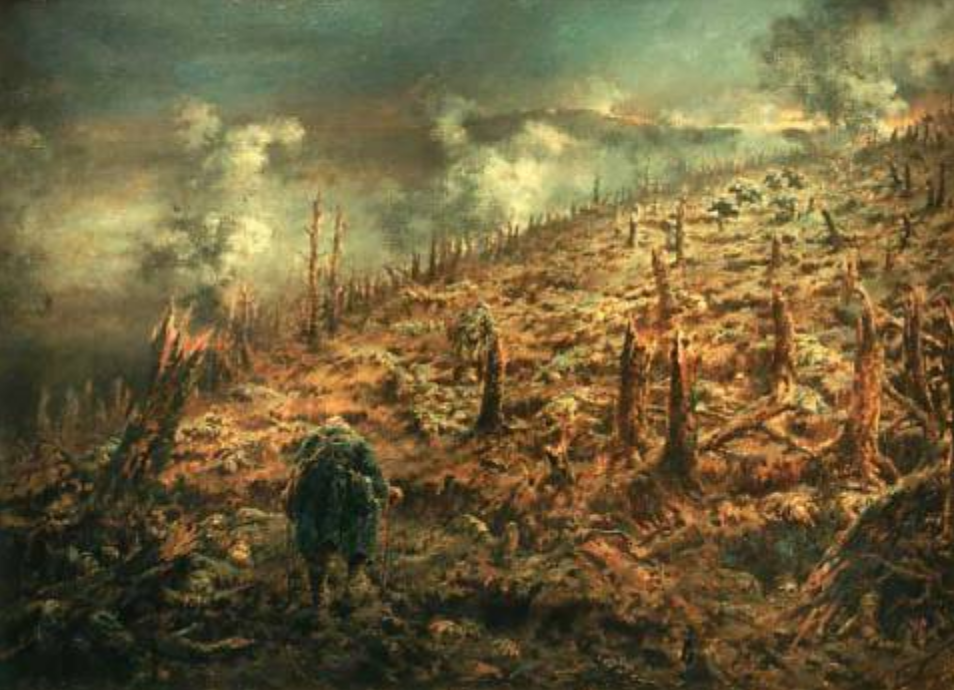
During the endless Battle of Verdun, which spanned most of 1916, the Germans at one point overran a French bunker called Fort Vaux. German bombardment of the Thiaumont Farm area during this attack smashed the 347th Infantry Regiment to which both Henri Herduin and Pierre Millant belonged. With the regiment commanders killed into the bargain, Herduin and Millant found themselves at the head of a remnant of 40 or so survivors spent of both energy and ammunition, forced to fall back to avoid German encirclement.
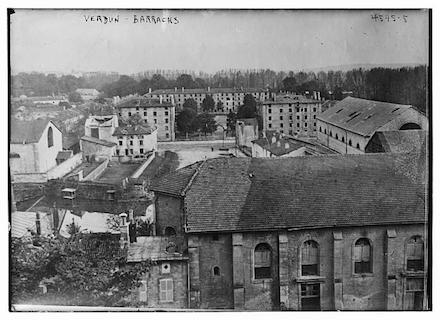
“Our division is broken, the regiment annihilated; I have just lived five terrible days, seeing death at every moment,” Herduin wrote to his wife Fernande on June 9th after he had presented himself at Anthouard barracks. He had not yet any inkling that he too would be a casualty of those terrible days. “Four days without drinking or eating, among the mud and the shells, what a miracle that I’m still here!”
Fate and the brass had a perverse sense of humor, for when the two lieutenants presented themselves and their fellow survivors to the reassembled remains of their regiment, about 150 men strong, they discovered that they’d survived all that mud and shelling only to die for France at the stake.
Their unit’s captain held a standing order to execute Herduin and Millant on sight for deserting their post: no need for even the pro forma proceedings of a tribunal. Indeed, the extrajudicial command might have been a fuck-you to civilian authorities who had recently attempted to curtail the army’s enthusiasm for executions. The captain, having no pleasure himself in this order, suffered Herduin to write a hasty explanation/appeal, to which the captain appended his own attestation of good character. Their missive was returned unopened, coldly marked Pas d’observation. Exécution immédiate. Had they not endured those privations to retreat but simply surrendered to the Hun, they would have been better off.
Herduin, a career soldier aged 35, gave his last service as an officer steadying the nerves of his own younger comrades in the firing squad with a demand to “hold to the end for France” — before issuing the firing command from his own lips.
Fernande made good on her husband’s own dying plea to her, and once the Great War’s guns fell silent she waged a public, and embarrassing for the army, fight to clear the men’s names. She eventually achieved a formal posthumous exoneration in 1926, as well as the honor- and pension-clinching appellations “Mort pour la France” applied to their death certificates. She even got a still-extant Rue Lieutenant Herduin christened in that man’s native city of Reims. On Armistice Day 2008, a marker to both men was unveiled on that street; yet another memorial stands to them in Fleury-devant-Douaumont, near the place they were shot.
On this date in 1697, the Paisley, Renfrewshire Gallow Green played stage for the strangling and burning of six “witches.” They’re known as the Paisley witches, the Renfrewshire witches, or the Bargarran witches, and are sometimes acclaimed the last mass-executed witches in western Europe.
This book posits a more than incidental resemblance between Salem and Renfrewshire, given that the “possessed child” figure was not a usual ornament for Scottish witchcraft cases.
In a setup bearing a disturbing similarity to the Salem witch trials,* an 11-year-old brat named Christian Shaw, the daughter of a local laird, got a tongue-lashing from the family servant and then turned around and accused her a sorceress.
The psychological mechanisms at play make interesting speculation in such cases. Was she merely a spiteful little monster, or did she believe in accordance with the superstitions of her time that the servant’s curses had effect, and suffer real afflictions that ensued upon this belief? Can we see her in the end as a creature necessarily produced by her nation in its troubled hour, unmoored as it was by the political and religious dislocations of the Glorious Revolution, gnawed by famine, and hurtling towards an unwilling union with England? (The bizarre execution of an Edinburgh university student for blasphemy also unfolded in 1696-1697.)
We leave such speculations to the reader as we plunge into the onset of supernatural doings in these environs almost a year before the consequent executions — via a 1698 pamphlet titled “A True Narrative of the Sufferings and Relief of a Young Girle Strangely Molested, by Evil Spirits and their Instruments, in the West”
August 22 [1696], the Child went to Bed in good health; but so soon as she fell asleep, began to struggle and cry, Help, Help: And then suddenly got up, and did fly over the top of a Resting-bed, where she was lying (her Father, Mother, and others being in the Room, and to their great Astonishment and Admiration) with such violence, that probably her Brains had been dasht out, if a Woman, providentially standing by, and supported by a Door at her back, had not broke the force of the Childs motion, who being laid in another Bed, remained stiff and insensible as if she had been dead, for the space of half an Hour; but for Fourty eight Hours thereafter could not sleep, crying out of violent Pains thorow her whole Body, and no sooner began to sleep or turn drowsie but seemed greatly affrighted, crying still Help, Help.
These frightening spasms continued for days, contorting her body and robbing her of speech; helpless doctors bled her to no effect.
Some dayes thereafter was an alteration in her Fitts, so far, that she got speaking, during the time of them; and while she was in the fits, fell a crying, that Katharine Campbel and Agnes Naismith were cutting her side, and other parts of her Body; Which parts were in that time violently Tormented. And when the fit was over she still averred, that she had seen the same Persons doing the same things which she complained of while under the fit (it being remarkable that in the intervals she was still as well and sensible as ever) and would not believe but that others present saw them as well as she!
Katharine Campbell was servant who had chewed her out. Agnes Naismith was an old lady with a witchy reputation. In time they would headline the execution that occasions this post.
We must here pause to remark that the decision of the adults around Christian Shaw to steer this crisis in the girl’s life towards a judicial witch hunt was by no means predetermined. While capital statutes against bewitchment remained on the books, they were fading in practice; according to the invaluable Survey of Scottish Witchcraftdatabase, there had been only a single witchcraft prosecution in Scotland since 1683, and that one did not result in execution. The sudden eruption of a dormant and vanishing cosmology, with sufficient force to devour seven humans, shocks the eye.
Credit must go to Shaw for a rare commitment to the performance, as her symptoms continued intermittently for months, and accumulated a growing roster of accused supernatural tormentors. She was taken to Glasgow for treatment, and taken again; she went on regimens of prayer and fasting; at one point she began pulling debris out of mouth like a prestidigitator, in such number and variety that her doctor remarked that “Were it not for the hairs, hay, straw, and other things wholly contrary to human nature, I should not despair to reduce all the other symptoms to their proper classes in the catalogue of human diseases.”
Although modernity will doubt that they bewitched the child, the accused women, Agnes and Katharine, knew exactly what was up when they were brought to confront their accuser. They addressed their common peril with opposite strategems. Agnes, “did (tho not desired) pray for her, viz. that the Lord God of Heaven and Earth might send the Damsel her health,” which prayer cured Christian Shaw of continuing to accuse Agnes of muddling her (“upon the contrary, as she apprehended, defending her from the fury of the rest” of the witches) — whereas the saltier Katharine “could by no means be prevailed with to pray for the Damsel, but upon the contrary when desired by some, cursed them and all the Family of Bargarran, and in particular the Damsel and all that belonged to her, withal adding this grievous Imprecation; The Devil let her never grow better, nor any concern’d in her, be in a better condition than she was in, for what they had done to her.” I like this Katharine, but Laird Bargarran had the sheriff throw her forthwith into the dungeon; the reader may recall from our foreshadowing that Agnes’s more diplomatic approach did not ultimately serve her any better.
By January, five months after Christian’s first fits, the doctors and ministers had been defeated and the Privy Council appointed a tribunal to investigate the matter and shoo away the hags bothering Christian Shaw. The annals of their actions makes for repellent reading, even by the standards of judges. Readers with strong eyeglass prescriptions can enjoy the full pdf here, but most will probably prefer this lucid summary by Undine, a onetime Executed Today guest blogger. We also have a Victorian compilation of records related to the affair here.
The hunt swept up a 14-year-old boy and his 11-year-old brother, a 17-year-old girl who was made to furnish accusations that incriminated still more people besides. One can see in our credulous 1698 account the enspelled little shit begin to revel in her theatrics and the power she held over her neighbors.
February 12. Margaret Laing and her Daughter Martha Semple, being delated by the three Confessants, and accused by the Girl to have been active instruments in her Trouble, came of their own accord to Bargarran’s House, and before they came up Stairs the Girl said, she was now bound up, and could not accuse Margaret Laing to her face: And accordingly the Girl’s Mother having desired somer of those who were sitting by her to feel some parts of her Body, and they having done it, found her Body so stiff and inflexible, that there was no moving of it, and immediately again found some parts of her Body contracted and drawn hard togethe [sic], as if by Cords; after this Margaret Lang and her Daughter, having gone to the Chamber of the Girle, did in presence of the Ministers and others, desire the Damsel to come to her; for she would do her no Harm, and laying her Arms about her, spake very fairly to her, and question’d her if ever she had seen her other Daughter among her Tormentors, to which the Girle did positively reply, she had frequently seen her Daughter; but declined thorow fear to accuse herself, saying faintly No, after which Margaret and her Daughter returning into the Hall, and the Minister enquiring at her why she said No, seeing she had accus’d her before, she answered, take me contrar, upon which she was seiz’d with a grievous Fit; yet after her recovery being urg’d again by those present to tell her Mind freely, whether or not Margaret Lang was one of her Tormentors the Child thereupon Essaying to say Yes, and having half-pronounced the Word, was cast into unexpressible Anguishes; and again in the interval of the Fit, she Essay’d to express the same thing, and saying only the word Tint (that is soft) was on a sudden struck with another fit, and when the fit was over, and the Child returned to the Chamber, Margaret Lang who was sitting near the Hall door, spoke these words after her. The Lord bless thee, and ding (that is beat, or drive) the Devil out of thee. A little after which words, Margaret going down stairs, the Damsel came to the Hall and said, her Bonds were now loos’d, and that now she could accuse Margaret Lang to her Face, and declar’d the occasion of her being so Restrain’d and Bound up while Margaret was present, was her letting fall a parcel of Hair at the Hall door as she came in; being a Charm made by her for that end, which also had been the occasion of her uttering the word Tint in the former fit: And accordingly a parcel of Hair had been found at the Hall-door, after Margaret Lang had gone straight from the Hall to the Chamber, which immediately was cast into the Fire and burnt. And its remarkable, that it could be attested that there was no Hair, or any other thing else in that place before Margaret Lang came in, and the Girle being enquired, what way she knew Margaret Lang had laid the forementioned Charm upon her, replyed, something speaking distinctly to her as it were above her Head, had suggested that to her.
In the end — and posterity unfortunately lacks the original trial record — there were seven condemned to death and although their names in the surviving accounts “are not very distinctly stated” they appear to comprise our two original accused, Katharine Campbell and Agnes Naismith, the aforementioned Margaret Lang, the 14-year-old child James Lindsay and an apparent kinsman named John Lindsay, and also John Reid and Margaret Fulton. (Some accounts more mawkishly make it little James Lindsay with his 11-year-old brother Thomas, but that’s not indicated by the primary sources which repeatedly note that Thomas is “under the age of pupilarity.”)
John Reid managed to hang himself in prison and cheat the executioner. Katharine Campbell did him one better by fighting her persecutors all the way to the stake, and deservedly showering everyone in earshot with curses. The legend has it that Campbell’s malediction lurks behind any civic setback endured by Paisley down the years, such as the 1810 Paisley canal disaster. A horseshoe placed over the embittered sorceress’s grave to keep ill fortune at bay was lost in the 1960s; in 2008, a brass horseshoe plaque was installed in its place at the intersection of Maxwellton and St. George Streets — the memorial admitting the injustice done to all the Renfrewshire witches.
As for the witches’ accuser, Christian Shaw mirrored in her own life’s story the epochal shift that transformed witches from a legally recognized threat to a ridiculous superstition — as she grew up to become essentially the founder of Paisley’s distinctive (and still to this day important) thread industry by creating the “Bargarran Thread” .
* Coincidentally, the first execution of the Salem trials also occurred on June 10.
On this date in 1639, the Duke of Valette was beheaded in Paris as a traitor. Having anticipated this cruel stroke, however, he was happily away in England at the time.
Valette (later the Duke of Epernon, like his dad) outlived his execution by 22 years.
Valette’s military reversal at the French Siege of Fuenterrabia in 1638 set him up for the revenge of his scheming in-law. Blamed for refusing to lead an ill-conceived charge, he got the Iraq War critic treatment when that charge turned into a debacle as he had warned.
But rather than face Richelieu’s summons to answer a charge he obviously had no odds of defeating, Valette crossed the channel and chilled in the exile court of another defeated Richelieu foe, Marie de’ Medici.
Just as Valette lost his head only ceremonially, he lost his homeland only temporarily. When Louis XIII died in 1643, Valette — by this time become the Duke of Epernon — was able to return and re-enter the ranks of respectable nobility, unimperiled by the headsman’s blade for the remainder of his days. He died in 1661.
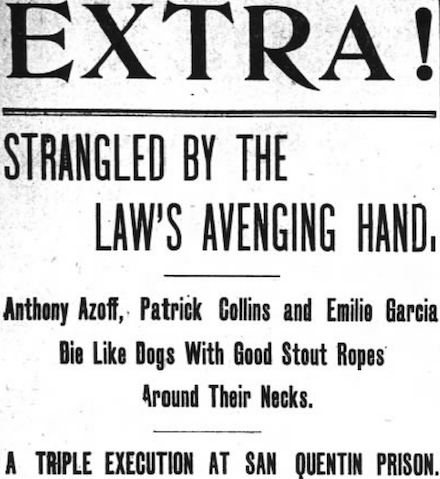
Headline from the Tacoma (Wash.) Daily News, June 7, 1895.
On this date in 1895, the hangman noosed for the cycle with single, double, and triple executions in three different U.S. states.
Arkansas
In Morrilltown, William Downs or Downes for criminally assaulting a woman called Pauline Bridlebaugh.
“On the scaffold Downs declared that he was guilty of part but not all he was charged with,” according to multiple newspaper reports. The eight-foot fall failed to snap his neck, and Downs strangled to death over 15 agonizing minutes.
Alabama
“Lee Harris and Abe Mitchell, colored murderers, highwaymen and thieves, were hanged here [Birmingham] today before 2000 people for the murder of Grocerymen Merriweather and Thornton. Both bodies were turned over to the undertakers, who purchased them several weeks ago for $18 from the men themselves.”
From the Oakland Tribune, June 7, 1895.
California
Three Californians hanged, sequentially, at San Quentin prison on the morning of June 7 in an affair timed to ensue the arrival of the 7:40 train from San Francisco, carrying about 100 official witnesses.
Emilio Garcia stabbed and slashed to death a San Bernardino old timer whom he believed to possess a hoard of gold.
Anthony Azoff fatally shot a Southern Pacific detective in the course of a botched robbery of that railroad firm’s offices; he was balked of a suicide attempt in the hours before his execution.
And Patrick Collins acquired more lasting infamy than any of his scaffold brethren by sensationally stabbing to death his estranged wife at the kindergarten where she worked when she refused his demand to hand over her wages.
Collins’s guilt was very apparent, so his trial gave the horrified public ample rein to sketch the brute in terms of the era’s crackpot racist typologies. In one Examiner article tellingly titled “He Was Born for the Rope,” it was postulated that “if a good many of Patrick Collins’ ancestors did not die on the scaffold then either they escaped their desert or there is nothing in heredity … Seeing him you can understand that murder is as natural to such a man when his temper is up as hot speech is to the anger of the civilized.”
Be they ever so headline-conquering in their time, such crimes are like to fade speedily from the public memory. Collins, the man who slaughtered his tightfisted wife, and Collins, the savage ethnic archetype, have improbably survived his moment of notoriety, by imparting to literature the inspiration for San Francisco novelist Frank Norris‘s 1899 offering McTeague.
In McTeague, a vicious husband murders the wife he has abandoned when she refuses him money. The murderer here presents as an overpowering ancestral beast within — attributable, says Christopher Dowd, to Norris’s “study of criminal anthropology, particularly the school of thinking developed by Cesare Lombroso regarding atavism, hereditary criminality, degeneration, and criminal physiognomy. According to Donald Pizer, by the time Norris wrote McTeague, he had developed a ‘preoccupation’ with the themes of atavism and reversion, and ‘particularly with the role of heredity in causing either an obvious physical or mental devolution or a return to an earlier family condition’. Suddenly, Norris had a way to explain the behavior of his murderous protagonist — he was born a criminal, having inherited the degenerate traits and predilections of his Irish ancestors. Combined with the newspaper reports of the Collins murder, criminal anthropology gave Norris all the tools he needed to write, what Pizer calls, ‘that mythical creature of literature, a naturalistic tragedy'”. For example, Norris zooms through the disordered mind of McTeague as he struggles to control himself on one occasion.
He was disturbed, still trembling, still vibrating with the throes of the crisis, but he was the master; the animal was downed, was cowed for this time, at least.
But for all that, the brute was there. Long dormant, it was now at last alive, awake. From now on he would feel its presence continually; would feel it tugging at its chain, watching its opportunity. Ah, the pity of it! Why could he not always love her purely, cleanly? What was this perverse, vicious thing that lived within him, knitted to his flesh?
Below the fine fabric of all that was good in him ran the foul stream of hereditary evil, like a sewer. The vices and sins of his father and of his father’s father, to the third and fourth and five hundredth generation, tainted him. The evil of an entire race flowed in his veins. Why should it be? He did not desire it. Was he to blame?
McTeague does not exit upon the gallows as did his real-life inspiration; instead, having murdered and robbed his wife, the fugitive flees to the scorching desert of Death Valley where he faces a fight to the finish with a friend/rival who has pursued him. McTeague overpowers this foe, but the man’s dying act is to handcuff himself to McTeague — condemning the latter to sure death.
McTeague has long been in the public domain; it can be perused here; a Librivox audio reading of the book is available here. It’s also been adapted to at least two films in the silent era — including one of the genre’s greats — plus a more recent PBS radio drama, an opera, and miscellaneous other media.
This tale of a dreadful Maltese wife-murder arrives via the Times of Malta’s roundup of sensational hanging crimes on that Mediterranean island. Now independent, Malta was still British-controlled at the time of the events in this excerpt.
A marker outside Corradino Prison records the people hanged on its gallows, including Guzeppi Micallef
The murder of 19-year-old Roza Micallef is undoubtedly the most sensational uxoricide of the 19th century. Roza was precious for her husband, Guzeppi, but he was fearful of losing her. This fear was the result of jealousy.
The couple, who had been married only for a few months, lived in a farmhouse at Maghtab. Roza’s parents objected to the marriage as Guzeppi’s brother was married to Roza’s sister and their marriage was not a happy one. However, Roza did not take heed her parents’ warnings and married Guzeppi.
Roza and her husband used to work in the fields with her parents. She was a lively woman and enjoyed talking to relatives and friends. Her husband objected to this behaviour and warned her to be less talkative. Two days prior to the murder, she was seen waving to her uncle, Alessandro. This affectionate gesture triggered off the quarrel Guzeppi had with his wife on the night of the murder.
After sunset on October 8, 1899, Roza’s brother, Teofilio, heard his brother-in-law crying for help as his wife had been hit by a shot accidentally fired by his shotgun. According to Guzeppi, the shotgun was resting against the wall when he accidentally hit it with his foot. The firearm slid to the ground and was discharged accidentally, hitting Roza in her breast.
When the police were called, Teofilio told them that some time before he heard the shot he called on his brother-in-law, Guzeppi, to give him some money. Teofilio said that when he was at his sister’s house he was sure that something wrong was afoot; however, he chose not to interfere.
Regarding the shot, Teofilio said that when he heard the firing of a shotgun he thought that Guzeppi had shot his neighbour’s dog which was barking at that time.
The post-mortem examination revealed that the shotgun had been discharged from a high position and not from the floor as Guzeppi had affirmed in his statement. Moreover, court experts appointed to investigate the case further confirmed that Roza did not die as a result of an accident.
Guzeppi was charged with his wife’s murder and his trial opened on May 28, 1900. The prosecution produced witnesses who testified that the accused was very jealous of his wife. However, Dr Etienne Micallef, the defence counsel, maintained that the accused was jealous because he feared he might lose his wife’s love and had no intention of killing her.
As the accused was found guilty with a unanimous vote, he was sentenced to death.
Representatives of the Chamber of Advocates, the president of the Chamber of Commerce and the Council of Government petitioned the [Lord] Grenfell [Governor of Malta] to commute the sentence but he refused the appeal.
Micallef was hanged on June 6, 1900. He was only 20 years old and the only man in Malta since 1800 to have been hanged for uxoricide.
On this date in 1806, immigrants Dominic Daley and James Halligan were hanged at Northampton, Massachusetts. In the words of one widely reproduced report, “They persisted in their innocence to the last moment, although there were perhaps not a single one of the numerous spectators present, which was presumed to amount to nearly 15,000, who entertained a doubt of their guilt.”
Today, nearly everyone thinks them innocent.
The case began, as many wrongful convictions do, with a particularly outrageous crime — a young farmer, Marcus Lyon, found dead in a Massachusetts creek en route to his home in Connecticut. He’d been shot through the chest and his brains battered out of his skull. The motive: robbery.
In the absence of substantive evidence, some witnesses with vague reports of strangers on the fatal turnpike furnished tissue for an entire theory of the case, and through the misapprehended focus of tunnel vision the strangers became Irishmen, and the Irishmen became Dominic Haley and James Halligan.
In the close aftermath of American independence, New England was still overwhelmingly Anglo-Saxon and Protestant. Most of the Irish people about at this moment were also Protestants: large-scale Irish Catholic immigration into the region only began in the 1820s and it panicked the normies when it came, with preachers and politicians railing against the insidious incursions of idolatrous papists.
So in 1805, when the hunt for strangers settled on two Irish-born Catholic immigrants … well, what was left to know? Just days later, a North Wilbraham Congregationalist minister thundered from the pulpit,
We see the evil attending a continued influx of vicious and polluted foreigners in this country. Many of the outrages we suffer proceed from this source. Who break open our homes in the unsuspecting hours of sleep? Who set fire to our large cities and towns for the sake of plunder? And who rob and commit murder on our highways? We are far from exculpating all of our own native citizens; we regret, indeed, that so many of them disgrace themselves and injure society by evil deeds. But these things notwithstanding, we are doubtless justified in saying, that a great proportion of the crimes above mentioned, together with many others which might be named, are committed by foreigners. And that atrocious deed which has so recently congealed all our blood with horror, in this place, is supposed to have been perpetrated by foreigners. Look at the annual reports of the overseers of the prisons and you will find them be principally occupied by foreigners
The first planters of this country were, generally speaking, men of pure lives and good morals and they were induced to come here for the sake of religion. And, for a long time, they maintained a wholesome and orderly state of society. But since the rapid increase of our commerce with other nations, and the great ingress of foreigners, many of whom are said to come here for the sake of escaping the retribution of justice in their own country; we have ripened apace in all the arts of vice and depravity. Some, who come among us from abroad, we readily acknowledge to be worthy and good men, and we cordially welcome their approach. But the number of these is comparatively small. The best and most useful citizens are cautiously retained, while the worst are readily parted with. Hence the rapid influx upon us, of late, of the most violent and abandoned of the human race. The late and present disturbances in foreign countries have greatly increased the calamity. The prisons of Europe and the West Indies are now disgorging themselves upon our shores; and this country is thus becoming the general asylum of convicts. This is a sore evil, and will furnish an increasing number of inhabitants for our prisons and victims for the halter.
The case in court would comprise 24 witnesses not one of whom had witnessed the crime; at most they could suggest that two strangers had taken the same well-trafficked public road on the same day as the victim, who was also a stranger in these parts. Even this much was not certain among the witnesses; their renderings were vague, tentative, contradictory — but witness recollections and prejudicial readings of circumstance soon shaped themselves around the shared understanding of events, and from so much smoke they wove the hemp.
The friendless immigrants’ court-appointed attorney, Francis Blake, who had been tasked with this first capital case of his life a bare 48 hours before the trial opened, made a vehement, eloquent, and futile address to the jury against “this illiberal, this inhuman prejudice” closing around the throats of his clients.
That the prisoners have, however, been tried, convicted, and condemned, in almost every bar-room, and barber’s-shop, and in every other place of public resort in the county, is a fact which will not be contested. That the sentence of the law has not been anticipated, and that they have not already suffered the penalty of death, may be ascribed rather to defect of power, than to lenity of disposition, in many of their accusers …
There is yet another species of prejudice, against the influence of which it is my duty to warn you. I allude to the inveterate hostility against the people of that wretched country, from which the Prisoners have emigrated, for which the people of New-England are peculiarly distinguished …
Pronounce then a verdict against them! Condemn them to the gibbet! Hold out an awful warning to the wretched fugitives from that oppressed and persecuted nation! Tell them that although they are driven into the ocean, by the tempest which sweeps over their land, which lays waste their dwellings, and deluges their fields with blood; — though they float on its billows upon the broken fragments, of their liberty and independence; — yet our inhospitable coast presents no Ararat upon which they can rest in safety; that although we are not cannibals, and do not feast upon human flesh, yet with all our boasted philanthropy, which embraces every circle on the habitable globe, we have yet no mercy for a wandering and expatriated fugitive from Ireland. That the name of an Irishman is, among us, but another name, for a robber and an assassin; that every man’s hand is lifted against him; that when a crime of unexampled atrocity is perpetrated among us, we look around for an Irishman; that because he is an outlaw, with him the benevolent maxim of our law is reversed, and that the moment he is accused, he is presumed to be guilty, until his innocence appears! …
The lives of the prisoners are now consigned to your disposal. Before you proceed to the performance of this awful duty, let me borrow the language of one of their countrymen, not degraded by the ignominious reproaches against his nation, but elevated to the highest rank among the orators of the elder world by the most splendid talents, the purest patriotism, and the most unsullied integrity. Let me beseech you to “remember that there is another than a human tribunal, where the best of us, will, on one day, have occasion to look back on the little good we may have done. In that solemn trial may your verdict on this day give assurance to your bones and afford you strength and consolation in the awful presence of an adjudging God!”
The words fell on deaf ears.
Daley and Halligan maintained their innocence from arrest to execution, but in the end they would require the offices of another foreign refugee, Father Jean-Louis de Cheverus, a French-born priest in Boston, who had fled the anti-clerical paroxysms of his own homeland. (Later, he would become the first Catholic Bishop of Boston.) It’s said that he stayed in jail with his charges, as no one in Northampton would suffer the papist priest to sleep under their own roof — and that his ministrations to them included the first Catholic mass said in that city.
Folklore cropped up around the 1830s to the effect that a local man had given a deathbed confession exonerating the hanged Irishmen … and that this murderer was the kinsman of one of the witnesses against Daley and Halligan. I cannot establish that this is any more than a just-so story, a fable, but even so it speaks to the continuing injury done by this execution to the now-growing Irish Catholic community. In time that demographic’s maturing numbers and political muscle flipped the story of Daley and Halligan from one of foreigners ripened in depravity to a sobering caution against bigotry and rush to judgment.
We have no real way, now, to access a definitive assessment of guilt or innocence; we can certainly say with confidence that the evidence was appallingly flimsy to hang a man even for the time. Both Daley and Halligan were posthumously exonerated by a writ of Massachusetts Gov. Michael Dukakis in 1984. Dukakis discussed that action, and history’s view of the Daley-Halligan railroading, in a 2011 panel available in podcast form here.
For additional resources, check this Historic Northampton page (already linked several times within this post). Below, you can read the entirety of an 1806 publication reporting the trial, from which the defense lawyer’s remarks have been drawn.
The three men hanged together on this date all concurred in their stories that only one of them stole the horses in question and the other two merely thumbed rides on his extra mounts as passing travellers. Whether or not this is true or was simply their common play for a potential ⅔ pardon posterity obviously has no way of determining.
The Last Speech and Dying Words of
Daniel O Neal, Edmond Mc. Guire, and Henery Graham
who was Executed near St. Stevens Green, on Wednesday June the 4th 1718.
Good Christians,
I was Born in the North of Ireland, of very good honest Parents, who brought me up very Tenderly, and never speard any Cost to Instruct and bring me up in the fear of God, Alas! all was in vain, for tho’ I took all the care that I could to attain to Learning but at the end I prov’d very Careless of the fame, for I neglected both the laws of God and Man, or else I had never been brought to this shameful End, it is true I was taken up for the Stealing of three Horses, and two Mares, and these my fellow Sufferers along with me, but as I shall Answer the great God, they Die Innocently, for as I was Riding along the Road, I overtook these my fellow Sufferers who seeing me leading 4 Horses asked me if I would let them ride, I tould them they should, now as I am a dying Man this is all they knew of it, which grives me to the Heart, and indeed I am more sorry for their Death, than my own.
I freely forgive all the World, and I beg forgiveness of all those whom I ever offended, I am now about six and thirty Years of Age, I die a [sic] of the Church of England, and the Lord have mercy on my Soul, Amen.
This is my true Speech and no other
Daniel O Neal
The Speech of Edmond M’Guire.
Good Christians,
I Was born in the North of Ireland, of Poor, but honest Parents, who with their Industry, Care and Labour, brought me to these Years, during which time, I behav’d my self true and honest in the World, and endeavour’d very hard for my Bread; but I being born to hard Fortune, I was taken up by one Mr. Legg, for being concern’d in stealing of three Horses and two Mares; ‘tiw true I had one of the aforesaid Beasts under me, but the way I came by it was in the manner following: I having been in Dublin for some time, was willing to return home to my Wife and Children, and overtaking Daniel O Neale, my fellow Sufferer; he having the Cattle abovemention’d, I ask’d him if he wou’d let me Ride, he said he wou’d oblige any Traveller as much as he could, and so bid me Mount one of the Horses, which I did, and was very thankful to him for his kindness; but to my great Sorrow, it has prov’d the worst rideing that ever I rid in my life: Now as I am a dying Man, I was never guilty of Stealing the value of two Pence in all my Life: nor had I any Hand in stealing those Beasts which I am to Dye for. I forgive all the World, as I hope to be forgiven. I am about 40 Years of Age, and Dye a Roman Catholik, and the Lord have Mercy on my Poor Soul. Amen, Amen.
The Speech of Henry Graham.
Good Christians,
I was born in the North of Ireland, of very honest Parents, who was very tender over me, and brought me up in the fear of GOD as much as in them Lay; but Fortune has been very Cruel to me, or else I had never came to this Place, for I liv’d with my Parents will I came to get a Wife; and indeed it was my Fortune to get a poor honest Girl, who endeavour’d very honest for her Bread as well as I, but the World frowning upon me, I went and listed in the Army, where I behav’d myself as became a good Subject, at lenth [sic] I was broak, and so return’d home to my Wife again, but my Business calling me home to Dublin, to my great Sorrow I went there, but having finish’d my Business, I was going home again, where unfortunately I met with Daniel O. Neal, and Edmond M’Guire a Riding along the Road, to whom I said, pray let me Ride, and indeed, they freely comply’d, but I had not Rid long before we were all taken and committed to Goal, and from that brought to Dublin, so Try’d and found Guilty of the same, and now brought to [t]his Place to end my life, now as God is my Judge, before whom I hope to appear in short time, I had neither Art nor Part in stealing of the said Horses, or any of them, and I die in Charity with all Men, and do freely forgive those who Swore away my Life as I hope to be forgiven, I am about 30 years of Age. I die a Protestant and the Lord have mercy on my Soul.
He served from 1940 as Mayor of Shanghai and speaker of the legislature, and late in 1944 became Acting President and soon actual President when ailing President Wang Jingwei traveled to Japan for medical treatment and died.
It was not long before Chen too had to relocate to Japan — in his case, as a fugitive. He was arrested and extradited back to China, where he defended himself from charges of collaboration arguing that he had acted only out of personal loyalty to his friend Wang. “Soon I will be reunited with Wang Jingwei in the next world,” was his tragic and filial sentiment upon learning his fate.
On this date in 1453, the man who was once the power behind Castile’s throne became its foremost cautionary metaphor.
The greatest privado — royal favorite — in Spain’s annals, Alvaro de Luna (English Wikipedia entry | the far more detailed Spanish) sprang from noble albeit illiterate stock. He came to the Castilian court in 1410 as a witty and talented young page and adroitly got his hooks into the five-year-old crown prince, the future Juan II.
Quite uncommonly for a royal favorite, Don Alvaro held his king’s affection for many decades, and even while enriching himself into the mightiest subject in the land, he energetically served his prince’s interest.
Chief among these was managing the truculent nobility who would surely have dominated the weak-willed Juan but for his capable lieutenant — who was known from 1423 as the Constable of Castile and Count of San Esteban de Gormaz in 1423. Don Alvaro proved a consummate politico, scheming to deflect the ambitions of Juan’s rivals and to consolidate the power of the throne … which meant his own power, too. To a very great degree the favorite was the real sovereign, until he suddenly wasn’t.
“Alvaro de Luna would probably not be particularly consoled by the judgement of modern historians,” observes a wry James Boyden in The World of the Favourite** — for they “praise his efforts on behalf of Juan II for opening the way to royal absolutism in Castile, citing his own arbitrary death sentence as the clinching proof of the newfound powers of the crown.”
Don Alvaro’s downfall from his post of seemingly unassailable preeminence satisfied every literary device imaginable, beginning with poetic justice.
When Juan’s first wife, Maria of Aragon, died in 1445 — and Don Alvaro’s own hand has been suspected in that death — the Constable managed Juan’s pivot to 19-year-old Portuguese princess Isabella as the successor queen.
From her advantageous position in the king’s bed, Isabella soon began to work against Don Alvaro. She resented his intrusions into even their most intimate chambers, and she surely feared sharing the fate of her predecessor, Maria. Eventually, her arguments carried the day. Boyden once again:
It is difficult to imagine a more striking illustration of the transitory nature of earthly fortune than the spectacle of the constable’s execution in a public square of Valladolid on 2 June 1453. Certainly the event caught the imagination of contemporary poets. ‘Look then to that great Constable,’ wrote Jorge Manrique, ‘the Master whom we knew so deeply favoured by the king / And yet even of him nothing more need be said than that we saw him beheaded. / His limitless treasures, his towns and villages, his power of command / What did they bring him but tears? / What were they to him except sorrows at the leaving?’
…
According to Juan II, Don Alvaro’s principal crime was that he ‘has for a long time held and usurped a chief position near me and in my household and court’, and despite having been admonished about his excessive pride and effrontery ‘he has persevered in it … grasping more power to himself each day, excessively, without temperance or measure, so that there remains to me no more room to rule and administer my kingdoms personally, nor to maintain my towns in justice and truth and law …’
Not surprisingly, the constable saw matters in another light. While the king alleged usurpation of his royal authority, Don Alvaro responded with a charge of ingratitude, levelled in a tone meant to convey the sadness and resignation of a loyal servant stripped at last of his illusions. Rather than withdraw into a well-deserved retirement after forty-five years of service, he wrote,
I chose … to serve as I was in duty bound and as I felt the situation demanded; I deceived myself, for this service has been the cause of my misfortune. How bitter that I should find myself deprived of liberty who more than once have risked life and fortune to preserve your highness’s freedom! I am well aware that for my great sins I have angered God, and I will consider it a boon if I can placate his rage through these travails.
This appeal to justice was accompanied by an offer of treasure, but neither swayed the king, who was so intent upon Don Alvaro’s destruction that he would finally order his execution despite the failure of a hand-picked tribunal to render a clear sentence of death.
Although it cut no ice with his king, Alvaro de Luna’s posture of betrayed fidelity — his courage and dignity on the scaffold, ere his throat was cut and his severed head mounted on a hook — helped to salvage what might easily have become a hateful reputation among Spaniards. The annalist Pedro de Escavias recorded that Don Alvaro “struck terror into all who saw him” but “he died with a good countenance and good courage, as a knight and a faithful Christian should. May God forgive him, for he handled many great matters in the days when he enjoyed the king’s favour.” (Quoted in the out-of-print volume The Greatest Man Uncrowned: A Study of the Fall of Don Alvaro de Luna) This respectful epitaph is evident in the numerous artistic treatments around the Constable’s corpse.
Collection to Bury the Body of Alvaro de Luna, by Ramirez Ibanez Manual (1884)
Collection to Bury the Body of Alvaro de Luna, by Jose Maria Rodriguez de Losada (1867)
Burial of Alvaro de Luna, by Eduardo Cano de la Pena (19th century).
Juan’s rancor did not extend to denying his favorite an ornate tomb in Toledo Cathedral. Like all the best sovereign-favorite pairs — Richelieu comes to mind — Juan II soon followed to the grave his secret-sharer, dying in July 1454 allegedly stricken with remorse.† His daughter was Isabella of Castile, famed of Christopher Columbus sponsorship.
* There appears to be some ambiguity among sources between June 2 and June 3 whose resolution lies beyond the reach of myself and perhaps of any human. I tentatively prefer June 2 based on a preponderance of citations, and because June 3 was a Sunday.
† However, Juan’s knowledge of his own failing health and a desire to disencumber his successors of this overmighty minister have also been suggested as reasons for Don Alvaro’s destruction. The favorite treads a very treacherous road indeed.
On this date in 1813, Anglo-American fur trader John Clarke had an indigenous Nez Perce summarily hanged for stealing a goblet … dangerously poisoning relations between the respective communities in the Pacific Northwest.
We lay our day’s scene in the Oregon Territory, far frontier of then-only-prospective American continental expansion, beyond even the fathomless reaches of the Louisiana Purchase. The Stars and Stripes had penetrated there courtesy of the Lewis and Clark Expedition, but British, Spanish, and Russian expeditions had planted their own flags too, to say nothing of the claims of its native inhabitants.
And all these claimants had one common desire: the pelts of the beavers swarming that verdant sector.
The New York businessman John Jacob Astor bought a stake in the fur trade in the form of the Pacific Fur Company, and set down the outpost of Astoria, Oregon. (Astor was destined to become one of the republic’s early homegrown plutocrats, a fact which is merely incidental for our purposes. It was the fur business that propelled him to wealth.)
One agent of the P.F.C. was a singularly undiplomatic trader aged about 31 summers, John Clarke. Calling on a mixed Nez Perce-Palouse village to trade his canoes for horses to make an overland journey, Clarke was irritated to find that prices weren’t to his liking and the locals enjoyed pilfering his baubles.
[Clarke] was a tall, good-looking man, and somewhat given to pomp and circumstance, which made him an object of note in the eyes of the wondering savages. He was stately, too, in his appointments, and had a silver goblet or drinking cup, out of which he would drink with a magnificent air, and then lock it up in a large gardevin, which accompanied him in his travels, and stood in his tent. This goblet had originally been sent as a present from Mr. Astor to Mr. M’Kay, the partner who had unfortunately been blown up in the Tonquin. As it reached Astoria after the departure of that gentleman, it had remained in the possession of Mr. Clarke.
A silver goblet was too glittering a prize not to catch the eye of a Pierced-nose. It was like the shining tin case of John Reed. Such a wonder had never been seen in the land before. The Indians talked about it to one another. They marked the care with which it was deposited in the gardevin, like a relic in its shrine, and concluded that it must be a “great medicine.” That night Mr. Clarke neglected to lock up his treasure; in the morning the sacred casket was open—the precious relic gone!
Clarke was now outrageous. All the past vexations that he had suffered from this pilfering community rose to mind, and he threatened that, unless the goblet was promptly returned, he would hang the thief should he eventually discover him. The day [May 31st, 1813] gassed away, however, without the restoration of the cup. At night sentinels were secretly posted about the camp. With all their vigilance a Pierced-nose contrived to get into the camp unperceived, and to load himself with booty; it was only on his retreat that he was discovered and taken. At daybreak the culprit was brought to trial, and promptly convicted. He stood responsible for all the spoliations of the camp, the precious goblet among the number, and Mr. Clarke passed sentence of death upon him.
A gibbet was accordingly constructed of oars; the chief of the village and his people were assembled and the culprit was produced, with his legs and arms pinioned. Clarke then made a harangue. He reminded the tribe of the benefits he had bestowed upon them during his former visits, and the many thefts an other misdeeds which he had overlooked. The prisoner especially had always been peculiarly well treated by the white men, but had repeatedly been guilty of pilfering. He was to be punished for his own misdeeds, and as a warning to is tribe.
The Indians now gathered round Mr. Clarke and interceded for the culprit, They were willing he should be punished severely, but implored that his life might be spared. The companions, too, of Mr. Clarke, considered the sentence too severe, and advised him to mitigate it; but he was inexorable. He was not naturally a stern or cruel man; but from his boyhood he had lived in the Indian country among lndian traders, and held the life of a savage extremely cheap. He was, moreover, a firm believer in the doctrine of intimidation.
Farnham, a clerk, a tall “Green Mountain boy” from Vermont, who had been robbed of a pistol, acted as executioner. The signal was given, and the poor Pierced-nose, resisting, struggling, and screaming, in the most frightful manner, was launched into eternity. The Indians stood round gazing in silence and mute awe, but made no attempt to oppose the execution, nor testified any emotion when it was over. They locked up their feelings within their bosoms until an opportunity should arrive to gratify them with — a bloody act of vengeance.
Having made his grand gesture, Clarke quickly realized that he had enacted it while his small party was alone in an Indian village where they were at the mercy of their far more numerous hosts. Fearing a backlash, the white traders accordingly hightailed it back to Astoria, and then evacuated Astoria itself.





 Briefly a Communist in his youth,
  The greatest


