
1887: Thomas Cluverius, Richmond murderer


Dallas Morning News, January 14, 1887.

On this date in 1887, a long-running (for the time) legal drama in Richmond ended with the hanging of Thomas Cluverius for murder.
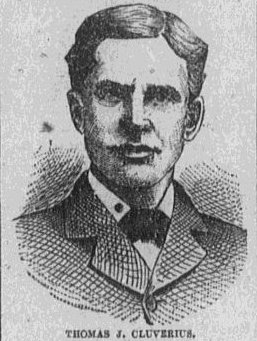
On Friday the 13th — March 13, 1885 — Cluverius killed his cousin and lover Lillian Madison, who was eight months pregnant with his child, an act “as dark as any that can be found in all the calendar of crimes.” (Columbus Daily Enquirer, Jan. 15, 1887)

From the illicit affair to the shocking crime of passion and calculation to the damning lost watch key found at the site of the murder: everything conspired to spill newsprint, not only in Virginia but nationwide.

Nevertheless, by the time he hanged, the young lawyer was supported by at least a chunk of public opinion prepared to credit his dogged insistence on innocence.* He maintained it all the way to the scaffold. The drama of a potential gubernatorial reprieve, backed by hundreds of Old Dominion worthies, went to literally the very last hour of the condemned man.

The facts of this case now 125 years in the grave enjoy meticulous and evocative coverage at The Shockoe Examiner, a Richmond blog that we come to via Murder by Gaslight’s Cluverius post.

We’re very pleased on this occasion to interview a writer who has given “Tommie” and “Lillie” a more literary treatment. John Milliken Thompson‘s first novel The Reservoir (review), just published in the summer of 2011, illuminates the timeless conflicts between lust and propriety, in the very specific locale of post-Reconstruction Richmond.

ET: For you as a writer, how did you come by this story, and why did you decide to make it your first novel?

JMT: I came across a brief mention of the case in a book on Richmond history and made a mental note of it.

Sometime later I began looking into the case and, after finding all kinds of material on the trial and on Richmond in the 1880s, I became more and more intrigued. A failed attempt to turn the story into a nonfiction account led me to write it as a novel.

Book CoverWhat was the most challenging thing about approaching the story?

Creating believable, interesting characters within a compelling plot is THE challenge of writing any piece of fiction. This one was no different, though it helped to have a historical framework and tons of good material to turn to.

That said, one of the toughest things about telling this story was getting the voice right. My goal was to create a narrative that could get close in to Tommie’s head, without revealing too much (to the reader or himself), and then pull farther back.

I found it interesting that you said you “felt so connected to these long-dead people that [you] owed it to them to get it right,” because I have that sense myself sometimes. In the end, what are you hoping that 21st century readers take away from the story? What did you take away from it?

In the end, I think what I most want is for readers to feel moved by the plight of these young people, who made some crucial mistakes and paid dearly for them. We all make mistakes in our youth; sometimes we learn our lessons before we get in deeper, sometimes not.

The inference is that Tommie killed Lillian because she was pregnant. How damaging would Lillian’s giving birth really have been to Tommie socially, professionally, or otherwise? Do we need to look for more complex motivations?

That’s a good question, and Tommie even considers what his life would be like if he had “done the right thing” by Lillie and married her. Even if he had been able to live down the scandal of marrying a pregnant girl, which in those days and in their circle would’ve been significant, it would still not have been the life this ambitious young man had envisioned for himself.

And what about the world he lived in — 1880s Virginia, and the place of the crime, Richmond. What’s this place like a generation after the Civil War? And why did this crime in this place become national news?

Well, Richmond, the former Confederate capital, was making a comeback after being ravaged by the war. This event caught the interest of the general public because of the high standing of the families involved and because the lawyers trying the case were distinguished men and famous orators.

Despite maintaining innocence to the last, it seems pretty difficult to imagine that Thomas Cluverius was actually innocent. Still, at the time there were plenty of people who apparently thought he might be. Why on earth did he attract that level of support? If not for the watch-key, might he have avoided conviction altogether?

That’s the fickle nature of the public — once the scapegoat has been cast out, there is a lingering sense of doubt and guilt that causes many of us to look into our own hearts … let he who is without sin.

I think the watch-key did play a big role, but it wasn’t necessarily the sine qua non. I think the sheer volume of testimony offered by the prosecution overwhelmed any reserve the all-male jury might have felt. The burden of proof, in fact if not by law, lay with the defense, and the proof (of innocence) simply wasn’t there.

What are you working on next?

I’m finishing up a coming-of-age novel about a young woman who suffers a number of poignant losses in turn-of-the-century North Carolina. By the way, until “turn-of-the-century” means turn of the 21st (maybe in two decades?) I’m using that phrase to mean turn of the 20th.

Thanks for inviting me on your blog.

* Or empathize with the young lawyer’s lost-potential pathos.

On this day..

1943: Jarvis Catoe

(Thanks to Meaghan Good of the Charley Project for the guest post. -ed.)

On this date in 1943, serial killer Jarvis Theodore Roosevelt Catoe was fried in the federal chair for the murder of Washington D.C. resident named Rose Abramowitz.

The 25-year-old victim, who had married only a month before, had hired Catoe to wax her kitchen floor.

Instead he raped and strangled her, left her sprawled on her bed and made off with $20.

Abramowitz wasn’t Catoe’s first victim and she would not be his last — although she was his first white victim; the previous ones had been black like Jarvis himself. This article summarizes Catoe’s career: homicides in New York City and Washington, beginning in 1935, as well as multiple robberies, rapes, indecent exposures and attempted kidnappings. To add insult to injury, an innocent man, James Matthew Smith, was convicted in his first murder and had already served several years of a life sentence by the time of Catoe’s arrest.

Time magazine called him a “one-man crime wave.” The D.C. police’s failure to catch him resulted in serious public embarrassment for the department and a dressing-down before Congress. Not bad for a killer so obscure his name isn’t even in Wikipedia.

Catoe’s last victim was Evelyn Anderson, a waitress in the Bronx. After he strangled her and left her body in an alley he took her purse and watch and gave it to a lady friend, who gave it to another friend, who gave it to a man who pawned it for $20. The New York Police, who had been checking the local pawn shops, found the watch and traced it through its various handlers, finally landing on Catoe, who had moved back to Washington by then.

He confessed to seven murders that he could remember, but reckoned the real body count was “about ten.” Most, but not all, of his victims had been sexually assaulted. A classic sexual sadist, Catoe stated he suffered from “spells” where he had an uncontrollable urge to kill. These spells tended to happen after he’d been reading detective stories and looking at pornography.

Catoe later retracted all his statements, saying he’d been “sick and weak” and the police and badgered him into making up stories. The jury didn’t buy it: in the Abramowitz trial, they were out for only eighteen minutes before voting for conviction and the death penalty.

He walked into the death chamber singing.

On this day..

1900: Louisa Josephine Jemima Masset

(Thanks to Meaghan Good of the Charley Project for the guest post. -ed.)

On this day in 1900, 36-year-old Louisa Josephine Jemima Masset (also called “Louise” in some accounts) was hung for the murder of her young son the previous year. She was the first woman, indeed the first person, to be executed in London in the brand spanking new 1900s.

Her crime, even by today’s standards, was shocking and there is little doubt that had it occurred today, Louisa would be featured on blogs with names like People You’ll See In Hell. (Actually, she got a TV miniseries in the early 1990s.)

The story of the murder and Louisa’s trial and death were recorded in detail in John J. Eddleston’s A Century of London Murders and Executions. Capital Punishment U.K. provides additional details, and the trial records can be seen here.

Our story begins a little after six on Friday, October 27, 1899, when a lady at the Dalston Junction train station in London found the body of a small boy shoved behind the door to the women’s lavatory. The child was naked, bloody and partially covered with a black shawl, and a bloodstained brick lay nearby.


Dalston Junction: Mind the gap. (cc) image from Matt From London

The post-mortem determined that the child had been beaten “with much violence” on the head and face, but the actual cause of death was suffocation. He probably died only about an hour or two before his body was found. There was no indication of his identity, so his description was published in the newspapers with hopes that someone would recognize him.

Someone did: the following Monday, a children’s nurse named Helen Eliza Gentle came forward and identified the murdered boy as Manfred Louis Masset, age three and a half, who had been in her charge until the previous Friday.

Manfred was illegitimate and had been in Helen Gentle’s care since shortly after birth. Louisa, his mother, doesn’t seem to have been the maternal type. She paid 37 shillings a month for his care and would visit him once every two weeks and take him to the park. The money supposedly came from Manfred’s father in France; Louisa herself earned a living as a day governess and gave piano lessons.

The arrangement with Helen Gentle ended when Louisa told Helen that she was sending Manfred to France to be with his father. Helen handed the child over to her at 12:45 p.m. on October 27, only hours before his death.


The day before giving him up, Helen Gentle took this picture of the tot to remember him by.

When she was tracked down at her brother-in-law’s house, Louisa denied having harmed her son and stated she didn’t even know he was dead until she read about it in the newspaper. She admitted the story about taking Manfred to France a lie and said she only wanted to transfer him to another carer, as she thought Nurse Gentle wasn’t educating him properly. Louisa claimed she had met two women, one of them a schoolmistress, in the park a few weeks earlier. She arranged to enroll Manfred for the price of £18 per annum, and handed the little boy over on October 27.

When pressed, however, Louisa couldn’t remember much about these women or their school. The police smelled a rat and took her into custody for murder.

At Louisa’s trial in December, she stuck to her story about giving Manfred to a schoolmistress. She said she’d handed him over at the train station at 4:00 p.m., along with a £12 deposit towards his school tuition, then took the 4:07 train to Brighton. No one at the station saw the two women Louisa described. However, three witnesses at the train station remembered seeing Louisa and Manfred, who was crying, hanging about the station for over an hour on the afternoon of Manfred’s death: one of those same witnesses saw and spoke to Louisa at the station at 6:50 p.m., nearly two hours after Louisa claimed to have left, and said her little boy wasn’t with her anymore.

The icing on the cake was when the brick used to batter Manfred was shown to be same kind as those in Louisa’s garden.

Louisa’s story was partially true; she did go to Brighton that day, hours later than she said, and Manfred’s clothes turned up in the waiting room of the train station there. Eudor Lucas, Louisa’s next-door neighbor, said they had spent the weekend together in Brighton, sleeping in the same bed, and he had “had connection” with her.

The jury must have been outraged by their blatantly immoral behavior, and in any case the evidence against Louisa was overwhelming. The jury got the case on December 18 and took thirty minutes to convict her. She was hung just three weeks later.

On this day..

1908: John Boyd, by John Radclive

On this date in 1908, John Boyd managed six fitful hours of sleep, had a breakfast of toast, poached eggs and tea, and then went to the Don Jail gallows for murdering his paramour’s rival suitor.

Canada had long before ceased public executions. Prior to Boyd’s execution, Don Jail hangings had occurred in a jail yard — technically behind prison walls, but easily peeped upon by curiosity-seekers willing to obtain higher ground. Boyd’s execution introduced a new privacy measure: it was the first of 26 hangings to occur in an interior chamber completely away from public eyes, the same place where Canada eventually held its last hangings in 1962.

But apart from this minor milestone, we notice on this date the hurried and disturbed departure of prolific hangman John Radclive. “Another poor soul gone,” he was overheard to say as he left.

Radclive is the subject of an empathetic Toronto Star profile that’s well worth the read.

He was Canada’s first professional hangman, with 69 recorded executions and perhaps just as many which the uneven documentation of the day failed to note. Predecessor of the better-known Arthur Ellis, Radclive learned his trade direct from William Marwood, and was put on the federal payroll as a full-time executioner in 1892.

He had a swagger in his ill-starred step back then: he once started a brawl boasting in a pub that he had “come to hang a Frenchman, and hoped it would not be the last.” By the time he got to Boyd and beyond, he was ready for the last. Alcoholism had wasted his nerves (and his liver: he died of cirrhosis in 1911). In 1910 Radclive told a psychiatrist,

“Now at night when I lie down, I start up with a roar as victim after victim comes up before me. I can see them on the trap, waiting a second before they meet their Maker. They haunt me and taunt me until I am nearly crazy with an unearthly fear.”

On this day..

1612: John Selman, Christmas cutpurse

400th death-day congratulations go to John Selman, a brass-balled nimblefingers who was hanged on this date in 1612 for stealing … at Whitehall … on Christmas … in the presence of the king. And, Selman himself added in his scaffold confessional, “in the time of divine Service, and the celebration of the Sacred Communion.” That’s like hitting for Stuart England’s malefaction cycle.

This common thief had tried to blend among the ermine-clad set at church with a black-velvet cloak getup, but drawn enough suspicion to be nabbed with a 40-shilling purse he’d brazenly boosted from a nobleman‘s retainer.

Francis Bacon, one of Selman’s judges, affected a suitably hyperbolic indignation at the effrontery of it all: “The first and greatest sinne that ever was committed was done in Heaven. The second was done in Paadise, being Heaven upon Earth, and truly I cannot chuse but place this in the third ranke.” Tens of thousands of human beings in the judge’s immediate ambit — England, Europe — had been slaughtering one another to the glory of God for the past century when Bacon said that. He’d surely give Nancy Grace a run for her money.

Then as now crime moved copy, and if the realm’s lord magistrates were ready to measure this guy up against Beelzebub, one can readily imagine the woodblock tweets he sent a-flying among the hoi polloi. Selman’s audacious escapade relieved his last days’ dread with the gift of celebrity. Writers scrambled to churn out Selman-tinged copy, like these inevitable ballads.

With hands and eyes to heaven,
all did in reverence stand:
While I in mischife used mine eye,
and my accursed hand,
Now was my mischiefe ripe.
my villanyes full growne,
And now the God in secret knew it.
did make it open knowne.

Hopefully God got a cut of the action from these writers. Talk about a Christmas gift for a scribe.

No less a personage than Ben Jonson hastily wrote Selman into his Twelfth Night masque Love Restored as “the Christmas Cutpurse”: this debuted the same night the real Selman made his last peace with God and man awaiting the next day’s hanging on the road to Charing Cross. (After all this Christmas reverence, they piously held off on the hanging until the full twelve days of Christmas had elapsed.)

Selman’s 15 minutes apparently took years to run, because Jonson went back to the same inspiration for 1614’s Bartholomew Fair — perhaps basing the character of Ezekiel Edgworth on Selman.

At playes and at sermons and at the Sessions,
‘Tis daily their practice such booty to make;
Yea under the gallows, at executions,
They stick not the stare-abouts’ purses to take;
Nay, one without grace, at a better place,
At Court, and in Christmas, before the Kings face.
Alack then for pitty! must I bear the curse,
That only belongs to the cunning Cut-purse?
Youth, youth you hadst better been starv’d by thy nurse,
Than live to be hang’d for cutting as purse.

“A Caveat for Cutpurses” from Bartholomew Fair

Jonson sure got that right: under Selman’s own gallows-tree this day, “one of his quality (a picke-pocket I meane) even at his execution, grew master of a true mans purse, who being presently taken, was imprisoned, and is like the next sessions to wander the long voiage after his grand Captaine Mounsier Iohn Selman.”

On this day..

1638: Four Frenchmen in effigy

We have touched in the past on the odd practice of executing effigies of criminals, a custom for which France had a particular penchant.

On this date in 1638, mannequins of Andre Armand, Gabriel Bonnaud, Sebastien Mareschal, and Simon Armand were “hanged” for murder.

As described in this French text, proceedings were delayed when, the previous November, the wife and mother-in-law of one of the absconded offenders appealed the sentence in their own inimitable way: by vandalizing the mannequins.

Thanks to Sonechka for deciphering the archaic French.

On this day..

1943: Rosanna and Daniel Phillips

Executions on New Year’s Day have not been unheard-of in U.S. history, but it’s been Auld Lang Syne since the last such event — a North Carolina double-gassing on this date in 1943.

The previous year, January 1, 1942, had seen the Tar Heel state host the Rose Bowl at Duke University’s stadium: that was just 25 days after Pearl Harbor, and the California coast was considered a potential target. With war in the Pacific trending America’s way, however, the tournament of Roses — although still not the associated parade — was back in Pasadena on New Year’s 1943. So instead, North Carolina did this.*

Daniel and Rosanna Phillips, black sharecroppers, died consecutively in the Raleigh Central Prison gas chamber for the ax murder of their farm owner a mere five months before.

This laboring couple, lovers living out of wedlock (they married after the murder), seem to have had a violent relationship with one another; their 13-hour trial would feature the defendants’ mutual recriminations of black magic, and allegations by each that the other one was the real killer. (Theft appears to have been the motive.)

(The lengthiest accessible summary of this case that I’ve been able to find is in this pdf of a lengthy journal article, “Black Female Executions in Historical Context” (scroll all the way to p. 77).)

The U.P. wire report (as run in the New York Times, Jan. 2, 1943) says that the pair forgave each other by the end. Still, Daniel was gassed first “at the request of the State Parole Commission, on the possibility that he might make a last-minute statement exonerating his wife,” which would have spared Rosanna. One wonders if she was still in a forgiving mood when she found out that he hadn’t breathed the word that might save her.

At least some newsmen also reported a malfunction in the chair’s cyanide-dropping rack for Rosanna’s execution, which required guards to re-open the chamber after its strapped and hooded subject had been sealed in, and putz about the mechanism while she waited.

* Actual reason to do this on New Year’s Day: the mere happenstance of automatically scheduling execution dates a set number of days after the defendants’ last appeal failed.

On this day..

1961: Robert McGladdery, the last execution in Northern Ireland

Northern Ireland checks in today at a half-century death penalty-free, dating back to the hanging this date in 1961 of Robert McGladdery.

An agricultural laborer and “well known bad lad”, McGladdery followed a young woman named Pearl Gamble out of a dance hall one night and strangled and stabbed her. It became an open-and-shut case when the police tail surveilling him witnessed McGladdery tramping into some undergrowth where his bloody dance-hall clothes were stashed.

This was all the more remarkable because McGladdery knew he was being watched. In fact, the Daily Mail later got into hot water with the crown because it went and interviewed the suspect: that interview was published while McGladdery was still free, the day before he decided to pay his respects to the evidence that could hang him.*

The case is the subject of the BBC “dramatised documentary” Last Man Hanging, as well as a couple of books.

Books about Robert McGladdery

(Review of Orchid Blue.)

* See London Times, Feb. 18, 1962.

On this day..

2009: Mosleh Zamani, because sex kills

On this date in 2009, Mosleh Zamani was hanged in Iran for making the beast with two backs.

And you thought you’d seen sexual hangups.

Twenty-three at the time of his execution, Zamani was all of 17 years old when he committed the “crime” that earned him the rope.

That crime: abducting and raping a 24-year-old woman.

So, okay, one might say: pretty rough punishment but also pretty serious misbehavior.

Save for a few minor details. Like, that the “raped” woman was actually Zamani’s girlfriend. And that she said the sex was consensual. Apparently this testimony from the mere victim was superseded by three random village prudes willing to complain about what the licentious youth get up to these days.

Given his cruel treatment, it will not surprise that Zamani was an ethnic Kurd and that his legal representation fell somewhere between poor and nonexistent.

Persian speakers (I am not one) can take in this interview with the young man’s family.

On this day..

1952: Hard Luck Billy Cook

On this date in 1952, the short and brutal life of William Cook ended in the San Quentin gas chamber.

A quintessential “terrible upbringing” criminal, young Billy was ditched with his siblings by their alcoholic widower father in an abandoned mine when he was a small child.

Though brothers and sisters found foster parents, Billy — afflicted by physical deformity and an ungovernable temper — had to make his way as a ward of the state. Constantly delinquent through his adolescence, he was institutionally handed off to the state penitentiary at age 17.

He got out at 22, with a grudge against the world and a knuckle tattoo reading “H-A-R-D L-U-C-K”, resolved — so he told his derelict father — to “live by the gun and roam.”

In a 22-day spree looping from California to Texas and Oklahoma and then back again, Cook slew six people: an entire vacationing family in Oklahoma, and then another kidnapped motorist in California. Taking drivers hostage was how he navigated America’s growing intercity road network, making the Cook story readily adaptable to titillate cinema-goers who knew the loneliness of the open road, in 1953’s The Hitch-Hiker. (Teaser line: “Who’ll be his next victim … YOU?”)

Cook took little care for his own secrecy and had to flee to Mexico to avoid a dragnet. Surprisingly, even the police chief of Santa Rosaria in Baja California recognized the wanted man, and he was captured there unawares and extradited back to the Golden State.

“I hate everybody’s guts,” he reportedly explained upon his capture. “And everybody hates mine.”

On this day..