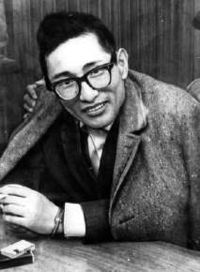
1970: Akira Nishiguchi, Vengeance Is Mine inspiration

On this date in 1970, Japanese serial killer Akira Nishiguchi was hanged for murder.

Born in 1925, Nishiguchi (English Wikipedia entry | Japanese) spent the war years in juvenile detention but emerged in time to work as an interpreter for the U.S. occupation.

He was arrested repeatedly (Japanese link) as a con man during the 1950s. Police had him pegged as a nonviolent serial fraud artist, but in 1963 he killed two drivers to steal from them, then went on the run in Tokyo.

For 78 terrifying days, his face — those fraud convictions came with fingerprints that identified him as the killer — gazed out of wanted posters as Nishiguchi scraped by in cheap hotels and desperate disguises, committing three more murders in the process. Finally, an 11-year-old girl recognized him, posing as a lawyer.

Nishiguchi is the subject of the 1979 Shohei Imamura film Vengeance Is Mine. (Review | Another)

On this day..

1852: Jose Forni, the first legal hanging in California

Detail view (click for the full image) of the hanging of Jose Forni (Forner)

“My friends! You have come to see an innocent man die. I die for having killed an assassin. He attempted to rob me; I resisted; he stabbed me and fled. Maddened and smarting from my wounds, I pursued, overtook, and killed him. I am a native of Valencia, Spain. I have but few friends in San Francisco.

I have resided in Cuba, where I have many friends. I was tried by a judge and jury who were utter strangers to me. I could produce no witnesses in my favor. What led to my killing my assailant is known only to God and myself. What I have said is true. After I have spoken these few words I shall never speak more. No doubt those who tried me acted justly according to the testimony. They could not have known the truth. The Americans are good people; they have ever treated me well and kindly; I thank them for it. I have nothing but love and kindly feelings for all. Farewell, people of San Francisco! World, farewell.”

Jose Forni’s last words (translated from Spanish)

Having so declaimed, Jose Forni (or Forner) dropped through a trap on San Francisco’s Russian Hill and into the history books as the first hanging under color of law in the state of California.

Forni was pretty small potatoes for such a milestone, a Spanish immigrant caught stabbing to death a Mexican in broad daylight a mere three months before.

Despite Forni’s mysterious last statement, everyone was in fact pretty sure they knew what led to the killing.

Forni was found with a sash containing $350. This sash, a Mexican style not popular with Spaniards, had been observed in the possession of the victim Jose Rodriguez earlier that evening, by a gambling-hall dealer who saw Forni follow Rodriguez out the door. (Source)

Forni stuck to the story that it was his, and that Rodriguez had tried to jump him and take it when Forni set the sash down to relieve himself. And that then, after he’d been stabbed in the leg, he chased down the assailant.

Yeah, right.

“It was a proud day for the law,” wrote (doc) historian Hubert Howe Bancroft. “It was a happy sight, I say, this hanging of the moneyless, friendless Spanish stranger.”

If this doesn’t seem like the sort of thing hippy-dippy San Francisco would ordinarily strut about, bear in mind that the previous year, a standing Committee of Vigilance had formed itself and meted out extrajudicial lynchings without waiting on “the quibbles of the law, the insecurity of prisons, the carelessness or corruption of the police, or a laxity of those who pretend to administer justice.” Similar committees operated elsewhere in the state.

So the fact that Forni was suffered to wait on the quibbles of the law was a sort of progress. And it does sound, from the report in the next week’s (December 16) Alta California, as if the populace were jolly pleased to see it.

A continuous line of human beings was pressing up the hill all the morning, until a crowd numbering three thousand at least had gathered together [n.b. – nearly a tenth of San Francisco’s population at this time -ed.] … the assemblage was indeed a singular one — there being at least one-fourth of the number composed of youths, women and children. Women elbowed their way as near as possible to have a full view of the gallows, whilst others were on horseback and in carriages, riding around with as much gaiety as if on a pleasure drive.

But what was most shocking was to see respectable looking parents taking their little sons and daughters into such a heterogenous crowd, to witness such a terrible spectacle. Despite the slight rain, they stood it out with heroical fortitude and patience worthy of a better occasion. Before the prisoner had arrived, the small boys amused themselves with playing marbles, the bigger ones with dog fights, whilst others whiled away the time recounting their experience in such matters.

Reflecting on the homicide that had occasioned all this festivity, the Alta prayed that “our criminal records never be stained again with the history of such a dark and bloody transaction.”

Yeah, right.

On this day..

1999: James Beathard, on the word of a known liar

(Thanks to Mary O’Grady for the guest post. -ed.)

Murder is not a common occurrence in Trinity County, Texas. The shotgunning of three members of the Hathorn family in their trailer home on the evening of October 9, 1984 remains notorious, even among locals who were not yet born on the date of the crime.

Clues scattered at the crime scene, African-American human hairs and Kool cigarette butts, were supposed to convince authorities that a certain sort of suspect had killed Gene Hathorn, Sr., his wife Linda Hathorn, and their teenaged son Marcus Hathorn. Mr. Hathorn’s recent receipt of a $150,000 property settlement and his recent disputes with his elder son, Gene Hathorn, Jr., led law enforcement in a different direction. Less than one month after the bodies were found, Gene Hathorn, Jr., and his running buddy James Lee Beathard faced charges of capital murder.

Prosecutors developed evidence that Gene Hathorn, Jr., hatched the plot to kill his family in order to inherit his father’s new wealth. It seems he was unaware that his father had formally disinherited him three weeks before he was murdered.

James Beathard was first to stand trial.

Called to the witness stand by District Attorney Joe Price, Gene Hathorn, Jr., testified against Beathard, to devastating effect. Hathorn claimed that Beathard entered the trailer, killed all three victims, and planted the false clues, while he himself fired only one shot through a window. Beathard was sent to death row.

When the younger Hathorn was brought to trial, District Attorney Price reversed his theory from Beathard’s trial, depicting Hathorn as the “inside man” and the strategist who believed he had concocted the perfect crime. Gene Hathorn, Jr., joined James Lee Beathard on Texas’s death row. Hathorn recanted his testimony against Beathard. No appeals court took notice.

In the mid-1980s, Texas’s male death row occupied part of the aging, red brick and steel Ellis I prison unit outside Huntsville. For prisoners such as James Beathard and Gene Hathorn who conformed themselves to the rules, a considerable amount of communication with other prisoners and with the outside world remained possible. Each of these sons of East Texas soon found himself editor of a death row periodical, the Lamp of Hope in Hathorn’s case and the Texas Death Row Journal for Beathard. Over the years, Beathard emerged as a prolific letter-writer and essayist, publishing a brief nonfiction piece describing life on death row in the British Guardian Weekly in August, 1996.

Beathard’s talent as a correspondent won him considerable sympathy during his fourteen years on death row. As they exchanged letters, American playwright Bruce Graham fictionalized Beathard in his short play, Coyote on a Fence.

James Beathard’s intelligence and powers of articulation were unusual among death row prisoners. Since he could be trusted to exit and re-enter his cell with no fuss and to refrain from blithering forth psychotic delusions, he was sometimes trotted out when prison authorities needed a condemned man to meet the press.

James Beathard’s appeals ran out at last in 1999. He was executed, still protesting his innocence, on December 9th of that year.

His partner in crime, Gene Hathorn, Jr., won an appeal in 2009 based on his trial attorney’s failure to introduce evidence of his father’s abuse of him in childhood. He is now serving consecutive life sentences, reportedly working as a prison cook in general population.

On this day..

2009: Yang Yanming, hedge fund manager

On this date in 2009, China executed a rogue securities trader for disappearing around $10 million.

The first person executed for securities corruption in China, Yang used his position as a trader for Galaxy Securities to embezzle some 65 million yuan for personal gain.

He never disclosed the money’s whereabouts, presumably taking the secret with him to the grave. (Or to the organ donor market.)

As gangster capitalists go, Yang could hardly be considered exemplary either by scale or by ruthlessness. His peculation undoubtedly harmed many people, but there’s no known whiff of violence about him; he was caught after attempting suicide.

But by the same token, the occasional sacrifice of such middling malefactors potentially helps discharge some of the tension generated by the structural inequality accompanying China’s new oligarchy. What to do in such a world?

“Preserve your moral integrity and don’t set too much store by business results,” Yang told a newspaper prior to his execution. You said it, brother.

On this day..

1869: Nicholas Melady, the last public hanging in Canada

Thanks to John Melady, author of Double Trap, for the guest post about his kinsman. -ed.

I was standing with my father, looking at the ruins of an old house. I thought what remained of the brickwork was interesting, until Dad said, rather offhandedly: “And this is where the murder happened.” I was rather shocked, and asked what he meant.

His answer led me to write Double Trap, the story of the last public hanging in Canada.

Briefly, the tale goes something like this.

A man named Nicholas Melady Senior, my great-grandfather’s half brother, amassed substantial landholdings in Huron County, Ontario Canada, prior to 1868. In the years just before that, he played various family members off against each other, and depending on his whim, one or other of them would be promised his inheritance. His son Nicholas Junior was used worst of all. He worked without pay for his father, was promised all or at least some of the lands, but then was told he would get nothing — several times.

One night, Nicholas Senior, who was commonly called The Old Man, was in bed with his new wife, when Nicholas Junior and two of his friends, all of whom were drunk, broke into the Old Man’s house. A terrible fight ensued, and it included a hand gun and an axe, but at the end of the thing, the Old Man and his bride were dead.

After some very shoddy detective work, Nicholas Junior and his two friends were rounded up and lodged in a basement cell of an old house in nearby Seaforth, Ontario. (The local magistrate owned the place.) Part of that cell still exists, including the barred window the culprits would have looked through — at the rest of the cellar. It is rather creepy to visit, and while I researched Double Trap, I did not want to be there for long, and never at night.

In due course, the three desperadoes were sent to an even more chilling old jail in Goderich, Ontario. (It is now a Canadian historic site, and is visited by throngs of people every year.) There, Nicholas Junior’s friends ultimately turned against him.

However, before that happened, local detectives used a unique stratagem to gain evidence against Nicholas. I could never be sure where they got the idea. They hired a beautiful young woman who was born in Michigan, (who was likely a prostitute) and talked her into spending time in a cell in the jail. She was paid to gain the trust of Nicholas, and hopefully a confession.

In that sense, she was the first part of the “double trap,” in the book’s title.

The woman was given the name “Jenny,” and in time, by dropping notes where he would find them, and ultimately putting herself in a position where she could whisper to him through his cell window, (she positioned herself in the women’s exercise yard; he was inside his cell), she caused him to fall in love with her. All of her notes, and his as well, were used in the trial that followed. The two never actually touched each other.

When she walked into the courtroom during the trial and took the stand to describe her job and show the letters Nicholas had written, he was utterly speechless with shock. He had completely trusted her, and to him, her betrayal was total.

The execution of Nicholas Melady was a macabre affair, as were events leading up to it. His death cell was positioned quite close to where he was hanged. He could hear workers building his scaffold, and while I cannot prove it, I believe he would have been able to witness the construction of the thing. The death cell still exists, and in researching this book, I visited it several times. Now that is creepy.

So is the ground where he took his final few steps, out to the scaffold. It was built on top of the prison wall. He went up the steps on the inside, then lurched to his death, down the outside of the wall — where all the spectators waited to see the spectacle. His fall, through the trapdoor in the gallows floor was the second trap of the book’s title.

The execution was the last public one in Canada. Three weeks later the government of the country abolished public executions because they were regarded as too barbaric. There was controversy however, around the one for Nicholas. Many people felt he had been betrayed, by his accomplices, and by “Jenny,” and so lots of talk in the community made the public officials fear that there would be demonstrations the day of the death.

For that reason, they moved the execution time up by about three hours. “Only” about 300 people witnessed it. Several thousand came to see the spectacle later in the day, but by the time they reached the site, the show was over. His body was cut down, and for reasons I could never fathom, was actually waked for two days in the same house where the killings took place. Lots of the curious came to see the corpse of the killer, laid out for display.

The day after the execution, the New York Times was the first newspaper on the street with the story. I could find no trace of “Jenny,” or what became of her after her jailhouse job. Her testimony in court was never really challenged.

I was able to position myself in the cell where Nicholas was when he whispered to “Jenny.” I then went into the women’s exercise yard and by leaning against the jail wall easily understood how the conversations between the two transpired.

The book is Double Trap, by John Melady. Published by Dundurn, and available in the United States at Dundurn Publishing, 2250 Military Road, Tonawanda, New York 14150. In Canada, the pub address is: Dundurn Publishing, 3 Church Street, Suite 500, Toronto, Ontario M5E 1M2 In Britain, the address is: Gazelle Book Services Limited, White Cross Mills, High Town, Lancaster, England LA1 4XS.

On this day..

1831: John Bishop and Thomas Head, the London Burkers

On this date in 1831, two of the “London Burkers” hanged for murdering a child to sell his body to anatomy schools for dissection.

It was one of the city’s most infamous crimes, touching explosive resentments among Londoners for the vampiric trade in human cadavers ultimately demanded by medical students. Thirty thousand packed the streets around Newgate Prison to send this date’s hated offenders on to the hereafter.

As the gang’s nickname indicates, it closely followed the similar affair of Burke and Hare in Edinburgh. (“Burking” had immediately come to mean “killing someone for their marketable cadaver”, a shadowy underworld phenomenon that was in need of a catchy name.) But although William Burke made the OED, it was the London Burkers who most directly triggered the legislation to reform the anatomy business.

Historian Sarah Wise wrote the acclaimed book about this case, The Italian Boy. Executed Today is thrilled to interview her on this 180th anniversary of the London Burkers’ deaths.

The Italian Boy purchase links for Anglophones

Book CoverET: Let’s begin with the title of your book, The Italian Boy — an allusion to the victim in the case. Who was this youth, how did he come to be in London, and what did the city look like to a penniless foreign child in 1830?

SW: Well the book is less a ‘whodunnit’ and more of a ‘who-was-it-done-to’. The identity of that particular victim was never fully established. But, as still happens today in murder cases, some types of victim seem to have more appeal than others, and rumour that a little Italian beggar boy was missing from his usual pitches snowballed into a situation where even the courts, police and newspapers were accepting it as fact that it was his body that had been delivered to an anatomist. The final chapter of my book goes into why this might not have been so.

The ‘Italian Boy trade’ was a racket, whereby traffickers paid poor peasant parents, worried about what future they could offer their children, and took charge of the child, walked them north to the wealthy cities of northern Europe, and got them exhibiting small animals or plaster images around the streets, in the hope of being thrown a penny or two. Huge sums could be obtained in this way, but needless to say, the children themselves saw little of this. [There’s an 1872 New York Times article describing the trade into North America here. -ed]

I was fascinated by the warmth shown to these kids in what was otherwise a pretty mean city. This really is the London of Oliver Twist — dark, filthy, with all sorts of Fagin types (and much worse) around. Child vagrancy (as with adult vagrancy) was all too common and yet there were practically no public or civic bodies to offer any help; the idea of hordes of kids sleeping rough is just extraordinary, but that’s how London was right up until the end of the 19th-century.

But Londoners loved these attractive, exotic-looking little Italian waifs, and would also defend other types of beggars if anyone appeared to be hassling them. Ordinary city-dwellers seemed to me, in reading the primary source material, to be a lot less withdrawn and in their own little world than we city-dwellers are today, and seemed to show more class, or social, solidarity.

And how about the killers? What’s their own background, and how do they get into the business of killing people to sell the bodies?

One of the killers, John Bishop, came from a good, solid, small-business background, having been bequeathed a successful carting company. He drank away the family firm, and then turned to the related trade of bodysnatching — there was often a close connection between those involved in city transport and those who needed to move their very questionable goods around surreptitiously. Both trades had the pubs in the street called Old Bailey as their headquarters.

The other killer, Thomas Head, aka Williams, was younger and harder to find out about. He was said to have come from a very poor but honest home, and his parents were devastated when he began to go off the rails in his adolescence, firstly petty-thieving, and then moving on to the less petty-thieving of grave robbery.

I’ve touched a bit elsewhere on the site on the underlying dynamic at work: more demand for medical cadavers than was being met by the gallows. Do we have a sense at this time, after the Burke execution, what proportion of those extra cadavers were being provided by resurrectionists? And how many might have been provided by outright homicide?

Numerical estimates vary hugely for every aspect of this subject. In terms of the sheer volume of bodies medical students were getting through, the 1828 Select Committee on Anatomy canvassed many opinions, and came up with the hugely divergent total of between 500 and 1,000 in a year — the ideal being three bodies per student, with each student completing a 16-month surgical and dissection training. The Select Committee suggested that on average, the Resurrection Men were supplying around 500 to 550 corpses a year — by one means or another. But all these stats should be used with caution.

As for grave robbery: it was all highly surreptitious, as you would expect — there is no great documentary source to turn to, and so we have only scraps of rumour and hearsay. John Bishop, one of the Italian Boy murderers, is said to have ‘lifted’ between 500 and 1,000 corpses in his career, which lasted from 1818 to 1831. That is a huge differential and there is no way of checking whether the lower or higher number is the more likely. Someone shouted at Bishop, in the Old Bailey cells, ‘You’re a bloody murdering bastard, and you should have been topped [hanged] years ago!’, which suggests that the Italian Boy killing was not his first.


Image of a burking, from a broadside on the London Burkers among a book full of street literature here.

As we know, only around twelve people a year were executed for murder in England in these years — people executed for other crimes were not sent to the anatomists. My guess is that many folks who died in public hospitals or workhouses were anatomised, but that this was a highly secret matter and went on illegally. The other main sources of corpses, to make up the shortfall, will have been corrupt undertakers, church sextons and gravediggers. I suspect many coffins in London graveyards were filled with nothing more than brick or earth. As the 1820s wore on, actual exhumations are likely to have declined in favour of more simple ‘sneak-thieving’, with insiders giving the tip-off about where a recently deceased body was likely to be found.

One more ‘statistic’ for you: in a plea bargain attempt during the Italian Boy case, the police placed in front of one prolific bodysnatcher a list of all the resurrection men they had ever known or come across and asked the witness if he would mark with a cross any of the 50 whom he thought capable of murder for dissection. When he handed it back, he had marked six names.

Huge irony: when anatomised, John Bishop was found to be one of the very best specimens the Royal College of Surgeons had ever dissected — great, strong muscles, extremely fit and hearty, from his horrible career in body-handling.

How overtly implicated were aspiring or actual doctors with this sort of thing (even “mere” resurrection as against murder) as a “necessary” part of their education that they chose to turn a blind eye towards? And was there any engagement with the problem as an ethical question?

The public cared hugely about the ethics; the legislature very little. That’s why Dr. Knox, in the Burke and Hare case, was so unusual — no one protected him when the case came to trial, and he was vilified and more or less chased out of Edinburgh. But in the Italian Boy murders, no doctor got anywhere near the witness box. Society and the legislature really rallied around them, to make sure the public did not take their feelings out on them.

But popular resentment that the doctors might have encouraged, or turned a blind eye to, grave-robbery (not murder) remained very common.

By around 1800, doctors and students had wholly outsourced exhumations for dissection material — gangs of specialised labouring men did it for them, and part of the deal was that (in return for a good wage) the bodysnatchers themselves, if caught, would keep silent, do their stretch in gaol, and they and their families would be looked after financially by the surgeons who commissioned them.

One surgeon, Joshua Brookes, fell foul of the bodysnatchers (refusing to put up their wages) and in revenge, they placed half-dissected corpses close to his Soho premises. These were tripped over in the dark by pedestrians, which caused a huge rumpus and the police had to come to protect Brookes from the mobs who wanted to stone his house. Such events were the exception, rather than the rule.

There’s something just sublimely Swiftian about a disposable person being literally, bodily consumed by the city and its professional class. Was it surprising that a doctor would bust these men when they came to sell the body, and/or that it would trigger an aggressive police response? Had they probably pulled this trick with a wink and a nod many times before?

The Italian Boy case was highly unusual in that it was a surgeon, Richard Partridge, who blew the whistle — not only on the killers but essentially on the whole trade. He was the anatomy teacher at the brand-new King’s College, which was very religious-based, though funnily enough, I don’t think Partridge himself was devout. In getting the men arrested, he really blew wide open this secretive, terrifying world of the trafficking of (poor people’s) corpses.

It is the Italian Boy case — not Burke and Hare — which brought about swift legal change, which ensured the demise of surreptitious grave-robbery for anatomical teaching.

Other than hanging the perps, what was the fallout from this case at the level of policy or social evolution? Was there conflict between the privileged and the poor over how to understand this sort of crime and how to go about addressing it?

The ‘resolution’, the ‘evolution’, was the 1832 Anatomy Act, which essentially legalised what had been going on all along. It permitted anatomists to claim as legitimate teaching material the corpse of anyone who died in a workhouse or public hospital whose body went unclaimed by friends or family for private burial. In practice, it seems that even when apparently friendless beggars died, and associates did come forward, the doctors had already earmarked the body for their own purposes.

This type of thing caused decades and decades of bitter class resentment in this country, and fear of doctors and hospitals was even discernible in my late parents’ generation. These worries still occasionally resurrect themselves. The UK’s Human Tissue Act of 2004 was passed following disclosure of the mass storage of children’s organs, without any permission or consent having been sought from the parents. I think consent remains a huge issue in medical matters, in most cultures, and those who are deemed powerless in some way — by class, race, caste, gender and so on — are by far the more likely to have their bodies commandeered in the name of science.

Sarah Wise has been a Londoner since the age of 14. She has a BA in English Literature and a Masters degree in Victorian Studies, from Birkbeck College, University of London. The Italian Boy: Murder and Grave Robbery in 1830s London won the Crime Writers’ Association Gold Dagger for Non-Fiction in 2005 and was shortlisted for the 2005 Samuel Johnson Prize for Non-Fiction.

Sarah was a major contributor to Iain Sinclair’s compendium London, City of Disappearances, published by Hamish Hamilton in 2006.

Her forthcoming book, Inconvenient People, investigates the phenomenon of sane people being put into lunatic asylums in Victorian England, and will be published in the summer of 2012.

On this day..

1920: Tom Johnson and Jim McDonald, criminal assailants

Charlotte Observer, Nov. 27, 1920 (Nov. 26 dateline)

Govenror Bickett today signed the death warrants of Tom Johnson and Jim McDonald, negroes convicted of criminal assault and whose appeal to the Supreme Court had been dismissed. Johnson, a native of Guilford county, and McDonald, of Davidson, will die in the electric chair at the state prison on December 3.


Charlotte Observer, Dec. 4, 1920 (Dec. 3 dateline)

Tom Johnson and Jim McDonald, Guilford and Davidson county negroes, died in the electric chair at the state prison here today for criminal assault, Johnson preceding McDonald to death by only a few minutes. The killing today was the fourth double electrocution by the state since the electric chair was substituted for the hangman’s noose. Both the prisoners appealed to the supreme court for new trials but their cases were dismissed two weeks ago.

On this day..

2010: Shahla Jahed, the footballer’s lover

At 5:00 a.m. this date last year, Shahla Jahed was hanged at Iran’s Evin prison for murdering the wife of Iranian footballer Nasser Mohammadkhani.

An international human rights cause celebre from the time of her 2004 conviction in a sordid televised trial, Jahed was also Mohammadkhani’s wife under a “temporary marriage” arrangement that was secret from his “real” wife Laleh Saharkhizan. So you might say, his mistress.

Both these women’s last day of liberty was the one in 2002 that Saharkhizan turned up knifed to death while Mohammadkhani was in Europe on soccer business. Jahed was arrested immediately, beginning a “taboo-breaking” legal odyssey.

After months of refusing to talk, she confessed to the murder in prison, even re-enacting the crime.

But by the time of her trial — in which an emotional, combative Jahed conducted her own defense — she very plausibly claimed that the confession had been extracted by torture. Here’s a bit of it, from the documentary Red Card (banned in Iran) that can be enjoyed in full on YouTube:

While Jahed herself made for can’t-look-away TV, the appearance of a onetime champion athlete in a feet-of-clay turn has led this affair to be compared to the O.J. Simpson murder case.

Like the Juice, Mohammadkhani was temporarily in some danger of death penalty charges himself; he spent several months in prison. Ultimately, he avoided jeopardy to his neck as a potential accessory or instigator by Jahed’s repudiated I-did-it-myself confession — possibly another reason why Jahed confessed in the first place — but the former striker did endure 74 lashes for the revelation that he and his temporary wife enjoyed chilling out with opium. Strictly verboten in Iran, of course.

And Mohammadkhani’s brush with the law scarred his honor even more than his backside. Beyond the possibility that she took the heat for him, the celebrity athlete potentially in a position to use his pull to save a woman’s life clammed up as her case progressed and deferred to his late wife’s family’s decision whether or not to give Jahed mercy. Reportedly, Mohammadkhani even attended the hanging — where Jahed again sobbed and begged for mercy until one of Saharkhizan’s relatives personally kicked the chair out from under Jahed’s feet.

The case itself had an unusually long lifespan in the judiciary; Jahed had been imprisoned well over eight years by the time she died. In 2008, the gears were even stopped by Ayatollah Hashemi Shahroudi, a figure known in Iran for his support of de-escalating capital punishment generally.

Shahroudi’s ordering a new investigation provided fodder for critics like Amnesty International who considered the trial unfair.

Iranian journalist Fereshteh Ghazi, who as a political prisoner in 2004 briefly shared a cell with our principal, made an even stronger critique.

Even if Shahla had committed the crime, which she didn’t, Shahla and the murdered wife are both victims of a male-dominated society, a system that gives all the rights to men. Shahla, Laleh [the murdered wife], and all other women like them are all victims of flaws in the Iranian judicial system and Iran’s unequal judicial system. Even the person who pulled away the chair today in her execution is a victim of the system.

Apropos of the women-in-the-judicial-system theme, Jahed’s case and even her execution were to some extent overshadowed by the simultaneous headline-grabbing matter of Sakineh Mohammadi Ashtiani, an Azeri woman who was at the time fighting a repugnant sentence of stoning for adultery. By December 2010, Iran had backed off the stoning bit without quite agreeing that Ashtiani wouldn’t be executed in some other way; in January 2011, it remitted Astiani’s death sentence altogether.

On this day..

1721: Cartouche, French bandit

On this date in 1721, the French outlaw Cartouche was broken on the wheel in Paris.

Your basic superstar robber during that archetype’s golden age, Louis Dominique Garthausen, aka Bourguignon, aka Cartouche was the son of a German mercenary-turned-French wineseller.

Little Cartouche — his nickname came from a Francophone corruption of his German surname — distinguished himself from childhood as the most charismatically intrepid of the local hooligans, and by adolescence was already the leader of a troupe of rascally thieves.

By his twenties, after a detour through the army, Cartouche and his merry men (the Cours des Miracles gang, after the slum they operated out of) were raiding the lucrative Versailles-Paris route, plundering the virtue of marchionesses, distributing stolen booty the poor, maintaining perfect courtesy in the society of gentlemen, and generally becoming the heroes of that species of literature that revels in bodice-busting sybaritic rakes who play by their own rules but have a heart of gold. (Sample escapade: walking a carnival parade with a cart full of police effigies — whipping them all the way, to the glee of the crowd. Thackeray celebrates more Cartouche folklore here, like the time he robbed as part of a threesome, talked one accomplice into murdering the other in order that the two survivors should have greater shares of the spoils to divide — only to round self-righteously on the killer once his pistols were safely discharged and gun him down in turn with the words “Learn, monster, not to be so greedy of gold, and perish, the victim of thy disloyalty and avarice!” That’s a pretty good one, whether it really happened or not.)

The flesh-and-blood police started to roll up this group around 1719, turning arrestees into informants and hunting ringleaders to ground. True to character, Cartouche defied with his liberty the growing price on his head, deftly giving gendarmes the slip until a confederate betrayed him into his enemies’ hands literally while his pants were down.


18th century engraving of the arrest of Cartouche.

The guy very nearly broke out of prison — tunneling out of a dungeon of the Chatelet into a neighboring basement, only to have the clank of his chains rouse the family dog into a woofing frenzy that betrayed him before he could vanish out the front door. But even back in the clink,

came a period of splendid notoriety: he held his court, he gave an easy rein to his wit, he received duchesses and princes with an air of amiable patronage … His portrait hung in every house, and his thin, hard face, his dry, small features were at last familiar to the whole of France. M. Grandval made him the hero of an Epic — “le Vice Puni.”

Cartouche was doomed to breaking on the wheel after a morning suffering the tortures of the boot in an unavailing effort to extract further incriminations from the rogue.*

Cartouche seems to have fully expected his troupe to reciprocate this heroism by rising to the dramatic occasion of a rescue from the very scaffold. But as the prisoner arrived at the Place de Greve, he perceived at last that like Christ he had been abandoned at the critical hour by the men who had sworn oaths with him. The great desperado’s final act was to retaliate upon these faithless friends (and family!) by taking aside his prosecutors and detailing his every accessory in crime, even his lovers. What the worst extremities of medieval torture could not procure from him, the compelling incentive of revenge instantly conjured.

Our hero went to his death this day but his revenant spirit stalked France for many months thereafter as dozens succumbed (pdf) to Cartouche’s scaffold indictment. One diarist recorded the following July,

Nothing but hangings and breakings on the wheel! Every day some Cartouchian executed.

* Available sources are flatly contradictory between the story that Cartouche was to die on the 27th and his confessions stalled things until the 28th, or was to die on the 28th all along, or was to die and did so on the 27th.

On this day..

1988: Adrian Lim and his two wives

On this date in 1988, a trio that had once formed an abusive family were all hanged in Singapore for their shocking ritual murders.


Top to bottom: Lim, Tan Mui Choo, and Hoe Kah Hong.

The Toa Payoh murders stunned Singapore in early 1981, when the brutalized bodies of a nine-year-old girl and a ten-year-old boy turned up in that district of the city-state.

A literal trail of blood led police from the second victim to a nearby seventh-floor flat cohabitated by a self-proclaimed spirit medium named Adrian Lim and his “holy wives” Tan Mui Choo and Hoe Kah Hong. In the apartment was a bevy skin-crawling incriminating evidence, like papers with the victims’ names written down, hairs later matched to the kids, and spatters of blood.

So this wasn’t a case so much for crime scene investigators as for psychologists.

Eschewing the forgettable life of a mere cable TV bill collector, a thirtysomething Adrian Lim had cultivated a side business in quack spiritualism in the early Seventies. He soon found this rewarding scam, in which troubled bar hostesses seeking personal guidance could be induced to pay him for a holistic regimen of eggs, needles, prayer to miscellaneous deities, and (often as not) sex with their “healer”, sufficient to support his lifestyle without further remuneration from the broadcast industry, so he went full time. And then he went right around the bend.

Even as a 9-to-5 desk jockey, Lim had already reeled in one depressed young woman as his live-in lover and business partner and willing enabler of Lim’s carnal con artistry. Lim did not scruple to pimp her out as a prostitute. This was Tan Mui Choo. (Click here for an interesting profile of a nun who counseled Tan Mui Choo, and later many other condemned prisoners, on death row.)

Hoe Kah Hong fell into Lim’s clutches a few years later, and although it was that young woman’s own mother who brought her in for Lim’s hocus-pocus, the charismatic witch doctor soon turned her against her family and moved her into the place, too. He eliminated Hoe’s husband by conning him into an electroshock treatment that Lim used to shock him dead.

This twisted family’s run of good luck and absurdly gullible customers came to an end late in 1980, when a cosmetics salesgirl whom Lim had drugged and raped (sometimes the spirits need a chemical assist with these things) started blackmailing him — and shopped him when he didn’t pay enough.

Under a pending sex-assault investigation, Lim conceived some bizarre plan to draw police attention away (or induce the goddess Kali to help him out of the pickle) by … murdering children. Makes sense, right?

It made enough sense to his holy wives to get them to help drug little Agnes Ng Siew Hock on January 24, 1981, help Adrian Lim rape her, help smother her with pillows, and help smear her blood on the apartment’s little sacrificial shrine. Two weeks later, they did much the same (less the rape) to Ghazali bin Marzuki. They were taken into custody the very next day.

While there’s little doubt about whether, the little matter of why was the topic on all Singapore’s lips.

In an eight-week trial that kept the public riveted with the ghastly and/or ludicrous particulars of the medium’s operation, dueling psychiatrists went front and center and measured out competing takes on the prisoners’ respective culpability. In he end, the draught was half-full for all three.

The trial’s “gruesome accounts of sexual perversion, the drinking of human blood, spirit possession, exorcism and indiscriminate cruelty” (Singapore Straits Times) made Lim a Bundy-esque object of public hatred; even others condemned to death refused to associate with him. He was the subject of the first feature-length domestic Singaporean film in English, 1992’s The Medium.

On this day..