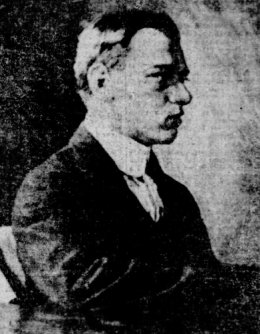
1912: Albert Wolter, white slaver

A century ago today, 20-year-old Albert Walter strolled the 15 feet from the death cell to the Sing Sing electric chair, calling out “Good-bye boys” to his fellow-prisoners as he died for the murder of 15-year-old Ruth Wheeler in a possible white slavery crime two years earlier.
Wolter left a note steadily — all the reports remark on the youth’s sangfroid; he took a nap while the jury went to deliberate with his life in its hands — avowing his innocence, and indulging the “hope there may come a time when the conscience of the perpetrator will overpower him, and he will come to the front and acknowledge his guilt.” He charitably added for “those who have maliciously prosecuted and killed me, for them I pray God’s forgiveness.”

Lots of New Yorkers would have had to ask it.

Despite his cool under fire, Wolter was overwhelmingly acclaimed the guilty party, the evidence against him being as close to airtight as circumstantial gets.

Newsmen ravenous for virginals despoiled by outlanders instantly sunk fangs into the story of the layabout 18-year-old German immigrant — idle lifestyle the product of parasitism upon the drudgery of a young countrywoman toiling 12-hour days at a bakery — who lured the “saintly” stenographers’ school graduate to his apartment with the promise of work and had her charred and headless trunk bundled up on the fire escape by morning. (Other charred remains, and Wheeler’s monogrammed signet ring, were retrieved from inside the apartment.)

Reporters soon sketched the persona of a burgeoning little pimp who had already routed several girls into prostitution. In amid the decadence and displacement of fin de siecle industrialization, you couldn’t ping a more heart-racing (pdf) moral panic than white slavery.*


Sale in a Roman Slave Market, by Jean-Leon Gerome (1883).

Congress was at that very moment in the process of legislating the (still-extant) Mann Act named for the Illinois legislator who sponsored it after a notorious 1909 Chicago case.

But the Big Apple, as the country’s largest city and its gateway for Europe’s polyglot huddled masses, was the reputed center of the whole reputed business.

This illustration from Fighting the Traffic in Young Girls is outstandingly captioned:

“THE FIRST STEP. Ice cream parlors of the city and fruit stores combined, largely run by foreigners, are the places where scores of girls have taken their first step downward. Does her mother know the character of the place and the man she is with?”

The men and the women who engage in this traffic are more unspeakably low and vile than any other class of criminals. The burglar and holdup man are high-minded gentlemen by comparison. There is no more depraved class of people in the world than those human vultures who fatten on the shame of innocent young girls. Many of these white slave traders are recruited from the scum of the criminal classes of Europe.

And in this lies the revolting side of the situation. On the one hand the victims, pure, innocent, unsuspecting, trusting young girls — not a few of them mere children. On the other hand, the white slave trader, low, vile, depraved and cunning, — organically a criminal.

-Chicago U.S. District Attorney Edwin Bell, prefacing the bodice-ripping 1910 Fighting the Traffic in Young Girls**

While the Empire State enacted its own Wolter-inspired law charging schools with vetting the employers who recruit their graduates, Wolter entered the criminal justice system on greased lightning (just like he left it). He was a condemned murderer within five weeks of Ruth Wheeler’s death.†

Wolter himself (evidently surprised to learn that he was old enough for the death penalty; that may not have been the case where he was from) tried to put the blame on a phantom Teuton, one “Frederick Ahner” who was the mastermind in Wolter’s own fall and who must have done the Wheeler business while Wolter was out at the park. That’s “the perpetrator” to whom Wolter’s last letter refers: his conscience never led Ahner to so much as materialize, much less to confess.

The fate of Wolter’s bakery-girl cohabitant — and, one might think, prospective accessory — Katchen “Katie” Mueller was very different. She precipitously aligned herself with her lover’s prosecutors, urged “My dear Al” to confess (almost successfully), and got respectable patronage “to break away from the life she had been leading”. A year after Wolter’s electrocution, Mueller’s redemptive next marriage made the society pages.

* Wolter may have been (pdf; see p. 61 footnote) a specific inspiration of the 1919 Theodore Dreiser play “The Hand of the Potter”, which is all about the era’s white slavery panic.

** Similar dubious (pdf) vice-crusader porn is to be had in (among many other period pieces) a 1911 tract by another Chicago prosecutor, Clifford Roe. Though The Great War on White Slavery is in the public domain, I haven’t been able to locate a complete text online — only this excerpt.

† On the other hand, the then-protracted period of 22 months required to proceed from conviction to execution made Wolter “dean of the death house” by the time he died.

On this day..

1961: Wasyl Gnypiuk, sleep-killer

(Thanks to Meaghan Good of the Charley Project for the guest post. -ed.)

On this day in 1961, a Polish/Ukrainian immigrant with the unpronounceable name of Wasyl Gnypiuk was hanged for murder in Lincoln, England.

The 34-year-old Gnypiuk was living in a toolshed in Worksop when he murdered his 62-year-old landlady, Louise Surgey, on July 17, 1960. He had spent some time in Nazi concentration camps during World War II, and suffered terrible nightmares as the result of his ordeal. The night of the murder, he broke into Surgey’s house while she was sleeping, drank some of her liquor, and passed out.

Gnypiuk — so he later claimed — had a dream where he was fighting Nazis. When he woke up, Surgey lay dead at his feet: he had strangled her in his sleep.

The authorities treated his claims with understandable skepticism. He didn’t help his case by trying to hide the body and stealing some money that had been lying around the house. He had a two-day trial in November and was duly convicted and sentenced to death. Gnypiuk was the last person to be hanged in Lincolnshire before the UK abolished the death penalty in 1965.

The truth about what happened will never be known for sure, but Gnypiuk is still regularly listed among cases of homicidal sleepwalking.

On this day..

1894: George Painter, Chicago infamous

While there may be serious doubt about the wisdom of capital punishment it is at present imposed by the law of this State, and if it is to be applied in any case then it should be in this … Any man who will live off of the shame of a woman and beat her from time to time as he would a dog, and finally kill her, must expect to suffer the penalty of the law.

-Illinois Gov. John Altgeld denying clemency to George Painter (Jan. 25, 1894)

On this date in 1894, the Land of Lincoln bloodily botched (but ultimately accomplished) the hanging of George Painter.

Painter died for the sordid murder of prostitute-lover-income source Alice Martin.

Painter insisted he was out at the pub when Martin was throttled and bludgeoned to death in their mutual bed, but the timelines left the alibi leaky and a patch of bloodiness on the reprobate’s coat undid him.

Despite swearing his innocence on pains of being “condemned to a flaming hell for all eternity” and winning three gubernatorial reprieves as his appellate lawyers scrounged up sketchy supportive testimony from various lowlifes, matters were pretty solidly against him by the end. So much so that the seemingly-sturdy rope, “of the same coil with which the anarchists were hanged,” snapped jaggedly when Painter was dropped.

The condemned killer’s body carthwheeled from the jolt of the rope’s end, crashing headlong into the concrete floor. Doctors advised that Painter’s neck was broken and life gone or ebbing … and puzzled executioners, unsure what to do with this unusual semi-successful botch, hauled the hemorrhaging near-corpse back up the scaffold, strapped it up, and dropped it again. You can’t be too careful.

We came by this story on the website of Robert Loerzel’s Alchemy of Bones, a wonderful book about another infamous turn-of-the-century Chicago homicide. (Loerzel’s post gives the train-wreck Painter case a much more detailed rubbernecking.)

Although the subject of Loerzel’s book, the immigrant sausage-maker Adolph Luetgert, was not put to death for his trouble, we were thrilled that the author sat down with Executed Today to find out a little bit about how criminal justice looked in Chicago on the eve of the 20th century.

Book CoverET: One of the aspects that you cover in Alchemy of Bones that’s also present in the Painter case is circumstantial evidence of uncertain probative value. What’s a definitive piece of evidence to a late 19th-century juror?

RL: Obviously if we had a time machine and we could go back 100 years and reinvestigate some of these cases with today’s forensic science, I think we would find a lot of cases of miscarriages of justice. It’s hard to tell looking at these cases today when all you have is these newspaper articles and court transcripts. You can look at it with common sense and try to determine from what people are saying whether there might be some element of doubt.

Today there’s been this huge change with the introduction of DNA evidence and we’ve suddenly discovered that a huge number of people on death row or in prison who are innocent. And that has caused a lot of people to question the reliability of eyewitness testimony and the identification of suspects.

All these things — the testimony of witnesses who say they saw something or said, yeah, that’s the guy — that’s what people in the 19th century were being convicted on. We’re talking about an era when even fingerprints weren’t being used yet.

In the Luetgert case one of the key things was that they found some bone fragments. The Luetgert case is one of these rare murder cases where for all intents and purposes there was no body found. We have some of those cases still today where someone is missing; all the circumstances seem to point to the fact that someone is dead. And prosecutors and police face an additional hurdle — they have to persuade a court that a murder actually happened.

With those sorts of cases, you had some bones that were found. The forensic science of the time — you coudn’t run a DNA test on it. Part of the question was, were those bone fragments even human? Is it possible that pig bones or cow bones were found in a sausage factory? Of course it was possible.

The Luetgert trial was one of the first cases which had testimony from anthropologists, which was a pretty new field at the time. They brought in some experts from the Field Museum.

How did that go?

It wasn’t necessarily the greatest start — but it was sort of like the criminal justice system started to take some baby steps toward bringing science into the courtroom.

Later, in the 1920s or 30s, there was a landmark case called Frye. They still today have the Frye rule — when courts look at a witness to determine if he is an expert. In the Luetgert case, they didn’t do that, and it was kind of a carnival. A high school chemistry teacher was one of the people they put on the stand to testify about the bones.

Luetgert’s crime, murdering his wife and dissolving her or possibly stuffing her into the sausages, was so much more infamous than Painter’s. Why didn’t Luetgert get the death penalty?

Then as now, it was somewhat arbitrary which criminals would get the death penalty and which would get a prison sentence.

In Illinois during that era, there were a lot of people convicted of crimes and sent to prison for much less than a life sentence. They had a system there of “indeterminate sentence” where they would sentence someone to a wide range of possible terms, maybe from two years to 50 years; it was really flexible and vague with the idea that it was a more humane way of dealing with criminals.

It probably also put the thought in the minds of jurors that, do we want to put this guy in prison and he might be getting out in a few years?

In the Luetgert case, there was some outrage that if you were going to convict a person of this crime, you have to sentence him to death. Some people thought that they sentenced him to life in prison because, what if his wife is still alive? There were all these stories coming out at the time of the trial where people thought they had seen Mrs. Luetgert.

So there was the thought, what if we hang him and a year later, Mrs. Luetgert shows up?

None of the jurors ever came right out and said it, but it’s possible that that doubt played some role in the decision not to sentence him to death.

Luetgert’s case got national media attention which Painter’s did not. Was it a milestone for that kind of treatment? What was the media landscape for crime reporting at the time?

There were a few other cases during that era, so it’s hard for me to say that this was the first. But it was certainly an early example of a sort of 19th century equivalent of what we experience with, for instance, the O.J. Simpson trial.

Newspapers covered it in great depth. In Chicago they had a dozen newspapers at the time; they would print page after page of transcripts and reports — far more detailed than anything you see in trial coverage in newspapers now.

The prosecutor, who later became Governor of Illinois, had six scrapbook volumes of newspaper coverage, with clips from Los Angeles and Buffalo and Baltimore and New York.

It actually looks like a lot of newspapers around the country did what we today call news aggregating. We complain about sites like the Huffington Post … well, a 19th century newspaper in a small town in Iowa would just publish a huge long excerpt of a story from a Chicago newspaper. And sometimes they would credit it and sometimes they wouldn’t.

Compared to present-day one- and two-paper cities, that’s still quite a difference.

There’s a lot of media out there now. If you look on the web, blogs, news aggregator sites, TV and radio. We still have a lot of media coverage now, it’s just spread out into a lot of different channels.

I was frankly shocked when I was researching how detailed some of the articles were. It helped me as a researcher. Interestingly, the readership included a lot of people who were not necessarily well-educated, yet newspapers wouldn’t hesitate to run page after page of transcripts. Nowadays, I think you’d have an editor saying, “give me 10 inches.”

Having written the book on the case, do you think Luetgert was rightly convicted?

I believe so. More than the forensic testimony, Adolph Luetgert’s behavior after his wife disappeared sort of points to a guilty conscience. He feared that certain people would go to the police and he either offered them jobs or threatened them.

Though this is precisely the sort of fuzzy circumstantial evidence those 19th century juries were acting on.

That’s absolutely true. In some of these cases you look at, what’s the difference between a man acting suspicious and an innocent man being wrongfully accused? There’s some overlap there.

On this day..

1936: Allen Foster, who fought Joe Louis

More than twenty-five years ago, one of the southern states adopted a new method of capital punishment. Poison gas supplanted the gallows. In its earliest stages, a microphone was placed inside the sealed death chamber so that scientific observers might hear the words of the dying prisoner to judge how the human reacted in this novel situation.

The first victim was a young Negro. As the pellet dropped into the container, and the gas curled upward, through the microphone came these words: “Save me, Joe Louis. Save me, Joe Louis. Save me, Joe Louis…”

It is heartbreaking enough to ponder the last words of any person dying by force. It is even more poignant to contemplate the words of this boy because they reveal the helplessness, the loneliness and the profound despair of Negroes in that period. The condemned young Negro, groping for someone who might care for him, and had power enough to rescue him, found only the heavyweight boxing champion of the world. Joe Louis would care because he was a Negro. Joe Louis could do something because he was a fighter. In a few words the dying man had written a social commentary. Not God, not government, not charitably minded white men, but a Negro who was the world’s most expert fighter, in this last extremity, was the last hope.

-Martin Luther King, Why We Can’t Wait

This story isn’t precisely accurate as Dr. King told it, but the factual basis for this empathetic legend is Allen Foster.

On this date in 1936, Foster was the first man executed by lethal gas in North Carolina — and en route to this minor distinction he punched his ticket for commemoration in civil rights literature when he flourished a flamboyant uppercut to witnesses as he was led to the gas chamber and cried out, “I fought Joe Louis!” It was an allusion to having matched with the world champ when both were youngsters in Alabama.

This coincidental brush with celebrity was about as strange as the fact that it occurred in a gas chamber at all.

After the arrival of the electric chair, the South adopted it virtually across the board; North Carolina had switched from hanging to electrocution in 1910.

But the Tarheel State was also generally more progressive than its neighbors;* V.O. Key would write of North Carolina, “It has been the vogue to be progressive. Willingness to accept new ideas, sense of community responsibility toward the Negro, feeling of common purpose, and relative prosperity have given North Carolina a more sophisticated politics than exists in most southern states.”

Part of that “sophisticated politics” was, in the 1930s, a growing debate about the application — indeed, the mere existence — of capital punishment.

According to Trina Seitz’s “The Kiling Chair: North Carolina’s Experiment in Civility and the Execution of Allen Foster” (North Carolina Historical Review, Jan. 2004):

North Carolinians were beginning to doubt the effectiveness of the sanction and the method used to enforce it. Furthermore, private citizens, humanitarians, and state institutions alike were increasingly scrutinizing the demographics of those being put to death.

Though this scrutiny did not lead so far as actual abolition, it provided the receptively reformist environment for Mitchell County Dr. Charles Peterson’s “pet project” of switching the execution protocol to lethal gas.

The reason for his fascination with gas seems to be obscure; the method had never been employed east of the Mississippi. Maybe it had something to do with 1932’s remarkably smooth gassing of a North Carolinian from nearby Burke County in Nevada, the nation’s gas chamber pioneer.

Whatever the reason, Peterson took a seat in the legislature in 1935 and won adoption for his idea in this very first session.

Unfortunately for Peterson — and doubly so for Foster — North Carolina didn’t have quite the same facility with hydrogen cyanide, and Foster’s execution was a notorious botch that immediately got people back on the electrocution bandwagon.

Foster was doomed for raping a white woman — this may be progressive North Carolina, but it’s still the South — and according to Seitz’s rendering of the News and Observer‘s first-hand report:

“Good-bye.” The Negro’s lips framed the words so clearly that no man in the witness room could doubt what he had said. As he said it, he winked and then forced a smile at the faces peering in at him. Then he began to suffer. No man could look squarely into his eyes and fail to perceive that they were registering pain. The Negro fought for breath, knowing he was going to die and fighting to get it over with as quickly as possible …

he sucked the gas desperately until his head rolled back three minutes later, indicating to physicians that the man finally had lost consciousness. But after a period of quiescence, his small, but powerfully built torso began to retch and jerk, throwing his head forward on his chest, where witnesses could see his eyes slowly glaze … The torturous, convulsive retching continued spasmodically for a full four minutes.

Officially, it took about 11 minutes for Foster to die, and as those agonizing minutes dragged by a physician broke the witness room’s mortified silence by exclaiming, “We’ve got to shorten [the execution method] or get rid of it entirely.” Um, yeah? The prison warden was quoted the next day as saying that even hanging was preferable to this.

The ensuing political controversy, however, did not succeed in reverting the method to electrocution.

Like the original electric chair, North Carolina’s gas chamber was the beneficiary of some hasty technical fixes: heating the gas chamber (it was at the freezing point when Foster died; Colorado executioners advised North Carolina that this would impede the gassing); tweaking the chemical formula.

The very next week, a white murderer named Ed Jenkins followed Foster into the toxic plume, this time to rave reviews: he “died painlessly and the method of execution was humane”. These advances were enough to keep the gas chamber in place, although the state legislature considered several bills to return to electrocution from 1937 to 1943.

During one such debate, North Carolina playwright Paul Green testified to the assembly (per Seitz),

Some day the electric chair and the gas chamber will be set up in the State Museum as symbols of an age of horror and ignorance. School children will look at them and feel superior to us as they look back upon an era of ignorance

Three hundred sixty-two people ultimately died in North Carolina’s gas chamber. And as Green anticipated, the execution chair resides today in the state’s Museum of History.

* This is still true of North Carolina: it has employed the allegedly more humane method of lethal injection since 1984, when no other Southern state save Texas used the needle until the 1990s; that use has been sparing enough that its per-capita execution rate remains markedly lower than most other former Confederate states; and in 2009, North Carolina implemented a stillcontroversial Racial Justice Act empowering condemned prisoners to challenge their sentence with statistical evidence of racial disparity even though courts don’t require this at all.

On this day..

1892: Patrick Boyle, bindle bandit

On this date in 1892, Patrick Boyle was hanged in Edwardsville, Illinois.

Boyle was a hobo who, whilst off a-tramping with a fellow-vagrant outside Nameoki, Ill., robbed said vagrant by shooting him in the back.

The victim was in good enough shape after this attack to comply with Boyle’s directive to turn out his pockets (yielding 95 cents) and cough up his bindle (yielding a couple of shirts) … and still doing well enough after transacting the business end of the stickup to hike back to Nameoki as Boyle made his getaway.

Sadly for him, the wound (however non-debilitating) was discovered to be mortal, and he passed away. But of course, he was around long enough to incriminate Boyle.

It didn’t take long for the law to catch up with Boyle, although he escaped once and made it 35 miles in handcuffs before recapture.

(A body can get around in manacles when he’s properly motivated.)

Once firmly in custody, legal matters advanced with the dispatch customary to the poor: according to the St. Louis Republic, the case was called in the morning; “a jury was selected by noon”; “The case was given to them at 6 o’clock, and at 10 they brought in a verdict.”)

Boyle was considered somewhat feebleminded and some clemency petitions led Gov. Joseph Fifer* to grant a dramatic last-second stay prior to Boyle’s planned hanging Jan. 16. But the stay was only good for one week, to give his supporters enough time to make a then-unusual appeal to the Supreme Court. It didn’t work.

* Fifer is a bit (in)famous for having just the previous year pardoned killer Thomas Neill Cream, who used this unexpected liberty after his first murder to strike out across the pond and become one of England’s more notorious serial killers. On the other hand, Fifer couldn’t find any mercy for the surviving Haymarket men.

On this day..

1880: Daniel Searles, the first hanging in Tioga County

From the New York Evening Express, January 21, 1880.

DANIEL SEARLES HANGED.


THE NEGRO MURDERER OF OLD MR. REWEY

Sketch of a Brutal Crime — The Condemned Man Owns His Guilt and Admits the Justice of His Sentence.

OSWEGOOWEGO, N.Y., January 21. — The first instance of capital punishment in Tioga county occurred here to-day at noon. The extreme penalty of the law was inflicted upon Daniel Searles, an illiterate negro, who in June last murdered Eldridge Rewey, an aged farmer, who lived alone in the neighboring vilage of Newark Valley.

The murder was for the purpose of robbery, and was one of fiendish atrocity. Calling at the farmer’s house in the early evening of June 25, Searles felled him senseless to the floor, and then cut his throat with a razor.

He obtained about $300 by searching the house, and, on preparing to leave, noticed that his victim had revived. Rewey had also drawn a knife from his pocket, as if to defend himself, which the negro wrested from him, and with which he nearly decapitated his helpless victim.

He was arrested next day, tried before Judge Follett at OswegoOwego, and on December 8 was sentenced to be hung to-day.

Searles has made no attempt to deny his guilt, openly confessing the crime and saying he deserved to die for it. He has preserved a brave exterior throughout, and passed his last night on earth seemingly with less anxiety than did his executioner.

The execution took place in a temporary frame structure in the jail-yard, erected for the purpose. A cordon of military attended. The gallows was the same on which Penwell was executed at Elmira in July, 1877, for wife murder. The ponderous drop weighed three hundred pounds.

The spectators were in attendance at 11:45, some two hundred being present. Prayers were said in the prisoner’s cell at noon and the death warrant read to him.

Part of the Daily Triple: 1880 and Death.

On this day..

1880: Andrew Scott and Thomas Rogan, bushrangers

On this date in 1880, Andrew George Scott and Thomas George “condemned to death for the part they took in the outrage at Wantabadgery, resulting in the death of constable Bowen, were executed at Darlinghurst Gaol.”


Andrew George Scott, aka Captain Moonlite (top); Thomas Rogan (bottom)

Scott is our main man here, an Anglican lay reader turned grifter turned flat-out outlaw with the nom de plunder “Captain Moonlite”: one of the strangest characters in Australia’s criminal annals.

How did a fellow with such a family-friendly alias end up involved in an “outrage”?

This colorful, charismatic immigrant (from Ireland, via New Zealand — and, legend has it, with a side trip to Italy to fight with Garibaldi) became a notorious public figure when, in outlandish masked getup, he robbed the bank of the South Victoria gold rush town of Mount Egerton.

His distinctive voice — remember, he was a parish reader — was recognized by his erstwhile friend at the other end of the gun, but Scott brazenly reversed the accusation and actually had his victim in the dock for a time. This Mount Egerton crime is the source of the man’s luminescent nickname, after the signature placed on a stickup note.

When he got out of prison in 1879 — having defended himself with panache, and escaped once along the way — he had a public profile, and actually got out on the lecture circuit for a brief spell.

But he soon returned to the annals of preposterous criminality.

Gathering five young followers, Moonlite went full-time into the bush. Allegedly spurned in a bid to join Ned Kelly‘s gang, Moonlite et al sought work at Wantabadgery Station.

When this refuge, too, turned them away, the outlaws found themselves in a rather pathetic state of hunger and desperately seized the place by main force. The resulting “outrage” was not a wholesale plunder of the station or wanton abuse of the prisoners (no rapes, no murders … although Moonlite did conduct a kangaroo “trial” of one of his hostages for attempting to escape: the verdict was not guilty): it was the inevitable ensuing shootout with police in which the bushrangers James Nesbitt and Augustus Wernicke died, along with the constable Bowen.

Two of the other three who survived this shootout also survived their brush with the law by blaming Captain Moonlite. The “Captain” may have been plenty eager to accept this fatal inculpation for reasons beyond those of mere honor.

In his prolific prison correspondence awaiting execution, Scott avowed his broken-hearted love for James Nesbitt, one of the two companions who had been killed in the shootout. The terms are astonishingly explicit for the time.

“My boy with a golden heart who died trying to save me … He was my constant companion; we had the deepest, truest bond of friendship. We were one heart and soul, he died in my arms and I long to join him, where there shall be no more parting. He died in my arms; his death has broken my hear. When I think of my dearest Jim, I am nearly driven mad. My dying wish is to be buried beside my beloved James Nesbitt”

Scott hanged wearing a ring of the late Nesbitt’s hair,* but his wish to share a burial plot was not honored — until Captain Moonlite was exhumed and reburied in 1995.


(cc) image from AYArktos.

* Asserted in Who’s Who In Gay and Lesbian History from Antiquity to World War II.

Part of the Daily Triple: 1880 and Death.

On this day..

1880: Prevost, predatory Parisian policeman

From a Paris Dispatch report via the New York Times. (Additional paragraph breaks have been added for readability.)

It is just 10 years ago, day for day, that the notorious Troppman, the murderer of the Kink family, was executed on the Place de la Roquette. This morning another convict of the same stamp underwent the penalty of death on the same spot.

Prevost, the policeman who murdered the woman Blondin and the jewelry-dealer, Lenoble, and afterward cut their bodies up and threw the pieces into the sewers, was guillotined there at daybreak.


Thwack: Prevost clobbers Lenoble.

It having become known last night that his appeal for mercy had been rejected by the President of the Republic, a large crowd began to assemble as early as 9 o’clock round the place of execution. To prevent a recurrence of the scenes of disorder which took place there when the young criminals Lebiez and Barre, the assassins of the woman Gilles, were put to death, a strong force of infantry and cavalry guarded the square and kept the people at a distance.

The crowd, in spite of the bitter cold and piercing north-east wind, grew more numerous toward midnight, and by the hour of execution all the thoroughfares leading to the spot were crammed with people.

The executioner arrived at 4 o’clock, and, aided by his assistants, erected the guillotine about 20 paces from the central door of the prison. The guillotine once in order, the headsman and his assistants entered the prison to arrange what is called the toilet of the culprit previous to his death.

The Abbe Crozes, the Chaplain of the jail, was the first to enter the prisoner’s cell. Prevost started up, gazed wildly at the reverend gentleman, and then buried his head in his hands, trembling and groaning.

“Alas!” said the Chaplain, “there is no hope now but in the mercy of God.”

Prevost had lured the jewel-trader Lenoble on the pretext of arranging a transaction, then for no reason save crass acquisition of his wares bludgeoned him to death with the iron rod-and-ball device used to link railroad cars.

It was a premeditated and gruesomely executed crime.

Using butchers’ knives he had pre-obtained for the purpose, Prevost spent the next several hours skinning Lenoble, dismembering Lenoble, and ultimately dicing Lenoble up into cutlets so that he could heap Lenoble in a basket and dispose of Lenoble’s bits in less-suspicious fragments in a variety of sewer grates and refuse heaps.

Such as was recovered was heaped together at the morgue, “a mass of quivering flesh, stripped of skin … bones covered with their tendons, sternum, ribs with fragments of the chest, bones of the shoulder blades and arms … the liver, heart and guts, and the fragments of skin torn off one by one from each severed part.”*

After his capture for this shocking crime, he admitted that he’d also been the author of the unsolved murder several years before of his lover, Adele Blondin — likewise for pecuniary gain, and likewise disposed of in pieces after Pevost’s ghoulish close work with corpse and saw.

The condemned man then left his bed, but he was too much overcome to dress himself. That task was done by the executioner and his assistants. He was then left alone with the Abbe Crozes to prepare his soul. He embraced the Chaplain several times and wept bitterly.

“Take courage, take courage,” said the reverend gentleman.

“Yes, yes,” replied Prevost, “I will take courage and try to meet my fate. I ask pardon of the Police administration, to which I belonged seven years.”

“If this … pawnbroker has been murdered by some one of a higher class in society,” Dostoyevsky had mused in Crime and Punishment in 1866, “how are we to explain this demoralisation of the civilised part of our society?”

Prevost’s demoralization afflicted his cognition as well as his conscience, because he had actually made previous chit-chat with fellow-officers to the effect that were he to commit the perfect crime he would surely go and butcher the body for no-fuss disposal.

The condemned man, after kissing the crucifix three or four times, marched out to the guillotine wit a firm step, and in an instant he was on the fatal bascule.

The spring was touched, a dull thud was heard, and the next second his head fell into the basket.

After the execution the body and head of the murderer were taken to the School of Medicine, and, having been sown together, electrical experiments were made on them, and in the opinion of all the doctors present death must have been instantaneous.

* This quote, and the other interspersed crime details, and the nice bashing illustration, are all via this French crime pamphlet.

Part of the Daily Triple: 1880 and Death.

On this day..

2006: Clarence Ray Allen, “beyond rehabilitation”

(Thanks to Meaghan Good of the Charley Project for the guest post. -ed.)

On this day in 2006, Clarence Allen was executed by the state of California for his role in the murders of three people.


Clarence Ray Allen packing heat and bravado in the 1970s (top); and, as a geriatric condemned man (bottom).

He could be seen as a kind of poster child for the death penalty: Allen was already serving a life sentence in prison for murder when he had the witnesses against him killed. As the Ninth Court of Appeals noted,

Given the nature of his crimes, sentencing him to another life term would achieve none of the traditional purposes underlying punishment. Allen … has proven that he is beyond rehabilitation.

The California Attorney General’s office provides a detailed account of his crimes here. (pdf) Crime Magazine ran a detailed piece on Allen in 2009. For Executed Today, a summary will suffice:

Allen, a father of two, presented an outward appearance of respectability (in fact, he ran a thriving security business) while organizing a gang of young people to help him commit many burglaries. In June 1974, Allen, his son Roger and other accomplices burglarized a Fresno supermarket and stole, among other things, $10,000 in money orders. Roger’s seventeen-year-old girlfriend, Mary Sue Kitts, later told Bryon Schletewitz, whose parents owned the supermarket, who had committed the burglary.

Allen had warned his gang that “snitches” would be put to death, and when he found out what Kitts had done he ordered her murder. Another member of the gang, Eugene Farrow, actually committed the deed, strangling Kitts and dumping her body in a canal. Her body has never been found.

Allen was convicted of the burglary and Kitts’s murder in 1977 and sentenced to life. Farrow pleaded guilty to second-degree murder.

After his conviction, Allen ordered the murders of eight of the witnesses who had testified against him at the trial, including Schletewitz and his parents. His other son, Kenneth (lovely family they are), supplied weapons and transportation to Billy Ray Hamilton, a recently paroled prisoner who had been offered $25,000 to commit the murders, and Hamilton’s girlfriend, Connie Sue Barbo. In 1980, Hamilton and Barbo broke into the supermarket and shot Schletewitz as well as Douglas Scott White and Jacqueline Rocha, two teenagers who were just in the wrong place at the wrong time.

Fortunately, Barbo was caught at the scene and Hamilton was arrested just a few days later, before he could get on with the hit list.

In 1982, Allen was sentenced to death for the three murders. Hamilton was also sent to Death Row, where he remains. Barbo got a life term. Kenneth accepted a plea agreement that offered minimal prison time in exchange for his testimony, but when he recanted his original statements the agreement was canceled and he got a life sentence.

Already fifty years old at the time of the supermarket murders, Allen had to wait a further twenty-six years for his date with death. While he was on Death Row his health deterioriated markedly.

By the time he was executed he was diabetic, nearly deaf, legally blind and confined to a wheelchair. He also had a heart attack in 2005 and had to have bypass surgery.

Given the circumstances of his crimes, his advanced age and poor health were the only mitigating circumstances his attorneys could think of to argue for a reprieve. The Ninth Court of Appeals didn’t agree that this constituted cruel and unusual punishment.

Writing for the panel of judges, Judge Kim Wardlaw said,

His age and experience only sharpened his ability to coldly calculate the execution of the crime. Nothing about his current ailments reduces his culpability and thus they do not lessen the retributive or deterrent purposes of the death penalty.

For the same reasons, California Governor Arnold Schwarzenegger refused to intervene to stop the execution, saying, “His conduct did not result from youth or inexperience, but instead resulted from the hardened and calculating decisions of a mature man.”

On the day of Allen’s execution, he had to be lifted from his chair onto the gurney. His last words were: “It’s a good day to die. Thank you very much. I love you all. Goodbye.” It took eighteen minutes and an extra dose of potassium chloride for him to die.

On this day..

2003: Daniel Juan Revilla

On this date in 2003, Daniel Juan Revilla was executed in Oklahoma for beating his girlfriend’s daughterson to death.

“Daniel gave his last few years to his project in the hope that his laughter and good spirit would live on through his work.”

Six months after his 18th birthday, Revilla appeared at the Jackson County hospital with his girlfriend’s infant son, screaming that the child had stopped breathing. The boy never revived.

Doctors trying to save little Mark Gomez couldn’t help but notice a catalogue of injuries: burns, bruises, cuts, brain hemorrhaging. Revilla’s explanation of careening through the house Homer Simpson-esque with the child — scalding him by trying to revive him with bathwater, bonking his head on the door running out to the hospital — didn’t persuade many.

Indeed, trial testimony from the mother and others tended towards the notion that Revilla openly disliked the kid because it wasn’t his, and was given to violently taking out his frustrated reproductive rivalry. He may have tried to “accidentally” kill the child previously.

The victim’s father, Juan Gomez, emerges from the news reports as a distinctly more impressive character, remembering the “short time, but still a good time” he had with Mark without losing empathy even for his murderous rival.

“I do forgive Mr. Revilla,” Juan Gomez told the media. “He was young at the time and I don’t think he realized what he did until it was too late. And I feel very sorry for his family for the loss of their son.”

Some thoughts of Daniel’s (about death row and the death penalty; he didn’t remark on the facts of the case) remain preserved on an ancient Internet page here. Sample:

The death penalty is unequivocally imposed arbitrarily. If you can’t afford justice, you’ll receive just as much justice as you can buy. In the case ofthe poor, that equals : none. There are those on death row, right now, with witnesses, evidence, DNA proof…etc, who can prove their innocence, if only they could afford it. Sadly, they can’t. Nor can they fight the Goliath system that oppresses them…They will die… The indigent, since they cannot afford to hire competent legal representation, are forced to capitulate. They abdicate their lives to the states ‘indigent defense system.’ An unimpressive, underfunded, jerkwater organization; implemented and appointed by the state, to facilitate the state’s desire to escort you through the formalities and into the execution chamber.

A comic series he drew during the half of his life he spent being escorted through the formalities and into the execution chamber was recently published as Dirt Road.

On this day..