1897: Henri-Osime Basset

On this date in 1897, all Versailles turned out to witness the beheading of recidivist pedophile Henri-Osime Basset, a 23-year-old who had kidnapped and strangled to death (French link) 13-year-old Louise Millier the previous summer.

Executioner Anatole Deibler and crew arrived at 3:30 a.m. to erect the portable guillotine at the pont Colbert* for the occasion, under the eyes of a curious pre-dawn crowd restrained by dragoons; by 4:45 la sinistre machine was fully installed.

About an hour after that, the prisoner Basset was awoken from his fitful sleep — he’d been plagued by restless guillotine-themed dreams lately, for some reason — and advised that his application for presidential clemency had been denied.

Le Petit Parisien nevertheless found the prisoner in steady enough spirits for his expiatory moment. He took the bad news with equanimity, received communion, and stuck close by the comforting priest to whom he had already given his last confession. (And who helpfully steeled the doomed man’s nerves with a steady supply of rum, cigars, and Bourdeaux wine.)

In any event, the practiced French executioners did not give Basset long to stew on his fate. After the toilette to prepare him for the blade, he was out the door shortly after 6 a.m. — broad daylight by now, and the crowd swollen in anticipation of the show. The blade fell at 6:33, and the remains of the late Henri-Osime Basset were immediately deposited at the Cimetirie des Gonards.

* This is pont Colbert in Versailles, not the cool then-new steel bridge in Dieppe, which is now the last hydraulic turn bridge still in use in Europe.

On this day..

1906: Johann Otto Hoch, bluebeard

On this date in 1906, still implausibly claiming his innocence, “Johann Otto Hoch” was hanged for the murder of his wife.

Though Hoch died “merely” for that one homicide, he was suspected of numerous others in a prolific career of avaricious bigamy.

Born as Jacob Schmidt in Germany a half-century or so before he hanged, Hoch immigrated to the U.S. in the 1880s and started wife-hopping for fun and profit, recycling names almost as frequently. (Hoch just happens to be the alias he was using when arrested: actually, it was the name of one of his victims, “a warped keepsake stored in an evil mind.”)

It’s a classic scam, really: woo, wed, and walk out — taking the spurned spouse’s assets with. Rinse and repeat. In 1905, Charlotte Smith of the Women’s Rescue League estimated that “no less than 50,000 women who have been married, robbed and deserted by professional bigamists.” (Chicago Tribune, Sept. 5, 1905)

“Marriage was purely a business proposition to me,” Hoch eventually admitted.

Sometimes Hoch was content to vanish with the cash (with nice twists, like a hat left by a riverbank to suggest drowning). Other times, he went above and beyond the standard in the professional-bigamy industry and availed the expedient of loosing the matrimonial bonds (and the purses of life insurers) by graduating himself to widowhood.

Precisely how many women he poisoned off with arsenic isn’t known exactly, but it’s thought to range into the double digits. And when he was on his game, he was known to churn through the ladies at breakneck speed. His last murder victim, and the one he hanged for, was Marie Walcker of Chicago … but as Marie lay dying of her husband’s expert ministrations, Johann, bold as brass, proposed to Marie’s sister Amelia. Those two “lovebirds” married a week later and within hours, the groom had disappeared, pocking $1,250.

Call Amelia doltish if you will, but she went straight to the police. It turned out it was Hoch who recklessly set himself up for capture with this whirlwind double-dip courtship, and the very freshly buried evidence of his recent malignity was easily retrieved from his late ex’s stomach. When arrested in New York, Hoch had a hollow pen full of arsenic.

Naturally, the marriage proposals poured in as Hoch awaited trial early in 1905.

Hoch was actually within moments of hanging in July 1905 when his defense team finally managed to raise the last $500 necessary to lodge an appeal. That’s right: justice with a co-pay. The legislature had considered, but had not passed, a law giving every death-sentenced person the right to appeal to the Illinois Supreme Court, and in lieu of such a measure, an appellant had to pony up for the privilege.

On this day..

1912: Thomas Jennings, fingerprinted

One hundred years ago today, Thomas Jennings was ushered the scaffold … while Thomas Jennings’s fingerprints ushered in a new age of policework (pdf).

Hegemonic authority had been on a long march towards a forensic regime that could affix an oft-ephemeral identity to the profoundly corporeal body.

In the late 19th and early 20th century, investigative techniques and jurisprudence marched double time to keep pace with new techniques — from photography to the unwieldy system of Bertillonage.

A variety of American institutions — the U.S. Army, a number of prison systems — had begun systematically cataloging their respective inmates’ fingerprints in the preceding years, but it was in the Jennings case that the system really earned its whorls. It was the first U.S. murder case pinned on fingerprint evidence.

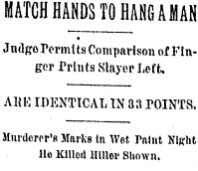
In September 1910, a Chicago homeowner in the present-day Beverly neighborhood surprised an intruder, and was shot dead. (pdf) In the course of the fight or the flight, the prowler splooshed his left hand into some wet paint on a railing.

Thomas Jennings, a paroled burglar, was arrested near the scene, and his fingerprints shown to match those left in the grieving Hiller household. A prosecution expert even gave a courtroom demonstration of dusting for prints.

This was as novel to judges as to jurymen, and given the dearth of other positive evidence against Jennings, the Illinois Supreme Court was called upon to deliberate upon the humble dactylogram. In the summer of 20111911, it stopped Jennings’ hanging just hours before it was to take place.

But its final word in December 20111911 only fitted the homebreaker’s noose.

We are disposed to hold from the evidence of the four witnesses who testified, and from the writings we have referred to on this subject, that there is a scientific basis for the system of fingerprint identification, and that the courts cannot refuse to take judicial cognizance of it …

Such evidence may or may not be of independent strength, but it is admissible, with other proof, as tending to make out a case. If inferences as to the identity of persons based on voice, the appearance or age are admissible, Why does not this record justify the admission of this fingerprint testimony under common law rules of evidence.

Courtrooms all around the world soon agreed, and within a generation the awesome investigative power of the fingerprint had fugitives going so far as to slice or burn off those incriminating little pads of flesh — the crime scene gold standard until the advent of DNA testing.

Jennings was hanged this date in a state-record five-man batch (the others, Ewald and Frank Shiblawski, Philip Sommerling, and Thomas Schultz, had all committed an unrelated murder together).

On this day..

1907: Gen. Antonio Paredes, Venezuelan rebel

In the small hours this date* in 1907, Venezuelan Gen. Antonio Paredes was summarily shot for an abortive rising against dictator Cipriano Castro.

The Andean military governor Castro had overthrown the previous kleptocracy in the Restoration Revolution of 1899.

Castro’s state was racked by internal conflicts as Castro’s body was by collapsing organ systems. Both factors helped encourage malcontents towards designs upon his job.

Paredes was one of the regime’s chief opponents, an admired officer who had been the last holdout (Spanish link) against the 1899 revolt from his own base in the port city of Puerto Cabello, latterly knocking about in exile openly scheming against Castro. Paredes steamed in to New York in the summer of 1906 “to obtain arms and ammunition … for this movement against Castro,” he told the New York Tribune in a story wired from coast to coast. “I came here solely on that mission.”**

Paredes finally landed in his homeland in early February 1907, just as Castro was undergoing an emergency surgery. The Chicago Tribune Feb. 9, 1907 dispatch ran under a headline announcing “Paredes’ Long Planned Insurrection Begun”.

But long planned evidently wasn’t well planned.

Making landfall with a token force of retainers, he banked on “rally[ing] an army of 5,000 to 8,000 men.” (Chicago Tribune, op. cit.) But he in fact rallied zero, and was almost instantly intercepted by Castro’s troops. After a couple of days in captivity, the men in the field received a curt telegram over Cipriano Castro’s name — either dictated from the president’s hospital bed between chloroform stupors, or simply given in his stead by powerful Interior Minister Julio Torres Cardenas — ordering the summary execution (Spanish link) of the prisoners.

The whole lot of 17 or 18 prisoners (including two US expatriates, John Godskin and Thomas Lovelace), were accordingly dispatched (Spanish again) without color of law.

Venezuela had actually abolished capital punishment for all crimes in 1863. While extrajudicial executions are always in a gray area, this might be the last event in that country’s history that could clearly be classified as an execution.

* This memoirs of Paredes’ 1899-1903 imprisonment at one point states that the execution occurred in the small hours of Feb. 16, but I believe this is mistaken.

** Quotes from an A.P. story titled “Planning Revolution Against Gen. Castro” in the Los Angeles Times, Aug. 11, 1906.

On this day..

1845: John Gordon, the last hanged in Rhode Island

Last year, the Rhode Island General Assembly approved a measure posthumously pardoning John Gordon — who on February 14, 1845 was the last man executed in that state.

Gordon’s hanging, for the murder of a prominent industrialist who had bad blood with Gordon’s brother, was long notorious in Rhode Island as one secured on highly uncertain evidence in an atmosphere of anti-Irish prejudice.

Executed Today is pleased to welcome on this occasion University of Rhode Island labor historian Scott Molloy, author of Irish Titan, Irish Toilers and a major advocate of the Gordon pardon.

ET: Can you set the scene — what’s going on in Rhode Island at this time, and what are the tensions surrounding Irish immigrants?

SM: Rhode Island was the site of the first factory in America in the 1790s, called Slater Mill. It really changed the face of Rhode Island and eventually the rest of the US.

In Rhode Island, curiously, as more and more people left the farms to work on the mills, they had an unusual requirement that really didn’t make any difference years earlier: in order to vote, you had to have so much land. (Specifically, $134 worth of land.)

By 1840, not only were the usual suspects not able to vote — women, people of color, Native Americans — 60% of native-born white male Rhode Islanders were also unable to vote. It meant that just a handful of people ruled the state, compared to the time of the American Revolution when just about every white male could vote. And immigrants in particular — and in those days, that was the Irish — were basically precluded from voting. You had a residency requirement, a property qualification. It made Rhode Island almost unique in New England, almost like a southern state.

A group of reformers came to the forefront, a guy named Thomas Wilson Dorr, a blueblood aristocrat, Harvard-educated, one of the best legal minds of the country. He threw his lot in with the reformers to try to get people the right to vote. It really polarized the state in 1842.

The Irish were sympathetic, but Irish priests tried to keep them out of it because they wanted to acclimate. But because a lot of the animosity toward people having the right to vote was directed at Irish immigrants. People blamed the Irish even though the Irish didn’t get particularly involved in the Dorr War.

Often times they got blamed for everything whether they did it or not. And of course we face the same situation with immigrants today.

What was the crime and how did the Gordons come to be the focus of the prosecution?

In 1843, a Yankee industrialist out in Cranston by the name of Amasa Sprague was found on New Year’s Eve 1843 bludgeoned to death in what today we might call a hate crime. He had a gold watch still on him, he had money in his poket, and he had been beaten to death.

Amasa Sprague was a very influential guy. His older brother who helped run the mill with him and was the US Senator from Rhode Island had the local city council lift the liquor license from the Gordon family’s business, which for all intents and purposes ended their livelihood. This was Nicholas Gordon’s shop: John Gordon had only just crossed over from Ireland.

When Sprague was found dead about six months after the license was lost, they focused on the Gordon family. The authorities formed a posse and they went after this Irish family.

Book CoverHow did anti-Irish sentiment manifest itself at trial?

The juries in all three trials had no Catholics and no Irish that I’m aware of. There was a lot of religious and socioeconomic animosity.

At the time, the Supreme Court of the state would sit in on the whole trial just because it was a capital trial, and the trial judge would say in the transcript — which is still available (pdf) — he basically says to the jury, if you find testimony that contradicts itself between a Yankee and an Irish witness, you should give the Yankee testimony more credence.

Doesn’t the fact that John Gordon’s brothers were not convicted militate against the notion of overwhelming anti-Irish prejudice?

You can’t go overboard on these things. The juries — all three of them — they found one Gordon innocent and in the other case they had a hung jury. I don’t want to say they were completely prejudiced, because they weren’t, but almost everything else in Rhode Island at that time was stacked up against them.

The earlier Irish who came in the 1820s and 1830s were a little bit better off, a little bit better-educated [compared to later Irish immigrants after the potato famine]. The animus against the Irish was still intense; the Irish were seen as criminal, unskilled, uneducated, ignorant. The Protestant majority at the time, mostly of English heritage, kind of brought that over with them even though they had been there for a long time.

So how did the legal proceedings play out?

They put two of the recently immigrated brothers up for conspiracy for murder, but not the oldest brother. So John Gordon and his brother William go on trial first.

The jury came back with a guilty verdict for John Gordon, who didn’t have much of an alibi, but a not guilty verdict for William, who did have an alibi. So you’ve got a conspiracy conviction with only one conviction.

Then they put Nicholas Gordon on trial, and the jury comes back deadlocked. His second trial is not going to be until the spring of 1845. In the interim, his brother John was to be hanged, Valentine‘s Day 1845 — rather than wait to see what happened at Nicholas Gordon’s trial and whether there even is a conspiracy.

The defense petitions the governor and the general assembly to hold off the execution until after the trial of the oldest brother. The governor washes his hands of it, and the general assembly votes very narrowly to go ahead with the execution.

So they hang him, and what’s interesting in that part of it is an itinerant, traveling Catholic priest — a guy named Father John Brady — hears John Gordon’s last confession.

Well, they invite the elite of providence inside the prison to watch the hanging. (There’s about 1,000 Irish outside the prison in support of John Gordon.) When they put the noose around his neck, the priest is with him, and the priest berates the elites and authorities, and he says, John, you are going before a just God who has seen way too many of your countrymen.

I always argue in my writings that this guy, he’s an immigrant, he’s uneducated, he’s just been in America for a few months. I just can’t believe that this guy would ever lie to the priest hearing his last confession, and the priest would never berate the elites unless he’d heard a confession of innocence.

After John Gordon’s hanging, his brother Nicholas goes on trial as planned, and they come back with another hung jury — this time, with a majority voting him as innocent. They were going to try him again except about 18 months later, Nicholas dies of natural causes.

I’ve seen a lot of people describe growing up hearing unambiguously that this was a wrongful execution. Is that how it was perceived right from the start? How universal was/is that perception?

There was such a collective feeling of guilt about this that in 1854, Rhode Island abolished the death penalty and John Gordon was the last person ever executed there.

There’s one flaw in the law. This was added late in the 20th century, that anyone convicted of killing a prison guard during an escape could still be killed. And there was an incident, I remember it as a kid maybe 30 years ago, but they still didn’t condemn even that person to death. But Rhode Island has never changed that.

None of us who ever testified ever said categorically that John Gordon was innocent, because we just can’t prove that. But we did say that he never got a fair trial, just like Sacco and Vanzetti in the 1920s.

We did in our research was come up with two or three suspects who had much better reason to assassinate Sprague. But there were no witnesses to the case. It was all circumstantial evidence. I have to say, every time I look at the case — there are some pieces of evidence that would make the Gordons look very guilty. There are other aspects of it that make them look very innocent. If it was in today’s world, the police would interrogate them as people of interest.

It’s not as cut-and-dried as some people make it. All I know is that they got an unfair trial.

Gordon was posthumously pardoned last year. How did that campaign get going, and how receptive were folks in the capitol?

The problem was a lot of people had forgotten the case. I had been writing for a number of years op-ed pieces in the Providence Journal, and mentioned John Gordon from time to time.

But it was an 80-year-old guy named Ken Dooley, and he grew up a couple miles from the murder site near Cranston, and he was a playwright. He came back home and remembered his grandmother singing some little ditty of a song 70 years ago saying something like “Poor Johnny Gordon”, and so he researched it, and he wrote a play.

And they put it on in Cranston, and over the couse of the month several thousand people saw it. A state representative, an Irish guy, saw the play four or five times and then introduced that into the general assembly trying to obtain a posthumous pardon — just to say that the evidence didn’t support the execution.

And Gov. Chaffee, who comes from an ancient Yankee family in Rhode Island, signed the damn thing. It was that play that this guy wrote and we were all amazed that this kind of came out of the blue. We held a lot of events around it — had church services, put up ceremonial headstones. I always tell people that I want this on my headstone: that I had a hand in getting John Gordon pardoned.


There are some excellent resources already available online concerning the Gordon case, including:

On this day..

2009: Minurul Islam and two friends, for a dowry death

On this date in 2009, a husband was hanged with two friends for murdering a wife who shorted him on his dowry.

The three were hanged at one minute past midnight in western Jessore jail after they failed to secure presidential pardons for the murder of Minu Ara, 18, the official, Kamrul Huda, said.

Minurul Islam and his two friends were sentenced to death in 2002 by the supreme court for killing Ara after her father failed to pay a promised dowry of 100,000 taka. [$1,450 US]

Their execution follows that of two men in southern Bangladesh in December over a similar dowry murder.

So-called “dowry deaths” — including not only outright murder but suicide driven by in-laws’ mistreatment — reportedly produces several thousand deaths per year in South Asia, including Pakistan and India.

On this day..

1992: Johnny Frank Garrett, “kiss my ass because I’m innocent”

On this date in 1992, Johnny Frank Garrett was executed by lethal injection, with the tart last words,

“I’d like to thank my family for loving me and taking care of me. And the rest of the world can kiss my everloving ass, because I’m innocent.”

Although Garrett was only 17 at the time a nun from a neighboring Amarillo convent was raped and murdered, and he may have qualified as developmentally disabled to boot — both factors that today would exclude him from execution — that whole innocence story didn’t have much public traction.

“No, no, not at all,” New Mexico attorney Jesse Quackenbush told this site in an interview. “He was villainized from day one: he was a nun-murderer who needed to be executed. The only sympathy really came from the Pope.”

But two decades on, Garrett’s dying profession is one of the more troublesome skeletons in the Texas execution machine’s closet, thanks in no small part to Quackenbush himself.

Quackenbush directed the documentary The Last Word (viewable free on Netflix), a powerful brief not only for Garrett’s innocence* but against the comprehensive rot of the system that shunted hm off this mortal coil — from the front-line investigators all the way through the Lone Star State’s intentionally broken executive clemency farce.

“It was a system-wide failure that caused this kid to die. It wasn’t just the legal system,” Quackenbush said. “The media played a part. The governor was looking more to her own re-election hopes.* There was a dysfunctional family. The Supreme Court wasn’t morally deep enough to realize that executing 17-year-olds and ‘mentally retarded’ prisoners was wrong. There’s the system in Texas that allowed the prosecutors to hand-pick the pathologists to provide junk science.

“It’s a multifaceted failure, and no one facet is more to blame than the others.”

Garrett, a white teenager, disappeared into a Kafkaesque legal labyrinth, after the alleged supernatural vision of a local soothsayer acclaimed him the culprit in the murder of a nun named Tadea Benz. Corporeal indicia of guilt falls somewhere between circumstantial and laughable: fingerprints in a convent he had visited many times, the inevitable jailhouse snitch, and an unrecorded supposed “confession” that Garrett refused to sign.

As in a preponderance of death cases, especially in Texas (pdf), a meek and all-but-unfunded defense team offered scant resistance as prosecutors made the most of this eminently disputable evidence: once the one-sided trial was in the books and the crucial direct appeals likewise slipped past, the proceedings lay beyond the reach of judicial review.

This novel is inspired by the Garrett case.

For all that, there yet remains one un-litigated piece of evidence.

Around the time of Sister Benz’s death, there was another rape-murder of another elderly Amarillo woman, a crime that authorities publicly described as “too similar” to the Benz case not to be part of the same crime spree.

That case went unsolved … but years after Garrett’s execution, DNA databases matched an old semen sample from that second crime to a Cuban rapist (he was among the criminals and undesirables that Castro expelled to the U.S. during the Mariel boatlift) named Leoncio Perez Rueda.

Suggestive.

More dispositive evidence in the form of still-testable crime scene samples may yet reside in Amarillo’s evidence lockers — semen and blood samples that, in the era of DNA, Quackenbush thinks would exonerate Johnny Frank Garrett.

If testing this sort of thing sounds like a no-brainer, you don’t work for Amarillo.

“The [Garrett] family offered the city of Amarillo complete civic immunity and they still refused to run a DNA test, and threatened to countersue** if the family tried to pursue it,” Quackenbush says. “In the state of Texas there are still only laws protecting DNA access for living people: if you’re already executed, you have no rights.”

Which is a particular pity — since “the chances of executing innocent people are still really high.”

* Quackenbush’s case for Garrett’s innocence is outlined in this legal memo (pdf). This site maintains an extensive archive of resources about the case.

** In this, it’s not unlike the Ruben Cantu case, where post-execution evidence of innocence has also been met with legal threats by the state.

On this day..

1942: Icchok Malmed

(Thanks to Meaghan Good of the Charley Project for the guest post. -ed.)

On this day in 1942, Icchok Malmed* was hanged on Kupiecka Street in the Bialystok Ghetto for throwing acid in a Nazi’s face and blinding him.

Zchor tells the story:

When the Nazis attacked the house at 29 Kupiecka Street, rounding up all of its residents into the street, a bold young man, Izchok Malmed, whipped out a jar of acid from his pocket, hurling it in the face of a Nazi soldier, who was blinded at once. Seeking revenge, the sightless Nazi fired his revolver several times, hitting another Nazi soldier and instantly killing him. In the melee, Malmed vanished.

Commandant Friedl, after learning what had happened, ordered that one hundred men, women and children living in the area where the incident occurred be rounded up and force-marched to a nearby garden, where they were lined up against the wall of an adjacent bet hamidrash and shot with machine guns.

Afterward Nazi soldiers captured another group of Jews, forcing them to dig a large pit for the bodies of the one hundred martyrs. A thin layer of earth covered them. Some were still alive, their hands groping upward through the earth.

The Nazi soldier accidentally shot by his colleague whom Malmed had blinded was carried to the Judenrat building, and his body was placed on [Judenrat Chairman Efraim] Barasz’s desk. Friedl then proclaimed to Barasz, “See what your Jewish criminals have done. Now we shall take revenge. You shall see what we can do.” Friedl issued an ultimatum for the perpetrator of the crime to surrender within twenty-four hours. Failing that, the entire ghetto would be destroyed with everyone in it.

Barasz knew the Nazis meant what they said. He sent word to Malmed to give himself up and thereby save thousands of Jewish lives. As soon as Malmed heard, he surrendered himself to the Nazis.

Tamarof’s diary described in detail Malmed’s courage. Asked why he killed the Nazi soldier, he replied: “I hate you. I regret I only killed one. Before my eyes my parents were murdered. Ten thousand Jews in Slonim were liquidated before me. I have no regrets.” Tamarof tried to slip poison to Malmed but failed. Even the police could not get near the prisoner.

The next morning, Izchok Malmed, a hero of the ghetto, was hanged in the square where he had performed his act of courage. Despite the horrible torture to which he had been subjected, Malmed cursed the Nazi murderers. After several minutes of hanging on the gallows, the rope broke and the body fell to the earth. Instantaneously, the Nazis riddled Malmed’s corpse with bullets and re-hanged the body for another forty-eight hours.

Kupiecka Street was renamed Malmed Street after the war. Near the site of Malmed’s execution is a plaque reading, in Polish and in Hebrew, “Icchok Malmed, the hero and fighter of the Bialystok Ghetto, was killed here by the Nazi murderers on 8 February 1943. In his honor.”

* The Zchor account spells his name “Izchok” but on the memorial plaque it says “Icchok”. It’s a form of the name Isaac.

On this day..

1951: The first four of the Martinsville seven

On this date in 1951, the first of two batches comprising the “Martinsville Seven” — black, all — went to the Virginia electric chair for gang-raping a white woman. (The remainder were executed on Feb. 5)


Newspaper scan (click for larger image) via Mr. Beaverhousen (cc).

Somewhat forgotten today, the Martinsville Seven were in their day the locus of radical activism against Jim Crow in the South — very much like Willie McGee, who was put to death in Louisiana later that same year.

In fact, this case generated a bit of a legal milestone: a month before the executions began, the U.S. Supreme Court declined an appeal seeking relief on the then-novel grounds of equal protection — rather than due process.

The argument was that the Old Dominion’s superficially race-neutral rape statute was anything but; that argument was buttressed by data showing that Virginia had executed 45 black men for raping white women from 1908 to 1950, but never once in that period executed any white man for raping a black woman. (The high court only declined to take the appeal; it wouldn’t get around to explicitly ruling equal protection claims based on racial patterns out of bounds until 1987’s McCleskey v. Kemp.)

This seems to be the debut use for this gambit, bound to become an increasingly powerful one both in and out of the courtroom during the civil rights movement.

And it was available — and necessary — here because the Martinsville Seven basically looked guilty as sin. Their confessions and the victim’s accusation and the testimony of a young eyewitness said that, drink-addled, they had opportunistically grabbed a white Jehovah’s Witness housewife when she was proselytizing on the wrong side of the tracks.

Eric Rise, author of The Martinsville Seven: Race, Rape, and Capital Punishment, noted in a scholarly article,*

certain striking characteristics distinguished the proceedings from classic “legal lynchings.” The evidence presented at trial clearly proved that nonconsensual sexual intercourse with the victim had taken place. All seven defendants admitted their presence at the scene, and although some of the men may not have actually consummated the act … The prosecution emphasized the preservation of community stability, not the protection of southern womanly virtues, as the dominant concern of Martinsville’s white citizens. Most significant, the trial judge made a concerted effort to mute the racial overtones of the trials. Although white juries decided each case, blacks appeared in every jury pool. Race-baiting by prosecutors and witnesses, notably evident at Scottsboro and other similar trials, was absent from the Martinsville proceedings. By diligently adhering to procedural requirements, the court attempted to try the case “as though both parties were members of the same race.”**

The standard playbook for fighting a “legal lynching” case was leveraging outrage over a plausibly innocent convict and an outrageous kangaroo court.†

Paradoxically, by taking these elements out of the mix (relatively speaking), the Martinsville Seven perfectly isolated the extreme harshness of the penalty and the structural discrimination under which it was imposed. The NAACP took up the case on appeal strictly for its discriminatory characteristics, steering for its part completely clear of any “actual innocence” argument.

These challenges posed discomfiting questions that jurists shrank away from. The Virginia Supreme Court, in denying an equal protection application, fretted that actual legal relief could mean that “no Negroes could be executed unless a certain number of white people” were, too. Timeless.

Though a later U.S. Supreme Court would completely overturn death-sentencing for rape, based in part on its overwhelming racial slant, justices have generally avoided meddling to redress broad statistical patterns rather than identifiable process violations specific to particular cases.

Those questions of substantive — rather than merely procedural — equality in the justice system remain potently unresolved, still part of Americans’ lived experience of the law from death row to the drug war to driving while black. As if to underscore the point in this instance, just two days prior to the first Martinsville executions, the Wall Street bankster acting as American proconsul in conquered Germany pardoned imprisoned Nazi industrialist Alfried Krupp, and restored him to the fortune he had amassed working Jewish slaves to death during the war. It was a very particular quality of mercy the U.S. showed the world in those days. (The Martinsville case was known, and protested, worldwide.)

Carol Steiker (she used to clerk for liberal Justice Thurgood Marshall, who as an NAACP lawyer worked on the Martinsville case) argues‡ that the Martinsville Seven’s legacy is linked to their later obscurity, for “[t]heir attempt to present statistical proof of discrimination in capital sentencing represents a ‘road not taken'” — neither in 1951, nor since.

The road taken instead had Joe Henry Hampton, 22, Howard Hairston, 21, Booker Millner, 22 and Frank Hairston, 19 electrocuted one by one this morning in 1951. Their three co-accused, John Clabon Taylor, 24, James Luther Hairston, 23, and Francis DeSales Grayson, 40, followed them on February 5.

* “Race, Rape, and Radicalism: The Case of the Martinsville Seven, 1949-1951” in The Journal of Southern History, Aug., 1992.

** This quote an actual trial admonishment of the judge, Kennon Whittle.

† Graded on a curve: this is still Jim Crow Virginia. Six trials were wrapped up at warp speed in 11 days, with a total of 72 jurors — each one white. The implied comparison is something along the lines of, all seven tried together in the course of an afternoon, with a good ol’ boy defense attorney mailing it in.

‡ Review of Rise’s book titled “Remembering Race, Rape, and Capital Punishment” in the Virginia Law Review, Apr., 1997

On this day..

1632: Aris Kindt, Rembrandt subject

We can trace to this date the event commemorated in young Rembrandt van Rijn‘s striking The Anatomy Lesson of Dr. Nicolaes Tulp … resolving to the public hanging the same day* of the Lesson‘s ashen exhibit, a robber by the name of Aris Kindt.


The Anatomy Lesson of Dr. Nicolaes Tulp.

Art history footnote: notice that the cadaver’s navel is a stylized “R”: the artist was playing around with his signatures during this period. Also, note the hand under dissection. The scene was actually re-enacted in 2006 to establish that Rembrandt’s done the forearm tendons incorrectly — it does look wonky. Additionally, the very fact that the anatomist is beginning with the arm rather than the usual trunk has led to speculation over whether this was an artistic choice or the doctor’s actual procedure in the thrall of a temporary medical vogue.

The 25-year-old painter had only moved to Amsterdam at the end of the previous year.

He broke through almost immediately with a commission — it was his first major group portrait and it would become known as his first major masterpiece (source), instantly establishing his preeminence in the city’s art scene — from the Amsterdam Guild of Surgeons to render one of its most important events: the annual public dissection of a criminal.**

Prior to the systematic medicalization of the corpse, when anatomizing a human was still a fraught and transgressive act, Netherlands cities were permitted only one such exposition per year. Its subject could only be a male criminal who would be given a Christian burial thereafter. (Contrary to the English model, posthumous dissection was not used to intensify a death sentence with a further terror.)

The affair would have been crowded not only with other doctors but city council members, intellectuals, and well-dressed respectable burghers. Anyone, in short, who was anyone (they paid for the privilege).

And, of course, its overseer, Nicolaes Tulp; Rembrandt’s framing will leave you no doubt as to which figure in the painting is in charge. The city’s most respected surgeon, Tulp was the Guild’s Praelector Anatomiae, “reader in anatomy”, dignified with the responsibility of publicly lecturing on the unfolding dissection.

The silent but essential final party was Aris Kindt, the alias of a Leiden†-born criminal around Rembrandt’s own age named Adriann Adriannsz. His life was forfeit as a recidivist thief who had lately mugged a gentleman for his cloak.

This common crook’s ghastly lifeless image‡ is more alive for us in posterity than nearly any of his more law-abiding contemporaries. The expressive composition surrounding him is pregnant with all of the moment’s paradoxes: the advance of humanism on the back of a cruel penal regime; the exaltation of the mind with the unsentimental commodification of the flesh; excellence and status bowing over that old emblem of mankind’s final equality in the tomb.

Evil men, who did harm when alive, do good after their deaths:
Health seeks advantages from Death itself.

-Dutch intellectual Casper Barlaeus in 1639 (quoted here)

Rembrandt must have agreed: he painted the Guild’s criminal dissection again in 1656.

* Some sources give January 16, 1632 for the execution. This possibility appears to me to be disbarred by the apparent January 17 dating of a Rembrandt portrait of Marten Looten; indeed, confusion over this Rembrandt-related January date may even be the ultimate source of the misattribution, if January 16 is indeed mistaken. Scholarly sources overwhelmingly prefer the 31st, apparently from primary documentation that both the hanging and a Tulp lecture took place on that date. (See, e.g., the out-of-print seminal academic work.)

** The 17th century Dutch left a number of similar “anatomy lesson” works. That same Amsterdam guild commissioned a new one every few years as part of its keeping up appearances; the last had been a 1619 portrait from Nicolaes Eliaszoon Pickenoy, The Osteology Lesson of Dr Sebastiaen Egbertsz.

† Speaking of Leiden: see this pdf thesis for a very detailed excursion into the anatomizing scene as practiced in that city.

‡ Needless to say, we can hardly presume that this painting is strictly representational. Still, this is Kindt for us, even if Kindt looked nothing like the fellow being taken apart.

On this day..