1859: John Stoefel, the first hanged in Denver

This date in 1859 saw the first hanging in Denver — then a nascent mining town known as Denver City.

Denver in 1859 dangled on the far end of a long western extrusion of the Kansas Territory, but had John Stoefel managed to refrain from murder just two years longer he might have had the privilege to be the first to hang in Colorado Territory instead.

Massachusetts Spy (Worcester, Mass.), April 6, 1859

Indeed, the town had only sprung into existence the previous summer — product of the Pike’s Peak gold rush that drew to the territory thousands of fortune-hunters, desperadoes, and merchants servicing same.

Characteristically for a boom town, Denver grew with more rapidity than order.

On a New York to San Francisco overland odyssey, newsman Horace “Go West Young Man” Greeley arrived in Denver in June, missing our milestone hanging by weeks; his annals (being dispatched east for publication) describe a hardscrabble* place that “can boast of no antiquity beyond September or October last.”

Outlaws and fugitives formed a class “not numerous, but … more influential than it should be”:

Prone to deep drinking, soured in temper, always armed, bristling at a word, ready with the rifle, revolver, or bowie-knife, they give law and set fashions which, in a country where the regular administration of justice is yet a matter of prophecy, it seems difficult to overrule or disregard. I apprehend that there have been, during my two weeks sojourn, more brawls, more pistol shots with criminal intent in this log city of 150 dwellings, not three-fourths of them completed, nor two-thirds of them inhabited, nor one-third fit to be, than in any community of equal numbers on earth.

No surprise, the first outright murder case to blot the infant city implicated two prospectors: our villain John Stoefel, one of a party of German emigres, shot his brother-in-law Thomas Biencroff on April 7 for his gold dust. From that point, Stoefel had 48 hours to live; standing on only the barest pretense of legal nicety, a “people’s court” convened to try and condemn Stoefel on the basis of his own confession, then immediately hanged him to an obliging tree.

The affair was reported in the very first issue of the Rocky Mountain News, a newspaper that debuted two weeks after Stoefel’s execution/lynching and was destined to survive until 2009.

* Greeley: “It is likely to be some time yet before our fashionable American spas, and summer resorts for idlers will be located among the Rocky Mountains.” You’ve come a long way, Colorado.

On this day..

1836: Maria del Rosario Villa and Gervasio Alipas lynched in Alta California

California on April 7, 1836 saw the first known installment of what would become a rich tradition of history of vigilance committee lynchings in the state — over an affair of the heart.

This was Alta California under Mexican rulership, a decade before the Yankees gobbled it up in the Mexican-American War.

Maria del Rosario Villa had abandoned her husband Domingo Felix (or Feliz) back in 1834 to take up with a vaquero named Gervasio Alipas (or Alipaz). The honor-stricken husband spent two years fruitlessly trying to reconcile until in 1836 at his behest the alcalde successfully pressured Maria into returning to her husband.

But on the couple’s return trip to their ranch, the lover Alipas intercepted them and did the husband Felix to death. Narciso Botello’s* annals describe that Alipas “took hold of his [Felix’s] horse and threw himself on Felix, grabbed him by his neckerchief, and pulled him off, dragging him along downhill and twisting the neckerchief, strangling him” — then pitched the choking victim into a gully where he finished him off with a machete. “Later it was proven by the tracks that the wife had been present.” (Source) She helped him dump the body near San Gabriel Mission, too.

Outraged both by the dastardly murder and by the wanton violation of matrimony that precipitated it, a gang of 55 organized themselves as a Junta of the Defenders of the Public Safety, led by Victor Prudon, a recent arrival to the area from the Hijar-Padres colony.** As no militia could be mustered inclined to oppose its will, on April 7 the junta forced open the jail where Alipas was interred, stood him up behind a church, and shot him to death. Villa — being held in an apartment at a private residence — was likewise forced out and marched to a nearby stable where she got the same treatment.

The vigilantes deposited the bodies back at the jail with the communique,

Junta of the Defendres of the Public Safety —

To the First constitutional Alcalde:

The dead bodies of Gervacio Alispaz and Maria del Rosario Villa are at your disposal. We also forward you the jail keys that you may deliver them to whomsoever is on guard. In case you are in need of men to serve as guards we are at your disposal.

God and Liberty. Angeles, April 7, 1836.

Victor Prudon, President
Manuel Arzaga, Secretary

And that was the end of the Defenders of the Public Safety, who disbanded a few days later, never to reconstitute. Indeed, while vigilance committees became regular features on the Californian landscape in later years, this is the sole such incident ever known to have occurred there under Spanish or Mexican rule.

* A Mexican who would serve two terms in the state assembly of California after it became a U.S. state in 1850.

** Mexico at this point was still in its first generation of independence; its hold on sparsely-populated California was not strong — and the missions set down there to convert natives to Christianity and project a Spanish presence had Russian competition.

The Hijar-Padres colony (Padres was the name of the colony’s organizer, Hijar its financier) was a nucleus of 200-odd souls dispatched to settle in California by one of the liberal intra-Santa Anna governments. The leaders soon became embroiled in a complex political rivalry with California’s governor and the colony itself failed to take root, its emissaries settling and taking work wherever they could. Many set down roots in California’s “Southlands” where Los Angeles, then just a small town but still the regional capital, would one day splay out its sunlit superhighways. While colonists were involved in the vigilance committee proceedings, no member of the love triangle was a colonist. (See C. Alan Hutchinson, “An Official List of the Members of the Híjar-Padrés Colony for Mexican California, 1834,” Pacific Historical Review, Aug. 1973.)

On this day..

1985: Major Zin Mo, failed assassin

On this date in 1985, North Korean Major Zin Mo was hanged in Buma’s Insein prison.

Eighteen months earlier nearly to the day, a huge bomb ripped apart Rangoon’s monumental mausoleum tribute to martyred founding hero Aung San.

The bomb was meant for visiting South Korean president Chun Doo-hwan,* who planned to lay a wreath at the site. But the infernal machine detonated too early, sparing its target — though 21 others lost their lives, 17 of them Korean, including Foreign Minister Lee Beom-seok.

The ensuing manhunt turned up three North Korean commandos, each of whom had been detailed short-fused grenades to commit spectacular suicide to evade capture.

Zin Kee-Chu started pulling stuff out of his bag. First a pile of money came out and while the policemen were temporarily distracted by the cash he then pulled out a hand grenade and detonated right there.

Their hand grenades had short 1 second fuses unlike our M-36 hand grenades with the longer 4 seconds fuses. So the explosion was immediate and some policemen and Captain Zin Kee-Chu himself were killed there. (Source)

But Major Zin Mo survived his explosives, albeit with devastating injuries, and fellow-captain Kang Min Chul lacked the fortitude to make the suicide attempt at all. Under none-too-gentle interrogation, Zin Mo kept his mouth shut and accepted his secret execution for the People’s Republic. Zin Kee-Chu didn’t have any better stomach to hang for his country than to blow himself up for it; he didn’t hang and lived out his life in Burmese captivity, having apparently cut a deal to tell all in exchange for his life.

There’s a phenomenal firsthand retrospective on these events, liberally illustrated, here, written by a present-day Burmese exile who was in Rangoon on the day the mausoleum was bombed.

* Chun was the guy who emerged in charge after Korea’s intelligence chief bizarrely assassinated President Park Chung-hee in 1979.

On this day..

1356: Four friends of Charles the Bad

On this date in 1356, the French King John II — John the Good, to history — avenged himself on his cousin and rival, Charles the Bad.

This affair embroils us in the French dynastic turmoil that spawned the Hundred Years’ War: five months after the nastiness in this post, King John was an English prisoner following the catastrophic Battle of Poitiers. It’s a good job he got his revenge in when he had the chance.

The fight — in its largest sense — was all about the throne of France, the poisonous fruit of the dynasty-wrecking Tour de Nesle affair of royal adultery decades before. That affair destroyed two princesses who could have become queens, and with it the potential of legitimate heirs for their husbands. With the family tree’s next generation barren, succession passed from brother to brother until the last brother died.

So now who’s big man in France?

Awkwardly, the last king’s nearest male relative also happened to be the king of France’s rival — his nephew, Edward III of England.

France barred Edward with a quickness, on the grounds that Edward was related via a female line. That put the patrimony in the hands of John the Good’s father, a previously un-royal cousin known as Philip the Fortunate. Less fortunately, this succession also conferred upon the new Valois line Edward’s rival claim and the associated interminable violent conflict.

Besides these two, there was yet another cousin who aspired to the French scepter: our guy Charles the Bad, King of the Pyrenees-hugging realm of Navarre. This guy’s mother had her legitimacy cast in doubt by the whole Tour de Nesle adultery thing years ago, and her woman bits had ruled her out of ruling France — but not Navarre. (No Salic Law in Navarre: a digression beyond this post.)

So Charles, her son and heir in Navarre, was at least as close to the Capetian dynasty as were his cousins — and maybe closer. He was also “one of the most complex characters of the 14th century,” in the judgment of Barbara Tuchman (A Distant Mirror: The Calamitous 14th Century). “A small, slight youth with glistening eyes and a voluble flow of words, he was volatile, intelligent, charming, violent, cunning as a fox, ambitious as Lucifer, and more truly than Byron ‘mad, bad and dangerous to know.’

“His only constant was hate.”

And Charles sure hated King John. Was it the political rivalry? The daughter John had foisted on him as a bride? The territory John nicked from Navarre to confer on John’s favorite as Constable of France?* Yes.

Charles had subtlety in his bag of clubs, and brutal directness too. In 1354, he revenged at least one slight by having his brother murder the aforementioned Constable — also a favorite and childhood friend** of King John — in a tavern ambush.

(There’s an audio introduction to Charles the Bad complete with hammy re-enactment of the homicide in episode 110 of the History of England podcast. What follows below leads off episode 111.)

Too weak politically at that moment to repay Charles in his own coin, John had to sullenly consent to a putative reconciliation … but he was only biding his time. Charles compounded the enmity by his scheming on-again, off-again negotiations with the English, hoping to leverage the war between those powers to his own advantage.

He was a constant thorn in King John’s side, and the latter had problem enough with the English invasions and the struggle he had to gin up tax revenue to oppose them. The apparent last straw: Charles buddied up to John’s son the Dauphin and tried to engineer a coup d’etat against John. John settled on a vengeful stroke to put both the King of Navarre and the crown prince in their places, a party-fouling scene to beggar Game of Thrones in Froissart’s description:
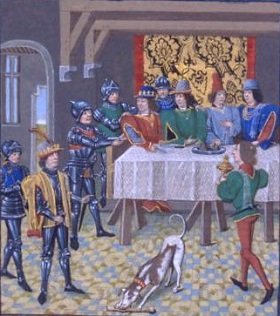
The king of France, on Tuesday the 5th of April, which was the Tuesday after midlent Sunday, set out early, completely armed, from Mainville, attended by about one hundred lances. There were with him his son the earl of Anjou, his brother the duke of Orleans, the lord John d’Artois, earl of Eu, the lord Charles his brother, cousins-german to the king, the earl of Tancarville, sir Arnold d’Andreghen, marshal of France, and many other barons and knights. They rode straight for the castle of Rouen, by a back way, without passing through the town, and on entering found, in the hall of the castle, Charles, duke of Normandy, Charles king of Navarre, John earl of Harcourt, the lords de Preaux, de Clerc, de Graville, and some others seated at dinner. The king immediately ordered them all, except the dauphin, to be arrested, as also sir William and sir Louis de Harcourt, brothers to the earl, the lord Fricquet de Friquart, the lord de Tournebeu, the lord Maubué de Mamesnars, two squires called Oliver Doublet and John de Vaubatu, and many others. He had them shut up in different rooms in the castle; and his reason for so doing was, that, since the reconciliation made on occasion of the death of the constable of France, the king of Navarre had conspired and done many things contrary to the honour of the king, and the good of his realm: the earl of Harcourt had also used many injurious expressions in the castle of Vaudreuil, when an assembly was holden there to grant a subsidy to the king of France against the said king, in order to prevent, as much as lay in his power, the subsidy from being agreed to. The king, after this, sat down to dinner, and afterwards, mounting his horse, rode, attended by all his company, to a field behind the castle, called the Field of Pardon.

The king then ordered the earl of Harcourt, the lord of Graville, the lord Maubué and Oliver Doublet to be brought thither in two carts: their heads were cut off,† and their bodies dragged to the gibbet at Rouen, where they were hung, and their heads placed upon the gibbet. In the course of that day and the morrow, the king set at liberty all the other prisoners, except three: Charles king of Navarre, who was conducted to prison in the Louvre at Paris, and afterwards to the Châtelet: some of the king’s council were appointed as a guard over him. Fricquet and Vaubatu were also confined in the Châtelet. Philip of Navarre, however, kept possession of several castles which the king his brother had in Normandy, and, when the king of France sent him orders to surrender them, refused to obey, but in conjunction with the lord Godfrey de Harcourt and other enemies of France, raised forces in the country of Coutantin, which they defended against the king’s troops.

* The post was vacant because the previous Constable had been executed.

** And distant kin, but who isn’t?

† By a convenient prisoner dragooned into the duty, who required many more hacks at the bone than there were heads to sever.

On this day..

1809: Four by William Brunskill at Horsemonger Lane

Jackson’s Oxford Journal, April 1, 1809:

ASSIZES. — At Surry [sic] assizes, the following capital convicts received sentence of death: — J.A. Davison, J. Mason, J. Wood, and S. Hilton, for burglary; W. Leech, for highway robbery; J. Bartlet, [sic] for an unnatural offence; T. Hall, for extorting money under a threat of charging J. Clarke with an unnatural offence; H. Edwards, for shooting at W. Smith; J. Stenning, for forging a note; C. March, for cattle-stealing; S. Turner, for privately stealing; and Mary Ann Ellis, J. Hopkins, and J. Cobb, for stealing in dwelling-house. The Judges reprieved all except Bartlett, Edwards, Mason, and Wood.

Robert Skinner was indicted for attempting to ravish Mary Ann Hill, on the 16th of February last, at Wandsworth. The prosecutrix, who stated herself to be only 16 years of age, deposed that her father was a market-gardener at Wandsworth, and the prisoner worked in his service. On the 16th of February last they were at work together in a shed. He was binding coleworts, and she was trimming them.


A field of colewort. (cc) image by patchara yu.

After he had finished, he came to where she was sitting and threw her down. He was, however, interrupted by the coming of a cart, or she believed he would then have committed the offence charged. On cross-examination, she said her father had a cottage in his garden in Garret-lane, and she, her sister, and another girl slept there alone. On the 14th of January the prisoner was there in the evening; they gave him some beef-steaks for his supper, and he would not go home. She gave him the mattress to lie upon without side her chamber door. — In the night she heard a noise, and got up to see what it was; they were both naked. She did not tell her father of this. A few nights afterwards they had him to supper again, and got him some sausages; he would stay all that night, and she then let him lie in the same bed, but she did not let him lie next to her. The Learned Judge here interrupted, and observed it was ridiculous to talk of any attempt at a rape after this. The prisoner was of course acquitted.


Jackson’s Oxford Journal, April 8, 1809:

EXECUTION. — James Bartlett, for an unnatural crime; Henry Edwards, for highway robbery; and John Biggs and Samuel Wood, for burglary, were executed yesterday morning, [April 4, 1809] at the usual hour, on the top of the New Prison, Horsemonger-lane, in pursuance of their sentence. The crowd assembled on the melancholy occasion was excessive. The unfortunate men met their fate with great fortitude, and died acknowledging the justice of their punishment. Biggs sarcastically observed to the Executioneer, [sic] when he was pinioning him in the usual way — “I wish you had a better office.”* — He with the rest died extremely penitent. A hearse conveyed the body of Bartlett to Limehouse, where he is to be interred. — He is stated to have conveyed before his trial upwards of 1500l. to his daughters.

* The hangman so busted upon was William Brunskill, who already had near a quarter-century in his poor office by that time. It’s a bit hard to tell from the printed account, but since Brunskill had some notable ten-thumbed hangings to his credit — like that of Joseph Wall seven years before — the “better office” remark might have been a Monmouth-esque professional rebuke.

On this day..

1721: Five for returning from transportation

On this date in 1721, six men hanged at Tyburn. One, John Cobige, was condemned for highway robbery. The other five were all sent to the gallows for returning from convict transportation.

Although forms of penal transportation dated back as much as a century before this time, 1721 was early years for the regime of systematically shipping convicted criminals to the New World.* The enabling legislation had been implemented only three years before.

Convict transportation allowed condemned prisoners’ death sentences to be remitted for labor service in the British colonies, typically 14 years. One could argue that this second chance at life was a mercy, even if the convicts themselves didn’t always see it that way.

But there was a distinct second category of transported convicts, besides the death-sentenced ones: petty crooks, whose crimes were not capital, who now could be directly sentenced to transportation for a term of 7 years. This was an essential innovation of the Transportation Act, one begged after by London magistrates who perceived a crime wave in the 1710s and wanted tougher measures to purge even minor criminals from the city.

In effect it was an interval of civic death, enforced by the threat of bodily death; its design bears some resemblance to the condition of prisoners in Thomas More‘s Utopia. Returning to England before the full term meant the noose — for both classes of transported convicts, including those whose initial crime was so petty that it didn’t merit execution even in Bloody Code England. This circumstance describes four of the Tyburn hangings on the third of April, 1721:

Of our date’s group, only John Filewood, who had posed as a porter to steal a valuable portmanteau, slashing its owner’s hand in the process, had received an initial death sentence commuted to transportation.

The prospect that a body could be shipped to the New World’s frontier for indentured labor over a handkerchief and executed for the “crime” of returning to hearth and home naturally chafed at the sense of justice. In 1721, the whole convict transportation arrangement was still so new that nobody had become inured to the horror of it. It’s plain from the sermon the Ordinary preached at them that the prisoners in question took their fates quite hard.

I took Occasion to mention to the Malefactors, the Returning from Transportation, which not one of them could be made to believe was sinful. I endeavour’d, to the best of my Capacity, to convince them that they were not faultless and unblameable in the following Manner: If the disobeying the higher Powers, even every Ordinance of Man, be sinful, as forbidden, (1 Pet. 2. 13, 14, and 17, &c.) Then their particular Offence, which is disobeying the Orninence of Man, must be forbidden in Scripture and be sinful.

Another way, that it may be shown is thus. Not only Robbing and Stealing, but whatsoever else is detrimental to the Society we are Members of, is a Sin: Now this particular Action is detrimental to the Nation, (both in the Practice, and also in the Example); and therefore is sinful.

I told them, if they could not be convinc’d that they had sinned, because they were possest of the Notion that the Legislative Power was in this particular too severe; they might read, 1 Pet. 2. 18. Be subject to your Masters, not only to the Gentle, but also to the Froward: But that this was not their Case.

Struggling to supercharge their repentance, the Ordinary arranged to have his resentful charges “carry’d constantly to the Chapel” — twice a day. But

they could not be convinc’d they had done any Harm in Returning from Transportation, [and] scarce any one of them could believe he should dye for it. Henry Woodford in particular undertook (as he had declared in Chapel he would) to demonstrate to me, That the returning to his Wife and young Children, in order to keep them from Starving in his Absence, was so far from being a Crime, that it was his Duty so to act; and that no Law could disingage him, or any thing but Death, from the great Duty of providing for his Family.

Out of all the doomed, Henry “seem’d most to resent his Dying” and complained that they ought better to have been overtly sold as slaves if this was their condition.

Still other terrors stalked these men. The highwayman Cobige, who at age 50 was the only one among them not in the spring of youth, “was in very great Passions of Grief some Days before his Death, because his second Wife, as he told me, was gone away from his Children.” His hanging would thus orphan a 14-year-old daughter and her three siblings all under 10 years of age. John Filewood, an admitted career criminal, regretted “having brought so much Disgrace to his good Mother and Sister, and not taking Warning at the untimely Death of his Brother, who was taken off much earlier in his Sins.”** And Martin Gray, a 22-year-old illiterate fisherman,

was greatly frighted, least his Body should be cut, and torn, and mangled after Death, and had sent his Wife to his Uncle to obtain some Money to prevent it. I cannot mention much of his good Behaviour; but before he died, he seem’d very much concerned; and told me, he had taken all Opportunities to hear his Fellow Prisoners read, and to pray with them; and that he hoped God would take Pity on him, a poor ignorant and foolish Fellow, and not throw him into Hell.

* Australia only became the convict destination of choice after the American Revolution closed those ex-colonies to the human traffic.

** James Filewood, who was hanged on Halloween 1718.

On this day..

1954: Henry Frank Decaillet

(Thanks to Meaghan Good of the Charley Project for the guest post. -ed.)

On this date in 1954, 52-year-old Henry Frank Decaillet met his death in the gas chamber at San Quentin in California.

Teenage girls seem to have been his type; when he married at 23 years old, his bride was just 14. They had five children, four of whom survived to adulthood. By the time of Decaillet’s crime, though, he and his wife had been estranged for years and had separated.

Decaillet, a farmhand, had joined his local Pentecostal Church and there he met Phoebe Ann Bair described as “a pretty brunette large for her age.” Her family was also part of the church. She was thirteen. He fell in love with her, he said, and they entered into a sexual relationship for about a year.

The affair had become the subject of local gossip by mid-1953 and the local police had a chat with Decaillet about the risks associated with having sex with minors. Phoebe herself had cooled towards him. He heard she had been “messing around with some boys” her own age and he became frantic.

On the evening of June 11, Decaillet accosted Phoebe at a Pentecostal Church meeting. She refused to speak to him and he drove to her house and took a .22 caliber rifle out of his car. He’d been carrying it around in his vehicle for some time, debating over what to do. Now he had made up his mind. He went into the Bair home, where three of Phoebe’s siblings and two other children were present. When they saw the gun, they went running out the door for the police.

Decaillet hid in a closet in the house. Phoebe and her parents arrived home at 9:45 p.m. Mr. and Mrs. Bair realized they’d left one of their other children behind at the church and left to pick her up, telling Phoebe to stay home and get ready for bed. After her parents left, as Phoebe was standing in the kitchen, Decaillet shot her through a crack in the door. She ran and tried to reach the front door, but he chased after her, grabbed her and shot her three more times in the head.

When the police arrived at the Bair residence, Decaillet was sitting on the sofa with rifle in hand and Phoebe’s head cradled in his lap. He admitted to his crime, saying he’d been planning it for weeks.

He said Phoebe had been leading an immoral life and he had killed her “to stop her from becoming a prostitute.”

Decaillet had little to say for himself after that. Although he was a heavy drinker who’d been treated at the state hospital for alcoholism — in fact he became a Pentecostal as part of his effort to turn over a new leaf — he was sober at the time of the murder. He said he knew what he’d done was illegal and wrong and agreed that he should die for it. He pleaded guilty to murder, without requesting leniency.

Less than a year passed between murder and execution.

On this day..

1698: Katharina Sommermeyer, Beierstedt witch

The last witch executed in the Saxon city of Braunschweig — Brunswick, in English — burned on this date in 1698.

Hers was a distinction that was long thought to adhere to the much better-documented Tempel Anneke, who suffered back in 1663. The eventual discovery in city archives of records for at least three later trials — Lucke Behrens in 1671, Elizabeth Lorentz in 1671, and our Katharina Sommermeyer in 1698 — corrected the record.

Unfortunately, only sketchy details are known about any of these women. Sommermeyer, the subject of our date’s small milestone, was a young woman of about 20, hailing from the tiny nearby village of Beierstedt. (Present-day population, according to Wikipedia: 386.)

On this day..

1777: James Molesworth, in the words of the Founding Fathers

John Adams to Abigail Adams

Philadelphia
March 31, 1777

I know not the Time, when I have omitted to write you, so long. I have received but three Letters from you, since We parted, and these were short ones. Do you write by the Post? If you do there must have been some Legerdemain. The Post comes now constantly once a Week, and brings me News Papers, but no Letters. I have ventured to write by the Post, but whether my Letters are received or not, I dont know. If you distrust the Post, the Speaker or your Unkle Smith will find frequent Opportunities of conveying Letters.

I never was more desirous of hearing frequently from Home, and never before heard so seldom. We have Reports here, not very favourable to the Town of Boston. It is said that Dissipation prevails and that Toryism abounds, and is openly avowed at the Coffee Houses. I hope the Reports are false. Apostacies in Boston are more abominable than in any other Place. Toryism finds worse Quarter here. A poor fellow, detected here as a Spy, employed as he confesses by Lord Howe and Mr. Galloway to procure Pilots for Delaware River, and for other Purposes, was this day at Noon, executed on the Gallows in the Presence of an immense Crowd of Spectators. His Name was James Molesworth. He has been Mayors Clerk to three or four Mayors.

I believe you will think my Letters, very trifling. Indeed they are. I write in Trammells. Accidents have thrown so many Letters into the Hands of the Enemy, and they take such a malicious Pleasure, in exposing them, that I choose they should have nothing but Trifles from me to expose. For this Reason I never write any Thing of Consequence from Europe, from Philadelphia, from Camp, or any where else. If I could write freely I would lay open to you, the whole system of Politicks and War, and would delineate all the Characters in Either Drama, as minutely, altho I could not do it, so elegantly, as Tully did in his Letters to Atticus.

We have Letters however from France by a Vessell in at Portsmouth — of her important Cargo you have heard. There is News of very great Importance in the Letters, but I am not at Liberty. The News, however, is very agreable.


John Hancock to George Washington

Philada
April 4[-8], 1777

Sir,

The enclosed Resolves of Congress, which I have the Honour of transmitting, will naturally claim your Attention from their great Importance.

The Regulations relative to the Payment of the Troops and the Department of the Paymaster General, will I hope be the Means of introducing Order and Regularity into that Part of the Army; where, it must be confessed, they were extremely wanted.

General Gates having laid before Congress the Proceedings and Sentence of a Court Martial on a certain James Molesworth who was accused and found guilty of being a Spy, they immediately approved the same. He has since suffered the Punishment due to his Crime. From his repeated Confession, it appears, that Mr Galloway was extremely active in engaging him to undertake this infamous Business, and was the Person employed to make the Bargain with him. He says indeed, Lord Howe was present: but from the Description he gave of his Person, it is supposed he must be mistaken.

The Congress have directed Genl Gates to take Genl Fermoy with him to Ticonderoga, and such other french Officers as he may think proper. Genl St Clair being ordered to Ticonderoga, but previously to repair to this City to wait the further Order of Congress, you will please to direct him to repair here accordingly as soon as possible. I have the Honour to be with the most perfect Esteem & Respect Sir Your most obed. & very hble Serv.

John Hancock Presidt

On this day..

1781: Diego Corrientes Mateos, Spanish social bandit

On this date in 1781, the Spanish social bandit Diego Corrientes Mateos was hanged and quartered in Seville.

A robber who plied the roads from Portugal to his native Seville, Corrientes (English Wikpedia entry | Spanish) was said to be of farmworker stock himself. His consequent good treatment of the rural common folk enabled him to operate with great freedom and situated him as a Robin Hood character; folklore has consequently inflated the valor of his exploits and the bile of Sheriff of Nottinghamesque pursuers like the lieutenant governor of Seville. For example, surprising his adversary on one occasion, Corrientes is supposed to have remarked, “I have learned that you boast you will be able to capture me.”

“Yes, and hang you,” shot back Francisco de Bruna.

“Then I must spare your life so you can fulfill your promise,” the sporting Corrietes allowed. (The reader will discern that Francisco de Bruna soon made good his threat.)

By the 19th century, he’d become a positive fixture of romantic and nationalist literature.

On this day..