1866: Robert Dodge, haunter

(Thanks to Robert Elder of Last Words of the Executed — the blog, and the book — for the guest post. Fans of this here site are highly likely to enjoy following Elder’s own pithy, almanac-style collection of last words on the scaffold. -ed.)

“The time will come when my innocence will be proven, and then Bob Dodge will haunt you for his murder.”

— Robert S. Dodge, convicted of murder, hanging, California.
Executed November 8, 1866

Borrowing a double-barrel shotgun, ostensibly to hunt quail, Dodge could not account for his whereabouts when a man who was quarreling with his brother was shot. Dodge went through two trials and during the second was found guilty of first-degree murder. In prison, he attempted suicide by taking opium.


To Elder’s hanging-day sketch (and since blog column-inches are free) we add the report of the San Francisco Evening Bulletin, Nov. 10, 1866 — itself channeling the Nevada Transcript. (Meaning Nevada City, Calif., not the state of Nevada.)

[Dodge] was twice tried and convicted of the murder of Mark P. Hammock, and after both trials the case was taken to the Supreme Court, whence the case was once sent back.

The verdict after the second conviction was sustained and the District Court ordered to fix a day for the execution.

The testimony against Dodge was entirely circumstantial.

Sheriff Gentry read the death-warrant, after which Dodge stepped to the rail in front and addressed those in the yard in a speech of ten minutes. He said he had once more the privilege of addressing them in this dark and gloomy world. He alluded to his home, his mother and friends, speaking of them in affectionate terms, and picturing the grief they would feel on hearing that their youngest son had died upon the gallows.

He spoke of the anxiety manifested to witness his death, and warned those present that the time would come when they would repent having seen it, and that when they discovered, as they surely would, that he was innocent, remorse would forever follow them.

He declared that he suffered on account of false testimony offered against him. He alluded to the future, saying that in “eternity Bob Dodge would be seen coming in glory.”

At the conclusion of the speech he turned to Sheriff Gentry and requested him to finish the work quickly. When asked if he had anything further to say by the Sheriff, he replied only “I am innocent.”

He then bid those on the platform good-bye, shaking hands with them, and then stepped upon the trap. His limbs were lashed with cords and the black cap placed over his head.

He then said, in a loud voice, “Boys, I want you all to hear, I am innocent.”

A prayer was read by Mr. Anderson, and at 18 minutes past 1 o’clock the trap fell, and the soul of Dodge was sent to a higher court for judgment.

On this day..

1895: Emma Williams, Frank Tinyana, and Jackey

From The Advertiser (Adelaide, SA), Nov. 5, 1895:

Melbourne, November 4.
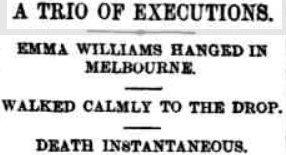
Emma Williams, who was convicted of the murder of her child at Port Melbourne on August 13 last, was executed in Melbourne Gaol this morning in the presence of about a dozen persons.

Public excitement was aroused over the murder when it was first discovered owing to the callous and unfeeling way in which the deed was done and the careless attitude of the mother afterwards. The victim, who was only two years of age, was taken by its mother to the pier in the Sandridge Lagoon, where she tied a stone to its body and pushed it into the water.

After her conviction the Anti-Capital Punishment League made strenuous efforts to obtain a reprieve, chiefly because the condemned woman alleged that she was pregnant.

Medical examinations did not support that statement, and it was discovered on Friday last that the condition which lent color to the woman’s statements was produced artificially.

At first Williams treated her terrible sentence with apparent unconcern, being buoyed up with the hope of reprieve; but when that expectation had passed she became most devout and earnest in her attentions to the ministrations of the gaol chaplain (the Rev. H. F. Scott), by whom she was attended to the scaffold. She expressed great sorrow for the crime she had committed and for the loose life she had led.

She remained in that frame of mind to the end.

When the sheriff demanded the body of the prisoner from the governor of the gaol at the door of the little cell alongside the gallows this morning she walked calmly on to the drop, but her face was blanched and wore a terrified expression.

In answer to the usual questions from the sheriff as to whether she wished to say anything Williams answered “No,” in a low but firm voice.

The white cap was immediately drawn over her face and the rope adjusted, and then, as Roberts, the hangman, turned to pull the lever, she exclaimed, “Oh, Lamb of God, I come.”

The next moment the drop fell, and at that moment Williams uttered a nervous, plaintive exclamation that was not quite a scream. Then all was over. The whole of the proceedings did not occupy more than a quarter of an hour, and death was instantaneous.

The dead woman had a very eventful career, having been married when she was 14 years old. At 15 she bore a daughter, who is still living. Her husband left her, and afterwards died in the Melbourne Hospital, while the widow continued a career of dissipation. Her daughter was adopted by a friend of her husband, and the child which she drowned was born after his death.

She was born in Launceston, Tasmania, where her mother still lives.

Brisbane, November 4.
A double execution took place at the Boggo Road Gaol this morning.

Jackey, an aboriginal, was hanged for the murder of a Javanese, Jimmy Williams, at Mount Morgan, and Frank Tinana [or Tinyana -ed.], a Dative of Manila, was executed for the murder of Constable Conroy, on Thursday Island. The men behaved well in prison. Jackey was able to recite prayers taught him by the Bey. Mr. Simmonds, and Father Dorrigan attended Tinana, who admitted having committed murder. He said he bad a jealous quarrel with another colored man, in which Constable Conroy attempted to arrest him. He then stabbed Conroy to death.

During the past few days both condemned men ate and slept well, and this morning they partook of breakfast. When they came upon the scaffold Tinana was agitated and seemed afraid. Neither man spoke.

The preliminaries were quickly arranged and the bolt was drawn. Death, in each case was apparently instantaneous. When Jackey, whose height was nearly 6 ft, fell blood burst from his nose and stained his white cap.


Diagram from an 1880 memorandum the British government sent to colonial authorities in Queensland detailing procedures for the cutting-edge long drop hanging method.

No colored men were present to witness the execution, which was carried out in the presence of the usual officials. Jackey left a letter to a woman who is looking after his child, telling her to take great care of the infant, to bring it up as a white man’s, and not to let it drink rum or go to the blacks’ camp. Tinana left a letter coached in terms of great affection to his wife.

On this day..

1862: Thomas Sanders, rapist

Thomas Sanders was hanged on this date in 1862 at Melbourne Gaol.

An ex-con at Norfolk Island, Sanders took to the bush with another man named John Johnson and in 1862 perpetrated a terrifying home-invasion raid upon the farm of Henry Cropley. They spent five hours there, eating, relaxing, and terrifying the family, comfortably remote on Keilor Plains from any possible source of help. Nobody died — but Sanders too a liking to the family serving-girl Mary Egan and raped her. Egan gave the evidence about her harrowing ordeal — and subject to Sanders’s own direct cross-examination* — just three weeks before Sanders hanged:

The tall man was standing in the middle of the room. I turned to look at him, and he told me to turn my face away, and put a chair for me against my master and missis. He then told the other man to “tie my master’s hands up,” and pulled a rope out of his pocket, and tied him up. He afterwards told me to get up and make tea. I got up and stood at the fire, but was so frightened I could not make tea.

When I saw my master tied up I began to cry, and the little man came up and told me to “shut up,” at the same time pulling a pistol out of his pocket. Sanders then searched the rooms. I saw him as I was standing at the mantelpiece. Johnson was walking about the kitchen with a double-barrelled pistol in each hand.

I thought they were then going away, but they came back again, and Sanders saw the ham hanging up in the kitchen. After they had had their own supper, Sanders sent Johnson to ask me if I would have any. I said I would not.

They had been drinking a bottle of port wine and some spirits. I then heard them go into my rom and pull out my little box. Sanders then said it was time to put the girls to bed.

He told my missis to go into her room, and then came back and took the cradle in. He stopped there some time. I can’t say how long, and then came out, and said to me, “You, girl, you go to bed.”

I went in, and he followed me into my room with the candle.

I was going t bed with some of my things n, and he made me get out and take off everything, except my chemise.

He then tied me hand and foot to the four corners of the bed, and as my foot slipped while he hurt my ankle, I kicked him in the face.

He then said, “Oh, you —- little wretch; I’ll give it to you for that.” I ceased to resist him, as I saw it was no good, and my master had told me to do what he told me. I did not resist him, because he had pistols in his pocket and he said if I did not do what he ordered me he would blow my head off, and would think no more of my life than a cat’s.

He ordered me then to be quiet, and tied my hands behind me. He then brought the other man in, and said, “Isn’t she an enticing little devil.”

I didn’t hear the other man say anything.

They then went out, and took the candle with them, and, after remaining a few minutes, Sanders returned, and said, “Now, my good girl, I’ll give it to you for kicking me in the face.”

It was in the dark. I could not see him, but I knew his voice. I think he was undressed.

He got into bed, and I said to him, “For God’s sake not to do anything t me, for I was a poor orphan girl.”

He did not seem to hear, but I spoke loud enough for my master and mistress to hear.

I then heard him at the foot of the bed, and he asked me “if I had any relations in the colony.”

I said “Yes, I had brothers and uncles.”

He said he didn’t care, and then he had connection with me.

I said, “God help me; there is no help.”

(The witness here described the circumstances, and was almost unable to proceed from agitation. They distinctly proved that a rape was committed.)

Afterwards I begged him to untie me, as the flesh was rising over the ropes, and hurt me. He then untied me.

I never told any one afterwards, as I never dreamt they would be taken up. I afterwards told the doctor everything.

The witness here looked round, at the desire of the Bench, and said, “These are the two men. The one (pinting to Sanders) is the man who had connexion with me.”

* Egan was credited with maintaining her composure admirably under the trying circumstances, but at noe point Sanders asked a question “of such a brutal nature that her firmness, which had been remarkable, gave way, and she had to be removed, in a fainting fit, from the court. The prisoner Johnson made some remark, and Sanders exclaimed “Oh, she’s well tutored!”

On this day..

1857: James Copeland, repentant gangster

On this date in 1857, “the great southern land pirate” James Copeland went to the gallows in the now-abandoned Mississippi town of Augusta.

Copeland‘s criminal career is the subject of a wonderfully old-timey reader by the Perry County sheriff who noosed him. (As it says right there on the title plate. Sheriff J.R.S. Pitts does not shrink from injecting his own story into the narrative, and to get to the action the reader must first wade through tedious digressions into the hangman’s biography, his civic-minded rationales for a prurient interest in outlaws — “such a life and history cannot fail, even at this late date … of materially interesting and benefiting the public at large” — and some whinging about the libel suits that dogged his attempts to materially benefit the public at large.)

After an “introduction”, a “preface”, and an “explanatory”, our volume comes at last to an illustrated 100-page autobiographical narrative which Pitts says that Copeland dictated to him while cooling his heels in jail.

Hardened and violent in life, Copeland under the eaves of death seems to made that familiar return to God and repentfully confessed his path into depravity beginning with youthful delinquencies the condign punishment of which was consistently deflected by his mother, “who always upheld me in my rascality.”

Having fallen into a legal scrape for pig-thieving, Copeland left behind charming rascality for Godfather territory when he made contact with an outlaw named Gale Wages and concocted a plan to vacate the charges by destroying the documentation … by torching the courthouse in which they rested.

“Such a sight I never had before beheld,” Copeland remembered of the blaze. “The flames seemed to ascend as high, if not higher than the tops of the tallest pine trees; they made everything perfectly light for over two hundred yards around.” After that bonfire, Copeland gave himself over to the guidance of a man who turned out to be halfway between Jabba the Hutt and a Masonic lodge chief.

Wages, Copeland found, had “a great many persons concerned with him, in different parts of the country, some of them men of wealth and in good standing in the community in which they lived.”

They had an organized Band that would stand up to each other at all hazard; they had a Wigwam in the city of Mobile, where they held occasional meetings … they had many confederates there whom the public little suspected …

I was there introduced by Wages, (who was their president,) as a candidate for membership, I should have been rejected, had Wages not interceded for me. I was finally passed and admitted to membership. Wages then administered to me the oath, which every member had to take. I was then instructed and given the signs and pass-words of the Clan.

Maybe the gang was right to doubt him, for Copeland broke this oath by divulging to his hangman-biographer numerous names of members as well as the Encyclopedia Brown-esque cipher this gang used to send coded messages.

Over the course of the next decade and more, Copeland’s narration has the gang and he romping through Dixie in misadventures that range from the charmingly picaresque — finagling a guest role at a Methodist pulpit by posing as wandering preachers upon which they netted several hundred dollars from the inevitable passed hat — to the much less charming:

A legend of $30,000 in gold that the squad claimed to have buried in Catahoula Swamp still circulates in Mississippi — spur to thus-far frustrated treasure hunters down to the present day.

We can’t know to what degree the voice that we read is Copeland’s own or that of Pitts interposing but the narrator we have affects at times a stagey horror at his sins.

With the gang determined to be rid of an Irish boatman on the Mississippi, Copeland draws the short straw to bludgen him to death in his sleep: “Oh, God! when I look back, it makes me shudder. Even now it chills the blood in my veins.” Copeland bashed his brains in with a hatchet and as day broke they slipped the weighted corpse into the river.

Copeland had moved up the ranks enough to share the marquee in the “Wages-Copeland gang” by the time things got real dark. In early 1844, a summit of the gang’s leadership determined spies were afoot and four of the suspected “butted their heads against a slung-shot hung to a man’s arm, and they went floating from Mobile wharf down the channel of the river.” Others they left “in a situation where he told no more tales” and “fed … the contents of two double-barrel shot-guns, about forty-eight buck-shot, and put him in a swamp near Eslaya’s old mill” and “put a rope around his neck, and we very soon squeezed the breath out of him.”

The end of the line could really have been any one of these incidents or the numerous others this post elides — enough blood feuds and hand-to-hand murders and the odds are sure to turn against you in the long run.

In 1849, now a wanted man, Copeland started drinking at a grocery near Mobile

and became intoxicated, and in that situation I imagined every man I saw was trying to arrest me. I fell in with a man by the name of Smith, an Irishman, and a difficulty occurred between us; I concluded that he intended to arrest me. I drew my double-barrel shot gun upon him and intended to kill him. He was too quick for me; he threw up my gun, drew his dirk and stabbed me just above the collar bone.

Having made himself both conspicuous and immobile, Copeland was tracked down by a posse and now he was really in the soup: “one indictment against me in Alabama for larceny, and another against me in Mississippi for murder.” Copeland pleaded guilty in Alabama and served a jail sentence there, hoping that the passage of years would buy him some opening to escape the hanging sentence that would surely await in neighboring Mississippi. But the Magnolia State was on its game and had a timely extradition request ready to receive James Copeland the moment his term in the Alabama pen expired.

The day arose clear and beautiful on which the sentence of the law and of outraged humanity was to be executed on the man who had so often violated their most sacred behests. The sky was blue and serene; the atmosphere genial; all nature was calm and peaceful; man alone was agitated by the various strong emotions which the execution of the fatal sentence of retributive justice on a fellow-man could not but create.

The place of execution was distant from the city of Augusta one-quarter of a mile. The gallows was erected on a beautiful elevation that was surrounded by the verdure of shrubby oak and the tall, long-leaf pine. The ground was everywhere occupied by thousands of spectators, gathered from Perry and the surrounding counties, to witness the solemn scene. It was indeed one that they will long remember.

About the hour of noon, the prisoner, after being neatly clad, was led from the jail by the officers of the law, placed in the ranks of the guard formed for the occasion, and the procession moved slowly toward the fatal spot.

Soon the doomed man appeared on the gallows. The death warrant was then read to him, and he was informed that he had but a short time to live.

He proceeded to address the awe-struck and silent multitude. He especially urged the young men present to take warning from his career and fate, and to avoid bad company. His misfortune he attributed principally to having been mislead while young.

When he had concluded, a number of questions were asked by the immediate spectators, in relation to crimes which had transpired within their knowledge; but he would give no direct answer — shrewdly eluding the inquiries.

The Sheriff then asked him, in hearing of many lookers on, if the details of his confession, previously made to that officer, were true. He replied that they were.

His hands were then tied and the cap pulled over his face, and he was told that he had but a few moments to live. He exclaimed, “Lord, have mercy on me!” and he was praying when the drop fell, and a brief struggle ended his blood-stained career.

On this day..

1996: Arshad Jameel, military man

Pakistani army Capt. Arshad Jameel (or Jamil) was hanged at Hyderabad Prison 20 years ago today.

Capt. Jameel exploited a security sweep to orchestrate the summary execution of nine Indian-armed terrorists … who turned out not to be terrorists at all, but ordinary residents of Tando Bahawal village whom Jameel had a personal grudge with.

It was a resonant case in a country dominated by its military and only wide public outrage at the journalistic expose unveiling the crime put Jameel in the dock of a military court.

Even so, the wheels turned so painfully slow that Pakistanis could not but suspect an institution accustomed to a broad grant of impunity of dragging its feet. Four years deep into Jameel’s appeals, two sisters of victims protested the delay by publicly immolating themselves on September 11, 1996. They died painfully of their burns, but they got the result they wanted: appeal denied.

On this day..

1905: Ed Lamb, bully

This date in 1905 was — in the title of the Manatee County Historical Society publication about the case — The Day They Hanged Ed Lamb in Braidentown/Bradentown/Bradenton.

It all started in the schoolyard.

Lamb’s son was the resident bully at the local Braden River School until one day that January he picked a fight with the son of Dave Kennedy and surprisingly got his — the bully’s — ass kicked.

Like many a child since, young master Lamb sent his problem up the generational chain of command. Ed Lamb, a mill hand, raised the beef with Dave Kennedy, a farmer, when the latter stopped by the mill a few days later to sell his wares, even menacing Kennedy with a knife.

But for the second time, a Kennedy went all lion on a Lamb and overpowered his antagonist. Enraged and embarrassed, Lamb stalked away to his nearby home, got a shotgun, and wasted Dave Kennedy. Masculinity: vindicated. Stunned bystanders allowed Lamb to escape.

Our Manatee County correspondent gives the surreal vignette from his own family history of the Kennedy children — being dismissed from school at news of the murder — walking home on a dirt road that very day and passing the disgraced Lamb family on a wagon with their possessions, heading out of town. “One of the children standing beside the roadway became frightened thinking that Ed Lamb would pop out fo the trunk at any moment.” He didn’t: Ed was on a lam all his own, and was recaptured the next morning and spirited away to Tampa to protect him from lynching. Lamb spent the months between his conviction and his execution harrying the local newspaper with letters entreating folks straighten up and get right with God, letters that notably failed to breathe word one of apology to the Kennedies.

The drop fell at 12 minutes past 12:00 non. But the rope slipped and the prisoner was raised a second time and shot into eternity. He was rendered unconscious by the first shock and never knew that he was let to fall a second time. His neck was broken by the second fall and he was pronounced dead by Dr. John Holten of Sarasota. He mounted the gallows cool and fearless and died without a murmur or a struggle. Inside the jail, 40 witnesses were in the jail when the execution took place, the gallows being inside the building. A few white people and a great many Negroes were congregated around the jail, but perfect order was maintained.

Lamb’s son, brother and sister-in-law were present when he mounted the scaffold, but were overcome and left before the drop fell. The doomed man kissed them goodbye and asked them to meet him in heaven. His wife was unable to come to the jail to see him for the last time. Was photographed. Lamb dressed himself for the scaffold with great deliberation. And at his request, was photographed after being attired for death. He talked freely. But in his last speech he said nothing about the crime for which he suffered. He said that he was willing to die. That he had made his peace with God and wanted all of his heirs to meet him in a better world. Sheriff Wyatt was cool and carried out his part well. The noose was adjusted and the black cap pulled down over the prisoner’s face. And the trap sprung that sent the murderer to meet his maker. The death warrant directed that the execution take place in private between the hours of 11:30 and 12:00, but the sheriff allowed the condemned man 12 minutes longer lease on life.

Manatee County paid Coursey and Barnett $16.70 for Lamb’s hangin’ suit, and paid J.W. Wilhelm & Co. $21.35 for his coffin.

On this day..

1770: William Linsey, resolutely bent upon working wickedness

On this date in 1770, inveterate burglar William Linsey was hanged in Worcester, Mass.

Linsey never killed anyone but just couldn’t lay off the thieving — as he owned himself in a gallows broadsheet: “Having so often escaped with impunity, for my wretched crimes, I was under no awe or restraint, neither learning God nor regarding man, resolutely bent upon working wickedness.” That didn’t mean he didn’t get caught: he frequently did, and once was pilloried, flogged, and branded all in the same day as punishment for fraud.

The quote is courtesy of a Linsey profile by friend of the blog and occasional guest poster Anthony Vaver, on his site Early American Crime — which notes that Linsey ultimately fell foul of a sort of colonial three-strikes law escalating penalties for mere property crimes all the way to the gallows in the case of repeat offenders.

On this day..

1828: Charles French, York printer

On this date in 1828, a young printer’s assistant morally corrupted by the theater went to the gallows at York, Upper Canada (soon to become Toronto, Ontario).

After boozing it up at a performance of Tom and Jerry, or, Life in London* at Frank’s Hotel, 21-year-old Charles French fell into a drunken row with Edward Knowlan or Nowlan and shot him dead, in a case that occasioned a local moral panic about the dangerous carousing nurtured by the nightlife in the small frontier town.

Frank’s Hotel, York’s very first theatrical venue, was “neither under order nor restraint,” French’s respectable parents pleaded in their unsuccessful clemency missive. It was “the haunt of the gay and dissolute, the idle and the profligate, the ruffian and woman of bad fame, those who show in the light of the moon were there — and from its temptations few parents or masters could restrain the youth.” (Source) Theater troupes were banned from York stages for five years after the French affair.

French’s defense had likewise attempted to raise doubts about his mental competency, and although this worked as well as it usually did in a 19th century courtroom there was no small sentiment for French’s reprieve: (K)nowlan was a notorious goon, and the circumstances of the fray seemed muddled enough to bring the shooter’s degree of calculation into question. Two alleged accomplices, acquitted in separate trials, swore that Knowlan had menaced French before French shot him.

The close clemency call carried a sharp political undertone. French was an understudy of the reform publisher William Lyon Mackenzie and his victim a Tory brawler who dealt out bruises in the service of Upper Canada’s “Family Compact” ruling clique. That his petition for mercy was rejected by Lt. Gov. Peregrine Maitland eventually became one of the (lesser) briefs against the Family Compact advanced a decade later during the Upper Canada Rebellion.

* The period’s several Tom and Jerry plays — no overt relationship is known between them and the 20th century Tom and Jerry cartoons — derived from Pierce Egan‘s smash hit Life in London, or, the day and night scenes of Jerry Hawthorn, esq., and his elegant friend Corinthian Tom in their rambles and sprees through the metropolis. The title characters capture vignettes around the city, naturally not excluding the condemned hold at Newgate, which they tour with their friend Bob Logic on the pretext of consoling one of Logic’s old friends.

An opportunity presented itself to our TRIO to visit the Condemned Yard in Newgate. “It was a mournful sight,” Logic observed to the Corinthian; “but as it was the intention of Jerry not to neglect visiting any place that might afford him information during his stay in London, he had been induced to make the proposition to Hawthorn; yet, he was free to confess, it was more especially on his own account, as he was compelled to attend, and companions would, therefore, prove very agreeable to his feelings upon such a melancholy occasion.” “We will accompany you, Bob,” replied Tom and Jerry.

The Plate represents the Morning of Execution, and the malefactors having their irons knocked off previous to their ascending the fatal platform that launches them into eternity. The Yeoman of the Halter [i.e., the hangman — at the time of Egan’s writing this would have been John Foxton] is in waiting to put the ropes about them. The Clergyman is also seen administering consolation to these unfortunate persons in such an awful moment; and the Sheriffs are likewise in attendance to conduct the culprits to the place of execution, to perform the most painful part of their duty, in witnessing the offended laws of their country put in force. It is a truly afflicting scene; and neither the pen nor the PENCIL, however directed by talent, can do it adequate justice, or convey a description of the “harrowed feelings” of the few spectators that are admitted into the Condemned Yard upon such an occasion. The tolling of the bell, too, which breaks in upon the very soul of the already agonized malefactor, announcing to him that he has but a few minutes to live, adds a terrific solemnity to the proceedings: —

Hear it not, Duncan, for ’tis a knell
That summons thee to heav’n or to hell.

The Condemned Yard is long, but narrow, and contains a great number of cells, one above another, forming three stories in height. Each cell measures nine feet in length, and six in width. [Compare with Dickens’s description -ed.] Every indulgence is allowed to those prisoners immediately the “death-warrant” arrives at Newgate, ordering them to prepare for execution. They are then allowed to remain in the Large Room (which the Plate represents), in order that the Clergyman may attend upon them as often as they desire it, and who, generally, previous to the morning on which they are to suffer, sits up praying with them the whole of the night. It is really astonishing, upon most of these occasions, to witness the resignation and fortitude with which these unhappy men conduct themselves: many of the most hardened and desperate offenders, from the kindness, attention, and soothing conduct of the Rev. Mr. Cotton, who is indefatigable in administering consolation to their troubled minds, have become the most sincere penitents; nay more, several prisoners, who have received a free pardon after having been ordered for execution, have since publicly declared that they should never again be in such a fit state to meet eternity. The criminal on the left side of the Plate, lifting up his hands in the attitude of prayer with the Clergyman, was once a character of considerable note at the West End of the Town, and from his vivacity, then designated “Lively Jem!” He soon ran through a fine fortune; and, to keep up his extravagances, he plunged into those destructive habits which ultimately brought him into this ignominious situation. Lively Jem, like most others, saw his error too late to repair it. He had not strength of mind sufficient to bear with the reverses of fortune; to fall from splendour to poverty was too much for his feelings; and, to avoid the jests and sneers of his once dashing acquaintance, under the appellation of “poor fellow!” and being excluded from their company, he thus violently terminated his thoughtless career. Jem had been at college with the Oxonian, and as his last request, lie had sent a message to Logic to attend upon him on this mournful occasion, in order to be the bearer of some important circumstances respecting himself to a female, to whom he had been very much attached, and who had also never been absent from him except this fatal morning. Logic was too much of a man to neglect another in the hour of misfortune; and it was to fulfil the request of a dying unfortunate acquaintance, that he came, accompanied by Corinthian Tom and Jerry, to the condemned Yard of Newgate.

On this day..

1829: Matej Tatarka, outlaw

On this date in 1829, the Slovak outlaw Matej Tatarka was hanged.

Tatarka — and most information about this character is in Slovak, as the links in the post will attest — was a brigand whose gang haunted the rugged wilds of the Tatras mountains straddling present-day northern Slovakia and southern Poland.

That was in the 1820s, a period when economic and political development in Europe were driving outlaws off the lands and into the wistful literature of a Romantic age. To consider an analogue: it was Ainsworth‘s 1834 novel Rookwood that elevated into myth the criminal career of Dick Turpin — a bandit who had hanged back in 1739.

Tatarka might have been the impetus for Slovakia’s simultaneous-to-Ainsworth recovery of its own hundred years’ dead knight of the road, Juraj Janosik.

Tatarka flashed into the emerging Slovak national consciousness in early 1829, when he escaped prison. Recaptured months later, the Habsburg empire’s sentence and execution of such a quaint figure could not fail to attract the interest of Slovak romanticists like Belopotcky, who helped circulate the fellow among artists by including Tatarka in his almanacs of Slovakian events.

It was so directly after the archaic Tatarka’s hanging that interest in Janosik revived in the 1830s that the causal inference is difficult to resist; Tatarka hanged at Liptovsky Mikulas in 1829 and the very next year a play about cheerful brigands opened in that same town. Poet Janko Kral, who celebrated Janosik in verse,* might have even witnessed Tatarka’s hanging.

* Kral’s Vignettes of Janosik in turn influenced his contemporary Jan Botto, whose Song of Janosik is 19th century literature’s definitive elegy for the bygone social bandit — concluding (with thanks to Sonechka for the translation)

When they hang me, the rain will mourn me
The moon and stars will shine for me
The winds will murmur over me, and the Tatras will resound with,
“Flown are thy golden days!”

Once they’d fixed on Tatarka’s predecessor, these Slovak writers couldn’t get enough; here’s Botto’s Death of Janosik in a dramatic reading:

On this day..

1933: Dallas Egan, dancing

On this date in 1933, Dallas Egan hanged at California’s San Quentin Prison — and pretty much nobody was happier about it than Dallas Egan.

A cynic might attribute the puckish jig he reputedly danced en route to the gallows to the liberal allotment of whiskey, straight he had swallowed at the sufferance of Gov. “Sunny Jim” Rolph* — “all the whiskey he can safely stand up under.” It was just the governor’s way of saying thanks to the murderer for going so easy on the justice system.

Barely a year before, Egan and three accomplices robbed a Los Angeles jewelry store when, mid-robbery, an old fella with a hearing deficiency paused at the store window to check his pocketwatch against the wares n display — one of those little accidental moments that make up a life, or in this case, a death. Two deaths, actually. Egan shot the misfortunate William Kirkpatrick dead when the man didn’t respond to an order the robber shouted. “I gave the man full warning,” Egan explained.

But Egan didn’t mean to minimize his guilt; he was fully committed from the time of his capture to get himself the noose.

“I don’t know whether or not I’m insane,” he mused to the court when an attorney tried to secure a sanity hearing for him (per this Los Angeles Times profile). “We’re all a little crazy; even you, Judge. But I don’t want nine years’ punishment, or 20 years. I want to pay in full!” In later months he would write the governor and the Supreme Court insisting on his just deserts and washing his hands of any appeal or clemency effort on his behalf.

Egan’s last morning, Oct. 20, 1933, began with a good breakfast, some final sips of whiskey and a cigar “tilted at a ridiculous angle,” according to one witness. The previous night he’d played a record of “Ida, Sweet as Apple Cider” over and over in his cell, telling guards: “I’ll dance out to that tune.” (Some newspapers misquoted this statement with the more formal “I want to dance out to the gallows.”)

When the hour came, he really did dance an Irish jig as he entered the death chamber handcuffed between guards. He then walked up the 13 steps, energetically and alone. Offering no final words, he plunged through the trapdoor.

Rolph’s generosity toward Egan resulted in a two-day controversy. Some Bay Area preachers chided him for it, but Rolph had the last word: “We would be pretty small when we sent a man into eternity if we could not grant his last request.”

“>Los Angeles Times, January 23, 2011

* Rolph would die in office of a heart attack the following June. He was a one-term governor but has a bit of notoriety for publicly applauding a 1933 lynching in San Jose.

On this day..