On this date in 1987, according to the sentence read to him in the climactic scene of The Decalogue no. 5,* Jacek Lazar was condemned to hang for the senseless murder of a taxi driver. (“Lazar” was fictional, but he had a real-life inspiration.)
The movie, plainly reflecting the director’s opposition to the death penalty, is the most overtly political of Krzysztof Kieslowski‘s ten-film cycle exploring the themes of the Ten Commandments. But it is far from tendentious.
The supposed date of the actual execution, depicted here, is not identified.
If one credits the dates, this hanging would be among the last performed in Poland. After April 1988, death sentences were no longer carried out, and Poland formally abolished the death penalty in the late 90’s — thanks in no small part to this film.
* Or Dekalog, per its Polish rendering. This particular installation of the series is also referred to as “A Short Film About Killing”.
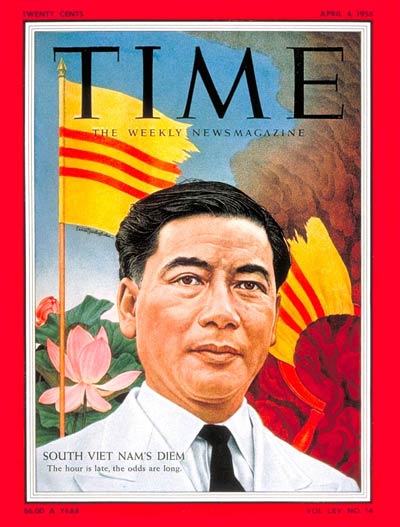
On this date in 1963, Ngo Dinh Diem, the first president of South Vietnam, was executed in the back of an armored personnel carrier along with his younger brother and secret police chief, Ngo Dinh Nhu, the day after their government had been overthrown in a military coup.
Born into the Buddhist country’s Catholic elite, Diem was brought up as a French colonial administrator but fled Vietnam in 1950 under a death sentence from Ho Chi Minh’s nascent Vietminh. Over several years living and lecturing in the United States, he established his anti-communist bona fides with influential conservatives and was returned to his native country as Prime Minister when the U.S. inherited the foundering French war against nationalist guerrillas.
Fearing communist victory at the polls, Diem blocked scheduled 1956 elections to unify North and South Vietnam, making an interim division permanent. But Diem made an inconsistent American client, often spurning Washington’s advice and alienating the Buddhist majority with heavy-handed authoritarianism that eventually prompted Buddhist monks to begin public self-immolation as a form of protest.
The government responded by arresting monks.
By now more a liability than an asset, Diem was ousted with the blessing of a fellow Catholic head of state, John F. Kennedy.
This first successful coup — Diem had already quashed attempted putsches in 1960 and 1962 — began a cycle of internecine revolts in which weak South Vietnamese governments were toppled in rapid succession … leaving Saigon ever more visibly the puppet of Washington, and dragging the United States ever more deeply into the Vietnam War.
On Halloween in 1589, the “Werewolf of Bedburg” was put to a horrible death for a supposed slew of crimes committed in lupine form in the environs of the German city of Cologne.
Our knowledge of the strange case of Peter Stubbe comes primarily from a single surviving account, and with many of the potential supplementary sources lost to the ravages of time and war, interpretations are inevitably speculative.
Stubbe reportedly confessed under (or facing) torture to having practiced witchcraft and claimed to have received a magic belt from the infernal powers enabling him to transform into a wolf. The doomed man owned, during the quarter-century riot of sin that ensued this youthful acquisition, to rape, murder, cannibalism, incest, filicide, slaughtering livestock and keeping a succubus in his bed. (Authorities were unable to recover this potent belt, and sighed that Satan must have reclaimed it.)
For these crimes, he was broken on the wheel, beheaded, then burnt — the latter punishment shared with his daughter and his mistress, apparently implicated as accessories.
Was there a real wolf terrorizing the vicinity? Was Stubbe an actual murderer with a supernatural cover story? Was he nursing a genuine delusion of lycanthropy? Did he back the wrong faith as strife over Protestantism rent Germany? Or was he just unluckily caught up in an instance of demonic hysteria?
Whatever the individual circumstances of Stubbe’s death might have been, it occurred during a surge of panic over the venerable superstition of were-beasts and shapeshifters (particularly pronounced in France) coeval with Europe’s crises of religious and political authority on the eve of the Thirty Years’ War.
Yet this troubled period bore the germ of a modernity whose pervasive social changes would upend, among other things, the idea of a real werewolf. As the sixteenth century closed, both medical and theological understandings of “werewolfism” increasingly located it in the realm of the psychological instead of the supernatural.
Within a few years of Stubbe’s torture, werewolves had left the hands of magistrates for those of doctors … bound eventually for the pens of screenwriters with Halloween fare in mind.