On this date in 1905, Fou Tchou-Li suffered the last execution by lingchi in Beijing, for the murder of a Mongolian prince.
Lingchi, or slow slicing, involved the public dismemberment of the victim. As such, it became iconic to westerners as an image of exotic Chinese cruelty — albeit iconic in a mythicized form, the accounts conflicting, undependable, Orientalist. (Many different ones are collected at the Wikipedia page.)
Lingchi is especially notable — apart from fathering the phrase “death by a thousand cuts” in the English lexicology — for its overlap with the era of photography.
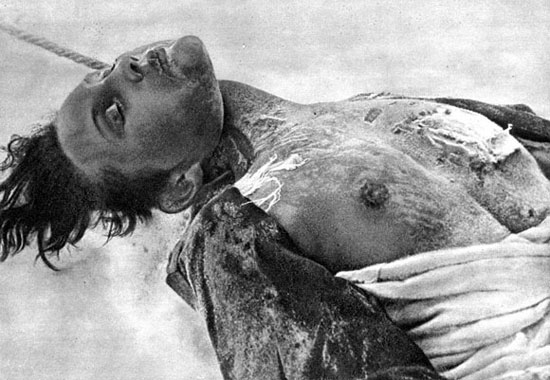
Fou Tchou-Li’s death was captured on film, and the images famously captivated Georges Bataille for the expression of seeming ecstasy on the face of the dying (or dead) man.
Bataille was said to meditate daily upon the image below in particular — “I never stopped being obsessed by this image of pain, at the same time ecstatic and intolerable.”
Agony and ecstasy? A sequence of images, strong stuff in spite of their low quality, describing Fou Tchou-Li’s execution can be viewed here. Notice, however, that it’s not the one pictured here — the scholar who maintains this page claims the man’s identity became confused by western interlocutors. The different, unnamed man who as “Fou Tchou-Li” riveted Bataille is pictured here.
In Regarding the Pain of Others, Susan Sontag explained the mystical nexus of pleasure and pain Fou Tchou-Li’s torture suggested to the French theorist, aptly comparing it to graphic but pre-photographic exaltations of torture in the western artistic tradition, such as Saint Sebastian:
To contemplate this image, according to Bataille, is both a mortification of the feelings and a liberation of tabooed erotic knowledge — a complex response that many people must find hard to credit. … Bataille is not saying that he takes pleasure in the sight of this excruciation. But he is saying that he can imagine extreme suffering as a kind of transfiguration. It is a view of suffering, of the pain of others, that is rooted in religious thinking, which links pain to sacrifice, sacrifice to exaltation — a view that could not be more alien to a modern sensibility.
It’s no idle point to say that all this reads quite a lot into a single frame that may not be all that representative of the moment, though that wouldn’t necessarily diminish Bataille’s gist. More, these are western interpretations of — projections upon — an image marked as fundamentally outside in a tableau irresistibly blending the colonizer and the colonized.
Taiwanese video artist Chen Chieh-jen interpreted the photography that so captivated Bataille, and its colonial context, in Lingchi: Echoes of a Historical Photograph (review).
Two weeks after this date, China abolished the punishment for good.
On this date in 1757, Robert-Francois Damiens became the last Frenchman to suffer the dreadful punishment of drawing and quartering.
Damiens attempted to assassinate King Louis XV, inflicting, however, only a slight dagger wound.
He may be best-known today as the subject of the jarring opening passage of Foucault’s Discipline and Punish, in which the full flower of this medieval torture* is described in detail by way of contrasting it with the regimented penal institutions that would sprout up in a few decades’ time. Here’s Foucault’s rendering of the scene:
On 1 March 1757 Damiens the regicide was condemned “to make the amende honorable before the main door of the Church of Paris”, where he was to be “taken and conveyed in a cart, wearing nothing but a shirt, holding a torch of burning wax weighing two pounds”; then, “in the said cart, to the Place de Grève, where, on a scaffold that will be erected there, the flesh will be torn from his breasts, arms, thighs and claves with red-hot pincers, his right hand, holding the knife with which he committed the said parricide, burnt with sulphur, and, on those places where the flesh will be torn away, poured molten lead, boiling oil, burning resin, wax and sulphur melted together and then his body drawn and quartered by four horses and his limbs and body consumed by fire, reduced to ashes and his ashes thrown to the winds” (Pièces originales…, 372-4).
“Finally, he was quartered,” recounts the Gazette d’Amsterdam of 1 April 1757. “This last operation was very long, because the horses used were not accustomed to drawing; consequently, instead of four, six were needed; and when that did not suffice, they were forced, in order to cut off the wretch’s thighs, to sever the sinews and hack at the joints…
“It is said that, though he was always a great swearer, no blashemy escaped his lips; but the excessive pain made him utter horrible cries, and he often repeated: ‘My God, have pity on me! Jesus, help me!’ The spectators were all edified by the solicitude of the parish priest of St Paul’s who despite his great age did not spare himself in offering consolation to the patient.”
Bouton, an officer of the watch, left us his account: “The sulphur was lit, but the flame was so poor that only the top skin of the hand was burnt, and that only slightly. Then the executioner, his sleeves rolled up, took the steel pincers, which had been especially made for the occasion, and which were about a foot and a half long, and pulled first at the calf of the right leg, then at the thigh, and from there at the two fleshy parts of the right arm; then at the breasts. Though a strong, sturdy fellow, this executioner found it so difficult to tear away the pieces of flesh that he set about the same spot two or three times, twisting the pincers as he did so, and what he took away formed at each part a wound about the size of a six-pound crown piece.
“After these tearings with the pincers, Damiens, who cried out profusely, though without swearing, raised his head and looked at himself; the same executioner dipped an iron spoon in the pot containing the boiling potion, which he poured liberally over each wound. Then the ropes that were to be harnessed to the horses were attached with cords to the patient’s body; the horses were then harnessed and placed alongside the arms and legs, one at each limb.
“Monsieur Le Breton, the clerk of the court, went up to the patient several times and asked him if he had anything to say. He said he had not; at each torment, he cried out, as the damned in hell are supposed to cry out, ‘Pardon, my God! Pardon, my Lord.’ Despite all this pain, he raised his head from time to time and looked at himself boldly. The cords had been tied so tightly by the men who pulled the ends that they caused him indescribable pain. Monsieur le [sic] Breton went up to him again and asked him if he had anything to say; he said no. Several confessors went up to him and spoke to him at length; he willingly kissed the crucifix that was held out to him; he opened his lips and repeated: ‘Pardon, Lord.’
“The horses tugged hard, each pulling straight on a limb, each horse held by an executioner. After a quarter of an hour, the same ceremony was repeated and finally, after several attempts, the direction of the horses had to be changed, thus: those at the arms were made to pull towards the head, those at the thighs towards the arms, which broke the arms at the joints. This was repeated several times without success. He raised his head and looked at himself. Two more horses had to be added to those harnessed to the thighs, which made six horses in all. Without success.
“Finally, the executioner, Samson, said to Monsieur Le Breton that there was no way or hope of succeeding, and told him to ask their Lordships if they wished him to have the prisoner cut into pieces. Monsieur Le Breton, who had come down from the town, ordered that renewed efforts be made, and this was done; but the horses gave up and one of those harnessed to the thighs fell to the ground. The confessors returned and spoke to him again. He said to them (I heard him): ‘Kiss me, gentlemen.’ The parish priest of St Paul’s did not dare to, so Monsieur de Marsilly slipped under the rope holding the left arm and kissed him on the forehead. The executioners gathered round and Damiens told them not to swear, to carry out their task and that he did not think ill of them; he begged them to pray to God for him, and asked the parish priest of St Paul’s to pray for him at the first mass.
“After two or three attempts, the executioner Samson and he who had used the pincers each drew out a knife from his pocket and cut the body at the thighs instead of severing the legs at the joints; the four horses gave a tug and carried off the two thighs after them, namely, that of the right side first, the other following; then the same was done to the arms, the shoulders, the arm-pits and the four limbs; the flesh had to be cut almost to the bone, the horses pulling hard carried off the right arm first and the other afterwards.
“When the four limbs had been pulled away, the confessors came to speak to him; but his executioner told them that he was dead, though the truth was that I saw the man move, his lower jaw moving from side to side as if he were talking. One of the executioners even said shortly afterwards that when they had lifted the trunk to throw it on the stake, he was still alive. The four limbs were untied from the ropes and thrown on the stake set up in the enclosure in line with the scaffold, then the trunk and the rest were covered with logs and faggots, and fire was put to the straw mixed with this wood.
“…In accordance with the decree, the whole was reduced to ashes. The last piece to be found in the embers was still burning at half-past ten in the evening. The pieces of flesh and the trunk had taken about four hours to burn. The officers of whom I was one, as also was my son, and a detachment of archers remained in the square until nearly eleven o’clock.
“There were those who made something of the fact that a dog had lain the day before on the grass where the fire had been, had been chased away several times, and had always returned. But it is not difficult to understand that an animal found this place warmer than elsewhere” (quoted in Zevaes, 201-14).
Among the throngs in attendance that day was Casanova who, according to his memoirs, rented out a windowed flat to watch that stomach-churning torture for four hours with some male friends and female companions.
One of the legendary libertine’s friends found this moment, serenaded by the prisoner’s “piercing shrieks”, opportune for an altogether different adventure of the flesh:
The three ladies packing themselves together as tightly as possible took up their positions at the window, leaning forward on their elbows, so as to prevent us seeing from behind. The window had two steps to it, and they stood on the second; and in order to see we had to stand on the same step, for if we had stood on the first we should not have been able to see over their heads. I have my reasons for giving these minutiae, as otherwise the reader would have some difficulty in guessing at the details which I am obliged to pass over in silence.
…
Tiretta kept the pious aunt curiously engaged during the whole time of the execution, and this, perhaps, was what prevented the virtuous lady from moving or even turning her head round.
Finding himself behind her, he had taken the precaution to lift up her dress to avoid treading on it. That, no doubt, was according to the rule; but soon after, on giving an involuntary glance in their direction, I found that Tiretta had carried his precautions rather far, and, not wishing to interrupt my friend or to make the lady feel awkward, I turned my head and stood in such a way that my sweetheart could see nothing of what was going on; this put the good lady at her ease. For two hours after I heard a continuous rustling, and relishing the joke I kept quiet the whole time. I admired Tiretta’s hearty appetite still more than his courage, but what pleased me most was the touching resignation with which the pious aunt bore it all.
Casanova’s Complete Memoires are available free online; this episode is recounted in the first chapter of “Paris and Holland”.
* Damiens’ punishment was in fact already archaic at the point when it was inflicted. Somewhat unsure of itself, the court sought precedent in the last regicide executed — Francois Ravaillac, who in 1610 was also the most recent person to suffer this horrific penalty. The clumsiness of the Damiens’ execution can surely be attributed to the art being a century and a half out of practice.
On this date in 2005, at an outdoor trial near Yuson, North Korea, Han Bok-nam was sentenced to death for trafficking across the nearby Chinese border and immediately executed by firing squad.
Hard information on death sentences from the opaque People’s Republic is notoriously rare on the ground. This day’s execution, and two in a nearby location the previous day, became known thanks to an illicit video smuggled out of the country in the following weeks — a gutsy operation that might well have exposed its perpetrators to a death sentence of their own had they been detected.
The 12-minute film — showing bicycle-riding citizens summoned to attend the grisly spectacle for maximum salutary effect — made international headlines and proved at least a momentary embarrassment for Pyongyang. This three-minute excerpt of the events of March 2 has been made freely available with English narration.
On this date in 1838, in The Count of Monte Cristo, the title character witnesses two men brought to the scaffold for public execution in Rome.
In Alexandre Dumas‘ classic, the count is really Edmond Dantes, wrongly imprisoned years before, who has escaped and enriched himself with a discovered treasure, purchasing thereafter his ennoblement. This date’s execution occurs shortly after Dantes has surfaced publicly as the count. He witnesses it with two young friends — goading one of the reluctant youths by remarking, “when you travel, it is to see everything. Think what a figure you will make when you are asked, ‘How do they execute at Rome?’ and you reply, ‘I do not know’!” — and the naked brutality with which the Count greets a scene horrifying to his more genteel companions prefigures the pitiless revenge he will soon visit on his onetime persecutors.
The scene is laid on the first day of Carnival — the concealed identities among the crowd and the tension between its celebratory state of mind and the public butchery played out before it both serving the novel’s themes.
The prisoners are: a murderer, executed by the unique (and error-prone) Roman method of mazzolatura, in which the prisoner is incapacitated with a blow from a mallet before being finished off with a knife; and, a young man wrongly condemned to the guillotine for banditry, who will be reprieved thanks to the protagonist’s intervention further to the latter’s designs of vengeance.
It was the first time Franz had ever seen a guillotine, — we say guillotine, because the Roman mandaia is formed on almost the same model as the French instrument. The knife, which is shaped like a crescent, that cuts with the convex side, falls from a less height, and that is all the difference. Two men, seated on the movable plank on which the victim is laid, were eating their breakfasts, while waiting for the criminal. Their repast consisted apparently of bread and sausages. One of them lifted the plank, took out a flask of wine, drank some, and then passed it to his companion. These two men were the executioner’s assistants. At this sight Franz felt the perspiration start forth upon his brow. The prisoners, transported the previous evening from the Carcere Nuovo to the little church of Santa Maria del Popolo, had passed the night, each accompanied by two priests, in a chapel closed by a grating, before which were two sentinels, who were relieved at intervals. A double line of carbineers, placed on each side of the door of the church, reached to the scaffold, and formed a circle around it, leaving a path about ten feet wide, and around the guillotine a space of nearly a hundred feet. All the rest of the square was paved with heads. Many women held their infants on their shoulders, and thus the children had the best view. The Monte Pincio seemed a vast amphitheatre filled with spectators; the balconies of the two churches at the corner of the Via del Babuino and the Via di Ripetta were crammed; the steps even seemed a parti-colored sea, that was impelled towards the portico; every niche in the wall held its living statue. What the count said was true — the most curious spectacle in life is that of death. And yet, instead of the silence and the solemnity demanded by the occasion, laughter and jests arose from the crowd. It was evident that the execution was, in the eyes of the people, only the commencement of the Carnival. Suddenly the tumult ceased, as if by magic, and the doors of the church opened. A brotherhood of penitents, clothed from head to foot in robes of gray sackcloth, with holes for the eyes, and holding in their hands lighted tapers, appeared first; the chief marched at the head. Behind the penitents came a man of vast stature and proportions. He was naked, with the exception of cloth drawers at the left side of which hung a large knife in a sheath, and he bore on his right shoulder a heavy iron sledge-hammer. This man was the executioner. He had, moreover, sandals bound on his feet by cords. Behind the executioner came, in the order in which they were to die, first Peppino and then Andrea. Each was accompanied by two priests. Neither had his eyes bandaged. Peppino walked with a firm step, doubtless aware of what awaited him. [i.e., a pardon] Andrea was supported by two priests. Each of them, from time to time, kissed the crucifix a confessor held out to them. At this sight alone Franz felt his legs tremble under him. He looked at Albert — he was as white as his shirt, and mechanically cast away his cigar, although he had not half smoked it. The count alone seemed unmoved — nay, more, a slight color seemed striving to rise in his pale cheeks. His nostrils dilated like those of a wild beast that scents its prey, and his lips, half opened, disclosed his white teeth, small and sharp like those of a jackal. And yet his features wore an expression of smiling tenderness, such as Franz had never before witnessed in them; his black eyes especially were full of kindness and pity. However, the two culprits advanced, and as they approached their faces became visible. Peppino was a handsome young man of four or five and twenty, bronzed by the sun; he carried his head erect, and seemed on the watch to see on which side his liberator would appear. Andrea was short and fat; his visage, marked with brutal cruelty, did not indicate age; he might be thirty. In prison he had suffered his beard to grow; his head fell on his shoulder, his legs bent beneath him, and his movements were apparently automatic and unconscious.
“I thought,” said Franz to the count, “that you told me there would be but one execution.”
“I told you true,” replied he coldly.
“And yet here are two culprits.”
“Yes; but only one of these two is about to die; the other has many years to live.”
“If the pardon is to come, there is no time to lose.”
“And see, here it is,” said the count. At the moment when Peppino reached the foot of the mandaia, a priest arrived in some haste, forced his way through the soldiers, and, advancing to the chief of the brotherhood, gave him a folded paper. The piercing eye of Peppino had noticed all. The chief took the paper, unfolded it, and, raising his hand, “Heaven be praised, and his holiness also,” said he in a loud voice; “here is a pardon for one of the prisoners!”
“A pardon!” cried the people with one voice — “a pardon!” At this cry Andrea raised his head. “Pardon for whom?” cried he.
Peppino remained breathless. “A pardon for Peppino, called Rocca Priori,” said the principal friar. And he passed the paper to the officer commanding the carbineers, who read and returned it to him.
“For Peppino!” cried Andrea, who seemed roused from the torpor in which he had been plunged. “Why for him and not for me? We ought to die together. I was promised he should die with me. You have no right to put me to death alone. I will not die alone — I will not!” And he broke from the priests struggling and raving like a wild beast, and striving desperately to break the cords that bound his hands. The executioner made a sign, and his two assistants leaped from the scaffold and seized him. “What is going on?” asked Franz of the count; for, as all the talk was in the Roman dialect, he had not perfectly understood it. “Do you not see?” returned the count, “that this human creature who is about to die is furious that his fellow-sufferer does not perish with him? and, were he able, he would rather tear him to pieces with his teeth and nails than let him enjoy the life he himself is about to be deprived of. Oh, man, man — race of crocodiles,” cried the count, extending his clinched hands towards the crowd, “how well do I recognize you there, and that at all times you are worthy of yourselves!” Meanwhile Andrea and the two executioners were struggling on the ground, and he kept exclaiming, “He ought to die! — he shall die! — I will not die alone!”
“Look, look,” cried the count, seizing the young men’s hands — “look, for on my soul it is curious. Here is a man who had resigned himself to his fate, who was going to the scaffold to die — like a coward, it is true, but he was about to die without resistance. Do you know what gave him strength? — do you know what consoled him? It was, that another partook of his punishment — that another partook of his anguish — that another was to die before him. Lead two sheep to the butcher’s, two oxen to the slaughterhouse, and make one of them understand that his companion will not die; the sheep will bleat for pleasure, the ox will bellow with joy. But man — man, whom God created in his own image — man, upon whom God has laid his first, his sole commandment, to love his neighbor — man, to whom God has given a voice to express his thoughts — what is his first cry when he hears his fellow-man is saved? A blasphemy. Honor to man, this masterpiece of nature, this king of the creation!” And the count burst into a laugh; a terrible laugh, that showed he must have suffered horribly to be able thus to laugh. However, the struggle still continued, and it was dreadful to witness. The people all took part against Andrea, and twenty thousand voices cried, “Put him to death! put him to death!” Franz sprang back, but the count seized his arm, and held him before the window. “What are you doing?” said he. “Do you pity him? If you heard the cry of `Mad dog!’ you would take your gun — you would unhesitatingly shoot the poor beast, who, after all, was only guilty of having been bitten by another dog. And yet you pity a man who, without being bitten by one of his race, has yet murdered his benefactor; and who, now unable to kill any one, because his hands are bound, wishes to see his companion in captivity perish. No, no — look, look!”
The command was needless. Franz was fascinated by the horrible spectacle. The two assistants had borne Andrea to the scaffold, and there, in spite of his struggles, his bites, and his cries, had forced him to his knees. During this time the executioner* had raised his mace, and signed to them to get out of the way; the criminal strove to rise, but, ere he had time, the mace fell on his left temple. A dull and heavy sound was heard, and the man dropped like an ox on his face, and then turned over on his back. The executioner let fall his mace, drew his knife, and with one stroke opened his throat, and mounting on his stomach, stamped violently on it with his feet. At every stroke a jet of blood sprang from the wound.
This time Franz could contain himself no longer, but sank, half fainting, into a seat. Albert, with his eyes closed, was standing grasping the window-curtains. The count was erect and triumphant, like the Avenging Angel!
The Count of Monte Cristo is available free at Project Gutenberg. This day’s scene occurs in chapter 35. (An announcement in chapter 34 establishes the date.)
* The executioner plays no part in the novel, but presumably it would be the prolific Mastro Titta.
On this date in 1944, Benito Mussolini had his son-in-law, the politician Galeazzo Ciano, shot for treason outside the gates of Verona along with four other fascists who had abandoned Mussolini.
A glamorous playboy in public life, Ciano was the scion of a wealthy fascist founder. The youth wed Mussolini’s eldest daughter in 1930 and quickly ascended the party’s ranks, becoming Foreign Minister at the tender age of 33.
Ciano’s treachery, and that of the others seated in chairs and shot from behind on this day, was to have voted with the majority of the Fascist Grand Council for deposing Mussolini as Allied attacks thrust Italy into a desperate position. This confused affair lacked the character of a coup d’etat, but Mussolini was indeed placed under arrest the next day and a separate peace concluded with the Allies in early September.
Ciano’s capture by this body set in motion a final personal drama with implications for later students of the Second World War. Edda Ciano escaped to Switzerland with her husband’s diaries — potentially damaging notes on the machinations of the Axis.
These scribblings she took hostage for the life of her husband. The blackmail was not accepted — to the grief of Edda, who never spoke to her father again.
One final quixotic rescue attempt cooked up by a female SS administrator on Ciano’s guard detail — the last of many women drawn to this charismatic man — foundered; the preordained death sentence came down on January 10th, and the men were shot the next morning.* Mussolini reportedly fretted in the small hours of the night over whether his standing in Hitler’s eyes would suffer should he intervene.
Edda had the diaries published as she threatened, and if they exposed scant novel evidence against his German and Italian compatriots, they offer a window upon diplomatic intrigue and personal relationships within the Pact of Steel.
The last entries were written from prison just three weeks before his execution, and (allowing that by that time the author had reason to lay blame for policy missteps explicitly at Mussolini’s door) the protracted effort they describe to steer the impulsive Duce towards some sane foreign policy — something that might have spared Italy the devastation of war and maintained a fascist government, as Spain managed to do — reads almost farcically in retrospect. Italy could make little material contribution to the war, and probably had as much to fear from Hitler in victory as from the Allies in defeat … but at every turn, Hitler’s inspiring star pulled the Italian dictator away from realpolitik and towards romantic catastrophe.
As the invasion of Poland approached, for instance, Ciano watched Mussolini vacillate on whether to cast his lot irrevocably with Hitler.
The Duce’s reactions are varied. At first he agrees with me [not to commit to war]. Then he says that honor compels him to march with Germany. Finally, he states that he wants his part of the booty in Croatia and Dalmatia.
Like World War II’s every nook and cranny, the Italian experience bestrode by Ciano has received eager literary coverage.
Edda and Galeazzo Ciano’s son Fabrizio also wrote a personal memoir entitled Quando il nonno fece fucilare papa (“When Grandpa had Daddy Shot”).
* Four of the five were only wounded by the initial volley, and the fifth was missed altogether; all were dispatched with a coup de grace.
On this date in 1989, 71-year-old dictator Nicolae Ceausescu and his wife Elena were condemned by a secret military tribunal and immediately shot in Targoviste as Communism in Romania suddenly, stunningly collapsed.
The last of the Revolutions of 1989 that toppled Communism through much of Eastern Europe in a matter of weeks left the indelible image of the man who had dominated Romanian politics since the mid-60’s bewildered as a party-summoned mass rally at Bucharest’s Revolution Square turned against him.
It was to be Ceausescu’s last public address. Within a day, the country had slipped from his control; before week’s end, he would face a firing squad with “The Internationale” on his lips at the conclusion of a drumhead trial.
In a confused political situation — the police who intercepted Ceausescu and his wife held them for several hours, attempting to divine which way the winds were blowing before handing them over to the mutinous army — Romanian state television would soon broadcast footage of the trial and the first couple’s corpses (though not the execution itself).
Caution: This video contains graphic footage
Immediately afterwards, Romania abolished the death penalty. Nicolae and Elena Ceausescu remain the last people executed in that country.
On this date in 1559, Protestant parliamentarian Anne du Bourg was publicly strung up and burned for his uncompromising defense of Calvinism.
All France burned, figuratively, with the Protestant Reformation — and literally, with Henri II‘s ruthless reaction against it. But that flame tempered and honed the Huguenots’ steel.
With the dissolute crowned head before him to attend a seating of Parlement considering the matter of the heretics’ suppression, Anne du Bourg delivered himself of a rebuke of “more courage than prudence” (Batiffol and Bodley):
While men are conducted to the stake for the sole crime of praying for their prince, a shameful license encourages and multiplies blasphemies, perjuries, debaucheries, and adulteries. (Martyn)
Incensed, the king had du Bourg and others of the “moderate” party arrested in Parlement and drug to the dungeon. And though his compatriots were satisfied to recant what imperiled them, du Bourg remained obdurate and even provocative, smuggling a pamphlet against the monarch out of prison.
Henri would not make good his vow to see du Bourg burnt, having been slain by a freak jousting accident. But it little availed du Bourg inasmuch as Henri’s untimely demise put the Catholic faction even more firmly in the saddle. The agitation of Protestants for du Bourg’s release went for naught, and the sharp-tongued minister of state had occasion to speak to posterity from the scaffold. “My friends, I am not here as a thief or a martyr, but for the evangelium.”
“His one speech did more harm to the Catholic Church than a hundred ministers could have done.”
-Eyewitness Florimond de Roemond, quoted in The Cambridge Modern History
The religious conflict that made an end of du Bourg soon exploded into civil war. Many more, like du Bourg, would find their triumph in death — until, after three bloody decades, a Protestant prince accepted triumph in apostasy by deciding that “Paris is worth a Mass.”
Forty-five years ago today, two men linked by nothing but fate stood back to back on the gallows of Toronto’s Don Jail and became the last hanged in Canada.
The doomed men were far from Canada’s greatest criminals. The 29-year-old Turpin was a small-time thief who shot a policeman while fleeing a restaurant robbery; the 54-year-old Lucas was convicted of killing an FBI informant despite lingering questions over his guilt and his mental impairment. Both were petty criminals with little previous violence to their history, seemingly almost too small for the historical role that even on the night of their hanging they seemed probable to play.
The Last to Die is the first book about Canada’s last execution, and has been met with generalacclaim. CourtTV Canada recently profiled the story:
Executed Today: Why you, why now, why this book? What brought you to it?
Robert Horshowsky: I’ve worked as a freelance writer for almost 20 years now, and in that time, some stories were assigned to me, while others were the product of my own imagination. This book, like many before it, got its start as an article.
In 2001, I was in the library at Maclean’s magazine, where I worked as a Researcher-Reporter. They have a large section on Canadian history, and I saw a book by John Robert Colombo, who is very well known for his works on history and trivia. I believe the book was 1001 Questions About Canada. Picking up Colombo’s paperback, the first page I turned to asked, “When was the last execution in Canada?” The brief paragraph mentioned Ronald Turpin, a Canadian criminal, and Arthur Lucas, a Black man from Detroit. Both men were hanged on Dec. 11, 1962. Since it was a book of trivia, there wasn’t much more information than that, which got me thinking, “I wonder if I can pitch a story on the 40th anniversary for the December 2002 issue of Maclean’s?” Although it is a weekly news magazine, Maclean’s often ran articles on subjects of historic note, and the story I submitted on Turpin and Lucas was very well-received by the editors.
The one thing I have been accused of my entire working life is over-researching a subject, and the piece entitled “The Last Night of the Condemned” was no exception. My editor at the time said, “You’re not writing a book” in regard to the amount of research I had conducted, and I took this, perhaps subconsciously, as a challenge.
I was hooked by the stories of Turpin and Lucas for a number of reasons. There had never been a book about them, a fact that still boggles my mind. The end of the death penalty in different countries is a subject that is widely covered. The last two men to hang in England, for example, were Peter Anthony Allen and Gwynne Owen Evans. They were executed in 1964, and a book was published about them a year later. Turpin and Lucas were hanged in 1962, and my book was published in 2007, 45 years after the fact. Of course, there were newspaper and articles about them, a chapter here and there, or a mention in a law textbook, but not much else, certainly not a book. Through my research I soon discovered that others had attempted plays and documentaries about the two, with little success. This made me wonder if the subject was cursed, which is certainly how I felt sometimes.
ET: What effect did writing the book have on you?
The book took a toll on me physically and mentally. Research at times was slow and painful, and obtaining documents – especially from the Canadian government – was a tedious and frustrating process. In Canada, we have something called the Freedom of Information and Access to Privacy Act, which I used over and over again to obtain jail records, court documents and the like on Turpin and Lucas. In the United States, I used the Freedom of Information Law to access documents on Arthur Lucas; since he was an American from Detroit, I figured there would be rap sheets and the like on him, which there were. All these documents were very useful, but getting hold of them was a real challenge, since you have to prove the person you’re inquiring about is dead, that no other persons will be incriminated or named in the documents, etc.
The hardest thing for me to deal with was the cancer that took my mother’s life in March of this year. Her last wish was that I finish this book, and I struggled against two deadlines: the publisher’s, and my mother’s. As soon as I finished a chapter, I gave it to mom to read, followed by the next. Completing the book was a bittersweet experience: although she read the entire thing, mom didn’t live long enough to see it published, passing away six weeks before it was printed. In hindsight, I’m shocked I didn’t fall to pieces. The most difficult section for me to write was the funeral of Frederick Nash, the policeman shot to death by Turpin. I wrote this after interviewing his widow, and three of his four daughters – the eldest was 11, and one of them, Karen, was only two months old when he died. That was tough, the mental image of these little kids holding flowers outside the church, not quite realizing that their father was never coming home again. That was one of the reasons I wanted to write an entire chapter about those people left behind, like officer Nash’s children, the Salvation Army chaplain who was with Turpin and Lucas when they died, and many others involved in the cases. Far too often, true crime books focus almost entirely on the killers, and not enough on the families of the victims.
ET: Canada was trending towards abolition, and Lucas and Turpin knew themselves that they might be the last ones hanged. Was it just happenstance, or was there some intentionality in pushing these cases in particular? What was the fallout in Canada?
RH: In the early 1960s, there was a push in many countries to eliminate capital punishment, and Canada was no exception. As early as 1914, a Canadian Member of Parliament named Robert Bickerdike introduced a private members’ bill for the abolition of the death penalty. Although it was defeated, there were other members’ bills over the years. In 1935, a woman named Thomasina Sarao was unintentionally decapitated during her hanging in Montreal, which led to more and more executions in Canada taking place behind closed doors. Sarao’s beheading didn’t directly lead to the end of capital punishment, but the idea of a woman dying in such a gruesome fashion certainly didn’t help the pro-death penalty camp!
Ronald Turpin
By the 1950s, more changes were made to Canada’s Criminal Code, limiting the reasons a person could be executed. By 1961, changes were made which divided murder into a capital and a non-capital crime. One of the reasons you would die was for the murder of a police officer, a crime committed by Roland Turpin when he shot Fred Nash in February of 1962. There was always the possibility that even though you were found guilty of murder, the jury could recommend mercy, sparing your life. This didn’t happen in either Turpin or Lucas’s case.
Prior to the executions of Turpin and Lucas, there were a number of appeals for both men. The Salvation Army chaplain who was spiritual advisor to both men, Cyril Everitt, even appealed to the Prime Minister at the Time, John Diefenbaker. Law professors tried to fight the hangings, with no effect.
There was no doubt Ronald Turpin killed the police officer. I believe he suffered from some sort of mania or persecution complex. This certainly wouldn’t absolve him of shooting and killing a cop, but there is no doubt – to me at least – that Turpin was mentally unstable.
Arthur Lucas
As for Arthur Lucas, there was a lot of evidence against him, and all of it was circumstantial. Chaplain Everitt wasn’t to save both men body and soul, and he believed with all his heart that Arthur Lucas was innocent.
There wasn’t so much fallout after the hangings as there was serious doubt. Doubt about the guilt of either man, especially Lucas, who was convicted entirely on circumstantial evidence. Doubt about the competency of their legal representation, which was conducted by a brilliant but alcoholic lawyer named Ross MacKay, who acted for both Turpin and Lucas. Imagine it: MacKay was just 29 years old and inexperienced. Turpin and Lucas were his first and last capital cases, and he had no budget, compared to the estimated $40,000 spent by the government to prosecute Lucas alone. On top of that, Mackay had less than three weeks between the trial of Arthur Lucas, and the trial of Ronald Turpin. There is evidence that MacKay showed up to court hung over on some days. And the majority of the newspapers were against Turpin – who had a lengthy criminal record for break-ins and the like – and Lucas, who was slow (his IQ was just 63, borderline retarded), and happened to look like a killer. Read More
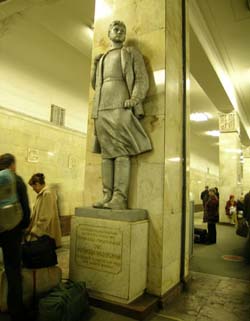
Known simply as “Tanya”, the nom de guerre which was the only information she volunteered during two days of torture, the power of the press offered her apotheosis into a propaganda coup for the Kremlin, and a symbol of courage that would long outlive Stalin. Before the public execution, the Nazis paused to photograph the scene; Kosmodemyanskaya availed the lull to harangue the Germans — “you can’t hang all 190 million of us!” — and call on the Russian villagers present to resist occupation.
Her bayoneted, mutilated body hung on the gibbet until the Red Army recaptured the village; witnesses related the tale of her dying heroism to a newsman.
It was only after the story of “Tanya” hit the press in January 1942 that her identity was established … and then promulgated widely. Anonymous and obscure in death, Zoya Kosmodemyanskaya would inspire millions and become the heroic emblem of otherwomen partisans.
Soviet propaganda poster unabashedly modeled on the already-iconic image of Zoya Kosmodemyanskaya’s abused corpse.


 “Finally, the executioner, Samson, said to Monsieur Le Breton that there was no way or hope of succeeding, and told him to ask their Lordships if they wished him to have the prisoner cut into pieces. Monsieur Le Breton, who had come down from the town, ordered that renewed efforts be made, and this was done; but the horses gave up and one of those harnessed to the thighs fell to the ground. The confessors returned and spoke to him again. He said to them (I heard him): ‘Kiss me, gentlemen.’ The parish priest of St Paul’s did not dare to, so Monsieur de Marsilly slipped under the rope holding the left arm and kissed him on the forehead. The executioners gathered round and Damiens told them not to swear, to carry out their task and that he did not think ill of them; he begged them to pray to God for him, and asked the parish priest of St Paul’s to pray for him at the first mass.