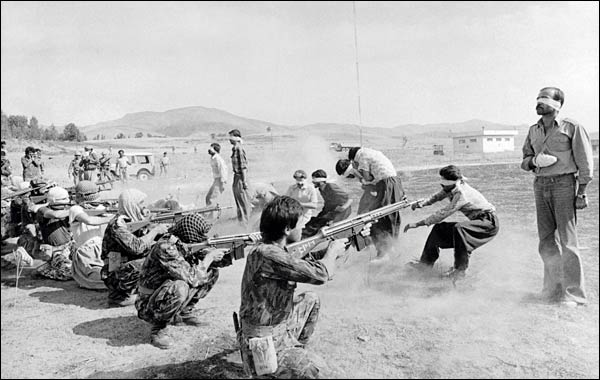
On this date in 1979, the only anonymous photograph to win a Pulitzer Prize captured nine Kurdish rebels and two of the Shah’s policemen executed by firing squad in revolutionary Iran.
This shot, one of a series taken of the event with the permission of the judge who condemned the men to immediate death in a half-hour trial at the Sanandaj airfield, ran the next day in the Iranian paper Ettela’at, whose editor prudently kept the photographer’s identity secret. Within two days, the stunning photo had rocketed around the world.
It won the Pulitzer Prize for Spot News Photography the following spring, still credited anonymously.
Two years ago, the Wall Street Journalrevealed — with the photographer’s permission — the identity of the man who shot this indelible image: Jahangir Razmi, who had gone on to a career as one of Iran’s top photographic journalists. He came to New York to collect the prize 27 years late.
On this date in 1305, Scottish knight Mel Gibson — er, William Wallace — was hanged, drawn and quartered at Smithfield for treason to a British crown he refused to recognize.
Among the lesser (but more pertinent here): that they weren’t — you knew this already — offering the former Guardian of Scotland the opportunity to reduce his suffering with a public submission, or use the stage for theatrical defiance. Hanging, drawing and quartering was a brand new execution Edward I was experimenting with for emasculating, disemboweling, and (so the idea went) utterly cowing the rebellious hinterlands of the British Isles. Wallace may have been just the second person to suffer it.
But only a pointy-headed blogger could possibly care when the main point is that back before Christendom succumbed to nancy decadences like Vatican II, men wore woad, defenestratedqueers, and tapped top-shelf babes.
Among the few things known for certain about William Wallace is that he did not score with Isabella of France. Or with Sophie Marceau.
Mel’s bloodbath only riffs the already-fantastic 15th century epic of “the Wallace” by Scottish minstrel Blind Harry, which in turn got a lyrical call-out in Robert Burns’ 18th century Scottish patriotic tune Scots Wha Hae.
National martyrs — and, sure, it helps to die at the right time, as Wallace did just before Robert the Bruce secured Scottish independence — feed a train of hungry authors and ready audiences in every time, place and medium.
However genuinely flesh-and-blood the limbs that wrought his feats and were torn apart on this day, Wallace returns to his generations of interlocutors half-shrouded in mythology. Seven centuries on, his contested (and sometimes absurd) use as precedent or metaphor stakes a claim to his Truth at least as compelling as battlefield tactics at Stirling Bridge. What does he “really” have to tell us? No matter how grisly his end, William Wallace doesn’t get to decide: it’s between you, me, Mel, and a few billion other folks.
Only a character really worth remembering is worth that kind of fictionalizing.
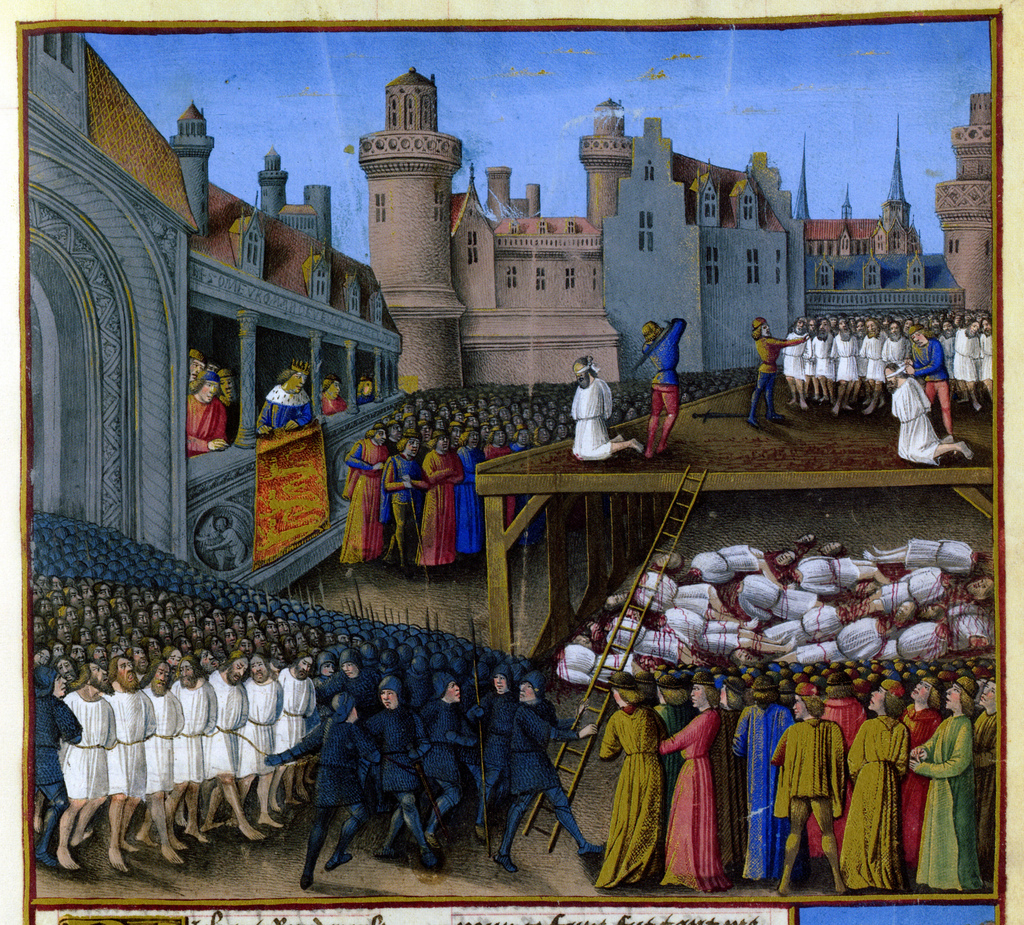
On this date in 1191, Richard the Lionheart had 2,700 Muslim prisoners of Acre demonstratively executed before his opposite number Saladin, when ransom arrangements dilated.
Courtesy of Project Gutenberg, here is Guizot on this ugly prod to action from the Third Crusade
From the 1st of August, 1191, to the 9th of October, 1192, King Richard remained alone in the East as chief of the crusade and defender of Christendom. He pertains, during that period, to the history of England, and no longer to that of France. We will, however, recall a few facts to show how fruitless, for the cause of Christendom in the East, was the prolongation of his stay and what strange deeds—at one time of savage barbarism, and at another of mad pride or fantastic knight-errantry—were united in him with noble instincts and the most heroic courage. On the 20th of August, 1191, five weeks after the surrender of St. Jean d’Acre, he found that Saladin was not fulfilling with sufficient promptitude the conditions of capitulation, and, to bring him up to time, he ordered the decapitation, before the walls of the place, of, according to some, twenty-five hundred, and, according to others, five thousand, Mussulman prisoners remaining in his hands.
The only effect of this massacre was, that during Richard’s first campaign after Philip’s departure for France, Saladin put to the sword all the Christians taken in battle or caught straggling, and ordered their bodies to be left without burial, as those of the garrison of St. Jean d’Acre had been. Some months afterwards Richard conceived the idea of putting an end to the struggle between Christendom and Islamry, which he was not succeeding in terminating by war, by a marriage. He had a sister, Joan of England, widow of William II., king of Sicily; and Saladin had a brother, Malek-Adhel, a valiant warrior, respected by the Christians. Richard had proposals made to Saladin to unite them in marriage and set them to reign together over the Christians and Mussulmans in the kingdom of Jerusalem. The only result of the negotiation was to give Saladin time for repairing the fortifications of Jerusalem, and to bring down upon King Richard and his sister, on the part of the Christian bishops, the fiercest threats of the fulminations of the Church. With the exception of this ridiculous incident, Richard’s life, during the whole course of this year, was nothing but a series of great or small battles, desperately contested, against Saladin. When Richard had obtained a success, he pursued it in a haughty, passionate spirit; when he suffered a check, he offered Saladin peace, but always on condition of surrendering Jerusalem to the Christians, and Saladin always answered, “Jerusalem never was yours, and we may not without sin give it up to you; for it is the place where the mysteries of our religion were accomplished, and the last one of my soldiers will perish before the Mussulmans renounce conquests made in the name of Mahomet.”
Good thing that Jerusalem issue has since been cleared up.
The BBC treated the scenario — complete with the resultant loss of the last chunk of the supposed True Cross — in a chunk of its 90-minute documentary on the Third Crusade:
On this date in 1890 the iconic symbol of the American death penalty made its grisly debut upon the person of William Kemmler at New York’s Auburn Prison.
The long New World tradition of hanging condemned prisoners came under fire as a barbarism in the late 19th century, leading reformers to look for killing procedures less likely to result in a horrendously protracted strangulation or a midair decapitation. As Empire State Governor David Hill put it,
The present mode of executing criminals by hanging has come down to us from the dark ages, and it may well be questioned whether the science of the present day cannot provide a means for taking the life of such as are condemned to die in a less barbarous manner.
On this stage, Executed Today presents a rogues’ gallery of homo Americanus, the salesmen and swindlers who would help the U.S.A. ride the lightning.
The Dentist
A true renaissance man, Buffalo dentist Dr. Alfred Southwick, applied his active mind to the need to better kill a fellow, and soon hit upon an inspiration — that is to say, a town drunk hit upon an electrical generator and died instantaneously, and the observant Southwick said “eureka!”
Without the subsequent industry of this neglected gentleman, who added to his repertoire scientifically-minded electrical butchery of animals alongside political gladhandings to bring a flutter to a busybody’s heart, the Chair’s entire oeuvre of machismo-sadism might have missed the country altogether. Just imagine living in a world where New York had pioneered its other leading reform alternative: lethal injection.
(This, incidentally, is why the chair is a chair, and not a bed or a stake or a St. Andrew’s Cross: because the guy who thought of it spent all day administering his own tender mercies to seated penitents.)
The Plutocrats
As Southwick nagged his senator and shocked stray cats into the great hereafter, the gears of commerce strove relentlessly ever-onward. The business of America was ever business, and never more so than the Gilded Age.
And the business of killing people was about to become the biggest business there was.
The age of electricity was buzzing into incandescence, and two rival standards were at currents amped over eventual dominance of this stupendous industry. Thomas Edison’s earlier Direct Current (DC) standard was being challenged by Nikolai Tesla’s Alternating Current (AC), backed by the financial muscle of George Westinghouse.
Cheaper and more efficient, AC tilted the playing field against Edison. Seeing his days numbered, the Wizard of Menlo Park fought back the way any dinosaur industry would: dirty.
This clip of the electric demise of a circus elephant — don’t hit “play” if you’re not up for animal cruelty — is from some years later (Edison kept tilting at windmills and megafauna carcasses as his DC empire disappeared), but it’ll give a sense of the horrifying spectacle.
With the New York legislature’s embrace of Southwick’s seated voltage people-eater, Edison turned his PR gears on the state, demanding they adopt his competitor’s “deadlier” current for the contraption. And they did, reflecting a widespread belief inculcated by Edison’s experiments — as this New York Times article on an Edison crony’s public livestock-killing show in the days leading up to the advent of the electrocution law indicates:
The experiments proved the alternating current to be the most deadly force known to science, and that less than half the pressure used in this city for electric lighting by this system is sufficient to cause instant death.
After Jan. 1 the alternating current will undoubtedly drive the hangmen out of business in this State.
Too bad for Edison that the business he was really trying to kill was made of sturdier stuff.
The Alcoholic Vegetable Merchant
As the 1880’s wane, we come at last to our subject — in several senses of the term — an illiterate nobody of German stock who chanced to kill his common-law wife with just the right timing to join in a new kind of experiment.
William Kemmler mounted a “cruel and unusual punishment” appeal against his sentence funded by Westinghouse himself: no dice. Perhaps appreciating the odd foothold on history he was about to attain, he showed little worry as he entered the execution room and sat himself — “undoubtedly the coolest man in the room,” a journalist present reported.
The End of the Beginning
That reporter’s description for the New York Herald graphically captures humanity’s first horrible encounter with this “humanitarian” machine, beginning with the prisoner’s parting remarks.*
Doubtless he knew that his words will go down in history and he had his lesson well learned. He addressed his audience [in] a commonplace way and without hesitation.
…
“Well, gentleman, I wish everyone good luck in this world, and I think I am going to a good place, and the papers have been sa[yi]ng a lot of stuff that isn’t so. That’s all I have to say.”
And so with a parting shot at what he was good enough to refer to not long ago as “those d—d reporters,” William Kemmler took his leave of earth. The quiet demeanor of the man as he entered had made a strong impression on those in the room. His self-possession after his oratorical effort simply amazed them. He got up out of his chair as though he were anxious to try the experiment, not as though he courted death, but as though he was thoroughly prepared for it. …
There was no delay. Kemmler constantly encouraged the workers at the straps with “Take your time; don’t be in a hurry; do it well; be sure everything is all right.” He did not speak with any nervous apprehension.
Warden Durston leaned over, drawing the buckle of the straps about the arm. “It won’t hurt you, Bill,” he said, “I’ll be with you all the time.”
A minute later Kemmler said, “There’s plenty of time.” He said it as calmly as the conductor of a streetcar might have encouraged a passenger not to hurry.
…
Kemmler was pinioned so close that he could hardly have moved a muscle except those of his mouth.
The Warden took a last look at the straps. “This is all right,” he said.
“All right,” said Dr. Spitzka, and then bent over and said, “God bless you, Kemmler.”
“Thank you,” said the little man, quietly.
“Ready?” Said the Warden.
“Ready,” answered the doctors.
“Goodbye,” said the Warden to Kemmler. There was no response.
GAVE THE SIGNAL.
The Warden stepped to the door leading into the next room. It was then forty-three and one-half minutes past six o’clock by the prison clock. “Everything is ready,” said the Warden to some one hidden from view in the next room.
The answer came like a flash in the sudden convulsion that went over the frame of the chair. If it seemed rigid before under the influence of the straps, [it] was doubly so now has it strained against them.
The seconds ticked off. Dr. McDonald, who was holding the stopwatch, said “Stop.”
Two voices near him echoed, “Stop.”
The Warden stepped to the door of the next room and repeated the word “Stop.”
As the syllable [passed] his lips the forehead of the man in the chair [grew] dark [in] color, while his nose, or so much of it as was exposed, appeared a dark red.
There was very little apparent relaxation of the body, however. [A] fly lighted on the nose and walked about unconcernedly. The witnesses drew nearer to the chair.
“He’s dead,” said Spitzka, authoritatively.
“Oh, yes, he’s dead,” said McDonald.
“You’ll notice,” said Spitzka, “the post-mortem appearance of the nose immediately. There is that remarkable change that cannot be mistaken for anything else, that remarkable appearance of the nose.”
The other doctors nodded [assent]. They looked at the body critically for a minute and then Spitzka said, [“]oh, undo that now. The body can be taken to the hospital.”
“Well, I can’t let you gentlemen out of here until I have your certificates,” said the Warden.
FOUND SIGNS OF LIFE.
It was while this businesslike conversation was going on that Dr. Balch made a discovery.
“McDonald,” he cried, “McDonald, look at that rupture,” he pointed at the abrasion of the skin on Kemmler’s right thumb. In the contraction of the muscles the figurehead[?] scraped against it and removed the skin, and from that little [wound] blood was flowing-[an] almost certain indication of life.
A low cry of horror went through the assemblage.
“[Turn] on the current,” excitedly cried Dr. Spitzka. “This man is not dead.”
The crowd fell back from the chair, as though they were in danger. The Warden sprang into the closed door and pounded on it with his hand.
“Start the current!” he cried. As he spoke of fluid began to drop from Kemmler’s mouth and to run down his beard; a groaning sound came from his lips, repeated and growing louder each time.
It seemed [an] age before the card was again turned on. In fact it was just seventy-three seconds from the end of the first contact when the first sound was heard to issue from Kemmler’s lips, and it was not more than a half [minute] before the card was again turned on.
RECOVERING CONSCIOUSNESS.
But every second to that time the horrible sound from those groaning lips was becoming more distinct, [a straining] of the chest against the leather harness stronger and more evident.
The man was coming to life. The spectators grew faint and sick. [Men] who had stood over dead and dying [men] and had cut [men] to pieces without an emotion [grew] pale and turned their heads away.
One witness was forced to lie down while one of the doctors fanned him.
But [the end] came at last. There was another convulsion of the body, and … it became rigid with the rigidity of iron.
“That man wasn’t dead,” cried Spitzka excitedly. As he spoke the body twitched again. The electrician had given the current gain new alternation and now 2,000 volts [were] playing in short, successive shocks down Kemmler spine. The sound ceased with the first convulsion, but the fluid continued to trip from the mouth and down the beard, making the body a sickening spectacle.
“Keep it on now until he’s killed,” said one of the doctors. …
“Keep it on! Keep it on!” Cried Warden Durston through the door.
Silence reigned for a moment. A bell without began to [toll] solemnly. …
BURNED BY THE CURRENT.
Then from the chair came a sizzling sound, as of [meat] cooking on hand. Following it immediately a billow of smoke came from the body and filled the air of the room with the odor of burning hair.
There was a cry from all the members of the little group, and Warden Durston cried through the door leading to the next room to [turn] the current off.
More shocking — so to speak — papers ran the next day’s headline “Kemmler Westinghoused,” the verb “to Westinghouse” being another shameless Edisonian bid to stamp his marketing project onto the Queen’s English. This fine, rounded, archaic neologism the right sports anchor could resuscitate as a fresh synonym for thrashing, horsewhipping, poleaxing, or else (in greater justice) for moderation and decency as the only principal in the sordid affair that rejected death-dealing by electricity.
(Officially, Edison also opposed the death penalty. Like Dr. Guillotin, he was doing his part for humanity in the meantime … just with a little skin in the game. Did we mention the business of America is business?)
Official reviews for the “art of killing by electricity” were, ahem, mixed.
“They could have done better with an axe.”**
-George Westinghouse
“Strong men fainted and fell like logs on the floor.”
-New York Herald
“Revolting … a disgrace to civilization.”
-New York Times
“We live in a higher civilization from this day on.”
-Alfred Southwick
Books (remarkably numerous!) about the creation of the electric chair
It should, in fairness, be noted that the U.S. was not the only country (pdf) to mull an electrocution chair in the 19th century … but it was (and for a long time remained) the only one to actually use one.
* The Herald excerpt, along with several other articles from the same paper about the Kemmler execution, is here, but the text has obviously been generated from a scan with uneven results. As I do not have access to the originals, [bracketed] remarks in the excerpt indicate this author’s own interpretations or interpolations of seemingly mistaken transcriptions.
** Some sources make it “would have done better with an axe.”
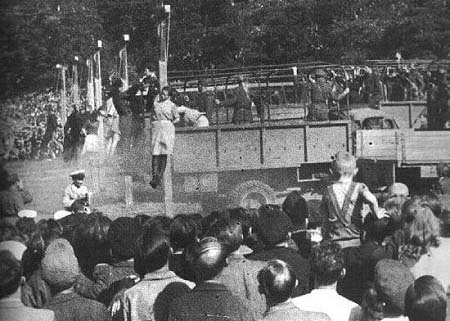
On this date in 1946, officials of Soviet-occupied Poland publicly hanged eleven convicted war criminals of the Stutthof concentration camp.
Set up immediately upon Germany’s September 1, 1939 invasion of Poland and not liberated until after official German capitulation in 1945, Stutthoff handled over 100,000 prisoners during its long service.
This day’s condemned — camp commandant Johann Pauls, five male kapos, and five female guards — were the product of the first of four Stutthof trials held in 1946-1947. At a hill in Gdansk known as Biskupia Gorka (Bishop Hill), upon a specially-erected row of four T-shaped double gallows centered around a pi-shaped triple gallows, and before a crowd of thousands, the doomed eleven were noosed on the back of military trucks which then drove away to leave them strangling to death with a “short drop” hanging.
The following gut-twisting images are among a number to be found here.
Above: on one end of the gallows row, the truck has just pulled away from Jenny Wanda Barkmann — a modish Hamburg lass in her mid-20’s known to Stutthof prisoners as “the Beautiful Specter” for her cruelty. Down the row, one can see that some of the prisoners are already swinging, while others have not yet been dropped.
Upon hearing her sentence, Jenny Barkmann retorted, “Life is indeed a pleasure, and pleasures are usually short.” (More about Barkmann, including trial photos, here.) In this closer view of her, just as in the first photo, she is still alive and struggling. Next to her, Ewa Paradies, another guard, is prepared for the same fate.
The central triple gallows. Commandant Johann Pauls hangs in the middle with Gerda Steinhoff — one of the senior female guards — in the foreground. The line of five male kapos recedes behind them into the enormous crowd of onlookers.
On this date in 1864, the Union army in the American Civil War hanged a black deserter outside Petersburg, Va., for — in the delicate words of the army dispatch — “an attempt to outrage the person of a young lady at the New-Kent Court-house.”
The Union army was just taking up position for the coming monthslong siege of the Confederate capital, Richmond. Johnson, who confessed to deserting another unit, offered savvy blue commanders a win-hearts-and-minds opportunity: a public reassurance that the Old Dominion’s dim view of Negro outrages upon young ladies would be honored by its soon-to-be occupiers.
Not bad in theory. The execution left something to be desired.
The field of public relations being very much in its infancy, the upshot of this salutary demonstration seems not to have been conveyed to its target audience; so, when a defending Confederate battery caught sight of the gallows being thrown up in brazen view of its own lines, it jumped to the not-unreasonable conclusion that the Yanks were about to make an example of a southern spy. Rebel guns promptly made the Union detachment their “target audience.” An artillery shot struck one Sgt. Maj. G. F. Polley (or Polly) and “tore him all to pieces” before
[a] flag of truce was sent out to inform the enemy that a negro was to be hung who had insulted a white woman the day before; they stopped firing. We then marched back and saw the negro hung.
The return on investment for the souls of Johnson and the misfortunate NCO was altogether unsatisfactory:
The incident was cleverly turned to advantage by the Confederates, who had been losing hundreds of Negro laborers by desertion. The Rebels marched Negroes past the spot, pointing out to them the perils of fleeing their lines, saying that the Yankees hanged all ‘Contrabands.’ For weeks nocturnal escapes of Negroes ceased on that front. (Source)
It wasn’t a total loss, however. The Library of Congress ended up with some striking archival photos.
(There’s a better touch-up of this last photograph of Johnson’s body being cut down here.)
On this date in 1997, an Exalted Cyclops of the Ku Klux Klan went to Alabama’s “Yellow Mama” for lynching a black teenager.
Henry Francis Hays, son of a top Klan officer in Alabama, had vented dissatisfaction with a jury’s failure to convict a black defendant for a white policeman’s murder by grabbing and stringing up a random black, 19-year-old Michael Donald.
Hays and his 17-year-old accomplice skated for more than two years because Mobile’s finest figured a publicly hanged black man probably had it coming from some drug deal.* Only through the victim’s mother’s persistence — she got Jesse Jackson involved, which helped involve the FBI — did the real murderers feel the heat.
Before long, the Klan would wish it had stayed out of the kitchen.
After Hays’ conviction, Michael Donald’s mother brought a civil action against the United Klans of America with the help of the Southern Poverty Law Center. The $7 million liability verdict she won financially destroyed the United Klans — perpetrators of some of the 1960s’ most infamous anti-civil rights terror — and Donald was awarded its national headquarters building in Tuscaloosa, Ala.
This novel keys on the Michael Donald lynching as part of a (fictional) Mobile teen’s coming of age.
Hays wasn’t through making the sort of history he’d rather not have made.
When his turn in the electric chair finally came in 1997, he became the first white in Alabama put to death for an offense against a black in 84 years.**
Seemingly less cocksure in answering for his crime than he had been in committing it, Hays had always maintained his innocence. A few days before walking his last mile, he finally confessed to the Mobile chapter head of the NAACP.
* Michael Donald was not, in fact, involved in drugs.
** There haven’t been any other executions for white-on-black crime since Henry Hays, a span of 11 more years and 22 more executions as of this writing. (via the Death Penalty Information Center’s Execution Database)
Lynching is such a vile word. Likely taken from the name of Captain William Lynch of Virginia (circa 1780), the term for administering justice while dispensing with a trial had, by 1916, long since taken on its more common meaning of a white-on-black public killing.
But Jesse Washington‘s case defies this simple definition, straddling the line between state execution and an unrestrained populace. Washington’s brutal lynching at the hands of a white mob in Waco, Texas, on May 15, 1916, clearly fits the definition, and the particularly grisly details of his demise conjure all-too-familiar images of violent racism in the pre-Civil Rights South; but in another more disturbing way, Washington was effectively executed, his punishment carried out not by the state of Texas, but by the people themselves.
Jesse Washington’s charred corpse after the lynching.
Washington was born in 1899, a black farmhand who may or may not have been mentally retarded.* While his life is not well-documented, his death most certainly is. Washington was arrested on May 8 of that year for the rape and murder of Lucy Fryer, the 53-year old wife of a well-to-do cotton farmer. Fryer was found bludgeoned to death. Washington was spared for a week by the Waco sheriff, who successfully took him into custody before a pre-trial mob got their hands on him; Washington was then sent to Dallas for holding to prevent a local incident. To appease the mob, he was transferred back to Waco and tried for the crime just one week later.
It’s unclear whether Washington was guilty — evidence is scant and the trial lasted just one hour, but Washington appears to have had ample opportunity to perpetrate the act and is purported to have confessed — but his guilt or innocence in the matter was not on the mob’s mind. On May 15, the well-attended trial ended, and in four minutes, the jury reached its guilty verdict. Before the 17-year old could be sentenced, and with little or no resistance offered by any of the various legal entities in the courthouse, several hundred of the onlookers (some brandishing weapons) rushed Washington and carried him out the doors. Outside, a larger crowd waited to beat and castrate him. A chain was thrown around Washington’s neck, and he was dragged to the town square, where he met an immense crowd as well as the pile of dry goods boxes that was to be his end.
A Fred Gildersleeve image of the lynching of Jesse Washington.
By some estimates, up to 15,000 (mostly white, though not exclusively white) people watched the horrible events unfold; without question, Waco’s mayor as well as several other public officials watched from their second-story perch at town hall on one side of the square. Washington was tossed onto the boxes and coal oil was poured over him. The other end of the chain was thrown over what has become known as the Hanging Tree, and the fuel below Washington’s feet was set ablaze. Immersed in the flames, he attempted to climb the blisteringly hot chain multiple times, each time to be lowered back into the cauldron. It’s unclear how long Washington was alive, but the event lasted more than an hour, after which his fingers and teeth were claimed as souvenirs, his body parts were separated from the torso, and the remains of Washington were dumped in a bag so they might be dragged once more through the Waco streets.
Also watching from the mayor’s position was a cameraman who wanted to sell photographs of Washington’s charred corpse as postcards. Fred Gildersleeve snapped a series of images which would briefly make Waco the most shamefully famous city in the nation. Gildersleeve’s work paints a portrait of a town possessed by spite and uncontrolled rage: thousands of white spectators standing about the burning body of Washington from above, then hundreds of blacks gathered around his burned and brutalized remains from ground level. Others took pictures as well,
some more disturbing than others.
A complete and startlingly brutal account of this murder is given by Patricia Bernstein in her 2005 book The First Waco Horror: The Lynching of Jesse Washington and the Rise of the NAACP, which also tracks the increased viability of the NAACP in the wake of the slaying. What makes this case noteworthy for this column, though, is that Washington was found guilty prior to his lynching, and he would doubtless have received a state-supported death sentence. At the time, Texas law would have allowed for a public hanging; presumably, the spectacle surrounding Washington’s execution would have been just as significant (though not nearly as gruesome). Instead, vigilante justice was administered on the young farmhand, and his case because a linchpin for the Civil Rights movement. As with other lynchings of the time, no persons were charged in the incident, though it was obvious that there was significant planning involved and, from some of the images, that some form of self-appointed executioner actively participated in the deed.
Unlike a state-sponsored execution, though, Washington’s death raised the ire of the jury foreman, who harshly criticized the court for not protecting him. And because he was lynched, his cause was also taken up by several Northern papers, pushed into the national spotlight by NAACP secretary Royal Freeman Nash and Elisabeth Freeman.** Over 90 years later, the town of Waco is still dealing with the Waco Horror. The lynching has reared its head multiple times as many residents have pushed for a plaque to be erected on the site of the lynching, as one was for a distressingly large number of prior lynchings in Waco. Some in the town continue to resist, asserting that Washington’s guilt absolved the mob of responsibility for its act.
A postcard commemorating the lynching; written on the back: “This is the barbecue we had last night. My picture is to the left with a cross over it. Your son, Joe [Myers].”
Washington’s case raises two of the critical issues in the modern death penalty debate: culpability of the executioner (and witnesses), and cruelty of punishment. Nobody in the mob was prosecuted for the crime, and in the Waco of that day, it would have been unusual if someone had; today, we take little interest in the state executioner but would vociferously condemn such mob action. On a similar note, Washington’s death was barbaric and brutal, and few would argue that such an execution should be undertaken through legal channels, but recent Supreme Court cases have found it difficult to identify the meaning of “cruel and unusual punishment”. The debate continues in the United States, but these are two arguments, posed by Cesare Beccaria, that caused Leopold II to outlaw capital punishment in the Grand Duchy of Tuscany in 1789, and cases like Washington’s suggest they should continue at the very least to give us pause today.
* Some accounts state simply that he was illiterate, and if this is the litmus test for mental retardation in the early 1900s, around 6 percent of the population fell into that category.
** Freeman worked tirelessly to drag information from Waco’s inhabitants, her actions likely sparking papers like the local Waco Times-Herald to quickly shut the door on the case; that paper officially apologized 90 years later for its and other newspapers’ roles in venerating the lynch mob.
On this date in 1945, Communist partisans shot Benito Mussolini and his mistress, Clara Petacci near Lake Como, along with fifteen or so additional fascist aides and officials.
It was an inglorious end for the flamboyant onetime socialist turned violent rightist, the man who had founded (and named) fascism; whose had inspired Hitler when the latter was still a streetcorner rabble-rouser, and then wandered suicidally into Germany’s orbit.
The next day, the victims’ bodies were hung up in Milan — the heart of Mussolini’s own power and still a stronghold of neo-fascist parties today — at Piazza Loreto for public abuse. The deposed Duce still had it in his power to stir the imagination of his Teutonic partner: news of the Italian dictator’s fate made it to the Fuhrer’s bunker and was said to have steeled Hitler’s resolve to take his own life with the dread vision of what should befall him if he were taken alive.
On this date in 1792, Joaquim José da Silva Xavier — better known to Brazilian history as Tiradentes — was hanged in Rio de Janeiro and his body quartered for public exposition.
Pedro Americo’s 1893 Tiradentes Esquartejado delivers what it promises.
Tiradentes — “tooth-puller,” a scornful nickname its owner has made glorious, alluding to the span of his itinerant career spent in dentistry — had participated in a conspiracy to detach the province of Minas Gerais from the Portuguese empire.
The Inconfidência Mineira featured the unpromising combination of a large number (the conspiracy was betrayed from within) of middle-class intellectuals (Tiradentes was of an unusually low social strata) without a common programme or a practical notion of what to do once they had seized power. That the Portuguese monarch felt at liberty to commute every other death sentence seems a measure of the plotters’ — if one may put it this way — toothlessness.
Tiradentes was obstinate in maintaining responsibility for the plot, although he wasn’t the leader in particular; for his resulting pains on the scaffold, he traded dentistry for immortality. Now officially recognized as a hero of Brazil, his name adorns the square where he was dismembered and (like Zumbi dos Palmares) his execution date is a public holiday.
When the tides of national fervor made such a rehabilitation politic, the would-be free state of Minas Gerais likewise adopted the conspirators’ banner as its own flag: the motto reads “Liberty, although overdue”.