2005: Mohammed Bijeh, the desert vampire

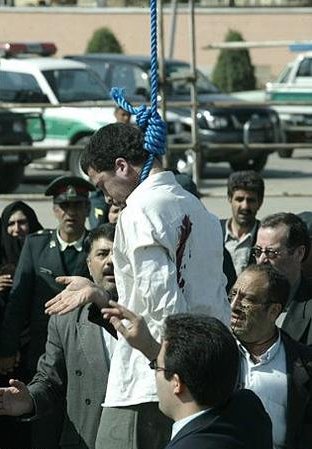
On this date in 2005, Iran “desert vampire” was flogged to the point of collapse and hanged before a bloodthirsty throng in Pakdasht.


Mohammed Bijeh collapses during his flogging (top); then, as he is hoisted by a crane — with what one would take to be the stab wound from a victim’s brother visible on his back. More frightful photos of this execution here.

Bijeh confessed to raping and murdering 16 boys age 8 to 15 over a yearlong spree.

His modus operandi? Lure them into the desert on the pretext of hunting animals.

Unsurprisingly a figure of intense public hatred, Bijeh stolidly endured his own death before a jeering mob.

Riot police held back the angry crowd, but at one point a brother of one of the victims managed to break through and stab Bijeh in the back.

After 100 lashes, the desert vampire was noosed to a crane arm by one of the victims’ mothers, and hoisted 10 meters into the air for public strangulation, to the cheers of onlookers who had to be restrained from savaging the body when it was finally brought down.

An accomplice, Ali Baghi, somehow avoided execution and got off with whipping and a prison term.

On this day..

1615: St. John Ogilvie

On this date in 1615, Scotland’s only post-Reformation Catholic martyr was hanged at Glasgow Cross.

The Protestant-born Ogilvie had been educated in Europe and there fallen under the sway of the Catholic faith forbidden in his homeland. He converted, trained as a Jesuit, and at his own request returned to minister to the secret Catholic population in Glasgow.

Within a year he was in irons, awaiting a death sentence he refused to spurn with a timely submission to King James‘ spiritual supremacy. Ogilvie greeted his conviction for treason — and like most Catholic martyrs in the British Isles, he protested his loyalty in vain — with the words,

God have mercie upon mee! … if there bee heere anie hidden catholikes, let them pray for me, but the Prayers of Heretickes I will not have.


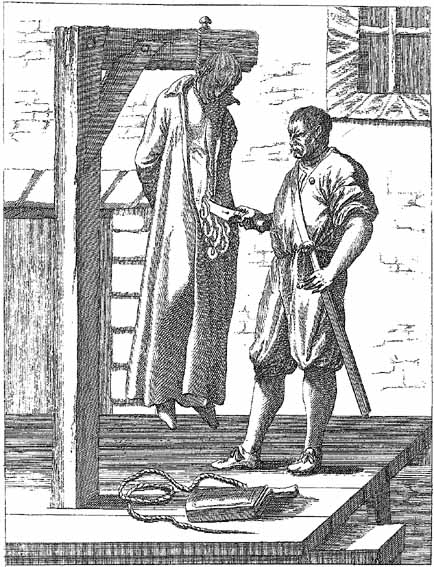
John Ogilvie? (See Update below)

There’s a multilingual Jesuit text celebrating Ogilvie available free from Google books.

Glaswegians can watch for more demonstrative tribute at St. Andrew’s Cathedral, which is poised to produce a monumental mural by Peter Howson.

Part of the Themed Set: The Church confronts its competition.


Update: Friend of the blog Louise Yeoman, whose guest post on a witchcraft execution remains one of the best pieces in this humble space, has an interesting correction to offer on Saint J.O. According to Yeoman, disemboweling “was not part of Scots law until 1708, when the British government wanted to hang draw and quarter some of those involved in the abortive Jacobite uprising of that year and were shocked to find that Scotland had no such penalty.” She’s backed by this contemporaneous account of Ogilvie’s death, which observes that even the “quartering” part of the sentence was not carried out.

So, what gives with the image, if Ogilvie’s corpse wasn’t carved up?

It’s from this (U.S.) Library of Congress page which marks it as a representation of Ogilvie in a late 17th-century text of Bohemian Jesuit propagandist Matthias Tanner. That provenance, of course, would be consistent with a bit of sanguinary exaggeration. It’s also possible that it’s mislabeled on the Library of Congress page, whose identification of it seems a bit oblique.

Working as I am from secondary sources, I tread cautiously here and welcome further clarification or correction.

On this day..

1944: Twenty-two or more Poles

The demonstrative public hanging this day in 1944 of Poles in the remains of the Warsaw Ghetto* was little more than an everyday atrocity in Nazi-occupied Poland — although, ten days after the gauleiter responsible for previous mass executions had himself been assassinated by the Polish Home Army, it presumably had an extra bit of meaning for the city’s denizens.

According to Gregor Dallas’s 1945: The War That Never Ended,

Nazi terror reached new heights for the non-Jewish population of Warsaw in the winter of 1943-4. People were seized at random in the streets and executed on the spot; between October and February some 270 to 300 men and women were publicly hanged or shot each week — the kind of atrocities the French commemorate in Tulle and Oradour were, in Warsaw, a part of daily life. ‘On my way to Leszno Church today,’ Julian Kulski, a young soldier of the Home Army, recorded on 11 February 1944, ‘I saw a crowd of people standing in front of the Wall. They were gazing at something above the Wall, on the Ghetto side of it. As I got closer, I could see for myself — hanged from the upper-storey balconies of what had been an apartment house were the bodies of twenty-two of our Freedom Fighters.’ Kulski, at any rate, took them for Freedom Fighters.


This blurry photo dated to the same day and location was taken from a moving tram.

This mass execution may also be one alluded to by Jewish resistance fighter Yizhak “Antek” Zuckerman,** who survived the war in Warsaw with false papers identifying him as a Pole. His A Surplus of Memory: Chronicle of the Warsaw Ghetto Uprising remembers such an execution occurring while they lived on Leszno Street after the ghetto’s destruction — and that it greatly upset his wife, Zivia Lubetkin, because Zuckerman was so late arriving home that day.

One day the Germans hanged fifty Poles on street lamps, something they often did. This time it was on Leszno Street, in retaliation for harassing Germans. In such a case, they would take fifty Poles from their “stock” in Pawiak, publish their names, add the crime for which they were being murdered, and hang them in the city on electric poles. In this case, they also strung people up on the outside walls of the ghetto, where there was still a wall, even though there was no longer a ghetto.

* Warsaw’s Jewish ghetto had been liquidated the previous spring; at this point, it was rubble behind the still-standing wall.

** Zuckerman also appeared as a witness in the Israeli trial of Adolf Eichmann.

On this day..

2006: A female spy by al Qaeda

On this date three years ago — or at least, so says the date in the camera’s viewfinder — a female spy was “tried” and “executed” in Iraq by al Qaeda affiliated terrorists for spying.

Warning: This is (by design) a graphic and chilling video. I have little information beyond the assertion of the video posters as to its veracity. Whether or not it may be relied upon factually or dated reliably, it’s a gut-twisting video of a woman being shot in the head.

[flv:http://www.nothingtoxic.com/mediar.php?552d90ab9f59a971705f6bf3300da297.flv 440 330]

A longer version is on a very not-safe-for-work site here.

On this day..

1870: Jean-Baptiste Troppmann, mass murderer

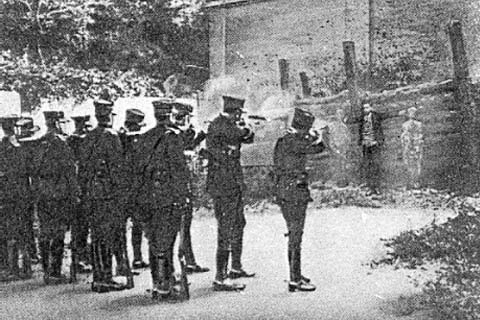
Outside Paris’s La Roquette prison this morning in 1870, mass murderer Jean-Baptiste Troppmann was guillotined for the sensational butchery of a family of eight.

Katherine Taylor’s In the Theater of Criminal Justice conceptualizes Troppmann‘s crime and trial as a test case for the evolving public performance of justice.

The Alsatian-born Troppmann, or Traupmann (French Wikipedia page | German) was apprehended trying to catch a ship for America shortly after a murdered woman and her five murdered children were discovered on the Plaine de Pantin on the outskirts of Paris.

The horrific state of the bodies (caution: link displays grisly post-mortem photos) produced a public sensation with the curious phenomenon of mass citizen pilgrimmages to the “field of cadavers” such that the Parisian police chief would later remember that “[i]t was necessary to close the entrance gate of the train station on the crowd that could no longer go in or out, that screamed from every direction in explosions of terror and rage: ‘Yet another victim of Pantin!'”

Troppmann had last been seen accompanying family father Jean Kinck on a business trip from which the latter was destined never to return … and it soon came to light that Jean Kinck had been the first of Troppmann’s victims, followed by the eldest son, interspersed with letters written to Kinck’s unwitting widow requesting bank transfers in the name of his deceased business partner.

As a judicial matter, this case was open and shut; Troppmann was convicted three months after his arrest, and went under the blade three weeks after that.

But the immense public fascination he generated would be a milestone in the development of the French tabloid press, which did brisk business* stoking the lucrative hysteria.

Small wonder such a staggering throng assembled for the dawn beheading — assembled even from the previous evening, to catch a glimpse of the grim apparatus being assembled for the next day’s play.

Among the multitude were various intellectual worthies, including the liberal Russian author Ivan Turgenev. His subsequent “Kazn’ Tropmana” (“The Execution of Troppmann” — the link is in Russian; I haven’t found a full English version), which includes meeting the remorseless prisoner and witnessing his pre-execution “toilette,” reflects the writer’s discomfiture with Madame Guillotine. Too appalled to watch the beheading, he turns away and narrates its sound.

a light knocking of wood on wood — that was the sound made by the top part of the yoke with the slit for the passage of the knife as it fell round the murderer’s head and kept it immobile … Then something suddenly descended with a hollow growl and stopped with an abrupt thud … Just as though a huge animal had retched … I felt dizzy. Everything swam before my eyes. … None of us, absolutely none looked like a person who realized that he had been present at the implementation of an act of social justice; each one tried mentally to turn aside and, as it were, throw off any responsibility for this murder

“I will not forget that horrible night,” Turgenev later wrote to a friend (pdf link), “in the course of which ‘I have supp’d full of horrors’ and acquired a definite loathing for capital punishment in general, and in particular for the way it is carried out in France.”

Most others present are presumed to have experienced the opposite sensation, as made plain in this more democratic English-language account freely available from Google books. Nevertheless, Troppmann enjoyed a literary afterlife with a poetic name-check in Maurice Rollinat’s Les Nevroses (French link; “Soliloque de Troppmann” is about 75% of the way down the page); and as noted in Richard Burton’s Blood in the City, death-obsessed Georges Bataille used the infamous surname for both a pen name and the name of a main character in two separate works more than half a century later. (Update: Victor Hugo got in on the act, too. See the comments.)

Although Troppmann’s name appears on some lists of serial killers, his eight homicides do not fit the term’s usual definition of a compulsive pattern of murders spread over time. Troppmann’s blood offerings were meant for no other idol but Mammon.

* According to Thomas Cragin’s Murder in Parisian Streets: Manufacturing Crime and Justice in the Popular Press, 1830-1900, the circulation of everyman broadsheet Le Petit Journal surged by 50% overnight after the discovery of Troppmann’s victims — “But just as cases such as this one could boost sales, their absence temporarily reduced circulation … [and] its publishers tried to ensure a steady supply [of murder stories].”

On this day..

1984: Alpha Otis O’Daniel Stephens: hear it live

On this date in 1984, Alpha Otis O’Daniel Stephens was electrocuted in Georgia for the execution-style murder of Roy Asbell after the latter surprised Stephens in the course of a burglary.

Stephens makes these pages for two reasons:

First, he survived his initial electrocution, requiring a second application of the lethal current — awful, though not exactly unheard-of.

Second, it emerged years later that the Georgia Department of Corrections was making audio recordings of its executions as a secret archive of the proceedings.

Several hours’ worth of these (subsequently leaked) recordings from various different Georgia electrocutions are available at SoundPortraits.org.*

We begin our trip back in time to Georgia’s execution chamber with the atmospheric sound of the warrant for his execution being read to the condemned and the witness — nicely juxtaposing the sentence of death with the body responsible for administering it: the Georgia Department of Offender Rehabilitation.

[audio:Alpha_Otis_O’Daniel_Stephens_warrant.mp3]

But the real action is the sound behind the curtain as prison officials realize the electrocution has not killed their man, wait agonizing minutes for the still-living body to cool enough for doctors to examine it officially, and begin the execution cycle anew. From the sound of it, they only barely killed him with the second pass: the officials are worrying openly that it looks like he’s still breathing very late in the procedure.

This file, obviously, comes with a content advisory sticker — though it lacks any directly identifiable hideous sound from the chair, or the prisoner, or the witnesses, the routine narrative of a prison bureaucrat as a man dies dreadfully in the next room is an altogether different order of horror.

[audio:Alpha_Otis_O’Daniel_Stephens_botched_execution.mp3]

This audio file was helpfully clipped by Dysfunctional Playground from the Pacifica radio Democracy Now! broadcast which aired it; the clip is itself an abridged version of a 20-minute original with long silences and unintelligible content excised.

The transcript of the abridged clip as aired by Democracy Now! follows below. Willis Marable, the main speaker on the tapes, was an assistant warden.


UNIDENTIFIED: Carry out the execution by the order of the court. There’s no reason to delay.

UNIDENTIFIED: Very well. On my count of three, press your buttons. One, two, three.

WILLIS MARABLE: The execution now has begun. There was one small jerk from the condemned at the time the execution was initiated. He is sitting very still now, and we are also now into the second phase of the execution. We are now into the third phase of the execution. No movement from the condemned. No activity, no movement from the witnesses. He appears to be relaxing a little bit more now. There’s sixty seconds remaining on the third phase of the execution. There is a slight movement from the condemned’s head. He seems to be moving his head from side to side slightly.

UNIDENTIFIED: I show the time is 12:19.

WILLIS MARABLE: Commissioner, he is still moving his head, and he seems to have slumped down in a relaxing-type position in the chair. But his head is moving from side to side slightly. Commissioner, Mr. Low, the execution is completed at this time. The electrical panel box is secured and locked. I do not detect any movement from the condemned at this time. He seems to have stopped moving his head and also his arms.

UNIDENTIFIED: I show the time is 12:20.

UNIDENTIFIED: You are in the lapse time countdown, is that correct?

WILLIS MARABLE: Yes, sir. We’re into the first minute of the lapse time now. No movement from any of the witnesses, and at this time no movement from the condemned. We have now completed one minute of lapsed time, four minutes remaining. Two minutes of lapsed time completed at this time, three minutes remaining. Still very little movement from any of the witnesses, and I detect no movement from the condemned at this time.

UNIDENTIFIED: I show the time is 12:22.

WILLIS MARABLE: Commissioner?

COMMISSIONER: Yes?

WILLIS MARABLE: Mr. Low?

COLONEL LOW: Yes.

WILLIS MARABLE: There is some slight movement. He’s still moving his head slightly. The only thing we can do is continue until the physicians can check him after the lapse time has expired.

COLONEL LOW: Don’t vary from your checklist.

WILLIS MARABLE: OK, sir. OK, we have completed three minutes of lapsed time, two minutes remaining. Commissioner? Mr. Low?

COLONEL LOW: Yes.

WILLIS MARABLE: He is still moving his head slightly, kind of a bobbing up-and-down movement. Commissioner?

COMMISSIONER: Yes.

WILLIS MARABLE: Mr. Low? We have completed four minutes of lapsed time. We have one minute remaining. And from my vantage point I do detect or it seems to be that he is breathing. Commissioner? Mr. Low? We have completed the five minutes lapsed time. Stand by for the physicians’ check. Commissioner?

COMMISSIONER: Yes?

WILLIS MARABLE: It appears the doctors agree with me that he’s still breathing. You want us to check him and then go through it again, or just go ahead and go through it again?

COMMISSIONER: Check him, and then go through it again. Definitely check him. Don’t vary from the checklist.

WILLIS MARABLE: Alright.

COMMISSIONER: Have them check him.

WILLIS MARABLE: OK. [inaudible] We’re going to do it again?

UNIDENTIFIED: It doesn’t say so.

WILLIS MARABLE: OK.

UNIDENTIFIED: It remains on.

WILLIS MARABLE: OK.

UNIDENTIFIED: The time is 12:26 and thirty seconds.

WILLIS MARABLE: Commissioner?

COMMISSIONER: Yes.

WILLIS MARABLE: The doctors have verified that he is still alive.

COMMISSIONER: Repeat the execution.

WILLIS MARABLE: Very well. You ready to go again?

COMMISSIONER: Better check all the connections. Val?

VAL: Yes, sir.

COMMISSIONER: Did you tell the witnesses that you’re repeating?

VAL: No, I didn’t.

COMMISSIONER: I think you should tell them.

VAL: OK. You want me to just advise them that—

COMMISSIONER: Just advise them—

VAL:—repeating the process and not go into any detail?

COMMISSIONER: That’s right.

VAL: OK.

WILLIS MARABLE: Commissioner? The superintendent is entering the execution chamber and approaching the mic at this time to advise the witnesses that we will proceed again with the execution.

COMMISSIONER: Well, listen, you can’t tell them—tell them there were some vital signs remaining, so the execution will repeat. See if you can get that message to them.

WILLIS MARABLE: It’s too late now. He’s already briefed them, and he’s on the way back in, sir.

COMMISSIONER: Fine, alright.

UNIDENTIFIED: I show the time is 12:28.

UNIDENTIFIED: OK, Commissioner, we’ll proceed at this time.

COMMISSIONER: Proceed.

UNIDENTIFIED: On my count of three, you press your button. One, two, three.

WILLIS MARABLE: Commissioner? Mr. Low? The execution is initiated again at this time. The condemned made one big jerk, and now he is relaxing in the chair. I do not detect any other movement from the condemned at this time. We have completed the first and second phase of the execution. We are now into the third phase. I do detect his head moving from side to side again. We’re still into the third phase of the execution. Commissioner? Mr. Low?

COMMISSIONER: Yes.

WILLIS MARABLE: He is still at this time moving his head from side to side and appears to be breathing. We’ll continue it just like we did previously.

UNIDENTIFIED: We’re going to have to check that [inaudible].

WILLIS MARABLE: We have fifteen seconds remaining on the third phase of the execution. Commissioner, Mr. Low, the third phase of the execution is completed. The equipment is switched off, secured at this time. We are now into the five-minutes lapse time.

COMMISSIONER: What is the status on the condemned?

WILLIS MARABLE: Sir, he appears to be breathing to me.

COMMISSIONER: You’re going to have to have them check those sponges and check their connections or something. There’s something they don’t have connected right, Willis.

WILLIS MARABLE: Yes, sir. Do you want us to go ahead and complete this whole thing and then—

COMMISSIONER: Yeah, complete the phase, and then you’re going to have to make the check.

WILLIS MARABLE: OK, sir. Commissioner, Mr. Low, we have completed one minute of lapse time. We have four minutes remaining. I might also advise at this time that I do not detect any movement from him at this time. He appears to have stopped moving. Still no movement from any of the witnesses. They were just sitting very still, observing the condemned in the chair.

UNIDENTIFIED: I show the time at 12:32.

WILLIS MARABLE: We have now completed two minutes of phase time, lapse time. We have three minutes remaining. I might also add that I do not detect any movement from the condemned. Commissioner, Mr. Low, we have now completed three minutes lapse time. We have two minutes remaining. There is still no movement from the condemned. Commissioner, Mr. Low, we have completed four minutes of lapse time. We have one minute remaining. Still no detectable movement from the condemned. He does seem to have stopped moving entirely. Commissioner, Mr. Low, we have completed our five minutes lapse time. Stand by for the physicians’ check.

At this time, the superintendent and the two physicians are entering the execution chambers for their check. The first doctor is now in the process of making his check for vital signs.

UNIDENTIFIED: I show the time at 12:36. I show the time is 12:37.

WILLIS MARABLE: The second doctor is still in the process of conducting his check for vital signs. The superintendent is at this time, Commissioner, Mr. Low, is still in the process of briefing the witnesses that at 12:37 hours this date the condemned was pronounced dead. He has instructed all witnesses to depart the witness room. Back to the front of the institution. At this time, the curtains are drawn.

* Here’s another recorded Georgia execution we’ve featured.

On this day..

1927: Father Miguel Pro, “Viva Cristo Rey!”

On this date in 1927, the anti-clerical Mexican government made the emblematic martyr of the Cristero War.

This video is in Spanish, but the storyline is pretty easy to follow — young man finds faith, lives faith, dies faith.

Miguel Pro‘s dying cry, “Viva Cristo Rey!” — “Long live Christ the King!” — was a refrain of Cristeros, anti-government guerrillas who in the late 1920’s fought the revolutionary Mexican government’s attempts to forcibly restrict the power of the Catholic Church.

That conflict had been brewing for years, an outgrowth of Mexico’s own complex history of colonization and development — measures to restrict the church’s size, wealth, and social reach had been mooted and sometimes implemented well back to the middle of the 19th century.

Early in the 20th, the confrontation was merely a twist on its classic form: liberal state-builders and the Catholic hierarchy were (or increasingly saw themselves as) diametrically opposed in their vision for Mexico.

That conflict came to a head under president Plutarco Elias Calles, an irreligious northerner with a project of national capital development for whom the church’s intransigence from its agrarian strongholds was most unwelcome … and who seemed to delight in provoking Rome with sport like mandatory physicals for priests, not neglecting to publicize the incidence of venereal disease thereby revealed.

Liberals had already brought about drastically reduced clerical privileges in the Mexican Constitution of 1917; its somewhat draconian measures were neither fully enforced nor fully resisted, but initiated a period where the two hostile institutions rudely grappled for their respective spheres of influence on the ground.

Calles was the rudest grappler of all, and his 1926 Calles Law pushed for anti-clericalism stricter than the letter of the constitution … and sparked armed resistance.

It was an exceptionally dirty war with routine summary executions on both sides and thousands of Catholic refugees — a dangerous environment for any priest with legal sanctions against basically every practice of the vocation. (Photos of Cristeros, some in heroic resistance and others in grisly martyrdom, can be eyeballed here.)

Pro, a Jesuit who like many was forced underground, was under state surveillance and got picked up in the aftermath of an assassination attempt against a prominent politician. He was chosen to make an example of — without an actual trial, possibly because there’s no actual reason to think he was involved in the bombing.

Looking at these pictures of Pro’s last moments, it’s hard to believe that they were taken and circulated at government direction to cow the Cristero movement. Fail.


Led out to execution in a police courtyard. The place of his death today is (bizarrely) Calle Loteria Nacional.


Calmly at prayer before his death, under the eye of the firing squad commander.


Pro himself refused a blindfold. But why state authorities carrying out the execution with an eye towards public relations would allow him to die in this pose is anyone’s guess.


He blessed and forgave the firing squad, of course.


Just beginning to topple at the moment the bullets struck him.


Like many firing squad executions, this one failed to kill its victim with the ceremonial volley. Pro was finished off with a coup de grace.

Calles was simultaneously — the key measures were also enacted in 1926 — involved in a confrontation with the United States over oil rights, a situation that came to the brink of war, with Washington saber-rattling about “Soviet Mexico”. It’s tempting to wonder whether the two situations weren’t related, especially since the new American ambassador* who had arrived only the month before Pro’s execution would ultimately negotiate both situations’ resolutions.

While the natural resource politics went their separate way, the Mexican Revolution’s anti-clerical strain didn’t so much disappear by negotiation as fade away over decades, with regular new outbreaks.

One thinks of Mexico today as such so staunch a Catholic country that it’s hard to imagine that some of these provisions were only officially repealed in 1998.

As for Pro, he’s welcome in Mexico by now — celebrated by Pope John Paul II who ultimately beatified him, and the inspirational source of this hymn whose refrain is his famous last cry.

There’s a faithful site in his honor here, and apparently a shrine to him in Houston, Texas run by a group pushing for his canonization.

* The American ambassador in question, Dwight Morrow, invited Charles Lindbergh on a goodwill tour to Mexico, where the aviator would meet the diplomat’s daughter not long after Miguel Pro’s martyrdom. Little could Lindbergh and Anne Morrow suspect that their love match would set them on the path to their own famous encounter with capital punishment.

On this day..

1942: Partisans by the Sonderbataillon Dirlewanger

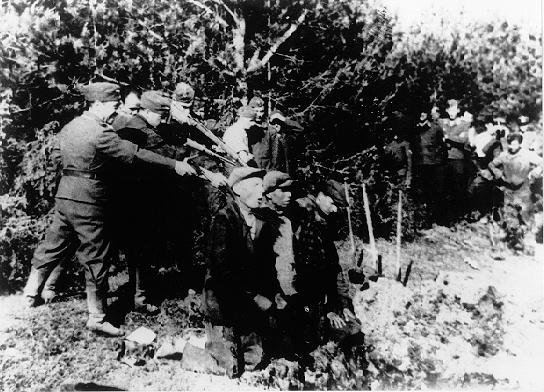
On an uncertain date in November 1942, this photograph of an SS unit executing anti-Nazi partisans in Belarus was taken.

Behind this striking but all too typical image of brutal field executions on the eastern front lies the sordid story of one of the strangest military formations in the Nazi service.

The Dirlewanger brigade was formed under a man whose fortuitous early enrollment in the NSDAP had enabled him to pull strings to get himself out of Dachau, where he had been sent after his second molestation conviction, and where unfolding events could have easily seen him on the other end of the firing squad.

Instead, Oskar Dirlewanger formed a unit of criminals and reprobates: poachers at first, and eventually, as it grew into the SS-Sonderbatallion Dirlewanger, men culled from the camps or soldiers condemned by the army, some literally trading the likelihood of execution themselves for service under one of the most disreputable commanders in the field.

Oh, and, just incidentally — it stuck them into a lawless environment where they could probably practice and refine their pathologies unchecked. Some “rehabilitation.”

As of this relatively early date, the convict floodgates weren’t yet entirely open, and the existing German volunteers were supplemented by a goodly portion of Soviet citizens recruited in the occupied territories. From 1942 to 1944, they hung around Belarus hunting guerrillas and doing to them — well, you know. (The original notion of using poachers was to exploit their ranger-like woodsman talents for anti-partisan warfare.)

Oh, and civilians. Tens of thousands of civilians. That almost goes without saying.

Sadly for Dr. Dirlewanger, events further south were undoing all his bloody work, for it was also in the November 1942 that the Red Army decisively turned the tide of the war with its counterattack at Stalingrad — in fact, it was this very date in 1942 that it completed its encirclement, stranding a quarter-million freezing Wehrmacht regulars on the banks of the Volga, only a handful ever to see Germany again.

The Dirlewanger brigade would have its own turn being minced by the Soviet war machine, though not before it had a notorious hand in drowning the Warsaw Uprising in blood.

Dirlewanger himself was tortured to death by Polish guards a few weeks after the war ended.

Part of the Themed Set: The “Ex” Stands For “Extrajudicial”.

On this day..

1911: Several revolutionaries on Double Ten Day

On the tenth day of the tenth month — Double Ten Day, as it has since been remembered in China and the Chinese diaspora — the quick execution of a few revolutionaries signaled the surprising end of China’s 2,000-year-old imperial government.

Actually, the collapse of imperial rule wasn’t such a surprise: China’s last dynasty had foundered in the face of the 19th century challenges of European colonialism; driven by multitudinous grievances, popular revolts and reform movements had buffeted China in recent years, most seriously the turn-of-the-century Boxer Rebellion.

The Qing Dynasty was a tinderbox. But one never knows what spark will set the flame.

On October 9, 1911, revolutionaries in the central China town of Wuchang — today merged with neighboring towns into the city of Wuhan — lit the fuse literally when a bomb they were building for a planned insurrection accidentally went off.

In the ensuing scramble, police raided the joint and found incriminating lists of thousands of revolutionary recruits. Arrests followed fast, and several (three*) of the arrested were summarily put to death on the morning of the tenth.

But the plot’s apparent misfortune actually turned out to be its spur to victory.
Realizing that their identities were exposed to the authorities, and that they were in danger of immediate execution, the revolutionaries … revolted.

Their military forces mounted a successful municipal coup d’etat.

While the central government dilated, insurrectionary Wuchang appealed to the provinces for solidarity, and within weeks the Wuchang Uprising had blossomed into full-fledged revolution: the Xinhai Revolution, to be exact. By the following February, China’s last child-emperor had been forced to abdicate.

For the first time in millennia, the fallen dynasty was not succeeded by another dynasty. Though the new state was itself heir to the myriad contradictions and weaknesses that dogged the Qing, it was a definitive turning point: China became Asia’s first democratic republic, the polity that today is Taiwan.

* The names Peng Chufan, Liu Yaocheng and Yang Hongsheng are proposed in this history.

Update: This excellent History Today article for the Double Ten centennial also specifies three executions, and even includes this outstanding public domain image from the Francis Stafford collection.

On this day..

1946: Amon Göth, Schindler’s List villain

On this date in 1946, Plaszow concentration camp commandante Amon Göth was hanged near the camp site by Poland’s postwar Communist government.

Göth is most widely recognizable as Ralph Fiennes’ fiendish character in Schindler’s List, one of the American Film Institute’s top movie villains of all time. (And, naturally, a first-class bastard in real life, too.)

A short-drop strangulation is not the way you’d want to go. It turns out, though, that Steven Spielberg (ever the sentimentalist) seriously tidied up the proceedings.

As you watch the video of the real Amon Goeth’s exit below — and it’s a snuff film, so proceed advisedly — consider the following:

  • Amon Goeth does bear a passing fair resemblance to Ralph Fiennes.

  • To judge by their getup — dig the masks! — the executioners might have been Batman and Robin.
  • To judge by the discharge of their duties, the executioners might have been Larry, Moe and Curly. Goeth survived two drops (notice the executioner on the right gesticulating in frustration as the second try fails) before they finally got it right:

On this day..