1971: Martyred Intellectuals’ Day in Bangladesh

This date’s observance marks the systematic execution by (West) Pakistani forces of the intellectual class of East Pakistan at the end of the civil war which would detach the east as the independent nation Bangladesh — an unavenged war crime as cynical as it was brutal.


Executed intellectuals in the Dhaka Rayerbazar, 1971.

This was not a single discrete massacre, but a continuing policy during the March-December 1971 war. December 14, just two days before the Pakistani army surrendered, was the peak date of a dreadful endgame paroxysm that saw hundreds of scholars, teachers, lawyers, doctors, artists, writers, engineers, and the like rounded up and summarily executed in a bid to decapitate the new Bengali state’s intelligentsia.

Though the martyrs were subsequently venerated in Bangladesh, the higher-stakes regional geopolitics have always made effective redress a nonstarter.

On this day..

1326: Hugh Despenser the Younger, King Edward II’s lover?

On this date in 1326, the power behind Edward II’s throne — and the presumed lover in his bed — was hanged, drawn and quartered and pointedly emasculated in a grisly public execution as the Queen and her lover took control of England.

(Wince.)

The younger Despenser, being carved up in an illustration from Froissart.

Poor King Edward — that’s the swishy princeling gay-baited in Braveheart — would suffer a horrid demise of his own a few weeks later. He’s the one most conveniently read as a gay martyr.

Hugh Despenser the Younger (or Hugh le Despenser) has his fans, but he’s much more likely to be taken for a villain.

An upstart knight who unexpectedly lucked into a jackpot inheritance when his wife’s brother died at Bannockburn — that’s the rumble Robert the Bruce starts at the end of Braveheart — Hugh the younger parlayed his newfound position of feudal magnate into the still better gig of royal favorite.

That job was open because its occupants had a distressing tendency to get dead, a fate obviously ordained for Hugh Despenser as well.

But whereas Edward’s childhood pal Piers Gaveston, the murdered former fave, aroused mostly personal pique among rival nobles, Hugh Despenser meant to use his favor to rule.

Despenser exploited his position to build up his wealth and control the king; with his father (you’ll never guess that he went by “the elder”), he became the de facto if never the de jure ruler of the realm.

At one point, his rivals in the nobility turned the tables and got him exiled. Hugh became a pirate in the English Channel while he maneuvered his way back onto dry land in his customary most-favored-consigliere position.

So although the British barons who wanted Despenser’s head were undoubtedly a distasteful lot themselves, and certainly capable of all manner of depravity in pursuit of their own crass self-interest, it doesn’t take a backwards view of human sexuality to get why Hugh Despenser would raise an early 14th century Briton’s hackles.

But you have to give England this: its politics back then were a damn sight more interesting than you get today. Anyone who uses the term “bloodsport” for the modern electoral charade ought to cross cutlasses with the likes of the dread pirate Despenser.

And it gets better. Meaning, for Hugh Despenser the Younger, worse. Much.

Queen Isabella — that’s Sophie Marceau’s hot-for-barbarian imported princess in Braveheart — became estranged from her Hugh-lovin’ husband,* and established herself back in France with her lover Roger Mortimer.

Then, the lovebirds invaded England.

Edward and Hugh were so unpopular at this point that “their” nobles who should have repelled the incursion went in a landslide for the invading adulterers.

Hugh Despenser’s father had already been hanged for his trouble by the time The Younger was taken; the latter tried to cheat the executioner by refusing all food and drink for days, truly a spartan image of desperate self-mortification in a rough day and age.

When you get a load of the death his royal captors had worked out for him — and which they were obliged to deliver to their starving captive hurriedly in Hereford rather than more ceremoniously back in London — you can understand why. After a perfunctory trial that same morning, they tore the former favorite apart.

Froissart’s rendering:

When the feast was over sir Hugh, who was not beloved in those parts, was brought before the queen and knights assembled; the charges were read to him – to which he made no reply; the barons and knights then passed the following sentence on him: first, that he should be drawn on a hurdle, attended by trumpets and clarions, through all the streets in the city of Hereford, and then conducted to the market-place, where all the people were assembled; at that place he was to be bound on a high scaffold, in order that he might be more easily seen by the people. First, his privates were cut off, because he was deemed a heretic, and guilty of unnatural practices, even with the king, whose affections he had alienated from the queen by his wicked suggestions. His private parts were cast into a large fire kindled close to him; Afterwards, his heart was thrown into the same fire, because it had been false and traitorous, since he had by his treasonable counsels so advised the king, as to bring shame and mischief on the land, and had caused some of the greatest lords to be beheaded, by whom the kingdom ought to have been supported and defended; and had so seduced the king, that he could not or would not see the queen, or his eldest son, who was to be their future sovereign, both of whom had, to preserve their lives, been forced to quit the kingdom. The other parts of sir Hugh thus disposed of, his head was cut off and sent to London.**

It’s reported that Isabella and Mortimer feasted and made merry as they beheld this hideous spectacle. Now that’s bloodsport politics.

Hugh the younger Despenser and his life and times are covered in amazing detail by a couple of active-posting enthusiasts of this particular period who have already been linked elsewhere in this post: the aptly-named Edward II blog (dig his biography of Hugh Despenser, among many other such dramatis personae; also his account of the execution, already cited); and, Lady Despenser’s Scribery (whose entire sidebar is pretty much all about our day’s principal; for the quick tour, see her biography and posts on the “trial” and execution).

* The reason for said estrangement can be situated anywhere one likes along the personal-political spectrum; one recent historical novel speculates (upon no authority but dramatic license) that Hugh raped the queen.

** Remains reportedly discovered last year were speculatively identified as Hugh Despenser’s; the litany of injuries to the body testify to the ghastly death-ritual its owner underwent.

On this day..

2003: Four for the oil of Chad

On this date in 2003, seven Chadians were shot in the capital of N’Djamena, with an eighth in the eastern city of Abeche. (A ninth would be executed three days later.)

Chad’s first known judicial executions since 1991 came as a shock to observers; the country had publicly mooted death penalty abolition earlier that very year.

It also seems to have come as a shock for its subjects.

Four of those executed this date — the four that concern us here — were ranking power-brokers in President Idriss Deby’s regime convicted of bumping off the head of the Chad Petroleum Company, one Sheik Ibn Oumar Idriss Youssouf.

Mahamat Adam Issa, Adouma Ali Ahmat, Abderamane Hamid Haroun and Moubarack Bakhit Abderamane had been condemned on Oct. 25, just a month after the Sheikh was assassinated outside the Foreign Ministry. Less than two weeks later, the perps were shot when Deby denied them clemency even with their Supreme Court appeal still pending (pdf). (The Chadian judiciary seems a rickety thing (pdf).)

The murder, for its part, came just a month after Chad christened a $3.7 billion pipeline project.

It’s often called the “Adouma affair” after its principal defendant, which helpfully suggests the murky oil politics surrounding the speedy execution.

Ali Adouma was a former Deby advisor; both Adouma and the victim were from Darfur, in neighboring Sudan, whose conflict has spilled into Chad (pdf).

The Sudanese government had at times sought Adouma’s extradition for financing anti-govenrment Zaghawa forces across the border; while the Zaghawa ethnic minority (whose ranks include President Deby) dominates Chad, its Darfurian brethren have had the worst of their conflict with the Sudanese government.

So even if the convicts’ torture-adduced confessions resembled the truth of the murder, it can be safely inferred that the fact and the haste of their executions were matters of state. (Adouma’s confidence that there would not actually be an execution was reportedly shaken only in the last hours of his life.)

What matter of state is a different, uncertain matter: to calm potential foreign investors who’d be understandably nervous about seeing a petroleum kingpin pinched on the streets without consequence? A sop to Khartoum in Deby’s ongoing diplomatic efforts to limit the knock-on from Darfur to Chad? Or a warning to Deby’s own base? (pdf)

The vague attempts at conciliation by the Chadian President do not please his entourage which almost sees it as treason. Last May, 80 soldiers tried to overthrow Deby and would have assassinated him …

President Idriss Deby, according to observers with knowledge of Chadian politics, would be in a “precarious” situation. The Chad regime, undermined by corruption and ever on the brink of a chronic socio-economic crisis … may become even “tougher”. In N’Djamena, the hasty conviction and execution of Ali Adouma are seen as a sign from the President to his inner circle, even the ones in charge of the national economy, that he is ready to use coercion, even against his own clan.

These pictures of the execution were published in a Chadian paper. In image three, the circled figure is one of the firing squad members, who was himself bizarrely reported fatally shot during the execution. (Whispers continue to circulate that the unlucky executioner had in fact been intentionally eliminated after receiving some sensitive parting confidence from the well-placed condemned.)

“Chad,” said Interior Minister Routouang Yoma Golom, “has given a wonderful example to wrong-doers.”

On this day..

1941: Masha Bruskina, Kiril Trus, and Volodia Shcherbatsevich, partisans

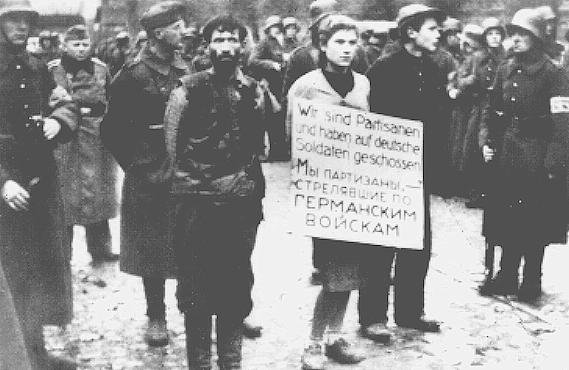
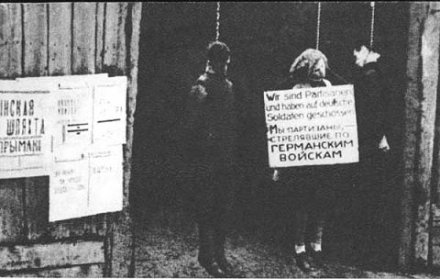
On this date in 1941, the German occupiers of Minsk conducted an infamous public hanging of partisans — perhaps the first such salutary public execution of resistance members of the war.

Jewish* 17-year-old Maria (Masha) Bruskina was the central figure of the grim tableau, and wore the placard announcing “We are partisans and have shot at German soldiers.” Evidently, she also attracted the most attention** from the onlookers to whom the scene was addressed.

Before noon, I saw the armed German and Lithuanian soldiers appear on the street. From over the bridge they escorted three people with their arms tied behind their backs. In the middle there was a girl with a sign-board on her chest. They were led up to the yeast factory gate. I noticed how calmly these people walked. The girl did not look around … The first one led to the gallows was the girl.

She was hanged with bewhiskered World War I vet Kiril Trus and the 16-year-old Volodia Shcherbatsevich. The men were members of a partisan cell organizing anti-fascist resistance; Masha Bruskina was a nurse who had been caught aiding the partisans by providing civilian clothes and papers for wounded Red Army soldiers under her care to smuggle them back to the resistance.

The scene of their deaths was captured in a series of powerful photographs taken by one of the Lithuanian Wehrmacht collaborators.

(More images here and here.)

* Phototextualities: Intersections of Photography and Narrative claims that Bruskina lightened her hair and changed her name to prevent her Jewishness affecting her resistance work; even though she was a Minsk native, her initial identification didn’t happen until 1968. The men who suffered with her were named almost immediately after the war.

** Despite the eye-catching place of the girl, she was officially unidentified for decades even after the name Masha Bruskina surfaced. In “A Historical Injustice: The Case of Masha Bruskina,” (Holocaust Genocide Studies 1997, 11:3) Nechama Tec and Daniel Weiss argued that Soviet authorities, and later Belarusian ones, found her Jewishness problematic and resisted identifying her because of it — while an ethnically Russian female partisan like Zoya Kosmodemyanskaya could be more conveniently accepted as a heroine. Maybe, but bureaucratic inertia and simple precedence (since Zoya Kosmodemyanskaya was known immediately while Masha Bruskina was not) are also plausible contributing factors.

A plaque unveiled at the Minsk yeast factory in 2009 finally called her Maria Bruskina.

On this day..

1896: Rainandriamampandry and Prince Ratsimamanga

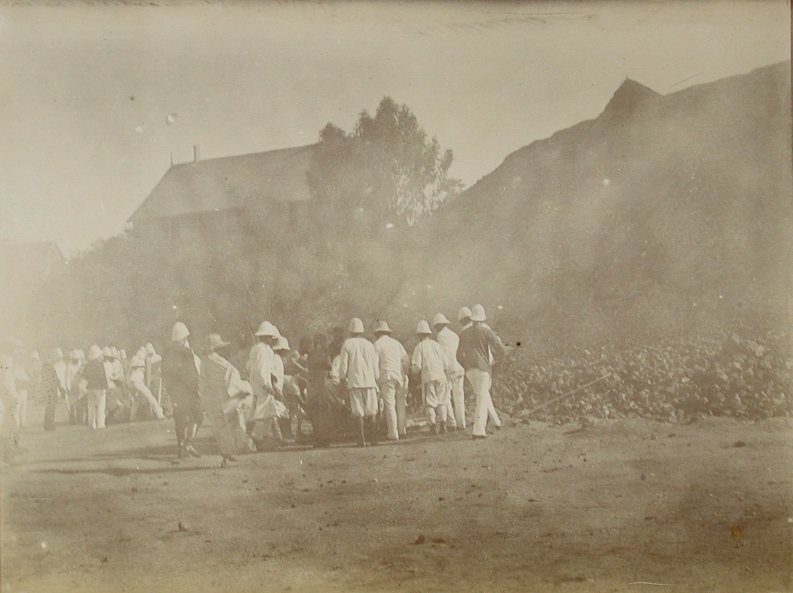
On this date in 1896, two Malagasy movers and shakers were shot to help cement French colonial control of Madagascar.

Interior Minister Rainandriamampandry

Having conquered the island militarily by 1895, France immediately faced indigenous resistance.

According to Stephen Ellis*

One of the most puzzling and fascinating of all resistance movements is that known as the revolt of the menalamba. It occurred over a wide area of central Madagascar, mostly in the kingdom of Imerina, in the two years following the French invasion of Madagascar in 1895. The most mysterious aspect of the rising has always been the question of who, if anyone, was its leader. The official version, that reported by the French government in Madagascar, was that the movement was inspired or directed by a number of magnates at the old Merina court. The published evidence is so ambiguous as to have obliged every subsequent author to accept this version, although there was considerable doubt expressed as to its truth at that time.

Managing this drumhead tribunal was just-arrived “Resident-General” Joseph Simon Gallieni, who seems to have alit (fresh from an assignment in Indochina) with the certain conviction that examples must be made.

While more wholesale bloodletting was deployed in the field, Gallieni selected some suitably high-profile exemplars from the supine state’s ruling elite — “Ratsimamanga, a nobleman who had been unpopular for many years because of his financial extortions,” says Ellis, and “Rainandriamampandry because … he had no close political friends and might therefore be considered dispensable.”

The convenient loss of the tribunal paperwork, which renders evaluation impossible and colonial motivation suspect, hardly would have been well beside the point. As one periodical in Paris (where Gallieni’s pacification project received enthusiastic greeting) approvingly put it,

As a lesson to the rebels, two great figures who had sided with them, Prince Ratsimamanga and Minister of the Interior Rainandriamampandry have both been tried, convicted and shot, all with such rapidity as to inspire their accomplices to salutary reflections.

Below: Selected photographs of the execution from the University of Southern California Digital Library. Click for larger images.

An aside: Madagascar was also the scene of intensely sectarian competition in the soul-saving business, resulting in an execution-day travesty reported in An Empire Divided: Religion, Republicanism, and the Making of French Colonialism, 1880-1914:

Gallieni gave permission to both the cure of the Antananarivo cathedral and a local French pastor to be with [Rainandriamampandry] during his last hours. But … the two started quarreling almost at once. Gallieni was deeply disturbed by the image of two religious men fighting during “the final minutes of a condemned man.”

* “The Political Elite of Imerina and the Revolt of the Menalamba. The Creation of a Colonial Myth in Madagascar, 1895-1898,” The Journal of African History, vol. 21, no. 2 (1980).

On this day..

1996: Dr. Mohammad Najibullah

On this date in 1996, the man who once ruled ruled Afghanistan under the aegis of a superpower succumbed to the tender mercies of his country’s fundamentalist insurgency.

Mohammad Najibullah was the last president of the Soviet-backed Democratic Republic of Afghanistan. Unfortunately for Najibullah, he was on the job when Moscow decided to throw in the towel on the Soviet-Afghan War.

After losing the subsequent civil war, the former President was trapped for a nervous few years in Kabul — blocked from joining his family in flight to India by the offices of former Soviet client and present-day American client Abdul Rashid Dostum.

When Kabul finally surrendered to the Taliban in 1996, the hated onetime Communist viceroy — whose stepping-stone to that post was heading the hated Afghan secret police — had a problem.

At the instigation of future Taliban second-in-command Mohammad Rabbani, Najibullah and his brother were hauled out of the U.N. compound where they had taken refuge, publicly beaten, tortured and castrated, and strung up on a traffic barricade.

There was a new sheriff in town.


On this day..

1600: The Pappenheimer Family

On this date in 1600, Bavarians thronged to a half-mile-long procession in Munich for the horrific execution of the Pappenheimer family.

They were marginal, itinerant types: the father, Paulus Pappenheimer, cleaned privies (“Pappenheimer” would remain as Nuremberg slang for a garbageman into the 20th century, according to Robert Butts); the mother, Anna, was the daughter of a gravedigger. They wandered, begged, did odd jobs. They were Lutherans in a Catholic duchy.

So they were vulnerable to their extreme turn of bad luck. Fresh to the throne of Bavaria, young Catholic zealot Duke Maximilian I wanted a crackdown on the infernal arts, and when others accused the Pappenheimers of witchcraft, they found they had become the stars of a show trial.

Tortured into a spectacular litany of confessions, Anne Llewellyn Barstow, records,

they were stripped so that their flesh could be torn off by red-hot pincers. Then Anna’s breasts were cut off. The bloody breasts were forced into her mouth and then into the mouths of her two grown sons … a hideous parody of her role as mother and nurse …

Church bells pealed to celebrate this triumph of Christianity over Satan; the crowd sang hymns; vendors hawked pamphlets describing the sins of the victims.

Meanwhile, Anna’s chest cavity bled. As the carts lurched along, the injured prisoners were in agony. Nonetheless, they were forced at one point to get down from the carts and kneel before a cross, to confess their sins. Then they were offered wine to drink, a strangely humane act in the midst of this barbaric ritual.*

One can hope that between the wine and loss of blood, the Pappenheimers were losing consciousness. They had not been granted the “privilege” of being strangled before being burned, but in keeping with the extreme brutality of these proceedings, they would be forced to endure the very flames.

Further torments awaited Paulus. A heavy iron wheel was dropped on his arms until the bones snapped … [then] Paulus was impaled on a stick driven up through his anus …

The four Pappenheimers were then tied to the stakes, the brushwood pyres were set aflame, and they were burned to death. Their eleven-year-old son was forced to watch the dying agonies of his parents and brothers. We know that Anna was still alive when the flames leapt up around her, for Hansel cried out, “My mother is squirming!” The boy was executed months later.

Ouch.


The Pappenheimers’ appalling end, famous in its own time, hit modern bestseller lists with Michael Kunze‘s work of popular history, Highroad to the Stake: A Tale of Witchcraft (Review).

Dr. Kunze was good enough to share his thoughts on the Pappenheimers’ milieu with Executed Today.

You present the Pappenheimers as a sort of “show trial” case; what makes a witchcraft show trial a compelling need for a German duke at the end of the 16th century? Why do you think witch persecution arises so especially in this period especially?

Towards the end of the 16th century the Middle Ages had been overcome. People no longer believed in a God taking care of every little thing in their lives. The world was no longer regarded a safe home, guarded by the Father in heaven. Religion had been replaced by reason. The kings, princes and dukes took over direct responsibility for their countries and citizens. They started to build modern states, rationally organized und fully controlled.

The main problem was that full control was difficult to achieve. The streets were in very bad condition, the countryside far stretched, the woods were dark, the villages far away. All kinds of crimes were committed, and when the police arrived the robbers, thieves and murderers had long disappeared. In time without photographs or identity papers it was difficult to trace them. The slow flow of information was also a problem.

That’s why the authorities tried to abhor criminals by show trials and spectacular executions. A witch trial was ideal, because people believed that all mischief and evil was induced by the devil. All criminals were more or less suspected of a deal with the devil.

What’s the biggest challenge we have in our time to re-imagining the world that witch prosecutors and “witches” lived in, or the biggest difference in mindset?

People in the 16th century were absolutely convinced that the devil was a real force trying to use humans to work against God’s intentions. They believed in a huge battle between good and evil, and those who changed sides and helped the devil were regarded as traitors committing High Treason.

At the same time the modern idea that everything that happens has an explainable cause made the authorities suspect the devil’s work behind every thunderstorm, not to mention deadly accidents. People were not more stupid than we are. It was the mixture of medieval superstitions and modern rationalization that led to the witch trials.

How did contemporaries of the Pappenheimers and Duke Maximilian think about this event?

It was indeed a monstrous case and quite an event at the time. The contemporaries did not doubt that 1) the Pappenheimer family had been instruments of the devil, and 2) that the brutal punishment had saved their souls. Duke Maximilian certainly regarded the execution as a means to stabilize safety in his country.

In researching the interrogations and trials in these cases, where did you get the sense that we still revert to “witch trial logic” in some modern cases? If so, when does it arise?

It’s obvious that we still interpret laws based on our beliefs and point of views. The judges involved in the witch trials thought they “knew” for certain that the devil can talk to people and make deals with them. They also believed that torture brings the truth to light. Isn’t today’s deal bargaining also a form of torture? After all the authorities tell the defendant that he will be severely punished if he does not confess. That’s what I call a forced confession. Yet it is done around the world.

Obviously, this execution is utterly horrific in its particulars. How typical would this sexualized theater — slicing off Anna Pappenheimer’s breasts, impaling Paulus Pappenheimer — have been for a witchcraft case at that time and place? How would this have been understood by witnesses, as opposed to “merely” burning or breaking on the wheel?

The point was to abhor by cruelty. People should see what horrors the criminals had to endure and tell it to everyone for years to come.

* Or, perchance, the wine was offered to revive them and protract their tortures.

On this day..

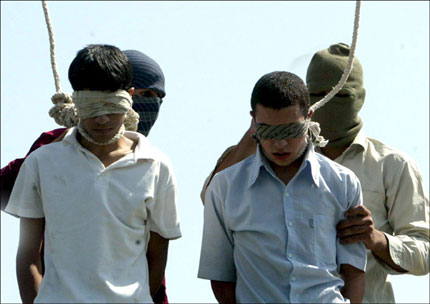
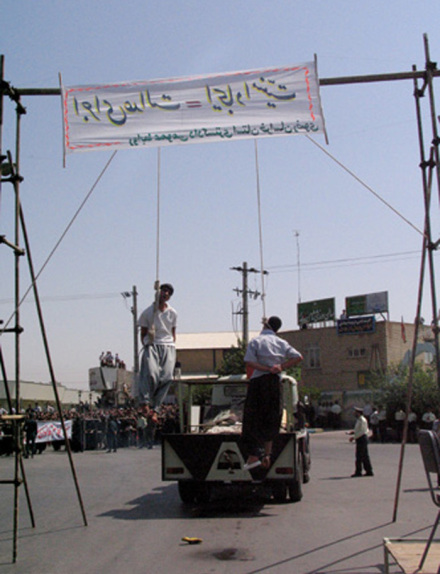
2005: Mahmoud Asgari and Ayaz Marhoni, gay teens

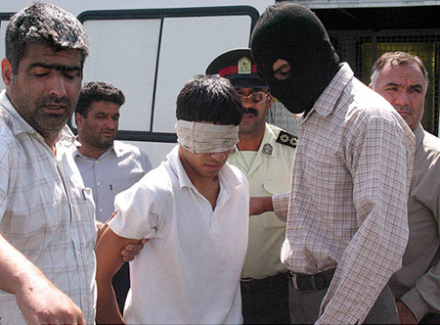
On this date in 2005, two teenagers were hanged in Mashhad, Iran.

Affecting photos of these two youths, their faces etched in fright and grief, their 16- and 18-year-old bodies pitifully boyish next to their executioners, became an immediate worldwide sensation.

These shocking images were quickly followed by a storm of controversy. The crime for which Asgari and Marhoni swung was the rape of a 13-year-old while both the offenders were themselves minors; gay organizations and human rights groups subsequently became mired in contentious dispute over whether (as a factual, legal, or tactical matter) they could be said to have succumbed to a “lethal reign of terror targeting Iranian gays”. For instance, was the conviction reliable, or a pretext? Would these boys actually have self-identified as “gay”?

To that were added charges and countercharges among western campaigners of racism, imperial lickspittle-ism, objective-pro-Islamic-fascism, and the like. Like, awfully convenient that Iran’s longtime dim view of homosexuality has everyone exercised at just the moment bombing Tehran was being openly mooted.

But whatever the text: those pictures. Still, those pictures.

It is certain that both Mahmoud Asgari and Ayaz Marhoni were juvenile offenders, whose execution is anathema almost everywhere in the world but Iran — just one of that country’s unique characteristics.

On this day..

1946: Karl Hermann Frank

On this date in 1946, the Sudeten German whose fifth column had paved the way for the Nazi conquest of Czechoslovakia expiated his war crimes at Prague’s Pankrac Prison.

Karl Hermann Frank (English Wikipedia page | German) had been a prewar mover and shaker in the Sudeten German Party, increasingly the Reich’s stalking-horse as it bluffed European rivals into acceding to Czechoslovakia’s dismemberment.

The onetime Czechoslovakian MP did well by the Anschluss, gaining the rank of Obergruppenführer and becoming one of Bohemia and Moravia’s top evildoers.

Notably, he helped orchestrate (though the orders for it came from above) the notorious massacre of Lidice in revenge for the assassination of Reich Protector Reinhard Heydrich.

The Lidice operation formed a war crimes charge against Herr Frank after the war, and Frank’s own lasting badge of infamy: the systematic destruction of the entire male population of an arbitrarily chosen village remains the emblematic crime of the Nazi occupation to this day.

(Source of the video)

Thousands of spectators came to see the former “Protector of Bohemia and Moravia” executed in Prague’s Pankrac Prison by the Austro-Hungarian “pole hanging” method, as depicted in the film above.

Those of Lidice’s widows who were able to come — and widows of some of the 30,000 other Czechs for whose executions Frank had been adjudged indirectly responsible — occupied the second row of seats. …

Not the slightest gleam of compassion could be seen in that long row of unforgiving eyes as Frank, garbed in a ragged Nazi Elite Guard uniform, walked quietly between two guards. …

As the noose was adjusted about his neck, Frank muttered: “Deutschland wird leben auch wenn wir nicht leben” (“Germany will live even if we do not live.”)

The spectators, admitted by special cards, watched quietly in the bright sunshine. (New York Times)

On this day..

1891: The Namoa pirates

On this date in 1891, Chinese authorities beheaded 15 at Kowloon, including the leaders of the then-notorious Namoa pirates.

They were nicknamed for the steamer they had infamously commandeered six months before. The tale is related by an English maritime official’s orientalist (and now public-domain) memoir, The Mystic Flowery Land:

The most daring and disastrously successful piracy of late years … was the “Namoa” piracy in 1890. The startling news of this outrage created a general feeling of unsafety and consternation among the foreign communities in China, mingled with grief and just resentment for the cold-blooded murder of Captain Pocock and Mr. Petersen, both most popular and respected men, the latter being a member of the Customs Service.

On Sunday, the 3rd of December, 1890, the Douglas, Lapraik, and Co‘s coasting steamer, “Namoa,” commanded by my late most esteemed friend Capt. Pocock,* left Hongkong at noon, bound on her usual trip up the coast to Swatow, Amoy, and Foochow with several European and a large number of Chinese passengers, most of the latter being Fuhkien people returning to their native homes after many years absence in the United States and California, each with his little hoard of hard-earned dollars, gained by a small lifetime of frugal toil and self-denial in a distant land. These poor men were nearing their well-remembered haunts of earlier days, to once more spend among the relations and friends of their youth the fast-approaching New Year.

Several Chinese passengers [during the voyage] came up out of the main between-decks and walked about for some minutes in a seemingly aimless manner; then others emerged from the hatch, until there were between forty and fifty on deck — some forward near the hatchway leading down to the junior officers’ mess, others near the bridge ladder and entrance to engine-room and stokehole, and the rest at the main hatchway, saloon entrances and after skylight.

Suddenly, at a given signal, off came their loose outer garments, and these harmless-looking passengers were armed men; each with a cutlass and two revolvers in hand, and at their appointed stations.

The ship was now entirely in the hands of the pirates, whose leader placed one of the gang at the helm, with directions to steer a certain course.

The attack had been planned and carried out with consummate tact and forethought, for the pirates were old hands — desperate scoundrels … two or three ventured below … among their terror-stricken countrymen, and ransacked their luggage, robbing them of their treasured packets of dollars, saved during long and lonesome years of comparative exile and drudgery. Every cent was taken from these poor fellows, who wept in vain, and heart-rending scenes ensued. But the wretches took all.

Then [the European passengers] were all driven into the captain’s little berth, which was barely large enough to hold them all, where they were nearly suffocated.

At this point, the pirates steam off to rendezvous with their confederates, transfer their persons and their booty to the getaway ships, and — after debating whether to burn the Namoa — instead abandon the ship unsunk and the hostages unkilled.

These put the ship to rights and got it back to Hong Kong.

Public indignation was great, and considerable pressure was brought to bear on the Chinese Government to bring the pirates to justice. Skilled foreign and Chinese detectives were sent out on their track, doggedly determined to run these criminals to earth and make them pay the full penalty of their dastardly deeds.

… most, if not all, of these notorious crime-hardened criminals were eventually brought to justice, suffering decapitation outside Kowloon city, the majority of them being executed on Monday, April 17th, 1891, and the remaining nineteen on Thursday, 11th May, of the same year.**

The pirates were such big news that posed photos were taken of their public executions. (Both images are detail views; click for the full picture.)

For some time great precautions were taken by the captains and officers of coasting steamers to search the luggage of all native passengers, and thus guard against a similar catastrophe.

* Captain Thomas Guy Pocock was killed by the pirates, and has a private memorial in Hong Kong Cemetery (aka Happy Valley Cemetery). He left a one-year-old son who died in World War I.

** According to a tome on legal administration in Hong Kong, the pirates were beheaded in batches mixed in with other criminals.

A wholesale execution took place at Kowloon City on the 17th April, 1891, when nineteen pirates were decapitated, thirteen of them for participating in the Namoa and other piracies, and six others for various offences in Chinese territory … on the 11th May fifteen more prisoners were beheaded at Kowloon by the Chinese authorities, amongst the number being six Namoa pirates, including the three leaders of the gang, one of the men being the captain of the junks on board which the pirates put their plunder … One of the leaders decapitated, named Lai A Tsat, was a man whose boldness and cunning in carrying out piracies had long made him a terror both at sea and on shore.

On this day..