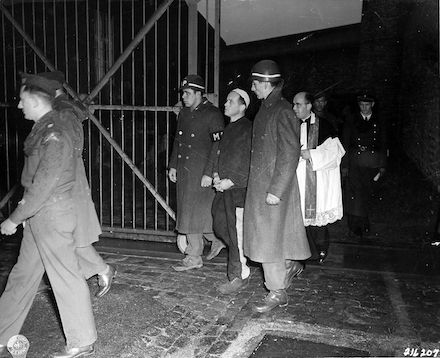
1943: Floyd McKinney

Nevada executed Floyd McKinney in its gas chamber on this date in 1943.

McKinney had caught a ride westward across the state on Highway 50 with 2nd Lt. Raymond Fisher and his wife.

Somewhere around Sand Springs, McKinney murdered Lt. Kinney with some sort of bludgeon, like a car jack, and shot Mrs. Fisher.

No motive was ever established, it might have been pecuniary since McKinney subsequently sold the Fishers’ car in Reno for $650.

On this day..

1857: Two members of the Aiken Party

The first “executions” meted out by Mormon captors to the Aiken or Aikin Party men who were attempting to cross the war-footing territory eastward from California took place on November 25, 1857, and were as clumsy as they were brutal.

Under the pretext of escorting them out of the state, Thomas Aiken, John Aiken, John “Colonel” Eichard, and Andrew Jackson “Honesty” Jones reached the small settlement of Salt Creek, Utah, on November 24. They had their least peaceful sleep there that night while their guides, acting on orders from the top of the state’s hierarchy, planned their murders.

Four toughs dispatched by Bishop Jacob Bigler slipped out of Nephi before dawn the next day. They’d ride on ahead, and later that evening “accidentally” meet the southbound Aiken men and their escorts, presenting themselves as a chance encounter on the trails to share a camp that night. These toughs plus the escorts gave the Mormons an 8-to-4 advantage on their prisoners, which was still only good enough to kill 2-of-4 when the time came:

David Bigler’s 2007 Western Historical Quarterly article, “The Aiken Party Executions and the Utah War, 1857-1858.”

After supper, the newcomers sat around the fire singing. “Each assassin had selected his man. At a signal from [Porter] Rockwell, [the] four men drew a bar of iron each from his sleeve and struck his victim on the head. Collett did not stun his man and was getting worsted. Rockwell fired across the camp fire and wounded the man in the back. Two escaped and got back to Salt Creek.”

We don’t actually know which two died at the camp and which two made it back to Salt Creek. Bigler suspects Thomas Aiken and John Eichard were the victims to die on the 25th; the editors of Mormon assassin Bill Hickman‘s confessional autobiography make it Thomas Aiken and Honesty Jones.

The doomed men were stopping at T. B. Foote’s, and some persons in the family afterwards testified to having heard the council that condemned them. The selected murderers, at 11 p.m., started from the Tithing House and got ahead of the Aikins, who did not start till dayhght. The latter reached the Sevier River, when Rockwell informed them they could find no other camp that day; they halted, when the other party approached and asked to camp with them, for which permission was granted. The weary men removed their arms and heavy clothing, and were soon lost in sleep — that sleep which for two of them was to have no waking on earth. All seemed fit for their damnable purpose, and yet the murderers hesitated. As near as can be determined, they still feared that all could not be done with perfect secrecy, and determined to use no firearms. With this view the escort and the party from Nephi attacked the sleeping men with clubs and the kingbolts of the wagons. Two died without a struggle.

As for the two survivors … that’s a tale for another day.

On this day..

1840: Zachariah Freeman

(Thanks for the guest post to American newsman and reformer John L. O’Sullivan. Best-known as the fellow who coined that potent brand for American empire, “manifest destiny,” O’Sullivan was also a vigorous advocate for abolishing capital punishment as a New York legislator in the 1840s, and made several proposals to that effect. The summary here is one of many reported in O’Sullivan’s appendix to his Report in favor of the abolition of punishment of death, by law, made to the legislature of the state of New York, April 14, 1841. The report did not achieve its objective. -ed.)

Tried in September, 1840, for the murder of Sarah Boyd, his quasiwife, in the town of Lysander, Onondaga county, on the 18th of May, 1840.

Both were negroes. They lived in the same house with his father, 80 years of age, his brother Elihu, and a woman who lived with his brother as his wife. Zachariah was much attached to Sarah, and had taken some steps toward making arrangements for a legal marriage with her.

Jealousy was the motive to the murder — or a combination of jealousy and insanity. They had some trifling dispute, in which she refused to comply with some domestic order of her husband, when he raised a chair, and struck her across the arm, knocking her down. On recovering herself, she declared she would never live with him again. He thereupon went to some woods at a short distance, and made an attempt to hang himself — whether in earnest, or to frighten them, does not appear clear. He was stopped with the rope round his neck, and brought back to the house.

While he was away she expressed great dread of his returning, saying, that if he did, she should be a corpse before morning — that though he had not threatened her, she saw it in his eye. While he was out, before returning to the house, he was praying and singing hymns. He entreated a reconciliation with her, which she refused; — he was willing to go down on his knees to her. She consented to leave it to the rest to decide the next morning, if he would now behave himself.

On this arrangement the rest went to bed — he remained up, smoking a pipe. He had insisted on smoking her pipe, refusing any other. According to his confession of what followed, he after a time leaned his head on the bed, and she kicked him. He then got the knife with which he committed the act, and went to some distance from the house for the purpose of killing himself; but while whetting it, determined to go back to see her once more. She was sitting up in bed. He placed his left hand on her shoulder, and attempted to kiss her. He had no thought of injuring her — “she was young, handsome, and everything that was nice, and it had not occurred to his mind to damage her at all.”

She refused to receive him, and slapped him on the face. He then gave her a stab, which was in a few moments fatal, immediately cutting his own throat also. Though a severe wound, this did not prove fatal.

The family were immediately roused, and eventually he was cured of his wound. He expressed much grief and repentance. He was jealous of his brother Elihu, whom he believed to have criminal intercourse with her. Zachariah had wished her to remove with him to another house, but she had refused. He said, after the affair, that “if she would not lie any more with him, he would not let her with any other man” — “he thought she should never sleep with another man, and he never with another woman.”

He said, he expected to be hanged, but added: “I shall go to the gallows in as good a cause as ever a man went.” His previous general character was good. He was hung November 19th, 1840.

On this day..

1888: Not Sarah J. Robinson

On this date in 1888, Massachusetts almost hanged Sarah J. Robinson.

The reader will easily infer from press appellations such as the “Massachusetts Borgia” or “Sommerville Borgia” that Mrs. Robinson was a prolific poisoner.

The true toll of Robinson’s career remains uncertain to this day but they monstrously included her own son and daughter — the victims that brought her within the shadow of the gallows.

An Irish immigrant, she had discovered the capacity of arsenic for relieving the financial burdens that, then as now, weighed upon the poor. In 1881, her landlord suspiciously died in her care, abating a debt of rent; a few years later, her husband did likewise, leaving her an insurance windfall, and then her sister too.

Still the maintenance of five children — four of her own, plus a nephew — harried her. To keep the wolves at bay she moved frequently, sold off furniture. And last, she enrolled two children in a working-class insurance fraternal and collected so speedily to attract the wrong attention. Her many murders afforded multiple bites at the legal apple, so when a jury hung on a charge of murdering her kids, they just turned around and got her for a nephew instead.

Mrs. Robinson was escorted to the court room … A large rocking chair was provided for her comfort in the rear of the court room outside the prisoner’s iron cage. She languidly sank into it, and as soon as seated requested a drink of water, which was brought her by Sheriff Tidd. Her hands trembled like leaves as she eagerly held the tumbler to her lips. (Boston Journal, June 29, 1888)

Notwithstanding her many victims, the prospect of noosing this trembling-hand, rocking-chair mother discomfited the public. The governor commuted her sentence to solitary imprisonment four days before her scheduled November 16, 1888 hanging.

On this day..

1779: Robert Young

This date in 1779 saw the execution in Worcester, Mass., of one Robert Young, a schoolteacher who favored the occasion with the following verse from his very own quill.

The man’s offense one may derive from his confessional, but apart from rapist who was this doomed poet? We refer the reader to the biography at friend and sometime guest-poster Anthony Vaver over at Early American Crime. (Vaver’s book Bound With An Iron Chain: The Untold Story of How the British Transported 50,000 Convicts to Colonial America comes recommended for those interested in the period.)

ATTEND, ye youth! if ye would fain be old,
Take solemn warning when my tale is told;
In blooming life my soul I must resign,
In my full strength, just aged twenty-nine.

But a short time ago, I little thought
That to this shameful end I should be brought;
But the foul fiend, excepting God controuls,
Dresses sin lovely when he baits for souls.

Could you the monster in true colours see,
His subject nor his servant would you be;
His gilded baits would ne’er allure your minds,
For he who serves him bitter anguish finds.

Had I as oft unto my Bible went,
As on vain pleasures I was eager bent,
These lines had never been composed by me,
Nor my vile body hung upon the tree.

Those guilty pleasures that I did pursue,
No more delight — they’re painful to my view;
That monster, Sin, that dwells within my breast,
Tortures my soul and robs me of my rest.

That fatal time I very well remember,
For it was on the third day of September,
I went to Western, thoughtless of my God,
Though worlds do tremble at his awful nod:

With pot-companions did I pass the day,
And then direct to Brookfield bent my way,
The grand-deceiver thought it was his time,
And led me to commit a horrid crime.

When it was dark I met the little fair,
(Great God forgive, and hear my humble pray’r)
And, O! dear Jane, wilt thou forgive me too,
For I most cruelly have used you.

I took advantage of the dark’ning hour,
(For beasts always by night their prey devour)
This little child, eleven years of age,
Then fell a victim to my brutal rage;

Nor could the groans of innocence prevail;
O pity, reader, though I tell the tale;
Drunk with my lust, on cursed purpose bent,
Severely us’d th’unhappy innocent.

Her sister dear was to have been my wife,
But I’ve abus’d her and must lose my life;
Was I but innocent, my heart would bleed
To hear a wretch, like me, had done the deed.

Reader, whoe’er thou art, a warning take,
Be good and just, and all your sins forsake;
May the Almighty God direct your way
To the bright regions of eternal day.

A dying man to you makes this request,
For sure he wishes that you may be blest;
And shortly, reader, thou must follow me,
And drop into a vast eternity!

The paths of lewdness, and these base profane,
Produce keen anguish, sorrow, fear and shame;
Forsake them then, I’ve trod the dreary road,
My crimes are great, I groan beneath the load.

For a long time on sin should you be bent,
You’ll find it hard, like me for to repent;
The more a dangerous wound doth mortify,
The more the surgeon his best skill must try.

These lines I write within a gloomy cell,
I soon shall leave them with a long farewell;
Again I caution all who read the same
And beg they would their wicked lives reclaim.

O THOU, Almight GOD, who gave me breath,
Save me from suffering a second death,
Through faith in thy dear SON may I be free,
And my poor soul ascend to dwell with Thee.

On this day..

1945: The Rüsselsheim Massacre perpetrators

The U.S. Army hanged five German civilians as war criminals at Bruchsal Prison on this date in 1945. Their crime: lynching the crew of a downed American bomber, the day after Allied bombing raids devastated the manufacturing town of Rüsselsheim.

The lynching is known as the Rüsselsheim Massacre, and it claimed the lives of six of the nine flyers of a B-24 Liberator cheekily christened Wham! Bam! Thank You, Ma’m!. One of their number survived thanks to his shrapnel wounds, which saw him safely to hospital while his comrades were being transported.

The other two were simply lucky to survive the beatings administered by a mob of enraged civilians who caught sight of the Americans under the escort of only two German soldiers. On the night of August 25-26, Britain’s Royal Air Force had dumped more than 1,600 tons of explosives on Rüsselsheim to destroy the Opel factory and rail lines there. It was only the latest, and ultimately the largest, of several raids on the town dating back to July. A later U.S. study reckoned 315 Opel workers killed and 277 injured during the July-August raids, to say nothing of the devastation on other townspeople and on Opel’s slave labor.* A POW, Frenchman Pierre Cuillier, recorded of the August 25-26 attack that “a bomb fell on the dug-out for Russian women. We hear of 119 victims, a number that in reality is surely much higher.”

Under the circumstances, the good folk of Rüsselsheim were not pleased on the morning of the 26th to see Allied airmen in their town being marched to a train transfer … even if, and surely the distinction must fail to impress amid the smoldering rubble of one’s own hometown, this particular American crew had not been part of this particular British bombing. (The Americans had been shot down two days earlier en route to do a similar thing to Hanover.)

“There are the terror flyers. Tear them to pieces! Beat them to death! They have destroyed our houses!” cried Margarete Witzler and Käthe Reinhardt. As the Americans protested, the crowd overpowered the guards and took its rough revenge with whatever bludgeons were ready to hand.

At last, Joseph Hartgen, an air raid warden, finished them off with his pistol … or at least, finished off six before his chamber went empty.


Spoiler alert: it will not go well for Herr Hartgen.

Somehow the two un-shot men, Sgt. William M. Adams, and Sgt. Sidney E. Brown, still drew enough breath by the end of the ordeal to sneak away when they were being dumped into a mass grave. Captured again a few days later, they survived the war in a POW camp.**

Eleven Rüsselsheimers stood trial in Darmstadt for these Lynchmorde by July, when war was still raging in the Pacific: it was the very first war crimes proceeding under U.S. occupation.

The defendants tried out a pre-Nuremberg version of the “only following orders” defense, blaming Nazi propaganda against bomber crews for inciting the murders. The U.S. prosecutor† scoffed: “They were all grown men and women. If they are called on to commit the murder and they do, they are just as responsible as any other murderers.”

Harten and six others of the 11 caught death sentences, but the two women — Witzler and Reinhardt — both had their sentences reduced.

Warning: Although not graphic, this is a video of actual hangings.

* Quotes and figures from Working for the Enemy: Ford, General Motors, and Forced Labor in Germany During the Second World War, which is topical because Opel was a General Motors subsidiary.

** Brown lived long enough to return to Rüsselsheim at official invitation in 2001 for a formal apology. However, at the time of the trial, it was still mysterious how there came to be only six exhumed bodies from eight lynched airmen: Adams and Brown only emerged out of the mass of returning POWs after convictions had already been secured.

† The army prosecutor at the proceeding was one Lt. Col. Leon Jaworski, but he’s better known for hunting larger game later in his career as the special prosecutor during the Watergate investigations. (Jaworski is the guy embattled President Richard Nixon appointed after firing Archibald Cox in the Saturday Night Massacre.) Jaworski’s eventual legal victory over the White House in United States v. Nixon obtained the incriminating Watergate tapes in late July of 1974, forcing Nixon’s resignation just days afterwards, on August 9, 1974.

On this day..

1707: Bartellemy Pichon dit La Roze, the first executed in Fort Detroit

The execution hook for today’s post does not arrive until the end of the excerpt below. Its subject is Antoine de la Mothe Cadillac* … the French explorer who founded Fort Pontchartrain** du Detroit, the germ of the present-day U.S. Motor City.

How did Monsieur Cadillac administer criminal justice in his frontier fortress? Read on …

Cadillac’s Autocratic Rule

The next step, and a step that was very early taken, was the enforced obedience to the will of the first commandant, Cadillac. The troubles he had with the Company of the Colony of Canada forced him to be arbitrary with the servants of that company, and he was arrested and sent to Montreal for putting one of these disobedient servants in prison. This was an attack on the government itself, and could not be overlooked by the governor-general. Cadillac kept away from Detroit for a long time, but eventually returned with his powers confirmed by the king. During his absence his little village came near being sacked and destroyed by turbulent Indians, and it was partly on this account that the home government looked with favor upon his attempt at arbitrary rule.

In 1711 Cadillac left Detroit for good and his successor got into trouble with the village priest and with many of the foremost citizens without unnecessary delay. Although the commandant was always very powerful, there were some matters that appeared to be beyond his authority to try. He could not try any cases in which he was personally interested. He could not try any capital cases or cases in which the life or liberty of the defendant was involved. He could not try these cases, but yet we find that Cadillac asserted that his authority reached to the taking of the life of any person who refused to submit to his orders. Cadillac himself was defendant in a civil suit in 1694, which was protracted until 1703, arising out of the seizure of the goods of a trader of Michilimackinac, when Cadillac was commandant there.

The goods were seized for infraction of the laws which prohibited the sale of brandy to the Indians. The suit was for the recovery of the value of these goods, which were destroyed. The trial was held at Montreal and was decided in favor of Cadillac.

INCENDIARISM

In 1703 some one set fire to the buildings in the village of Detroit and the church was burned, as well as a large warehouse filled with furs, and several other buildings. Cadillac himself was severely burned in attempting to stem the conflagration. There was much speculation as to who set the fire. Cadillac accused the Jesuits of instigating the work. There were no Jesuits in Detroit, but he accused them of sending an Indian from Mackinac to do the work for them. There were some very bitter letters written on the subject between Cadillac and the Jesuit priests at Mackinac and Montreal, but the matter, with them, ended with the letter writing. This did not disclose the incendiary and others were suspected or accused of setting the fire. Shortly after this, in 1706, Jacques Campau accused Pierre Roquant dit la Ville of the crime. Canadian or French justice was administered in the manner that appears odd at this distance. In this case La Ville was arrested and taken to Quebec and lodged in prison. Campau was also summoned to attend the investigation as the complaining witness and most important person. The trial, or investigation, was held at Quebec December 2, 1706 before le conseil extraordinairment and resulted in an apparently extraordinary verdict, for not only was the defendant acquitted, but the complaining witness, Campau, was compelled to pay five hundred livres for the trouble and expense he had caused.

CRIMINAL ASSAULT

In 1705 Pierre Berge (or Boucher) dit La Tulipe, a drummer (tambour) in the company of Cadillac, committed a criminal assault upon Susanne Capelle, a little girl twelve years of age. He was convicted before the conseil superieur of Quebec and was sentenced to make a public confession of his crime and on his knees in the church he was compelled to ask pardon for his sins — he was then to be executed. It was almost impossible to carry out the last part of the sentence, for no one appeared willing to act as executioner. In the jail at Quebec was a man named Jacques Elie, who had been condemned to death for some offense committed at the siege of Port Royal in Acadia. Elie was promised a pardon for his crime if he would act as executioner of Tulipe and the latter was thus duly hanged on November 26, 1705. These were some of the cases the commandants were unable to deal with at home and sent to the higher courts at Montreal and Quebec for trial and disposition.

MILITARY LAWS

Another class of cases, those involving the military laws — disobedience to military orders, desertions and that class of cases [–] were attended to by the soldiers themselves and came before the commandant in his capacity of military officer and not as a civilian.

There is a record of one of these early trials by court-martial. During the absence of Cadillac from the village in 1705, Bourgmont had charge of the post for a time. He misbehaved himself in various ways to such an extent that the citizens nearly rose in rebellion and the public indignation was so great that Bourgmont sought safety in flight. After Cadillac’s return, he set about investigating the matter and in 1707 sent an officer named Desane, with fifteen men, to hunt up and capture Bourgmont, Jolicoeur, and Bartellemy Pichon dit La Roze, all of whom were deserters, and who were then leading an abandoned life on the shores of Lake Erie. They were also commanded to bring with them a woman named Tichenet, who was then living a scandalous life with Bourgmont and who was, in part, the cause of Bourgmont’s desertion.

Apparently La Roze was the only deserter who was captured and he was tried by a court consisting of Antoine de la Mothe Cadillac, Francois LeGautier, Sieur de la Vallee Derasie, Pierre D’Argenteuil, Guignolet Lafleudor and Francouer Brindamour. The defendant was found guilty and sentenced “a avoir la teste cassee jusque a se que mort sensuive,” meaning that he should have his neck stretched until he was dead. The word “teste” in old French, for modern “tete,” meaning the head, was applied in this case to the neck. This sentence was duly carried out in the garrison of the Fort Pontchartrain du Detroit November 7, 1707. No appeal was taken, nor was it possible that any could be. This was the first capital case in Detroit, but not the last one, for there were several others in later years.

* Cadillac’s adoptive title is of course the inspiration for the automobile manufacturer of that name. The name sources to a town in the Gironde, and has now gone international.

** U.S. readers might better recognize Lake Pontchartrain, the enormous, flood-prone estuary jutting into present-day New Orleans. Post-Detroit, our man Cadillac became the governor of French Louisiana, and between the two tributes left him in the New World it is no surprise to find that the comte de Pontchartrain was Cadillac’s patron.

On this day..

1807: Henry Niles

From the Greenfield (Massachusetts) Gazette, November 30, 1807:

NEW LONDON, (Con.) Nov. 11.

On Wednesday last, Henry Niles, an Indian, was executed in this city, for the murder of his wife, pursuant to the sentence of the Supreme Court.

The day before his execution the prisoner attempted to anticipate his sentence, and with a piece of the blade of a knife opened a vein in his thigh, from which a large quantity of blood issued before his purpose was prevented.

On the day of execution, he was taken from prison by the Sheriff and his Deputies, (the Independent Company acting as guards) and carried to the Presbyterian meeting house, where a sermon was preached by the Rev. Mr. [Abel] M’Ewen.

At the place of execution the prisoner made a short speech to the spectators, and was then launched into eternity.

It is 21 years since the execution of a criminal in this city, and the spectacle of the public death of a human being, though “a poor Indian,” drew together a large concourse of people; the number has, by many observers, been computed at 6, 8, and 10 thousand. The prisoner behaved with much calmness, and when passing from prison thro’ the crowd, his countenance bespoke the magnanimity of the American savage.

The death of his wife was occasioned by a quarrel produced by intoxication, the effects of which are known to be peculiarly mischievous among the aborigines of America.

On this day..

1799: Sarah Clark, a melancholy instance of human depravity

The ensuing poem, titled “Melancholy Instance of Human Depravity” and published in an 1805 collection, laments a serving-girl’s murder by arsenic of the master and mistress of her house. It was a crime of unrequited love: the intended victim of the poisoned bread was not this couple but their daughter, whom Sarah Clark fancied a rival for the affections of a young man in her former household. Sarah Clark hanged for the murders on October 30, 1799, in Carlisle, Pennsylvania, but Miss Isabella Oliver was never punished for her verse.

UPON the bank of a slow-winding flood
The good Alphonso’s modest mansion stood;
A man he was throughout the country known,
Of sterling sense, to social converse prone:
He walk’d the plains with such majestic grace,
When time had drawn its furrows on his face,
‘Twas easy to infer his youthful charms,
When first the fair Maria bless’d his arms:
Maria—Oh! what mix’d emotions rise,
Grief, pity, indignation; and surprise,
At thought of thee! —

Thy sweetness might have mov’d the harshest mind;
Thy kindness taught th’ ungentlest to be kind;
And yet a fiend enshrin’d in female mould
Could thy heart-rending agonies behold;
When by her cruel wiles thy wedded heart
Was basely sever’d from its dearest part.
The lov’d Alphonso’s breathless corpse she view’d,
And yet her harden’d heart was unsubdu’d.
Perhaps, she saw thee sink beside his bed,
Or lean in speechless sorrow o’er the dead;
Or heard thee faintly cry — The knot’s unti’d
Come, gentle death, thou cans’tnomore divide:
But spare our children, our lov’d offspring spare;
They still are young, and life is worth their care.
To me the charm that sweeten’d life is gone;
Weep not, my friends, I cannot die too soon.
Fast through her reins the subtle poison spread,
And join’d with grief, to bow her aged head.
Her children strive her drooping head to stay;
The monster works to rend those props away;
But triumphs not: a greater power sustains
And bears them through excruciating pains.
Oft did Maria, in serener days,
With tender transport on her offspring gaze;
Maternal love was pictur’d in her face,
The happy parent of a blooming race;
Now the fond mother feels at every pore;
Worse than her own, the pangs her children bore.
Yet still herself, sweet, affable, and mild,
The patient sufferer on her murd’rer smil’d;
Who by her bed officiously attends,
Concern and kind solicitude pretends,
Yet still pursues her own infernal ends.

Hence aid medicinal is render’d vain,
By frequent potions of the deadly bane;
While cruel torture rack Maria’s frame,
And by degrees puts out the vital flame.
Now pause, my muse, and seriously enquire,
What could this hellish cruelty inspire!
Why strike at those who no offence had given?
It seems like stabbing at the face of heaven!
In her dark mind what ugly passions breed!
Like gnawing worms, they on her vitals feed.
Without an object, what could malice do?
Alvina’s near, she’s often in her view;
In her polluted soul foul envy’s rais’d;
Because perhaps she hears Alvina prais’d;
A groundless jealousy her breast inflames;
‘Gainst thee, Alvina, she the mischief aims.
The wicked miscreant working in the dark,
Spreads ruin round, but cannot hit the mark:
A power divine restrains the falling blow
Thus far thou may’st, but shalt no farther go.
What deadly venom rankled in that breast!
What worse than poison must the soul infest,
Which still its fatal purpose could pursue,
Tho’ general destruction might ensue!
Oh! sin, prolific source of human woe!
To thee mankind their various sorrows owe;
Thro’ thee our world a gloomy aspect wears,
Ajd is too justly stil’d a vale of tears.
Man was first form’d upon a social plan;
And tie unnumber’d fasten man to man:
None are, howe’er debas’d, in form or mind,
Cut off from all communion with their kind.
Witness the wretched subject of these lines.
Alas! how many suffer’d by her crimes!
Who more detach’d, of less import, than she?
Yet mark her influence on society.
But there are crimes of a less shocking kind,
That find an easy pass from mind to mind:
As fire spreads from one building to another,
The vicious man contaminates his brother;
Why wonder, then, that Adam could deface
His maker’s image in an unborn race?
When his own hand the sacred stamp had torn,
Could he transmit it whole to sons unborn?
In him the foul contagion first began;
From sire to son the deadly venom ran;
Thus poisoning all the mighty mass of man.

The sad effect is dreadful to endure;
But human wisdom could not find a cure:
Thus, Scripture, reason, and experience, tend
To prove, the power that made alone can mend.
Oh! Christ, thou sum and source of every good,
Thou that for sinners shed’st thy precious blood,
In thee our various wants are all suppli’d;
Thy death our ransom, and thy life our guide.
In thee thy followers second life attain;
And man reflects his maker’s face again.
Is sin progressive, spreading every hour?
Has heaven-born virtue no diffusive power?
Our blessed Saviour is a living head;
The streams that issue from him can’t be dead,
But scatter life and fragrance, as they spread.

On this day..

1855: Jeremiah Craine

(Thanks to Robert Elder of Last Words of the Executed — the blog, and the book — for the guest post. This post originally appeared on the Last Words blog. Fans of this here site are highly likely to enjoy following Elder’s own pithy, almanac-style collection of last words on the scaffold. -ed.)

Susan, receive me; I will soon be with you.

-Jeremiah V. Craine, convicted of murder, hanging, California.
Executed October 26, 1855

Though married with four children in Kentucky, Craine had an affair with eighteen-year-old Susan Newnham. Craine, who believed in spiritualism, said his relationship with Susan was “sanctioned by heaven.” This did not stop Craine from shooting Susan several times, claiming that she pleaded that they make a suicide pact to escape gossip and her family’s anger about their relationship. Craine was stopped from committing suicide the next day. At his execution, Craine read an address to the assembled crowd, calling Susan his “wife.” He was allowed to sing a song he wrote to the tune of “The Indian Hunter’s Lament,” in which he described his wish to die.

On this day..