1922: Eleuterio Corral and Rumaldo Losano, escapees

(Thanks to Meaghan Good of the Charley Project for the guest post. -ed.)

On this day in 1922, Eleuterio Corral and Rumaldo Losano were hanged in New Mexico’s Grant County Jail in Silver City for the 1921 murder of a prison guard.


Corral (left) and Losano (right).

Losano and Corral were serving time in the Grant County Jail for robbery (Corral) and attempted larceny (Losano) in the spring of 1921. Losano had only fifteen days days left to go on his sentence. Nevertheless, on April 2, 1921, the two young men decided to make a break for it. The jailer, sixty-year-old Ventura Bencoma, had been sick with the flu and during the early morning hours he decided to have a lie-down. While Bencoma slept, Corral and Losano were able to get out of the cell they shared.

A nearby cell was unoccupied and used for storing coal and firewood, and had an ax. The two convicts sneaked up on Bencoma and brained him with the ax, took his gun and keys, and threatened to shoot the other prisoners if they made any noise. They tried to use the keys to release another prisoner, Jesus Rocha, but weren’t able to get the lock undone and gave up. As soon as the pair had run off into the darkness, the others started screaming for help and woke up the sheriff, who was also enjoying a siesta of his own up on the second floor and had missed the entire jailbreak.

Bencoma died within a few hours, as the sheriff and a posse of men were searching for Losano and Corral. On April 5, after a brief exchange of gunfire, the fugitives were captured hiding in a shack. Their statements are summarized in West C. Gilbreath’s Death on the Gallows: The Story of Legal Hangings in New Mexico, 1847-1923:

Both Eleuterio and Rumaldo bragged out loud of their escape and short freedom. Both men told Sheriff Casey it was Jesus Rocha who planned the escape and was to have joined them. Sheriff Casey learned from the two that after Jailer Bencoma’s keys and pistol were removed, they were to unlock the steel cell door to Jesus Rocha. Once he was released, the three were to go up to the second floor where Sheriff Casey’s quarters were and call him to the door. Once the Sheriff opened the door, he would be shot and killed with the jail’s pistol. The three would then arm themselves with the Sheriff’s rifles and ammunition. They planned to saddle the horses in the Sheriff’s corral and flee to Mexico. The plan began to fall apart after both failed to unlock the cell door to Jesus Rocha.

In light of this information, Jesus Rocha was charged with murder alongside his criminal colleagues. At trial, Losano and Corral recanted their statements about his involvement and claimed Rocha had not been a part of the escape plan. All three were convicted and sentenced to hang, but the Supreme Court of New Mexico subsequently reversed Rocha’s conviction, leaving Corral and Losano to face the noose without him.

Their families in Mexico pleaded for mercy, claiming that at the time of the murders, Corral was just sixteen years old and Losano seventeen. However, three physicians who examined them judged Corral was least nineteen and Losano was probably older than twenty.

A few days prior to the execution, the deputy warden conducted a surprise search of the condemned men’s cell. Both of their mattresses contained hacksaws and makeshift knives: they’d been planning another violent escape attempt. Unsurprisingly, the state governor, Merritt C. Mechem, refused to commute the sentences, telling Sheriff Casey, “Every guard’s life out there would be in danger with those two in the penitentiary.”

Officials set up the scaffold only about fifty feet from where Bencoma was murdered. Corral went first, then Losano. Both of them were calm and offered the standard prayers, apologies for their crimes and pleas for forgiveness.

On this day..

1894: John Hardy, desperate little man

On this date in 1894, West Virginia hanged before a crowd of 3,000 for a mining camp murder three months before.

Hardy was reportedly already at odds with Thomas Drews, a fellow laborer in the booming Appalachian coal industry, over their mutual pursuit of the same woman when Hardy lost big to Drews in a craps game on October 13, 1893.
While it’s true that twenty-five cents doesn’t really seem all that “big”, this sum could represent a decent slice of a day’s pay in the coal mining game, and that in an industry where downward wage pressure had generated a ferocious national strike only months before. Hardy was profoundly nonplussed to have to fork over the sweat of his brow to a love rival and, with the added incitement of whiskey, shot Drews dead. (Ten more spectators at his hanging wound up in stir themselves for drunk and disorderlies.)

Hardy’s execution has pride of place in Americana as the inspiration for the tune “John Hardy Was A Desperate Little Man”. (Or simply, “John Hardy”; as a folk figure, he has occasionally been confused or conflated with John Henry)

One of the most popular folk ballads in American history, the song has foggy origins but amazing reach: it has been performed, covered, and reinterpreted by a scores of artists including the Carter Family, Lead Belly, Duke Ellington, Woody Guthrie, Pete Seeger, and Bob Dylan with the Grateful Dead.

On this day..

1784: Cassumo Garcelli, a Tuscan sailor on Boston Common

On this date in 1784, for a murder in a bar brawl he had committed with his hard-drinking cronies, Tuscan mariner Cassumo Garcelli was hanged on Boston Common.

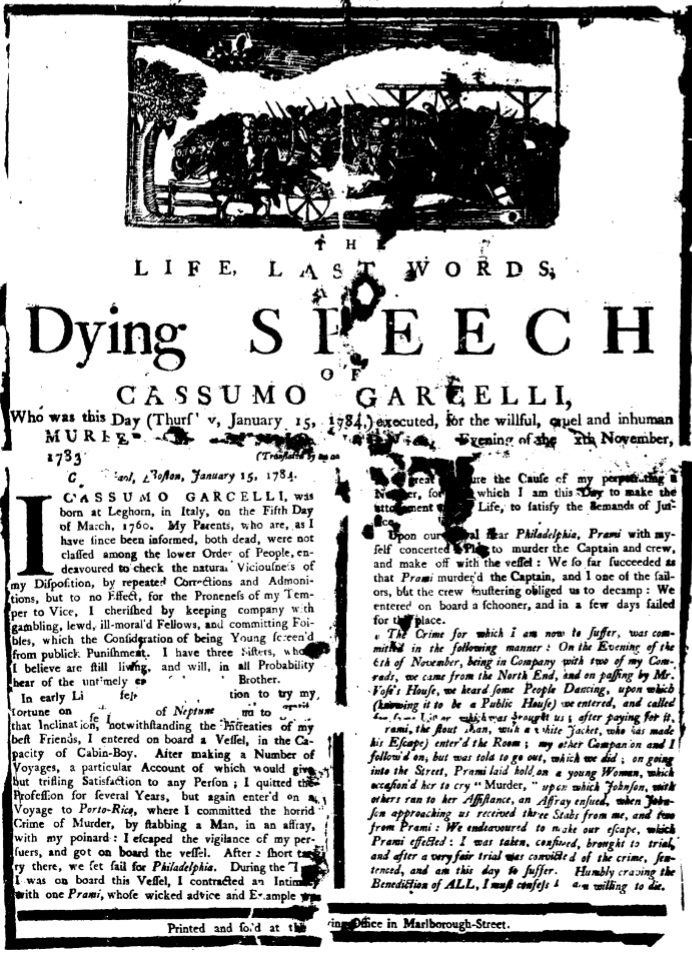
To judge by the bog-standard broadsheet purporting to report the condemned man’s gallows’ shade contrition for his youthful vice and wicked examples, piratical Catholic seamen appear to have understood the spectacle of their public execution in a friendless foreign land in a manner quite suspiciously similar to the understanding likely to be held by a New England printer.

In the transcription that follows, I have made a few interpolations, and one outright elision, owing to sections of text obscured by printing faults on the preserved version of this document.


Click on the image to see the full original document.

Who was this Day (Thursday, January 15, 1784) executed, for the willful, cruel and inhuman murder of Mr. John Johnson on the evening of the sixth November, 1783.

I, Cassumo Garcelli, was born at Leghorn, in Italy, on the Fifth Day of March, 1760. My Parents, who are, as I have since been informed, both dead, were not classed among the lower Order of People, endeavoured to check the natural Viciousness of my Disposition, by repeated Corrections and Admonitions, but to no Effect, for the Proneness of my Temper to Vice, I cherished by keeping company with gambling, lewd, ill-moral’d Fellows, and committing Foibles, which the Consideration of being Young screen’d from publick Punishment. I have three Sisters, who I believe are still living, and will, in all Probability, here of the untimely [death of their] Brother.

In early Life […] to try my fortune … notwithstanding the Intreaties of my best Friends, I entered on board a Vessel, in the Capacity of Cabin-Boy. After making a Number of Voyages, a particular Account of which would give but trifling Satisfaction to any Person, I quitted the Profession for several Years, but again enter’d on a Voyage to Porto-Rico, where I committed the horrid Crime of Murder, by stabbing a Man, in an affray, with my poinard: I escaped the vigilance of my persuers, and got on board the vessel. After a short tarry there, we set sail for Philadelphia. During the Time I was on board this Vessel, I contracted an Intimacy with one Prami, whose wicked advice and Example was in a great Measure the Cause of my perpetrating a Number [sic], for [one of?] which I am this Day to make the attonement of my Life, to satisfy the demands of Justice.

Upon our arrival near Philadelphia, Prami with myself concerted a Platt to murder the Captain and crew, and make off with the vessel: We so far succeeded as that Prami murder’d the Captain, and I one of the sailors, but the crew mustering obliged us to decamp: We entered on board a schooner, and in a few days sailed for this place.

The Crime for which I am now to Suffer, was committed in the following manner: On the Evening of the 6th of November, being in Company with two of my Comrads [sic], we came from the North End, and on passing by Mr. Vose’s House, we heard some People Dancing, upon which (knowing it to be a Public House) we entered, and called for some Liquor, which was brought to us, after paying for it.

Vami, the stout man, with a white Jacket, who has made his Escape, enter’d the Room; my other Companion and I follow’d on, but was told to go out, which we did; on going into the Street, Prami laid hold on a young Woman, which occasion’d her to cry “Murder,” upon which Johnson, with others ran to her Assistance, an Affray ensued, when Johnson approaching us received three Stabs from me, and two from Prami: We endeavoured to make our escape, which Prami effected: I was taken, confined, brought to trial, and after a very fair trial was convicted of the crime, sentenced, and am this day to suffer. Humbly craving the Benediction of ALL, I must confess [and am] willing to die.

On this day..

1864: Private Samuel Jones, in retaliation for Private Daniel Bright

The New York Times of January 23, 1864

Gen. Getty:

DEAR SIR: We, the subscribers, request to say that there was found this morning a dead man, and still hanging, in our neighborhood, as the inclosed scrip which was found pinned to his back, will show you by whom it was done. We have made a suitable box and buried him near the place he was found hung. Should his friends wish to get his body, they can get it by applying to any of the subscribers. We trust that you will not attach any blame to any of the citizens of this neighborhood, as we were entirely ignorant of any of the circumstances until we found the body. From all we can learn, he was brought across the Chowan River to this place, and as soon as the men who had him in charge hung him, they went back.

It was signed by ten people of Pasquotank County, North Carolina.

The note they enclosed, retrieved from the hanging body, read:

NOTICE

Here hangs Private Samuel Jones, of Company B, Fifth Ohio regiment, by order of Maj.-Gen. Pickett, in retaliation for Private Daniel Bright, of Company L, Sixty-second Georgia regiment, hung Dec. 18, 1863, by order of Brig.-Gen. Wild.

Bright, a member of the newly-formed 66th North Carolina guerrillas, had been hanged as a spy. Jones had been obtained by casting lots among Union prisoners of war held at the Confederate capital of Richmond, in response to Pickett’s demand for some Yankee to execute tit for tat. (Pickett’s proclivity for retaliatory executions would soon require him to quit the country at the end of the Civil War.)

On this day..

1957: Jack Gilbert Graham, terror of the skies

Jack Gilbert Graham was gassed* on this date in 1957 in Colorado for a cold-blooded mass murder in the skies.

Just a petty crook until his turn towards cinematic infamy, Graham fell badly in debt and looked to the friendly skies to recover his financial footing.**

When his mother, Daisie King, flew to Alaska to visit family on November 1, 1955, Graham purchased a $37,500 life insurance policy on her at the airport,† knowing that 25 sticks of dynamite had been packed into her luggage. When Graham’s bomb exploded minutes after departure, mom went down in the wreckage … and 43 other people besides. Nobody survived. Chillingly, it appeared to be a crime copied from a notorious 1949 Canadian airline bombing that sent two people to the gallows over an affair of the heart.

These cardinal sins turned literally deadly were bad enough when folks in the way got quietly poisoned off, but one could hardly fail to be alarmed at the prospect of an actual trend developing out of random private grievances turning into terror in the skies with bystanders killed by the (at least) dozens.

Once Colorado authorities zeroed in on Graham, they sought a quick trial and maximum sentence for deterrent effect. Graham halfheartedly retracted his confession but otherwise did little to fight the result; if anything, his callous indifference to the fates of a whole planeload of people stood him in a very poor light.

“As far as feeling remorse for those people, I don’t. I can’t help it,” he told a Time magazine reporter. “Everybody pays their way and takes their chances. That’s just the way it goes.”

He was easy to find, and even easier to hate.

The bombing happened on the first of November in 1955. Twelve days on, he had confessed to the FBI.‡ By May of the following year, Graham was convicted in a sensational trial — one of the first ever televised — and his appeals wrapped up a mere eight months after that.


Graham is also the reason Lenny Bruce is on the no-fly list.

* Graham died hard, screaming and thrashing against the straps in the gas chamber. The warden assured observers (accurately) that this sort of thing, horrible as it was to behold, was not uncommon.

** In Mainliner Denver: The Bombing of Flight 629, Andrew Field argues that personal resentment towards his mother drove Graham more than did pecuniary motives.

† Air travel was regarded as a much more perilous venture at this time, and insurance was commonly sold at airports.

‡ Though the feds helped the investigation, there were at that time no applicable federal statutes under which to charge Graham — so the judicial proceedings were strictly Colorado’s affair. Formally, he was charged with only one count of murder: that of his mother. It was charge enough for the task at hand.

On this day..

1899: Bailer Decker, Theodore Roosevelt’s first

This report of the New York Times, Jan. 10, 1899, concerns the forgettable murderer whose electrocution was approved on his first day in office by New York’s new governor — Theodore Roosevelt, soon to become President of the United States.

SING SING, N.Y., Jan. 9 — Bailer Decker, the negro wife murderer of Tottenville, Staten Island, died to-day in the electric chair in Sing Sing Prison. The curren was twice turned on, each time with a voltage of 1,780. He was pronounced dead five minutes after the first shock.

Decker met death without flinching. Just before he started from his cell to the execution room he requested of Warden Sage that the other four murderers in the condemned cells be permitted to sing “Comrades.” The Warden granted the request, and Decker joined in the singing with a clear tenor voice.

The witnesses to the execution included H.F. Bridges, Warden of the Massachusetts State Prison, at Charlestown. That State, it is said, is likely to adopt the electric chair. Mr. Bridges expressed himself as pleased with the method of the execution.*

The crime for which Decker was executed was the murder of his wife, a white woman, on May 25 last. Decker was an oysterman, but spent much of his time in saloons. He was jealous, and shot the woman while in a drunken rage. He then fired a bullet into his own abdomen with suicidal intent.

* Indeed, Massachusetts did adopt the electric chair in 1900: it would eventually use this device to kill Sacco and Vanzetti in 1927.

On this day..

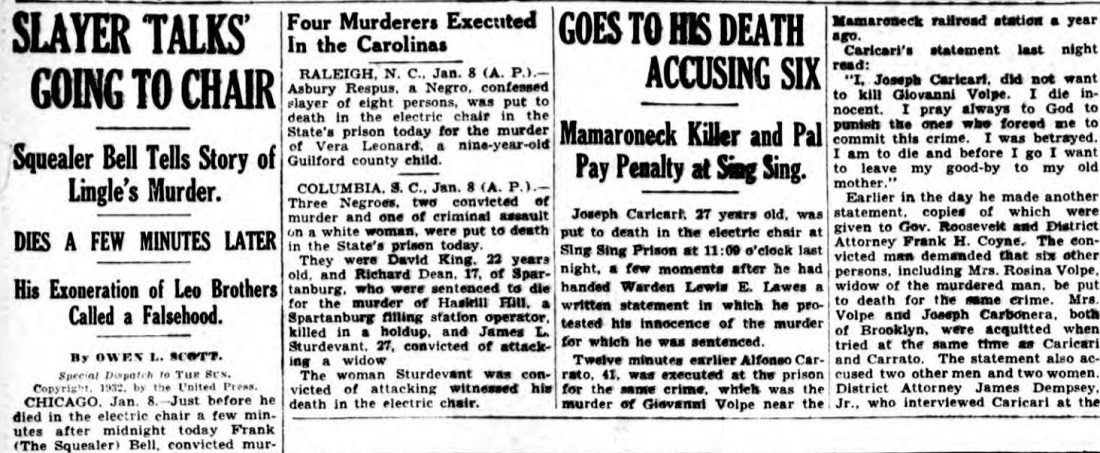
1932: Asbury Respus, North Carolina serial killer

(Thanks to Meaghan Good of the Charley Project for the guest post. -ed.)

On this date in North Carolina, a middle-aged man named Asbury Respus was executed for the murder of nine-year-old Vera DeWitt Leonard.

And that wasn’t all: though virtually forgotten today, Respus was a serial killer with eight confessed murders to his name.

He claimed that he fell from a barn rafter as a youth and was never quite the same after that, being prone to “spells” of homicidal rage. This story may well have been true; he had a noticeable indentation in his skull.

According to Respus’s confession, he killed his first and second victims in Northampton County in the early 1900s. Their names were Lizzie Banks, whom he shot, and Zenie Britt, whom he beat to death with a stick. The third victim was Becky Storr, killed in Boydton, Virginia around 1910; she too had been bludgeoned with a stick.

These early murders are attested only by Respus’s own confession; the first verifiable homicide by his hand took place in 1912. Sentenced to 15 years for manslaughter in the shooting death of a Northampton County man named Ed D. Wynne, Respus escaped from a road gang in 1916 and began life as a drifter.

They can’t have hunted this fugitive very hard. He never went far, always staying in the vicinity of Greensboro, North Carolina.

All four victims prior to his incarceration had been African Americans, as was Respus himself. On January 14, 1918, Respus crossed the color line to axe to death a 56-year-old white woman named Jennie Brown in her home, which he then burned to the ground. So thoroughly did his arson consume the premises that no evidence of a crime remained … leaving Respus free to continue his murder spree. From here on out, by whatever happenstance, all victims were white.

On July 22, 1920, he came across a little boy named Robert Neal Osborne and drowned him in a stream, just for kicks. Again he got lucky: little Robert’s death was recorded as accidental. On July 17, 1925, he murdered 80-year-old widow Eunice Stephenson by striking her on the head and hanging her body from a ceiling beam. This homicide was recognized as such but went unsolved for years.

Vera Leonard was Respus’s youngest female victim and his undoing. Respus may have killed her with rape on his mind. As it was, he went with his old standby, a blunt instrument to the head; afterwards, he burned her body “to a char.” He did not blame his “homicidal spells” for Vera’s murder but instead said he’d been out of his mind on drugs.

Respus expressed gratitude that he was going to his death. “I’d rather he dead and in heaven,” he said, “than here on earth being tormented to death.”


It was a busy day for U.S. executioners. Headlines from the Jan. 8, 1932 edition of the New York Sun.

On this day..

1927: Robert Greene Elliott conducts six electrocutions in one day

On this date in 1927, Robert Greene Elliott — the “state electrician” who wired the majesty of the law to condemned men and women from Rockview, Pa. to Windsor, Vt. — had the busiest day of his illustrious career.

Once just a regular prison electrician, Elliott graduated himself to the euphemism in 1926 and was soon the go-to angel of electric death throughout the northeast. He pulled the lever a reported 387 times for men and women who sat in the new killing device in New York, New Jersey, Pennsylvania, Massachusetts, Connecticut and (just one time) Vermont; when John Dos Passos wrote that “they have built the electricchair and hired the executioner to throw the switch,” well, he could have been talking about Elliott’s $150-per-head bounty.

January 6, 1927 was a full and lucrative day for Elliott.

He started the day off with a triple execution in Boston’s Charleston Prison — the first triple electrocution in Massachusetts history.* Then he took a train to New York — relaxed with family — took in a picture — and then conducted the Empire State’s triple execution in the evening. (All six of his luckless subjects in either state had been sentenced for various robbery-murders.) His $900 in wages between the two occasions would be the equivalent of a $12,000+ payday today.

Friend of the site Robert Walsh has a wonderful post detailing this character’s remarkable career; venture if you dare into the world of a prolific killer of the Prohibition and Depression eras, here.

Elliott also wrote an autobiography, Agent of Death, which is out of print and difficult to come by.

* Elliot would return there a few months later for a more famous trio: Sacco and Vanzetti, along with their accomplice Celestino Madeiros. Some other noteworthy clients of Elliott: alleged Lindbergh baby kidnapper Bruno Richard Hauptmann and illicitly photographed femme fatale Ruth Snyder.

On this day..

1945: Robert E. Folkes, the first condemned man to see the Oregon gas chamber

(Thanks to Robert Elder of Last Words of the Executed — the blog, and the book — for the guest post. Fans of this here site are highly likely to enjoy following Elder’s own pithy, almanac-style collection of last words on the scaffold. -ed.)

“I have nothing to say except that I am innocent. It’s easier to convict a Negro than a white person. So long everybody.”

Robert E. Folkes, convicted of murder, gas chamber, Oregon.
Executed January 5, 1945

Folkes, age twenty-three, was convicted of slashing a woman’s throat on a Southern Pacific train while working as a cook. The Associated Press described him as “the first condemned man to see the chamber,” as Folkes was the first prisoner to ever walk into the Oregon gas chamber without a blindfold on.

On this day..

1864: James Utz, St. Louis spy

Confederate agent James Morgan Utz had a blue Christmas indeed in 1864, awaiting his December 26 execution for espionage.

The Missourian had been captured traveling with a small band out of St. Louis disguised in Union uniforms and carrying supplies and ciphered messages for the invading Confederate army of General (and former governor) Sterling Price.

The federals handled Utz as a spy and a military court sentenced him to hang — a sentence that had already been carried out by the time President Lincoln’s grant of executed clemency arrived.

Tuesday morning last I was horrified at the announcement by a friend that Jas. Utz, Paul’s companion and leader in their attempt to go South, had been executed, being hung on Monday, the day after Christmas, in the jail yard.

It plunged me in a stupor or excitement from which my mind was not free for the entire day. The sentence barely issued and the punishment instantly carried out! The hurry, the suddenness was most revolting. No time given for taking leave of family, friends! No time for appealing for mercy or for a reprieve. No time allowed for composing himself for death!

Diary of a family member of Paul Fusz, one of Utz’s secret party. (Fusz, only 17 when captured, was pardoned after serving six months at hard labor.)

On this day..