In September 1761, a man named Francois Rochette was detained in Toulouse, France, having been arrested traversing the nearby countryside on suspicion of being one of that area’s robbers.
Rochette was not a robber.
He was much, much worse: a Huguenot minister.
Interrogation soon made the situation clear. Technically, his heretical calling could subject Rochette to the death penalty, but the authorities weren’t going to be unreasonable about this — and “as Rochette was not surprised in the exercise of his function, he might easily have escaped by concealing his profession. Those, who interrogated him went even so far as to point out to him this means of acquittal.”
Every legal regime needs a bit of discretion, a bit of look-the-other-wayism, lest the letter of the law excite a judicial slaughter that public sentiment could never support.
Francois Rochette wasn’t interested in signing himself off a clerk or a cloth-merchant and being on his cagey way. He would not elide his calling: would not abet an other-way look.
Rochette’s obstinately overt Protestantism and the prospect of juridical proceedings against him put the whole city on edge. Catholics and Huguenots armed themselves, bracing for a horrid St. Bartholomew’s Day replay. Three brothers named Grenier hastened to Toulouse to aid their fellow-Huguenots, and were arrested; miraculously, the feared citywide bloodbath never quite materialized.
But now Francois Rochette and his Grenier backers would stand trial, in an environment where authorities were disposed to view their offense as one not merely of wrongthink but of stirring up a civic disturbance and endangering the city itself. They were accordingly condemned to death by a now-stringent court for their literally dangerous heresy on February 18, 1762.
That night, the Huguenots’ last on earth, inevitably featured a visitation of Catholic priests come to save their souls.
“It is for your salvation,” said they, “that we are here.” The answer of one of the prisoners was, “If you were at Geneva, ready to die in your bed (for no one is slain there on account of his religion), would you be pleased if four ministers came, under the pretence of zeal, to persecute you until your last breath? Do not, then unto others that which you would not wish to be done unto yourselves.”
On the 19th of February, at two o’clock in the afternoon, the mournful procession started on its way. Rochette was, according to the terms of the sentence, bare-headed, bare-footed, with a halter hung about his neck, from which, before and behind, labels were suspended, with these words, Minister of the pretended Reformed religion.
When the array passed before the church of Saint Etienne, an attempt was made to force him, in pursuance of the terms of the Parliament’s condemnation, to kneel with a torch of yellow wax in his hand, and to ask pardon of God, the king, and justice, for all his crimes and misdeeds.
Rochette stepped down from the tumbril, and instead of abjuring or making a confession which his heart denied, he pronounced on his knees the following words: “I beseech God to pardon me for all my sins, and I firmly believe that they have been washed away by the blood of Jesus Christ, who has redeemed us so dearly. I have no pardon to ask of the king, whom I have ever honoured as the Lord’s annointed, and loved as the father of my native land; I have ever been a good and faithful subject, and of this I believe my judges to be convinced. I have always preached to my flock patience, obedience, and submission; and my sermons, which you possess, are summed up in these words: ‘Fear God, honour the king.’ If I have contravened the law touching religious assemblies, it was by God’s commandments I contravened them; God must be obeyed before men. As for justice and the law, I am guilty of no offence against them, and I pray God may pardon my judges.”
Every door, balcony, window, roof, and approach near to the place of execution, was covered with spectators. “Toulouse,” says Count de Gebelin, an eye-witness, who related these circumstances, “Toulouse, that city drunk with the blood of martyrs, seemed a Protestant town. People asked what was the creed of these heretics; and when they heard our martyrs speak of Jesus Christ and of his death, every one was surprised and afflicted. They were infinitely touched, also, with the lofty, yet mild bearing of the three brothers, which compelled their admiration almost as much as the inexpressible serenity of the minister, whose graceful and spiritual physiognomy, whose words full of firmness and courage, and whose youth, filled every beholder with interest, knowing, as all did, that he only died because he disdained to save his life by a lie.”
Rochette was executed first. He exhorted his companions until the end, and sang the canticle of the Protestant martyrs: This is the blessed day. “Die a Catholic,” said the executioner, moved with pity. “Judge which is the better religion,” replied Rochette, “that which persecutes, or that which is persecuted.”
The youngest of the thre brothers (he was only twenty-two years of age), hid his face in his hands to shut out this tragic scene. The two others contemplated it with calmness. As they were gentlemen, their sentence was, to be beheaded. Tyembraced each other, recommending their souls to God. The eldest offered his head to the axe first. When it came to the turn of the last, the executioner said: “You have seen your brothers die; change, lest you perish like them.” “Do thy duty,” said the martyr, and his head rolled upon the scaffold.
Count de Gebelin adds, as he concludes his recital: “Everyone present returned home in silence, in a state of consternation, and unable to persuade themselves that there could be such courage and such cruelty in the world; and I, who describe it, cannot refrain from tears of joy and sadness, as I contemplate their blessed lot, and that our church should be still capable of affording examples of piety and firmness that will compare with the most illustrious monuments of the primitive church.”
It was only days later — March 10, 1762 — that Toulouse followed up this example of piety and firmness by breaking Jean Calas on the wheel in another prosecution of a Huguenot driven by sectarian sentiment (albeit not directly for heresy, in the Calas case).
Backlash against the Calas case, led by Voltaire, helped put to the fore the long-percolating Enlightenment values of tolerance. Official persecution of Protestants slackened greatly in the years to come and never again rose to a death penalty situation; the whole policy was officially revoked in 1787.
On this date in 1999, Sean Sellers became the last person put to death in the U.S. for a crime committed at the age of 16.
Sellers was just four months into his 17th year when he shot dead an Oklahoma City convenience store clerk in a haze of adolescent angst.
“When I was that person, that murderer, I felt superior,” he later wrote in a confession. “I looked down on people with the secret knowledge that I had killed and was capable of killing them too. When I was not that person I was just a confused teenager, going to school, working, learning to drive, still full of anger, and counting the days when I’d be 18 so I could move OUT of that house.”
Six months later, he moved OUT for good by killing his mother and stepfather as they slept. This killing did not stay secret.
But on trial for having avowedly killed as “an offering to Satan” during the height of the 1980s’ bizarre devil-worship panic, his age barely figured at all. A cash-strapped public defender tried to argue that he was possessed; later, a defense psychiatrist claimed that Sellers suffered from multiple personality disorder. It’s safe to say the young man wasn’t right in the head at some level, but this sort of thing is juridical grasping at straws.
Sellers later converted to Christianity, but this conversion wouldn’t help him any more than it had helped Karla Faye Tucker the year before. In Sellers’ case, quite a lot of people thought it was all more or less a scam — the manipulative killer’s ploy to avoid the needle.
One footnote to the much-hyped Satanism angle was the teenage Sellers’ interest in Dungeons & Dragons. (Just him and a few million other people.)
A guy like Sean Sellers magic missile-ing a beholder one day and then wasting his parents the next — that was pretty much the Platonic ideal of the anti-D&D campaign. People magazine said the hobby “fueled his darkening fantasies”. (For his part, Sellers disputed the connection.)
Although this sort of thing looks pretty laughable, there are still some authorities who fail their saving throw against dumb when it comes to the infernal pastime.
Haven’t they seen the after-school special?
As an aside, this “rant” (author’s word) from a man whose ex-wife became involved in the Sellers clemency campaign is a pretty interesting snapshot of the prisoner himself, and of the relationships in close proximity to him.
One hundred years ago today, John Williams was hanged at Lewes Gaol for murdering a police officer.
Not this John Williams.
Williams was supposed to be the mysterious prowler spotted lurking outside a Hungarian countess’ Eastbourne home on October 9, 1912. The prowler was treed on the portico of the house by a responding police officer, but shot that cop dead and made good his escape.
The ensuing “Case of the Hooded Man” — the branding is not quite Sherlock Holmes, but it suits this blog — concerned the legal contest over whether John Williams was that prowler/shooter.
Circumstantial though it was, quite a lot of evidence supported that conclusion.
The day after the murder, Williams was informed upon by a young friend, Edgar Power, who knew him by his real name of George McKay. Williams/MacKay had passed Power a note on the night the policeman died reading, “If you would save my life come here at once to 4 Tideswell Road. Ask for Seymour [the name of Williams’s girlfriend]. Bring some cash with you. Very Urgent.”
Power set up a meeting with Williams where the police could nab him. (Power would later testify at trial that his friend had bragged specifically about his “good shot” that hit the policeman.)
Not yet done, our busybody stool pigeon then called on Williams’s girlfriend and persuaded her to move the murder weapon she had hidden with her beau … enabling police to grab that piece of evidence, too.
That gun made its mark in the emerging science of forensic ballistics. Seminal ballistics expert Robert Churchill was able to conclusively link this firearm to the portico murder by means of an early application of a now-familiar technique.
Churchill fitted a new hammer and springs and then test-fired [the gun]. Those test bullets had the same rifling pattern as the bullet used to kill Inspector Walls, and Churchill had no doubt about his conclusions that it was a gun of that very same make which had fired the fatal bullet.
In order to demonstrate the technicalities of Churchill’s evidence, Sergeant William McBride, one of the very first police photographers at Scotland Yard, used close-range photography to illustrate the pattern of the grooves on the bullets. He also collaborated with Churchill in placing dentist’s wax inside the gun barrel, then withdrawing it when it had cooled and set hard. This enabled him to photograph the pattern in the wax, caused by the grooves of the inside of the gun barrel, showing the same profile that would match a lead bullet fired through that gun barrel.
A nationwide petition for Williams’s pardon would circulate after his conviction upon the production of some dubious evidence throwing suspicion upon another (phantasmal, so far as anyone could determine) party. The Home Secretary replied to those appeals in the House of Commons a week before the execution:
The house will understand that there is no part of the Home Secretary’s duty which throws greater responsibility upon him or is indeed more painful, then that which has to be exercised in connection with the prerogative of mercy. Of course, any man would be only too glad to find a scintilla of evidence or reason, or I might say to invent a reason, which would enable him to save a human life. But my duty, as I understand it, is to act in accordance with the law and the traditions of my office … the whole story [of a man’s alleged twin brother committing the crime] is an invention because [the man], having known John Williams in the past, he did not like to think of his being hanged.
The last known witchcraft execution in Bermuda history occurred on this date in 1655.
The isolated English colony was at this period laboring under social crisis, or a set of crises. It had been declared in rebellion by Cromwell‘s parliament for taking too-vigorous umbrage at King Charles‘s execution. Its official C of E ministers were being challenged by breakaway independents of various stripes of Puritanism. The tobacco crop blew away one year. And it may have had a perilous gender imbalance (too many women, too few men: Bermuda definitely did have this problem in the 18th century). (Source for this whole paragraph) Perhaps it’s no surprise that its Puritan governor* would oversee a spasm of witch persecutions from 1651 to 1655.
Jane Hopkins and another woman named Elizabeth Page were both stuck in the dock on this occasion. They’d recently arrived on the Mayflower** and the captain “did vehemently suspect them to be witches,” seemingly on account of their traveling sans male.
Page bewitched the ship’s helm according to a witness who beheld her run “her finger over the compas, And yt ran round from North to South, And turned backe againe.” That’s pretty impressively infernal, but here in the 17th century they knew to look for some hard forensic evidence … so a group of matrons in Bermuda was empaneled to feel Elizabeth Page up in search of a witch’s teat. Much to the woman’s good fortune, she possessed “not any marke or spotts or signes … only something more than ordinary (in a certain place).” She was accordingly acquitted.
Jane Hopkins’ body was not so ordinary.
The eyewitness testimony against her was a fellow-passenger to whom Hopkins sighed that she wished God would send some sign clearing up all these suspicions of devilry. A rat — ubiquitous in seafaring life, mind you — promptly appeared. To add to this damning divine indictment, a peeping tom on the ship watching her dress had noticed some sort of mark on her shoulder.
Sure enough, Hopkins’s gropers discerned “in her mouth a suspicitious marke and under her arme she hath a dugge or Teat, And upon her shoulder a wart, and upon her necke another wart … all these were insensible when they were prickt.” With this sort of slam-dunk evidence, the jurymen could hardly do otherwise than agree that Hopkins “hath felonously and wickedly consulted and covenanted with the Devil & him hath suckled and fedd contrary to nature & the law of God and man, as doth appeare by markes & signes upon her body.” (The full trial records can be perused here)
It’s not absolutely certain that Jane Hopkins was the last person executed in Bermuda for witchcraft. There were several additional witch prosecutions to follow in the 17th century: some ended in acquittal, others in conviction. There was even at least one more death sentence, but that hanging was stayed and the final disposition of the case is unknown.
* Governor Josiah Forster’s legacy for the isles — other than hanging witches — was the “Forster Chair” made in his honor.
** Not the same ship as the Mayflower of Plymouth Colony fame.
In the 1870s, the illegal settlement of Deadwood, South Dakota attained pride of place among Old West frontier towns, complete with vigilante justice, lethal gunfights, and lucrative brothels.
Yet even though it was the source of South Dakota’s first legal hanging — Wild Bill Hickok’s murderer Jack McCall, who swung in Yankton — Deadwood itself did not play host to a proper judicial execution until this date in 1882.
The unhappy subject of this occasion? James Gilmore, a surly and perhaps deranged Ohioan who had senselessly gunned down a Mexican fellow-laborer named Bicente Ortez when both men were driving wagons on the Pierre-Deadwood route. Gilmore got upset when Ortez spooked his oxen, waited until the teams made camp that night, and then walked up to Ortez during dinner and shot him in the arm.
As the startled Ortez tried to flee, Gilmore pumped three more shots into his back.
(This was near Deadman’s Creek. How trite.)
Anyway, Gilmore’s ox-driving companions might have disliked Ortez themselves because they gave Gilmore a horse and a few bucks and, while his mortally wounded ex-comrade lay painfully expiring all the night long, let the shooter flee into the wilds. He’d be captured only months later, still driving livestock for some ranch.
“Is it for killing that son of a bitch Mexican?” he asked the marshals, incredulously.
(The prosecutor would close his trial with a charge to the jury that “in this land of the free, every man, regardless of color, creed, or other station in life was equal before the law, and the law protected with its folds, the plebian as well as the millionaires, and it knows no difference between the bull-whacker and the bonanza king.”)
Gilmore was convicted of murder and sentenced to die in the autumn of 1881. However, the offender’s advocates pushed his appeals all the way to the U.S. Supreme Court. According to the Cincinnati Daily Gazette (Dec. 16, 1882), whose interest in the case derived from Gilmore’s nativity in Steubenvile, Ohio,
It is the opinion of many who knew him best, that James Gilmore had not a mind sufficiently well balanced to make him responsible for the terrible deed for which he was sentenced. Many stories are told of his strange freaks when a child (he is not yet twenty-two years old), which shows that he was of a very irritable temperament. At one time, fancying himself insulted by a citizen of this place [Steubenville], he attempted to shoot two fine horses belonging to the offender, with a small pistol… At another time he set the school building on fire and then placed himself in the most dangerous position he could find. He would frequently run away from home, and was found once by a brother, who is an officer in the United States Navy, in New York City.
Evidently, Gilmore’s non-naval other brother was a lawyer, who was able to corral testimony as to his sibling’s unsound mind from a variety of worthies who knew the unbalanced James in his youth.
But those appeals ultimately failed, as did Gilmore’s father’s simultaneous push in Washington D.C. (since the Dakotas were still federal territory) for executive clemency. Advised by Gilmore’s detractors that the condemned murderer “was a second Guiteau of a most diabolical character,” (Grand Forks Herald, Oct. 28, 1882), President Chester A. Arthur declined to interfere. Arthur was a guy who couldn’t be soft on Guiteaus.
Gilmore never denied responsibility for murdering Ortez, and at his (private) hanging he attributed the whole thing to his “bad temper” ever since his mother died when he was a child.
Elsewhere in the U.S. on the same busy day, Peter Thomas was hanged in Mansfield, La. for murdering a fellow sharecropper in a rivalry over a woman; John Redd was hanged in Seale, Ala., for murdering a woman in the throes of unrequited love; and, a Mississippi gentleman named A. Farkas was to have been hanged for murdering his wife, Emma, except that the execution was respited at the last moment to permit him a judicial appeal — which Farkas eventually won.
“The law of England has displayed no unnecessary nicety, in apportioning the punishments of death …. Kill your father, or catch a rabbit in a warren — the penalty is the same! Destroy three kingdoms, or destroy a hop-bine — the penalty is the same!”
E.P. Thompson’s classic Whigs and Hunters: The Origins of the Black Act, has its titular legislation as “an expression of the ascendancy of a Whig oligarchy, which created new laws and bent old legal forms in order to legitimize its own property and status”
On this date in 1723, seven Waltham Blacks were hanged at Tyburn.
These poachers were the impressive first salvo of the Black Act, a new-minted statute early in the landmark government of Robert Walpole.
This law had been enacted to combat the rise of game poaching. As we’ve noted before, poaching was a longtime conflict zone in a Great Britain emerging as distinctly capitalist.
The Black Act would not merely sharpen those conflicts — it would intentionally define them, helping to enclose a labor marketplace enforced with hemp.* The Black Act added nearly 50 capital offenses to the rolls; it was a seminal statute for the 18th century’s notorious “Bloody Code”.
“The Black Act had a much wider sweep than a statute intended merely to protect the royal forests,” Frank McLynn notes. Poaching gangs “provided the occasion for draconian legislation; they were not its cause.”
These huntsmen were, early in the 18th century, increasingly bold taking game on forest preserves in defiance of hunting restrictions that made an absurd mishmash of feudal anachronisms and latter-day statues all of which contrived to limit the hunt only to a handful of wealthy landed aristocrats. It was, per Blackstone, “a bastard slip, known by the name of the game laws … wantoning in the highest vigour.”
This vigourous wantoning actually made for a multilateral class conflict. The rural poor, being displaced by enclosures, were barred from opting out of proletarianization for a life on the forage. (Nobody was allowed to sell game meat.) Sportsmen had the run of the land, but only the very richly landed could be “sportsmen”: small farmers were forbidden to take game even on their own property, whereas those whose huge estates licensed them to hunt were entitled to tramp through neighboring crops in pursuit of their quarry.
Poaching followed these un-neighborly injuries to traditional commons rights as vigorously as hounds follow hares. The state answered with the Black Act, and did not scruple to accuse known companies of “Blacks” of being Jacobite catspaws.
So named because it targeted poachers’ practice of “blackening” their faces, the 1722 law made it a hanging crime to go on the hunt in disguise, as well as a hanging crime to poach deer, rabbits, conies, or fish. Formerly, “deer-stealing” and the like had been mere misdemeanors.
The act also mandated death for a broad range of other rustic crimes such as damaging orchards, gardens, or cattle, with like penalties attached to conspiring to commit any of these crimes or rescuing anyone imprisoned for these crimes.**
The seven hanged this date were “Blacks” who happened to be captured shortly after the Black Act took effect in mid-1723 — from Windsor forest, and elsewhere. As a show of resolve in enforcing its grim new decrees, the crown had all these men shipped to London, far from their own communities where jurymen themselves aggrieved by game laws were known to acquit.
* Lest one doubt this red-tinged historiography of the Act, its apologists were no less clear on its objectives.
“No man, however successful in the profession, can expect to get as much profit by deer-stealing, as by following his lawful business,” intoned the Newgate Calendar about today’s hangings. “[Y]oung persons cannot learn a more important maxim than that in the scripture; ‘the hand of the diligent maketh rich.’
“In this place it may not be improper to make a single remark on the game laws. These are supposed to be, possibly not without reason, severe: it is contended that those animals which are wild by nature are equally the property of every man. Perhaps this is the truth: but persons in the lower ranks of life should remember, that when laws are once enacted, THEY MUST BE OBEYED. Safety lies in acquiescence with, not in opposition to, legal institutions.” (emphasis added)
** Just for good measure, it also prescribed the noose for just about every form of arson, and for anyone who “shall wilfully and maliciously shoot at any person in any dwelling-house, or other place” regardless of injury.
On this date in 1835, John Smith and James Pratt (sometimes reported as John Pratt) were hanged outside Newgate Prison for (in the exhausting fulminations of the Old Bailey trial records) “feloniously, wickedly, diabolically, and against the order of nature, carnally … commit[ted] and perpetrate[d] the detestable, horrid, and abominable crime (among Christians not to be named) called buggery.”
These men were the last put to death anywhere in the realm under the ghastly Tudor-era Buggery Act,* and indeed among the last to die at Newgate for any crime other than murder or attempted murder.
“The grave will soon close over me,” Smith allegedly wrote to a friend before his hanging, “and my name [be] entirely forgotten.”
But that’s not altogether true.
Unbeknownst to the sufferers, they were destined for literary preservation by a young writer on the make, one Charles Dickens: Smith and Pratt make an appearance in Dickens’ Sketches by Boz, an 1836 compilation of London scenes of which “A Visit to Newgate” is perhaps the best-known.
This piece narrates a visit Dickens paid, according to William Carlton’s “The Third Man at Newgate” (The Review of English Studies, Nov., 1957), on November 5, 1835. Dickens would write in subsequent correspondence that the experience left him “intensely interested in everything I saw.”
Prisons and the threat or reality of execution would loom large in that redoubtable author’s canon. “You cannot throw the interest over a year’s imprisonment, however severe, that you can cast around the punishment of death,” the perspicacious 23-year-old told his publisher.
So too did the still-living apparitions of the condemned Smith and Pratt occupy Dickens’s reflections in “A Visit to Newgate”; they comprise a good third of the essay.
In the press-room below, were three men, the nature of whose offence rendered it necessary to separate them, even from their companions in guilt. It is a long, sombre room, with two windows sunk into the stone wall, and here the wretched men are pinioned on the morning of their execution, before moving towards the scaffold. The fate of one of these prisoners was uncertain; some mitigatory circumstances having come to light since his trial, which had been humanely represented in the proper quarter. The other two had nothing to expect from the mercy of the crown; their doom was sealed; no plea could be urged in extenuation of their crime, and they well knew that for them there was no hope in this world. ‘The two short ones,’ the turnkey whispered, ‘were dead men.’
Smith and Pratt, of course, were the “dead men.”
Their third companion, otherwise unconnected with them, was a soldier named Robert Swan, convicted of robbery. Swan was indeed reprieved, a few days before the execution. “Boz” sketched the aspect of these men as he observed them:
The man to whom we have alluded as entertaining some hopes of escape, was lounging, at the greatest distance he could place between himself and his companions, in the window nearest to the door. He was probably aware of our approach, and had assumed an air of courageous indifference; his face was purposely averted towards the window, and he stirred not an inch while we were present. The other two men were at the upper end of the room. One of them, who was imperfectly seen in the dim light, had his back towards us, and was stooping over the fire, with his right arm on the mantel-piece, and his head sunk upon it. The other was leaning on the sill of the farthest window. The light fell full upon him, and communicated to his pale, haggard face, and disordered hair, an appearance which, at that distance, was ghastly. His cheek rested upon his hand; and, with his face a little raised, and his eyes wildly staring before him, he seemed to be unconsciously intent on counting the chinks in the opposite wall. We passed this room again afterwards. The first man was pacing up and down the court with a firm military step – he had been a soldier in the foot-guards – and a cloth cap jauntily thrown on one side of his head. He bowed respectfully to our conductor, and the salute was returned. The other two still remained in the positions we have described, and were as motionless as statues.
If we have Dickens to thank in part for this unexpected glimpse of these poor fellows in the shadow of death, we also can hardly help but notice that — and this is in keeping with Smith’s forecast of posthumous anonymity — he does not name them, nor breathe a word about their scandalous crime. Only the man destined for the reprieve has animation; Smith and Pratt, immobile and affectless, are … but are little else besides. “Dead men,” like that turnkey said. This is not necessarily implausible, but it is also very pat for the literary construction of “A Visit to Newgate,” and we might be entitled to wonder how close to journalistic accuracy the writer has really come here, or regret the details Dickens has discarded that might have salvaged their humanity for a later readership.
Dickens’ party proceeded from these characters to a tour of the physical cells in which these doomed “statues” passed their last sleepless nights.
A few paces up the yard, and forming a continuation of the building, in which are the two rooms we have just quitted, lie the condemned cells. The entrance is by a narrow and obscure stair-case leading to a dark passage, in which a charcoal stove casts a lurid tint over the objects in its immediate vicinity, and diffuses something like warmth around. From the left-hand side of this passage, the massive door of every cell on the story opens; and from it alone can they be approached. There are three of these passages, and three of these ranges of cells, one above the other; but in size, furniture and appearance, they are all precisely alike. Prior to the recorder’s report being made, all the prisoners under sentence of death are removed from the day-room at five o’clock in the afternoon, and locked up in these cells, where they are allowed a candle until ten o’clock; and here they remain until seven next morning. When the warrant for a prisoner’s execution arrives, he is removed to the cells and confined in one of them until he leaves it for the scaffold. He is at liberty to walk in the yard; but, both in his walks and in his cell, he is constantly attended by a turnkey who never leaves him on any pretence.
We entered the first cell. It was a stone dungeon, eight feet long by six wide, with a bench at the upper end, under which were a common rug, a bible, and prayer-book. An iron candlestick was fixed into the wall at the side; and a small high window in the back admitted as much air and light as could struggle in between a double row of heavy, crossed iron bars. It contained no other furniture of any description.
A year after Sketches‘ February 1836 publication, Dickens’ serialized novel of the London underclass Oliver Twist began its run. That story’s heart-wrenching denouement of the thief Fagin awaiting execution in Newgate seems to owe a debt to Dickens’ meditation in Sketches on the dolorous condition of Smith, Pratt, or any doomed prisoner facing death in these awful cells.
“A Visit to Newgate” concludes:
Conceive the situation of a man, spending his last night on earth in this cell. Buoyed up with some vague and undefined hope of reprieve, he knew not why – indulging in some wild and visionary idea of escaping, he knew not how – hour after hour of the three preceding days allowed him for preparation, has fled with a speed which no man living would deem possible, for none but this dying man can know. He has wearied his friends with entreaties, exhausted the attendants with importunities, neglected in his feverish restlessness the timely warnings of his spiritual Fagin in Newgate – Cruikshank consoler; and, now that the illusion is at last dispelled, now that eternity is before him and guilt behind, now that his fears of death amount almost to madness, and an overwhelming sense of his helpless, hopeless state rushes upon him, he is lost and stupefied, and has neither thoughts to turn to, nor power to call upon, the Almighty Being, from whom alone he can seek mercy and forgiveness, and before whom his repentance can alone avail.
Hours have glided by, and still he sits upon the same stone bench with folded arms, heedless alike of the fast decreasing time before him, and the urgent entreaties of the good man at his side. The feeble light is wasting gradually, and the deathlike stillness of the street without, broken only by the rumbling of some passing vehicle which echoes mournfully through the empty yards, warns him that the night is waning fast away. The deep bell of St. Paul’s strikes – one! He heard it; it has roused him. Seven hours left! He paces the narrow limits of his cell with rapid strides, cold drops of terror starting on his forehead, and every muscle of his frame quivering with agony. Seven hours! He suffers himself to be led to his seat, mechanically takes the bible which is placed in his hand, and tries to read and listen. No: his thoughts will wander. The book is torn and soiled by use – and like the book he read his lessons in, at school, just forty years ago! He has never bestowed a thought upon it, perhaps, since he left it as a child: and yet the place, the time, the room – nay, the very boys he played with, crowd as vividly before him as if they were scenes of yesterday; and some forgotten phrase, some childish word, rings in his ears like the echo of one uttered but a minute since. The voice of the clergyman recalls him to himself. He is reading from the sacred book its solemn promises of pardon for repentance, and its awful denunciation of obdurate men. He falls upon his knees and clasps his hands to pray. Hush! what sound was that? He starts upon his feet. It cannot be two yet. Hark! Two quarters have struck; – the third – the fourth. It is! Six hours left. Tell him not of repentance! Six hours’ repentance for eight times six years of guilt and sin! He buries his face in his hands, and throws himself on the bench.
Worn with watching and excitement, he sleeps, and the same unsettled state of mind pursues him in his dreams. An insupportable load is taken from his breast; he is walking with his wife in a pleasant field, with the bright sky above them, and a fresh and boundless prospect on every side – how different from the stone walls of Newgate! She is looking – not as she did when he saw her for the last time in that dreadful place, but as she used when he loved her – long, long ago, before misery and ill-treatment had altered her looks, and vice had changed his nature, and she is leaning upon his arm, and looking up into his face with tenderness and affection – and he does NOT strike her now, nor rudely shake her from him. And oh! how glad he is to tell her all he had forgotten in that last hurried interview, and to fall on his knees before her and fervently beseech her pardon for all the unkindness and cruelty that wasted her form and broke her heart! The scene suddenly changes. He is on his trial again: there are the judge and jury, and prosecutors, and witnesses, just as they were before. How full the court is – what a sea of heads – with a gallows, too, and a scaffold – and how all those people stare at HIM! Verdict, ‘Guilty.’ No matter; he will escape.
The night is dark and cold, the gates have been left open, and in an instant he is in the street, flying from the scene of his imprisonment like the wind. The streets are cleared, the open fields are gained and the broad, wide country lies before him. Onward he dashes in the midst of darkness, over hedge and ditch, through mud and pool, bounding from spot to spot with a speed and lightness, astonishing even to himself. At length he pauses; he must be safe from pursuit now; he will stretch himself on that bank and sleep till sunrise.
A period of unconsciousness succeeds. He wakes, cold and wretched. The dull, gray light of morning is stealing into the cell, and falls upon the form of the attendant turnkey. Confused by his dreams, he starts from his uneasy bed in momentary uncertainty. It is but momentary. Every object in the narrow cell is too frightfully real to admit of doubt or mistake. He is the condemned felon again, guilty and despairing; and in two hours more will be dead.
Lotta books about Dickens
A magistrate with the Dickensian name of Hesney Wedg(e)wood appealed vigorously for clemency for Smith and Pratt — pointing out that the only reason these two had been doomed among the rather many enthusiasts** for this victimless offense was that they were penurious enough to have to pursue their desires in a lodging-house rented by a friend where they were easily spied-upon.
(The testimony lodged against them in court came from the nosy landlord who got suspicious, and with his wife peeped through the keyhole on “Pratt laying on his back with his trowsers below his knees, and with his body curled up—his knees were up—Smith was upon him—Pratt’s knees were nearly up to Smith’s shoulders—Smith’s clothes were below his knees … and a great deal of fondness and kissing.” The landlord burst in on the sodomites and put a stop to the fondness right away.)
“There is a shocking inequality in this law in its operation upon the rich and the poor,” wrote Wedgwood.
It is the only crime where there is no injury done to any individual and in consequence it requires a very small expense to commit it in so private a manner and to take such precautions as shall render conviction impossible. It is also the only capital crime that is committed by rich men but owing to the circumstances I have mentioned they are never convicted. The detection of these degraded creatures was owing entirely to their poverty, they were unable to pay for privacy, and the room was so poor that what was going on inside was easily visible from without. (Quoted here)
* The first executed under the Buggery Act shared his scaffold with Thomas Cromwell almost 300 years before. Although there were no further executions for sodomy after Smith and Pratt in 1835, that penalty remained theoretically available for the “crime” until 1861.
Almost a full year had elapsed since Anna Fessler had received a few shrovetide cakes from the daughter of the neighboring millers.* Hours later, Fessler (who had delivered a child just a week before) took painfully ill and died in her bed.
The cakes led back to the miller’s wife Anna Schmieg, of course. But decades after the Thirty Years’ War, the whole witchcraft construct was on its way out. Robisheaux builds a powerful micro-history of the local magistrate’s painstaking effort to satisfy the era’s rigorous legal standards for witch-persecution.
These standards would soon break down entirely, but in the here and now (or there and then), the authorities had to establish Schmieg’s malevolent reputation, and figure out if there was sufficient evidence to license torture. There wasn’t, the legal doctors whom Hohenlohe consulted advised; Hohenlohe made up a justification to do it anyway.
Anyway, the torture did to a co-accused what torture usually does. That luckless itinerant local woman was named Barbara Schleicher: she’d been under a pall from the accusation of a previously-tortured “witch” in a nearby village a few years before, and with the requisite pressure she soon copped to everything. Schmieg denied and fought and repelled, but eventually she too broke down and made the fatal confession. So, on November 8, 1676, before a court constituted of local grandees,
Anna Elisabeth Schmieg and Barbara Schleicher had to confess one more time, openly and publicly.
This was the moment of danger. Were Anna now to curse the judges as she had cursed the executioner before she was tortured, “asking them to join her for God’s Judgment in the Valley of Jehosaphat,” the proceedings might break up. She could be tortured again, but the curse would have had a shocking effect and raised the question about whether an injustice was about to be committed.
Because of these dangers, instead of asking the women to speak for themselves, the county’s officer spoke for them, saying that the two poor sinners had freely confessed their crimes and were ready to be given over to justice. The scribe read of Anna’s use of witchcraft and murder, as well as her seduction by Satan. He pronounced that she had done so many evil things that she could not even remember them all. He then read out a list of Schleicher’s crimes, which included witchcraft, murdering two husbands, turning herself into a wolf, and attempting to commit suicide. Whoever these two poor sinners had been before that day, they were now publicly branded as witches, poisoners, and murderers.
Talk about speak now or forever hold your peace. For not raising a ruckus, the court threw a bone to the wicked and now-confessed hags and mitigated the sentence of tearing at their flesh with iron tongs followed by burning at the stake to tearing at their flesh with iron tongs followed by strangulation followed by burning at the stake.
Chief Justice Assum turned to the court assessors and asked them whether the sentence had been decided as the court scribe had read it. Together they replied yes. Assum then rose, broke the ceremonial staff in two, and threw the pieces to the floor. With this old legal gesture, the blood court was symbolically breaking its staff over the lives of the prisoners. Then he said, “God help their poor souls.” [Local Count] Heinrich Friedrich’s representative then asked that the executioner carry out the sentence. According to prescription, the command to the executioner was repeated three times. At the close the chief justice forbade everyone present, on penalty of bodily punishment, from seeking revenge for this act of justice. No one was to take up violence against the law or question what was being done. The court scribe repeated his admonition.
The executioner then led the women out of the court, across the drawbridge, and over into the market square, where they joined the procession that had assembled. Drummers beat out a cadence, schoolboys sang hymns, and the sober procession marched down Langenburg’s long main street and out the gate at the east end of the town.
Once past the town gate, Anna’s and Barbara’s expulsion from the community was complete. From many perspectives, as we have seen, Anna’s emotional world was not like our own. It would be wrong to assume that Anna and Barbara felt the same anxiety and fear that we would today as they climbed the “Path of Straw” to Gallows Hill. The belief that someone who received absolution before an execution, and who did not sin again by resisting, would go right to heaven may help explain why prisoners rarely resisted at this point. Most tried to meet their fate as best as they could. Considering the suffering of the last ten months, Anna may have welcomed her end. She and Schleicher may also have been fortified for the ordeal by wine. Prayer may have brought them solace. However she felt about her fate, no record mentions her resisting or cursing the executioner or members of the court.
The scene at the gallows must have been crowded. The execution was seen as an example, and it was considered essential that the Langenburg schoolchildren be let out of school to join the procession. There, with the rest of their neighbors, they would have watched Anna and Barbara torn with hot irons and then strangled with a rope. After the bodies were burned to ashes, the last ritual gesture was made. “Lord Chief Justice,” Master Endris asked, “Have I carried out the law?” To which Assum would have replied, “If you have executed what the law and the sentence require, then the law has been fulfilled.”
This verbal exchange was critical for the execution to have fulfilled its purpose. At this moment the law, formally in suspense since Anna’s arrest, had been restored. The breach in public order that had opened on Shrove Tuesday was now mended. Count Heinrich Friedrich had seen to it. The chief justice and the assessors filed back into town and into the courtroom. Once they took their seats, it was announced that justice had been done. A lavish feast awaited them.
Just stay away from the cakes.
* A delicious tradition. Here’s a recipe for vanilla-frosted custard-filled shrovetide buns, from Denmark. Deadly deadly Satanpoison is optional.
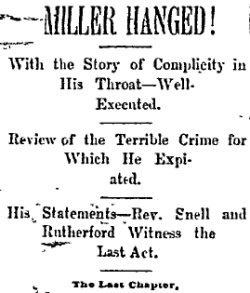
This date in 1885 saw the hanging in Grand Forks, North Dakota* of 19-year-old farmhand George Miller for butchering his employer’s wife and child in order to loot the farmhouse while the patriarch was away.
For this terrible American Gothic crime, we turn to the American Press.
Miller was the first person hanged in North Dakota and the local Grand Forks Herald marked the date with a voluptuous recounting (occupying an entire page, plus two more columns on the next page) of the late scandal all the way to the felon’s scaffold accusation. Here it is, in its entirety …
In the middle of last January when all the earth was wrapped in a mantle of purity, an esteemed minister of the gospel, the father of a bright family of children and a devoted husband with a loving wife, resided on his prosperous farm in the township of Inkster, this county, surrounded with the 320 broad and fertile acres, horses and cattle and improved farming implements he called his own. His earthly possessions he had acquired by industry, thrift and economy, with the wifely assistance and the aid of the little boys and girl that had blessed their union. This gentleman was Rev. C. Y. Snell at one time minister of the Baptist church in Grand Forks, but who had, like nearly all settlers in Dakota taken advantage of his rights and acquired a farm, which had brought a handsome return. His summer’s work done, his grain garnered, he had sent three of his children to Grand Forks to acquire a good education in her public schools, and remaining at the farm, was his wife Abbie and little son Herbie, aged eleven, and the hired man George Miller, a young man of quiet demeanor, aged about 19 years, who had helped to garner the summer’s fruits and whom both Mr. and Mrs. Snell had implicitly trusted.
Thus situated on the 16th of January, Rev. Snell bade his wife and son good-be, little dreaming that the
SHADOW OF THE DEMON
was in his door and before another fortnight his loved ones would be prone, stark and mangled in the icy embrace of blood and horrid death. He went on his errand of good will to Mayville where he was engaged in missionary labor for his Lord and Master. On the 31st of January, two weeks after his absence, he received a telegram informing him of the doleful event — the murder of his wife and boy, and he hastened with bowed form and bleeding heart to the spot where the light of his joy had been ruthlessly extinguished.
OH RUEFUL SCENE!
The demon had done his worst! Have not the details of that heartless butchery been told again and again? Why not draw the veil upon the foul deed? The ghastly corpses of the innocent and unsuspecting sleepers — mother and son, hurled into eternity in a moment while taking the repose of the righteous — as found there by the neighbors a week after the tragedy — divulged the heartlessness of the assassin whoever he might be, and the thorough depravity of the soul that could impel the ruthless ax to deeds of death.
THE VILLAINOUS SHREWDNESS
with which the murderer had avoided suspicion was manifest in the fact that so long a time had elapsed before the discovery of the crime, and will be further apparent as the story progresses. He had been a companion of Henry Rutherford and to avoid immediate discovery, Miller the confessed criminal, had told the nearest neighbors that he intended to give Mrs. Snell a drive on Sunday and that he would haul wood the following week. Thus no suspicion was aroused until late in the week. Friday, Rutherford a simple, untutored laborer who lived alone at Bennett’s place about 60 rods from the Snell residence, thought it strange that there was no stir or animation about the place, and after finding the stock nearly famished, and watering it, alarmed the neighbors and the dreadful truth was discovered. The neighbors H.P. Reiton, Simeon, Miller, C.G. Gordon, Mr. Vietch, Henry Blakely and others found the dead bodies undisturbed and the rifled trunk with its empty money box and the robbed children’s bank just as the murderer had left them. Thus it was plain
THE MOTIVE WAS MONEY —
the sordid lust for gold that causes men to imperil their souls and makes of earth a probationary sheol for evil minds. Mr. Snell had sold considerable grain and when he left he took $300 with him, leaving some money, together with some keep-sakes and the children’s savings in the cash-box in the trunk. After he had gone, Miller sold more wheat and received from agent Holden $205, which he may have turned over to Mrs. Snell or not. But that the robbery of Mr. Snell in some way, was in his mind for a week before the crime was committed is shown by the testimony of Mr. Holden to the fact that Miller asked him a week before, whether he could deliver a load of wheat unknown to Mr. Snell and it further shows that the idea of robbery did not originated with Rutherford at a dance on the 20th of January, only four days before the murder as Miller claimed in his statement before the judge. It shows that the robbery was in contemplation by him without an accomplice and, being ignorant of the fact that Mr. Snell had taken $300 with him to Mayville, he doubtless committed the crime for more money that he received —
FLEEING FROM JUSTICE
After committing the crime, he hastily placed the ax beneath the bed, threw up the bedclothes over the faces of the dead, robbed the trunk of its keep-sakes, harnessed the best pair of horses in the stable, took Snell’s driving gloves and drove forty miles over the cold bleak prairie with the thermometer at 30 degrees below zero, arrived in Grand Forks at break of day Sunday morning in front of the Northwestern Hotel and ordered the team put away and his breakfast prepared. In the sled-box was an overcoat of the boy he had murdered which had probably been left there when the unsuspecting youth last accompanied him in the delivery of the wheat the proceeds of which he contemplated stealing. There was also left there the overalls which Miller had worn and upon which bright specks of blood had been discovered and whose dumb voices cry out testimony against the last black lie of the series which the obdurate murderer coined in the cell against poor simple Rutherford. With the team was Snell’s faithful dog, which followed the fleeing assassin. Upon his arrival here, he commenced a series of ingenious but
BASE COINAGES TO EVADE PURSUIT.
He told Powery, the clerk at the Northwestern Hotel, that he had come to meet his brother at the train and he might go to Winnipeg for a week. He also exhibited some gold pieces which he wanted changed, but the clerk had no change. The design of this story was too evidently to direct pursuit towards Winnipeg, if the team were soon identified as Snell’s. He soon walked off seemingly unconscious of any obligation to pay for his breakfast and next called at the Chicago clothing house, rousing Mr. Ephraim out of his late Sabbath repose. He told Mr. Ephraim a different tale. He was thrown of[f] his guard by the sharp questioning of Ephraim, while selling him the buffalo overcoat, black valise, pocket book, and other out-fit that later led to the capture and identification. He explained the possesion of his roll of bills, amounting to several hundred dollars by saying that he had sold a team of horses receiving $275 for it and intended to go to Turtle Mountain, thus evading the true objective point. He also got rid here of the tell-tale keep-sakes, the gold dollars which Mr. Snell had treasured for years, and the nickles, dimes and quarters which the little Snells had perhaps been years in gathering. Being shown the way to the barbershop of Mr. Kruger by Mr. Ephraim, after he had bought his disguise, he further changed his apperance by getting his hair cut close and his face shaved. Here he left the only clue to the direction in which he was intending to go, by inquiring whether a train left for Crookston, and up to the discovery of this fact by a HERALD representative, the officers seemed to be impressed with the fact that he had really gone to Winnipeg to which point as well as others they telegraphed as soon as it was learned that the team was left in this city. It must be remembered that it was not until the following Saturday that the tragedy was made known and in that time the murderer might have left the country, if he had not been paralyzed by his own wickedness and depravity. Learning at the barbershop that no train left for Crookston on Sunday, he walked to the station on the railroad track and bought a ticket for Fargo, displaying the new red pocket book to the agent. After spending a few days at Fargo among variety women, and having had his picture taken by a photographer, he went to Brainerd, Minn., where he stopped at the house of Malcolm McLaren for a few days more.
I’d be very surprised if our suspect was from Brainerd.
While at Brainerd, he associated with women of loose character and spent considerable money lavishing presents upon them. It seems that he met a female there whom he had formerly known in Iowa. At first he talked to Mr. McLaren about going into business. He wanted to do chores, when he learned that his money was nearly all gone. The St. Paul papers on Sunday morning following the discovery contain accounts of the murder with description of the hired man of Snells, but imperfect, as his disguise was not known, but when the statement of the Northwestern clerk about the gold pieces was published, Mr. Ephraim at once reported the Sunday morning transaction and it was thus that
HIS SIN FOUND HIM OUT.
His new outfit together with the way he had disguised himself were immediately telegraphed to the associated press by the HERALD and with it a statement of the reward offered. When the papers arrived at Brainerd, Miller had quietly decamped, realizing that he was too near the scene of the tragedy. But McLaren, an old detective immediately concluded that the fellow who had staid [sic] at his house was the person sought, and securing a deputization from the sheriff, he drew money for an indefinite trip, learned that Miller had boarded the train with a ticket for Anoka, and followed him up. On the same train went Hartley and another, bent on the same errand and watching McLaren. At Anoka, McLaren happened to strike the bus for the very hotel at which Miller was stopping and he now felt certain of
ARRESTING HIS MAN.
Miller was in his room and armed. McLaren knew the character of the brute better than the inexperienced who put any faith in his pretences during his last days. He concluded to wait till Miller came down, and while McLaren was at breakfast, he heard the murderer’s foot-falls on the stairs and entering the washroom. McLaren immediately left the table and coming up behind Miller with his pistol cocked arrested him, but as he did so, Miller laid his hand on the revolver in his hip-pocket, but the gun of the sheriff had the desired effect and he was disarmed. His attempt to get away from McLaren on various pertexts [sic] and his denial of all knowledge at the start are remembered. It was not until they were in the cars and coming back to Brainerd, that he
CONFESSED HE DID IT ALONE.
The way he happened to weaken was this, McLaren said to him, “Now you may as well tell all about it. I can tell you of a place in the forests where you will never be found, if you get away at the next station.” Miller then told his first story about how he was crazed with drink after being chid by Mrs. Snell, and killed her and the boy, and after getting over his stupor, and seeing what he had done, he stole the money and tried to get away. He reiterated this oft-told tale to Sheriff Jenks and others at Brainerd and again to reporters of Fargo papers, who managed to get up a considerable maudlin sentimentality for him. For prudential reasons, there having been a great deal of feeling that he should be given short shrift and a stout rope, he was kept at Fargo for several days, and finally brought here very quietly and lodged in jail. When it was known that he was in jail and likely to be tried speedily and executed according to law, popular excitement over the enormity of the crime subsided. The Rev. J.T. Davis and Rev. Snell, at an early day obtained an interview with Miller, and he reiterated the intoxication story as before in their presence, calling upon God to strike him dead if his story was not true. He also as positively stated to the gentelemen that he alone did the crime and no one was concerned with him in it.
It was not until after the Grand Jury had found a bill that this mild, child-like and bland assassin,
CHANGED BASE.
He then asserted that Henry Rutherford was with him, concocted the idea of robbery and urged it against his wishes, until he was finally persuaded to connive and assist, although Rutherford he said, actually did the horrible deed, while he did the running away to South America. In the face of his former statements this story only seemed to aggravate his villainy. However, able counsel, Judge C.B. Pratt, was assigned him and every thing that legal subtlety and experience could avail, was rallied to save his neck from the law’s penalty. The people, however, were fortunate in having so learned and able a coadjutor as District Attorney W.A. Selby and so just and firm a judge as Hon. W.B. McConnell; for, notwithstanding the able, artful and persistent defense made by Judge Pratt, justice was vindicated. Upon the defendant’s own plea of “guilty,” ascertained, verified and corroborated by all the witnesses, who fully and completely exonerated Rutherford from the suspicions cast upon him, and satisfied the conscience of the court, sentence of death was passed upon him and his appeal to the higher court sent back with an approval of the action of the District Court. His statement to the Judge, when informed of this action, suggesting some new matters not before mentioned, is still fresh in the recollection of everybody.
The last few days of his life seemed to have passed by him in a happy, careless, indifferent and easy frame of mind. He talked freely about his own execution, expressed no great sorrow or penitence for, at least the part he played in the atrocious crime, but pretended that he was glad the end was so near. His spiritual advisor, Rev. F. Doran conversed and prayed with him and did all in his power to turn his thoughts towards that awful Judge who hath decreed that “whoso sheddeth man’s blood, by man shall his blood be shed.”
HIS LAST NIGHT
on earth was uneventful. About eight o’clock he was left alone for a time in his cell and was seen from Bruce avenue to perform various antics, rising suddenly from his chair and jesticulating wildly with his arms as if again swinging the baleful ax which brained his helpless victims. He was restless and this has been observed that when left to himself and his thoughts, he was not the calm, self-possessed person he appeared to be when in the presence of visitors. During the evening, Rev. Snell had an interview with him for about an hour and a half. The prisoner claimed to others that he had succeeded in persuading Mr. Snell of the correctness of his last story. He was set up with by Deputy Sheriff Ackerman and others until after midnight. At one o’clock he retired and at 7:30 this morning he arose apparently refreshed. He ate a hearty breakfast consisting of beefsteak, potato, cake, etc. His cell has a window pane out and the wind being in the south, Miller was cold and was brought down into the office where he smoked a cigar, one of a number left him some days ago by some women who called upon him and were recognized by the prisoner as old acquaintances. The district attorney was present and inquired further about portions of Miller’s statement made to Rev. Doran. Presently Sheriff Pierce of Nelson county and friends came in, also County Commissioner Steele, Henry Rutherford and Mr. Vietch. Rutherford was told that Miller still insisted upon his story and was asked what he thought of it. He said, “then Miller lies. That is all.” Soon after an interview was had between
MILLER AND RUTHERFORD
in the presence of District Attorney. Miller said to Rutherford: “You know you had a hand in this thing as I have said.” Rutherford, without any trepidation replied: “It is a lie and you know it. I don’t like to be lied about.” Subsequently the statement in the nature of a history of his career and the crime was read in the presence of Rutherford who said nothing. When asked about it, he said it was “no such thing. It was all a dang’d lie!” When asked about the part in which Miller alludes to the false mustache, Rutherford said he had such a mustache but did not think Miller had ever seen it. He said he kept it in his trunk and described it to the district attorney corresponding with the description given by Miller. This circumstance and one in respect to changing wagon boxes, also a statement now made that the Snell stock was not famished, although the witnesses testified that it was, were industriously emplyoed [sic] last night and this morning to weaken the district attorney and cause him to apply for the respite of Miller. Mr. Snell himself after his interview with Miller last night seemed to have been influenced by his story and urged and begged the district attorney to intercede for Miller. Mr. Selby said he could do nothing unless Mr. Snell or some one on his behalf, would swear that Rutherford was an accomplice, when he would take such action as was proper in the cause of justice. Up to noon, Snell had done nothing of the kind. There was also pressure brought to bear from various sources to effect the same purpose, but none were willing to assume any responsibility.
THE LAST HOUR
was spent in the parlor of Sheriff Jenks with Revs. Currie and Doran who administered all the Christian consolation the solemnity of the occasion could afford. They talked to him, prayed for him and he himself made a fervid prayer. His nerve maintained his head erect to the end, which did not seem to fear.
ASCEND THE SCAFFOLD.
At 1:30 accompanied by Sheriff Jenks, he ascended the scaffold. The Sheriff suggested that if he had anything to say he should speak. Miller stood with the rope almost danging in his face, his hands clasped, and his body slightly bent. About two feet in front of him stood Henry Rutherford who, during Miller’s 15 minute talk, kept his gaze firmly fixed on Miller’s face. Rutherford looked like a person suffering great mental strain and slightly changed color at times while Miller was speaking, but his eyes never flinched. Rev. Mr. Snell occupied a position to the left of Rutherford, almost touching him and when Miller alluded to Rutherford’s alleged connection with the murder, Mr. Snell gazed almost fiercely into Rutherford’s face, Rutherford meanwhile keeping his eyes fixed on the doomed man. C.B. Pratt, Miller’s counsel, during the recital of the murderer’s statement, watched Rutherford closely.
Miller spoke with apparent effort and several times during the recital of his story had occasion to put his handkerchief to his eyes.
HIS LAST WORDS.
Gentlemen: — I am accused of the crime of murder which I did not commit. I have not committed murder. I was in company with the party and gave my consent, but gentlemen, I never committed the murder myself.
On the 30th day of January I was in Inkster with Mr. Rutherford. He and I sold 100 bushels of Mr. Snell’s wheat and we divided the money. That night we got home between eight and nine o’clock and Rutherford asked me how much wheat Mr. Snell had and I told him over 200 bushels besides a few loads which I had drawn. He wanted to know how much money was in the house and I told him as near as I could. He wanted to know how we could get it and I told him we could chloroform the folks and get it and he said he would do it. The 22nd, 23rd and 24th we were hauling grain to town and we talked again about getting the money. That night I went down to his house to supper and Mr. Blakely came in and that stopped our talk there. I went to Mr. Snells and that night I had a long conversation with Mrs. Snell and when it got about bed time I went to my room with my lantern and sat down on the bed and pulled off my rubbers when I heard a knock at the back door and went and opened it and Rutherford sad, George are you ready to do that? I said no, I hae had a long talk with Mrs. Snell and she is so good and kind to me that I cannot do it. He says you said you would do it and now you got to do it. He said dead folks tell no tales. He said he would do it and handed me a mustache to put on so folks would not know him and took the axe and went in and I went to the barn and harnessed one horse and was just putting one collar on the other when he came out and said, hurry up George I have done it. I tied the horse and I went in and found them dead. He says hurry up let us get away before anyone happens to catch us moving around so he hurried and got the team hitched up and I went to the house and got the money and gave him an even $100 and took $115 mysel and got what clothes I wanted. I wanted to change my clothes and put on a white shirt, but he said hurry up for I could get what clothes I wanted at Grand Forks. He brought the team up and tied them and I got what things I wanted and he helped me fasten up the storm door. He wanted me to go direct to South America and go right through. Said for me to write him when I got there and he would write me the circumstances here. At this ponit Miller was overcome with emotion and stopped a while.
Now gentlemen, every word hat I have told you is true and now as dear as that family was to me, I never could have consented to murder them as I was used there as their son. I was always treated well; they thought the world of me and I did of them but by the hands of another man’s deed I am to be hung and I am going to my grave and I am thankful that I can trust in God and feel that my sins have been pardoned.
And now I feel that the other party shall receive the same punishment that I have. It is not because I am down on him and it is not for malice but it is just what should be done. As dear and as good as that family was to me I could not go in and murder them. But thank heaven I am willing to die. This world would be no pleasure to me after this and I do not want to go to penitentiary. I am better satisfied to go to my grave. I am fully satisfied and feel that what has been done is just, as that family always used me like a son, always good, always dear in every shape, never refused me money, never refused me anything.
Now, gentlemen, I want you all to remember that this is the truth and nothing else. I won’t meet you any more in this world face to face but I hope we can all meet in the world to come.
When Miller had finished Henry Rutherford turned to District Attorney Selby and asked that he might make a statement of denial.
ADJUSTING THE ROPE.
Sheriff Jenks, who occupied a position on the scaffold just behind Miller, then approached and commenced binding the wretche’s [sic] hands and limbs with straps, and while placing the cap, which was of brown worsted, Miler again commenced to speak, and even while the sheriff was placing the noose around his neck Miller asked his executioner to say “good bye” for him to his friends.
THE DROP.
Barely a second’s time had elapsed from the moment the noose was adjusted before the trap was sprung, so adroitly and neatly did Sheriff Jenks do his work. Miller’s body shot down at 1:45 o’clock with a sickening thud, his neck being broken by the fall. A few moments after the drop the body quivered and the legs were slightly drawn up several times. Life was pronounced extinct 15 minutes after the fall by Coroner Roundwell and at 2:10 the body was cut down and carried into an adjoining cell, where the straps were removed. Shortly afterwards undertaker Caswell took charge of his remains which were interred this afternoon in the cemetery among the unknown sleepers. Thus ends this chapter of the bloodiest and most heartless murder in the annals of Dakota and the murder’s just doom, should be a warning to all evil-doers that there is no mercy for the slayers of the innocent.
MILLER’S STATEMENT.
Following is a statement prepared by Miller and given to Rev. Doran several days since. He swore to it this forenoon before Judge Cochrane, in presence of several gentlemen.
TERRITORY OF DAK.
GRAND FORKS, Oct. 30, 1885.
The last statement and confession of Geo Miller, before his execution in Grand Forks, Oct. 30, 1886.
TERRITORY OF DAK.,
COUNTY OF GRAND FORKS.
I, George Miller, was born in Toledo, Ohio February 17, 1866. My father and mother are both dead; about 12 years ago my mother died and my father 2 years later; have one brother, four years older than myself named Frank, two sisters both younger than I, two and four years; father was Bohemian; mother French; came from Iowa to Casselton last June, 1884, remained there 2 days; from Casselton to Larimore, arriving about the 13th of July, 1884, left there on the 11th, arriving at Mr. Snell’s that evening; at the expiration of four months hired to him for $30.00 a month; never refused to pay me; liked the family; first got acquainted with Henry Rutherford in Mr. Snell’s harvest field. He and I thrashed wheat together in August, 1884; often I met him at Mr. Bennet’s place in the evenings and was with him all through thrashing. Had hauled wheat once or twice before the dance by Brothrs [sic?] Bogs and also by Rutherford; went from Rutherford’s house; I furnished the cutter and he the horse; went together; he and I began to drink together; on the 1st of January took four or five drinks together that day in three different saloons and each took a pint of liquor home with us. The next day Rutherford went to Inkster; came back to “Vietches” where Mrs. Vietch was doctoring him, when Mrs. Snell and Essa Vickery saw him and told me that he was drunk; drank almost every time we went to Inkster; on the 20th of January, 1885, we sold five sacks of Mr. Snell’s wheat; I had 35 sacks of Mr. Snell’s wheat; Rutherford had 20 sacks of his own, we called it 10 bushels; spent most of it for liquor and cigars; changed sacks between the livery stable and saloon; he gave me half the money.
The dance was on Tuesday, the 20th of January; got to the dance about 8 or 9 o’clock, left about 3:30 a.m.; Rutherford asked me how much wheat I had hauled off; told him over 2000 bushels; he asked how much money there was about the house; I told him 6, 7, 8 or 9 hundred dollars; he said can’t we get it; I did not think we could, the trunk was too near the bed; he said we could kill the folks and get it; I did not want to do that, I said wait until we go to town and get some chloroform; Rutherford did not want to do this for fear we would be caught; nothing more was said about it for two days; coming from town I rode with him; he asked me what I thought about what we had talked about; told him it was not right to kill them for a little money;
And for what? A little bit of money.
he said we must work some plan to get it; I told him nothing must be done at this time. Nothing more was said until the Saturday it was done; we went to town together and on returning, when about to separate to go to our homes he asked me to come over that afternoon and help him sack up wheat, I told him I would; he said we would talk over this other thing, referring to the money of Snell’s.
In the afternoon I went over and we worked at the wheat and made all the arrangements to kill the folks; I was to leave with the team either for Larimore or Grand Forks and then take the first train for South America, we were both to go in and do the killing, I stayed at Rutherfords for supper, Harry Blakely came to call on Rutherford, we stayed and talked until eight or nine o’clock, then I started hom and Rutherford and Blakely started to go to Abner Veitches. I went to Mr. Snell’s and did the chores, Mrs. Snell was pleasant and talked pleasant, the last thing I did was to bed the horses and nail up the granary, that was about ten o’clock at night, I then went to the house and whittled my shavings and left them by the stove, pulled my rubbers off my felts and went into my room and set down on the front side of my bed, and was just going to pull of[f] my felts when Rutherford knocked at the kitchen door, I went to let him in, he says are you ready to do that, I told him no I was not, he said it had to be done, you gave your consent at the granary, “dead folks tell no tales.” I said if you want to do it you can, I won’t, he says all right, get me the ax, I went out and got it and when I gave it to him he pulled a false mustache out of his pocket and told me to put it on him, it was black and fastened in the nose with two wires, he had on woolen mittens. I think I got my coat, cap and mittens from the dining room and went to the barn while he did it and had one horse harnessed when he came out and said hurry up I have killed both of them, let us [get out of] the place before anyone sees us moving around, he led out one horse and took the other and hitched on to the sleigh, drove to the front door to hitch both horses, we both went in the house, I went into the bed room and got the money and took it into the dining room and divided it. He had $100, two $20, one $10 and one $50 bill, I had one hundred and fifteen dollars, he put his in his pocket and I put mine in my coat pocket, then I went into the bed room and changed coat and vest, then I got my overcoat and scarf and a large pair of mittens, fine boots and overshoes and handed them to him to carry to the sleigh for me. I took two or three blankets off my bed and took them with me. I got the key and locked up the door, he held up the storm door while I put the blocks against it, we got into the sled and rode up to his corner, he told me to go to South America, I told him I would, when he got to the corner we stopped and bid each other good-bye by shaking hands, he said as soon as I got there I was to write to him and he would let me know how things were, I told him I would.
GEO. MILLER.
Signed in the presence of
JAMES A. JENKS.
GEO. B. WINSHIP
TERRITORY OF DAK.,
COUNTY OF GRAND FORKS.
I, George Miller being first duly sworn on his oath says that I have heard read the foregoing statement by me subscribed and know the contents thereof and the whole thereof and that the statements therein made are true of my own knowledge.
GEO. MILLER.
Subscribed and sworn to before me this 30th day of October, 1885.
J. M. Cochrane,
Judge of Probate.
* At the time, not North Dakota but the Dakota Territory; North and South Dakota would attain statehood four years later.
On this date in 1987, Eshan Nayeck was hanged in Port Louis — capital of the Indian Ocean island nation Mauritius, a former Dutch, French, and British colony near Reunion Island.
It was just the second execution (French link) since Mauritius attained its independence in 1968, and it remains to this day the last.*
Nayeck sensationally stabbed to death a man named Abdool Rashid Atchia in Port Louis’s Central Market in 1983.
Scene of the crime: Central Market in Port Louis, circa 2006. (cc) image from erwinkarim.
* Mauritius abolished the death penalty in 1995, but its current Prime Minister Navin Ramgoolam has publicly mooted (pdf) restoring capital punishment “for crimes such as drug trafficking.”


 A few paces up the yard, and forming a continuation of the building, in which are the two rooms we have just quitted, lie the condemned cells. The entrance is by a narrow and obscure stair-case leading to a dark passage, in which a charcoal stove casts a lurid tint over the objects in its immediate vicinity, and diffuses something like warmth around. From the left-hand side of this passage, the massive door of every cell on the story opens; and from it alone can they be approached. There are three of these passages, and three of these ranges of cells, one above the other; but in size, furniture and appearance, they are all precisely alike. Prior to the recorder’s report being made, all the prisoners under sentence of death are removed from the day-room at five o’clock in the afternoon, and locked up in these cells, where they are allowed a candle until ten o’clock; and here they remain until seven next morning. When the warrant for a prisoner’s execution arrives, he is removed to the cells and confined in one of them until he leaves it for the scaffold. He is at liberty to walk in the yard; but, both in his walks and in his cell, he is constantly attended by a turnkey who never leaves him on any pretence.
 In the middle of last January when all the earth was wrapped in a mantle of purity, an esteemed minister of the gospel, the father of a bright family of children and a devoted husband with a loving wife, resided on his prosperous farm in the township of

