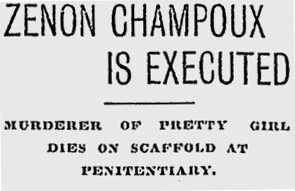
1904: Zenon Champoux, French degenerate

On this date in 1904, the state of Washington carried out its first execution under the auspices of a new law requiring that hangings be held in that state’s penitentiary in Walla Walla.*

Its subject was French-Canadian laborer Zenon Champoux, and his crime was as flamboyant as his moniker: publicly planting a knife in the forehead of a dance hall girl who did not return his affections.

The first man executed under the auspices of the Evergreen State, we admit, is a milestone that’s a bit on the smaller side.

But we think his name stands out admirably in the annals, especially paired with a characterization like the Seattle Star gave him: French degenerate.

“Zenon Champoux, French Degenerate” — it’s the scoundrel who’s rogering your girl, or else the branding on his designer condoms. On this date in 1904, it was just the guy at the end of his rope.

* Previously, hangings had been conducted by counties, in public. Laws removing them to the auspices of the state and behind the walls of a prison were in vogue at the time.

Washington went on to abolish the death penalty in 1913, only to reinstate it again in 1919.

On this day..

1591: John Dickson, “broken on ane rack”

On this date in 1591, Scotsman John Dickson was condemned to death (which he immediately suffered) for murdering his father.

“The criminal record,” observes this volume of Scottish crime, “contains neither the particulars of the murder, nor the evidence against the prisoner.”

What is particular to this case is the method of execution: the breaking-wheel, or something very similar to it, a tortuous death used throughout continental Europe but that never caught on in the British Isles.

John Dickson, younger of Belchester, being apprehended, ta’en, and brought to Edinburgh, was put to the knawledge of ane assize for the slaughter of his awn natural father [in July 1588], and also for the lying for the said offence at the process of excommunication. [Being convicted, he was] brought to the scaffold, and at the Cross broken on ane rack, [and] worried—where he lay all that night, and on the morn [was] carried to the gallows of the Burgh-moor, where the rack was set up, and the corpse laid thereupon. (Passage from here or here.)

Dickson’s is the first of only two such “breaking” death sentences, in which the doomed is staked out spread-eagled and has his limbs shattered one by one, documented in Scotland. (The other is that of Robert Weir in 1604; an assassin in 1571 “is said, also” to have suffered such a fate, but actual documentation has been lost.)


Sort of like this. (Source)

On this day..

1901: “Black Jack” Tom Ketchum, who was left in three pieces

On this date in 1901, a two-bit outlaw from a vanishing frontier made his reservations for hell.

Tom Ketchum — who had become known as “Black Jack” when misidentified with another hombre he resembled — was the last man to hang in America for attempting to rob a train. Given the way the authorities in Clayton, N.M., conducted the job, that’s probably for the best.

This Texas-born outlaw enjoyed a colorful career in the 1890s Southwest plundering trains, killing folk, and other distinctively American pastimes. His name attaches to the [in]famous Hole in the Wall Gang.

He was finally caught attempting a dangerous one-man train robbery, when a conductor (taking part in his third stickup, and tired of being on the wrong end of the gunbarrel) got the drop on Ketchum and winged him with a shotgun. Too weakened by his injury to escape, Ketchum surrendered himself to the law, and his wounded arm to the surgeons.

The un-amputated remainder belonged to Clayton, N.M. — New Mexico Territory, that is, which was not yet a state at this time, but was keen on making an example to stanch the tide of train robberies.

(Formally, the charge that hung Ketchum was “felonious assault upon a railway train”; he was the only person executed for this offense before the Supreme Court decided that a hanging crime needed more victims than just an iron horse. This jurisprudential advance might not have done Black Jack very much good anyway, since neighboring Arizona had also put in an extradition request for murder.)

So far, so good.

Then, they actually dropped him.

When the body dropped through the trap the half-inch rope severed the head as cleanly as if a knife had cut it. The body pitched forward with blood spurting from the headless trunk. The head remained in the black sack and flew down into the pit.

SOME MEN GROANED.

Some men groaned and others turned away, unable to endure the sight. For a few seconds the body was allowed to lie there half-doubled up on its right side, with the blood issuing in an intermittent stream from the severed neck as the heart kept on with its mechanical beating. Then with cries of consternation the officers rushed down from the scaffold and lifted the body from the ground. It was only then apparent exactly what happened.

The drop of the body was seven feet and the noose was made so it slipped easily. Ketchum was a heavy man, and the weight of the body, with the easy-running noose, caused the rope to cut the head cleanly off. Dr. Slack pronounced life extinct a little over five minutes from the time the body dropped through the trap. It is stated too much of a drop was given for so heavy a man.

Just so we’re clear: a seven-foot drop is much, much too far for a man of Ketchum’s 190-plus pounds. Maybe they were distracted by rumors of an escape attempt.

The newspaper account above cites much more forgettable scaffold-talk from Ketchum, but we can’t help but find charm (and obviously, black humor) in his alleged last words,

I’ll be in hell before you start breakfast, boys! Let her rip!

Fictional? If so, they’re more like what Ketchum’s last words ought to be. Although let St. Peter‘s ledger reflect that Ketchum was a decent enough chap to post a letter to President McKinley on the morning of his own execution copping to several robberies for which other people were imprisoned.

Initially buried — naturally — at Clayton’s Boot Hill, this infernal denizen’s grave can now be found (and more than a century on, tourists and admirers do find it) at Clayton Memorial Cemetery.

On this day..

1846: The last civil executions in Portugal

Portugal has not carried out a civil (non-military, non-wartime) execution since hanging two murderers on this date in 1846.*

Despite some impressively sanguinary exercises of capital punishment in its history, the Iberian nation has been in the European vanguard of death penalty abolition.

Writing on what turned out to be the eve of Portugal’s landmark 1867 renunciation of the death penalty for criminal offenses, the 1866 report of Britain’s capital punishment commission observed:

The last execution which took place was at Lagos, on the 22nd of April 1846. And it is right to state also, that ever since the definitive re-establishment of a liberal government in this country, capital punishments have never been very numerous. Thus during the 13 years which elapsed between 1833 and 1846, inclusive, out of 99 culprits condemned to death there were only 32 executed, and the sentences of the remaining 67 were commuted.

[Portugal] is, then, the only [country] in Europe in which the punishment of death has been for the last 18 years de facto suppressed. Public opinion has gone before the law: and the law, in effacing this punishment from its provisions, far from being in anticipation of society, will not do more than give its sanction to a fact which has long been accepted by general feeling, and which at the present day it would be difficult to contravene. Even if the punishment of death were to remain inserted in the text of our penal legislation, I think I may with safety affirm it would be impossible to meet with a Minister of Justice who would venture to recommend the King to withhold the exercise of the Royal prerogative of pardon, and who would have the heart to order the timbers of a new scaffold to be again erected on the soil of Portugal.

Despite an abortive feint at backsliding during World War I, the popular sense of the issue does not seem to have changed much in the interim.

The tragedy of man, ‘a postponed dead body’ as Fernando Pessoa said, does not need an untimely exit from the stage. It is tense enough without an end that is artificial and planned by butchers, megalomaniacs, potentates, racisms, and orthodoxies. Therefore, being human, we demand unequivocally that all peoples should have a code of humanity. A code that for all citizens guarantees the right to die their own death.

-Portuguese writer Miguel Torga, at a 1967 colloquy marking the centennial of Portugal’s formal abolition of the death penalty for ordinary crimes.

* There are some scantily documented World War II treason executions; the death penalty was officially abolished for treason (the last capital crime on the books) in 1977.

On this day..

2004: Abdullah Shah, Zardad’s dog

On this date in 2004, an Afghanistan liberated from the Taliban enjoyed its first freedom-execution: the secret shooting for various war atrocities of Abdullah Shah.

Shah worked for Afghan warload Zardad Khan during the early 1990s civil war that brought the Taliban to power.

And by “worked for,” we mean that Zardad kept Shah chained up in a cave, and used him to bite his prisoners and (!) devour their testicles.

Michael Vick, eat your balls out.

“Zardad’s Dog” — the guy’s nickname, as well as the title of a short film made about his case, which was also the first capital prosecution in post-Taliban Afghanistan — was well-qualified for his bestial career.

Implicated in possibly hundreds of deaths, his 20 murder convictions included three of his wives (another of his wives, whom Shah tried to burn to death, testified against him) and five of his own children.

“The president felt compelled by the need to ensure justice to the victims,” a Karzai spokesman said. “Especially in view of the nature of the crimes he [Abdullah Shah] committed.” So compelled was he that the government only publicly declared the execution a week later.

Skeptical observers have noted that Karzai might have also felt this particular “need to ensure justice to the victims” in a case where the condemned had the goods on some of the top men in Karzai’s own government, who resided further up Shah’s own chain of command.

Amnesty International considered his case rife with other irregularities. Kabul temporarily suspended judicial executions thereafter; the country would not carry out another execution until 2007 (pdf).

Shah’s eponymous boss, Zardad, slipped into England on asylum. A year after his “dog’s” execution, Zardad drew a 20-year sentence at the Old Bailey for various acts of torture and summary execution during Afghanistan’s civil war.

On this day..

1747: Simon Fraser, Lord Lovat

Unprincipled, octogenarian Scottish noble Simon Fraser,* Lord Lovat was on this date in 1747 the last to lose his head on Tower Hill.

The Clan Fraser patriarch was an expert double-dealer from his youth in Restoration England — when he recruited a small regiment in nominal service to William and Mary but allegedly plotting to desert to the Stuarts at the opportune moment.

That moment never came … and the Stuarts’ fruitless quest for it in the decades to come would eventually claim the Lord Lovat.

But first up: a long life of opportunistic, frequently reprehensible political maneuvering.

  • He kidnapped, raped, and forcibly married a woman from a rival clan in order to gain claim on a contested succession (Lovat had to flee the country, a death sentence in absentia at his heels)
  • He expediently converted to Catholicism to get in with the exiled Stuarts and their continental allies
  • He forged incriminating documents in an unsuccessful bid to undermine rival nobles
  • He played both sides of the Hanover-Stuart intrigue, ingratiating himself with both Jacobites and London during the 1715 rising. He did this so adeptly that George I served as Lovat’s son’s godfather

When the Jacobites decided to double down on doomed risings in 1745,** this wily knave finally managed to commit himself to the wrong team at the wrong time. Hey, everyone should be allowed one fatal mistake every 80 years or so. (Read all about those years in this public-domain biography.)

Though Lovat was so infirm he had to be borne on a litter, his military acumen would have been worth the rebels’ while had they possessed the muscle to get into a fair fight.

But they didn’t, and Lord Lovat was captured in the undignified circumstance of being stashed in a tree, and at length fitted for a no less undignified trial.

He could neither walk nor ride, as he was almost helpless; he was deaf, purblind, eighty years of age, ignorant of English law, and it was therefore not a matter of surprise that the high-born tribes, who thronged to his trial, were disappointed in the brilliancy of his parts, and in the readiness of his wit. “I see little of parts in him,” observes Walpole, “nor attributed much to that cunning for which he is so famous; it might catch wild Highlanders.” … It appeared, indeed, doubtful in what form death would seize him first, and whether disease and age might not cheat the scaffold of its victim.

Oh, well.

Only the good die young.

By his public life, he has left an indelible stain upon the honour of the Highland character, upon his party, upon his country.

* Not to be confused with the Canadian explorer for whom British Columbia’s Simon Fraser University is named.

** The 1745 rebellion spawned a popular patriotic song that became the national anthem: “God Save the King/Queen”.

One of the tune’s impolitic verses you won’t hear performed at glitzy official ceremonies (or much of anywhere at all) is this nationalist blast at the Jacobite party:

Lord grant that Marshal Wade
Shall by thy mighty aid
Victory bring
May he sedition hush,
And like a torrent rush
Rebellious Scots to crush
God save the King.

All of which, one supposes, gives Simon Fraser claim to a spot in the fine print of the credits for the song, and for that matter, for the Sex Pistols’ riposte.

Nothing new, this scandalous punk riff: English radicals were travestying the nationalist anthem within the lifetime of many who personally saw the rebellious Scot Lord Lovat crushed.

On this day..

1693: Anne Palles, the last witch executed in Denmark

On this date in 1693, fortified with a half-pot of wine provided at public expense, 74-year-old Anne Palles was beheaded and then burned as a sorceress — the last “witch” put to death in Danish history.

Palles got caught up in the usual way: an aged farmer’s wife misfortunate enough to be attached to a couple of incriminating coincidences. Nine-tenths of Denmark’s 1,000 or fewer executed witches were women, two-thirds of them over 50 years old. (Danish-language source.)

Palles was accused (Danish) by a “wise woman” who was herself trying to beat a rap for attempted murder with black magic.

Once that happened, it all started to make sense (more Danish): the sudden death of a woman her husband had once danced with; the poor production of cows passing a place where Palles had pissed.

Clap her in prison and twist her arm a little, and she’ll cop to having “given herself to the Devil, life and soul”, and rolled with an infernal familiar (a black cat: how trite) by the name of “Puus”.

Though you wouldn’t call a thousand executions a drop in the bucket, Denmark never really experienced the witches’ holocaust that occurred in some other European locales. A 1576 law* providing an automatic judicial appeal for sorcery condemnations is often credited for this happy-ish circumstance; in this case, Palles recanted her confession on appeal as torture-induced, and a divided high court in Copenhagen only confirmed the death sentence by an 11-6 vote. (Antonin Scalia writing for the majority.) Even her burning-alive sentence was moderated by the crown to beheading, followed by posthumous burning.

Everyone being a little uncomfortable with the case didn’t ultimately do Anne Palles much good. Another woman, Anne Kruse, had died in prison with her, and was posthumously burned at the stake; the woman who’d made the initial accusations was flogged … and Anne Palles had her head struck from her body and her remains burned to ashes as a witch.

But an era had passed with the cooling of those embers.

Just three years later, an outbreak of witch accusations — the “possessions of Thisted” — rocked northern Jutland. This case boomeranged on its accusers (we’ve seen that elsewhere in Scandinavia), and largely put a stop to witchcraft prosecutions … though the superstition that generated them would persist for quite some time longer.

After 1650 — and thus long before the official day of reckoning for witch-belief during ‘the possession of Thisted’ in 1696-98 — a marked drop in the numbers of witch-trials took place … and the Jutland High Court judges grew more and more sceptical. One of them, the Professor of Mathematics, Villum Lange [Danish bio], wrote to Peder Schumacher (the later Griffenfeldt) in 1670: ‘During the past few days we have had a crowd of women brought before us, accused of sorcery. We have condemned a number of them to the stake; but because they are so foolish and simple-minded we have recommended to the court that the case should first be brought before His Majesty for appeal … One of them confessed to us herself that she had talked with the devil; but whether it was melancholia or some other form of fantasy, or was the honest truth, God alone knows. To me she appeared to be a person in her second childhood.’ No wonder that rumours soon began to circulte that this High Court judge ‘was siding with the sorceresses and saying that no sorceresses existed.’ Towards the close of the century the common people were complaining that the Jutland High Court judges never condemned anyone to the stake any more, and tht was the reason for there being so many sorceresses in Jutland.

But it was only among the educated upper clases [sic] that attitudes were changing. Among ordinary folk the need for witch-trials continued to be felt far into the future, and when the authorities would no longer agree to her this type of case, people several times took the law into their own hands. In 1722 some pesants at Gronning on Salling lynched a witch by burning, and in 1800 the last murder of a witch occurred at Brigsted in the neighbourhood of Vejle.

Gustav Henningsen, “Witchcraft in Denmark”, Folklore, Vol. 93, No. 2 (1982), pp. 131-137

* The first of its kind in Europe. Two other legal ordinances from earlier in the 16th century restricted the use of torture to gain confessions and barred courts from crediting the accusations of other convicted witches, and they also helped constrain outbreaks of widespread persecutions. (Anne Palles’s case looks to have skated pretty close to the line on both of those counts.)

On this day..

1965: John Harris, white anti-apartheid martyr

On this date in 1965, John Harris hanged in Pretoria Central Prison for an anti-apartheid bombing: the first and only white person put to death for political crimes in apartheid South Africa.

An idealistic young teacher, Harris planted a bomb in a whites-only section of Johannesburg’s Park Station, intending to demonstrate that whites, too, opposed racial segregation. But the bomb threat he phoned in was not acted upon, and the symbolic device killed a 77-year-old woman and badly burned many others.

5.30 am was the time set for the execution. We were all awake, thinking of John. Not long afterwards the phone rang. Ad Hain answered. The voice said: “Your John is dead.” She recognised the voice as one of the Special Branch men’s.

-John Harris’s widow’s testimony to the post-apartheid Truth and Reconciliation Commission

His death (reportedly with “We Shall Overcome” on his lips) earned affecting tribute and flattering comparisons from his black countrymen.

Mr. Harris, a teacher and a member of the Liberal Party since 1960, is one of those few courageous White men in South Africa who believed passionately in racial equality, identified himself with the oppressed people and suffered persecution. His passport was seized in 1963. He was served with banning orders in February 1964 preventing him from continuing his work with the Liberal Party and the Non-racial Olympic Committee.

Like many others, he became convinced that there was no way left to influence the situation except by clandestine activity. When most of his colleagues in the underground organization, the African Resistance Movement, were jailed or fled the country, he tried to plan a spectacular demonstration. He placed a bomb in the Johannesburg station and telephoned the police so that the area would be cleared. The police did not act promptly and an elderly lady lost her life as a result of the explosion.

Under the prevailing circumstances in South Africa, the means of struggle are for the liberation movement to decide in the light of the conditions in the country.

The responsibility for the consequences lies very much on the rulers of Pretoria who, in defiance of the world and all sense of decency, created a situation which left no other alternative to decent people than to engage in violence.

In mourning the execution of Mr. Frederick John Harris, let me say that it will not be forgotten that in the struggle of the South African people this man, a member of the privileged group, gave his life because of his passionate belief in racial equality. This will serve to strengthen the faith of all those who fight against the danger of a “race war” and retain their faith that all human beings can live together in dignity irrespective of the colour of their skin.

I have recently received a message sent by him from his death cell in Pretoria Central Prison in January. He wrote:

“The support and warm sympathy of friends has been and is among my basic reinforcements. I daily appreciate the accuracy of the observation that when one really has to endure one relies ultimately on Reason and Courage. I’ve been fortunate in that the first has stood up — my ideals and beliefs have never faltered. As for the second, well, I’m not ashamed — I know I’ve shown at least a modicum of the second. ”

When I think of John Harris, the first White martyr in the cause of equality in South Africa, I am reminded powerfully of a great White American, a man who gave his life over a century ago — on December 2, 1859, to be exact — because of his passionate hatred of slavery: I mean John Brown.

People said then that John Brown was eccentric, that he was unwise in attacking the arsenal at Harper’s Ferry, Virginia, and that his act would only strengthen the slave lords.

History has made a very different judgement. Whether the particular act of John Brown was right or wrong, wise or unwise, his cause was right and invincible.

-1965 statement on this date’s hanging by Achkar Marof

Harris’s conviction was secured with the states-evidence turn of one of his compatriots in the white anti-apartheid African Resistance Movement. For this betrayal, John Lloyd earned his freedom and had already moved to England by the time Harris was executed.

Lloyd built a public service life of his own in the UK. However, his bid for parliament on the Labour ticket in the 1990s was scotched when public exposure of his past (as (a) a leftist terrorist; and (b) a betrayer of his fellow-leftists) brought him more baggage than one man can tote in a general election.

Harris’s rough treatment under arrest also continues to haunt his former interrogators in South Africa.

On this day..

1935: Thomasina Sarao, miscalculated

Shortly after midnight this date* in 1935, the career of 71-year-old Canadian executioner Arthur Ellis came to an end with the botched hanging of Thomasina Sarao.

All a simple matter of physics.

When the old-school “drop ’em from a cart” method of strangulation hanging gave way to the “new drop”, the hangman’s art eventually came to encompass the scientific application of the humane level of force to the doomed person’s vertebrae.

Something in the neighborhood of 1,000 ft/lbs was about right. Too little, and the poor wretch strangles to death. Too much, and you rip the head right off.

Thomasina Sarao got too much, and it ripped her head right off.

They’d worked everything out to a handy table, see, where if you weighed this much, they knew to drop you this far, derived from the formula

1020/weight in pounds (less 14 lbs for the head) = drop in feet

Except in the widow Mrs. Sarao’s case — the Italian immigrant had offed her husband to collect the insurance** — Arthur Ellis was given the wrong weight for his client. He coiled a noose for a woman 32 pounds lighter than the person who actually mounted the scaffold, and he therefore made it more than a foot too long.

That whole “ripping off a woman’s head” thing really harshed everyone’s vibe. So, although hangings had long been moved behind prison walls, the Canadian government stopped the ongoing practice of allowing members of the general public to obtain tickets to witness them.

“Arthur Ellis” — it was actually a trade name he’d made up, and so dignified that one of his successors used the same alias — died three years after his grisly retirement party. He’s saluted by the Arthur Ellis Awards, the Crime Writers of Canada’s annual awards: a little trophy of a guy getting hanged.

[Ellis Trophy][Ellis Trophy]
Winners of the Arthur Ellis Award, like Robert J. Sawyer, get this trinket to commemorate. At least the little wooden fetish has his head attached to his shoulders. (Images (c) Robert J. Sawyer, and used with permission.)

* March 28 is sometimes reported, but the period press reports (like this wire story) seem to agree on the 29th, as does this index of Canadian executions.

** Two male co-conspirators, Leone Gagliardi and Angelo Donofrio, were also hanged for the same crime, a few minutes before Sarao on a different scaffold.

On this day..

1845: John Tawell, the man in the Kwaker garb

On this date in 1845, John Tawell was publicly hanged in Aylesbury (while broadsheets were hawked beneath the scaffold to the crowd of thousands) for the murder of his mistress — making history as the first criminal apprehended with the use of the telegraph.

Tawell had had an interesting 60-plus years on the planet. He did well as a young banker on the make to avoid the halter for the capital crime of forging banknotes.*

In those sanguinary days of our penal code, this crime, if brought home, would have led to his certain condemntion and ignominious execution as a felon. The particulars of the affair were, however, suppressed as far as possible, on account of the insuperable disinclination of the bankers to be in any way instrumental in taking away human life.**

Clapped in irons and sent to Australia, he waxed wealthy — “by his fortunate, and, it is to be presumed, honest trading,” our wry biography remarks. (As a pharmacist. That’s what we in the biz call “foreshadowing.”)

Tawell returned to England in 1831, got Sarah Hart as a bit on the side (she’d initially been hired to nurse Tawell’s dying wife), and then married a respectable Quaker woman. To conceal the affair — or perhaps because the payola Tawell was obliged to send for the maintenance of his mistress and the kids he begat with her was chewing into his straitened finances — Tawell poisoned Hart on New Year’s Day 1845.

Unfortunately for him, he was noticed leaving the scene of the crime by a neighbor, who found the victim before she had even expired.

Tawell had hopped a slow train for London ahead of apprehension, but it transpired that the station had installed the newfangled telecommunications device, the telegraph, which was requisitioned to dispatch to Paddington station a famous missive.

A murder had just been committed at Salt Hill and the suspected murderer was seen to take a first class ticket to London by the train that left Slough at 7.42pm. He is in the garb of a Kwaker with a brown great coat on which reaches his feet. He is in the last compartment of the second first-class carriage.

(The telegraph didn’t have a “Q”, so they had to improvise a phonetic spelling. k l8r.)

(This landmark police event is not to be confused with the first use of wireless telegraphy to apprehend a criminal — the next century’s very similar philandering-apothecary-on-the-lam case of Dr. Crippen.)

Caught, convicted,† condemned. (And confessed, secretly, to the prison chaplain.) The usual. Botched strangulation hanging. Hardly unusual. Love triangle murder? Downright trite.

But still: Tawell’s strange and variegated life left a strange and variegated legacy. (pdf)

In Australia, the memory of Tawell lingered for many years after his death because considerable legal argument took place about the validity of the Crown’s hndling of his property there. The Governor, Sir William Denison, affixed the Great Seal of the colony to the grant documents on his own initiative, which creted a serious difference between him and his chief minister. Known as the “Great Seal case”, it dragged on for some 16 years before it was resolved. It provided a dramatic epilogue to Tawell’s activities.

John Tawell had pharmacy qualifications of a sort, and he was no better or worse than many of the doctors around Sydney at the time who had received no regular professional instruction. When Tawell ventured into competition with the medical establishment in the colony it was a huge gamble because until 1820 many government doctors saw private patients and had clerks to do their dispensing, usually from hospital stores. He showed that independent pharmacy could thrive away from the medical shadow, but the commercial nature of his success also showed that the founding of independent pharmacy in Australia occurred as a retailing activity rather than as a needed profession.

* As a teen, Tawell was friends with a Quaker linen-draper who was himself ultimately executed for forgery, Joseph Hunton.

** This claim for bankers’ gentility is advanced in the context of the story of a banker who in fact went on to commit murder. Aside from that obvious paradox, it will come as no surprise to any denizen of the post-bailout neoliberal era that bankers proved more than ready to involve themselves in human misery, sufficiently remunerative. If Tawell’s sweetheart plea bargain reveals anything about the financier class, it’s that bankers aren’t keen on precedents for taking away bankers’ lives.

† John Tawell’s trial lawyer, the eminent jurist and politician Sir Fitzroy Kelly, disputed the coroner’s poisoning conclusion by arguing that Sarah Hart might have just eaten too many apple seeds. (Prussic acid, aka hydrogen cyanide, does occur naturally in many fruits.)

This attempted Chewbacca defense earned the barrister the nickname “Apple-pip Kelly”. However, since the cutting-edge technology of the day was only telegraph and not Twitter, the case does not appear to have launched any of Apple-pip Kelly’s progeny into lucratively pointless careers as famous-for-being-famous socialites.

On this day..