1762: Jean Calas, intolerably

(Thanks to Mary O’Grady for the guest post. -ed.)

In the 1760s, Toulouse was no place for a Huguenot, not even for an affable, prosperous paterfamilias like Jean Calas. The whole southwestern region of France barely tolerated Protestants.

The Calas household included two adult sons, Louis, who had converted to Roman Catholicism, and Marc-Antoine, their sisters, as well as their parents, Jean Calas and his wife, and a longtime maid who was Catholic. Monsieur and Madame Calas and their daughters were Protestant, as was Marc-Antoine. Friends and associates described the ménage as placid, except for occasional outbursts of misbehavior by elder son Marc-Antoine.

Jean Calas was a textile dealer. On October 13, 1761, young Marc-Antoine Calas was found hanged in his father’s shop. Wishing to spare the family’s reputation from the stigma of suicide as well as his son’s corpse from the mutilation which was customary for suicides, Jean Calas at first claimed to the authorities that an intruder killed his son.

An ugly rumor swept Toulouse: Marc-Antoine was murdered by his own parents, because he planned to convert to Catholicism. (Never mind that Jean Calas kept his Catholic son Louis in the bosom of his family and employed a Catholic servant.) Jean Calas was arrested and subjected to a trial that was anything but fair; by this time, he had admitted, too late, that his son had hanged himself, probably over gambling debts.

No dice. The appellate court of Toulouse condemned Jean Calas to death on March 9, 1762. The execution was set for the following day.

Murder of a family member was held to be a particularly hideous crime, and hideous was the penalty: breaking on the wheel. Jean Calas was tied to a cartwheel in the main square of Toulouse. His limbs were broken with iron rods. He proclaimed his innocence until the executioner finally strangled him to death.

L’affaire Calas inspired Voltaire to new vigor in his fight for religious toleration. In 1763 he published A Treatise on Tolerance, a landmark document which remains well-read today.

O different worshippers of a peaceful God! if you have a cruel heart, if, while you adore he whose whole law consists of these few words, “Love God and your neighbor,” you have burdened that pure and holy law with false and unintelligible disputes, if you have lighted the flames of discord sometimes for a new word, and sometimes for a single letter of the alphabet; if you have attached eternal punishment to the omission of a few words, or of certain ceremonies which other people cannot comprehend, I must say to you with tears of compassion for mankind: “Transport yourselves with me to the day on which all men will be judged and on which God will do unto each according to his works.

“I see all the dead of past ages and of our own appearing in his presence. Are you very sure that our Creator and Father will say to the wise and virtuous Confucius, to the legislator Solon, to Pythagoras, Zaleucus, Socrates, Plato, the divine Antonins, the good Trajan, to Titus, the delights of mankind, to Epictetus, and to many others, models of men: Go, monsters, go and suffer torments that are infinite in intensity and duration. Let your punishment be eternal as I am. But you, my beloved ones, Jean Châtel, Ravaillac, Damiens, Cartouche, etc. who have died according to the prescribed rules, sit forever at my right hand and share my empire and my felicity.”

…

May all men remember that they are brothers! May they hold in horror tyranny exerted over souls, just as they do the violence which forcibly seizes the products of peaceful industry! And if the scourge of war is inevitable, let us not hate one another, let us not destroy one another in the midst of peace, and let us use the moment of our existence to bless, in a thousand different languages, from Siam to California, [God’s] goodness which has given us this moment.

-Voltaire, A Treatise on Tolerance

As a result of Voltaire’s efforts, 50 French judges were appointed to a panel to review Jean Calas’s case. Their charge was to decide whether anti-Huguenot prejudice had cost Jean Calas his life. They reversed Calas’s conviction on March 9, 1765, the third anniversary of the poor man’s condemnation.

A few French books about Jean Calas

On this day..

1942: Jakub Lemberg and family

(Thanks to Meaghan Good of the Charley Project for the guest post. -ed.)

On this date in 1942, on the first day of Purim, Jakub Lemberg was executed together with his family in the Nazi ghetto in Zdunska Wola, Poland.

Lemburg, a 43-year-old internist and pediatrician, was head of the Judenrat in Zdunska Wola and thus it was his task to do the Nazis’ dirty work, such as putting together lists of his fellow-Jews for deportation.

He revealed himself to be a man of exceptional character and courage, and the circumstances of his death, as recorded in Louis Falstein’s The Martyrdom of Jewish Physicians in Poland, should not be forgotten:

The Gestapo chief ordered Dr. Lemberg to deliver ten Jews to be hanged for the ten hanged sons of Haman. Dr. Lemberg replied that he could deliver only four Jews: himself, his wife and their two children. Hans Biebow, “the Butcher of Lodz,” seized Dr. Lemberg and turned him over to the executioners, who killed him in the cemetery.

The Zdunska Wola ghetto was liquidated five months later. And in 1947, Biebow got his.

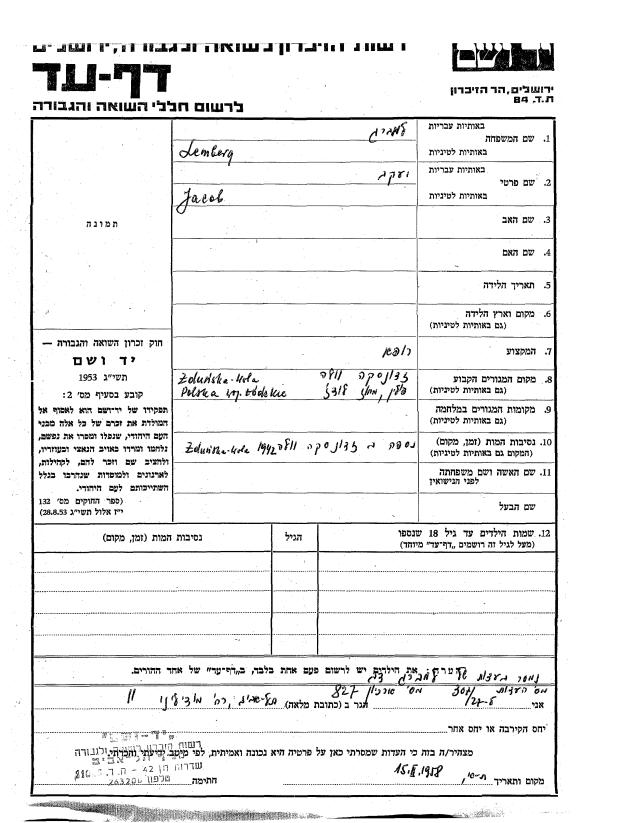
Here’s an image of Lemberg testimony (in Hebrew) from the Yad Vashem database.

On this day..

1942: Five Jews in Sokal

(Thanks to Meaghan Good of the Charley Project for the guest post. -ed.)

The synagogue at Sokal.

On this day in 1942, the Nazis shot five Jewish men from Sokal, which was then part of Poland and now belongs to the Ukraine.

During the first years of the war, the Germans had designated Sokal as a Judenstadt (literally “Jew-town”), a central destination point for all Jews expelled from nearby towns and villages. Or, as diarist Moshe Maltz put it, “A solitary island in a sea of blood.”

It was Maltz, an Orthodox Jew and native of Sokal, who recorded the executions described in this entry. He kept regular notes throughout the war about the plight of Sokal’s Jews — not a diary exactly, but a chronicle, meant for the benefit of history.

On February 24, five Jews from Sokal were taken to a place somewhere on the outskirts of town and shot. One of them was Yeshaye, son of Yankel the coachman. In 1940, during the period of Soviet occupation, Yeshaye had been a coachman working for the NKVD. Now the Gestapo called him and ordered him to turn over to them the reins of his horses. They said to him, “We’ll give you three days to deliver those reins to us. If we don’t get them by that time, we’ll have you shot.” Yeshaye thought that the Gestapo must be joking. How could he go on working as a coachman without his reins? Unfortunately for Yeshaye, the Gestapo men were in dead earnest.

Also among the five shot was Dr. Knopf, a lawyer who had converted to Christianity. The Germans had ordered him to dismiss his Gentile maid so that she could be sent to work in Germany. Knopf petitioned the Gestapo to let him have his maid back. That’s why the Germans shot him. Despite his baptism, he was simply not an Aryan. The third victim was blind Yankel, who was found guilty of buying and slaughtering a calf. Under German occupation regulations, cattle can be slaughtered only by officially approved butchers.

In October 1942, the Jews of Sokal were confined to a ghetto. The following month Maltz wrote, with the same dispassionate tone, of the murder of his fourteen-month-old daughter at the hands of the Nazis.

Later in November he escaped from the ghetto with his wife and surviving son. They had made an arrangement with a Polish woman who lived nearby, and moved into her hayloft, above the pigsty.

Eventually fourteen people from three families in all would come to live in the hayloft. All of them survived except Maltz’s sister, who died of fever while in hiding. The others staggered out into daylight, barely able to walk, when the Russians liberated the area in July 1944.

Maltz and his entire family eventually emigrated to the USA.

After his death in 1993, his diary was translated and published under the title Years of Horror, Glimpse of Hope: The Diary of a Family in Hiding. In 2009, a Pennsylvania State University professor made a prize-winning documentary based on the book, called No. 4 Street of Our Lady. You can watch it on Netflix or read an article about it here.

On this day..

1845: John Gordon, the last hanged in Rhode Island

Last year, the Rhode Island General Assembly approved a measure posthumously pardoning John Gordon — who on February 14, 1845 was the last man executed in that state.

Gordon’s hanging, for the murder of a prominent industrialist who had bad blood with Gordon’s brother, was long notorious in Rhode Island as one secured on highly uncertain evidence in an atmosphere of anti-Irish prejudice.

Executed Today is pleased to welcome on this occasion University of Rhode Island labor historian Scott Molloy, author of Irish Titan, Irish Toilers and a major advocate of the Gordon pardon.

ET: Can you set the scene — what’s going on in Rhode Island at this time, and what are the tensions surrounding Irish immigrants?

SM: Rhode Island was the site of the first factory in America in the 1790s, called Slater Mill. It really changed the face of Rhode Island and eventually the rest of the US.

In Rhode Island, curiously, as more and more people left the farms to work on the mills, they had an unusual requirement that really didn’t make any difference years earlier: in order to vote, you had to have so much land. (Specifically, $134 worth of land.)

By 1840, not only were the usual suspects not able to vote — women, people of color, Native Americans — 60% of native-born white male Rhode Islanders were also unable to vote. It meant that just a handful of people ruled the state, compared to the time of the American Revolution when just about every white male could vote. And immigrants in particular — and in those days, that was the Irish — were basically precluded from voting. You had a residency requirement, a property qualification. It made Rhode Island almost unique in New England, almost like a southern state.

A group of reformers came to the forefront, a guy named Thomas Wilson Dorr, a blueblood aristocrat, Harvard-educated, one of the best legal minds of the country. He threw his lot in with the reformers to try to get people the right to vote. It really polarized the state in 1842.

The Irish were sympathetic, but Irish priests tried to keep them out of it because they wanted to acclimate. But because a lot of the animosity toward people having the right to vote was directed at Irish immigrants. People blamed the Irish even though the Irish didn’t get particularly involved in the Dorr War.

Often times they got blamed for everything whether they did it or not. And of course we face the same situation with immigrants today.

What was the crime and how did the Gordons come to be the focus of the prosecution?

In 1843, a Yankee industrialist out in Cranston by the name of Amasa Sprague was found on New Year’s Eve 1843 bludgeoned to death in what today we might call a hate crime. He had a gold watch still on him, he had money in his poket, and he had been beaten to death.

Amasa Sprague was a very influential guy. His older brother who helped run the mill with him and was the US Senator from Rhode Island had the local city council lift the liquor license from the Gordon family’s business, which for all intents and purposes ended their livelihood. This was Nicholas Gordon’s shop: John Gordon had only just crossed over from Ireland.

When Sprague was found dead about six months after the license was lost, they focused on the Gordon family. The authorities formed a posse and they went after this Irish family.

Book CoverHow did anti-Irish sentiment manifest itself at trial?

The juries in all three trials had no Catholics and no Irish that I’m aware of. There was a lot of religious and socioeconomic animosity.

At the time, the Supreme Court of the state would sit in on the whole trial just because it was a capital trial, and the trial judge would say in the transcript — which is still available (pdf) — he basically says to the jury, if you find testimony that contradicts itself between a Yankee and an Irish witness, you should give the Yankee testimony more credence.

Doesn’t the fact that John Gordon’s brothers were not convicted militate against the notion of overwhelming anti-Irish prejudice?

You can’t go overboard on these things. The juries — all three of them — they found one Gordon innocent and in the other case they had a hung jury. I don’t want to say they were completely prejudiced, because they weren’t, but almost everything else in Rhode Island at that time was stacked up against them.

The earlier Irish who came in the 1820s and 1830s were a little bit better off, a little bit better-educated [compared to later Irish immigrants after the potato famine]. The animus against the Irish was still intense; the Irish were seen as criminal, unskilled, uneducated, ignorant. The Protestant majority at the time, mostly of English heritage, kind of brought that over with them even though they had been there for a long time.

So how did the legal proceedings play out?

They put two of the recently immigrated brothers up for conspiracy for murder, but not the oldest brother. So John Gordon and his brother William go on trial first.

The jury came back with a guilty verdict for John Gordon, who didn’t have much of an alibi, but a not guilty verdict for William, who did have an alibi. So you’ve got a conspiracy conviction with only one conviction.

Then they put Nicholas Gordon on trial, and the jury comes back deadlocked. His second trial is not going to be until the spring of 1845. In the interim, his brother John was to be hanged, Valentine‘s Day 1845 — rather than wait to see what happened at Nicholas Gordon’s trial and whether there even is a conspiracy.

The defense petitions the governor and the general assembly to hold off the execution until after the trial of the oldest brother. The governor washes his hands of it, and the general assembly votes very narrowly to go ahead with the execution.

So they hang him, and what’s interesting in that part of it is an itinerant, traveling Catholic priest — a guy named Father John Brady — hears John Gordon’s last confession.

Well, they invite the elite of providence inside the prison to watch the hanging. (There’s about 1,000 Irish outside the prison in support of John Gordon.) When they put the noose around his neck, the priest is with him, and the priest berates the elites and authorities, and he says, John, you are going before a just God who has seen way too many of your countrymen.

I always argue in my writings that this guy, he’s an immigrant, he’s uneducated, he’s just been in America for a few months. I just can’t believe that this guy would ever lie to the priest hearing his last confession, and the priest would never berate the elites unless he’d heard a confession of innocence.

After John Gordon’s hanging, his brother Nicholas goes on trial as planned, and they come back with another hung jury — this time, with a majority voting him as innocent. They were going to try him again except about 18 months later, Nicholas dies of natural causes.

I’ve seen a lot of people describe growing up hearing unambiguously that this was a wrongful execution. Is that how it was perceived right from the start? How universal was/is that perception?

There was such a collective feeling of guilt about this that in 1854, Rhode Island abolished the death penalty and John Gordon was the last person ever executed there.

There’s one flaw in the law. This was added late in the 20th century, that anyone convicted of killing a prison guard during an escape could still be killed. And there was an incident, I remember it as a kid maybe 30 years ago, but they still didn’t condemn even that person to death. But Rhode Island has never changed that.

None of us who ever testified ever said categorically that John Gordon was innocent, because we just can’t prove that. But we did say that he never got a fair trial, just like Sacco and Vanzetti in the 1920s.

We did in our research was come up with two or three suspects who had much better reason to assassinate Sprague. But there were no witnesses to the case. It was all circumstantial evidence. I have to say, every time I look at the case — there are some pieces of evidence that would make the Gordons look very guilty. There are other aspects of it that make them look very innocent. If it was in today’s world, the police would interrogate them as people of interest.

It’s not as cut-and-dried as some people make it. All I know is that they got an unfair trial.

Gordon was posthumously pardoned last year. How did that campaign get going, and how receptive were folks in the capitol?

The problem was a lot of people had forgotten the case. I had been writing for a number of years op-ed pieces in the Providence Journal, and mentioned John Gordon from time to time.

But it was an 80-year-old guy named Ken Dooley, and he grew up a couple miles from the murder site near Cranston, and he was a playwright. He came back home and remembered his grandmother singing some little ditty of a song 70 years ago saying something like “Poor Johnny Gordon”, and so he researched it, and he wrote a play.

And they put it on in Cranston, and over the couse of the month several thousand people saw it. A state representative, an Irish guy, saw the play four or five times and then introduced that into the general assembly trying to obtain a posthumous pardon — just to say that the evidence didn’t support the execution.

And Gov. Chaffee, who comes from an ancient Yankee family in Rhode Island, signed the damn thing. It was that play that this guy wrote and we were all amazed that this kind of came out of the blue. We held a lot of events around it — had church services, put up ceremonial headstones. I always tell people that I want this on my headstone: that I had a hand in getting John Gordon pardoned.


There are some excellent resources already available online concerning the Gordon case, including:

On this day..

1992: Johnny Frank Garrett, “kiss my ass because I’m innocent”

On this date in 1992, Johnny Frank Garrett was executed by lethal injection, with the tart last words,

“I’d like to thank my family for loving me and taking care of me. And the rest of the world can kiss my everloving ass, because I’m innocent.”

Although Garrett was only 17 at the time a nun from a neighboring Amarillo convent was raped and murdered, and he may have qualified as developmentally disabled to boot — both factors that today would exclude him from execution — that whole innocence story didn’t have much public traction.

“No, no, not at all,” New Mexico attorney Jesse Quackenbush told this site in an interview. “He was villainized from day one: he was a nun-murderer who needed to be executed. The only sympathy really came from the Pope.”

But two decades on, Garrett’s dying profession is one of the more troublesome skeletons in the Texas execution machine’s closet, thanks in no small part to Quackenbush himself.

Quackenbush directed the documentary The Last Word (viewable free on Netflix), a powerful brief not only for Garrett’s innocence* but against the comprehensive rot of the system that shunted hm off this mortal coil — from the front-line investigators all the way through the Lone Star State’s intentionally broken executive clemency farce.

“It was a system-wide failure that caused this kid to die. It wasn’t just the legal system,” Quackenbush said. “The media played a part. The governor was looking more to her own re-election hopes.* There was a dysfunctional family. The Supreme Court wasn’t morally deep enough to realize that executing 17-year-olds and ‘mentally retarded’ prisoners was wrong. There’s the system in Texas that allowed the prosecutors to hand-pick the pathologists to provide junk science.

“It’s a multifaceted failure, and no one facet is more to blame than the others.”

Garrett, a white teenager, disappeared into a Kafkaesque legal labyrinth, after the alleged supernatural vision of a local soothsayer acclaimed him the culprit in the murder of a nun named Tadea Benz. Corporeal indicia of guilt falls somewhere between circumstantial and laughable: fingerprints in a convent he had visited many times, the inevitable jailhouse snitch, and an unrecorded supposed “confession” that Garrett refused to sign.

As in a preponderance of death cases, especially in Texas (pdf), a meek and all-but-unfunded defense team offered scant resistance as prosecutors made the most of this eminently disputable evidence: once the one-sided trial was in the books and the crucial direct appeals likewise slipped past, the proceedings lay beyond the reach of judicial review.

This novel is inspired by the Garrett case.

For all that, there yet remains one un-litigated piece of evidence.

Around the time of Sister Benz’s death, there was another rape-murder of another elderly Amarillo woman, a crime that authorities publicly described as “too similar” to the Benz case not to be part of the same crime spree.

That case went unsolved … but years after Garrett’s execution, DNA databases matched an old semen sample from that second crime to a Cuban rapist (he was among the criminals and undesirables that Castro expelled to the U.S. during the Mariel boatlift) named Leoncio Perez Rueda.

Suggestive.

More dispositive evidence in the form of still-testable crime scene samples may yet reside in Amarillo’s evidence lockers — semen and blood samples that, in the era of DNA, Quackenbush thinks would exonerate Johnny Frank Garrett.

If testing this sort of thing sounds like a no-brainer, you don’t work for Amarillo.

“The [Garrett] family offered the city of Amarillo complete civic immunity and they still refused to run a DNA test, and threatened to countersue** if the family tried to pursue it,” Quackenbush says. “In the state of Texas there are still only laws protecting DNA access for living people: if you’re already executed, you have no rights.”

Which is a particular pity — since “the chances of executing innocent people are still really high.”

* Quackenbush’s case for Garrett’s innocence is outlined in this legal memo (pdf). This site maintains an extensive archive of resources about the case.

** In this, it’s not unlike the Ruben Cantu case, where post-execution evidence of innocence has also been met with legal threats by the state.

On this day..

1942: Icchok Malmed

(Thanks to Meaghan Good of the Charley Project for the guest post. -ed.)

On this day in 1942, Icchok Malmed* was hanged on Kupiecka Street in the Bialystok Ghetto for throwing acid in a Nazi’s face and blinding him.

Zchor tells the story:

When the Nazis attacked the house at 29 Kupiecka Street, rounding up all of its residents into the street, a bold young man, Izchok Malmed, whipped out a jar of acid from his pocket, hurling it in the face of a Nazi soldier, who was blinded at once. Seeking revenge, the sightless Nazi fired his revolver several times, hitting another Nazi soldier and instantly killing him. In the melee, Malmed vanished.

Commandant Friedl, after learning what had happened, ordered that one hundred men, women and children living in the area where the incident occurred be rounded up and force-marched to a nearby garden, where they were lined up against the wall of an adjacent bet hamidrash and shot with machine guns.

Afterward Nazi soldiers captured another group of Jews, forcing them to dig a large pit for the bodies of the one hundred martyrs. A thin layer of earth covered them. Some were still alive, their hands groping upward through the earth.

The Nazi soldier accidentally shot by his colleague whom Malmed had blinded was carried to the Judenrat building, and his body was placed on [Judenrat Chairman Efraim] Barasz’s desk. Friedl then proclaimed to Barasz, “See what your Jewish criminals have done. Now we shall take revenge. You shall see what we can do.” Friedl issued an ultimatum for the perpetrator of the crime to surrender within twenty-four hours. Failing that, the entire ghetto would be destroyed with everyone in it.

Barasz knew the Nazis meant what they said. He sent word to Malmed to give himself up and thereby save thousands of Jewish lives. As soon as Malmed heard, he surrendered himself to the Nazis.

Tamarof’s diary described in detail Malmed’s courage. Asked why he killed the Nazi soldier, he replied: “I hate you. I regret I only killed one. Before my eyes my parents were murdered. Ten thousand Jews in Slonim were liquidated before me. I have no regrets.” Tamarof tried to slip poison to Malmed but failed. Even the police could not get near the prisoner.

The next morning, Izchok Malmed, a hero of the ghetto, was hanged in the square where he had performed his act of courage. Despite the horrible torture to which he had been subjected, Malmed cursed the Nazi murderers. After several minutes of hanging on the gallows, the rope broke and the body fell to the earth. Instantaneously, the Nazis riddled Malmed’s corpse with bullets and re-hanged the body for another forty-eight hours.

Kupiecka Street was renamed Malmed Street after the war. Near the site of Malmed’s execution is a plaque reading, in Polish and in Hebrew, “Icchok Malmed, the hero and fighter of the Bialystok Ghetto, was killed here by the Nazi murderers on 8 February 1943. In his honor.”

* The Zchor account spells his name “Izchok” but on the memorial plaque it says “Icchok”. It’s a form of the name Isaac.

On this day..

1961: Wasyl Gnypiuk, sleep-killer

(Thanks to Meaghan Good of the Charley Project for the guest post. -ed.)

On this day in 1961, a Polish/Ukrainian immigrant with the unpronounceable name of Wasyl Gnypiuk was hanged for murder in Lincoln, England.

The 34-year-old Gnypiuk was living in a toolshed in Worksop when he murdered his 62-year-old landlady, Louise Surgey, on July 17, 1960. He had spent some time in Nazi concentration camps during World War II, and suffered terrible nightmares as the result of his ordeal. The night of the murder, he broke into Surgey’s house while she was sleeping, drank some of her liquor, and passed out.

Gnypiuk — so he later claimed — had a dream where he was fighting Nazis. When he woke up, Surgey lay dead at his feet: he had strangled her in his sleep.

The authorities treated his claims with understandable skepticism. He didn’t help his case by trying to hide the body and stealing some money that had been lying around the house. He had a two-day trial in November and was duly convicted and sentenced to death. Gnypiuk was the last person to be hanged in Lincolnshire before the UK abolished the death penalty in 1965.

The truth about what happened will never be known for sure, but Gnypiuk is still regularly listed among cases of homicidal sleepwalking.

On this day..

1894: George Painter, Chicago infamous

While there may be serious doubt about the wisdom of capital punishment it is at present imposed by the law of this State, and if it is to be applied in any case then it should be in this … Any man who will live off of the shame of a woman and beat her from time to time as he would a dog, and finally kill her, must expect to suffer the penalty of the law.

-Illinois Gov. John Altgeld denying clemency to George Painter (Jan. 25, 1894)

On this date in 1894, the Land of Lincoln bloodily botched (but ultimately accomplished) the hanging of George Painter.

Painter died for the sordid murder of prostitute-lover-income source Alice Martin.

Painter insisted he was out at the pub when Martin was throttled and bludgeoned to death in their mutual bed, but the timelines left the alibi leaky and a patch of bloodiness on the reprobate’s coat undid him.

Despite swearing his innocence on pains of being “condemned to a flaming hell for all eternity” and winning three gubernatorial reprieves as his appellate lawyers scrounged up sketchy supportive testimony from various lowlifes, matters were pretty solidly against him by the end. So much so that the seemingly-sturdy rope, “of the same coil with which the anarchists were hanged,” snapped jaggedly when Painter was dropped.

The condemned killer’s body carthwheeled from the jolt of the rope’s end, crashing headlong into the concrete floor. Doctors advised that Painter’s neck was broken and life gone or ebbing … and puzzled executioners, unsure what to do with this unusual semi-successful botch, hauled the hemorrhaging near-corpse back up the scaffold, strapped it up, and dropped it again. You can’t be too careful.

We came by this story on the website of Robert Loerzel’s Alchemy of Bones, a wonderful book about another infamous turn-of-the-century Chicago homicide. (Loerzel’s post gives the train-wreck Painter case a much more detailed rubbernecking.)

Although the subject of Loerzel’s book, the immigrant sausage-maker Adolph Luetgert, was not put to death for his trouble, we were thrilled that the author sat down with Executed Today to find out a little bit about how criminal justice looked in Chicago on the eve of the 20th century.

Book CoverET: One of the aspects that you cover in Alchemy of Bones that’s also present in the Painter case is circumstantial evidence of uncertain probative value. What’s a definitive piece of evidence to a late 19th-century juror?

RL: Obviously if we had a time machine and we could go back 100 years and reinvestigate some of these cases with today’s forensic science, I think we would find a lot of cases of miscarriages of justice. It’s hard to tell looking at these cases today when all you have is these newspaper articles and court transcripts. You can look at it with common sense and try to determine from what people are saying whether there might be some element of doubt.

Today there’s been this huge change with the introduction of DNA evidence and we’ve suddenly discovered that a huge number of people on death row or in prison who are innocent. And that has caused a lot of people to question the reliability of eyewitness testimony and the identification of suspects.

All these things — the testimony of witnesses who say they saw something or said, yeah, that’s the guy — that’s what people in the 19th century were being convicted on. We’re talking about an era when even fingerprints weren’t being used yet.

In the Luetgert case one of the key things was that they found some bone fragments. The Luetgert case is one of these rare murder cases where for all intents and purposes there was no body found. We have some of those cases still today where someone is missing; all the circumstances seem to point to the fact that someone is dead. And prosecutors and police face an additional hurdle — they have to persuade a court that a murder actually happened.

With those sorts of cases, you had some bones that were found. The forensic science of the time — you coudn’t run a DNA test on it. Part of the question was, were those bone fragments even human? Is it possible that pig bones or cow bones were found in a sausage factory? Of course it was possible.

The Luetgert trial was one of the first cases which had testimony from anthropologists, which was a pretty new field at the time. They brought in some experts from the Field Museum.

How did that go?

It wasn’t necessarily the greatest start — but it was sort of like the criminal justice system started to take some baby steps toward bringing science into the courtroom.

Later, in the 1920s or 30s, there was a landmark case called Frye. They still today have the Frye rule — when courts look at a witness to determine if he is an expert. In the Luetgert case, they didn’t do that, and it was kind of a carnival. A high school chemistry teacher was one of the people they put on the stand to testify about the bones.

Luetgert’s crime, murdering his wife and dissolving her or possibly stuffing her into the sausages, was so much more infamous than Painter’s. Why didn’t Luetgert get the death penalty?

Then as now, it was somewhat arbitrary which criminals would get the death penalty and which would get a prison sentence.

In Illinois during that era, there were a lot of people convicted of crimes and sent to prison for much less than a life sentence. They had a system there of “indeterminate sentence” where they would sentence someone to a wide range of possible terms, maybe from two years to 50 years; it was really flexible and vague with the idea that it was a more humane way of dealing with criminals.

It probably also put the thought in the minds of jurors that, do we want to put this guy in prison and he might be getting out in a few years?

In the Luetgert case, there was some outrage that if you were going to convict a person of this crime, you have to sentence him to death. Some people thought that they sentenced him to life in prison because, what if his wife is still alive? There were all these stories coming out at the time of the trial where people thought they had seen Mrs. Luetgert.

So there was the thought, what if we hang him and a year later, Mrs. Luetgert shows up?

None of the jurors ever came right out and said it, but it’s possible that that doubt played some role in the decision not to sentence him to death.

Luetgert’s case got national media attention which Painter’s did not. Was it a milestone for that kind of treatment? What was the media landscape for crime reporting at the time?

There were a few other cases during that era, so it’s hard for me to say that this was the first. But it was certainly an early example of a sort of 19th century equivalent of what we experience with, for instance, the O.J. Simpson trial.

Newspapers covered it in great depth. In Chicago they had a dozen newspapers at the time; they would print page after page of transcripts and reports — far more detailed than anything you see in trial coverage in newspapers now.

The prosecutor, who later became Governor of Illinois, had six scrapbook volumes of newspaper coverage, with clips from Los Angeles and Buffalo and Baltimore and New York.

It actually looks like a lot of newspapers around the country did what we today call news aggregating. We complain about sites like the Huffington Post … well, a 19th century newspaper in a small town in Iowa would just publish a huge long excerpt of a story from a Chicago newspaper. And sometimes they would credit it and sometimes they wouldn’t.

Compared to present-day one- and two-paper cities, that’s still quite a difference.

There’s a lot of media out there now. If you look on the web, blogs, news aggregator sites, TV and radio. We still have a lot of media coverage now, it’s just spread out into a lot of different channels.

I was frankly shocked when I was researching how detailed some of the articles were. It helped me as a researcher. Interestingly, the readership included a lot of people who were not necessarily well-educated, yet newspapers wouldn’t hesitate to run page after page of transcripts. Nowadays, I think you’d have an editor saying, “give me 10 inches.”

Having written the book on the case, do you think Luetgert was rightly convicted?

I believe so. More than the forensic testimony, Adolph Luetgert’s behavior after his wife disappeared sort of points to a guilty conscience. He feared that certain people would go to the police and he either offered them jobs or threatened them.

Though this is precisely the sort of fuzzy circumstantial evidence those 19th century juries were acting on.

That’s absolutely true. In some of these cases you look at, what’s the difference between a man acting suspicious and an innocent man being wrongfully accused? There’s some overlap there.

On this day..

2006: Clarence Ray Allen, “beyond rehabilitation”

(Thanks to Meaghan Good of the Charley Project for the guest post. -ed.)

On this day in 2006, Clarence Allen was executed by the state of California for his role in the murders of three people.


Clarence Ray Allen packing heat and bravado in the 1970s (top); and, as a geriatric condemned man (bottom).

He could be seen as a kind of poster child for the death penalty: Allen was already serving a life sentence in prison for murder when he had the witnesses against him killed. As the Ninth Court of Appeals noted,

Given the nature of his crimes, sentencing him to another life term would achieve none of the traditional purposes underlying punishment. Allen … has proven that he is beyond rehabilitation.

The California Attorney General’s office provides a detailed account of his crimes here. (pdf) Crime Magazine ran a detailed piece on Allen in 2009. For Executed Today, a summary will suffice:

Allen, a father of two, presented an outward appearance of respectability (in fact, he ran a thriving security business) while organizing a gang of young people to help him commit many burglaries. In June 1974, Allen, his son Roger and other accomplices burglarized a Fresno supermarket and stole, among other things, $10,000 in money orders. Roger’s seventeen-year-old girlfriend, Mary Sue Kitts, later told Bryon Schletewitz, whose parents owned the supermarket, who had committed the burglary.

Allen had warned his gang that “snitches” would be put to death, and when he found out what Kitts had done he ordered her murder. Another member of the gang, Eugene Farrow, actually committed the deed, strangling Kitts and dumping her body in a canal. Her body has never been found.

Allen was convicted of the burglary and Kitts’s murder in 1977 and sentenced to life. Farrow pleaded guilty to second-degree murder.

After his conviction, Allen ordered the murders of eight of the witnesses who had testified against him at the trial, including Schletewitz and his parents. His other son, Kenneth (lovely family they are), supplied weapons and transportation to Billy Ray Hamilton, a recently paroled prisoner who had been offered $25,000 to commit the murders, and Hamilton’s girlfriend, Connie Sue Barbo. In 1980, Hamilton and Barbo broke into the supermarket and shot Schletewitz as well as Douglas Scott White and Jacqueline Rocha, two teenagers who were just in the wrong place at the wrong time.

Fortunately, Barbo was caught at the scene and Hamilton was arrested just a few days later, before he could get on with the hit list.

In 1982, Allen was sentenced to death for the three murders. Hamilton was also sent to Death Row, where he remains. Barbo got a life term. Kenneth accepted a plea agreement that offered minimal prison time in exchange for his testimony, but when he recanted his original statements the agreement was canceled and he got a life sentence.

Already fifty years old at the time of the supermarket murders, Allen had to wait a further twenty-six years for his date with death. While he was on Death Row his health deterioriated markedly.

By the time he was executed he was diabetic, nearly deaf, legally blind and confined to a wheelchair. He also had a heart attack in 2005 and had to have bypass surgery.

Given the circumstances of his crimes, his advanced age and poor health were the only mitigating circumstances his attorneys could think of to argue for a reprieve. The Ninth Court of Appeals didn’t agree that this constituted cruel and unusual punishment.

Writing for the panel of judges, Judge Kim Wardlaw said,

His age and experience only sharpened his ability to coldly calculate the execution of the crime. Nothing about his current ailments reduces his culpability and thus they do not lessen the retributive or deterrent purposes of the death penalty.

For the same reasons, California Governor Arnold Schwarzenegger refused to intervene to stop the execution, saying, “His conduct did not result from youth or inexperience, but instead resulted from the hardened and calculating decisions of a mature man.”

On the day of Allen’s execution, he had to be lifted from his chair onto the gurney. His last words were: “It’s a good day to die. Thank you very much. I love you all. Goodbye.” It took eighteen minutes and an extra dose of potassium chloride for him to die.

On this day..

1999: Recak Massacre

(Thanks to Meaghan Good of the Charley Project for the guest post. -ed.)

On this day in 1999, Serbian militants killed approximately 40 to 45 Kosovo Albanians near the village of Reçak in Kosovo. The victims allegedly included a twelve-year-old boy and at least one woman.

Depending on who you listened to, it was either a massacre against innocent civilians, or a military action against guerillas.

The New Kosova Report, adopting the former point of view, summarizes in a 2008 article:

In the early morning of 15 January, 1999, forces from Serbian Interior Ministry (MUP) and Yugoslav Army (VJ) moved into the village with tanks and began to shoot at houses sheltering civilians. After ransacking all the houses, they gathered 28 Albanian men and boys and ordered them to head towards a hill outside the village for questioning. There they were sprayed with machine guns and 23 of them died. Only five survived by pretending they were dead. Another 22 people were shot and/or decapitated at different places in the village. Some in a ravine behind the village, while others in front of their houses.

A local villager named Shefqet Avida gave photographer and BBC Radio reporter Melanie Friend an account which was later quoted in Friend’s book No Place Like Home: Echoes from Kosovo.

Policemen — Serbs — were hiding here, expecting them. I heard the Serbs saying, “Anyone under fifteen years old, don’t touch, but upwards of sixteen or seventeen years old, just kill them …” The people, when they were captured here, were made to stay in line, and every one of them was shot, and after that with a … very nice knife … they took eyes from the faces and hearts from the chest, and the Serbs later said, “That’s not true, we didn’t do that,” the mice, they’d eaten them. […]

Serbian police were shooting until four or five in the afternoon. When the observers arrived in the morning, we went with them to see the place where the people were murdered. Three of us stayed here all night to guard the bodies. […] Thirteen members of my family were killed there.

The Serbs denied having murdered civilians and claimed all those killed were all Kosovo Liberation Army fighters, shot during a skirmish with Serbian forces. To this day, many maintain the entire thing was staged, a hoax set up by the KLA in order to get support for their side.

Trying to sort the matter out, the European Union dispatched forensic experts to the scene from Finland. Helena Ranta, one of the experts, concluded that “There were no indications of the people being other than unarmed civilians.” When her opinion was broadcast in a press release, many mistook it for being the opinion of the entire group of scientists.

The Finns’ official report, however, has never been released. Dr. Ranta, a forensic dentist, later accused officials from the Ministry for Foreign Affairs of pressuring her to go against the Serbs.

Yugoslav and Belarusian scientists also examined the bodies and said they believed all the dead were KLA combatants. In response, critics blasted them for using allegedly out-of-date and unscientific testing methods.

News of the killings made headlines all over the world and incited NATO to finally get involved in the war. A couple of years later, Yugoslav dictator Slobodan Miloševic was brought up on war crimes charges; ordering the Reçak killings was one of them. It was later removed from the indictment for lack of evidence, however. (Miloševic died before his trial was concluded.)

In 2001, a Kosovo Serb police officer was sentenced to fifteen years in prison for participating in the killings. Outside observers, including the United Nations and Amnesty International, criticized the trial proceedings, accusing the Kosovo war crimes tribunal of ethnic bias and politically motivated decision-making. As of this writing, no one else has been called to account for what happened in Reçak.

On this day..