1593: John Penry, Shakespeare’s midwife?

On this date in 1593, a Welsh divine with a poor impression of the Church of England was hustled off from dinner to be strung up for sedition.

Dismayed by the poor quality of pastors in his native Wales — men of poor character, poor education, and poor command of Welsh — John Penry was one of many calling for a reformed Episcopal clergy. Critiques of his type formed the germ of the Puritan movement already underway, which would blossom after his death.

Penry would have been around to see all that if he hadn’t hacked off the realm’s chief vicar by running a salty underground press, most notably publishing the pseudonymous Martin Marprelate.

(These satiric treats can be savored here. The identity of their author(s) has always been debated — Penry himself is one candidate, though not a fashionable one today, as his attributed writing seems too earnest to have come from the same pen as Martin Marprelate.)

Hold the Dessert

The Oxford man dodged the law for a good three years in the Scottish reaches, until he couldn’t resist moving to London, where (fittingly) a local clergyman recognized him.

The mere draft — nasty, but uncirculated — of a petition sufficed for the condemnation on grounds of sedition, and the annoyed Archbishop had the pleasure of inking his John Hancock on the Welshman’s death warrant.

Penry seems to have had a few friends in high places and some hope of cheating the executioner; he must have been taken by surprise when the sheriff burst in during the late afternoon this day to haul him immediately to a gallows at St. Thomas a Watering — unannounced, the better to keep attendance down,* with the prisoner denied the customary parting speech.

“Hang him with his pen”

But was Penry’s ill turn a boon to the world of literature?

The day after Penry’s execution, star English playwright Christopher Marlowe was killed in a fray whose timing some find a bit suspicious.

Some enthusiasts think Marlowe faked his death and went on to write Shakespeare under a pen name. And if he did that, his confederates would have needed a body to pass off as Marlowe’s … the body, perhaps, of a man of Marlowe’s age and class who’d just been hanged a couple of miles up the road.

The Welsh Martyr

Shakespeare aside, Penry remains “the Welsh martyr” to this day, reckoned the greatest Protestant martyr of his land. (For more about him, a sympathetic 19th century tract, John Penry, the Pilgrim Martyr, is available free from Google books.)

The injury of his draconian sentence is so far from forgotten in Wales that — hot off the presses — the 21st century Archbishop of Canterbury is being asked for a mea culpa on behalf of his 16th century predecessor.

Coincidentally, John Penry is also the name of a murderer and longtime death row prisoner in the USA, once the subject of a landmark decision** permitting the execution of the mentally retarded. That modern Penry is now serving a life sentence.

* Penry’s family and friends didn’t know about the hanging until it had already happened.

** Since reversed.

On this day..

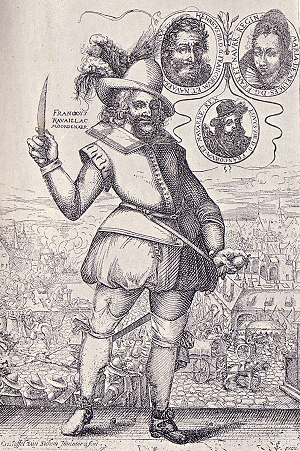
1610: Francois Ravaillac, because Paris was worth more than a mass

On this date in 1610, the fanatical Catholic who assassinated Henri IV of France was ripped apart on the Place de Greve.

The road to this man’s calvary begins long before his infamous crime, even long before the birth of his illustrious victim.

The Protestant Reformation — so richly represented in the executioner’s annals — had fractured France in the 16th century.

After decades of voluptuously indecisive Catholic-versus-Hugeunot slaughter, matters had finally been settled by the man upon whom French absolutism would erect its (ill-fated) edifice.

Henri IV, the first Bourbon monarch and a Huguenot, had unified the country by the sword, capped by his memorably politic conversion to Catholicism in 1593 to win over the holdout capital of Paris — the occasion of his understated declaration that “Paris is worth a mass”.

Let us tarry here to appreciate “the good king Henri” in a kaleidoscope of flattering artwork to the tune of Vive Henri IV, the monarchy’s unofficial anthem after its subject’s passing:

Did you catch that last image?

Henri’s fine gesture of sectarian triangulation and the reign of relative calm it inaugurated were naturally resented by godly partisans of both camps who either considered his conversion a betrayal or considered the king a closet Protestant.

At the crazed end of this latter spectrum, we meet our day’s principal, Francois Ravaillac.

Readers unconstrained by time may enjoy this Tolstoyan trek into the regicide’s mind and milieu, but it will suffice us to say that the modern shotgun-wielding postal clerk who just seemed like a quiet, harmless type to all his coworkers might like the cut of Ravaillac’s jib. A bit of a loner, a bit of a professional washout, with a penchant for religious visions and a passel of ill-arranged grievances … by this point in the movie, that’s about what you expect the police profiler to be reciting.*

It is only right that such a contemporary-sounding lone nut story ought to have a vigorous conspiratorial counternarrative.

There has always been a strong suspicion that behind Ravaillac’s hand was the work of the scheming Catholic Duc d’Epernon, perhaps even with the complicity of Henri’s wife Marie de’ Medici, who had conveniently been crowned as queen the day before the murder** and promptly teamed up with Epernon to cement an alliance with a traditional French rival, the ultra-Catholic Habsburgs.

Balzac, for one, had no doubt about it:

all of [her] actions were prejudicial to France … Marie de’ Medici wasted the wealth amassed by Henri IV.; she never purged herself of the charge of having known of the king’s assassination; her ‘intimate’ was d’Epernon, who did not ward off Ravaillac’s blow, and who was proved to have known the murderer personally for a long time. … [T]he victory Richelieu at last won over her (on the Day of the Dupes) was due solely to the discovery the cardinal made, and imparted to Louis XIII, of secret documents relating to the death of Henri IV.

The historical jury is out on that question, presumably for good.

If Ravaillac was a conspirator, he proved to be a damned good one, denying under repeated torture that he had any accomplices. On this date, the tortures reached their crescendo and conclusion — to the horrible delight of the Parisian mob, as reported by Alistair Horne (via The Corner):

On 27 May, still protesting that he had acted as a free agent on a divinely inspired mission, Ravaillac was put to death. Before being drawn and quartered, the lot of the regicide, on the Place de Grève scaffold he was scalded with burning sulphur, molten lead and boiling oil and resin, his flesh then torn by pincers. Then his arms and legs were attached to horses which pulled in opposite directions. One of the horses “foundered,” so a zealous chevalier offered his mount; “the animal was full of vigour and pulled away a thigh.” After an hour and a half of this horrendous cruelty, Ravaillac died, as the mob tried to prevent him receiving last rites. When he finally expired,

“…the entire populace, no matter what their rank, hurled themselves on the body with their swords, knives, sticks or anything else to hand and began beating, hacking and tearing at it. They snatched the limbs from the executioner, savagely chopping them up and dragging the pieces through the streets.”

Children made a bonfire and flung remains of Ravaillac’s body on it. According to one witness, Nicholas Pasquier, one woman actually ate some of the flesh. The executioner, supposed to have the body of the regicide reduced to ashes to complete the ritual demanded by the law, could find nothing but his shirt.

Ravaillac was the last Frenchman drawn and quartered for a century and a half — but his punishment as a regicide formed the precedent for that handed down in 1757 to Damiens.

* No need, though, as Francois wasn’t hard to catch: he stepped up to Henri’s carriage when it was caught in a traffic jam on May 14, 1610, and stabbed the king to death plain as can be. He was lucky (sort of) to avoid a lynching.

** Rubens later painted a gaudy celebration of this event.

On this day..

1498: Girolamo Savonarola, as he had once burned vanities

On this date in 1498, the Dominican friar who had once bent Florence to his austere will was hung in chains and burned.

Girolamo Savonarola preached standing-room-only, millenial sermons against worldly immorality, in the early 1490’s. By 1494, when peninsular politics chased a weak Medici scion from Florence, he had become its master.

He makes a complex character, with a streak of flawed greatness even his contemporary enemies recognized; his anti-Renaissance theology was severe but not dour, fired as it was by a genuine spiritual passion that spoke to real needs of his audience and a real crisis growing in the Church. And he did not disdain the revolutionary real-world implications of his faith.

Savonarola instituted Republican government with a touch of the Taliban — a vice squad of young hooligans to rough up rouged ladies and card-players;* a famous Bonfire of the Vanities in which Botticelli incinerated some of his own work — but also a populist economic touch.

For reasons both internal (the killjoy factor of busting up dice games wore out its welcome) and external (his French ally Charles VIII was driven from Italy, and Savonarola made a dire enemy of the corrupt Borgia pontiff Alexander VI), the priest’s grip on Florence weakened. In April 1498, he was arrested with two other clerics; all three were tortured into signing confessions, then hanged in the Piazza della Signoria by an insolent executioner.

The doomed Savonarola anguished that he had not been strong enough to resist the tortures of the rack, and penned in contrition the Latin meditation Infelix ego:

Alas wretch that I am, destitute of all help, who have offended heaven and earth — where shall I go? Whither shall I turn myself? To whom shall I fly? Who will take pity on me? To heaven I dare not lift up my eyes, for I have deeply sinned against it; on earth I find no refuge, for I have been an offence to it…

Like Savonarola’s memory and teachings, it spread — often illicitly — in a Europe ready for religious reform. Infelix ego has been frequently set to devotional music, like this version by Orlande de Lassus:

[audio:Infelix_Ego_Lassus.mp3]

Savonarola might have been in himself a dead end, an unsuccessful prophet quickly rolled back, but he nonetheless possesses a recognizable essence that distills both the Zeitgeist of his time and the immemorial hunger for simplicity and virtue that coexists with the equally human celebration of pleasure and beauty. He left complex legacies to both the Church and the city his reforms sought (and ultimately failed) to scourge.

In religion, his castigation of the vice and sin of the Church (a position of which he was an outstanding but hardly a lonely advocate) prefigured the coming Reformation. But Savonarola also never left off the most devout affiliation to Catholicism, nor sought institutional schism even when he had been excommunicated.** What to make of such a man? He is both depicted (at the base of a Martin Luther statue) at the Worms Reformation Monument, and proposed for present-day Catholic canonization.

So too his secular legacy — the theocrat who burned books and expelled the Medici and was reduced to ashes for his reactionary principles — merits a respectful recollection in Florence, even if few would actually want to live in his republic. He repelled Machiavelli, a libertine counselor of the post-Savonarola Florentine Republic, but perhaps fascinated him as well, as a prince with a precisely backward grasp of his own power.

This stone marking the site of the execution stands at a crossroads of tourist traffic in a thicket of statuary, mostly nude and/or classically inspired, outside the entrance to one of Europe’s principle collections of Renaissance art.

One wonders what the old Dominican would have made of it.

Books about Savonarola’s Florence

* Savonarola also made sodomy punishable by death.

** Alexander VI tried first to get him (in Lyndon Johnson’s fragrant phrase) inside the tent pissing out by making him a cardinal, which Savonarola spurned.

On this day..

1536: Anne Boleyn

On this date in 1536, Anne Boleyn lost her head.

Any queen decapitated by her king would of course rate an entry in these grim pages. But this does not quite explain Anne Boleyn‘s enduring appeal, relevance and recognizability for the most casual of modern observers, and her concomitant footprint in popular culture, even with the “Greek tragedy” quality of her life.

Anne stands at the fulcrum of England’s epochal leap into modernity. Whether she was that fulcrum might depend on the reader’s sympathy for the Great Man theory of history, but little more do we injure our headless queen to regard her as the woman for her time and place — the accidental hero (or villain) raised up and thrown down by the tectonic forces of her milieu.

Through Anne was born — for reasons of momentary political arrangements of long-forgotten dynasts, which seems a shockingly parochial proximate cause — the English Reformation, and through the Reformation was born the crown’s decisive triumph over the nobility, the broad middle class nurtured on the spoils of Catholic monasteries, the rising Britannia fit to rule. Most would take as an epitaph historical accidents of such magnitude.

Of course, by those same accidents, Anne was the instrument of thousands of deaths herself, and little did she appear troubled in life by the corpses upon which she ascended the throne.

Her own family maps the change wrought on England. An ancestor was beheaded in the Wars of the Roses, medieval England’s last great breakdown; her uncle Thomas Howard was one of the throwback scheming Dukes, mastered by his sovereign to the extent of issuing Anne’s capital sentence from his own lips;* the beheaded woman’s daughter, Queen Elizabeth I, set a recognizably centralized English state on the path of empire.

Fitting tribute that, from the Tower where she met her end** to lands undreamt-of in her time, people still, like Henry, find her captivating.

[audio:http://www.bl.uk/whatson/podcasts/podcast95533.mp3]

* Anne’s father also declared for her guilt. Unprincipled as these men undoubtedly were, it cannot have been a pleasant responsibility; the question of whether she was actually guilty of adultery-cum-treason, the fatal charge extracted from a supposed lover by torture, has been hotly and inconclusively disputed by posterity.

** With a solemn speech submissive to Henry but not admitting any guilt — in an earlier moment of levity, she had famously remarked of the French swordsman hired to do the job, “I heard say the executioner was very good, and I have a little neck.”

On this day..

1569: Dirk Willems, for loving his enemy

On this date in 1569, Dirk Willems paid the penalty for a famous act of charity.

Willems was condemned by the still-ascendant Catholic church as an Anabaptist, but escaped prison.

Fleeing a pursuer across a frozen pond, Willems had an opportunity to make good his escape when his persecutor crashed through the ice. But he turned back to save the drowning man:

One good turn did not deserve another: the man arrested Willems, and the compassionate Protestant found himself burned to death* this day at Asperen.

Hundreds of Anabaptists suffered similar fates, many of them registered in the Martyrs Mirror (available online here). But Dirk Willems’ story has always been one of the most affecting and popular with the Mennonite communities who trace their lineage to the Anabaptists:

[W]hen he fled he was hotly pursued by a thief-catcher, and as there had been some frost, said Dirk Willems ran before over the ice, getting across with considerable peril. The thief-catcher following him broke through, when Dirk Willems, perceiving that the former was in danger of his life, quickly returned and aided him in getting out, and thus saved his life. The thiefcatcher wanted to let him go, but the burgomaster, very sternly called to him to consider his oath, and thus he was again seized by the thief-catcher, and, at said place, after severe imprisonment and great trials proceeding from the deceitful papists, put to death at a lingering fire by these bloodthirsty, ravening wolves, enduring it with great steadfastness, and confirming the genuine faith of the truth with his death and blood, as an instructive example to all pious Christians of this time, and to the everlasting disgrace of the tyrannous papists.

(Bygones, tyrannous papists: last year, a Mennonite delegation to the Vatican gave Pope Benedict XVI a framed picture of Willems saving his romish persecutor.)

Few are the faiths that lack a martyrology, but notwithstanding the incendiary language of our 17th-century source, the place of martyrs (“Dirk Willems warns Mennonites not to expect to be rewarded for good works — a sharp contradiction to the American gospel of success”) and the right way to commemorate them without stoking confessional hostility occupy unusually nuanced places in Mennonite thought.

* The burning came off badly, the Martyrs Mirror records:

[A] strong east wind blowing that day, the kindled fire was much driven away from the upper part of his body, as he stood at the stake; in consequence of which this good man suffered a lingering death, insomuch that in the town of Leerdam, towards which the wind was blowing, he was heard to exclaim over seventy times, “O my Lord; my God,” etc., for which cause the judge or bailiff, who was present on horseback, filled with sorrow and regret at the man’s sufferings, wheeled about his horse, turning his back toward the place of execution, and said to the executioner, “Dispatch the man with a quick death.” But how or in what manner the executioner then dealt with this pious witness of Jesus, I have not been able to learn, except only, that his life was consumed by the fire.

On this day..

1916: Jesse Washington lynched after conviction

Lynching is such a vile word. Likely taken from the name of Captain William Lynch of Virginia (circa 1780), the term for administering justice while dispensing with a trial had, by 1916, long since taken on its more common meaning of a white-on-black public killing.

But Jesse Washington‘s case defies this simple definition, straddling the line between state execution and an unrestrained populace. Washington’s brutal lynching at the hands of a white mob in Waco, Texas, on May 15, 1916, clearly fits the definition, and the particularly grisly details of his demise conjure all-too-familiar images of violent racism in the pre-Civil Rights South; but in another more disturbing way, Washington was effectively executed, his punishment carried out not by the state of Texas, but by the people themselves.

Jesse Washington’s charred corpse after the lynching.

Washington was born in 1899, a black farmhand who may or may not have been mentally retarded.* While his life is not well-documented, his death most certainly is. Washington was arrested on May 8 of that year for the rape and murder of Lucy Fryer, the 53-year old wife of a well-to-do cotton farmer. Fryer was found bludgeoned to death. Washington was spared for a week by the Waco sheriff, who successfully took him into custody before a pre-trial mob got their hands on him; Washington was then sent to Dallas for holding to prevent a local incident. To appease the mob, he was transferred back to Waco and tried for the crime just one week later.

It’s unclear whether Washington was guilty — evidence is scant and the trial lasted just one hour, but Washington appears to have had ample opportunity to perpetrate the act and is purported to have confessed — but his guilt or innocence in the matter was not on the mob’s mind. On May 15, the well-attended trial ended, and in four minutes, the jury reached its guilty verdict. Before the 17-year old could be sentenced, and with little or no resistance offered by any of the various legal entities in the courthouse, several hundred of the onlookers (some brandishing weapons) rushed Washington and carried him out the doors. Outside, a larger crowd waited to beat and castrate him. A chain was thrown around Washington’s neck, and he was dragged to the town square, where he met an immense crowd as well as the pile of dry goods boxes that was to be his end.

A Fred Gildersleeve image of the lynching of Jesse Washington.

By some estimates, up to 15,000 (mostly white, though not exclusively white) people watched the horrible events unfold; without question, Waco’s mayor as well as several other public officials watched from their second-story perch at town hall on one side of the square. Washington was tossed onto the boxes and coal oil was poured over him. The other end of the chain was thrown over what has become known as the Hanging Tree, and the fuel below Washington’s feet was set ablaze. Immersed in the flames, he attempted to climb the blisteringly hot chain multiple times, each time to be lowered back into the cauldron. It’s unclear how long Washington was alive, but the event lasted more than an hour, after which his fingers and teeth were claimed as souvenirs, his body parts were separated from the torso, and the remains of Washington were dumped in a bag so they might be dragged once more through the Waco streets.

Also watching from the mayor’s position was a cameraman who wanted to sell photographs of Washington’s charred corpse as postcards. Fred Gildersleeve snapped a series of images which would briefly make Waco the most shamefully famous city in the nation. Gildersleeve’s work paints a portrait of a town possessed by spite and uncontrolled rage: thousands of white spectators standing about the burning body of Washington from above, then hundreds of blacks gathered around his burned and brutalized remains from ground level. Others took pictures as well,
some more disturbing than others.

A complete and startlingly brutal account of this murder is given by Patricia Bernstein in her 2005 book The First Waco Horror: The Lynching of Jesse Washington and the Rise of the NAACP, which also tracks the increased viability of the NAACP in the wake of the slaying. What makes this case noteworthy for this column, though, is that Washington was found guilty prior to his lynching, and he would doubtless have received a state-supported death sentence. At the time, Texas law would have allowed for a public hanging; presumably, the spectacle surrounding Washington’s execution would have been just as significant (though not nearly as gruesome). Instead, vigilante justice was administered on the young farmhand, and his case because a linchpin for the Civil Rights movement. As with other lynchings of the time, no persons were charged in the incident, though it was obvious that there was significant planning involved and, from some of the images, that some form of self-appointed executioner actively participated in the deed.

Unlike a state-sponsored execution, though, Washington’s death raised the ire of the jury foreman, who harshly criticized the court for not protecting him. And because he was lynched, his cause was also taken up by several Northern papers, pushed into the national spotlight by NAACP secretary Royal Freeman Nash and Elisabeth Freeman.** Over 90 years later, the town of Waco is still dealing with the Waco Horror. The lynching has reared its head multiple times as many residents have pushed for a plaque to be erected on the site of the lynching, as one was for a distressingly large number of prior lynchings in Waco. Some in the town continue to resist, asserting that Washington’s guilt absolved the mob of responsibility for its act.

A postcard commemorating the lynching; written on the back: “This is the barbecue we had last night. My picture is to the left with a cross over it. Your son, Joe [Myers].”

Washington’s case raises two of the critical issues in the modern death penalty debate: culpability of the executioner (and witnesses), and cruelty of punishment. Nobody in the mob was prosecuted for the crime, and in the Waco of that day, it would have been unusual if someone had; today, we take little interest in the state executioner but would vociferously condemn such mob action. On a similar note, Washington’s death was barbaric and brutal, and few would argue that such an execution should be undertaken through legal channels, but recent Supreme Court cases have found it difficult to identify the meaning of “cruel and unusual punishment”. The debate continues in the United States, but these are two arguments, posed by Cesare Beccaria, that caused Leopold II to outlaw capital punishment in the Grand Duchy of Tuscany in 1789, and cases like Washington’s suggest they should continue at the very least to give us pause today.

* Some accounts state simply that he was illiterate, and if this is the litmus test for mental retardation in the early 1900s, around 6 percent of the population fell into that category.

** Freeman worked tirelessly to drag information from Waco’s inhabitants, her actions likely sparking papers like the local Waco Times-Herald to quickly shut the door on the case; that paper officially apologized 90 years later for its and other newspapers’ roles in venerating the lynch mob.

On this day..

1881: Not Billy the Kid

“You will be hanged by the neck, Billy, until you are dead, dead, dead!”

“You can go, Judge, to hell, hell, hell!”

We have no source for whether William Bonney’s reply to the judge who sentenced him to hang was vindicated by the Almighty. But the judge’s sentence, due to be executed this day, assuredly never came to pass: two weeks before, Billy the Kid effected the last of his famous escapes.

The exploits of this legendary gunfighter — and his legend rather exceeds his exploits — are exhaustively chronicled online. The Manhattan-born Kid, a pup of 21 at his death, was a gunfighter in the Lincoln County War, a fight between two frontier magnates. Billy counted himself among the Regulators, a deputized posse (so it claimed, by way of legality) that was the armed militia of a murdered rancher.

Billy’s winning way with the press after his capture helped endear him to popular imagination, even after he was condemned in Mesilla, New Mexico for ambushing a lawman.

Here’s how Emilio Estevez played the crime in Young Guns:

On April 28, in a building that still stands in Lincoln, New Mexico, Bonney got the drop on one of his guards and high-tailed it out of town.

Though spared the ignominy of the gallows, Billy the Kid would not long outlive his judicially appointed hour. Lincoln County sheriff Pat Garrett found and killed the fugitive a few months later.

Ironically, this transaction darkened the reputation of the successful officer of the law — the circumstances of the killing were ambiguous, and seem less than honorable to some — while helping valorize the young outlaw who by all rights should long since have been at the end of a rope. And for this, maybe Billy’s shade has stood Garrett’s a drink or two, because a shadowy and youthful disappearance from the scene helped catapult Billy into folklore that has long outlasted the forgotten Lincoln County War.

Billy the Kid — even the name evokes the American self-image with perfect pitch — has come to so fully embody the floating signifiers of the Wild West, of America in its adolescence, that around the same time Bob Dylan composed “Knockin’ on Heaven’s Door” for the clip above (the 1973 film Pat Garrett and Billy the Kid), Billy Joel took the gunslinger for an all-purpose western motif in “The Ballad of Billy the Kid”. Joel’s song’s describes a life that seems to be just what the listener thinks it ought to be while remaining factually untrue of its titular character in almost every particular, including, in his version, a picturesque death by hanging:

The ballad form of romanticized narrative poetry suits our elusive subject well. Skip music and cinema a generation ahead and we have Guns n’ Roses covering “Knockin’ on Heaven’s Door” and power balladeer par excellence Jon Bon Jovi climbing the charts with this signature hit from the Young Guns II soundtrack:

On this day..

1685: Margaret McLachlan and Margaret Wilson, the Solway Martyrs

On this date in 1685, a woman of 63 and another of 18 were staked to the tidal channel of Bladnoch River near Wigtown and drowned by the rising waters.

Margaret Wilson remembered in heroic — and sexy — marble at Knox College in Toronto, Canada. (Larger version.)

They were holdout Covenanters — Scottish Presbyterians resisting English Episcopalian control in a struggle both theological and political (here’s a backgrounder).

To skip over much meaningful history, the Covenanter movement of local presbyter control had at this point been defeated politically and militarily, if not spiritually. The due demanded by the British crown was prayer for the king — an oath, in effect, of submission to the Episcopal hierarchy and, by the same token, to London. Many Scots remained obdurate, including children — the 18-year-old Margaret Wilson was arrested with her 13-year-old sister, though their father managed to scrape together a bond payment to save the younger girl.

And fiendish penalties were deployed to force their capitulation or cow their sympathizers. In this case, a recent law prescribed public drowning for Covenanter women, and the two Margarets were duly condemned to be

ty’d to palisados fixed in the sand, within the flood mark, and there to stand till the flood overflowed them and drowned them.

The ploy on this day was to put the old woman further out, where she would drown first, in hopes of terrifying the teenager into submission. The young Margaret held firm.

Here is the women’s end related in The History of the Sufferings of the Church of Scotland by Robert Wodrow, who dubbed the bloody suppression of the Covenanter movement in the 1680’s “The Killing Time”:

The two women were brought from Wigton, with a numerous crowd of spectators to so extraordinary an execution. Major Windram with some soldiers guarded them to the place of execution. The old woman’s stake was a good way in beyond the other, and she was first despatched, in order to terrify the other to a compliance with such oaths and conditions as they required. But in vain, for she adhered to her principles with an unshaken steadfastness. When the water was overflowing her fellow-martyr, some about Margaret Wilson asked her, what she thought of the other now struggling with the pangs of death. She answered, what do I see but Christ (in one of his members) wrestling there. Think you that we are the sufferers? No, it is Christ in us, for he sends none a warfare upon their own charges. When Margaret Wilson was at the stake, she sang the 25th Psalm from verse 7th, downward a good way, and read the 8th chapter to the Romans with a great deal of cheerfulness, and then prayed. While at prayer, the water covered her: but before she was quite dead, they pulled her up, and held her out of the water till she was recovered, and able to speak; and then by major Windram’s orders, she was asked, if she would pray for the king. She answered, ‘She wished the salvation of all men, and the damnation of none.’ One deeply affected with the death of the other and her case, said, ‘Dear Margaret, say God save the king, say God save the king.’ She answered in the greatest steadiness and composure, ‘God save him, if he will, for it is his salvation I desire.’ Whereupon some of her relations near by, desirous to have her life spared, if possible, called out to major Windram, ‘Sir, she hath said it, she hath said it.’ Whereupon the major came near, and offered her the abjuration, charging her instantly to swear it, otherwise return to the water. Most deliberately she refused, and said, ‘ I will not, I am one of Christ’s children, let me go.’ Upon which she was thrust down again into the water, where she finished her course with joy.”

Update: Gravestone photos and maps of the area can be found here.

On this day..

1628: Johan Bernhard Reichardt, a nine-year-old witch

On this date in 1628, a prepubescent boy went to the stake at Würzburg, the victim of a witch-hunting spasm amid the confusion of the Thirty Years’ War.

Here is the story as related by Midelfort’s Witch Hunting in Southwestern Germany, 1562-1684:

Bernhard Reichardt, a magistrate and wealthy man of Markelsheim, had tried to give his young son, Johan Bernhard, a decent education by sending him to school at Neuen Münster in Würzburg. In December of 1627, however, the father became convinced that his son had been seduced into witchcraft there, and transferred Johan Bernhard to the Jesuit school at Dettelbach. By mid-March 1628 the authorities in Würzburg were aware that this nine-year-old boy had been involved in witchcraft and wrote politely to the Teutonic Order in Mergentheim to ask for assistance in extraditing the child to Würzburg for questioning. Johann Caspar, Administrator of the Teutonic Order, responded at once that the boy was to be delivered up formally to the authorities at the border. By the end of March he was under the jurisdiction of the Würzburg authorities. Far from merely questioning him, the Würzburg court got Johan Bernhard to sign a confession on April 8 that he had been seduced into witchcraft by a classmate. Among other horrors, he had denied God, Mary, and all the saints and angels. With his own blood he had written “Ich, Johannes Bernhardus Reichard, hab mich dem Teüfel vergeben.” He had flown to numerous dances and, although only nine years old, had had intercourse with the devil on numerous occasions. Like adults, Johan Bernhard always found the devil “hard as horn” and “of a cold nature.” Implicating his complices, the boy noted that he had seen three other persons known to him at the dances.

One month later, on May 9, 1628, the authorities at Würzburg burned Johan Bernhard Reichardt and four others. Johann Caspar in Mergentheim heard of the execution only after it had occurred, but agreed fully that it had been justified.

Little Johan was far from the only child prosecuted as a witch in Europe, and many very young children number among the casualties of the Würzburg witch trials. With Catholic and Protestant armies romping back and forth over German principalities, it was a ripe moment for feeling the presence of existential threats to the civilization … and for trying children as adults.

Midelfort, again:

[A] “New Treatise on the Seduced Child-Witches” thundered against the rapid increase in childhood witchcraft. The author asserted that the first reason for such conditions was the sins of the parents, for whom witch-children were a fitting punishment. But more important, such witchcraft was due to the sins of the children themselves. One should not think that they were innocent merely because they were young. Their cursing, coveting, and immoral words and games were proof enough that these children had fallen into mortal sin.

And why, after all, shouldn’t children be witches? Everybody else was. The chancellor of Würzburg’s Catholic Prince-Bishop wrote a comrade in the summer of 1629:

As to the affair of the witches, which Your Grace thinks brought to an end before this, it has started up afresh, and no words can do justice to it. Ah, the woe and the misery of it — there are still four hundred in the city, high and low, of every rank and sex, nay, even clerics, so strongly accused that they may be arrested at any hour … a third part of the city is surely involved … there are children of three and four years, to the number of three hundred, who are said to have had intercourse with the Devil. I have seen put to death children of seven, promising students of ten, twelve, fourteen, and fifteen.

In the version of this story preserved in Mackay’s Memoirs of Extraordinary Popular Delusions, desperate public demonic incantations repeated by “witches” who were either persuaded of their own guilt or hopeless of any source of aid save the infernal were absorbed by youngsters’ timeless instinct for that which is forbidden by their elders, further feeding the frenzy:

Many an unhappy urchin, who in a youthful frolic had repeated it, paid for his folly the penalty of his life. Three, whose ages varied from ten to fifteen, were burned alive at Wurzburg for no other offence. Of course every other boy in the city became still more convinced of the power of the charm. One boy confessed that he would willingly have sold himself to the devil, if he could have raised him, for a good dinner and cakes every day of his life, and a pony to ride upon. This luxurious youngster, instead of being horsewhipped for his folly, was hanged and burned.

However locally and temporarily overwhelming this current, it was never without resistance — everyday people willing to complain that charges were absurd, judges inclined to skepticism. An onset of acquittals was known to presage the end of a witch-hunting spasm.

A particular voice left to us is Friedrich von Spee, a Jesuit theologian whose tract Cautio Criminalis — Precautions for Prosecutors — accepted the existence of witches but argued forcefully against the legal apparatus of accusation and torture. To Spee’s mind, not two in fifty burned witches were truly in league with the devil, and his book quickly became influential to both Catholic and Protestant audiences. It remains in print down to the present day

On this day..

1916: Syrian and Lebanese nationalists, who christen “Martyr’s Day”

On this date in 1916, a landmark and a holiday — and a founding story of national betrayal — were born with the Ottoman Empire’s hanging separatist nationalists simultaneously in Damascus and Beirut.

The lightning-rod British journalist Robert Fisk has referenced this event numerous times. Here’s his description, focusing on the Beirut location:

Prior to the First World War, 33 Arabs in what is now Lebanon and was then Syria had appealed to the French consul in Beirut to help them to gain independence from the Turks – or at least offer French protection.

The letters — from both Muslims and Christians, one from a Palestinian and another from a senior officer in the Ottoman army — were written in secret and duly reached the consul. But when France broke off relations with the Sublime Porte on the outbreak of war, the diplomat — rather than pack those subversive letters off to his new residence in Egypt — hid them in the abandoned consulate.

And so it came to pass that the local French-language interpreter at the consulate, imprisoned in Damascus, sought to gain his freedom with Ahmed Jemal Pasha, commander of the Turkish Fourth Army in Syria, by betraying to him the exact location where the consul had hidden the documents. Ottoman security agents then broke into the consulate — which was supposed to be under the protection of the still-neutral United States — and found the incriminating letters. Jemal Pasha’s fury was now directed against these treacherous letter writers with Saddam-like fury.

They were dragged from their homes, taken to the hill town of Aley, brutally tortured and sentenced to be hanged by a drum-head military court. And hanged they duly were, only a few feet from the spot where the sea will now wash up to the square and scarcely 50 metres from the tomb where Rafiq Hariri now lies. A priest was hanged in his robes. The Ottoman officer went to his death in full military uniform.

And three days after the last batch of Lebanese patriots were hanged in 1916, François Georges Picot signed his infamous secret agreement with Sir Mark Sykes to divide up the Middle East, taking Syria for France — and Palestine for the Brits — which would ensure that the French government rather than an independent Lebanese government took over Lebanon.

Now here’s the rub. Not only had every leading Lebanese patriot been liquidated just before the Sykes-Picot agreement. But the French diplomat who had shamefully left those fatal letters behind in his consulate in Beirut was – wait for it – the very same François Georges Picot.

Convenient.

It is as martyrs that this day’s victims are best known, rather than their particular individual achievements. But Abdul-Karim al-Khalil had the day’s picturesque exit; just before he kicked away his own ladder, denying the executioner the pleasure, he declared:

O paradise of my country, carry our feelings of brotherly love to every Lebanese, to every Syrian, to every Arab, tell them of our tragic end and tell them: “For your freedom we have lived and for your independence we are dying!”

As a result of this day’s dealings, May 6 is known in both countries as Martyrs’ Day — an apt occasion for renewing the two states’ ties — and both Beirut and Damascus have a Martyrs’ Square. This is the monument in Beirut:

On this day..