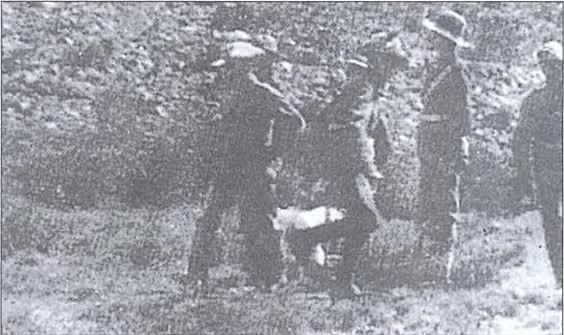
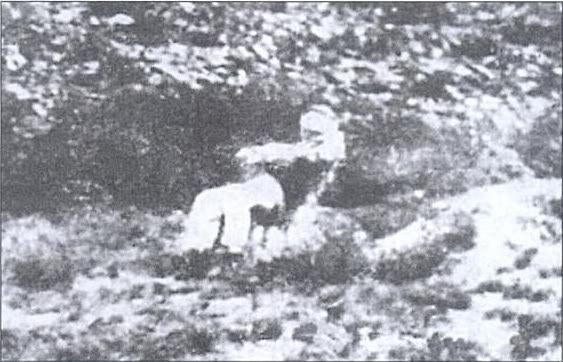
1937: Tom Steinbock and Juan Mirbol in Sartre’s The Wall

On an uncertain date in the Spanish Civil War, two principal characters are shot in Jean-Paul Sartre‘s first short story, “The Wall”.

“Le Mur” in French, a title also suggesting the dead spirits of Roman mythology, “The Wall” was penned in 1937 as Sartre’s personal response* to the Spanish Civil War.


Sartre published “The Wall” at almost the exact same time — summer 1937 — as Picasso finished Guernica. (Guernica was bombed in April 1937.)

“The Wall” is highly non-specific as to time and circumstance; a mention of “winter” — as of writing, the winter of 1937 was the only one yet elapsed in the conflict — and a few disembodied calendar indicators like “the 9th” and “Tuesday”.

Instead, it’s an existential reflection on the inscrutability of death. The narrator, one Pablo Ibbieta, awaits the morning’s firing squad with an International Brigade volunteer named Tom Steinbock and a Spanish innocent named Juan Mirbal.

All three of us watched [a Belgian doctor] because he was alive. He had the motions of a living human being, the cares of a living human being; he shivered in the cellar the way the living are supposed to shiver; he had an obedient, well-fed body. The rest of us hardly felt ours — not in the same way anyhow. I wanted to feel my pants between my legs but I didn’t dare; I watched the Belgian, balancing on his legs, master of his muscles, someone who could think about tomorrow. There we were, three bloodless shadows; we watched him and we sucked his life like vampires. …

In the state I was in, if someone had come and told me I could go home quietly, that they would leave me my life whole, it would have left me cold: several hours or several years of waiting is all the same when you have lost the illusion of being eternal. I clung to nothing, in a way I was calm. But it was a horrible calm — because of my body; my body, I saw with its eyes, I heard with its ears, but it was no longer me; it sweated and trembled by itself and I didn’t recognize it any more. I had to touch it and look at it to find out what was happening, as if it were the body of someone else. …

[Juan] wept: I could clearly see he was pitying himself; he wasn’t thinking about death. For one second, one single second, I wanted to weep myself, to weep with pity for myself. But the opposite happened: I glanced at the kid, I saw his thin sobbing shoulders and I felt inhuman: I could pity neither the others nor myself. I said to myself, “I want to die cleanly.”

Tom and Juan go to the wall that morning.

Pablo, an anarchist, is subjected to one last interrogation before he’s shot: the fascists are hunting a confederate of his, and they offer Pablo his life in exchange for giving up the whereabouts of this Ramon Gris. “His life had no more value than mine; no life had value,” Pablo muses. “They were going to slap a man up against a wall and shoot at him till he died, whether it was I or Gris or somebody else made no difference.” Impulsively, almost whimsically, he directs them to a cemetery as a bogus location: “It was a farce. I wanted to see them stand up, buckle their belts and give orders busily.”

Except … unbeknownst to Pablo, Ramon Gris had just moved his hiding place to that very cemetery. For reasons as nonsensical as Ibbieta’s own initial condemnation, his life is swapped for Gris’s at the last moment.

* Specifically, according to Sartre, Self-Formation, and Masculinities, after a student asked for help sneaking into Spain to fight the fascists.

On this day..

1942: Icchok Malmed

(Thanks to Meaghan Good of the Charley Project for the guest post. -ed.)

On this day in 1942, Icchok Malmed* was hanged on Kupiecka Street in the Bialystok Ghetto for throwing acid in a Nazi’s face and blinding him.

Zchor tells the story:

When the Nazis attacked the house at 29 Kupiecka Street, rounding up all of its residents into the street, a bold young man, Izchok Malmed, whipped out a jar of acid from his pocket, hurling it in the face of a Nazi soldier, who was blinded at once. Seeking revenge, the sightless Nazi fired his revolver several times, hitting another Nazi soldier and instantly killing him. In the melee, Malmed vanished.

Commandant Friedl, after learning what had happened, ordered that one hundred men, women and children living in the area where the incident occurred be rounded up and force-marched to a nearby garden, where they were lined up against the wall of an adjacent bet hamidrash and shot with machine guns.

Afterward Nazi soldiers captured another group of Jews, forcing them to dig a large pit for the bodies of the one hundred martyrs. A thin layer of earth covered them. Some were still alive, their hands groping upward through the earth.

The Nazi soldier accidentally shot by his colleague whom Malmed had blinded was carried to the Judenrat building, and his body was placed on [Judenrat Chairman Efraim] Barasz’s desk. Friedl then proclaimed to Barasz, “See what your Jewish criminals have done. Now we shall take revenge. You shall see what we can do.” Friedl issued an ultimatum for the perpetrator of the crime to surrender within twenty-four hours. Failing that, the entire ghetto would be destroyed with everyone in it.

Barasz knew the Nazis meant what they said. He sent word to Malmed to give himself up and thereby save thousands of Jewish lives. As soon as Malmed heard, he surrendered himself to the Nazis.

Tamarof’s diary described in detail Malmed’s courage. Asked why he killed the Nazi soldier, he replied: “I hate you. I regret I only killed one. Before my eyes my parents were murdered. Ten thousand Jews in Slonim were liquidated before me. I have no regrets.” Tamarof tried to slip poison to Malmed but failed. Even the police could not get near the prisoner.

The next morning, Izchok Malmed, a hero of the ghetto, was hanged in the square where he had performed his act of courage. Despite the horrible torture to which he had been subjected, Malmed cursed the Nazi murderers. After several minutes of hanging on the gallows, the rope broke and the body fell to the earth. Instantaneously, the Nazis riddled Malmed’s corpse with bullets and re-hanged the body for another forty-eight hours.

Kupiecka Street was renamed Malmed Street after the war. Near the site of Malmed’s execution is a plaque reading, in Polish and in Hebrew, “Icchok Malmed, the hero and fighter of the Bialystok Ghetto, was killed here by the Nazi murderers on 8 February 1943. In his honor.”

* The Zchor account spells his name “Izchok” but on the memorial plaque it says “Icchok”. It’s a form of the name Isaac.

On this day..

2002: Daniel Pearl

“I decapitated with my blessed right hand the head of the American Jew, Daniel Pearl, in the city of Karachi, Pakistan. For those who would like to confirm, there are pictures of me on the Internet holding his head.”

-9/11 mastermind Khalid Sheikh Muhammad, in a claim made after torture in Guantanamo but nonetheless considered accurate according to a detailed 2011 report on Pearl’s death*

Warning: Although the filming was botched, this execution video still has plenty of gore and a severed head.

On this date in 2002, American hostage Daniel Pearl was executed by his captors in Karachi, Pakistan.

The 38-year-old Wall Street Journal reporter had been abducted January 23 by Islamic radicals while pursuing an interview with a (mistakenly) suspected handler of shoe bomber Richard Reid. Instead of being taken to the interview, Pearl was disappeared and held hostage for a variety of implausible demands targeting the United States’ relationship with Pakistan’s military government.

The reporter’s death this day was not confirmed until late February, when his killers released a video on the Internet interspersing images of American and Israeli violence with footage of Pearl speaking — and then, horrifically, of Pearl being beheaded with a knife.** It was the first of several hostagebeheading videos various militants would release in the next few years.

Pearl’s captors drew a direct line from his Jewishness to his murder in the statements they forced him to make:

My name is Daniel Pearl. I am a Jewish American from Encino, California USA … I come from, uh, on my father’s side the family is Zionist … My father’s Jewish, my mother’s Jewish, I’m Jewish … My family follows Judaism. We’ve made numerous family visits to Israel … Back in the town of B’nei Braq there is a street named after my great grandfather Chayim Pearl who is one of the founders of the town.

It was the more startling because Pearl himself was a very secular Jew. Pearl did not set out to be a martyr for his cultural or religious heritage: that identity as the identity was thrust upon him.

And it’s been suggested that it was thrust upon Pearl’s captors as well, whose object in kidnapping an American reporter might have been a much more parochial kidnapping commonplace — publicity, cash — but who became politically boxed in when their hostage was publicized by the media as a “Jewish-American reporter”. One of the emails the captors had pre-drafted actually announced Pearl’s release. It was edited after the kidnapping … to announce Pearl’s execution within 24 hours, as a Mossad agent. Al-Qaeda’s Khalid Sheikh Mohammed seems to have been summoned from outside the abductors’ circle as a ringer with the captors unsure of how to dispose of their prey.

As an investigative reporter, Pearl’s own work had in some notable instances countered the preferred narratives of American hegemony. For instance, his reporting rubbished American charges that the Khartoum pharmaceutical factory Bill Clinton ordered bombed in 1998 was actually a chemical weapons plant. His work in Kosovo led him to contradict the most bellicose “genocide” allegations from that region’s dirty ethnic war.

He was a star reporter in the prime of his life, a man who poured out words that defined a career and a public persona. From February 1, 2002, suddenly and without justice, that text was torn from his hands. In its place, during the charged months after September 11 and the American invasion of Afghanistan, came a silent Rorschach blot.

Pearl, the Jewish martyr. Pearl, the victim of blowback. Pearl, the journalistic icon. Pearl, the naive liberal in the heart of darkness. Pearl, the mandate for waterboarding and Iraq.

Pearl, the object lesson.

Pearl, the axe for others’ grinding.

Omar Sheikh, a Pakistani militant reportedly linked to Britain’s MI6 and the author of the kidnapping, was arrested within days of Pearl’s murder. He remains imprisoned under sentence of death in Pakistan for the crime.

* Mohammed also claimed that he wanted to kill Pearl personally to “make sure I got the death penalty” if he were eventually arrested.

** Among the many bone-chilling details to emerge from the subsequent investigation, it became clear that the actual murder was not shown — only some quick flashes of re-enacted throat-cutting — because the cameraman missed the shot of the kill.

On this day..

2011: Ahmed Ali Hussein, enemy cleric

On this date last year, the Islamist Somali al-Shabaab publicly shot a man named Ahmed Ali Hussein in Mogadishu.

The 44-year-old, reportedly an ecclesiastic member of the rival al-Ictisam sect, was allegedly induced to confess that he’d been working with American intelligence. He was chained up and riddled with hundreds of bullets while neighbors were made to watch.

“In the documents we have, Ahmed Ali Hussein has worked with United States’ Federal Bureau Investigation (FBI) for 16 months,” an al-Shabaab spokesperson explained. Hussein was not permitted to defend himself.

So, extrajudicial killing of cleric on uncontested secret evidence of aiding the enemy. Put Somalia down for the cutting edge of jurisprudence.

On this day..

1902: Gideon Scheepers, Boer guerrilla

Scheepers lives because they shot him.”

-Hermi Baartman, Graaf-Reinet Museum

On this date in 1902, Kommandant Gideon Jacobus Scheepers was shot by the British for his exploits in the Boer War.

The young Dutch-descended Scheepers (here’s his Afrikaans Wikipedia page) was a soldier from the still-independent Boer states which were being reduced in this war to British dependencies.

In 1901, late in the proceedings, Scheepers took a column of irregulars into the British Eastern Cape Province and wrought havoc behind the lines. Some exploits are the stuff of legend, like the time he rode into a town, released all the Boer prisoners, locked up the British magistrate, and hauled down the Union Jack — to the delight of the Boer locals.

He would spend that year giving the British much better than he got, but the war was also infamously dirty.

According to David Harrison’s The White Tribe of Africa: South Africa in Perspective, “Scheeepers’ men also flogged and shot natives who helped the British, looted as well as burned farms, and executed Boer ‘traitors’.”

Was any of that criminal?

Since Scheepers was over enemy lines, the Boers who joined him could be held liable for treason … but that didn’t hold for Scheepers himself. His execution turned on holding these unsavory acts as war crimes: his 30-count charge sheet included seven arsons, seven murders, and various and sundry abuses of prisoners and blacks. Scheepers was really sore about the last; natives were supposed to be kept out of the fighting, but the prisoner very credibly insisted that the ones he “murdered” were under arms as scouts for the British.

“We Afrikaners will never find justice under the English,” Scheepers wrote as a prisoner. “Everything is for the kaffirs.”

(There’s a vociferous defense of Scheepers from a pro-Boer history here, and a more sober one by a London press correspondent here.)


Scheepers is read the death warrant on January 17, 1902 — before Graaf-Reinet townspeople assembled by British orders.

For non-Loyalist Boers and for many throughout the world — the U.S. House of Representatives even moved a resolution calling for Scheepers to be accorded POW status according to the Geneva Convention — it smacked of a setup.


Gideon Scheepers (mostly obscured by his guards) tied to a chair for execution.


Just shot, Gideon Scheepers slumps backward in his chair.

While martyrdom guaranteed Scheepers a lasting legacy, bizarre posthumous turns helped elevate it into legend. When the dead man’s family turned up after hostilities to retrieve his bones, the grave turned out empty, leading to a years-long saga with colorful frauds presenting bogus remains, a mentally ill man doing the Grand Duchess Anastasia act and claiming to be Scheepers, and the actual corpse remaining stubbornly elusive.

The bereaved mother’s ultimately fruitless search for her son’s final resting place inspired the poem “Gebed om die Gebeente”(“Prayer for the Bones”), by D.J. Opperman. (Here’s a translated version.) That verse was recently set to music as a cantata by composer Hendrik Hofmeyr.

Scheepers’ allies, however, had simply been beaten in the field. On May 31, 1902 they capitulated to the British.

If we are asked why in 1978 a memorial should be erected for a man who died in 1902, then the answer is simple. The life and work of this man was such that history placed him in the heroes’ gallery and nothing and no one can deprive him of that place.

-Nationalist Prime Minister John Vorster upon the unveiling of a Scheepers monument

This interesting “On the Trail of Gideon Scheepers” series has a detailed and richly illustrated narrative of the man’s final year.

On this day..

1999: Recak Massacre

(Thanks to Meaghan Good of the Charley Project for the guest post. -ed.)

On this day in 1999, Serbian militants killed approximately 40 to 45 Kosovo Albanians near the village of Reçak in Kosovo. The victims allegedly included a twelve-year-old boy and at least one woman.

Depending on who you listened to, it was either a massacre against innocent civilians, or a military action against guerillas.

The New Kosova Report, adopting the former point of view, summarizes in a 2008 article:

In the early morning of 15 January, 1999, forces from Serbian Interior Ministry (MUP) and Yugoslav Army (VJ) moved into the village with tanks and began to shoot at houses sheltering civilians. After ransacking all the houses, they gathered 28 Albanian men and boys and ordered them to head towards a hill outside the village for questioning. There they were sprayed with machine guns and 23 of them died. Only five survived by pretending they were dead. Another 22 people were shot and/or decapitated at different places in the village. Some in a ravine behind the village, while others in front of their houses.

A local villager named Shefqet Avida gave photographer and BBC Radio reporter Melanie Friend an account which was later quoted in Friend’s book No Place Like Home: Echoes from Kosovo.

Policemen — Serbs — were hiding here, expecting them. I heard the Serbs saying, “Anyone under fifteen years old, don’t touch, but upwards of sixteen or seventeen years old, just kill them …” The people, when they were captured here, were made to stay in line, and every one of them was shot, and after that with a … very nice knife … they took eyes from the faces and hearts from the chest, and the Serbs later said, “That’s not true, we didn’t do that,” the mice, they’d eaten them. […]

Serbian police were shooting until four or five in the afternoon. When the observers arrived in the morning, we went with them to see the place where the people were murdered. Three of us stayed here all night to guard the bodies. […] Thirteen members of my family were killed there.

The Serbs denied having murdered civilians and claimed all those killed were all Kosovo Liberation Army fighters, shot during a skirmish with Serbian forces. To this day, many maintain the entire thing was staged, a hoax set up by the KLA in order to get support for their side.

Trying to sort the matter out, the European Union dispatched forensic experts to the scene from Finland. Helena Ranta, one of the experts, concluded that “There were no indications of the people being other than unarmed civilians.” When her opinion was broadcast in a press release, many mistook it for being the opinion of the entire group of scientists.

The Finns’ official report, however, has never been released. Dr. Ranta, a forensic dentist, later accused officials from the Ministry for Foreign Affairs of pressuring her to go against the Serbs.

Yugoslav and Belarusian scientists also examined the bodies and said they believed all the dead were KLA combatants. In response, critics blasted them for using allegedly out-of-date and unscientific testing methods.

News of the killings made headlines all over the world and incited NATO to finally get involved in the war. A couple of years later, Yugoslav dictator Slobodan Miloševic was brought up on war crimes charges; ordering the Reçak killings was one of them. It was later removed from the indictment for lack of evidence, however. (Miloševic died before his trial was concluded.)

In 2001, a Kosovo Serb police officer was sentenced to fifteen years in prison for participating in the killings. Outside observers, including the United Nations and Amnesty International, criticized the trial proceedings, accusing the Kosovo war crimes tribunal of ethnic bias and politically motivated decision-making. As of this writing, no one else has been called to account for what happened in Reçak.

On this day..

1916: Sergeant John Robins, before evacuating Gallipoli

On this date in 1916, Sergeant John Robins of the 5th Battalion, Wiltshire Regiment — demoted for the occasion to Private — was shot “at a point on the beach 400 yards North of the mouth of the Gully Ravine” for disobeying orders.

This redundantly named topography was a feature of an ill-starred (for the British) peninsula Robins’s army was quite ready to see the back of: Gallipoli.*

Winston Churchill’s brainchild for a knockout punch in the First World War had long since come to grief — the enduring grief of the British, Australian, and New Zealand troops who died by the thousands under Ottoman guns whilst attempting to seize the Dardanelles, open the Black Sea, knock the Turks out of the war, and expose the Central Powers’ soft underbelly.

It didn’t do any of those things, but it did help Mel Gibson’s career.

The first days of 1916 were the very last days of the Gallipoli campaign, by which time the object was just to get out.

Actually, the invaders’ positions had been steadily, stealthily evacuated over the preceding weeks — successfully slipping away without alerting the Ottomans to the opportunity for a turkey shoot. The evacuation, at least, was a triumph.

Sergeant Robins was a part of this hot mess; he’d once had to flee from his bed when the Turks surprised his camp and overran it. But it didn’t seem to be jangled nerves that did him in so much as the everyday infirmity of the flesh.

By December 1915, a quarter of his unit was laid up on the sick rolls, but when Robins begged off a patrol assignment for unwellness, the powers that be didn’t reckon him among the legions of ill — but court-martialed him for refusing an order. A rather stunned Robins attempted to explain:

On the night in question I was not well enough to go out. I was eight and a half years in India where I suffered a good deal from fever and ague, and I still get fits of this. I had been suffering from this for several days off and on, and the wet weather had greatly affected me. I have been out here for nearly five months and this is the first trouble I have ever been in. I have always done my duty. This would not have happened if I had been quite well. At the time I did not realise the seriousness of what I did.

He realised the seriousness when he was shot at 8 a.m. on January 2, 1916. A week later, his unit — all his countrymen’s units — were out of Gallipoli.

On this day..

1942: Three Bialystok Jews

(Thanks to Meaghan Good of the Charley Project for the guest post. -ed.)

On this day in 1942, three anonymous Jewish residents of the Bialystok Ghetto in Nazi-occupied Poland were hung in the public square across the street from the Judenrat (Jewish Council) building. The three worked at the ghetto’s oil factory, and had been caught smuggling sunflower seeds.

The residents of the ghetto paid little attention to the execution, accepting it with resignation. It was hardly remarked on.

But this event was yet another small indication of dire events looming in the near future. Compared to those in other Nazi ghettos, such as those at Warsaw and Lodz, the Bialystok Jews had it pretty good. The ghetto, noted Sara Bender in her 2008 book The Jews of Bialystok During World War II and the Holocaust, was “organized, industrious, and even prosperous. Unlike other ghettos, it never experienced starvation or abject poverty.”

And it was seen as relatively safe. This day’s sort of vicious, arbitrary executions for minor rule infractions, which were so common elsewhere, were not at all frequent in Bialystok. Neither were the mass deportations that had by late 1942 decimated almost all the other ghettos.

Well, Bialystok’s turn was coming.

Unbeknownst to the Bialystokers, just as the sunflower seed smugglers were meeting their end, the powers that be in Berlin were debating the future of the ghetto. The Nazis in immediate charge of the ghetto wanted to keep it, and had logical reasons for doing so: namely, that it was a center of great industry, producing all kinds of goods for the German Army at almost no cost.

Killing off tens of thousands of hardworking slaves during wartime makes about as much sense as hanging three people over sunflower seeds, but this is what Berlin decided to do.

In early- to mid-February 1943, there was a surprise Aktion in the ghetto: 2,000 were killed and a further 10,000 deported to the Treblinka Extermination Camp. About 30,000 remained.

Once it was over, most of the surviving Bialystokers breathed a sigh of relief and hoped against hope that the worst was over — while a small underground group quietly organized an uprising for when the time came.

The rebellion, however, never really had time to get off the ground. When the final deportation occurred in August 1943, almost everyone went quietly in shock to their deaths. A cell of less than 100 fighters put up a few days’ struggle, enough to earn a footnote in history, before the last of the ghetto blew away with the ashes.

On this day..

1872: Du Wenxiu, Panthay rebellion leader

On this date in 1872, China’s Panthay Rebellion came to an end with the surrender, suicide, and execution — in that order — of Du Wenxiu.

The Panthay Rebellion (also known as the Du Wenxiu Rebellion) was one of several cataclysmic revolts to shake foundering imperial China in the 19th century.

This one was centered in the city of Dali (also known as Talifoo) in the southeastern Yunnan Province, near the Burmese border.* The rebels in question were the Hui people, a predominantly Muslim ethnic group who had been pushed around for years by Qing officials and by the ethnic Han.

The backstory of Han-on-Hui ethnic cleansing in the 1840s makes for harrowing reading, lowlighted by the 1845 massacre of 8,000 Hui in Baoshan.

An even more ambitious operation in May 1856 went down in Kunming, where a massacre — Qing officials publicly posted a directive to “kill [the Hui] one and all”** — claimed several thousand more and razed the city’s mosques. This outburst spawned an attempt at wholesale ethnic cleansing throughout the province … but that attempt blew back on its perpetrators by triggering a rebellion that would require a generation to tame.

The unexpected tenacity of Hui resistance was multiplied by the disadvantages for the Chinese state of operating in a distant and mountainous territory, and its preoccupation with the much larger simultaneous Taiping Rebellion. Though these considerations were not sufficient to dissuade local officials from picking the fight in the first place, they would help them come to regret it.

Hui resistance quickly coalesced into an organized rebellion, and that rebellion overran Dali by the end of the year, establishing itself as the seat of an independent kingdom called Pingnan Guo. Meanwhile, the onset of the Second Opium War left China incapable of contemplating a reconquest.

Du Wenxiu, the half-Han Islamic convert rebel leader acclaimed Sultan Sulaiman of Dali, was therefore left with some operating room to establish a Hui state. He led a pluralistic nation (for the Hui themselves were and are a pluralistic identity) in the western half of Yunnan, stretching from the Tibetan frontier almost to Kunming. (They came close but never quite managed to take this city).

Alas, in due time and with sufficient stability elsewhere in China the Pingnan state came under withering attack from the late 1860s. It sought help from the British as a potential foil against Chinese power, but the aid was not forthcoming and probably would have been too little and much too late. The Pingnan / Panthay / Hui state

ended much as it had begun — in a bloody massacre of the Hui populace. On 26 December 1872, imperial troops surrounded Dali, the Pingnan capital. Du Wenxiu, in a move that he hoped would spare the lives of the city’s residents, made the decision to hand himself over to the Qing general. Swallowing a fatal dose of opium as his palanquin carried him to the Qing encampment, Du was already dead by the time that he was delivered to the Qing commander. Not to be robbed of the gratification of killing him themselves, Qing officials hastily dragged Du before the Qing troops to be decapitated.† According to Emile Rocher, a French adviser to the provincial officials in Yunnan at the time, Du’s head was encased in honey and sent to the emperor.

Du’s sacrifice, however, was in vain. Three days later, imperial troops began a massacre that, according to the government’s own conservative estimates, took ten thousand lives by the time it was concluded — four thousand of the victims were women, children, and the elderly. Hundreds drowned trying to escape from Dali by swimming across Erhai Lake. Others attempted to flee through the narrow passes at either end of the valley. All were chased down and slain by the Qing troops. The imperial soldiers were ordered to cut an ear from each of the dead. These grisly trophies filled twenty-four massive baskets and, together with Du’s severed head, were sent to Beijing, where they served as a silent and unequivocal corroboration of the Pingnan regime’s bloody demise.**

Du Wenxiu was within living memory when the Qing themselves fell; shortly after that happened, an honorary tomb was constructed for the martyred rebel outside Dali.

* “Panthay” is a Burmese word for Chinese Muslims.

** David Atwill, “Blinkered Visions: Islamic Identity, Hui Ethnicity, and the Panthay Rebellion in Southwest China, 1856-1873,” The Journal of Asian Studies, Nov. 2003. This article and/or Atwill’s book (review) on the same subject appear to be the ultimate source of nearly every accessible English resource on the Panthay Rebellion.

† According to the London Times (Aug. 27, 1873) the aides and litter-bearers who accompanied the dying Du to the Qin camp were also beheaded for their troubles. It ballparks the ensuing butchery at 40,000 to 50,000 souls.

On this day..

1941: Eight Russian POWs at Flossenburg

Seventy years ago today, eight unknown Russians — prisoners of the Wehrmacht’s ultimately self-defeating thrust into the Soviet Union — hanged at Flossenburg concentration camp.

By way of a moving 1995 New York Times article, these anonymous Red Army men give us a glimpse at the world of the pink triangle.

Between 10,000 and 15,000 homosexuals may have been incarcerated in the camps, Dr. [Klaus] Mulller said, out of approximately 100,000 men who were arrested under Paragraph 175 of the German criminal code, which called for the imprisonment of any “male who commits lewd and lascivious acts with another male.” (The law was silent on lesbianism, although individual instances of persecutions of lesbians have been recorded.)

Perhaps 60 percent of those in the camps died, Dr. Muller said, meaning that even in 1945, there may have been only 4,000 survivors. Today, Dr. Mliller knows of fewer than 15.

Their travails did not end at liberation. They were still officially regarded as criminals, rather than as political prisoners, since Paragraph 175 remained in force in West Germany until 1969. They were denied reparations and the years they spent in the camps were deducted from their pensions. Some survivors were even jailed again.

Old enough to be grandfathers and great-grandfathers, the survivors scarcely courted attention as homosexuals, having learned all too well the perils of notoriety. “It is not easy to tell a story you were forced to hide for 50 years,” Dr. Mullers said.

One of the first men to break his silence was the anonymous “Prisoner X. Y.,” who furnished a vividly detailed account of life as a homosexual inmate in the 1972 book, The Men With the Pink Triangle, by Heinz Heger, which was reissued last year by Alyson Publications.

By a coincidence that still astonishes him, Dr. Muller said, Prisoner X. Y. — “the best documented homosexual inmate of a camp” — turned out to be Mr. [Josef] Kohout.


The Men With the Pink Triangle inspired the play Bent, later made into a motion picture.

After his arrest in 1939, Mr. Kohout was taken to the Sachsenhausen camp and served at the Klinker brickworks, which he called “the ‘Auschwitz’ for homosexuals.” Prisoners who were not beaten to death could easily be killed by heavy carts barreling down the steep incline of the clay pits.

In 1940, he was transferred to Flossenburg. On Christmas Eve 1941 inmates were made to sing carols in front at a 30-foot-high Christmas tree on the parade ground. Flanking it were gallows from which eight Russian prisoners had been hanging since morning. “Whenever I hear a carol sung –no matter how beautifully — I remember the Christmas tree at Flossenburg with its grisly ‘decorations,’ ” he wrote.

On this day..