1793: 213 or so Lyonnaise

Upon learning of the recent Republican capture of Toulon from the British and anti-revolutionary allies — a military achievement authored by a 24-year-old artillerist by the name of Napoleon Bonaparte — Joseph Fouche dispatched the following missive from the city where he his iron-fisted occupation was earning the epithet “Executioner of Lyon(s)”

Despite showing himself a ferocious Jacobin during the Terror, the Machiavellian Fouche helped author Robespierre‘s downfall and later became ennobled as the Duke of Otranto under Bonaparte. Needled by the Corsican about having voted for Louis XVI’s execution, Otranto aptly riposted, “Yes, sire; and that is the first service I had the honour of rendering your majesty!”

Joseph Fouche to Collot d’Herbois
22nd December 1793

And we likewise, my friend, have contributed to the surrender of Toulon, by spreading terror amongst the traitors who had entered the town, and by exposing to their view the dead bodies of thousands of their accomplices.

The war will be at an end if we know how to profit by this memorable victory; let us show ourselves terrible, that we may not fear becoming weak or cruel; let us annihilate in our anger, and at one single blow, every conspirator, every traitor, that we may not feel the pain, the long torture of punishing them as Kings would do.

Let us follow the example of nature in the exercise of justice. Let us be avenged as a nation, let us strike as quick as lightning, and let even the ashes of our enemies disappear from the land of liberty.

Let the perfidious and ferocious English be assailed from every quarter; let the whole republic turn into a volcano, and pour forth the devouring lava upon them: may the infamous island that produced those monsters, who no longer belong to the human species, be hurled for ever in the waves.

Farewell, my friend: tears of joy gush from my eyes, and overflow my heart. The courier is setting off. I shall write to you by the post.

FOUCHE

P.S. We have but one means of celebrating our victory. We shall this evening send 213 rebels to the place of execution: our loaded cannons are ready to salute them.

(Translation primarily as rendered in the London Times, July 18, 1815)

Whether this horrifying last bit of revolutionary braggadocio was in fact effected does not seem to be quite clear. This book claims that Fouche had 192 executed that day for the amusement of a party of Jacobins and prostitutes, which has the suspicious whiff of propaganda about it.

Hubert Cole, in Fouche: The Unprincipled Patriot reckons it “only” 67, with Fouche routinely inflating his atrocity figures a la military body counts for the benefit of ardent revolutionaries in Paris.

The use of cannon loaded with anti-personnel grapeshot — condemned tied together in pairs and then indiscriminately blasted; troops on hand to finish off survivors with bayonets — was an innovation in death-dealing technology that the National Convention did not appreciate, and Fouche was obliged to return to the more decorous methods of regular firing squads and that newfangled beheading machine.

* Not to be confused with Nazi torturer Klaus Barbie, the Butcher of Lyon. We hope the good people of Lyon will not require too many more synonymous sobriquets.

On this day..

1861: William Johnson, impulse deserter

One hundred fifty years ago today, a now-long-forgotten deserter from the Union Army was shot in Washington, D.C. This sad event in the then-novel American Civil War received lavish coverage in the pages of Harper’s Weekly, which we reproduce below.

THE EXECUTION OF JOHNSON.

ON page 828 we illustrate the military execution of Johnson, who was shot at Washington for desertion on 13th. The culprit’s crime is clearly described in the following extract from his confession:

I had not the slightest intention of deserting up to a few minutes before I started in the direction of the enemy’s lines. The way I came to leave our army was this: I was on the outposts, and after dinner, when out watering my horse, I thought I would go to the first house on the Braddock road and get a drink of milk. When I rode up to the house I saw a man and a boy. I asked the man for some milk and he said he had none, and to my inquiry as to where I could get some, he said he did not know, except I should go some distance further on. I said I thought it would be dangerous to go far, and he remarked that none of the rebels had been seen in that vicinity for some time. It was then that I conceived the idea of deserting. I thought I could ride right up to the rebel pickets and inside the enemy’s line, go and see my mother in New Orleans, stay for a few weeks in the South, and then be able to get back to our regiment again, perhaps with some valuable information. I never had any idea of going over to the rebels, and as it is I would rather be hung on a tree than go and join the rebel army. I don’t see what under heaven put it into my head to go away. I acted from the impulse of the moment. When the man at the house said none of the enemy had been seen lately in that vicinity I asked where it was that the five rebels I had heard of had been seen some time ago, and he said it was at the round house on the left-hand side of the road. I asked him where the road led to. He said to Centreville, and so I went that way. Riding along on the Braddock road, some miles beyond our pickets, I suddenly came across Colonel Taylor, of the Third New Jersey regiment, with his scouting party. I thought they were the rebels, but at first was so scared that I did not know what to say. However, I asked him who they were, and he said they were the enemy. Said I to him, “I’m all right, then.” “Why so?” said he. “Because we are all friends,” said I; “I am rebel too—I want to go down to New Orleans to see my mother.” Then he asked me how our pickets were stationed. I told him two of our companies which had been out went in that day toward the camps. He asked if I thought he could capture any of them, and I told him I did not think he could. He asked why, and I replied that there were a number of mounted riflemen around. The head scout asked me what kind of arms the Lincoln men received, and at the same time said, “Let me see your pistol.” I handed him my revolver. Colonel Taylor took it, and cocking it, said to me, “Dismount, or I will blow your brains out!” I was so much frightened I thought my brains had been blown out already. 1 dismounted, delivered up my belt and sabre, while at the same time they searched my pockets, but there was nothing in them except a piece of an old New York Ledger, I believe. Then he tied my hands behind me, and sent me back to camp in charge of three men, besides another who took my horse.

He was duly tried by court-martial and found guilty. The sentence having been approved, it was ordered that it be carried into effect on 13th. The following extracts from the Herald report complete the melancholy history:

The spot chosen for the impressive scene was a spacious field near the Fairfax Seminary, a short distance from the camp ground of the division. The troops fell into line, forming three sides of a square, in the order designated in the programme, precisely at three o’clock P.M.

In the mean time the funeral procession was formed at the quarters of Captain Boyd, Provost Marshal of the Alexandria division, near the head-quarters of General Franklin. Shortly after three o’clock it reached the fatal field.

The Provost Marshal, mounted and wearing a crimson scarf across his breast, led the mournful cortege. He was immediately followed by the buglers of the regiment, four abreast, dismounted. Then came the twelve men—one from each company in the regiment, selected by ballot—who constituted the firing party. The arms—Sharp’s breech-loading rifle—had been previously loaded under the direction of the Marshal. One was loaded with a blank cartridge, according to the usual custom, so that neither of the men could positively state that the shot from his rifle killed the unfortunate man. The coffin, which was of pine wood stained, and without any inscription, came next, in a one-horse wagon. Immediately behind followed the unfortunate man, in an open wagon. About five feet six inches in height, with light hair and whiskers, his eyebrows joining each other, Johnson presented a most forlorn spectacle. He was dressed in cavalry uniform, with the regulation overcoat and black gloves. He was supported by Father M’Atee, who was in constant conversation with him, while Farther Willett rode behind on horseback. The rear was brought up by Company C of the Lincoln Cavalry, forming the escort.

Arriving on the ground at half past three o’clock, the musicians and the escort took a position a little to the left, while the criminal descended from the wagon. The coffin was placed on the ground, and he took his place beside it. The firing party was marched up to within six paces of the prisoner, who stood between the clergymen. The final order of execution was then read to the condemned.

While the order was being read Johnson stood with his hat on, his head a little inclined to the left, and his eyes fixed in a steady gaze on the ground. Near the close of the reading one of his spiritual attendants whispered something in his ear. Johnson had expressed a desire to say a few final words before he should leave this world to appear before his Maker. He was conducted close to the firing party, and in an almost inaudible voice spoke as follows: “Boys,—I ask forgiveness from Almighty God and from my fellow-men for what I have done. I did not know what I was doing. May God forgive me, and may the Almighty keep all of you from all such sin!”

He was then placed beside the coffin again. The troops were witnessing the whole of these proceedings with the intensest interest. Then the Marshal and the chaplains began to prepare the culprit for his death. He was too weak to stand. He sat down on the foot of the coffin. Captain Boyd then bandaged his eyes with a white handkerchief. A few minutes of painful suspense intervened while the Catholic clergymen were having their final interview with the unfortunate man. All being ready the Marshal waved his handkerchief as the signal, and the firing party discharged the volley. Johnson did not move, remaining in a sitting posture for several seconds after the rifles were discharged. Then he quivered a little, and fell over beside his coffin. He was still alive, however, and the four reserves were called to complete the work. It was found that two of the firing party, Germans, had not discharged their pieces, and they were immediately put in irons. Johnson was shot several times in the heart by the first volley. Each of the four shots fired by the reserves took effect in his head, and he died instantly. One penetrated his chin, another his left cheek, while two entered the brain just above the left eyebrow. He died at precisely a quarter to four o’clock.

The troops then all marched round, and each man looked on the bloody corpse of his late comrade, who had proved a traitor to his country.

On this day..

1715: Four Jacobites including George Lockhart’s brother

On this date in 1715, four Jacobites who had participated in the 1715 Jacobite rising were shot together at Preston.

These executions came in the aftermath of the Battle of Preston, with the Jacobite cause in full collapse. It was an affecting scene, the first of many among the Preston captives.

After [Major John Nairn] was shot, Captain Lockhart would not suffer any of the common soldiers to touch his friend’s body, but, with his own hands and the help of the other two gentlemen [about to be executed], laid Major Nairn in his coffin, and, with the greatest composure of mind, performed the last offices to his dear companion: After which, he was shot, and the other two performed the like to his body.

Then the others [John Shaftoe and John Erskine] were shot, and laid together, without a coffin, in a pit digged for that purpose. Which tragical scene being thus finished, Mr. Nairn and Mr. Lockhart were decently buried. (Source)

False Equivalent

The “Captain Lockhart” named here was Philip Lockhart, brother to anti-unionist politician George Lockhart.* George Lockhart, years before, somehow ended up on the committee whose job it was to hammer out the terms on which that union would take place.

As a result, Lockhart’s memoirs record an inside look at the tawdry payoffs that roped Scottish elites into the union arrangement — beginning first of all with “the Equivalent”, a massive British inducement to Scottish lords who had lately gone comprehensively bust gambling on the dot-com scam of New World colonization, the Darien scheme.

the Equivalent was the mighty Bait; here was the Sum of 398,085 Pound Sterling to be remitted in Cash to Scotland (tho’ the Scots were to pay it and much more back again in a few Years, by engaging to bear a Share of the Burthens impos’d on England, and appropriated for Paymnt of England’s Debts.) … here was a swinging Bribe to buy off the Scots Members of Parliament from their Duty to their Country, as it accordingly prov’d: For to it we may chiefly ascribe, that so many of them agreed to this Union. The Hopes of recovering what they had expended on the African Company, and obtaining Payment of Debts and Arrears due to them by the Scots Government (it being articled in the Treaty, that it should be expended this Way) prevail’d upon many to overlook the general Interest of their Country.

Just Deserts

This, however, was not the reason that Philip et al were first in line for punishment after Preston. Instead, they were in trouble because they were British officers who had deserted.

At least, that was the crown’s position. As a legal matter, it wasn’t quite that simple: the “deserters” weren’t on active duty, but rather, were half-pay officers.

This ambiguous category had been introduced as a sort of reserve system to keep idled officers available to the army, but developed into a general dumping-ground of incompetents, invalids, and retirees (half-pay could be used as an ad hoc pension) in an army still only semi-professionalized. Moreover, according to Margaret Sankey, the system

was thoroughly corrupt by 1715. Much of the half-pay list was made up of men who were unfit to be called back into active service, while many of the commissions had been sold to brokers for an immediate cash settlement … [some officers] saw half-pay as a well-deserved personal gift from Queen Anne for … service under Marlborough, and one that carried no obligations to the current monarch whatsoever ‘as no more than a gratuity and a reward for the hazards they had run and the fidelity they had shewn their late mistress.’

It was also a period of dynastic turnover: six different monarchs representing three different houses had ruled England/Great Britain in the preceding 30 years, each man or woman coming to the throne under contestable circumstances. Various gentlemen-officers had sworn various oaths to various entities and they in good faith did not necessarily consider those blanket oaths transferable to the new “British” state and to every Tom, Dick, and German elector who styled himself king of it.

Martial Prowess

These neither-fish-nor-fowl soldiers, then, presented a delicate jurisprudential question. No less a personage than the Lord High Chancellor suggested back in Privy Council that, since half-pay officers would not be eligible to sit on a court-martial jury, they must likewise not be eligible to be court-martialed.

The plurality of the government, and certainly the military, saw it otherwise.

Nevertheless, all concerned were constrained not to be entirely indiscriminate. Of six men prosecuted, the one who was able to prove that he had “thrown up” his half-pay commission walked altogether: he’d been in rebellion, but he hadn’t deserted to do it. Another defendant, who threw himself on the court’s mercy rather than trying to parse a half-reason why half-pay licensed his revolt, received that mercy. (It didn’t hurt that that one was also the child of a (loyal) duke.)

The rest of the lot was abandoned to its fate, leading the correspondent who recorded the particulars of their execution concluded to conclude,

this is a swatch of the usage people may expect that fall into some men’s clutches, from whom all good Christians and true Scotsmen should fervently pray, that God, out of his infinite goodness and mercy, would deliver every honest man!

* These Lockharts were sons of the Scottish judge George Lockhart whose senseless 1689 murder we have previously noticed.

On this day..

1944: French collaborator in Rennes

This U.S. Army photo from a few months after D-Day is filed simply thus:

“Photo taken at the instant bullets from a French firing squad hit a Frenchman who collaborated with the Germans. This execution took place in Rennes, France.” Himes, November 21, 1944.


Click to see a larger image of this stunning photo — or, take in this huge copy.

On this day..

c. 865: Ragnar Lodbrok, Viking raider

On an unknown date in (perhaps) the 860s, Norse raider Ragnar Lodbrok (or Ragnar Lothbrok) was allegedly put to death in the Indiana Jones-esque manner of being cast into a pit of snakes.

Ragnar is a half-legendary character who plundered France and Britain in the mid-ninth century, the heyday of Viking marauders; he’s also the lead character of the cable TV series Vikings.

He’s known from Scandinavian sagas, like the Ragnarssona Þattr, which describes Ragnar’s final battle after shipwrecking in Northumbria.

At that time, there was a king called Ælla ruling over Northumbria in England. And when he learns that raiders have come to his kingdom, he musters a mighty force and marches against Ragnar with an overwhelming host, and hard and terrible battle ensues. King Ragnar was clad in the silken jacket Aslaug had given him at their parting. But as the defending army was so big that nothing could withstand them, so almost all his men were killed, but he himself charged four times through the ranks of King Aella, and iron just glanced off his silk shirt. Finally he was taken captive and put in a snake-pit, but the snakes wouldn’t come near him. King Aella had seen during the day, as they fought, that iron didn’t bite him, and now the snakes won’t harm him. So he had him stripped of the clothes that he’d been wearing on the day, and at once snakes were hanging off him on all sides, and he left his life there with much courage.

Here’s Ernest Borgnine as Ragnar in the 1958 film The Vikings, dying in a pit full of wild dogs, not snakes. Well, it’s the same animal kingdom.

“How the little pigs would grunt if they knew how the old boar suffers!” he’s supposed to have exclaimed, keeping to the nature theme.

Although Vikings didn’t really seem to need a casus belli to pillage England, the little pigs would in fact do some serious grunting when they found out about the boar: Ragnar’s sons punitive sorties against England martyred the Christian king St. Edmund.

Update: When this post was first written in 2011, information about this distant Viking captain was not all that plentiful. Ragnar’s starring turn in a TV serial since that time has somewhat broadened his cultural footprint.

On this day..

1972: Evelyn Anderson and Beatrice Kosin, missionaries

On this date in 1972, Vietnamese communists in Laos summarily executed two American missionaries.


Evelyn Anderson (top) and Beatrice Kosin

Evelyn Anderson and Beatrice Kosin were nurses dispatched to southeast Asia with the Christian Missions of Many Lands, which does what it says on the tin.

On Oct. 27, 1972, North Vietnamese communists seized the town of Ban Kengkok, near Savannakhet.

Though several other western missionaries escaped, and were evacuated by helicopter, Anderson and Kosin were captured and tied up in a hut.

A mission to extricate them was scratched — allegedly from on high because the ongoing secret negotiations between the U.S. and North Vietnam on ending the war had just reached a turning point. Someone evidently felt this a skirmish across the border concerning (and possibly killing) good Christian heartland girls might prove politically inflammatory at this delicate moment.*

So it didn’t happen, and that October 1972 diplomatic breakthrough eventually formed the basis of the Paris Peace Accords, publicly unveiled in January 1973, that set the framework for American withdrawal and gave Henry Kissinger his controversial Nobel Peace Prize.

This was all very nice — but also very far from Anderson and Kosin, who were left to swallow to the dregs their sacrificial draught.

A coded message sent early on Nov. 2, 1972 (American radio operators intercepted it) ordered their immediate execution, and the directive was accomplished without delicacy: the hut they were held in was simply torched, with them still inside.

* Also notice that this is days before the U.S. presidential election.

On this day..

1943: Not Anatoly Kuznetsov, insignificant little chap

(Thanks to Meaghan Good of the Charley Project for the guest post. -ed.)

On November 1, 1943, a fourteen-year-old boy named Anatoly Kuznetsov came within seconds of execution in his hometown of Kiev in Nazi-Occupied Ukraine. As he admitted decades later, his crimes were numerous and all were worthy of the death penalty, according to the laws of the Germans. They included such grave sins as stealing beets, breaking curfew and sticking up an anti-Nazi leaflet.

By the time I reached the age of fourteen, I had committed so many crimes on this earth that I should have been shot many times over. […] Moreover, I was not a member of the Party or the Komsomol, nor a member of the underground; I was not a Jew or a gypsy; I did not keep pigeons or have a radio set; I did not commit any crimes openly; and I did not get taken as a hostage. I was in fact a most ORDINARY, unexceptional, insignificant little chap in a peaked cap.
But if the regulations drawn up by the authorities had been observed scrupulously, according to the principle of ‘If you did it you pay the penalty,’ then I had LOST THE RIGHT TO BE ALIVE twenty times over.

I persist stubbornly in remaining alive, while the number of my crimes increases in a catastrophic manner, so that I have stopped counting them. All I know is that I am a terrible criminal who has still not been caught.

The closest young Kuznetsov actually came to being killed was on November 1, 1943.

His very existence in Kiev had become a capital offense by then: all the civilians were supposed to have followed the German Army as it retreated from the city ahead of the advancing Russians, on pain of instant death.

Yet Kutznetsov stayed, hiding in abandoned buildings and bombed-out ruins, drinking rainwater, eating whatever he could find. By November 1 he had been dodging the evacuation order for over a month. And so he was called to account:

At that moment I heard a noise. I started, raised my head and saw a German soldier carrying a rifle; then I caught sight of another one on the street outside … When I thought they were not looking in my direction I dodged round the corner of the house, again cowering down rather stupidly, not looking round and averting my eyes from them in a sort of superstitious belief that they would not see me. I heard someone shout, “Hey! … Hey!” and I straightened up and stopped.

The soldier eyed me very sternly. He was a dark-haired, stocky fellow of about thirty, rather awkward in his movements, wearing old, muddy boots. His was a very ordinary, everyday type of face … In German he said:

“Come here.”

I took a few steps along the wall.

“You’ll be shot,” he said sternly, and started to raise his rifle.

It was, apparently, loaded, since he did not shoot the bolt. Another German came up, took him by the arm and said something in a very calm and indifferent tone, which sounded roughly like: “Don’t do it, there’s no point.” (That’s what I thought he said.)

The second soldier was rather older, quite an elderly man, with sunken cheeks. The dark-haired one answered him back and turned his head away for a moment. In that brief moment—I realized—I ought to have jumped up and dashed away… The dark one simply raised his rifle, turned his head for a moment, said something to the elder one, and that was the last moment of my life. […]

Right in front of my face — not in the cinema, or in a picture or in a dream — I saw the black hole at the end of the barrel, and had in my nose the unpleasant smell of gunpowder (meanwhile the elder German apparently went on saying something, but the dark one — alas! — wouldn’t listen); ages seemed to pass and there was no shot.

Then the end of the barrel dropped from my face to my chest and I realized at once in amazement that that, apparently, was how I was to be killed — shot in the chest!

Then he lowered the gun altogether. […]

He had only to squeeze his finger. I suppose on November 1st every year I ought to remember and thank that finger, the forefinger on his right hand, which let me live.

Five days later, the Red Army arrived and Kiev was liberated.

Kuznetsov would grow up to write a memoir and documentary history of his experiences during the occupation, including his aforementioned brush with death. The book, Babi Yar: A Document in the Form of a Novel, is considered a classic in the literature of World War II and the Holocaust. Parts of it have already been quoted on Executed Today.

Kutznetsov died in London in 1979. He was forty-nine years old.

On this day..

2003: Two Palestinian collaborators

On this date in 2003, Samer Ufi and Mohamed Faraj (some sources give the latter’s name as Suleiman) were publicly shot by masked al-Aqsa gunmen in the West Bank town of Tulkarem (or Tulkarm) for Israeli collaboration.

A videotape of the two admitting to supplying Israel information which led to militants’ assassination was played in the camp on the eve of their shooting. The dead men’s families contended that they had been tortured into the confession.

Tulkarem in 2003 was a place easy to feel under siege.

Recently prosperous, the fertile district close upon the Israeli border was suffering the effects of the ongoing Palestinian rising.

Tulkarem was in the process of being riven by Israel’s “apartheid wall”splintering communities and devastating a recently prosperous economy.

Isabel Kershner reports in Barrier: The Seam of the Israeli-Palestinian Conflict:

Some eighteen to twenty-two thousand Palestinian laborers from the Tulkarm district used to go and work in Israel every day. Now they are prevented by the security barrier that went up during 2003 … an eight-meter-high concrete wall complete with round gray watchtowers, built to prevent Palestinian snipers from shooting at passing cars on the Trans-Israel Highway that skirts Tulkarm to the west. Additional stretches of fence hermetically seal the surrounding villages off from Israel, as well as from some of their agricultural land.

Meanwhile, as elsewhere in the West Bank and Gaza, a a fast-growing list of assassinations struck militants in the community.

We don’t know in these parts whether the executed men truly were informers, but Israel is known to obtain many such targets by way of informers — often reluctant Palestinians it blackmails or bribes. Accused informers are regularly executed in the Palestinian territories.

“For myself, if I were Palestinian, I would hate them to death,” an Israeli intelligence advisor told the BBC of the collaborators recruited by Tel Aviv. “He is a traitor — I need him — but he’s a traitor”.

Part of the Themed Set: Illegitimate Power.

On this day..

1941: Forty-eight French hostages

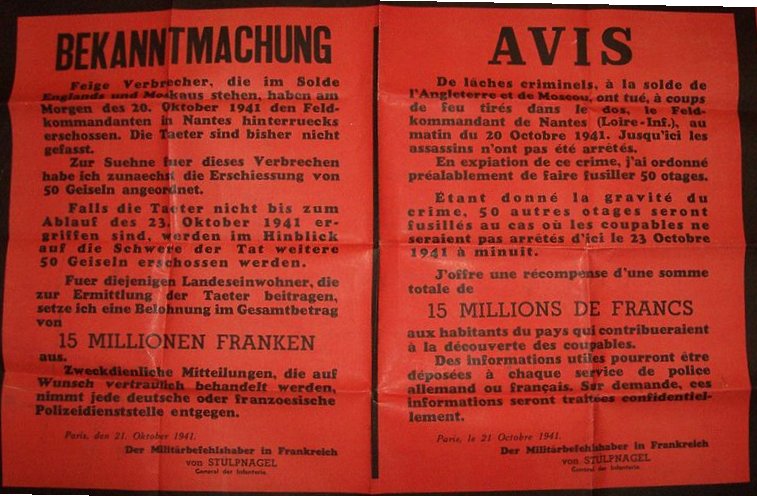
On “a beautiful autumn day” this date in 1941, four dozen French leftists were executed by that country’s occupiers as punishment for the murder of a German officer.

On October 20, 1941 — sixteen months into the German occupation — a pair of Communist commandos assassinated the Feldkommandant of Nantes, Lt. Col. Karl Hotz (French link).

News of this crime went straight to Adolf Hitler himself, who personally ordered a fearful reprisal.

The list of the executed hostages as published Oct. 23 in L’oeuvre

Accordingly, the collaborationist Petain government was induced to select 50 persons from among the ranks of detained German political prisoners. Pierre Pucheu, who would later be executed himself,* intentionally selected Communist types in an effort to confine the retaliation to fellow-travelers.

On this date, those 50 — well, 48, but who’s counting?; the numbering can get dodgy in these mass-execution scenarios — were put to death at three different locations: five at Fort Mont-Valerien; sixteen at Nantes; and most notoriously, 27 internees of Choisel (French link) at Chateaubriant.**

In three different batches of nine, the 27 reds and trade unionists were fusilladed into the ranks of Gallic martyrdom. They remain among the most emblematic French martyrs of the occupation; there’s a cours des 50-Otages named for them in Nantes, and various streets that bear individual victims’ names — such as Rue Jean-Pierre Timbaud in Paris. (Timbaud was a Communist steelworker.)


Monument to the martyrs of Chateaubriant. Image (c) Renaud Camus and used with permission.

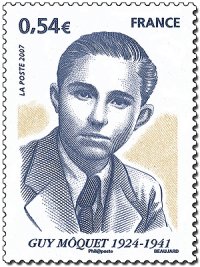
The youngest, 17-year-old Guy Moquet (you can find his name on the Paris Metro) was the son of an exiled Communist parliamentarian (French link).

He made headlines in 2009 when current French President Nicolas Sarkozy had added to the educational curriculum the reading of Moquet’s brave-but-sad last letter to his family: the decision drew some rather mean-tempered fire because of Moquet’s political persuasion. In the end, the text bore a fairly universal reading that could play inoffensively to posterity — like its postscript injunction,

“You who remain, be worthy of the 27 of us who are going to die!”

There’s a thorough roundup of the Oct. 22 executions (including poetic tribute) here.

* Vindicating Winston Churchill’s prophecy to the Times upon receiving news that “These cold-blooded executions of inocent people will only recoil upon the savages who order and execute them.” (Oct. 25, 1941, as cited in the The Churchill War Papers, vol. 3)

** Fifty more were supposed to be executed if the assassins weren’t promptly turned in, but that second batch never took place. (There was, however, a different batch of 50 executed on October 24 in retaliation for a different political assassination. Maybe they just all ran together.)

Part of the Themed Set: Illegitimate Power.

On this day..

1964: Nguyen Van Troi, Viet Cong urban guerrilla

On this date in 1964, South Vietnam executed a 17-year-old Communist for a plot to assassinate American Secretary of Defense Robert McNamara.

The young electrical worker and Viet Cong urban guerrilla Nguyen Van Troi was nabbed in the spring of 1963 trying to off both McNamara, famous for the megatonnage he would bestow on Southeast Asia, and U.S. ambassador Henry Cabot Lodge, Jr.

(Later, when the South Vietnamese client president whose guests these men ostensibly were was being shot in an armored personnel carrier with the Americans’ blessing, Ngo Dinh Diem might have had cause to wish this youth’s inhospitable gesture had not been undone by his men. Lodge was a particularly vocal advocate in the Kennedy administration for overthrowing Diem.)

For the months leading up to his public shooting, he became an international cause celebre; North Vietnam would later milk his martyrdom with a postage stamp, an award, and numerous public streets.

The international reach of his case was underscored when a Venezuelan revolutionary cell kidnapped an American officer shortly before Troi’s execution, and threatened to shoot him in retaliation. (They didn’t.)

Against this, South Vietnam counterposed the unedifying spectacle of a 17-year-old patriot put to death, energetically declaiming at the stake while cameras rolled,

It is the Americans who have committed aggression on our country, it is they who have been killing our people with planes and bombs…. I have never acted against the will of my people. It is against the Americans that I have taken action.

Naturally, he became a worldwide leftist martyr. There’s an Estadio Nguyen Van Troi in Cuba; American actor Troy Garity, son of Jane Fonda from her “Hanoi Jane” days, is also named for Nguyen Van Troi.

Robert McNamara, meanwhile, had many, many years yet to live, and many, many more Vietnamese deaths to burden his conscience.Troi’s widow wrote a 1965 book about him, out of print but still available on the used book market.

On this day..