1718: A horse thief and two travelers, “the worst rideing that ever I rid”

This date’s post brings us back to one of our regular wells, James Kelly’s Gallows Speeches From Eighteenth-Century Ireland … and the days when a life was cheaper than a horse.

The three men hanged together on this date all concurred in their stories that only one of them stole the horses in question and the other two merely thumbed rides on his extra mounts as passing travellers. Whether or not this is true or was simply their common play for a potential ⅔ pardon posterity obviously has no way of determining.

The Last Speech and Dying Words of
Daniel O Neal, Edmond Mc. Guire, and Henery Graham

who was Executed near St. Stevens Green, on Wednesday June the 4th 1718.

Good Christians,

I was Born in the North of Ireland, of very good honest Parents, who brought me up very Tenderly, and never speard any Cost to Instruct and bring me up in the fear of God, Alas! all was in vain, for tho’ I took all the care that I could to attain to Learning but at the end I prov’d very Careless of the fame, for I neglected both the laws of God and Man, or else I had never been brought to this shameful End, it is true I was taken up for the Stealing of three Horses, and two Mares, and these my fellow Sufferers along with me, but as I shall Answer the great God, they Die Innocently, for as I was Riding along the Road, I overtook these my fellow Sufferers who seeing me leading 4 Horses asked me if I would let them ride, I tould them they should, now as I am a dying Man this is all they knew of it, which grives me to the Heart, and indeed I am more sorry for their Death, than my own.

I freely forgive all the World, and I beg forgiveness of all those whom I ever offended, I am now about six and thirty Years of Age, I die a [sic] of the Church of England, and the Lord have mercy on my Soul, Amen.

This is my true Speech and no other

Daniel O Neal

The Speech of Edmond M’Guire.

Good Christians,

I Was born in the North of Ireland, of Poor, but honest Parents, who with their Industry, Care and Labour, brought me to these Years, during which time, I behav’d my self true and honest in the World, and endeavour’d very hard for my Bread; but I being born to hard Fortune, I was taken up by one Mr. Legg, for being concern’d in stealing of three Horses and two Mares; ‘tiw true I had one of the aforesaid Beasts under me, but the way I came by it was in the manner following: I having been in Dublin for some time, was willing to return home to my Wife and Children, and overtaking Daniel O Neale, my fellow Sufferer; he having the Cattle abovemention’d, I ask’d him if he wou’d let me Ride, he said he wou’d oblige any Traveller as much as he could, and so bid me Mount one of the Horses, which I did, and was very thankful to him for his kindness; but to my great Sorrow, it has prov’d the worst rideing that ever I rid in my life: Now as I am a dying Man, I was never guilty of Stealing the value of two Pence in all my Life: nor had I any Hand in stealing those Beasts which I am to Dye for. I forgive all the World, as I hope to be forgiven. I am about 40 Years of Age, and Dye a Roman Catholik, and the Lord have Mercy on my Poor Soul. Amen, Amen.

The Speech of Henry Graham.

Good Christians,

I was born in the North of Ireland, of very honest Parents, who was very tender over me, and brought me up in the fear of GOD as much as in them Lay; but Fortune has been very Cruel to me, or else I had never came to this Place, for I liv’d with my Parents will I came to get a Wife; and indeed it was my Fortune to get a poor honest Girl, who endeavour’d very honest for her Bread as well as I, but the World frowning upon me, I went and listed in the Army, where I behav’d myself as became a good Subject, at lenth [sic] I was broak, and so return’d home to my Wife again, but my Business calling me home to Dublin, to my great Sorrow I went there, but having finish’d my Business, I was going home again, where unfortunately I met with Daniel O. Neal, and Edmond M’Guire a Riding along the Road, to whom I said, pray let me Ride, and indeed, they freely comply’d, but I had not Rid long before we were all taken and committed to Goal, and from that brought to Dublin, so Try’d and found Guilty of the same, and now brought to [t]his Place to end my life, now as God is my Judge, before whom I hope to appear in short time, I had neither Art nor Part in stealing of the said Horses, or any of them, and I die in Charity with all Men, and do freely forgive those who Swore away my Life as I hope to be forgiven, I am about 30 years of Age. I die a Protestant and the Lord have mercy on my Soul.

Henry Graham.

On this day..

1813: A Nez Perce thief, by the Pacific Fur Company

On this date in 1813, Anglo-American fur trader John Clarke had an indigenous Nez Perce summarily hanged for stealing a goblet … dangerously poisoning relations between the respective communities in the Pacific Northwest.

We lay our day’s scene in the Oregon Territory, far frontier of then-only-prospective American continental expansion, beyond even the fathomless reaches of the Louisiana Purchase. The Stars and Stripes had penetrated there courtesy of the Lewis and Clark Expedition, but British, Spanish, and Russian expeditions had planted their own flags too, to say nothing of the claims of its native inhabitants.

And all these claimants had one common desire: the pelts of the beavers swarming that verdant sector.

The New York businessman John Jacob Astor bought a stake in the fur trade in the form of the Pacific Fur Company, and set down the outpost of Astoria, Oregon. (Astor was destined to become one of the republic’s early homegrown plutocrats, a fact which is merely incidental for our purposes. It was the fur business that propelled him to wealth.)

One agent of the P.F.C. was a singularly undiplomatic trader aged about 31 summers, John Clarke. Calling on a mixed Nez Perce-Palouse village to trade his canoes for horses to make an overland journey, Clarke was irritated to find that prices weren’t to his liking and the locals enjoyed pilfering his baubles.

American scribbler Washington Irving recorded the ensuing events:

[Clarke] was a tall, good-looking man, and somewhat given to pomp and circumstance, which made him an object of note in the eyes of the wondering savages. He was stately, too, in his appointments, and had a silver goblet or drinking cup, out of which he would drink with a magnificent air, and then lock it up in a large gardevin, which accompanied him in his travels, and stood in his tent. This goblet had originally been sent as a present from Mr. Astor to Mr. M’Kay, the partner who had unfortunately been blown up in the Tonquin. As it reached Astoria after the departure of that gentleman, it had remained in the possession of Mr. Clarke.

A silver goblet was too glittering a prize not to catch the eye of a Pierced-nose. It was like the shining tin case of John Reed. Such a wonder had never been seen in the land before. The Indians talked about it to one another. They marked the care with which it was deposited in the gardevin, like a relic in its shrine, and concluded that it must be a “great medicine.” That night Mr. Clarke neglected to lock up his treasure; in the morning the sacred casket was open—the precious relic gone!

Clarke was now outrageous. All the past vexations that he had suffered from this pilfering community rose to mind, and he threatened that, unless the goblet was promptly returned, he would hang the thief should he eventually discover him. The day [May 31st, 1813] gassed away, however, without the restoration of the cup. At night sentinels were secretly posted about the camp. With all their vigilance a Pierced-nose contrived to get into the camp unperceived, and to load himself with booty; it was only on his retreat that he was discovered and taken. At daybreak the culprit was brought to trial, and promptly convicted. He stood responsible for all the spoliations of the camp, the precious goblet among the number, and Mr. Clarke passed sentence of death upon him.

A gibbet was accordingly constructed of oars; the chief of the village and his people were assembled and the culprit was produced, with his legs and arms pinioned. Clarke then made a harangue. He reminded the tribe of the benefits he had bestowed upon them during his former visits, and the many thefts an other misdeeds which he had overlooked. The prisoner especially had always been peculiarly well treated by the white men, but had repeatedly been guilty of pilfering. He was to be punished for his own misdeeds, and as a warning to is tribe.

The Indians now gathered round Mr. Clarke and interceded for the culprit, They were willing he should be punished severely, but implored that his life might be spared. The companions, too, of Mr. Clarke, considered the sentence too severe, and advised him to mitigate it; but he was inexorable. He was not naturally a stern or cruel man; but from his boyhood he had lived in the Indian country among lndian traders, and held the life of a savage extremely cheap. He was, moreover, a firm believer in the doctrine of intimidation.

Farnham, a clerk, a tall “Green Mountain boy” from Vermont, who had been robbed of a pistol, acted as executioner. The signal was given, and the poor Pierced-nose, resisting, struggling, and screaming, in the most frightful manner, was launched into eternity. The Indians stood round gazing in silence and mute awe, but made no attempt to oppose the execution, nor testified any emotion when it was over. They locked up their feelings within their bosoms until an opportunity should arrive to gratify them with — a bloody act of vengeance.

Having made his grand gesture, Clarke quickly realized that he had enacted it while his small party was alone in an Indian village where they were at the mercy of their far more numerous hosts. Fearing a backlash, the white traders accordingly hightailed it back to Astoria, and then evacuated Astoria itself.

On this day..

1584: Samuel Zborowski, dangerous precedent

On this date in 1584, Samuel Zborowski was beheaded at Krakow’s Wawel Hill for treason and murder committed ten years before.

A monument to the timeless abuse of the prosecutor’s discretion, Zborowski (English Wikipedia entry | Polish) was a powerful nobleman who got into a snit when nobody of equal stature would enter the lists with him at a tournament.

Instead, his challenge was answered by a common trooper in the retinue of the castellan of Wojnice,* one Jan Teczynski. Pissed at the affront, and doubly so when his own retainer was defeated by Teczynski’s, Zborowski went right after Teczynski right there in the presence of the newly elected Polish king, Henry de Valois.** The affront of lese-majeste was compounded when Zborowski’s flailing mace mortally wounded another castellan who attempted to intervene.

The outlawed Zborowski fled to the protection of Stephen Bathory,† Voivode of Transylvania.

That might have been that, and left Zborowski to join Europe’s forgettable ranks of exiles, adventurers, and pretenders playing out the string under the patronage of some foreign prince.

But when the elective throne of mighty Poland came open soon thereafter, Zborowski’s patron decided that he liked the look of it — and he obtained the result, with the help of a dynastic marriage into Poland’s Jagiellon dynasty of illustrious memory.

Since the Zborowskis had been big supporters of Stephen Bathory, Samuel returned as well, justifiably anticipating not merely pardon but elevation. To their dismay, they found themselves frozen out … and they responded with a series of insubordinations: plotting with the invading Russians, fomenting an unwanted diplomatic crisis with freelance attacks upon the Ottomans.

In the end, our man was undone by the same violent highhandedness that had forced his flight from Poland in the first place. Zborowski’s ill treatment of the young lute composer Wojciech Dlugoraj left the latter so desperate to escape Zborowski’s court that Dlugoraj stole some treasonable correspondence between Zborowski and his brothers and sent it to Zborowski’s enemy, Jan Zamoyski.‡ Those letters indicated that Samuel was contemplating assassinating the king.

Zamoyski found, and Bathory agreed, that the most expedient way to remove this troublemaker was simply to execute the 1574 sentence, from that bludgeoned castellan. The new regime had conveniently never bothered to lift it.

Although legal, Zborowski’s execution was obviously quite irregular and it outraged many in the nobility who perceived it a potential precedent for absolutism; recrimination over the action tore apart the 1585 meeting of the Polish Sejm. (In later years, this body formally endorsed Zamoyski’s actions but only after enacting a Lex Zborowski to better govern the handling of treason cases.)


Jan Matejko‘s 19th century rendering of Samuel Zborowski en route to beheading.

* At the time an important fortified city, Wojnice or Wojnicz was ravaged by a Swedish army in the 1650s and never recovered; today, it’s a town — having only re-promoted itself from “village” status in 2007 — of fewer than four thousand souls.

** This youngest son in the French royal house had seemed to the Valois safe to make available on the transfer market for foreign sovereigns. However, his brothers’ uncanny talent for dying young without issue very soon required his return to his homeland to take up the throne of France as Henri III during that country’s Wars of Religion. There Henri proved not to be exempt from the family curse: we have previously explored the circumstances of his own violent death — which was also the end of the House of Valois — during the War of the Three Henrys.

† A legendary surname in the annals of horror. This Stephen Bathory was the maternal uncle of the infamous “Countess of Blood”.

‡ The gambit did indeed get the scared lutenist free from Zborowski’s control, but he had to flee to Germany for fear of Zborowski kinsmen’s vengeance.

On this day..

1916: Francis Sheehy-Skeffington, Patrick McIntyre and Thomas Dickson, by Captain Bowen-Colthurst

On the morning of this date in 1916, British Captain John Bowen-Colthurst ordered the summary execution of three Irish journalists in his custody: part of a still-notorious murderous rampage through Dublin amid the Easter Rising.

Bowen-Colthurst’s subsequent “insanity” skate has been a sore subject in the century since its predictable enactment.

The product of landed Anglo-Irish elites — his childhood manor, Dripsey Castle, still stands — had trotted the globe in service of the empire: the Boer Wars, India, Tibet, and the western front.

It’s the sort of background that should have made Bowen-Colthurst a calm hand in a tight spot.* Instead, the Easter Rising panicked him. Atrocities against Irish nationalists are not exactly surprising in the abstract here, but Bowen-Colthurst’s behavior in these hours was so erratic and violent that his men would remark that he had lost his head … although they strikingly never disobeyed his patently illegal orders.

At Portobello Barracks in Dublin, which in this week swarmed chaotically with off-duty leave soldiers reporting themselves for duty in the face of the armed insurrection, the Third Royal Irish Rifles’ commander was absent on sick leave and evidently took command discipline with him. “Captain Colthurst, although not the equal in rank of Major Rosborough, was the senior office in point of service and, according to all the evidence, considered himself at liberty to ignore his brother-officers,” Francis Sheehy-Skeffington’s widow explained.

Sheehy-Skeffington — a gentle pacifist affectionately known among antiwar socialists and the women’s movement as “Skeffy” — had been arrested on sight on April 25th, while out and about trying to dissuade looters. Bowen-Colthurst marched him out overnight as a human shield for a random patrol, and did not mind murdering before his eyes a passing young man caught out after curfew.

Proceeding along, Bowen-Colthurst grenades a tobacconist’s shop, mistakenly thinking that its owner, named Kelly, was Sinn Fein man Tom Kelly. In fact, the tobacconist Kelly was a loyalist, as were the two publishers that Bowen-Colthurst arrested at his place: Patrick McIntyre and Thomas Dickson.

Ignoring their protests, our unstable captain brought all three men back to the barracks. By morning’s light, he had decided on no authority but his own to have them executed.

“I am taking these prisoners out and I am going to shoot them because I think it is the right thing to do” was all the justification that he submitted. Later, he would say that he feared the prisoners would escape; that, believing that Germans were landing and revolutionaries were gunning down Black and Tans throughout Dublin, “I took the gloomiest view of the situation and felt that only desperate measures would save the situation.” So he shot the one guy who didn’t want to fight and two guys who were on his own team. According to later testimony, he would even order Skeffy to be re-shot upon being informed that the man was still moving several minutes after execution.

Still, the tilting captain had enough self-possession to openly worry to a brother-officer that he might have committed a hanging offense … and to actively conceal the evidence of it. Had events not been exposed by a courageous whistleblower, Sir Francis Vane, everything surely would have been obfuscated into the soupy fog of war. Embarrassingly compelled by Vane’s tattling to court-martial Bowen-Colthurst only to pass him off to an asylum (and later, to Canada), the brass took it out on Vane by terminating his career a few months later: “this officer was relegated to unemployment owing to his action in the Skeffington murder case in the Sinn Fein rebellion.”

Uproar at the Bowen-Colthurst affair had some interesting knock-on effects: for one thing, the naked impunity available to an officer at a time when enlisted men in France were being shot at dawn for minor disciplinary lapses might have contributed to the British command’s decision later in 1916 to permit the execution of a shellshocked lieutenant. And, an associate of the loyalist British commander in Ireland during the Easter Rising claimed that Sheehy-Skeffington blowback subsequently led to the execution reprieve granted to Eamon de Valera: that future president of independent Ireland just so happened to have his name “first on the list” when the matter came to a head.

Today, a visitor center at the former Portobello Barracks (now called Cathal Brugha Barracks) memorializes the three men executed there on April 26, 1916.

* We don’t mean to be cavalier about the psychological strains inflicted by violence. Bowen-Colthurst seemed to exhibit signs of shell shock in the trenches, whether due to the shells themselves or to having lost his younger brother in the war.

On this day..

1941: Harry Gleeson, posthumously exonerated

On this date in 1941, Harry Gleeson hanged for murder in Ireland — wrongly, the government admitted in 2015.

Gleeson was the nephew and farmhand of a man called John Caesar, whose County Tipperary property abutted a cottage inhabited by a local prostitute called Moll McCarthy. On November 21, 1940, Gleeson found Moll McCarthy dead on a farm field. Her face had been destroyed by a gunshot; her murder orphaned seven children, many of them the illegitimate progeny of local married men.

Nine days later, Irish police arrested a surprised Gleeson for the murder. He hotly denied their theory that he had availed himself of the victim’s services, and then slain her to prevent his uncle finding out about it.

It was, the Irish Times says in a review of one of the several books about the case, “a definitively Irish murder case: the prosecution claimed that ‘Gleeson was meeting Moll at the field pump, away from prying eyes, and arranging to give her potatoes in exchange for sex.'”

As a criminal case, it involved that brew of tunnel vision preoccupation with the wrong guy and outright cheating to nail him that frequently characterizes errant convictions. But there may have been a political undercurrent besides.

Gleeson was defended by former Irish Republican Army chief of staff Sean MacBride,* and it’s been hypothesized that the barrister’s political affiliations critically unbalanced the case for at least a couple of important reasons:

  • A prejudicial court and jury perhaps gave their verdict as much against MacBride as against Gleeson. (The jury issued its conviction alongside an unsuccessful application for clemency.)
  • MacBride himself might have pulled some punches from the defense bar in view of the possibility — as charged by Kieran Fagan in The Framing of Harry Gleeson — that McCarthy was actually murdered for informing on IRA men.

A few books about Mary MacCarthy and Harry Gleeson

* MacBride’s father John “Foxy Jack” MacBride hanged in 1916 for his role in the Easter Rising.

On this day..

1489: Hans Waldmann, mayor of Zurich

An equestrian monument to Hans Waldmann at Zurich’s the Münsterhof plaza reminds of that onetime mayor’s beheading on this date in 1489.


(cc) image from Roland zh.

His city’s most outstanding personality of the age, Waldmann (English Wikipedia entry | the far more detailed German) sprang from merchant stock. He’d soared to the top in his Swiss city-state via his gift for military command, which stood Zurich in good stead during the Burgundian Wars.

Despite his war heroism, the peasantry of Zurich’s rural proximities soon grew to hate Waldmann as the spear tip of the urban oligarchy. Notoriously, he ordered the destruction of peasants’ dogs to preserve the hunting privilege for the powerful.

On the first of April, a revolt toppled Waldmann’s authority. He was arrested on a diverse slate of accusations including treason, peculation, and sexual corruption.

For the four days intervening, he endured “ceaseless torture, hanging, and stretching,” but the mayor retained enough vigor to walk “manly” and “proud” (in the words of a Bernese observer) to his scaffold.


Waldmann’s Farewell, by Johann Caspar Bosshardt (1847).

Detail view (click for the full-page illustration) of Hans Waldmann’s beheading, from the Lucerne Chronicle (1513).

On this day..

1900: Joseph Hurst

On this date in 1900, Joseph Hurst hanged in Glendive, Montana for murdering Sheriff Dominick Cavanaugh — whom Hurst had run against in the most recent election. A literal life-and-death ballot!

Did he assassinate a political opponent to gain his office? (Hurst was briefly appointed to the sheriff’s post after Cavanaugh’s murder, before the investigation turned against him.) Or, was he railroaded by a prejudiced town? “If the evidence upon which this man has been convicted and twice sentenced to death, had been laid before me as the prosecuting officer of this county,” wrote another Montana district attorney in a widely circulated missive, “I should be ashamed to think I had compelled Hurst to employ a lawyer and submit to a prosecution before a magistrate.”

The question generated a furious controversy in its time, inundating Gov. Robert Burns Smith with a record deluge of mercy appeals from around the American West. Newspapers drew up column-inches for vigorous briefs as to Hurst’s innocence or guilt.

As is frequently the case, partisan political fissures reached all the way to bedrock disagreement about reality itself, for although Hurst expressed his innocence on the scaffold the respective sides circulated opposing contentions about whether he did or did not privately confess the crime in the end.

A representative bit of the original newspaper coverage. More can be found in Officer Down, by Jim Jones.


Anaconda Standard, February 28, 1900


Anaconda Standard, March 4, 1900


Anaconda Standard, March 13, 1900


Helena Independent, March 30, 1900.


Butte Weekly Miner, April 5, 1900


A different story from the very same Butte Weekly Miner, April 5, 1900

On this day..

1766: Nicholas Sheehy, Whiteboys priest

On this date in 1766, Irish priest Nicholas Sheehy was hanged, drawn, and quartered in Clonmel — a victim to the years-long campaign of enclosures by Ireland’s landlords, whom English agriculturist Arthur Young reported as “harpies who squeezed out the very vitals of the people and by process, extortion, and sequestration dragged from them the little which the landlord had left them.”

Sheehy was a sympathizer of the peasant “Whiteboys” resistance movement, so named for the snowy frocks these secret guerrillas donned when out on midnight raids to strike back against the owners where tenants’ livelihoods were at stake. Where landlords enclosed public grounds, Whiteboys knocked down the fences; where they displaced peasant farmer with commercial livestock, Whiteboys hamstrung the cattle.

“It could not be expected,” wrote Margaret Anne Cusack, “that the Irish priest would see the people exposed to all this misery — and what to them was far more painful, to all this temptation to commit deadly sin — without making some effort in their behalf.”

Father Sheehy, parish priest of Clogheen, was one of these, and a villain in the eyes of Protestant elites for his denunciations of enclosure and his comforts to its more muscular foes.

He had interfered in the vain hope of protecting his unfortunate parishioners from injustice; and, in return, he was himself made the victim of injustice. He was accused of encouraging a French invasion — a fear which was always present to the minds of the rulers, as they could not but know that the Irish had every reason to seek for foreign aid to free them from domestic wrongs. He was accused of encouraging the Whiteboys, because, while he denounced their crimes, he accused those who had driven them to these crimes as the real culprits. He was accused of treason, and a reward of £300 was offered for his apprehension. Conscious of his innocence, he gave himself up at once to justice, though he might easily have fled the country. He was tried in Dublin and acquitted. But his persecutors were not satisfied.

A charge of murder was got up against him; and although the body of the man [John Bridge, a former Whiteboy turned informer -ed.] could never be found, although it was sworn that he had left the country, although an alibi was proved for the priest, he was condemned and executed. A gentleman of property and position came forward at the trial to prove that Father Sheehy had slept in his house the very night on which he was accused of having committed the murder; but the moment he appeared in court, a clergyman who sat on the bench had him taken into custody, on pretence of having killed a corporal and a sergeant in a riot. The pretence answered the purpose …

At the place of execution, Father Sheehy most solemnly declared, on the word of a dying man, that he was not guilty either of murder or of treason; that he never had any intercourse, either directly or indirectly, with the French; and that he had never known of any such intercourse being practised by others.

Father Sheehy’s head wound up on a pike (it was said that the birds in reverence would not peck at it), and his name in the rich firmament of Irish martyr-patriots. He’s been occasionally proposed for canonization.

On this day..

1525: Cuauhtémoc, the last Aztec emperor

Although the primary accounts — those by conquistadors Hernán Cortés and Bernal Díaz del Castillo, and historian Francisco Lopez de Gomara* — did not explicitly record the date, February 28 is the traditionally recognized anniversary of the execution of the last Aztec emperor, Cuauhtémoc.

A monument to Cuauhtemoc in Mexico City. (Author’s photo; public domain)

Cuauhtemoc (English Wikipedia entry | Spanish) was enthroned early in 1521, in a Tenochtitlan already in the train of devastation brought by the Spanish, which had over the preceding months laid low the Emperor Moctezuma II (by violence) and his brother Cuitlahuac (by smallpox, a disease that halved the city’s population within a year).

He was about 23 or 24 years old, a nobleman who must have distinguished himself in war — “a handsome man, both as regards his countenance and his figure,” in Bernal Diaz’s estimation; “a valiant man and a good warrior” by Gomara’s account.

And it would fall to him to bear his proud kingdom’s ruin.

Having previously been welcomed to Tenochtitlan as guests, Cortes and the Spanish had fought their way out and now returned as besiegers, joined by most of the Aztecs’ resentful former subject kingdoms. They soon had Tenochtitlan in a stranglehold, undaunted by the frightening sacrifice of captured prisoners.

all in a moment the large drum of Huitzilopochtli again resounded from the summit of the temple, accompanied by all the hellish music of shell trumpets, horns, and other instruments. The sound was truly dismal and terrifying, but still more agonizing was all this to us when we looked up and beheld how the Mexicans were mercilessly sacrificing to their idols our unfortunate companions, who had been captured in Cortes’ flight across the opening.

We could plainly see the platform, with the chapel in which those cursed idols stood; how the Mexicans had adorned the heads of the Spaniards with feathers, and compelled their victims to dance round the god Huitzilopochtli; we saw how they stretched them out at full length on a large stone, ripped open their breasts with flint knives, tore out the palpitating heart, and offered it to their idols. Alas! we were forced to be spectators of all this, and how they then seized hold of the dead bodies by the legs and threw them headlong down the steps of the temple, at the bottom of which other executioners stood ready to receive them, who severed the arms, legs, and heads from the bodies, drew the skin off the faces, which were tanned with the beards still adhering to them, and produced as spectacles of mockery and derision at their feasts ; the legs, arms, and other parts of the body being cut up and devoured!

In this way the Mexicans served all the Spaniards they took prisoners; and the entrails alone were thrown to the tigers, lions, otters, and serpents, which were kept in cages. These abominable barbarities we were forced to witness with our own eyes from our very camp; and the reader may easily imagine our feelings, how excessively agonizing! the more so as we were so near our unfortunate companions without being able to assist them. Every one of us thanked God from the bottom of his soul for His great mercy in having rescued us from such a horrible death!

Bernal Diaz

Wracked by famine after Cortes successfully cut off its food and water, Tenochtitlan succumbed that August. (The conquistadors found they could barely endure the stench of countless rotting bodies as they took control of the famished city.) When captured, Cuauhtemoc implored Cortes through tears (again according to Bernal Diaz),

I have done what I was bound to do in the defence of my metropolis, and of my subjects. My resources have now become entirely exhausted. I have succumbed to superior power, and stand a prisoner before you. Now draw the dagger which hangs at your belt, and plunge it into my bosom.

There would be no bosom-daggering. Cortes had a much worse fate in mind.

He saluted Cuauhtemoc for his intrepidity in defense, vowing to maintain the latter as the ruler of Mexico … Cortes’s ruler, to ratify the dictates of the conquerors, beginning with commanding his remaining loyalists to surrender. Cuauhtemoc obeyed, with what posterity can only guess must have been fathomless shame and sorrow.

Upon humiliation, Cortes heaped physical torture when the invaders’ ransack of their captured city turned up far less lesser quantities of material loot than they had anticipated — torture which Cuauhtemoc and a cousin-king of a loyal Aztec ally both endured heroically without augmenting the Spanish bottom line. Bernal Diaz once again:

The next thing which Cortes did was to collect all the gold, silver, and jewels that had been found in Mexico, of which, however, there was very little; for Quauhtemoctzin, it was said, had ordered all the treasures to be thrown into the lake four days previous to his capture. A great quantity had likewise been purloined by the Tlascallans, Tezcucans, Huexotzincans, Cholullans, and other auxiliary troops which had assisted us in the siege, besides what had fallen into the hands of the troops on board the brigantines.

The crown officials were positive that Quauhtemoctzin had concealed the greater part, and asserted that Cortes was very pleased that the monarch refused to say a word where it was hidden; for he would then be able to get the whole treasure into his own possession.

The officers then proposed that Quauhtemoctzin and the king of Tlacupa, his most intimate friend and cousin, should be put to the torture, in order to extort from them a confession as to what had become of the treasures: but Cortes could not make up his mind to insult so great a monarch as Quauhtemoctzin, whose territory more than trebled that of Spain, and that for mere lust after gold. Moreover, the monarch’s household assured us they had given up all the gold they possessed to the officers of the crown, which, it was well known, amounted to 380,000 pesos, the whole of which had been melted into bars; and one thing is certain, that the emperor’s and Cortes’ fifths were deducted from that sum; but the conquistadores were not at all satisfied, and considered this sum much below the real amount, and several expressed their suspicion to Alderete, the royal treasurer, that Cortes’ only reason for not wishing to put the monarch to the torture was, that he might secretly take possession of all his riches. Cortes, not willing that such a suspicion should any longer he upon him, or that he should afterwards be called to an account on this score, at last consented that both should be put to the torture.


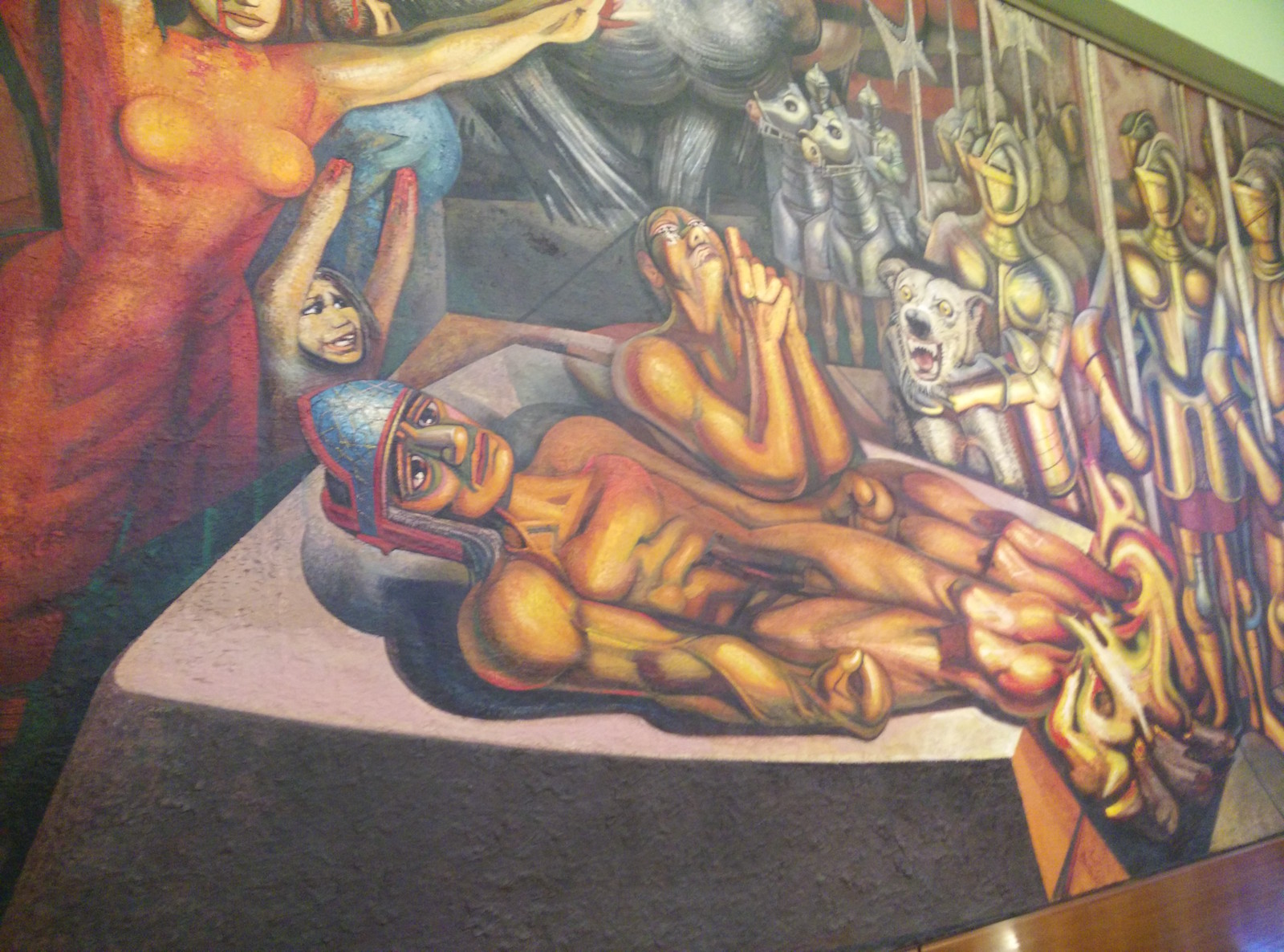
Detail view (click for the full image) of David Alfaro Siquieros‘s monumental 1950-51 mural, The Torment of Cuauhtemoc.

Boiling hot oil was then applied to their feet; upon which they confessed that, four days prior to Quauhtemoctzin’s capture, all the gold, with the cannon, crossbows, and muskets, which we had lost in the night of sorrows, when we retreated from Mexico, besides those which had been taken in Cortes’ last defeat on the causeway, had been thrown into the lake. A number of good swimmers were then sent to dive for the treasure in the spot they pointed out, but nothing was found. Yet there was some truth in the statement; for I was myself present when Quauhtemoctzin led us to a large and deep reservoir of water, built of stone, which lay near his palace. From this reservoir we fished up a sun of gold similar to the one sent us by Motecusuma, besides many jewels and other trinkets, though all of little value. The king of Tlacupa also informed us that he had hidden all manner of valuable things in some large houses, about twelve miles from Tlacupa, and he would accompany us there to point out the spot where he had buried them.

Alvarado was then despatched thither with six soldiers, among which number I also was; but when we arrived at the spot, this king assured us he had merely invented all this in the hopes that we would have killed him in a moment of anger at our disappointment.

(Diaz later added that “the suspicion was become pretty general that he [Cortes] had concealed the greater part of Quauhtemoctzin’s treasure,” and indeed some disgruntled companions — unsatisfied with the share they had been allotted for so magnificent a conquest — would come to lodge this charge against Cortes formally with Emperor Charles V.)

Cortes eventually brought both these hostages/puppet kings/torture victims along with him on a 1524-1525 expedition to Honduras, perhaps to deprive them of any opportunity to rebel in his absence.

On the evening of February 27, Cortes received a report or a rumor that the Indian kings had rebellion on their mind just the same. The timetable from this report to execution is uncertain from the records, but if it was not within 24 hours it cannot have been much longer. Diaz, a hostile-to-Cortes witness here whose narrative indicates his dismay at proceedings, describes it thus:

I have now to relate a circumstance of a very different nature, which occasioned much grief to us all. Quauhtemoctzin and other Mexican chiefs who accompanied our army had, it would appear, spoken among themselves, or secretly determined to put the whole of us to death, then march back to Mexico, and assemble the whole armed power of the country against the few remaining Spaniards, and raise an insurrection throughout the whole of New Spain. This circumstance was discovered to Cortes by two distinguished Mexican chiefs, one of whom was named Tapia, and the other Juan Velasquez. This latter personage had been Quauhtemoctzin’s captain-general during our war with Mexico, and his testimony was borne out by the investigation which Cortes made into the matter, and by the confession of several of the caziques themselves who were implicated in the conspiracy. These men fearlessly declared, that seeing how carelessly and dispiritedly we roamed about; that numbers of the men were ill from want of food; that four of our musicians, with the buffoon and five soldiers, had died of hunger; and that three other men had turned back, more willing to run the risk of reaching Mexico again than of moving forward, the thought struck them that they could not do better than fall suddenly upon us while we were crossing some river or marsh, particularly as they were upwards of 3000 in number, all armed with lances, and several of them with swords. Quauhtemoctzin did not hesitate to acknowledge that these men had spoken the truth, but added that the conspiracy did not emanate with him, and that he himself had never for a moment contemplated carrying it into effect, but had merely spoken about it with the other caziques. All the cazique of Tlacupa confessed was, his having declared to Quauhtemoctzin that it was better to die at once than daily to have death before their eyes on these fatiguing marches, and see their countrymen and relations perish with hunger.

These were sufficient proofs for Cortes, and without any further ceremony he sentenced Quauhtemoctzin and his cousin the king of Tlacupa to the gallows. Before, however, this sentence was executed, the Franciscan monks, with the assistance of Dona Marina, strove to comfort these unfortunate men, and commended their souls to God. When they were being led to the place of execution, Quauhtemoctzin turned to Cortes, and said: “Oh Malinche! I have for a long time perceived, from your false words, that you had destined me for such a death, because I did not lay violent hands on myself when you entered my city of Mexico! Why are you thus going to put me unjustly to death? God will one time ask this of you!”

The king of Tlacupa said, he could only rejoice in a death which he would be permitted to suffer with his monarch Quauhtemoctzin.

Previous to their being hung, both these unhappy caziques confessed to father Juan, who understood the Mexican language, and they begged of him to commend their souls to God. For Indians they were good Christians, and they died in the true faith, and fully believed in our holy religion.

The death of these two monarchs grieved me excessively, for I had known them in all their glory, and on our march they honoured me with their friendship, and showed me many little attentions; for instance, they would often order their servants to go in quest of fodder for my horse; besides which, they were innocent of the guilt imputed to them, and it was the opinion of all who accompanied this expedition that they were put to death unjustly.

But I will leave this miserable subject, and return to our march, on which we henceforth observed the utmost vigilance, for we greatly feared the Mexicans might rise up in arms against us, after they had thus beheld their monarch ignominiously hung by the neck from a tree. But hunger, fatigue, and sickness weighed heavier upon their minds than the misfortune of Quauhtemoctzin.


Detail view (click for the full image) of the “rebel” kings hanged from a tree.

Gomara and, of course, Cortes characterize the accusations against the Indian kings as true and the proceedings against them lawful. From the footnotes in this same Bernal Diaz volume, we have this from the later Jesuit historian and ethnographer Juan de Torquemada, who was fluent in Nahuatl:

I find it differently represented in a history written in the Mexican language, and which I believe to be perfectly correct. While Cortes (the Mexican author says) was quartered in a certain township, the Mexican chiefs one evening began to discourse among themselves about the recent hardships they had suffered, and Cohuanacotzin said to Quauhtemoctzin, to Tetlepanquetzaltzin, and to other distinguished Mexicans, ‘Thus you see, gentlemen, from kings we are become slaves, and we suffer ourselves to be led about by Cortes and this handful of Christians. If we were other people than we are, and would break through the promise we have made these Spaniards, we could play them a pretty trick here, and revenge ourselves upon them for all they have done to us, and the ill-treatment my cousin Quauhtemoctzin has suffered at their hands.’ To this the Mexican monarch replied, ‘I beg of you Cohuanacotzin to drop this subject, lest some one should overhear us, and imagine we were in earnest.’ It appears (continues Torquemada) that they were indeed overheard, for the whole of this discourse was reported to Cortes by a low-minded Mexican of the lower classes.

By law, Mexican flags fly at half-staff in his honor on February 28.

* These texts are cited throughout the post, but for ease of reference … Bernal Diaz: Memoirs of the Conquistador Bernal Diaz del Castillo, vol. 1, vol. 2 | Gomara: The Pleasant Historie of the Conquest of the West India; now called New Spaine | Cortes: History of New Spain, which is a Spanish text as I could not locate an English translation. However, even the Anglophone is liable to appreciate (from p. 225) the illustrations of Indian material culture observed by the Spaniards.

On this day..

1955: Three for the death of King Ananda of Thailand

On this date in 1955, Thai royal secretary Chaliew Pathumros and royal pages Butr Patamasarin and Chit Singhaseni were shot as regicides. (Many other transliterations of these names, and the other Thai names in this post, are possible.) Few now believe that it was they who killed the young King of Thailand, Ananda Mahidol … but who really did it?


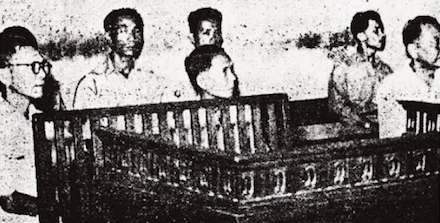
The defendants left to right across the front row: Chit Singhaseni, Butr Patamasarin, and Chaliew Pathumros.

Inheriting the throne of Siam — it became Thailand in 1939* — as a nine-year-old expatriate student in Switzerland, the wispy King Ananda would be described by Lord Mountbatten as “a frightened, short-sighted boy … a pathetic and lonely figure.” Some questioned whether he wanted to be king; others, whether monarchy would or should survive in Thailand at all. (Absolute monarchy had given way to constitutional monarchy in 1932.) Ananda’s own deceased father, a prince who had gone to Harvard, studied medicine, and married a commoner, seemed to model a different direction altogether, and Ananda’s legally questionable selection in 1935 might have been designed intentionally to enthrone a figure with no capacity for governance.

In any event, he would not bear this strange burden for very long — for his reign ended at 9:20 in the morning on June 9, 1946, announced by the single report of His Majesty’s own Colt .45 in Boromphiman Throne Hall. Ananda Mahidol was 20 years old, and he’d been expecting within a few days to fly back to Switzerland and wrap up his law degree. Instead, shot dead in the head at point-blank range, he was the vortex of a murder(?) mystery that continues to this day to elude a satisfactory accounting. His younger brother immediately succeeded him as King Bhumibol Adulyadej and would reign for 70 years** but even he couldn’t say what happened in this 1980 BBC interview.

The palace initially announced that the king had killed himself accidentally while toying with his gun but as more information leaked out it speedily rubbished the hypothesis of accidental or suicidal self-infliction. According to a British forensic pathologist who examined the evidence,†

The pistol found at the King’s side was by his left hand, but he was right-handed. The wound, over the left eye, was not in one of the elective sites, nor a “contact” discharge. The direction of fire was not inward towards the centre of the head.

Such findings pointed to the more politically explosive possibility that someone else shot King Ananda, which was also the conclusion of an official Thai inquiry late in 1946.

Soon, charges that the late king had been murdered at the behest of Prime Minister Pridi Banomyong — a republican who in his student days had been prominent in the successful movement to overthrow royal absolutism — were being aggressively bandied by his opposition. This rumor would eventually be enlisted as justification for a 1947 military coup that forced Pridi to flee Thailand.

Having made the punishment of Ananda’s assassins part of his putsch’s raison d’etre, the authoritarian former Axis collaborator Field Marshal Phibun now fixed his gaze on three palace servants who had been close to the young king in his last hours. Through them, Phibun’s new regime could condemn Pridi in absentia.

In a bizarre and ridiculous legal saga that began in 1948, the trio would be depicted as part of a sinister plot under Pridi’s direction to slay the king — Chaliew as Pridi’s instrument, and the two pages, who were in personal attendance upon Ananda at the time of his death, as complicit witnesses/accessories. (The judgment never quite says directly who pulled the trigger.) Over the course of the legal odyssey, two of the scapegoats’ defense attorneys were murdered, and two more arrested for treason: representing these regicides was such a dangerous task that by the end their team comprised only two young attorneys, one of whom was Chaliew’s freshly-graduated daughter.

Even so, only Chit was convicted in the first go-round but prosecution appeals against the verdict succeeded in condemning both of the other men, too. (One can read the full verdict in English here.) They would be executed one by one via a machine gun fusillade to the back, delivered through a screen — the distinctive local method. Bhumibol could have spared them. He didn’t.

But talk of these men as arch-traitors faded as political exigencies shifted in the subsequent decades. Their alleged conspiracy was incoherently depicted from the start, and nothing of direct evidence really implicated them: one can see in the BBC clip above that King Bhumibol doesn’t even bother discussing them when asked about Ananda’s death. It’s left the rather consequential question of who killed the king in a puzzling irresolution, a situation compounded by Thailand’s expansive lèse majesté law which renders taboo many obvious lines of inquiry when a royal is slain in a closed residence peopled by other royals. Speculation still centers on the three main scenarios considered from the outset: suicide, homicide, and accident.

Suicide

South African historian Rayne Kruger examined the obscure event in The Devil’s Discus: The Death of Ananda, King of Siam and concluded that it might have been suicide after all. In Kruger’s conception, it would have been occasioned by the young king’s mooning over a fellow law student back in Switzerland (Marylene Ferrari) who was forbidden him by his royal station.

It was published in 1964, and is banned under Thailand’s aggressive censorship program.

Homicide

William Stevenson’s The Revolutionary King postulates that fugitive Japanese war criminal Masanobu Tsuji, who was hiding out in Thailand at the time, masterminded the king’s assassination.

Bhumibol and the Thai court permitted Stevenson intimate access for several years researching this volume, although this did not prevent the book from also meeting a chilly reception in Thailand. (It’s unclear to me whether it was in fact ever formally banned, as some sites assert.) Although Stevenson’s theory about the killer doesn’t have many adherents, one supposes that in view of the author’s access, Bhumibol must have suggested it or assented to it during their private conversations.

Accident

Scottish journalist and former Reuters Bangkok correspondent Andrew MacGregor Marshall, author of another book banned in Thailand (A Kingdom in Crisis: Thailand’s Struggle for Democracy in the Twenty-First Century), has argued that the only plausible inference from the strange pattern of circumstantial evidence is that King Bhumibol himself — then an 18-year-old — pulled the trigger, likely by accident while horsing around with Ananda.

If Ananda was not assassinated by an intruder, did not shoot himself by accident, and did not commit suicide, that means he was shot by somebody known to be at the Barompiman Hall that morning. And only one person was not able to fully account for their movements that morning: Bhumibol. In particular, his testimony to investigators appeared to conflict with that of the royal nanny …

Discrepancies in the accounts of what happened when Bhumibol went to see Ananda at 9 a.m. are also telling. Investigators began to suspect the most likely scenario was that Bhumibol had indeed gone to see Ananda, but had not been turned away by the pages as he and they were later to claim. He went into Ananda’s room.

What happened there over the next 20 minutes, only Bhumibol knows for sure.

Bhumibol and Ananda both owned several guns and enjoyed playing with them. Indeed, Bhumibol had been known in the past to playfully point a gun at his brother. This has led many people to speculate privately that Bhumibol and Ananda were playing some kind of game in the bedroom that morning and that something had gone terribly wrong. The forensic evidence suggests Ananda was asleep when he was killed, however, although there remains the likelihood that, as the British ambassador’s secret cable suggests, the scene was rearranged after Ananda’s death. In any event, no credible explanation for the death of Ananda has ever been proposed other than this: between 9 a.m. and 9:20 a.m. Ananda’s Colt .45 was taken out from his bedside cabinet, and somehow Bhumibol came to shoot his brother with it, with the muzzle very close to Ananda’s forehead. Perhaps they were playing, or perhaps Ananda was still dozing and Bhumibol wanted to wake him with a practical joke, holding the gun to his head and pulling the trigger. Most probably, he removed the magazine from the Colt .45 automatic, put it to his brother’s head, and pulled the trigger, forgetting that even with the magazine removed, one round remains in the breech. Less likely, but possible, is that they argued about something and Bhumibol brandished the gun in a fit of anger. Bhumibol alone has the answer, and he seems unlikely to ever give us the truth.

This theory, which is also of course lèse majesté in Thailand, is supported by Paul Handley, yet another journo with a banned book (The King Never Smiles: A Biography of Thailand’s Bhumibol Adulyadej).

Marshall’s website zenjournalist.org touches this event in a number of posts; he makes the case most directly and thoroughly in “The Tragedy of King Bhumibol”, Part III and Part IV. These and other posts also marshall diplomatic cables and intelligence reports showing that Bhumibol as the killer was common private scuttlebutt among both Thai and foreign officials from the very first days to the point of being received, albeit publicly unutterable, wisdom. For example, American diplomat Kenneth Landon‡ casually remarks as fact that King Ananda was “killed by his brother, either intentionally or accidentally, by the gun the OSS guy had given them to play with” in this recording made by his son for a family history. (It occurs in passing at 4:48)

Rumor is not proof, of course, but this theory would certainly account for the shroud of permanent mystery surrounding June 9, 1946, not to mention the king’s own grave public persona (“The King Never Smiles …”). For Marshall, Bhumibol — a fun-loving, jazz-playing sprite at the time he allegedly shot his beloved older brother — was a figure of monumental tragedy and, at least before he got to the point of allowing innocent people to take the fall for it, his dissembling about Ananda’s death

was not a way of shirking responsibility. Quite the reverse: his failure to confess was in many ways a profound sacrifice. Had he told the truth about the death of Ananda, he could have escaped back to Switzerland for a very comfortable life as a playboy prince, albeit a notorious one. Instead, he lied, and accepted the crushing burden of kingship, a role that he had never wanted. He resolved to devote himself tirelessly to royal duty for the rest of his life. It probably seemed the only way he could even begin to make amends.

* Thailand was again Siam from 1946 to 1948. I’ve simply used “Thai” and “Thailand” throughout this post about events overlapping this period, the better to avoid confusion.

** Bhumibol, who died in 2016, was among the world’s longest-reigning monarchs ever. As of this writing his son holds the throne.

† The palace immediately took control of, and meddled with, the scene, so the available evidence falls very far short of what a crime scene investigator might wish for.

‡ Kenneth Landon’s wife Margaret, his longtime companion in Siam/Thailand since the two first went as missionaries in 1927, is noteworthy as the author of Anna and the King of Siam, which is the basis for (among other adaptations) the Rodgers and Hammerstein musical The King and I and the Jodie Foster film Anna and the King.

On this day..