1689: John Chiesly, for alimony

Q. Why is divorce so expensive?
A. Because it’s worth it!

This date brings us a cautionary parable of the dangers of wedlock.

John Chiesly (or Chiesley, or Cheisly), an ill-tempered bloke with a wife he’d wished to put aside, had been ordered in arbitration to support her (and their 11-strong brood) to the tune of a £93 annuity.

Chiesly had a counteroffer to this liberal award: he shot dead the magistrate, Sir George Lockhart, the highest-ranking judicial officer in Scotland.* And he did it in broad daylight, making no attempt to fly.

“I have taught the President how to do justice,” Chiesly boasted as he was arrested.

That was on March 31, 1689.

On April 1, he was tried and convicted (torture was authorized “for discovering if ther were any accomplices, advysers, or assisters to him in that horrid and most inhumane act … yet the samen shall be no preparative or warrand to proceed to torture at any tyme hereafter, nor homologatione of what hes bein done at any tyme bypast”).

On April 3, he was drawn to execution at either Drumsheugh or at the Gallowlee, had the offending right hand cut off while still alive, then was hanged in chains with the murder weapon around his neck.

Then his spirit went on to haunt Dalry as “One-Armed Johnny,” until his remains were discovered and properly buried in 1965.

Still.

If you think this guy had relationship issues, consider the fate of his daughter, Rachel.

She inherited dad’s hot temper and took it to her own marriage.

When her husband tried to ditch her, the woman now known as Lady Grange stalked him so relentlessly that Lord Grange kidnapped her, faked her death, and held her secretly imprisoned in the Hebrides for 15 years. (More in this pdf)

Now that is an expensive divorce.

* Chiesly’s murder orphaned George Lockhart, later a notable anti-union politician; George’s brother Philip Lockhart was himself executed for the 1715 anti-Hanoverian Jacobite rising.

On this day..

1623: Amboyna Massacre

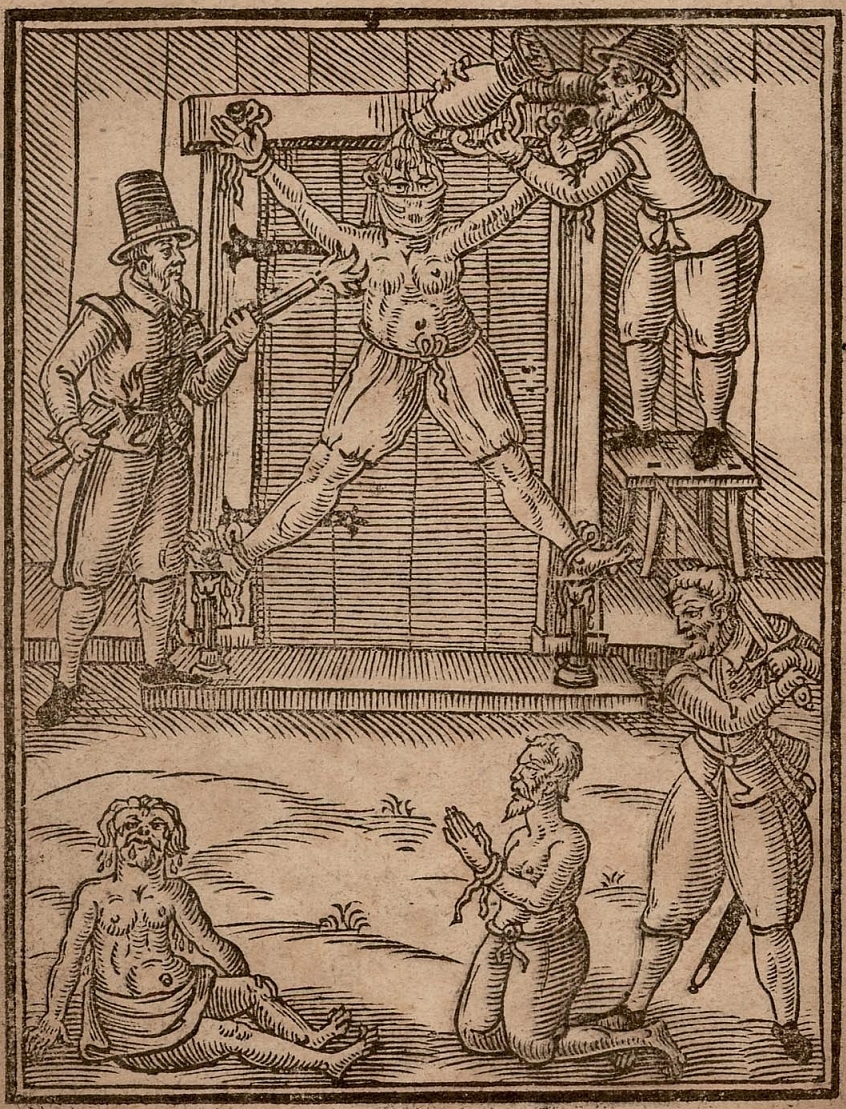
On February 27,* 1623, the Dutch East India Company beheaded twenty who had been waterboarded into confessing to a terrorist plot.

English prisoner suffering “waterboarding” faux-drowning torture, published under the name “A true relation of the unjust, cruell, and barbarous proceedings against the English at Amboyna in the East-Indies 1624”.

The torturers “poured the water softly upon his head until the cloth [wrapping his head] was full, up to the mouth and nostrils, and somewhat higher, so that he could not draw breath but he must suck in all the water.” More nasty description.

(cc) Image from Flickr | BiblioOdyssey

Posh Spice

As in modern times, this scenario originated with resource competition in the Muslim world … in this case, competition for spice, in Indonesia.

European colonialism had pitted the Dutch East India Company against its British counterpart on the archipelago, both scrabbling after the lucrative trade in cloves and pepper, with garnishes of nutmeg, cinnamon, mace, and ginger.

The two rival powers had, as we lay our story, recently come to a tense truce, dividing the commerce between them — and swapping mutual accusations of violating that pact. The arrangement basically gave the Dutch a bigger slice of the pie, so we’ll find them when the cloves hit the fan having the balance of power on their side.

Terrorists

We’re going to oversimplify to set the scene.

On Ambon Island, one of the very “Spice Islands” (i.e., the Moluccas) — at the Dutch-controlled fortification of a trading post also shared by the English — the Dutch merchant-governor Herman van Speult heard that a Japanese mercenary had asked about the Dutch fortifications.

The security-conscious van Speult ordered that unfortunate soldier interrogated under torture.

As tends to happen when the interrogators in such a case are convinced of a ticking time bomb situation, the torture uncovered a ticking time bomb situation.

The mercenary got the Dutch to stop burning and drowning him by “revealing” a highly implausible** English plot to seize the Dutch fort, with 20 guys or so and no prospect of imminent outside aid. Wouldn’t you know it: when the supposed confederates named by the mercenary were similarly tortured, they too admitted the plot. Van Speult’s English opposite number, Gabriel Towerson, was one of them.

The Amboyna Massacre followed anon, with Towerson and nine other British East India Company employees beheaded, along with nine Japanese mercenaries and one Portuguese. (The latter ten worked for the Dutch East India Company, not the British. A fifth column!)

They went to their deaths protesting their innocence, and many smuggled out written recantations to that same effect: “tortured … with that extream Torment of Fire and water, that Flesh and Blood could not endure it, and we take it upon our Salvation, that they have put us to Death Guiltless.”

Anger in the English Street

That last quote comes from Karen Chance, “The Amboyna Massacre in English Politics, 1624-1632,” in Albion: A Quarterly Journal Concerned with British Studies (Winter 1998).

As the title of that piece suggests, the Amboyna Massacre outraged Towerson’s countrymen and -women once word finally made it back to the mothership. (In addition to the torture/wrongful execution dimension, the legal authority of the Dutch trading concern to impose judicial punishment on their English counterparts was questionable at best.)

English demands for satisfaction against the perpetrators continued to complicate Dutch-English relations into the reign of Charles I and beyond. Even Oliver Cromwell required, as the price of peace for the First Anglo-Dutch War in the 1650s, punishment of any surviving offenders. (Which was apparently nobody at all.)

And still later, the burgeoning British Empire’s propaganda arm reached for the Amboyna narrative to justify seizing New Amsterdam on the grounds that the Dutch had attempted to spring a massacre on English settlers — “their Amboyna treacherous Cruelty extended itself from the East to the West Indies, and pursued thus the straight channel of Dutch blood”.

As for the trade-jockeying: the Netherlands’ commanding position in Indonesia ultimately squeezed the English out.** But don’t fret for Old Blighty: she turned attention to gobbling up India, and made a lot more bank than did the Dutch spice racket.

* February 27 was the date according to the Julian calendar in use at this time by the British. By the Gregorian calendar the Dutch were using, the massacre took place on March 9.

** For more on both the fanciful nature of the supposed plot, and the economics of the East Indies trade as it unfolded in the 17th century, see D.K. Bassett, “The ‘Amboyna Massacre’ of 1623”, Journal of Southeast Asian History, September 1960.

On this day..

1619: Lucilio Vanini, aka Giulio Cesare

On this date* in 1619, Italian freethinker Lucilio Vanini was adorned with a placard reading ‘Ateiste et blasphemateur du nom de Dieu’ and taken to Toulouse’s Place du Salin where he had his blasphemous tongue cut out,** then was strangled and burned at the stake.

You can think of Vanini as a sort of Giordano Bruno mini-me — a bit less intellectually distinguished, a bit less famous, but doing the same peripatetic, pantheistic act before orthodoxy ran him down.

Ordained a priest (like Bruno), Vanini’s 34 years were spent perambulating (like Bruno): France, Switzerland, the Low Countries, even England, where he briefly auditioned Anglicanism.

Alas, (like Bruno) the libertine monk’s occult philosophy had no real home; he fled Paris for Toulouse (the place Bruno earned his doctorate), and was there charged with blasphemy.

Vanini veiled his dangerous speculations in nominally pietistic cant, but he probably could have done better misdirection than a title like De Admirandis Naturae Reginae Deaeque Mortalium Arcanis (Of the Marvelous Secrets of the Queen and Goddess Nature — available in Latin from Google books).

Vanini was bold enough to suggest an equivalency between human and animal souls, and reckon both mortal. Though his works purported to prove the existence of God, and he even made to his accusers a version of the “first cause” argument, they thought (probably rightly) he wasn’t being serious.

They also thought (again, probably rightly) Vanini and his aristocratic patrons were debauched; Vanini’s execution kicked off a dangerous crisis for hedonists in France and elsewhere in the 1620s.

There’s much more about Vanini in French here, and in English in this chapter of the public-domain The Skeptics of the Italian Renaissance.

* Some sources report Feb. 19. The source of this discrepancy isn’t clear to me; the then-10-day gap between the Julian and Gregorian calendars is an obvious suspect, but as this execution took place in Catholic France, the modern Gregorian calendar had been adopted decades before.

In any event, primary documentation appears to me to support the 9th.

” le samedi neuvième du mois de février … fut donné arrêt au rapport de M. de Catel, conseiller au parlement, par lequel il [Vanini] fut condamné à être traîné sur une claie, droit à l’Eglise Saint-Etienne, où il serait dépouillé en chemise, tenant un flambeau ardent en main, la hart [la corde avec laquelle on étranglait les criminels.] au col, et, tout à genoux devant la grande porte de la dite église, demanderait pardon à Dieu, au roi, à la justice, et de là … serait conduit à la place du Salin où, assis sur un poteau, la langue lui serait coupée, puis serait étranglé, son corps brûlé et réduit en cendres; ce qui fut exécuté le même jour.”

** “Before putting fire to the stake, Vanini was ordered to put forth his sacrilegious tongue for the knife. He refused; it was necessary to employ pincers to draw it forth, and when the executioner’s instrument seized and cut it off never was heard a more horrible cry. One might have thought that he heard the bellowing of an ox which was being slaughtered.” (Source) This account of the magistrate Gramont has to be considered in view of his interest in showing the condemned inadequate to his jaunty resolve, “Let us go, let us go joyfully to die, as becomes a philosopher.”

On this day..

1685: Robert Pollack and Robert Millar, Covenanters

On this date in 1685, Robert Pollack and Robert Millar (or Pollock and Miller) were hanged in Edinburgh as Covenanters.

An East Kilbride shoemaker and a Rutherglen mason, respectively, they were a tick and a tock in the Killing Time — lost like tears in rain amid the torrent of Presbyterian martyrs.

These adhered to James Renwick‘s subversive doctrine of Scottish presbyter control against the overweening Anglican Episcopacy, a conflict of characteristically comingling religious and political characters.

Since most of the Covenanter-killing was being done summarily by soldiers in the field, these Roberts were actually the rare gallows-birds to be condemned in civil court, for which trouble they strangled at the Gallowlee on the road from Edinburgh to Peith.

Their last testaments can be read here, along with those of many other such martyrs.

Forsake not the assembling of yourselves together, and employ your strength in the holding up of the fallen-down standard of our Lord, and if ye be found real in this duty, ye shall either be a temple, which shall be a glorious sight, or else ye shall be transported, and be a member of the Church triumphant; so ye shall be no loser, but a noble gainer either of the ways.

-Robert Millar

Though not up to the fame of having their own statuary, Pollack/Pollock has a place on the Covenanter monument in East Kilbride … where the martyrs’ spiritual descendants recently held the movement’s first open-air Conventicle since the 1680s.

Part of the Themed Set: Resistance and Rebellion in the Restoration.

On this day..

1673: Mary Carleton, “German princess”

On this date in 1673 ended the adventures of “German princess” and early modern celebrity Mary Carleton.

Mary vaulted into the ranks of famous-for-being-famous in 1663, when the pamphleteering forerunners of Perez Hilton caught wind of a bigamy scandal wherein Mary, presenting herself as a mysterious German noble, had hitched with 18-year-old law student John Carleton and run through his money.

Once the public made her acquaintance … well, there was just something about Mary.

Over two dozen pamphlets are known sensationalizing her subsequent trial and acquittal for hubby-hopping, including post-acquittal volleys by both John and Mary.

(These pamphlets don’t currently appear to be available in their original forms online, but substantial excerpts from the most famous of them can be found in the public domain 1914 book The Mary Carleton narratives, 1663-1673: a missing chapter in the history of literature. This volume argues the Carleton publications are a stylistic progenitor of the English novel as it emerged in the hands of, for instance, Defoe. We certainly would be remiss not to notice here our real-life anti-heroine’s parallels (pdf) with Moll Flanders.)

Actually the daughter of a Canterbury fiddler, Moll Carleton was accused of having ditched her first spouse (a shoemaker) for a surgeon, then ditched the surgeon for John Carleton.

Having adroitly beat that rap in a court of law (if not exactly in the court of public opinion) “the German Princess” went into show business; that ubiquitous diarist Samuel Pepys caught her on stage, playing herself, remarking

I’ve passed one trial, but it is my fear
I shall receive a rigid sentence here:
You think me a bold cheat, put case ’twere so,
Which of you are not? Now you’d swear I know.
But do not, lest that you deserve to be
Censur’d worse than you can censure me:,
The world’s a cheat, and we that move in it,
In our degrees, do exercise our wit;
And better ’tis to get a glorious name,
However got, than live by common fame.

Well, why not?

In a time with scant social mobility for women, Carleton — which is the name by which she’s been remembered although she was born “Mary Moders” — carved it out with the tools at her disposal, which makes her an irresistible academic subject.*

Carleton/Moders is nearly the anti-Martin Guerre: whereas the male Arnaud du Tilh subsumed his own identity to insinuate himself into the existing social part of “Martin Guerre”, Mary Carleton’s shifty identity excised her from the social circumstances that would otherwise define her. (She was even reported to have taking to masculine cross-dressing.) Paradoxically, her fictitious biography enabled her to be taken for her own self, which explains why she stuck with her blank-slate “German origins” backstory after it had been publicly discredited.

And after the stage gig had run its course and her identity become disposable once again, she easily resumed her marital perambulations.

Mary Jo Kietzman called Carleton’s life “self-serialization.” The Newgate Calendar sanctimoniously records some of her adventures.

After a few years below the Restoration radar, Carleton was caught up for petty larceny and given a death sentence commuted to penal transportation to Jamaica. (England had just seized it from Spain during Cromwell‘s Protectorate.)

Two years later, she returned to England — not the only one to prefer the danger of Tyburn to the rigors (and obscurity) of the colonies.

She could only live as herself at the peril of her life. And on this day, she clinched her lasting fame at the end of a rope.

* e.g., Mihoko Suzuki, “The Case of Mary Carleton: Representing the Female Subject, 1663-73,” Tulsa Studies in Women’s Literature, Vol. 12, No. 1 (Spring, 1993).

Part of the Themed Set: Resistance and Rebellion in the Restoration.

On this day..

1670: Claude Duval, gentleman highwayman

It’s been 340 years since the immortal highwayman Claude Duval (or Du Val, or Du Vall) went to the Tyburn gallows and was turned off into legend as the ne plus ultra of English gentleman thieves.

Duval, actually, was French, an import to Isles in the train of some forgotten noble migrating with the restoration of royal prerogatives.

On the English highway, this formerly impecunious retainer coruscated as a knight of the road, the very model of the chivalrous outlaw against whom the likes of Dick Turpin would be compared to disadvantage. Macaulay recorded

how Claude Duval, the French page of the Duke of Richmond, took to the road, became captain of a formidable gang, and had the honour to be named first in a royal proclamation against notorious offenders; how at the head of his troop he stopped a lady’s coach, in which there was a booty of four hundred pounds; how he took only one hundred, and suffered the fair owner to ransom the rest by dancing a coranto with him on the heath;


William Powell Frith‘s painting (1860) of Claude Duval dancing with his prey.

how his vivacious gallantry stole away the hearts of all women; how his dexterity at sword and pistol made him a terror to all men; how, at length, in the year 1670, he was seized when overcome by wine; how dames of high rank visited him in prison, and with tears interceded for his life; how the king would have granted a pardon, but for the interference of Judge Morton, the terror of highwaymen, who threatened to resign his office unless the law were carried into full effect; and how, after the execution, the corpse lay in state with all the pomp of scutcheons, wax lights, black hangings and mutes, till the same cruel judge, who had intercepted the mercy of the crown, sent officers to disturb the obsequies. In these anecdotes there is doubtless a large mixture of fable; but they are not on that account unworthy of being recorded; for it is both an authentic and an important fact, that such tales, whether false or true, were heard by our ancestors with eagerness and faith.

Gillian Spraggs justifiably observes that no matter how genuinely gallant the brigand, his profession entailed relieving others of their rightful produce by main force. But then, the same could be said of the lords of the realm.

No, although Duval’s legend invites debunking, this must be for another blog.

We take Duval here at his mythological acme: he is the patron saint of the early modern bandit, the Superman of English outlawry, succoring with the fantasy of freedom upon the road the thousands of porters and scullery maids and apprentices chained to their oars below-decks upon Britannia’s ship of state.

What matter the rest?

This day, we toast Claude Duval, the Knight of the Road, in the manner of the fetching inscription (since destroyed by fire) under which he was reportedly buried:

Here lies DuVall: Reder, if male thou art,
Look to thy purse; if female, to thy heart.
Much havoc has he made of both; for all
Men he made to stand, and women he made to fall
The second Conqueror of the Norman race,
Knights to his arm did yield, and ladies to his face.
Old Tyburn’s glory; England’s illustrious Thief,
Du Vall, the ladies’ joy; Du Vall, the ladies’ grief.

Part of the Themed Set: Resistance and Rebellion in the Restoration.

On this day..

1677: William Drummond, for Bacon’s Rebellion

“Mr. Drummond, I am more glad to see you than any man in Virginia; you shall hang in half an hour.”

Virginia Governor William Berkeley didn’t deliver gallows justice as rapidly as promised, but the outcome was just as certain.

Scotsman William Drummond, the former colonial governor of Abermarle and therefore the first governor of North Carolina,

was made to walk to Middle Plantation, about eight miles distant, and tried before a drum-head court-martial, the next day, at the house of James Bray, Esq., under circumstances of great brutality. He was not permitted to answer for himself; his wife’s ring was torn from his finger; he was stripped before conviction, was sentenced at one o’clock and hanged at four. (Source)

There’s nothing worse than a poor winner.

Drummond caught Berkeley’s considerable wrath for associating himself with Nathaniel Bacon’s Rebellion of frontier settlers demanding lower taxes and more energetic genocide against their Indian neighbors. When Berkeley balked, the movement metastasized into a republican revolution which declared the agent of royal authority in Virginia to have abdicated and proposed to reconstitute it by popular convocation.

It was very much short of an actual attempt to separate from England, but in its form and complaints one easily perceives the germ of the American Revolution a century hence. Sarah Drummond was reported to have been at least as vehement as her hanged spouse, and she is credited with prophesying “the child that is unborn shall have cause to rejoice for the good that will come by the rising of the country.”

Armed struggle between two desperate factions was truncated by the fatal case of dysentery* contracted by the namesake insurrectionary. His unpleasant and untimely demise crippled the rising rising, and left Drummond as about the most prominent target available for the victorious Berkeley’s fury.

Not that there wasn’t much more to go around — even when the British navy finally landed in late January with reinforcements too late to do any good, a general amnesty Berkeley had not clemency enough to use, and a successor to Berkeley the aging governor did not like one bit. Nineteenth-century historian George Bancroft in his History of the Colonization of the United States writes of the crackdown,

In defiance of remonstrances, executions continued till twenty-two had been hanged.** Three others had died of cruelty in prison; three more had fled before trial; two had escaped after conviction. More blood was shed than, on the action of our present system [i.e., the constitutional government of the United States], would be shed for political offences in a thousand years. Nor is it certain when the carnage would have ended, had not the assembly convened in February, 1677, voted an address “that the governor would spill no more blood.”

Finally the new guy managed to get Drummond on a boat back to the mother country with an unflattering report of his conduct. The crotchety septuagenarian, who had been a spry mid-30’s courtier when first appointed Virginia governor by Charles I, was coldly received by Charles II. “The old fool,” remarked the sovereign, “has taken more lives in that naked country than I have taken for the murder of my father.”

* “The bloodie flux” was an unsatisfying avenger for his foes, as indicated by the doggerel

“Bacon is Dead, I am sorry at my hart
That lice and flux should take the hangman’s part”

** Some sources put the total number executed at 23, not 22; I have been unable to locate the source of this discrepancy.

Part of the Themed Set: Resistance and Rebellion in the Restoration.

On this day..

1661: Thomas Venner and the Fifth Monarchy Men

On this date in 1661, the restored English monarchy made an end to the interregnum’s religious crazies.

A few other images of Thomas Venner are available here.

“It is difficult in these days to follow with patience, or even with complete seriousness, all the ramifications of Fifth Monarchy speculation,” writes historian Louise Fargo Brown, whose gratis tome The Political Activities of the Baptists and Fifth Monarchy Men in England proceeds to do just that.

This blog wants for both patience and seriousness, so we’ll sum up that Venner et al were the holy rollers of the day, the true whack-jobs in the millenarian hustle of Cromwellian England.

Venner himself was born in New England, and there’s a zippy bio of him in The New England Historical and Genealogical Register. The North American colonies and Parliamentarian Britain helped to incubate political/religious heterodoxy for one another, and Venner was not the only budding religious zealot in the distant marches to emigrate to London after Charles I lost his head.

There the cooper became an outspoken apostle of the Fifth Monarchists, a part of Cromwell’s coalition made for disappointment with the mundane machinations of statecraft. Relieved in time of any a share in General Ironsides’ burden of helming the state in choppy waters, the men of the Fifth Monarchy were at liberty, to retire with their slide rules and philosopher’s stones to calculate the (imminent) date of the apocalypse foretold by Daniel and pursue the maxim not yet born that, starting with a mistake, a remorseless logician can end up in Bedlam.

All well and good to mock from posterity, and from a country where Left Behind is a bestseller no less. To be fair to the Monarchy Men, one could as well say that the egalitarian political language of these “arrant Radicals and levellers” just happened to be scriptural.* They would hardly be the last to foretell a golden age made ready by the slaying of a king, not by a long shot.

At any rate, our Bostonian tradesman became such an outspoken prophet of the return of “King Jesus” that Cromwell was obliged to clap him in irons.

Venner didn’t take the hint well, nor other more salutary warnings, and Venner instigated a riot of his few dozen followers at the start of January 1661 that took London unawares and did some damage before it was put down.

Diarist Samuel Pepys records of the riots that

[a] thing that never was heard of, that so few men should dare and do so much mischief. Their word was, “The King Jesus, and the heads upon the gates.” Few of them would receive any quarter, but such as were taken by force and kept alive; expecting Jesus to come here and reign in the world presently, and will not believe yet but their work will be carried on though they do die.

Thomas Venner and his compatriot Roger Hodgkins died that traitor’s death this day, along with William Oxman and Giles Pritchard, the latter two having their sentences commuted to simple hanging and posthumous beheading. The remaining survivors of his band climbed the scaffold two days later.

* e.g., “Then shall the Oppressor cease and no more complaining be heard in the streets. Taxes should be no more. And Trade and industry should abound. … The poor should have bread, and the Army no more in Arrears. Prison doors should be open and Debtors satisfied without Arrests … then peace and safety, plenty and prosperity, should overflow the land.” (Cited by Brown)

Part of the Themed Set: Resistance and Rebellion in the Restoration.

On this day..

1676: Joshua Tefft, drawn and quartered in Rhode Island

On this date in 1676, Puritan colonist Joshua Tefft (or Tifft, or Tift) became perhaps the only person ever to suffer the traitor’s death of hanging and quartering in what is now the United States.

The 30-ish Rhode Island farmer got sucked into King Philip’s War and was captured by colonists apparently fighting for the Narragansett Indians during a the Great Swamp Fight.

Lacking a first-person account from Mr. Tefft, we are left to descry (or project) his purpose. Tefft himself claimed that he had been enslaved by the Indians, but he made this claim in the context of trying to avoid a grisly execution; opposing witnesses said he’d been much more enthusiastic in the fight, raising an evident horror of civilized man gone native.

Without English clothes and with a weather-beaten face, he looked like an Indian to the English. Tefft was a troubling example of what happened to a man when the Puritan’s god and culture were stripped away and Native savagery was allowed to take over. (Source)

He was one man caught up in a war, so of course he could have been many things. But Tefft invites speculation on racial self-identification on this still-tenuous New World frontier.

Living immediately adjacent to the Narragansett, Tefft was probably on good terms with the natives, something that at least some Anglos had keenly worked after for fifty-plus years. Some sources report (or charge) that he had taken an Indian wife,* and the Narragansett redoubt attacked in the Great Swamp Fight was a fortified encampment full of non-combatant types, hundreds of whom were eventually slaughtered.

And Rhode Island had a long-running border dispute with its Puritan fellow-colonists that intersected their historical differences on religious toleration. (Tefft is also decried as irreligious, though whether that’s literally true or just an extra heaping of opprobrium is anyone’s guess.) Why, after all, should a man not cohabit among the friendly peoples of his wife, and assist them when attacked — for the Narragansett were not at war until they were attacked — by a bunch of Connecticut and Plymouth colony prigs who’d want to shanghai him into their army?

One colonist able to sympathize with the Indians’ situation wrote of them that “perhaps if Englishmen, and good Christians too, had been in their case and under like temptations, possibly they might have done as they did.” Who knows but that some were, and they did.

Our Scouts brought in Prisoner one Tift, a Renegadoe English man, who having received a deserved punishment from our General, deserted our Army, and fled to the Enemy, where had good entertainment, and was again sent out by them with some of their forces; he was shot in the knee by our scouts, and then taken before he could discharge his musket, which was taken from him and found deep charged, and laden with Slugs: He was brought to our army, and tryed by a counsel of war, where he pretended that he was taken prisoner by the Indians, and by them compelled to bear Arms in their Service; but this being proved to be false, he was condemned to be hanged and Quartered, which was accordingly done. (Source)

But while some Indian tribes allied with some whites, European identification ultimately proved much too strong to admit any possibility of not banding together against the “savages.” When vengeful Narragansett warriors raided Providence the following spring and torched the house of Rhode Island founder Roger Williams, Massachusetts in sympathy lifted its 39-year-old exile on the man they’d have hung as a heretic in days gone by.

By then, it had long been over for Joshua Tefft, whose trial preceded execution by only two days. Joshua’s son Peter and other descendants of the Tefft family, however, would be fruitful and multiply.

By the time these New World settlements became the United States a century later, drawing and quartering was still on the books in England. But the New York legislature expressed (pdf) the sense of that realm’s North American offspring that this sentence even for treason was “marked by circumstances of Savage Cruelty, unnecessary for the Purpose of public Justice, and manifestly repugnant to that Spirit of Humanity, which should ever distinguish a free, a civilized, and Christian People.”

* Joshua Tefft’s previous wife, Sara, had died from childbirth a few years before. For Sara, also notable as the owner of what was once thought to be the oldest marked headstone in New England, it was her second husband … the first, Thomas Flounders, was hanged for murder.

Part of the Themed Set: Resistance and Rebellion in the Restoration.

On this day..

1682: Alexander Cockburn, hangman, condemned

Domestic annals of Scotland: from the reformation to the revolution (reporting an item initially recorded by Lord Fountainhall):

1682. Jan. 16. Alexander Cockburn,* the hangman of Edinburgh, was tried before the magistrates as sheriffs, for the murder, in his own house, of one Adamson or Mackenzie, a blue-gown beggar. The proof was slender, and chiefly of the nature of presumption — as, that he had denied Adamson’s being in his house on the alleged day, the contrary being proved, groans having been heard, and bloody clothes found in the house; and this evidence, too, was chiefly from women. Yet he was condemned to be hanged within three suns. One Mackenzie, whom Cockburn had caused to lose his place of hangman at Stirling, performed the office.

Condemned by the evidence of women. How much worse can it get?

There is no report I have been able to locate of Cockburn’s actual hanging date; the “within three suns” sentence was standard for the time.

In days of yore, (says Aubrey) lords and gentlemen lived in the country like petty kings, had jura regalia belonging to the seignories, had castles and boroughs, had gallows within their liberties, where they would try, condemn, and execute; never went to London but in parliament time, or once a year to do homage to the king. Justice was administered with great expedition, and too often with vindictive severity. Pennant informs us that “originally the time of trial and execution was to be within three suns!” About the latter end of the seventeenth century** the period was extended to nine days after sentence; but since a rapid and unjust execution in a petty Scottish town, 1720,† the execution has been ordered to be deferred for forty days on the south, and sixty on the north side of the Tay, that time may be allowed for an application to the king for mercy.

* Not to be confused with barrister Alexander Cockburn (we’ve already met him) … nor, of course, with the late acerbic journalist.

** Specifically, 1695 — well after our day’s hangman had turned hanged man.

† This picturesque over-hasty execution detail appears to me to be folklorish and of questionable reliability. The bottom footnote here attributes the legal change to a cracking yarn about a dancing-master and an officer (here’s the broadside). This source puts it down to a man who committed murder while drunk and was caught, tried, and hanged before he so much as sobered up.

On this day..