1909: Garry Richard Barrett

(Thanks to Meaghan Good of the Charley Project for the guest post. -ed.)

On this date in 1909, two-­time murderer Garry Barrett was executed at the Alberta Penitentiary, a federal prison in Canada. To quote the Edmonton Journal, he’d made the least of his second chance.

Barrett, an American born in Michigan, had been a farmer who lived with his wife and stepchildren in Saskatchewan. He had a fairly normal existence but was prone to bouts of severe depression. It was during one of these times, on October 16, 1907, that he flew into a rage, pointed a gun at his wife, and pulled the trigger.

The gun failed to go off.

Barrett’s stepson, Burnett, threw himself in front of his mother. Barrett pulled the trigger again. This time the gun did go off. Burnett was shot and ultimately died of his injuries.

There was little he could say for himself at his murder trial, given the evidence against him, and he was accordingly convicted and sentenced to death. However, the jury recommended mercy, and the authorities commuted his sentence to life in prison and sent him to the Alberta Penitentiary in Edmonton.

On April 15, 1909, less than a year later, Barrett was working in the prison carpentry shop when he suddenly picked up a hatchet and planted it in the skull of Deputy Warden Richard Stedman.

There seemed to be no motive for his actions, as Stedman was well­-liked and popular among the prison inmates. However, that day Barrett had asked to see a doctor and Stedman hadn’t gotten one for him.

One month and two days later, Barrett found himself again before a judge facing a murder charge. This time there would be no recommendation of mercy.

Rather than summon a professional hangman to execute the condemned man, the prison used one of its own guards. Barrett’s last words were, “Gentlemen, I am going to be hanged, but I killed the deputy warden in self­-defense. Had I not done so my flesh would now be the food for vultures.” He then began denouncing members of the Masonic Order, until his speech was cut short and the chaplain commenced with the Lord’s Prayer.

Barrett’s execution was badly botched, as the Edmonton Journal records:

It was a long, slow death. The noose wasn’t properly tied, and the knot slipped out of position when the trap was sprung. The hangman twice began to cut down the body, but both times the doctor stepped in because Barrett wasn’t yet dead. He was finally declared dead of strangulation 15 minutes later.

The guard/executioner then cut the rope into pieces and distributed it to his fellow guards as souvenirs.

Barrett’s body was claimed by his son, who buried it in Butte, Montana.

On this day..

1899: Cordelia Poirier and Samuel Parslow

On this date in 1899, Cordelia Poirier was hanged in Ste. Scholastique, Quebec with her lover Samuel Parslow.*

Cordelia Viau by her maiden name, the femme fatale in this transaction found that in her marriage to one Isidore Poirier she was much the sturdier spirit.

“She was a masterful woman,” this old public-domain text on insurance crimes muses, “and Poirier seems to have been a man of very common mould. He was not great or strong enough to make his wife admire or respect him, yet was too obstinate to yield to her domination.”

Cordelia soon turned this gap in magnetism to good effect on Mr. Parslow, a local carpenter, to the considerable scandal of their village, Saint-Canut.

An intolerable domestic situation drove Isidore Poirier to the bottle, and Cordelia Poirier to the insurance underwriters — from whom she obtained two separate $1,000 policies on the life of her spouse. Much to the discredit of her agents (and, one must suspect, to the commission wage model), the wife’s blunt inquiries as to whether a death by assassination woud void the policies were met with simple affirmations rather than a summons to the constable.

Sure enough, Isidore Poirier suffered just such a death on November 21, 1897: after vespers (Cordelia was an organist at the church), she and Parslow barged in on the intoxicated Isidore at his home and Parslow slashed him to death with a butcher knife. The body was discovered the next day, and it wasn’t hard to put means to motive and clap the adulterers in gaol.

Having perhaps not thought this venture through, Samuel Parslow and Cordelia Poirier promptly began informing on one another in hopes of avoiding the rope. Their confessions would only cinch one another’s fates. By the time of trial, Parslow had to feebly accuse Mrs. Poirier of hypnotizing him.**

Her cynical domestic crime and vampish reputation earned her an extreme level of disapprobation: her behavior obviously inverted and betrayed the model of domestic virtue whose penumbra of sentimentality has often been counted on to save female murderers from the gallows. Cordelia Poirier was actively hated.

“The crowd inside the jail jeered [Cordelia Poirier],” it was reported — “but even then her nerve did not desert her, and at the suggestion of the executioner she turned and faced the Jeerers, and stood erect and prayed to the last.”

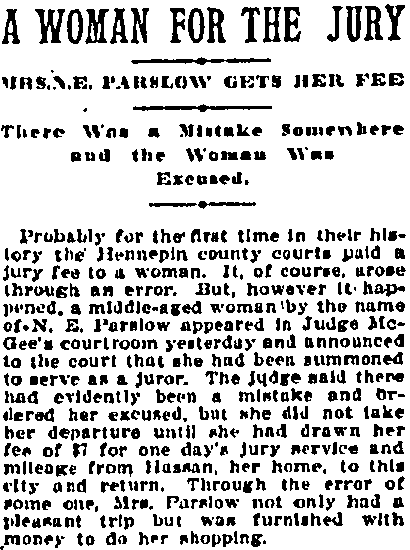
* Thanks to the wonders of database searches, research for this post also revealed a completely different legal drama off the same era related to a competely different Parslow. This story is from the Feb. 4, 1898 Minneapolis Journal.

** All reports do paint Cordelia Poirier as the stronger will in her adulterous relationship, as well as her marital one, and the instigator of the murder.

On this day..

1868: Thomas Jones, bad uncle

(Thanks to Meaghan Good of the Charley Project for the guest post. -ed.)

Four days after Christmas in 1868, Thomas Jones was executed in London, Ontario for one of the most sensational murders perpetrated in the region at the time. He had brutally slaughtered his twelve-year-old niece in the town of Delaware.

Early that year, according to this article on the case, Jones had tried to rob his own brother’s house while wearing a false beard to disguise his identity. Unfortunately for him, young Mary Jones recognized her uncle and subsequently testified against him in the ensuing trial. Thomas Jones held this against her, as did Thomas’s daughter Elizabeth, who was thirteen.

On June 11, 1868, Mary’s mother sent her to Uncle Thomas’s house to fetch a cup of flour. (One wonders why she did so, given the history of bad blood between uncle and niece.) Mary never returned.

Suspicion inevitably fell on Thomas, who insisted she’d come and gotten the flour and left his home alive and well. Forty-eight hours after Mary’s disappearance, the search party got fed up, grabbed Thomas’s ten-year-old son and threatened to kill him if he didn’t tell what happened to his cousin.

The boy led them to her body, hidden in the woods under a fallen tree. Her skull had been fractured.

According to the child, both his father and his sister Elizabeth had participated in Mary’s murder. Public feeling ran high against the accused and the entire family had to be taken into custody and transported from Delaware to London to avoid a possible lynching. Only Thomas and Elizabeth faced murder charges, but according to this account, Thomas’s wife and younger son were kept in jail for four months and his two older sons, both in their teens, remained there until well after their father’s death.

The prosecution’s theory was that either Thomas had murdered his niece after Elizabeth lured her into the woods at his direction, or Thomas talked Elizabeth into committing the murder.

At trial, Elizabeth tried to take the rap for her father, claiming she’d beaten Mary to death entirely on her own and Thomas had only helped her hide the body. Thomas’s youngest son testified in support of this, saying he’d witnessed his sister striking Mary with a club.

Thomas used his underaged daughter’s statements like a shield — he would maintain his innocence to his dying breath — but in the end the jury convicted him of murder. What may have tipped the balance was the medical evidence, which indicated Mary had been dealt some powerful blows, stronger than a child could have inflicted.

Elizabeth was convicted of manslaughter and sentenced to ten years for her role in the crime, in spite of her youth. The older two of Thomas’s three sons, ages seventeen and fifteen, were finally released without charge in the spring of 1869. Elizabeth served seven years before she was freed.

In spite of the bitter cold many residents of Delaware came to watch Thomas hang at the Middlesex County Gaol. Around six thousand people were in the crowd — approximately half the population of London. This would be the last hanging in Middlesex county.

On this day..

1879: Swift Runner, wendigo

The first legal hanging in Alberta, Canada, took place on this date in 1879. Generations later, it’s still remembered as one of the province’s worst, and strangest, crimes.

The hanged man was a native Cree known as Swift Runner (Ka-Ki-Si-Kutchin) — a tall and muscular character with “as ugly and evil-looking a face as I have ever seen,” in the words of an Anglo Fort Saskatchewan officer. Whatever his comeliness, Swift Runner was on good terms with the frontier authorities, who trusted him as a guide for the North West Mounted Police. That is, until the Cree’s violent whiskey benders unbalanced him so much that the police sent him back to his tribe … and then his tribe kicked him out, too.

He took to the wilderness to shift as he could with his family in the winter of 1878-79: a wife, mother, brother, and six children.

But only Swift Runner himself would return from that camp.

When police were alerted to the suspicious absence of Swift Runner’s party, the former guide himself escorted investigators to the scene.

One child had died of natural causes, and was buried there.

The eight other humans had been reduced to bones, strewn around the camp like the set of a slasher film.*

They had all been gobbled up by a wendigo.

The wendigo (various alternate spellings, such as windigo and witiko, are also available) is a frightful supernatural half-beast of Algonquin mythology, so ravenous it is said to devour its own lips — and human flesh too. For some quick nightmare fuel,* try an image search.

The revolting wendigo was mythically associated with cannibalism, so closely that humans who resort to anthropophagy could also be called wendigos. According to Swift Runner, the ferocious spirit entered into him and bid him slaughter and eat all his relations.

Swift Runner is the poster child for the “Wendigo Psychosis”, a mental disorder particular to the Northern Algonquin peoples. In the psychosis, diagnosed by the early 1900s but hotly disputed in psychological literature, people are said to have experienced themselves possessed by the wendigo and wracked by violent dreams and a compulsion to cannibalism. It’s importantly distinguished from famine cannibalism: though it was the wilderness during winter, Swift Runner had access to other food when he turned wendigo. The author of a 1916 report on the phenomenon said he had “known a few instances of this deplorable turn of mind, and not one instance could plead hunger, much less famine as an excuse of it.”**

The disorder, whatever it was, was nevertheless surely bound to the precariousness of life in the bush; wendigo cases vanish in the 20th century as grows afflicted populations’ contact with the encroaching sedentary civilization.

For Canadian authorities in 1879, however, there was no X-File case or philosophical puzzle: there was a man who had shot, bludgeoned, and/or throttled his whole family and snapped open long bones to suckle on their marrow.

But if the verdict and sentence were clear, the logistics were less so: hangings were virgin territory for the Fort Saskatchewan bugler put in charge of orchestrating the event. Swift Runner, by this time repentant, had to wait in the cold on the frigid morning of his hanging while the old pensioner hired to hang him retrieved the straps he’d forgotten, to pinion his man, and fixed the gallows trap. “I could kill myself with a tomahawk, and save the hangman further trouble,” Swift Runner joked

* In the Stephen King novel Pet Sematary (but not in its cinematic adaptation) the master adversary behind the reanimation of murderous household pets is a wendigo. For a classical horror-lit interpretation, Algernon Blackwood’s 1910 The Wendigo is freely available in the public domain.

** Cited by Robert A. Brightman in “On Windigo Psychosis,” Current Anthropology, February 1983.

On this day..

1888: Tsimequor, indigenous Snuneymuxw

(Thanks to Meaghan Good of the Charley Project for the guest post. -ed.)

On this date in 1888, Tsimequor, a member of the Snuneymuxw First Nation, was executed in Nanaimo, British Columbia for a bizarre murder that clashed Aboriginal and white Canadian cultures.

What happened is explained in Jeffrey Pfeifer and Ken Leyton-Brown’s book Death By Rope: An Anthology of Canadian Executions:

The matter that brought Tsimequor to public attention arose out of a tribal custom designed to help members of the community better deal with grief following the death of a child. The custom dictated that when a child died, it was the practice for all other persons in the tribe who bore the same name to immediately change their names. In this way, relatives of the deceased child would be less likely to be reminded of their loss.

Tsimequor’s son Moses died in 1888 and, as per custom, all the Snuneymuxw who were named “Moses” changed their names to something else.

But there was one little boy in the community whose name was Moïse — “Moses” in French — and Tsimequor demanded that he change his name as well. The four-year-old’s parents refused, and days later somebody killed their son.

Had it been solely in the hands of the Snuneymuxw, the crime might have been forgiven. But to the Canadian legal authorities killing a four-year-old because of his name was unambiguously capital murder, and so Tsimequor was arrested and brought to trial. He maintained his innocence, but was convicted on November 7, 1888 and sentenced to death.

Pfeifer and Leyton-Brown record:

Surprisingly, there was considerable sympathy for Tsimequor expressed in the local newspaper, which pointed out that the crime had been committed “through superstition” and noting that Tsimequor had had no legal counsel to defend him at the trial. According to one newspaper report, “a sentence designed to educate Aboriginal people would be more appropriate.” There was however no doubt which tradition would be followed in this case.

Tsimequor was hanged in the Nanaimo Gaol five weeks after his trial.


Privy Council minutes determining that ‘law should be allowed to take its course’ with the hanging of the indigenous man Tsimequor in 1888

On this day..

1814: Private John McMillan, deserter

HEAD QUARTERS, FALLS OF NIAGARA
OCTOBER 28TH 1814.

At a General Court Martial, held at Stamford, on the 25th instant, and continued by adjournment to the 28th of the same month, Private John McMillan, of the 2nd regiment of Lincoln Militia, was arraigned on the following charges, viz.: —

1st. For having deserted to the Enemy, with his Arms and Accoutrements, when on Duty, on or about the 6th of Octoer, 1813.

2nd. For having been taken bearing Arms in the Service of the Enemy on or about the 17th of September last.

And “The Court, after duly considering the Evidence for the Prosecution and on behalf of the Prisoner, were clearly of the opinion that he is guilty of both charges, and therefore Sentence him to suffer Death, at such place and time as His Honor the President may be pleased to direct.”

His Honor the President approves the finding and Sentence of the Court, and directs that the same be carried into Execution at Bridgewater [Niagara Falls] on Monday morning next, the 31st instant, at 11 o’clock

British militia general order during the War of 1812

On this day..

1883: Frederick Mann

(Thanks to Meaghan Good of the Charley Project for the guest post. -ed.)

On this date in 1883, Frederick Mann was hanged for murdering four members of his master’s family.

Frederick was an immigrant from London and worked as a live-­in farmhand and manservant to the Cooke family in Little Rideau, Ontario. He was only seventeen years old.

Frederick had been living with the Cookes for only a few months at the time of the murders. He seemed to get on fine with Mr. and Mrs. Cooke and their five children, although he sometimes mistreated their livestock. Then, on January 2, 1883, for no apparent reason, he went berserk.

That morning Frederick followed one of the Cooke family’s adult daughters, Emma, into the granary and tried to rape her. When she screamed for help, he strangled her with a rope. Emma’s cries were heard by her mother, who went running to her aid, but Frederick strangled her too.

Following this he went into the barn and attacked his master Ruggles W. Cooke with an ax, chopping his head to pieces. Frederick then went into the farmhouse and attacked sons George and Willie Cooke, who were both still asleep. He killed Willie with a blow to the head but was only able to wound George on the thigh before the boy got away from him. George and his two sisters wrestled the ax away from Frederick, who then fled the farmhouse. (There are reports that George later died of his leg injury.)

He was arrested the next day, just across the Ottawa River in Quebec.

During subsequent investigation it came out that, when he had been working for a family in Montreal, he’d tried to poison them. Doctors who subsequently examined the defendant determined he had “keen intelligence … but low moral nature.” The press reported Frederick had committed the murders “in revenge for a fancied insult.”

Although his attorney prepared for an insanity defense, in the end there was no trial: Frederick pleaded guilty to all four murders on September 17 when he appeared in court. His lawyer pleaded for leniency, but the judge passed the sentence of death.

Young Frederick’s execution was gruesome, as recorded in Jeffrey Pfeifer and Ken Leyton­-Brown’s book Death By Rope: An Anthology of Canadian Executions:

The identity of the hangman was unknown but he was clearly inexperienced and the Sheriff had to show him how to properly pinion the prisoner’s legs. The hangman’s level of inexperience was made even clearer when he pulled the lever, sending Mann through the trap. The drop had been miscalculated and Mann hung less than 1/4 of an inch from the ground. To make matters worse, the noose had been placed incorrectly around the condemned man’s neck and the knot slid under his chin. The spectators were left to watch in horror for almost ten minutes as Mann slowly suffocated, his toes almost touching the ground. After death had been declared Mann was buried in the yard of the gaol, but not before his brain had been removed and sent to Montreal to be examined.

On this day..

1922: Benny Swim, “dead as a door-nail” (or not)

On this date in 1922, Benny Swim suffered a double hanging for a double murder.

Benny Swim(m) grew up on a squalid backwoods farm in the New Brunswick “badlands” where violence and moonshine were as ubiquitous as poverty: “the poorest human beings I have ever met in a civilized country,” in the words of an English observer who chanced to meet the story’s principals on a hunting trip before they made the crime headlines.
According to a somewhat lurid 1981 Toronto Star profile, Benny was “a moody, difficult boy who didn’t get along at home” and left school at age 12 after attacking a crowd of bullying schoolmates with a knife.

His cruel life’s best comfort was an incestuous passion for his cousin Olive Swim(m).

Olive did not leave her cousin’s lust unrequited — Olive’s father said the two lived as de facto man and wife for a year and a half — but neither was she faithful to the jealous Benny. Our visiting hunting party discovered that firsthand when one of its number took Olive out for a drive and parked with her. Before they could get to steaming up the windshield, a gunshot ripped through it, fortuitously harming neither. “Benny, Benny, don’t shoot again!” Olive cried as she leapt out of the adulterous conveyance.

In February-March of 1922, 17-year-old Olive became so infatuated with a former soldier that she ran off and married him, moving away and refusing to receive her former paramour. Benny met in his customary way the turn of his fortunes: he got himself a revolver and went to see the newlyweds making no attempt to disguise his intentions.

Harvey Trenholm he surprised chopping woods in the snow and shot him dead in the face. A screaming Olive he met at the door of her new home as she attempted to flee, and shot her in the chest, and then, as she staggered away from her assailant, in the back. “It’s awful what a woman can bring a man to do,” the killer would later remark.

The only person on the scene whom he couldn’t manage to kill was himself. His suicide shot failed to penetrate his skull and lodged under the skin. The sheriff found him, following the trail of bloody snow from the crime scene, recuperating at a neighboring farm. “Sheriff, this is awful,” Swim said to him. “I suppose I will hang for it.”

And how.

With the regular hangmen unavailable, they hired a guy named Doyle from Montreal to conduct the execution at the Carleton County Jail in Woodstock.

Doyle, who claimed to have several hangings on his resume, conducted Benny to the scaffold and, at 5:06 a.m., dropped him as the the prisoner was in the midst of reciting the Lord’s Prayer. One eight-foot fall later, and it was another zipless kill for the cocksure Doyle. “Splendid job ain’t it?” Doyle boasted. “The man is as dead as a door-nail.”

What Doyle lacked in professional decorum, he also lacked in professional competence.

Though Swim was unconscious, the fall had not broken his neck — and the hangmen then proceeded to blithely cut the “dead” man down without leaving him to dangle long enough to ensure death. When the body was laid out back in its cell as prison staff set about attending to the posthumous necessaries, the doctor designated to certify death discovered a pulse. And breathing. And soon enough, coughing and choking sounds. The pulse was growing stronger — the doctor believed he could bring Benny back around.

A hushed argument then followed in the little cell over the essence of the judicial sentence “hanged by the neck until dead.”* The sheriff, possibly considering the enormously embarrassing fallout no less than the letter of the law, carried the day. Two ministers, who had been singing hymns with Benny Swim minutes beforehand, helped the assistant hangman, a fellow named Gill, carry the still-insensible man back to the gallows and propped him up for a second noosing. (Doyle, whose indecorous remarks had been overheard by the general public peeping at the hanging over the jailyard walls,** was spirited away within the jail for fear that he might stand to join the ranks of lynched executioners. He remained in protective custody for much of the day, and was at last secretly escorted back to a train station and sent home to Montreal.)

Public fury at the affair, and the scandalous word-of-mouth reports of hangman Doyle’s behavior, conspired to make the late double murderer into an object of pity. Benny’s funeral, noted The Press (Oct. 17, 1922), was “very largely attended. There were 150 teams in the procession. The large number of people attending … testified to the disgust of the community against hanging, a relic of the dark ages.”

* “It is clear that if, upon judgment to be hanged by the neck until he is dead, the criminal be not thoroughly killed, but revives, the sheriff must hang him again. For the former hanging was no execution of the sentence.” –Blackstone

** Woodstock’s jail was hardly constructed with steady gallows-traffic in mind. “The yard is small, bordering on the street and there is nothing to obstruct the view of the public from what takes place therein,” ran one report at the time. “The Swim hanging would have been hardly more public if the scaffold had been erected on the street.”

On this day..

1923: Florence Lassandro, unwilling feminist

On this date in 1923, the only woman ever executed in Alberta’s history was hanged at Fort Saskatchewan.

Alberta had introduced alcohol prohibition in 1916. Florence Lassandro and her husband Carlo, Italian immigrants, were in the profitable contraband business that resulted, employed by the “Emperor Pic” — a rum-running godfather named Emilio Picariello.

Emperor Pic and Florence were together in a vehicle crossing from the British Columbia border in September, 1922, when an attempt to serve a warrant resulted in a chase in which Picariello’s son (fleeing in another vehicle) was shot through the hand. Shortly thereafter, Picariello and Lassandro sought out the shooter, police constable Steve Lawson, and in the resulting confrontation Lawson himself was shot dead.

The circumstances of this fatal encounter are murky and disputed; Lassandro initially claimed to have pulled the trigger, and this helped to get both she and Picariello condemned to death for the crime. As her execution neared — under circumstances we’ll get into momentarily — she amended that statement.

“We agreed that it would be best for me to take the responsibility and say that I did it, as women don’t hang in Canada and he would get off,” she said in a telegram to the Justice Minister (according to Jana Pruden‘s Edmonton Journal story of Oct. 9, 2011). “I never shot a gun in my life — was always afraid of them.”

But in the public debate over her prospective hanging, the question wasn’t so much about Lassandro not being a triggerman but about her not being a man.

The discomfiture still usual in our own day over putting a woman to death was certainly present in early 20th century Canada. No woman had hanged anywhere in Canada since Hilda Blake 24 years years prior.

But Florence Lassandro found an unexpected hand cutting away this lifeline: the women’s movement.

Canadian women had won suffrage in most provinces during the war years, and only in 1921 had the first woman been seated in Parliament. The next movement milestone on the horizon (it would be achieved in 1929) was winning juridical recognition of women as legal “persons”.

So the women’s movement in 1920s Canada was deeply sensitive to any appearance of special pleading which appeared to place adult women on any footing lesser to adult men. A Prohibition gangster who shot a cop would surely be hanged if a man; indeed, Emilio Picariello, slated to die on the same morning as Florence Lassandro, had no real hope of clemency. So wasn’t Florence Lassandro’s claim on mercy nothing but the old sentimental paternalism that women were trying to escape?*

“I also desire to protest against the pernicious doctrine that because a person who commits a murder is a woman that person should escape from capital punishment,” wrote Emily Murphy, Canada’s (and the British Empire’s) first female magistrate. “As women we claim the privileges of citizenship for our sex, and we accordingly are prepared to take upon ourselves the weight of the penalties as well.”

An Alberta provincial barrister agreed, if a bit condescendingly: if “women will occupy themselves with all those things (law, Bench, franchise, etc.), taking the places side by side with men as their equal in all things, including even part in the framing and administration of our own laws, surely women should be equally subject to those laws in the event of their offending against them.” (Both quotes from Westward Bound: Sex, Violence, the Law, and the Making of a Settler Society.)

So Florence Lassandro was subject to those laws indeed.**

Early on the morning of May 2, Emilio Picariello (about whom, just to prove the point, we’ve barely spoken) went first to the gallows, scornfully refusing the hood. Minutes after he swung, Lassandro — visibly stricken with fright — followed.

“Why do you hang me when I didn’t do anything?” she implored of the official witnesses. “Is there not anyone who has any pity?”

No one answered.

“I forgive everyone.”

And then she hanged.

Twelve months later, Prohibition was repealed in Alberta.

* This is by no means a latter-day insight. Olympe de Gouges‘s French Revolution-era Declaration of the Rights of Woman and the Female Citizen turned the equation around and argued, “Woman has the right to mount the scaffold; she must equally have the right to mount the rostrum.”

As a somewhat digressive aside, Paul Friedland has made the case that men experiencing a very gender-specific shock at seeing women attending executions was instrumental in the gradual removal of once-public executions behind prison walls.

** Lassandro’s fellow-Italians had her back where her fellow-women did not, and they argued — not unreasonably — that Canada already had a de facto practice of never executing women and it was awfully convenient that everyone was now so high-minded about scrapping taboo once there was a poor Italian immigrant in the dock.

On this day..

1874: Private Joseph Michaud, the first in Manitoba

The Canadian province of Manitoba logged its first judicial hanging on this date in 1874.

Private Joseph Michaud, an artillery gunner, earned the distinction with one of the classic criminal archetypes, the ill-advised bender. Having snuck out on the town — Winnipeg, in this case — a progressively more belligerent Michaud found himself by the wee hours slashing with his knife one of his fellow duty-derelicters.

That other soldier wasn’t the murder victim: it was, instead, a passerby who saw Michaud brandishing his weapon and attempted to intervene. The boozy artillerist chased that poor man down and left the Good Samaritan a bloodied corpse in the street, pocked with thirty or more knife wounds.

Once he sobered up, Michaud was as appalled as anyone. At his trial, his plea was “coupable dans mon coeur et je merite la morte.” (“Guilty in my heart and I deserve to die.”) In a similar vein, Canada’s temperance movement seized on the case of the remorseful young man driven to an act of madness by drink. “The miserable end of this young man Michaud ought to be a lesson to our young men to keep away form the temptation of strong drink.” (That quote and a longer summation of the trial are here.)

On this day..