1916: Benjamin De Fehr, fragging driver

On this date in 1916, Canadian World War I enlistee Benjamin De Fehr was shot for murder.

De Fehr was one of 25 Canadians to go to the stake for military offenses during the Great War. Twenty-two of those were condemned as deserters; another for cowardice when he refused to advance.

De Fehr, by contrast, picked up his rifle inexplicably on August 19, 1916, and shot his Regimental Sergeant-Major James R. Scott in the back. He was tried three days later, and executed three days after that. His best defense was a disputed claim that he was drunk, probably not a winner under the circumstances even if true.

“Shot at dawn” soldiers have earned a good deal of latter-day sympathy, but suffering from shellshock and fragging your RSM are two different things. De Fehr wasn’t even a front-line soldier himself; he was a driver behind the lines. He was excluded from the 2006 posthumous pardon of 306 British Commonwealth soldiers executed during World War I.

He’s buried in Nord-Pas-de-Calais, France, just three plots away from his victim.

On this day..

1899: Three in the Klondike Gold Rush

On this date in 1899, the gallows of gold rush boom down Dawson City, Yukon strained for three murderers.

The 1896 gold strike in the Klondike triggered a huge rush of prospectors warming sub-Arctic climes with visions of sudden wealth. “When the world rang with the tale of Arctic gold, and the lure of the North gripped the heartstrings of men,” as put by that lure’s great muse Jack London, who himself had already come and gone from the Dawson City by this time, and struck his own variety of fortune in the process.

Miners pouring into the Yukon did not, of course, enter virgin territory. Native peoples had occupied it for thousands of years.

In May 1898, two prospectors, Christian Fox and William Meehan, camped near the mouth of McClintock Creek were only mildly uneasy about the arrival of the Nantucks, Tagish brothers who set up an adjacent camp. Relations were amicable for a while, but when returning one afternoon from the day’s work the prospectors were suddenly fired upon from ambush by their neighbors.

Meehan was slain in the fusillade. The injured Christian Fox managed to float away, get to land, and reach a miners’ settlement. He described the attack thus:

I was lying on the sacks against the side of the boat … and I saw Joe standing with his gun like this … and all the boys went into the brush, and I says to myself “Now they have shot us for our outfit, and are hurrying down to the next bend in the river to catch the boat … My only show is to get to the opposite side of the river and try to make for a white habitation” … I took the paddle in my hand and tried to paddle the boat but I was too weak, so I … used it as a pry … The boat ran up to a nice little level place where it was grassy and as I stepped out I stepped over the leg of my partner as he was stretched out over the boat with his head back and his mouth open and I saw that he was dead, and I said “Good by Billy old boy, I can do nothing for you here.”

By Fox’s report, the four Nantucks were soon taken into custody.


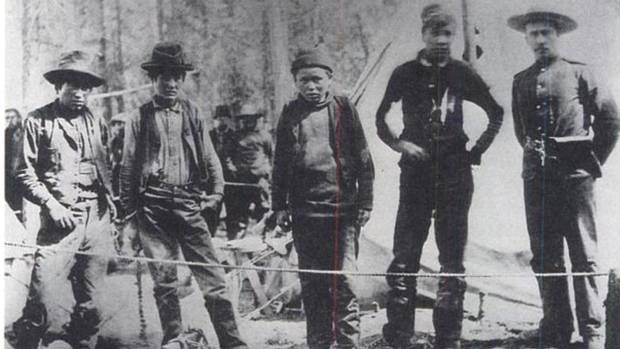
The four Nantuck brothers, shackled after arrest.

The trial unfolded in a court at the territorial capital of Dawson City. A compelling chapter in Strange Things Done: Murder in Yukon History does wonderful work with the cultural disconnections, including a two-page exchange between judge and interpreter (and, off-camera, Frank Nantuck) in which the court struggles to get the accused sworn “so help me God” since Frank’s cosmology has no idea of an afterlife. “He says, when he is dead he is dead — that is all I can get out of him,” the helpless middleman reports.

Q Has he any knowledge of God at all or any idea about a future state of rewards and punishments?

A No sir.

Q Or any clear belief in religion of any kind?

A No sir.

Q Will you say to him that we want him to tell us the truth and not to tell us anything that is not the truth; that he may be punished if he tells us anything that is not the truth; that we are going to ask him some questions and that he must tell us just the truth; ask him if he will agree to do that.

The outcome of the trial will not surprise and there was no question but that the Nantucks had done the shooting. What the Dawson court only barely noted was that brothers had been detailed to avenge two Tagish deaths. An old woman had previously been given or found some “baking powder” and proceeded to make bread with it: in fact, it was arsenic, which was used in mining. Here again is the cultural dislocation; the Nantucks living next to Fox and Meehan were trying to feel out whether those two prospectors were of the tribe that had provided this poison, and of equivalent social rank to the two men who died eating the arsenic-bread. Basically, neither side in this subarctic tragedy had any concept of what the other was on about.

There’s a play about this case, Justice. Peruse the play’s pdf companion study guide on the real historical case here.

In the end, all four Nantucks were condemned to die; Frank was probably still a minor, and he had cooperated with the investigation, so his sentence was commuted to life imprisonment … which did not turn out to be very long at all, since Frank and his condemned brother Joe both died in jail of tuberculosis during the 1898-99 winter.

Dawson Nantuck and Jim Nantuck remained to hang.

Momentarily sensational, the case was long forgotten among whites; it has, however, remained in the oral tradition of Yukon First Peoples. Both communities, however, saw the case brought to the fore when excavations accidentally turned up their remains — along with those of two other hanged men.

One of the other two was the third man to hang this date, a fellow by the name of Ed Henderson. Henderson was an American prospector whose fate might be a bit less instructive for posterity. He suffered from a horrible bladder infection that caused him to pass bloody water every 15 or 20 minutes. “The tortures of the damned,” he described it to court. Wincing yet?

The fact that Henderson suffered from it meant his two prospector-mates suffered from it as well — call it purgatory-level suffering; a member of their party had to relieve himself constantly and thrashed about in his sleeping bag all night for the agony it caused him.

Their empathy for his situation was overturned along with Ed Henderson’s inside-the-tent piss-bowl one night. The drenched and vengeful Tomberg Peterson started an immediate brawl, but Henderson’s leaky plumbing didn’t impair his ability to shoot Peterson dead. Henderson himself reported the incident when the prospectors reached their destination, possibly thinking that no jury would convict him.

The trio comprises the first men hanged by the Yukon Territory, which was only separated from the Northwest Territory in 1898. In fact, there was a bizarre procedural deficiency for the Nantucks (but not for Henderson): they were condemned by the court of the wrong, former territory since word of the territories’ separation had not reached Dawson City at the time of the trial. Nobody saw fit to remedy this blunder, however.

On this day..

1884: Charles Henry, iced in the Arctic

On this date in 1884, U.S. Army Private Charles B. Henry of the Lady Franklin Bay Expedition (LFBE) was summarily executed in the distant northern reaches* of present-day Nunavut.


It’s waaaaaay up there. Click to view larger map, but don’t expect details.

The “Greely expedition” — so called after its commander, Adolphus Greely — was dispatched from Washington in the enthusiasm of the First International Polar Year. This was a multinational collaborative to gather scientific data about the globe’s frigid polar reaches; technically, this first IPY spanned 1882 to 1883, but the ill-starred Greely mission set out in 1881.

The LFBE was headed for a narrow icebound inlet named for a woman who lost her explorer husband on an Arctic voyage. That bay juts like a dead tree limb out of the Robeson Channel into the remote northern wildernesses of Ellesmere Island.

The mission laid down for the 25 men of the Lady Franklin Bay Expedition in 1881 was to establish a weather station, and to collect astronomical and geomagnetic data.

But long before the starving remnants of that crew put Private Henry to sudden death, they had supplanted that noble endeavor with the classic objective of polar adventure: mere survival.

Matters started promisingly enough: the ship that ferried these men to their ordeal dropped them without incident at a natural harbor in Lady Franklin Bay, where the intrepid men built Fort Conger — a sturdy frame house 65′ x 21′ x 14′. They would spend the next two years making scientific measurements, exploring, and awaiting planned resupply ships in the summers.

Ice-choked waters, however, do not open reliably to this location. The resupply missions in both 1882 and 1883 failed — and left the mission with a life-or-death choice.

Per prearranged contingency, the supply ships, should they not be able to reach Camp Conger, were to drop their provisions at a backup location. Much against his men’s will, Greely gave up Camp Conger to chase this hypothetical cache. Camp Conger was more difficult for any future ships to reach but was secure, warm enough, and blessed with seal-hunting enough to keep the team in good health.

Camp Sabine was reached only after a terrifying and near-fatal float down the coast in an ice floe (!) and it proved when they reached it a much less congenial spot for wilderness survival. The resupply missions that hadn’t reached Camp Conger had failed so thoroughly that only a very small drop had even made it to Camp Sabine. Conditions prevented the party from returning to Camp Conger or from crossing the water to another inhabited Arctic station: instead, they wintered in the mouth of hell; seal-hunting here was not favorable, and most days they were only able to supplement their dwindling cache of life-giving calories with a few shrimp and scraps of lichen peeled off the frozen rocks.

Not only ravenous hunger afflicted the party, but scurvy too, and still worse a morale collapse among party members who regarded Lieutenant Greely’s leadership very lightly. Huddled in a makeshift stone hut, three years gone from hearth and home, bored and helpless and stretching out less-than-subsistence rations as far as possible and farther, nerves began to fray … and party members began to succumb to conditions.

Charles Buck Henry did not wear well on this desperate party.

“Henry” was actually the new alias of a German immigrant formerly known as Charles Henry Buck. Buck had served time for embezzling whiskey money from a frontier cavalry company, then escaped and slew a Chinese man in a Deadwood, S.D. brawl. Henry stole from the expedition’s small store of food: he was not the only one, but he was perhaps the baldest thief and the one with the fewest redeeming features that would balance this behavior. He’d been confined in March to his sleeping bag as the closest thing to punishment that Greely could visit on him. Still, Henry stole more. Resentful comrades ostracized him, while silently sizing up the discomfiting likelihood that the hulking German would be odds-on to kill any man among them in a fair scrap.

This day, Greely finally caught him stealing once too often.

Notwithstanding promises given by Pvt C.B. Henry yesterday [to stop stealing] he has since as acknowledged to me tampered with seal thongs if not other food … This pertinacity and audacity is the destruction of this party if not at once ended. Pvt Henry will be Shot today all care being taken to prevent his injuring any one as his physical strength is greater than that of any two men. Decide the manner of death by two ball and one blank cartridge. This order is imperative & absolutely necessary for any chance of life.

A.W. Greely
1 Lt. 5 Cav. ASO & Asst
Cmdg. L.F.B. Expd

That order Greely issued to his able assistant, Sgt. David L. Brainard. Brainard proceeded to gather two other men who contrived to “execute” Henry by a stratagem of approaching Henry armed, but casual, and distracting the unrestrained condemned man long enough to get the drop on him. They shot him dead just as Henry recognized his danger and started to lunge for a nearby axe — an incredibly chancy engagement that could easily have turned the whole expedition into a hyperboreal edition of “The Most Dangerous Game” had the mountainous Henry avoided or survived that gunshot.

Instead, his body with its fatal bullet wound was discovered by accident when the Greely party was at long last rescued later that June, and returned along with just seven** (barely) living souls out of the 25 who set sail in 1881. Those fortunate survivors — the relief mission’s commander reported them “crying like children, hugging each other, frantic with joy”† as their rescue vessel pulled into view — would be forever defined by their participation in the LFBE: toasted for their survival story while also dogged by dark rumors of cannibalism.

According to polar and maritime historian Glenn Stein, FRGS, who spent several years researching this jaw-dropping case,‡ they also closely husbanded the story of their one-time mate’s execution. Mr. Stein is also U.S. Liaison a present-day polar journey, the South 2014 Expedition, and he was gracious enough to speak with Executed Today about the LFBE’s execution.


ET: The Lady Franklin Bay Expedition was a U.S. expedition launched as part of the first International Polar Year. Could you situate the LFBE in the context of polar expeditions at this time?

GS: In the years following the 1875-76 British Arctic Expedition, it was suggested that nations should stop competing for geographical discoveries and instead dispatch a series of coordinated expeditions dedicated to scientific research. Eleven nations took part in the first International Polar Year (IPY) 1882-83, and the United States contributed two components to its first participation in an international scientific effort. In 1881, it was decided that the U.S. Army Signal Corps would establish one scientific station 500 miles from the North Pole, at Lady Franklin Bay, Grinnell Land. The other station was at Point Barrow, Alaska.

The executed man in this instance is Charles Henry, formerly known as Charles Buck. This man had a pretty disreputable history. How was he able to get on this expedition? – And, how did he become the Chicago Times correspondent for this journey? Did he actually file any stories?

Buck enlisted in the Fifth Cavalry under the alias Charles B. Henry, and wrote to Lieutenant Greely from Fort Sidney, Nebraska, in April 1881, volunteering for the expedition. Henry had the strong recommendation of his company commander, Captain George T. Price, to back him up. Greely and Price were friends, so Greely leaned toward taking Henry (who repeatedly telegraphed Greely with reminders of his availability). Another story is that Henry joined from Fort Sidney when one of the original expedition members deserted just before it was to leave. However, as far as I’m aware, there was only one desertion from the LFBE, and that person was replaced by Private Roderick R. Schneider, First Artillery.

Supposedly, since Henry was the only volunteer from the Fifth Cavalry, with a strong recommendation from post commander Lieutenant Colonel Compton, Greely decided to take him.

According to A.L. Todd’s Abandoned (1961), before joining the expedition back East, Henry “got permission to stop off in Chicago to visit relatives, and managed to make an arrangement with the Chicago Times to act as that paper’s special correspondent with the Lady Franklin Bay Expedition.” In his Ghosts of Cape Sabine, Len Guttridge (2000) made references to Henry’s newspaper articles: “One or two eventually published in the Chicago Times attested to an effective if florid command of the English language.”

This expedition lasted three years, 1881-1884, and it came to a considerable amount of grief. Could you sketch out what happened to the LFBE, and how it found itself in such a perilous situation in its last months?

By the end of August 1881, a frame house was constructed at Lady Franklin Bay and named Fort Conger. Over the next two years scientific data was collected and sledging parties were sent out, discovering many new geographic features, and setting north, east, and west “farthest” records. Because of the mismanagement of resupply expeditions from the United States, expedition members initiated a planned retreat by boat to Cape Sabine in August 1883 — but the journey turned into a nightmare. The party eventually ended up at Cape Sabine, where the men constructed a stone house for the winter, with an upturned boat for a roof. It was christened Camp Clay. Throughout the following months, the men’s spirits and energy dwindled, and constant hunger was now their companion. Worse, food was being stolen from the commissary storehouse. More than once, angry accusations flew back and forth within the party. The daily ration for each type of food was measured out to hundredths of an ounce.

The first death occurred on Jan. 18, 1884, when Sergeant William H. Cross died of starvation. In spite of the privations, only one man died that winter, even though scurvy was also present. In the spring Death returned with a vengeance.

So by the end, there’s a party near to starvation, just scraping by on a starvation diet. Naturally there’s a temptation for people to steal from the camp rations.

Henry wasn’t the only person to have stolen, but it seems from your description like he was the most distinctly resented by the rest of the party. Why was that?

During his time at Fort Conger, Henry was the originator of many profane remarks, misdeeds, and lies, so Greely and others had learned not to trust him.

Until the publication of my article, “An Arctic Execution,” LFBE historians consistently wrote that no one on the expedition knew of Henry’s criminal history as a forger, thief and accused murderer. However, I discovered within Sergeant Brainard’s unpublished daily notes that he definitely knew of Henry’s past — so who else knew as well? In consequence, although others also stole food, Henry would have been treated with less tolerance.

The specific details of the execution, and the variations on the story that are given later, are quite fascinating. The execution was ordered by the camp commander, but Henry was not confined and had no idea what was coming, because the shooting party could have been in some danger as well. Given the rough and ready circumstances, why then, does the execution party go to such elaborate ends to anonymize the shooter? There’s the “three guns, two balls” order, and then they can’t comply with that since there’s only one usable rifle, so they swear an oath among themselves never to tell.

Firing squad duty obviously preys upon the conscious and subconscious mind. It’s possible that passing the rifle around and swearing an oath replaced the anonymity provided by the “three guns, two balls” order. Keep in mind that, if the three men survived their Arctic ordeal, their participation could impact them for the rest of their lives — in and out of the Army.

This was particularly true of Sergeant Brainard, who was promised a commission by Greely. Decades after the execution, Brainard declared that “no matter what the provocation, the family of a man doesn’t want to think of him as an executioner.”

As a factual matter, it was either Brainard or Francis Long who pulled the trigger, since Frederick distracted Henry and lured Henry into the trap.


Charles Henry (left), and his two potential executioners: David Brainard (center) and Francis Long (right).

What’s left of Henry is buried in New York. If you really wanted to find out what happened, you would have to exhume the remains. Henry’s sister, Dora Buck, did request the exhumation and autopsy of his body, but these were never allowed to take place. Officially, as my article notes, Henry’s remains were buried with full military honors. What we are left with today are cemetery records, which state that Charles Henry “Died of Starvation.”

And you think Brainard carefully managed the way the dangerous execution story got out.

Brainard is like a historian’s dream. Not only was he there, not only was he a very intelligent individual — but he made a record of many things, keeping daily notes that go from start to finish.

I hand-copied each page, three years of field notes, and I referenced these in my article. Those notes represent his impressions at the time they were written, not edited versions. One crucial thing Brainard recorded about Henry was that he “is a born thief as his 7th Cavalry name will show — a perfect fiend.” That’s significant, because it doesn’t appear in Brainard’s published writings. Why omit that piece of information? There’s one reason: Brainard knew beforehand that Henry was a criminal, and if it was known Brainard possessed this information, then he may appear prejudicial regarding the decision to shoot Henry.

It starts to add up, because who had control of the expedition members’ journals on the passage home? Brainard.

Who wrote up an incomplete journal on the way home — and then, many months later, turned in writings covering several more months — but ending in March 1884? Brainard.

I’ve examined the three volumes of his original journal. Everything was very carefully written, and Brainard made sure the story he wanted told got into these journals.

And what transpired afterward?

Sgt. Brainard had been promised a commission by Greely for his leadership on the LFBE. That’s a huge deal — to get commissioned from the ranks for gallant and meritorious service, and not even in wartime, but peacetime. At that time, and for many years thereafter, he was the only living officer of the Army, active or retired, holding a commission awarded for specific distinguished services. I believe Brainard was a “good guy” and a stand-up guy, but at the same time, would he really chance ruining his opportunity to get that commission? The whole execution business could have made things really difficult for him.

When they evacuated Fort Conger, and later on were literally floating south on a piece of ice, there was almost a mutiny. The mutineers went to Brainard, saying Greely had to be relieved of command, that he was going to get everyone killed. But Brainard wouldn’t go along with it — in part, he probably realized it would destroy his future.

You have to start looking at these motivations; and it’s not an entirely unsympathetic view, because people in these positions had jobs to do.

It took a lot of pushing to get Brainard’s commission to Second Lieutenant approved, and this didn’t happen until October 1886. In 1917, when he was near the end of his career, he was actually appointed Brigadier General. Brainard went from buck private to Brigadier General!

After the LFBE’s rescue later in 1884, how was the matter of the execution handled? I’m reading between the lines here, but it seems to me that, while it was not a secret, it was also downplayed as a public matter in the immediate aftermath — Henry buried with full military honors, that sort of thing. As it emerged more publicly thereafter, was there ever any controversy or a significant sentiment that Greely had handled the situation improperly? Was there ever a question about the legality of his order?

Greely made a verbal report regarding the execution to his departmental superiors several days before Henry’s burial. He then wrote to Adjutant General of the Army R.C. Drum in August 1884, to report Henry’s execution and request that a court of inquiry be ordered or a court martial convened regarding the matter. Drum responded in November 1884 that after examining the expedition’s records, “the Secretary of War entertains no doubt of the necessity, and the entire propriety of your action in ordering the execution of Private Henry, under the circumstances and in the manner set forth in your report.”

It was understood that any military officer operating in the field possesses a fair degree of discretion in carrying out orders, and Greely had Henry executed in order to preserve lives.

Newspaper articles certainly featured Henry’s execution, but stories of cannibalism (including the condition of Henry’s remains) and the political scandal related to the mishandling of the attempted relief of Greely prior to his rescue were much more high profile stories.

You have a professional interest in polar exploration, and obviously starvation risks are endemic to these situations when matters go awry. Have you encountered any similar instances of a polar party executing one of its members for the sake of maintaining discipline?

A somewhat similar execution scenario, also an attempt to preserve the lives of starving men, had played out during Sir John Franklin’s 1819-22 Arctic Land Expedition. A detachment of four men from the expedition, including Surgeon John Richardson, discovered that their comrade, Midshipman Robert Hood, had been murdered by an Iroquois voyageur named Michel Teroahauté (also known as Ferohaite).

Under the circumstances, Richardson shot Michel to save their own lives.

How did you come to find out about this story and why did you decide to research it in such depth? Over a century on from the events themselves, what does the fate of Charles Henry have to tell us today?

I can trace back my knowledge of the execution to at least September 1988, when I bought a copy of The Polar Passion, by Farley Mowat (1967). Several years later, I acquired a large collection of items once belonging to General Brainard, which included most of his medals and orders, photographs, books, and a bone knife he brought back from the Arctic. Brainard is a fascinating historical figure and human being (I like to call him the quintessential American), and I spent a good deal of time researching and writing about his life. In the process I discovered there were many contradictory details about the execution.

On July 13, 2005, I was sitting at an outside bar in Jamaica, when it dawned on me that if I dug deep enough, I just might be able to figure out what really happened during the execution of Private Henry.

So, I began jotting down notes on three 4″ x 5″ pieces of paper — “1. Primary Question: Who was the shooter?” Of the three men involved, the evidence dictates the trigger man must have been either Brainard or Long — but in the absence of conclusive evidence we’ll probably never know which one. And I ultimately decided that’s okay, because it’s the way the three wretched souls wanted it to be on that fateful summer day in 1884, and I needed to respect their wishes.

The events during the Lady Franklin Bay Expedition, especially Charles Henry’s fate, are reminders of how crises bring out the best — and worst — in human nature. At various times in our lives we’re all confronted with personal crises: how we deal with them is what counts. Writing “An Arctic Execution” forced me to stretch my mind beyond what I thought were its limits to attempt to understand defining moments in the lives of human beings who were at the brink of oblivion.

A few books about the Greely expedition

* This expedition established a “farthest north” record: it was for the next several years the most northerly latitude that any explorer could document ever attaining.

** One of the seven retrieved by the Thetis, Sgt. Joseph Elison, was at death’s door. Wasted to 78 pounds and stricken with frostbite and gangrene that required his rescuers to amputate both hands and both legs, Elison died at sea — leaving just six survivors of the Lady Franklin Bay Expedition who would ever again set foot on American soil.

San Francisco Bulletin, July 18, 1884, quoting Winfield Scott Schley — later famous as a Spanish-American War hero.

‡ Glenn M. Stein, “An Arctic Execution: Private Charles B. Henry of the United States Lady Franklin Bay Expedition 1881-84,” Arctic, Vol. 64, No. 4 (December 2011). Read it here (pdf).

On this day..

1945: Bruno Dorfer and Rainer Beck, Wehrmacht deserters

On this date in 1945, five days after the Germans had surrendered to the Allies in World War II, two deserting sailors were shot at Amsterdam.


Dorfer (top) and Beck.

The strangest thing: Bruno Dorfer and Rainer Beck were deserters of the Wehrmacht’s Kriegsmarine … and they were shot by a court-martial conducted by the Wehrmacht itself.

This surprising and shameful story is told in full by Chris Madsen in “Victims of Circumstance: The Execution of German Deserters by Surrendered German Troops Under Canadian Control in Amsterdam, May 1945,” a 1993 Canadian Military History journal article available online in pdf form.

Basically, a pocket of fortified German resistance remained hunkered down in the Netherlands as the war approached its close. That force of 150,000 surrendered to a much smaller number of Canadians on May 5 on terms that maintained German responsibility for administering its armed forces and the civilian areas under its control — a highly anomalous situation in an occupied country as the Third Reich winked out of existence altogether.

Canadians and Germans, according to Madsen, enjoyed a collegial relationship as the Canadians gradually took German forces into custody … or received German forces who helpfully marched themselves into custody. But even under guard, these “imprisoned” Germans still retained significant autonomy and a German command structure that Canadians were loath to interfere with — an arrangement so expedient that it severely tested the bounds of propriety. So invested were the Canadians in maintaining their opposite numbers’ unit cohesion* that they handed some deserters (and plenty of men were deserting the German army) back over to the nominal prisoners!

Rainer Beck had been deserted for the best part of a year: the son of a Social Democratic father and a Jewish mother, he’d ditched harbor defense the previous September and had been laying low with his sister in Amsterdam. Bruno Dorfer was a more recent deserter. They naturally assumed that with the Canadian takeover, they’d be good to go: they turned themselves in to Canadian soldiers with an eye towards regularizing their status.

They were in for quite a surprise, as Madsen relates:

Major Oliver Mace, acting commanding officer of the Canadian regiment, ordered Major J. Dennis Pierce, the company commander in charge of the former factory [where the German prisoners were being held], to place the two deserters inside the compound because “they were certainly Germans and we had no other place to put them.” …

At 1005 hours on 13 May 1945, Pierce informed 2 Canadian Infantry Brigade of the intended German course of action: “German Marine deserters being tried this morning. German Commander intends [to] shoot them.” The German camp leadership established a Standgericht or a court martial within the camp … [and] brought Dorfer and Beck before three officers, a team of military lawyers “whom Pierce himself had ‘put in the bag’ in the streets of Amsterdam earlier in the week.” [Fregattenkapitan Alexander] Stein regarded the proceedings as a show trial for his authority. At the insistence of the German naval commander, the entire camp population witnessed the event. A parade state, taken earlier that morning, counted 1,817 German marines inside the camp. The two accused, represented by a German military lawyer, underwent rigorous cross-examination before this large staring crowd … Oberleutnantnginieur Frank Trmal, a young German officer present at the fifteen-minute trial, remembered Beck’s defense:

For some reason Beck, who was older, decided to defend himself and told the court that we (the Germans) all knew several weeks ago the war was all over for us and that it was a matter of time before we surrendered. He told the captain and the court that any further fighting by us against the Canadians would be senseless bloodshed. With this the captain jumped to his feet in a rage, screaming at Beck that he was calling all of us, his comrades, and his officers, murderers. It is something that I will never forget.

After the inevitable-yet-incredible conviction, Stein appealed to his Canadian guards for a bit of comradely assistance in carrying out the court-martial’s order.

The Seaforth Highlanders obligingly delivered up eight captured German rifles with ammunition, plus a heavy truck to help their “prisoners” execute their deserters. A Canadian military cable testifies in its clipped and plaintive language to the egregious moral vacuum afflicting the chummy occupation: “German marines in Amsterdam have picked up some of their own deserters. They have been tried by military law and sentenced to be shot. May they do this.”

The answer was determined not by any senior Canadian officer, but by the German high commander who had surrendered the Dutch pocket the week before, Johannes Blaskowitz. It was on his approval that Dorfer and Beck were shot against an air raid shelter wall at 1740, not eight hours after their bizarre public trial.

When the story surfaced publicly in 1966 as a result of Der Spiegel investigations, Stein was unrepentant. “Beck would never have been a credit to Germany anyway,” he told the Globe and Mail (Oct. 28, 1966). “Deserters only turn into criminals in civil life too.”

This execution is dramatized in the 1969 Italian-Yugoslav film Dio è con noi (The Fifth Day of Peace, also released as Gott mit Uns and The Firing Squad).

* Conceivably as part of a policy to have Wehrmacht troops in readiness in case the western allies segued directly into war with the Soviet Union. Jacques Pauwels writes in The Myth of the Good War: America in the Second World War:

it is a fact that many captured German units were secretly kept in readiness for possible use against the Red Army. Churchill, who not without reason had a high opinion of the fighting quality of the German soldiers, gave Field Marshall Montgomery an order to that effect during the last days of the war, as he was to acknowledge publicly much later in November 1954. He arranged for Wehrmacht troops who had surrendered in northwest Germany and in Norway to retain their uniforms and even their weapons, and to remain under the command of their own officers, because he thought of their potential use in hostilities against the Soviets. In the Netherlands, German units that had surrendered to the Canadians were even allowed to use their own weapons on May 13, 1945, to execute two of their own deserters!

On this day..

1649: Saint Jean de Brébeuf, missionary to the Huron

It was on this date that the Jesuit missionary Saint Jean de Brébeuf was martyred by indigenous Iroquois near present-day Midland, Ontario.

(cc) image from Patrick Shanks

Brebeuf was of Norman stock, kin to poet Georges de Brebeuf.

Ordained in 1622, Brebeuf soon decamped to the New World to Christianize the natives.

There he teamed up with another Jesuit missionary named Gabriel Lalemant and established the Sainte-Marie among the Hurons mission.

As the name advertises, this outpost aimed to minister to the Hurons (Wyandot); to that end, Brebeuf — who learned the local tongue well enough to write a catechism and a dictionary — composed the still-beloved Christmas song “Huron Carol”.

Brebeuf’s own missives recording Huron established him an energetic chronicler who has been styled Canada’s first serious ethnographer. For instance, Brebeuf on the POW treatment he saw the Huron dish out:

when they seize some of their enemies, they treat them with all the cruelty they can devise. Five or six days will sometimes pass in assuaging their wrath, and in burning them at a slow fire; and they are not satisfied with seeing their skins entirely roasted, — they open the legs, the thighs, the arms, and the most fleshy parts, and thrust therein glowing brands, or red-hot hatchets … After having at last brained a victim, if he was a brave man, they tear out his heart, roast it on the coals, and distribute it in pieces to the young men; they think that this renders them courageous … we hope, with the assistance of Heaven, that the knowledge of the true God will entirely banish from this Country such barbarity. (From the Jesuit Relations, volume 10)

Well … not just yet.

Brebeuf regrettably foreshadowed his own ghastly fate, for during his ministry, the Huron and Iroquois went to war. No fewer than eight men posted to Brebeuf’s mission were martyred during 1640s Huron-Iroquois wars.

On March 16, 1649, Iroquois captured Brebeuf and Lalemant, and subjected them to a horrific death just like the sort of thing Brebeuf had seen inflicted by the Huron. Other Jesuit missionaries recorded the tortures from eyewitness accounts given in the subsequent weeks:

As soon as they were taken captive, they were stripped naked, and some of their nails were torn out; and the welcome which they received upon entering the village of St. Ignace was a hailstorm of blows with sticks upon their shoulders, their loins, their legs, their breasts, their bellies, and their faces, — there being no part of their bodies which did not then endure its torment.

Father Jean de Brebeuf, overwhelmed under the burden of these blows, did not on that account lose care for his flock; seeing himself surrounded with Christians whom he had instructed, and who were in captivity with him, he said to them: “My children, let us lift our eyes to Heaven at the height of our afflictions; let us remember that God is the witness of our sufferings, and will soon be our exceeding great reward. Let us die in this faith; and let us hope from his goodness the fulfillment of his promises. I have more pity for you than for myself; but sustain with courage the few remaining torments. They will end with our lives; the glory which follows them will never have an end.” “Echon,” they said to him (this is the name which the Hurons gave the Father), “our spirits will be in Heaven when our bodies shall be suffering on earth. Pray to God for us, that he may show us mercy; we will invoke him even until death.”

Some Huron Infidels — former captives of the Iroquois, naturalized among them, and former enemies of the Faith — were irritated by these words, and because our Fathers in their captivity had not their tongues captive. They cut off the hands of one, and pierce the other with sharp awls and iron points; they apply under their armpits and upon their loins hatchets heated red in the fire, and put a necklace of these about their necks in such a way that all the motions of their bodies gave them a new torture. For, if they attempted to lean forward, the red-hot hatchets which hung behind them burned the shoulders everywhere; and if they thought to avoid that pain, bending back a little, their stomachs and breasts experienced a similar torment; if they stood upright, without leaning to one side or the other, these glowing hatchets, touching them alike on all sides, were a double torture to them. They put about them belts of bark, filled with pitch and resin, to which they set fire, which scorched the whole of their bodies.

At the height of these torments, Father Gabriel Lallement lifted his eyes to Heaven, clasping his hands from time to time, and uttering sighs to God, whom he invoked to his aid. Father Jean de Brebeuf suffered like a rock, insensible to the fires and the flames, without uttering any cry, and keeping a profound silence, which astonished his executioners themselves: no doubt, his heart was then reposing in his God. Then, returning to himself, he preached to those Infidels, and still more to many good Christian captives, who had compassion on him.

Those butchers, indignant at his zeal, in order to hinder him from further speaking of God, girdled his mouth, cut off his nose, and tore off his lips; but his blood spoke much more loudly than his lips had done; and, his heart not being yet torn out, his tongue did not fail to render him service until the last sigh, for blessing God for these torments, and for animating the Christians more vigorously than he had ever done.

In derision of holy Baptism, — which these good Fathers had so charitably administered even at the breach, and in the hottest of the fight,—those wretches, enemies of the Faith, bethought themselves to baptize them with boiling water. Their bodies were entirely bathed with it, two or three times, and more, with biting gibes, which accompanied these torments. “We baptize thee,” said these wretches, “to the end that thou mayst be blessed in Heaven; for without proper Baptism one cannot be saved.” Others added, mocking, “we treat thee as a friend, since we shall be the cause of thy greatest happiness up in Heaven; thank us for so many good offices, — for, the more thou sufferest, the more thy God will reward thee.”

These were Infidel Hurons, former captives of the Iroquois, and, of old, enemies of the Faith, — who, having previously had sufficient instruction for their salvation, impiously abused it, — in reality, for the glory of the Fathers; but it is much to be feared that it was also for their own misfortune.

The more these torments were augmented, the more the Fathers entreated God that their sins should not be the cause of the reprobation of these poor blind ones, whom they pardoned with all their heart. It is surely now that they say in repose, Transivimus per ignem et aquam, et eduxisti nos in refrigerium.

When they were fastened to the post where they suffered these torments, and where they were to die, they knelt down, they embraced it with joy, and kissed it piously as the object of their desires and their love, and as a sure and final pledge of their salvation. They were there some time in prayers, and longer than those butchers were willing to permit them. They put out Father Gabriel Lallement’s eyes and applied burning coals in the hollows of the same.

Their tortures were not of the same duration. Father Jean de Brebeuf was at the height of his torments at about three o’clock on the same day of the capture, the 16th day of March, and rendered up his soul about four o ‘ clock in the evening. Father Gabriel Lallement endured longer, from six o’clock in the evening until about nine o’clock the next morning, the seventeenth of March.

Before their death, both their hearts were torn out, by means of an opening above the breast; and those Barbarians inhumanly feasted thereon, drinking their blood quite warm, which they drew from its source with sacrilegious hands. While still quite full of life, pieces of flesh were removed from their thighs, from the calves of the legs, and from their arms, — which those executioners placed on coals to roast, and ate in their sight.

They had slashed their bodies in various parts; and, in order to increase the feeling of pain, they had thrust into these wounds red-hot hatchets.

Father Jean de Brebeuf had had the skin which covered his skull torn away; they had cut off his feet and torn the flesh from his thighs, even to the bone, and had split, with the blow of a hatchet, one of his jaws in two.

Father Gabriel Lallement had received a hatchet- blow on the left ear, which they had driven into his brain, which appeared exposed; we saw no part of his body, from the feet even to the head, which had not been broiled, and in which he had not been burned alive,—even the eyes, into which those impious ones had thrust burning coals.

They had broiled their tongues, repeatedly putting into their mouths flaming brands, and burning pieces of bark, — not willing that they should invoke, in dying, him for whom they were suffering, and who could never die in their hearts. I have learned all this from persons worthy of credence, who have seen it, and reported it to me personally, and who were then captives with them, — but who having been reserved to be put to death at another time, found means to escape.

But let us leave these objects of horror, and these monsters of cruelty; since one day all those parts will be endowed with an immortal glory, the greatness of their torments will be the measure of their happiness, and, from now on, they live in the repose of the Saints, and will dwell in it forever.

Brebeuf’s intercultural legacy allegedly lives on in sport form. Though it’s unverifiable folklore, it is said that Brebeuf saw Iroquois tribesmen playing the game of baggataway and, reckoning the sticks used to manipulate the ball resembled bishops’ croziers, conferred upon the game the name lacrosse.

Europeanized versions of this game (“with a few genteel refinements”) remain wildly popular in Canada, and are growing throughout North America. Lax bros can be found especially in the environs of well-heeled private high schools … like Brebeuf Jesuit Prep School (Indianapolis, Indiana).

On this day..

1673: The effigy of Charles Alexis dit Dessessards

According to this registry of events in French Quebec before the English conquest, one Charles Alexis dit Dessessards was ordered broken on the wheel by Quebec’s high executioner on this date in 1673.

He had been convicted of murdering a fur-trapping buddy named Herme, and plundering his pelts.

In the terrifying words of the sentence, he was at 3 p.m. to have “arms and legs broken with four blows, then be strangled and thrown on a wheel to remain there until seven o’clock in the evening. His body will then be brought to the gallows, there to remain until entirely consumed” by the elements. On top of everything, he had a 200-livre fine to pay.

There was just one bit of good news for the murderer Charles Alexis dit Dessessards:

“Until the said Charles Alexis is apprehended, the aforesaid sentence will be executed upon his effigy.”

MARS

Le 6. — “Charles Alexis dit Dessessards, convaincu d avoir tué de guet-à-pens le nommé Herme, son camarade de voyage, et d’avoir volé ses hardes et pelleteries, sera conduit sur la grande place de cette vile (Québec), par l;exécuteur de la haute justice, un lundi, à trois heures après-midi, et là, sur un échafaud qui y sera dressé à cet effet, y aura les bras et les jambes rompues de quatre coups qu’il recevra vif; sera ensuite étranglé et jeté sur une roue pour y demeurer jusqu’à sept heures du soir. Son corps sera porté sur les fourches patibulaires pour y demeurer jusqu’à parfaite consommation. Condamne en outre à deux cents livres d’amende envers le Roy, à la restitution des choses volées et le surplus de ses biens confisqué. Et en attendant que le dit Charles Alexis soit appréhendé, sera exécuté en effigie aux fourches patibulaires, un lundi, à l’heure que dessus.

On this day..

1839: Amos Perley and Joshua Doane, for the Upper Canada Rebellion

On this date in 1839, Amos Perley and Joshua Doan(e) were hanged in London, Ontario for a feeble armed invasion from Detroit.

The Battle of Windsor was pretty much the last gasp of Canada’s Rebellions of 1837 — touching Lower Canada (Quebec) as well as Upper (Ontario).

The effort saw stateside refugees of the Upper Canada Rebellion, also known as the Patriot War, organize an attempt to overthrow British-Canadian authority between Windsor and Niagara. But a brief incursion (a few houses were captured) failed to trigger a general response in a populace that was all risings’ed out, while United States authorities stayed well clear of these troublemakers. Officials had little difficulty mopping them up.

Six different people (named here) were executed at intervals in London, Ontario, beginning on January 7, 1839 — and ending with the two this date.

Amos Perley was a New Brunswick native who had been an American resident (citizenship status is unclear) for some time, but fell in with the Patriots.

Joshua Doane was a Quaker — a sect ordinarily leery of armed conflict and liable to be considered disloyal as a result — who abandoned the whole pacifism thing in favor of the Patriot cause. He’d had to beat it over the border when the last round of Upper Canada disturbances had been put down the previous winter: he wouldn’t get another chance after the 1838 invasion fizzled.

Doane’s touching last letter to his soon-to-be-widow survives.

London, January 27th, 1839

Dear Wife,

I am at this moment confined in the cell from which I am to go to the scaffold. I received my sentence today, and am to be executed on February 6th. I am permitted to see you tomorrow, any time after 10 o’clock in the morning, as may suit you best. I wish you to think of such questions as you wish to ask me, as I do not know how long you will be permitted to stay. Think as little of my unhappy fate as you can; as from the love you bear me, I know too well how it must affect you. I wish you to inform my father and brother of my sentence as soon as possible. I must say good-bye for the night, and may God protect you and my dear child, and give you fortitude to meet that coming event with the Christian grace and fortitude which is the gift of Him, our Lord, who created us. That this may be the case, is the prayer of your affectionate husband,

JOSHUA G. DOANE.

At this point, “people [in London] were so fed up” with the intermittent public hangings they’d been subjected to that the remaining condemned had their sentences commuted instead to penal transportation, and got shipped to Australia instead.

The disruptions did, however, help to contribute to the 1840 political unification of Upper and Lower Canada.

On this day..

1908: John Boyd, by John Radclive

On this date in 1908, John Boyd managed six fitful hours of sleep, had a breakfast of toast, poached eggs and tea, and then went to the Don Jail gallows for murdering his paramour’s rival suitor.

Canada had long before ceased public executions. Prior to Boyd’s execution, Don Jail hangings had occurred in a jail yard — technically behind prison walls, but easily peeped upon by curiosity-seekers willing to obtain higher ground. Boyd’s execution introduced a new privacy measure: it was the first of 26 hangings to occur in an interior chamber completely away from public eyes, the same place where Canada eventually held its last hangings in 1962.

But apart from this minor milestone, we notice on this date the hurried and disturbed departure of prolific hangman John Radclive. “Another poor soul gone,” he was overheard to say as he left.

Radclive is the subject of an empathetic Toronto Star profile that’s well worth the read.

He was Canada’s first professional hangman, with 69 recorded executions and perhaps just as many which the uneven documentation of the day failed to note. Predecessor of the better-known Arthur Ellis, Radclive learned his trade direct from William Marwood, and was put on the federal payroll as a full-time executioner in 1892.

He had a swagger in his ill-starred step back then: he once started a brawl boasting in a pub that he had “come to hang a Frenchman, and hoped it would not be the last.” By the time he got to Boyd and beyond, he was ready for the last. Alcoholism had wasted his nerves (and his liver: he died of cirrhosis in 1911). In 1910 Radclive told a psychiatrist,

“Now at night when I lie down, I start up with a roar as victim after victim comes up before me. I can see them on the trap, waiting a second before they meet their Maker. They haunt me and taunt me until I am nearly crazy with an unearthly fear.”

On this day..

1838: The first hangings of the Lower Canada Rebellion

On this date in 1838, Joseph-Narcisse Cardinal and Joseph Duquet were hanged for a rebellion.

As the names suggest, these weren’t rosbifs themselves: they were French, born under crown jurisdiction by grace of their forbears’ thrashing at British hands in the Seven Years’ War.

In 1837, French Lower Canada rose in rebellion — la Guerre des patriotes, to the Quebecois. The British dispatched it.

Cardinal and Duquet were young notaries of radical sympathies who organized a sort of aftershock insurrection (French link) in 1838 at their native Chateauguay. It was instantly suppressed, its authors court-martialed for treason.

Those patriotes spared the pains of the gallows were condemned instead to a different kind of suffering — exile. The folk song “Un Canadien Errant” (“The Wandering Canadian”) eulogizes the land lost to these unfortunates.

“If you see my country,
my unhappy country,
Go, say to my friends
That I remember them.”

A monument pays tribute to all those executed or exiled for the rebellion.

On this day..

1869: Nicholas Melady, the last public hanging in Canada

Thanks to John Melady, author of Double Trap, for the guest post about his kinsman. -ed.

I was standing with my father, looking at the ruins of an old house. I thought what remained of the brickwork was interesting, until Dad said, rather offhandedly: “And this is where the murder happened.” I was rather shocked, and asked what he meant.

His answer led me to write Double Trap, the story of the last public hanging in Canada.

Briefly, the tale goes something like this.

A man named Nicholas Melady Senior, my great-grandfather’s half brother, amassed substantial landholdings in Huron County, Ontario Canada, prior to 1868. In the years just before that, he played various family members off against each other, and depending on his whim, one or other of them would be promised his inheritance. His son Nicholas Junior was used worst of all. He worked without pay for his father, was promised all or at least some of the lands, but then was told he would get nothing — several times.

One night, Nicholas Senior, who was commonly called The Old Man, was in bed with his new wife, when Nicholas Junior and two of his friends, all of whom were drunk, broke into the Old Man’s house. A terrible fight ensued, and it included a hand gun and an axe, but at the end of the thing, the Old Man and his bride were dead.

After some very shoddy detective work, Nicholas Junior and his two friends were rounded up and lodged in a basement cell of an old house in nearby Seaforth, Ontario. (The local magistrate owned the place.) Part of that cell still exists, including the barred window the culprits would have looked through — at the rest of the cellar. It is rather creepy to visit, and while I researched Double Trap, I did not want to be there for long, and never at night.

In due course, the three desperadoes were sent to an even more chilling old jail in Goderich, Ontario. (It is now a Canadian historic site, and is visited by throngs of people every year.) There, Nicholas Junior’s friends ultimately turned against him.

However, before that happened, local detectives used a unique stratagem to gain evidence against Nicholas. I could never be sure where they got the idea. They hired a beautiful young woman who was born in Michigan, (who was likely a prostitute) and talked her into spending time in a cell in the jail. She was paid to gain the trust of Nicholas, and hopefully a confession.

In that sense, she was the first part of the “double trap,” in the book’s title.

The woman was given the name “Jenny,” and in time, by dropping notes where he would find them, and ultimately putting herself in a position where she could whisper to him through his cell window, (she positioned herself in the women’s exercise yard; he was inside his cell), she caused him to fall in love with her. All of her notes, and his as well, were used in the trial that followed. The two never actually touched each other.

When she walked into the courtroom during the trial and took the stand to describe her job and show the letters Nicholas had written, he was utterly speechless with shock. He had completely trusted her, and to him, her betrayal was total.

The execution of Nicholas Melady was a macabre affair, as were events leading up to it. His death cell was positioned quite close to where he was hanged. He could hear workers building his scaffold, and while I cannot prove it, I believe he would have been able to witness the construction of the thing. The death cell still exists, and in researching this book, I visited it several times. Now that is creepy.

So is the ground where he took his final few steps, out to the scaffold. It was built on top of the prison wall. He went up the steps on the inside, then lurched to his death, down the outside of the wall — where all the spectators waited to see the spectacle. His fall, through the trapdoor in the gallows floor was the second trap of the book’s title.

The execution was the last public one in Canada. Three weeks later the government of the country abolished public executions because they were regarded as too barbaric. There was controversy however, around the one for Nicholas. Many people felt he had been betrayed, by his accomplices, and by “Jenny,” and so lots of talk in the community made the public officials fear that there would be demonstrations the day of the death.

For that reason, they moved the execution time up by about three hours. “Only” about 300 people witnessed it. Several thousand came to see the spectacle later in the day, but by the time they reached the site, the show was over. His body was cut down, and for reasons I could never fathom, was actually waked for two days in the same house where the killings took place. Lots of the curious came to see the corpse of the killer, laid out for display.

The day after the execution, the New York Times was the first newspaper on the street with the story. I could find no trace of “Jenny,” or what became of her after her jailhouse job. Her testimony in court was never really challenged.

I was able to position myself in the cell where Nicholas was when he whispered to “Jenny.” I then went into the women’s exercise yard and by leaning against the jail wall easily understood how the conversations between the two transpired.

The book is Double Trap, by John Melady. Published by Dundurn, and available in the United States at Dundurn Publishing, 2250 Military Road, Tonawanda, New York 14150. In Canada, the pub address is: Dundurn Publishing, 3 Church Street, Suite 500, Toronto, Ontario M5E 1M2 In Britain, the address is: Gazelle Book Services Limited, White Cross Mills, High Town, Lancaster, England LA1 4XS.

On this day..