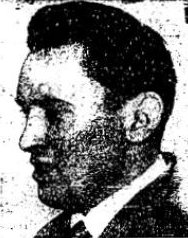
1935: Del Fontaine, punch drunk boxer

On this date in 1935, Canadian pugilist Del Fontaine was hanged at Wandsworth Prison, “the bravest fellow we ever saw go to the scaffold.”

Winnipeg-born as Raymond Henry Bousquet, Fontaine twice won the Canadian middleweight belt.

But a grueling, 98-fight career took its toll on the man.

By the end — when he had crossed the pond for a couple years traversing the English rings — Del Fontaine was visibly punch-drunk. The onetime champion lost 12 of his last 14 fights.

Punch drunk — scientific name dementia pugilistica — is just the classic diagnosis for “concussed all to hell,” afflicted by traumatic brain injury and its mind-altering long-term effects: Depression, violence, mood swings, loss of judgment and impulse control. Those are the kinds of behavior patterns that tend to brush up against the criminal justice system.

The syndrome’s popular name suggests its most visible injury, to motor skills — a symptom Fontaine’s colleagues in the business could readily diagnose.

Del shouldn’t have been in the ring at all for his last fight. He wasn’t in a fit state,” fellow prizefighter Ted Lewis testified at Fontaine’s trial, recalling a Newcastle bout that ended in a flash on three first-round knockdowns. “As a boxer, he has received more punishment than anyone I have ever seen.” The house doctor at a Blackfriars venue Fontaine had appeared at earlier in 1935 said the fighter complained of double vision and sleeplessness, and couldn’t walk straight. (London Times, Sep. 17, 1935)

If 1935 was a few decades’ shy of our present-day understanding of concussions, it was still well-enough known to those who had experience of the punch-drunk that psychological changes accompanied the physical impairments. Those who knew Del Fontaine knew he wasn’t right in the head.

The reason this tribunal had to sit for the humiliating public probe of Fontaine’s mental crevasses was that Fontaine had left his wife and kids behind when he crossed the Atlantic. Once he got to the Isles, he took up with an English sweetheart in Bristol.

This Hilda Meek, a West End waitress a decade the junior of her lover, became the object of an obsessive infatuation. In a fit of jealous rage, Fontaine gunned her down (and her mother too, although mom survived) when he caught Meek making a date with another man.

Fontaine was captured, unresisting, dolorously on the scene, and openly admitted his actions. Acquittal on the facts would be a nonstarter; diminished responsibility because of dementia pugilistica was the best defense gambit available.

The highly restrictive legal bar against an insanity defense aced out the legal maneuver: however impulsive and moody a lifetime of concussions had left him, they couldn’t be said to have prevented him “knowing right from wrong.” Still, his case attracted a fair bit of public sympathy, and when a petition for clemency went nowhere, hundreds of people, including a number of other boxers, turned up at Wandsworth to protest on the morning the punch-drunk Del Fontaine hanged for murder.

On this day..

1786: David Nelson, but not William Horbord

This date in 1786 offers us the fine legal salami-slicing of how to stanch a race war with a noose.

Our salami’s name is David Nelson, a furloughed veteran of the Queen’s Rangers in the late American Revolution relocated to the environs of Fredericton, New Brunswick.

There, he and a fellow veteran named William Horbord or Horboard shot dead a native Maliseet for stealing their hog.

This brought neighboring peoples to a deadly tense standoff. The Maliseet demanded justice for their victim; white Canadians demanded … well, the right to shoot Maliseet without fear of their own neck.

Nelson and Horbord went right on trial, but how to finesse the situation?

According to an exhibit that unfortunately seems to have vanished from the Virtual Museum of Canada, natives “camped out around the presiding Judge Kingsclear’s home.” That must have got his commute off to an awkward start each day.

So a Solomonic compromise obtained: after the two were duly convicted and doomed to hang, Nelson, the principal offender, was measured for his coffin … while Horbord, deemed less culpable, received a pardon.

Now that’s gallows diplomacy.

On this day..

1939: The only triple execution in Manitoba

On this date in 1939, the Canadian province of Manitoba carried out at Headingley Gaol the only triple execution in its history.

Peter Korzenowski and William Kanuka hanged side by side just after midnight that February 16, while their accomplice Dan Prytula waited 14 minutes for his turn on the gallows.

Less than a year before, drunk on moonshine, the trio beat and kicked 81-year-old Anna Cottick to death on her Dauphin-area farm in an attempt to plunder the place of a rumored $1,000. In fact, they only found twenty-three bucks.

According to an article that appeared on the regrettably extinct Manitoba’s Buried History site,

The process of finding enough corroborating evidence to obtain murder convictions was the stuff of modern crime dramas.

As soon as the Royal Canadian Mounted Police arrived at the Cottick farm, members noticed fresh tire tracks entering and leaving the yard. They were tracked three miles west to within 150 yards of Kanuka’s residence, and from there to the Gilbert Plains home of Prytula’s sister. The tire marks were a perfect match to the treads on Prytula’s 1929 Ford. It was confiscated and, while casts were taken of its treads, Prytula was arrested and his blood-stained clothes, boots and three .32 calibre bullets were seized and sent to the RCMP crime lab for testing.

As one group of police officers were arresting Prytula and Korzenowski, another searched the Cottick residence for additional evidence. Almost immediately they noticed what appeared to be fingerprints on the glass smashed by the assailants. Fragments were sent to experts in Winnipeg, along with a window frame and piece of wall where the bullets fired by Korzenowski and Prytula lodged.

The RCMP also searched the residence and yard of Korzenowski, located a few hundred yards from where Kanuka had been staying. There they found the revolvers used in the break-ins, hidden in a pile of stones. Korzenowski was promptly arrested, and three days later he and his two friends were part of an identification line-up paraded in front of the hospital beds of the Cotticks.*

To top all that off, they bugged the men’s jail cell with a dictograph and snared them in several incriminating conversations. Representative remark: the lawyers are so expensive, “No wonder one has to go robbing.”

* Anna’s 91-year-old husband survived the home invasion.

On this day..

1789: The Canadian Burglars

“More solemnity was perhaps never observed at any execution before” the hanging this date in 1789 of William Mooney Fitzgerald and John Clark in St. John, New Brunswick.

The fate of these two Irish career criminals is one of many arresting stories told on the Early American Crime blog, whose entry (and complementary podcast) this site could hardly improve upon.

Connoisseurs of historical executions are well-advised to subscribe.

On this day..

1952: Lennie Jackson and Steve Suchan, of the Boyd Gang

On this date in 1952, Steve Suchan and Lennie Jackson were hanged at Toronto’s Don Jail for the murder of a policeman.


Lennie Jackson (top) and Steve Suchan

Both Such and Jackson were members of the Boyd Gang, a swashbuckling troupe of show-stealing bank robbers in post-World War II Toronto … but in the timeless mold of the folk hero outlaws.

Not hanged with them (or ever; he died in British Columbia in 2002) was the gang’s leader and namesake, Edwin Alonzo Boyd.

The wartime commando legendarily launched his stick-up career by robbing a bank so unrecognizably made-up that he was able to walk back in and change a $20 without notice a few days later.

Boyd’s further exploits (and occasional close scrapes: he seemed to have a gift for not getting hit when people shot back at him) plundering banks, and then escaping jail with the cohorts who became the “Boyd Gang” to plunder some more, threw a splash of color across the headlines of staid 1950s Ontario that moved newspapers.

Toronto historian Mike Filey remarked in this CBC documentary

When the Boyd Gang stuck up a bank and it made the front page, people started cheering for them, because it put some excitement in their lives. And of course the interesting thing about Edwin was, if there is such a thing, he was a “good” bad guy.*


More about this movie here

Jackson and Suchan were two of that group who helped author the Boyd Gang’s most notorious larcenies. And they put a screeching halt on the “fun” of the Boyd gang’s crime spree in March 1952 when they shot a Toronto cop dead at a traffic stop.

Suddenly, it wasn’t just the banksters getting hurt. The crooks couldn’t dodge the ensuing manhunt.

But somehow the quartet of criminals locked up in the Don Jail with this murder rap hanging over them actually managed to escape again, hours ahead of their arraignment. It turned out to be the bandits’ last great exploit, worth only a few days of liberty before they were recaptured.

Jackson and Suchan went from trial to gallows — said to be a badly botched hanging — in mere weeks. Boyd and another gang member named Willie Jackson (the two Jacksons weren’t related) drew long prison sentences from which they were paroled in 1966.

Some Books about Edwin Boyd

* Or was he?

On this day..

1895: Not Almighty Voice

On October 22, 1895, Cree warrior Almighty Voice was arrested for the considerable crime of killing a cow without the right permit. When a white guard japed that workmen were “erecting a scaffold from which you will be hanged next morning” — actually, they were putting up a building — it set off one of the longest and bloodiest manhunts in Saskatchewan history.

Almighty Voice took the prospect of having his neck stretched this date seriously enough to break out of prison the night of October 22-23.

A week later, a Mountie tried to arrest Almighty Voice and was shot dead for his trouble. From a spurious criminal complaint that likely would not have been pursued, the specter of the gallows had sent Almighty Voice into wanted-outlaw status.

For a year and a half he mostly avoided detection, and if the other Cree on his reservation had knowledge of his whereabouts, the government’s $500 reward was not enough to induce them to supply it.

In May 1897, Almighty Voice and two fellow-travelers were finally caught in a shootout. The Cree did just fine in this exchange, but two more Mounties and (for some reason) a postmaster were not so lucky.

The next day, the Mounties turned cannon on the Indians’ position, finally killing the three of them in the bombardment — or else inducing them to kill themselves.

Nineteen months on, seven men were dead on account of our guard’s ill-chosen bit of gallows “humor.” Hardy-har-har. But Almighty Voice remains a legendary name in Saskatchewan.

On this day..

1608: Jean Duval, for plotting against Champlain

On or about this date in 1608, explorer Samuel de Champlain judged guilty and had executed for plotting his own murder a Norman locksmith among his host of men establishing the Quebec settlement.

Though there were previous European forts on the site, Quebec City had been formally founded by Champlain just a month earlier, on July 3, and we here join the exposition of the public-domain Pioneers of France in the New World.

Hanging judge: Samuel de Champlain monument in Ottawa. Creative Commons image from dugspr.

They were pioneers of an advancing host, — advancing, it is true, with feeble and uncertain progress, — priests, soldiers, peasants, feudal scutcheons, royal insignia: not the Middle Age, but engendered of it by the stronger life of modern centralization, sharply stamped with a parental likeness, heir to parental weakness and parental force.

In a few weeks a pile of wooden buildings rose on the brink of the St. Lawrence, on or near the site of the market-place of the Lower Town of Quebec. The pencil of Champlain, always regardless of proportion and perspective, has preserved its likeness. A strong wooden wall, surmounted by a gallery loopholed for musketry, enclosed three buildings, containing quarters for himself and his men, together with a courtyard, from one side of which rose a tall dove-cot, like a belfry. A moat surrounded the whole, and two or three small cannon were planted on salient platforms towards the river. There was a large storehouse near at hand, and a part of the adjacent ground was laid out as a garden.

In this garden Champlain was one morning directing his laborers, when Tetu, his pilot, approached him with an anxious countenance, and muttered a request to speak with him in private. Champlain assenting, they withdrew to the neighboring woods, when the pilot disburdened himself of his secret. One Antoine Natel, a locksmith, smitten by conscience or fear, had revealed to him a conspiracy to murder his commander and deliver Quebec into the hands of the Basques and Spaniards then at Tadoussac. Another locksmith, named Duval, was author of the plot, and, with the aid of three accomplices, had befooled or frightened nearly all the company into taking part in it. Each was assured that he should make his fortune, and all were mutually pledged to poniard the first betrayer of the secret. The critical point of their enterprise was the killing of Champlain. Some were for strangling him, some for raising a false alarm in the night and shooting him as he came out from his quarters.

Having heard the pilot’s story, Champlain, remaining in the woods, desired his informant to find Antoine Natel, and bring him to the spot. Natel soon appeared, trembling with excitement and fear, and a close examination left no doubt of the truth of his statement. A small vessel, built by [Francois] Pontgrave at Tadoussac, had lately arrived, and orders were now given that it should anchor close at hand. On board was a young man in whom confidence could be placed. Champlain sent him two bottles of wine, with a direction to tell the four ringleaders that they had been given him by his Basque friends at Tadoussac, and to invite them to share the good cheer. They came aboard in the evening, and were seized and secured. “Voyla donc mes galants bien estonnez,” writes Champlain.

It was ten o’clock, and most of the men on shore were asleep. They were wakened suddenly, and told of the discovery of the plot and the arrest of the ringleaders. Pardon was then promised them, and they were dismissed again to their beds, greatly relieved; for they had lived in trepidation, each fearing the other. Duval’s body, swinging from a gibbet, gave wholesome warning to those he had seduced; and his head was displayed on a pike, from the highest roof of the buildings, food for birds and a lesson in sedition. His three accomplices were carried by Pontgrave to France, where they made their atonement in the galleys.

More about Champlain in this podcast, by the author of Champlain’s Dream: the Visionary Adventurer Who Made a New World in Canada.

On this day..

1734: Marie-Joseph AngƩlique, for burning Montreal

On this date in 1734, a Portuguese-born slave known as Marie-Joseph AngƩlique was publicly hanged before the burned ruins of old Montreal on an accusation of having set the blaze.

Having recently been caught attempting to abscond with her lover, a white servant named Claude Thibault, Angelique was the instant consensus community suspect when Montreal caught fire on April 10. Forty-six buildings in the still-small frontier town burned; Angelique was arrested the very next morning.

(Thibault fled town, his fate unknown but presumptively no worse than what befell his paramour.)

Nobody died in the fire, but conflagrations were deadly serious back in the bucket brigade era.

The sentence

calls for the said Marie Joseph Angelique in reparation for the Fire caused by Her and other issues brought forward at the trial, to be condemned to make honourable amends Disrobed, a Rope around her Neck, holding in her hands a flaming torch weighing two Pounds before the door and main entrance of the parish Church of the said City of Montreal, where She will be led by the Executor of the high Court And there on her knees state and declare in a loud and intelligible voice that she maliciously and defiantly and wrongly set the Said fire for which She is repentant, [and] ask Forgiveness from God, the King and the Court; this done she is to be taken to the public square of the said City of Montreal to be Hanged until dead at the gallows erected for this Purpose at the said square, and then her dead Body is to be placed on a flaming pyre and burned and her Ashes Cast to the wind, her belongings taken and confiscated by the King; prior to this the said Marie Joseph Angelique is to be subjected to torture in the ordinary and extraordinary ways in order to have her reveal her accomplices …

And so she was.

Although the torture broke Angelique’s now-useless denial of her own guilt, she maintained her defense of Claude Thibault, insisting that she acted alone. It’s up for debate whether she did, in fact, act alone, or act at all — and if Angelique was guilty, what meaning or intent one can ascribe to her action.

There’s a fascinating exploration of this case, including the available primary documents, available in English or French.

On this day..

1935: Thomasina Sarao, miscalculated

Shortly after midnight this date* in 1935, the career of 71-year-old Canadian executioner Arthur Ellis came to an end with the botched hanging of Thomasina Sarao.

All a simple matter of physics.

When the old-school “drop ’em from a cart” method of strangulation hanging gave way to the “new drop”, the hangman’s art eventually came to encompass the scientific application of the humane level of force to the doomed person’s vertebrae.

Something in the neighborhood of 1,000 ft/lbs was about right. Too little, and the poor wretch strangles to death. Too much, and you rip the head right off.

Thomasina Sarao got too much, and it ripped her head right off.

They’d worked everything out to a handy table, see, where if you weighed this much, they knew to drop you this far, derived from the formula

1020/weight in pounds (less 14 lbs for the head) = drop in feet

Except in the widow Mrs. Sarao’s case — the Italian immigrant had offed her husband to collect the insurance** — Arthur Ellis was given the wrong weight for his client. He coiled a noose for a woman 32 pounds lighter than the person who actually mounted the scaffold, and he therefore made it more than a foot too long.

That whole “ripping off a woman’s head” thing really harshed everyone’s vibe. So, although hangings had long been moved behind prison walls, the Canadian government stopped the ongoing practice of allowing members of the general public to obtain tickets to witness them.

“Arthur Ellis” — it was actually a trade name he’d made up, and so dignified that one of his successors used the same alias — died three years after his grisly retirement party. He’s saluted by the Arthur Ellis Awards, the Crime Writers of Canada’s annual awards: a little trophy of a guy getting hanged.

[Ellis Trophy][Ellis Trophy]
Winners of the Arthur Ellis Award, like Robert J. Sawyer, get this trinket to commemorate. At least the little wooden fetish has his head attached to his shoulders. (Images (c) Robert J. Sawyer, and used with permission.)

* March 28 is sometimes reported, but the period press reports (like this wire story) seem to agree on the 29th, as does this index of Canadian executions.

** Two male co-conspirators, Leone Gagliardi and Angelo Donofrio, were also hanged for the same crime, a few minutes before Sarao on a different scaffold.

On this day..

1924: Alikomiak and Tatimagana, Inuit

On this date in 1924, the Canadian government made an example of two Inuit murderers on the Arctic Sea’s Herschel Island.

Alikomiak.

Alikomiak and Tatimagana (there are many alternate transliterations of each name) had been arrested in 1921 for killing four in a wife-stealing affair, then killed two more while in custody.

Canada, in the midst of a decades-long process of projecting its sovereignty in the Arctic, had let lenient treatment of some Inuit “criminals” in a few notable cases during the preceding years, and there was sentiment that an example of the majesty of the law was in order. “Make these tribes understand that the stern but at the same time just hand of British justice extends also to these northern shores,” the prosecutor implored the jury. (pdf, a great resource on this case)

To say nothing of whites’ sense that Inuits were savages.

Mr. Rasmussen states that 75% of the male population are murderers in fact it is the exception, where a man is a weakling or has something wrong with him, that a man has not at least one killing to his credit. These people are always on the offensive. This is particularly the case among the Netsilik band. While at Pelly Bay he offered a reward to his native Greenland Boy if he could find one man who was not a murderer. These people hold life very cheaply and as Mr. Rasmussen says it is a very easy matter to get killed. An attempt was made on his life at the H.B.C. post at Kent Peninsula. Now that these people know that the Police from Chesterfield Inlet and Kent Peninsula Detachments have arrested and taken out natives for committing murder, they immediately prepare for a fight on observing the approach of a strange sled or outfit. They are prepared to die fighting and have absolutely no fear of death yet they have the greatest fear of being taken away from their own country. Here I would like to say that this latter is the reason Alicomiak gave for killing Cpl. Doak and O. Binder at Tree River and lends truth to Mr. Rasmussen’s statement also judging from the absolute fearlessness with which Alicomiak and Tatamigans met their death here on the scaffold in February last would further corroborate it. In his travels from Pelly Bay through to Ellice River, Rasmussen says that on approaching a native camp of a number of natives, they, on noticing his strange outfit, at once made preparations for a fight thinking he was a policeman and on such occasions the first thing he had to do was to inform them that he was not a policeman, where upon they were most friendly and hospitable and would talk openly of murders they had committed when questioned about it.

That Dr. Knud Rasmussen cited at second-handed in the RCMP brief above was a great chronicler of the Inuit, and would record of this day’s hanging how “heavy and cumbersome machinery was required to get the two murderers sentenced. Judges, jury and witnesses had to be summoned from long distances.” The legal personnel were sent especially for this trial, along with the timber to build a gallows. You could say the verdict was foreordained.

Rasmussen’s work on the Inuit was recently put to celluloid by the director of Atanarjuat: The Fast Runner … another dimension, like the hanging this date, in the complex collision of cultures.

There was only one more hanging in the Yukon before Canada abolished the death penalty, though Canada was hardly finished using Inuit as instruments of its northern policy.

On this day..