1718: Stede Bonnet, gentleman pirate

On this date in 1718, the Barbados buccaneer Stede Bonnet was hanged for piracy in Charleston, S.C.

Bonnet had few of the typical swashbuckler’s resume-builders during this Golden Age of Piracy: he was neither a mariner by trade nor a desperate outlaw by circumstance, but a wealthy English landowner in Bermuda.
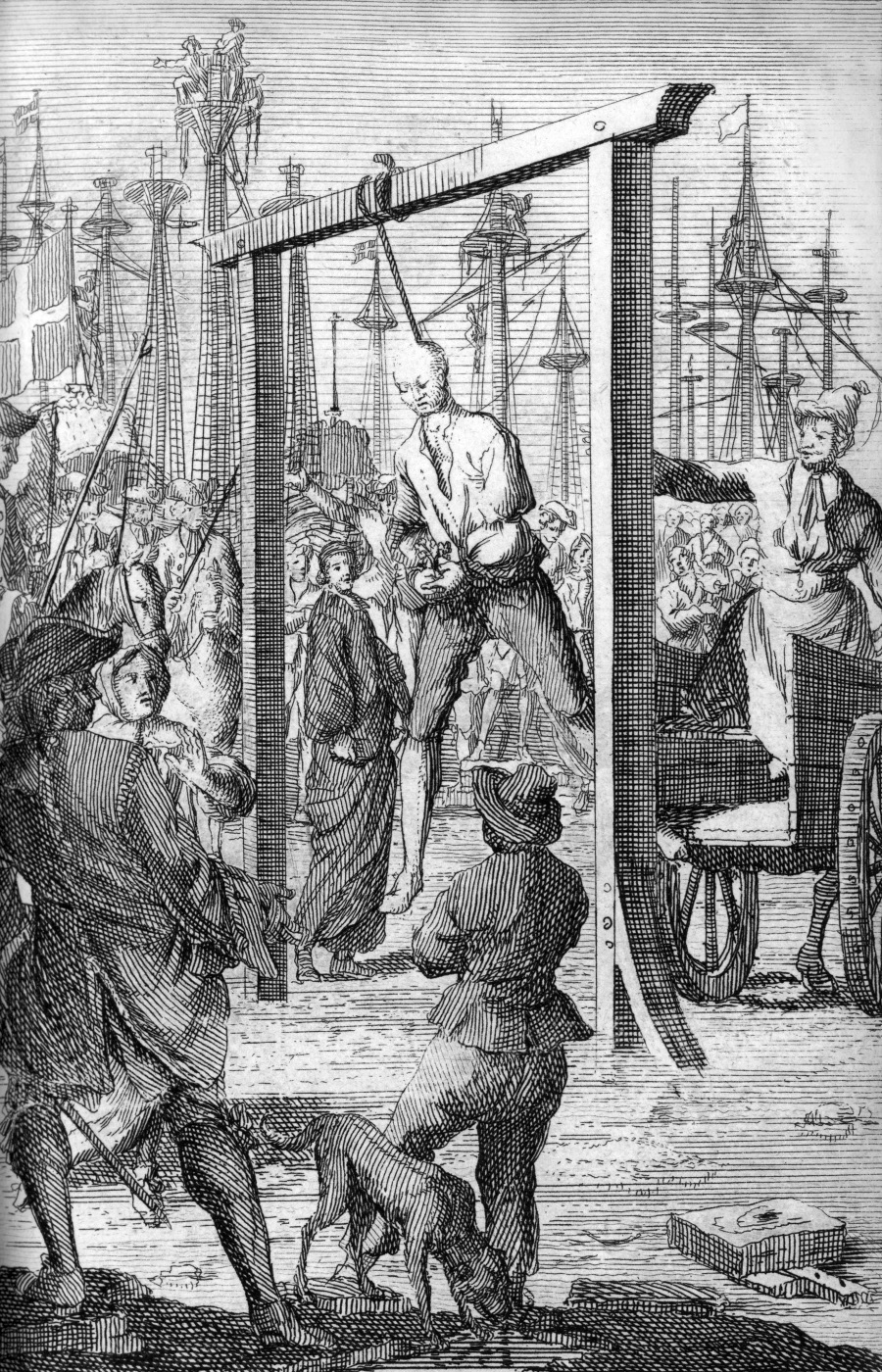
“He had the least Temptation of any Man to follow such a Course of Life, from the Condition of his Circumstances,” wrote the pseudonymous author (alleged to be Daniel Defoe) of A General History of the Pyrates. But as age thirty hove into view and the seven-year itch demanded scratching, Bonnet undertook an abrupt career change “said to have been occasioned by some Discomforts he found in a married State.”

Bonnet’s version of a cherry-red convertible was a six-gun sloop named Revenge,* which he tricked out from his ample inherited fortune and took cruising for action on the North American coast.

Or, just get this Victorian satire free from Google books.

He raided from New England to the Carolinas, fell in with Blackbeard (which more credible cutthroat charismatic promptly appropriated Bonnet’s hireling** crew), lost his ship, got it back, turned himself in, got a pardon … the rich guy packed plenty of adventure into little more than a year of raiding, but he never seems to have advanced his freebooting skills past the “gentleman hobbyist” level.

South Carolina ships captured Bonnet near Cape Fear, which is actually North Carolina, but never mind: South Carolinians well remembered this character from his involvement with Blackbeard’s recent blockade of Charleston.

Bonnet got gentleman’s quarters upon detention, and his elite education enabled him to favor the colony’s governor with a simpering plea for clemency.

Honoured Sir,

I have presumed, on the Confidence of your eminent Goodness, to throw my self, after this manner, at your Feet, to implore you’ll graciously be pleased to look upon me with tender Bowels of Pity and Compassion; and believe me to be the most miserable Man this Day breathing: That the Tears proceeding from my most sorrowful Soul may soften your Heart, and encline you to consider my dismal State …

if I had the Happiness of a longer life in this World … I’ll voluntarily put [wickedness] ever out of my Power, by separating all my Limbs from my Body, only reserving the Use of my Tongue, to call continually on, and pray to the Lord, my God, and mourn all my Days in Sackcloth and Ashes to work out confident Hopes of my Salvation …

Good grief.

All of which pathos was unwisely belied by an escape attempt which made pardon completely untenable.

Most of Bonnet’s captured crew was hanged en masse on Nov. 8; Bonnet managed to drag on several stays of execution before he followed them from his comfortable digs to the common gallows. A stone monument marks the spot.

* There were many pirate ships Revenge, including that of famous women pirates Anne Bonny and Mary Read and that of the Dread Pirate Roberts. There’s also a band “The Pirateship Revenge”.

** Bonnet paid his crew out of his own pocket, a practice at odds with the more egalitarian pirate norm of crews taking like shares and choosing (or demoting) their own captains.

On this day..

1775: Thomas Jeremiah, Charleston’s wealthiest free black

(Thanks to Meaghan Good of the Charley Project for the guest post. -ed.)

On this day in 1775, Thomas Jeremiah, a free black man in the then-colony of South Carolina, was hung after being convicted of attempting to a slave insurrection.

The case against him was extremely weak, but he was tried/framed under the Negro Act of 1740 (in a slave court, although he was not a slave), wherein the defendant was considered guilty until proven innocent. South Carolina’s own royal governor, William Campbell, called it a case of “judicial murder.”

Very little is known about Jeremiah. He left no diary or letters behind, and most of his trial records have been lost. We know he was married but we know nothing about his wife, whether she was a slave or a free black like himself, or whether they had any children. We don’t know how he became free or how he learned his trade. He is, in fact, so obscure that he doesn’t even have his own Wikipedia entry.

What little we do know, however, suggests that he was a most extraordinary man: a fisherman and ship’s pilot, one of less than 500 free blacks in the city of Charles Town (now called Charleston), Jeremiah had somehow managed to claw his way up and amassed a net worth of £1,000, or about $200,000 in today’s money. He was one of the wealthiest free black men in North America, and certainly the wealthiest self-made one.

Himself a slaveowner, he had no reason to start a slave rebellion, but this didn’t matter to those who convicted him. Jeremiah’s life, trial and death are discussed in detail in J. William Harris’s 2009 book, The Hanging of Thomas Jeremiah: A Free Black Man’s Encounter with Liberty. (This book review provides a good summary.)

2010 saw the publication of a second book, The World of Thomas Jeremiah: Charles Town on the Eve of the American Revolution.

Jeremiah was basically a victim of his own success. He had risen too high; he made the local white elites uncomfortable. As Harris noted, Jeremiah “did not need to gather arms or preach revolution to undermine slavery, because his whole life was a refutation of whites’ basic justification for slavery.”

Henry Laurens, a wealthy businessman, future Continental Congressman, slaveowner, and contemporary of Jeremiah’s, stated he was “a forward fellow, puffed up by prosperity, ruined by Luxury & debauchery & grown to amazing pitch of vanity & ambition.” He needed to be smacked down and he was, most severely.

In the spring and summer of 1775, revolution was fomenting everywhere. White “Patriots” wanted an opportunity to get out from under England, but they feared their slaves would use the conflict to try and get out from under them.

Nat Turner and Charleston’s own Denmark Vesey — these immortal rebels lay years into the future, but their very prospect made slave rebellions an omnipresent fear among the white populace. It was jumpy. And when two slaves accused Jeremiah of trying to persuade them to rebel, it jumped.

Only a few months passed between Jeremiah’s arrest and his execution. By that time he was a broken man, welcoming death. After he was hung, his body was cut down and burned to ashes.

Books about Thomas Jeremiah

On this day..

1781: Isaac Hayne, paroled prisoner of war

On this date in 1781, South Carolina patriot Isaac Hayne was hanged for breaking his conditional British parole and re-enlisting in the American Revolution.

Though Hayne is not, to us, the most famous revolutionary executed by the British, he might have been considered by his contemporaries as the most prominent individual to go to the scaffold for the cause.

A wealthy planter (lots of slaves!) whose home and grave can still be toured in Jacksonboro, Hayne was among 5,000 to surrender to the British when the latter captured Charleston in 1780.

These prisoners were required to swear an oath of allegiance to the crown in exchange for their parole, which Hayne reluctantly agreed to do because his family had been hit with smallpox.

He declared to a friend that,

as they [the British] allow no other alternative than submission, or confinement in the capital, at a distance from my wife and family, at a time when they are in the most pressing need of my presence and support, I must, for the present, yield to the demands of the conquerors. I request you to bear in mind, that previous to my taking this step, I declare that it is contrary to my inclination, and forced on me by hard necessity. I will never bear arms against my country … I do not mean to desert the cause of America.

But as the British southern campaign foundered over the year ahead, the mother country eventually attempted to call him up to do just that: bear arms against his country.

Hayne thought his parole terms protected him from ever having to serve against the colonies, so he simply got back into the fight on the revolutionary side instead. He was captured in that capacity.

The British commander Francis Rawdon handled his relapsed prisoner with uncommon severity, putting him to a drumhead military tribunal with a preordained outcome and refusing the many public pleas for leniency.

The irregular and vengeful nature of these proceedings, and Hayne’s seemingly honorable conduct, raised hackles on both sides of the Atlantic; shortly after hanging Hayne, Rawdon returned to the British Isles to find a good deal of pointed criticism of his behavior. (Parliament quashed any damaging official inquiry, and Lord Rawdon actually extracted an apology from the peer who had the temerity to motion the investigation — an intolerable impeachment on Rawdon’s honor.)

The Hayne incident was widely understood to have been conditioned by British frustration at its failing fortunes in the war. By the time of the execution, the redcoats held nothing of South Carolina save Charleston itself. General Cornwallis had recently marched north from the Palmetto State; in a few weeks’ time, he would surrender his sword and the British cause alike after the decisive British defeat at Yorktown, Virginia.

And though the commandants at Charleston scarcely anticipated that stunning reversal, they had only a few months before suffered the upsetting (but more legally tenable) hanging of the honorable British Major John Andre as a result of the Benedict Arnold affair. British forces were reputedly on the lookout for any opportunity to trade tit for tat.

Continental Gen. Nathaniel Greene alleged that the British officer who received the petition for Hayne’s life simply wrote on it John Andre — and sent it back.


Isaac Hayne was the great-uncle of South Carolina pol Robert Y. Hayne, best remembered for a hot sectional debate with Massachusetts Sen. Daniel Webster. (Read it all here, if you must.)

It was during this exchange of Senatorial disquisitions that Webster delivered one of the noted orations of the antebellum era, the aptly-named Second Reply to Hayne:

I have not allowed myself, Sir, to look beyond the Union, to see what might lie hidden in the dark recess behind. I have not coolly weighed the chances of preserving liberty when the bonds that unite us together shall be broken asunder. I have not accustomed myself to hang over the precipice of disunion, to see whether, with my short sight, I can fathom the depth of the abyss below; nor could I regard him as a safe counselor in the affairs of this government, whose thoughts should be mainly bent on considering, not how the Union may be best preserved, but how tolerable might be the condition of the people when it should be broken up and destroyed. While the Union lasts, we have high, exciting, gratifying prospects spread out before us and our children. Beyond that I seek not to penetrate the veil. God grant that in my day, at least, that curtain may not rise! God grant that on my vision never may be opened what lies behind! When my eyes shall be turned to behold for the last time the sun in heaven, may I not see him shine on the broken and dishonored fragments of a once glorious Union; on States dissevered, discordant, belligerent; on a land rent with civil feuds, or drenched, it may be, in fraternal blood! Let their last feeble and lingering glance rather behold the gorgeous ensign of the republic, now known and honored throughout the earth, still full high advanced, its arms and trophies streaming in their original lustre, not a stripe erased or polluted, not a single star obscured, bearing for its motto, no such miserable interrogatory as “What is all this worth?” nor those other words of delusion and folly, “Liberty first and Union afterwards”; but everywhere, spread all over in characters of living light, blazing on all it sample folds, as they float over the sea and over the land, and in every wind under the whole heavens, that other sentiment, dear to every true American heart, – Liberty and Union, now and for ever, one and inseperable!

When not being rhetorically posterized by New England gasbags, Robert Hayne made time to pen a justification for his famous forebear’s conduct for the Southern Review in 1828 — comparing the British behavior of executing rather than detaining a prisoner who broke parole to the massacre at Jaffa Napoleon notoriously ordered in 1799.

(Actually, Isaac Hayne’s old nemesis Francis Rawdon had only died in 1826; Robert Hayne wrote his piece to confute a vindication of himself that Lord Rawdon — also recognized by his subsequent titles, Earl of Moira and Marquess of Hastings — had authored, decades after the fact, of his conduct in the Hayne matter.)

Though this 37-page slog of Robert Hayne’s is obviously in the public domain by now, it appears it is not yet freely available online. However, it’s the source of the otherwise unattributed quotes in this article.

Part of the Themed Set: The Empire Strikes Back.

On this day..

1822: The audacious Denmark Vesey

On this date in 1822, white South Carolinians hanged the most terrifying slave insurrectionary who never rose — and breathed a sigh of relief as they clamped the shackles ever tighter upon their groaning servile class.

Inspired by slave revolts shaking the Caribbean, the Denmark Vesey plot was the South’s worst nightmare: Nat Turner, multiplied by about nine thousand.

That’s the size of the slave and free black network Vesey is said to have recruited — ready to undertake a coordinated uprising to seize Charleston, slaughter the white populace, and possibly then to sail for a Haiti whose own slave revolt had recently established it a black-governed republic. The mind boggles at such a scheme’s bravado … but in an age when horseshoes and mizzenmasts could outrun information, Vesey’s plot could have been past any prospect of obstruction before anyone in a position to obstruct it even knew what happened. Had they not flown but defended Charleston, the event would have ignited a conflagration to outshine every other slave uprising.

The weak point, of course, were those 9,000 — or however many — slaves who had to act ruthlessly and in unison, and keep their peace until they struck. It is incredible enough that such a secret kept among so many for up to four years.

The plot finally leaked mere days before it was to have been attempted when a middling player attempted the unnecessary freelance recruitment of a house slave — a class Vesey had intentionally (and rightly, events would prove) excluded for dangerously excessive personal loyalty to their masters’ families.*

Melancholy Dane

A well-educated and well-traveled man on account of his years as the personal property of a slaver — Joseph Vesey, who bequeathed his purchase both a surname and the given name Telemaque, subsequently corrupted into “Denmark” by Charlestonians — the plot’s signature hero/villain had managed to purchase his freedom and establish himself in the anomalous position of free black artisan/entrepreneur in the slaveholding South.

His successful carpentry business (apt choice, for a martyr) had given him the prestige and the werewithal to start an independent African Methodist Episcopal church where he poured out a hatred of chattel slavery undiminished by his own liberty.

For several years before he disclosed his intentions to any one, he appears to have been constantly and assiduously engaged in endeavoring to imbitter [sic] the minds of the colored population against the whites. He rendered himself perfectly familiar with those parts of the Scriptures which he could use to show that slavery was contrary to the laws of God; that slaves were bound to attempt their emancipation, however shocking and bloody might be the consequences … (Source)

His judges were later incredulous that he’d be so hung up about it:

It is difficult to imagine, what infatuation could have prompted you to attempt an enterprise so wild and visionary. You were a free man, comely, wealthy, and enjoyed every comfort compatible with your situation. You had, therefore, much to risk and little to gain.

An American Spartacus?

Denmark Vesey blurs into myth as he approaches his end, together with lieutenants: among them, Peter Poyas, the organizational maven of the operation who was hanged along with Vesey and four others; and Gullah Jack, an African priest among the 29 more who would die in the weeks ahead.

Most of the principals held their tongues before interrogators; the tribunals were held secretly; their records were censored against the apprehension by other slaves of the potential for such designs as “a bottle with poison to put into my master’s pump & into as many pumps he could about town.”

But there was enough known to shatter forever any illusion of paternal congeniality more liberal masters might have fancied. One planter was incredulous that his agreeable charge might be involved in such nefarious doings until he asked the man directly and was astonished to hear from his trusted coachman’s lips the frank intention “to kill you, rip open your belly and throw your guts in your face.” (Both quotes are from this book review.)

Whites were scared. “I have never heard in my life, of more deep laid plots or plots more likely to succeed,” wrote Anna Haynes Johnson, niece to Gov. Thomas Bennett. (Source) Another concluded that “our NEGROES are truly the Jacobins of the country.” (Source)

But as initial panic (and federal troop deployments) gave way to a more pervasive undertow of security paranoia, the affair was self-consciously downplayed and records intentionally destroyed for fear that too-careful documentation of its particulars could map the way for a revival. An 1861 piece in The Atlantic — an excellent read on the progress of the conspiracy — grapples with what was even then a gaping evidentiary vacuum.

The intense avidity which at first grasped at every incident of the great insurrectionary plot was succeeded by a distaste for the memory of the tale; and the official reports which told what slaves had once planned and dared have now come to be among the rarest of American historical documents. In 1841, a friend of the writer, then visiting South Carolina, heard from her hostess for the first time the events which are recounted here. On asking to see the reports of the trials, she was cautiously told that the only copy in the house, after being carefully kept for years under lock and key, had been burnt at last, lest it should reach the dangerous eyes of the slaves. The same thing had happened, it was added, in many other families. This partially accounts for the great difficulty now to be found in obtaining a single copy of either publication; and this is why, to the readers of American history, Denmark Vesey and Peter Poyas have been heretofore but the shadows of names.

Antebellum September 11

Even as a nonstarter, the insurrection was an antebellum 9/11 that spurred a reactionary crackdown on perceived liberalities in the system — most vividly symbolized by the construction of the fortress that became the still-extant military academy The Citadel, but more systematically impinging blacks’ everyday freedom to assemble and worship, and even requiring (until the Supreme Court overruled the law) free black sailors be detained whenever a northern ship called at port. Pro-slavery southerners blamed open disapprobation for slavery voiced in Congress during the recent Missouri Compromise wrangling, and even similar sentiments expressed in the British parliament, for emboldening the terrorists.

All this yielded a rich political harvest from the fruit of the gallows — like Charleston mayor James “there is nothing they are bad enough to do, that we are not powerful enough to punish” Hamilton, who rode his timely suppression of the plot to Congress later that year.

Such political profiteering, combined with the sketchiness of primary sources, has licensed a revisionist take on the orthodox history — that there was never any conspiracy, but that reactionary white elites concocted the plot from a tissue of loose liberation talk, false confessions, and latent white fear in order to win political power. This contested minority interpretation has been a recent topic of academic dispute, since Michael P. Johnson floated it in 2001 (an account is required to read Johnson’s original essay; here’s a synoptic article that appeared subsequently in The Nation).

Markers of historiography around these competing versions of Vesey, bearing directly on the question current in today’s Charleston of whether and how to memorialize this episode, are ripe with controversial modern-day implications.

Consider: if Vesey is a rebel indeed, the silence of (most of) the plotters is a noble acceptance of torture to protect their confederates; if they’re framed, they’re silent because there’s nothing to confess. Either way, the modern reader’s sympathies are likely to lie with the blacks, but Johnson’s interpretation removes the locus of action from them to white elites. If he’s right, would that derogate an entire narrative of black resistance to slavery, drain the martyrdom from their deaths? Or would it correct an overstated romantic mythology of armed resistance, and color this day’s hanging with a different heroism: refusing to purchase their lives with a false accusation?

* For his timely betrayal, Peter Desverneys received his liberty and a state pension; he later became a slaveholder himself. See Black Slaveowners.

On this day..

2004: Jerry McWee, a former policeman

On this date in 2004, South Carolina executed a man who had once been on the other side of the law.

Jerry Bridwell McWee hardly fit the profile of a future death row inmate when he met one George Scott. McWee was pushing 40, had no criminal record, and had once done a stint as an Augusta, Ga., police officer.

But it wasn’t many months that the two had iced a couple of Aiken County denizens in a hunt for drug money.*

It may have worked to Scott’s advantage that he was a career criminal, and had the instinct to turn state’s evidence before his confederate could send him to the gurney. Even so, it took some wheedling to get a death sentence out of the jury, which was clearly better inclined to give McWee life. A law (since reversed) at that time forbade advising jurors on parole scenarios, so the jury’s repeated pleas to know when the prisoner might be released under a life sentence — actual answer: age 71, at the earliest — were denied.

It was bum luck for Jerry under the circumstances, but also a mess of his own making; there was no question of innocence or some other mitigating point that gave him any likelihood of winning South Carolina’s first executive clemency.

The invaluable archives at the Clark County (Ind.) prosecutor’s web page collect news stories about every modern execution in the United States. On Jerry McWee’s page, an Associated Press report from the death chamber sketches an affecting portrat of two families’ grief.

In his final statement read by his lawyer, McWee asked both his own family and [victim John] Perry’s family to forgive him. “I only wished that things could have been different,” McWee wrote. “I would give anything if only that could have been the case.” A tear formed in his eye as his mother blew a kiss back at him and his final words were read. That tear finally rolled down the side of his head moments after he stopped breathing. More than 10 minutes later, McWee was officially declared dead at 6:18 p.m.

Celia McWee softly sobbed, a well-wadded tissue in her hand, as she waited for prison officials to open the curtain to the death chamber. She gasped “Oh my God” and her cries got louder as the curtain opened and she saw her clean-shaven son strapped to the gurney, his arms extended, and intravenous tubes stretching through a nearby wall. A minister put his hand on her shoulder. After glancing at his mother, Jerry McWee looked back at the ceiling, softly mumbling as the tubes shuddered. He blinked several times and his breathing got shallow, then stopped. Celia McWee’s sobs got softer as it was obvious McWee was no longer breathing. But she never took her eyes off her son.

A member of Perry’s family also witnessed the execution, and his gaze never left McWee’s body either. After the execution, Perry’s wife and family issued a statement thanking the community, law enforcement and prosecutors and saying it was not a time to rejoice. “God has given us free will – we are each responsible for our actions,” part of the statement read. “Please make choices you can live with. Please pray for the soul of Jerry B. McWee.”

The executed man’s mother, Celia McWee, also lost a daughter to murder in 1980; she had been, and remains, a mainstay of the anti-death penalty movement. On this biographical page, she sets the scene through a mother’s eyes.

One day Jerry came to my work. We said hello but I was still angry and didn’t ask if he wanted to talk. I thought, “If you’re going through a hard time, then good, because now you’re being punished for what you did.” To this day I’ll never forgive myself for not reaching out to him.

Jerry didn’t want me to witness the execution but I fought tooth and nail to be there. I couldn’t let him die in front of a room full of strangers. … The wife of Jerry’s victim wasn’t there, and I would say she’s the most sympathetic person I’ve ever known. She never publicly denounced what my son did, nor did she ever call for his execution.

Just before the lethal injection, Jerry turned to take a good long look at me and then blew me a kiss. After that he closed his eyes and I watched the blood drain from his face. I don’t know what could be harder than watching your son die like that. A mother does not see a 30, 40, 50-year-old man strapped to that cross-like gurney. She sees the child she gave birth to, the child that in her eyes never grew up.

* In two separate crimes, each had been the triggerman once. Formally, McWee was executed only for the first murder, a clerk McWee had shot in the course of robbing a convenience store of $350. He subsequently pleaded guilty to the second murder, for which he received a life sentence; Scott did likewise.

On this day..

1943: Sue Logue, George Logue and Clarence Bagwell

On this date in 1943, as the New York Times laconically led the story, “[t]wo men and a woman died in the electric chair … bringing to eight the number of deaths in ‘The Logue Case,’ which started over a dead calf.”

This culmination to an operatic South Carolina feud has a book all its own, and that scarcely seems equal to the events.

The dead calf in question* belonged to the Logue family, and (your headsman wouldn’t make this up) had been kicked to death by a mule of the neighboring Timmermans. Perhaps mistaking themselves for a cartoon parody, the two leading families of rural Edgefield County, S.C., used the incident to escalate a long-simmering feud.

Killing higher up the food chain soon followed.

The Timmerman patriarch wasted the Logue patriarch — Sue Logue’s husband and George Logue’s brother — but claimed self-defense and was acquitted. (Body Count: 1)

So Sue and George hired (via nephew Joe Frank Logue) a down-on-his-luck plasterer to even the score. Clarence Bagwell said he’d kill everyone in the county for $500, but he earned his fee just by gunning down old man Timmerman. (Body Count: 2)

The investigation brought the law to the Logue doorstep, and the requisite gun battle ensued. A sharecropper on the farm was killed. So was the sheriff — he was Sue Logue’s cousin — and the sheriff’s deputy. (Body Count: 5)

“[T]he only circuit court judge in South Carolina history to have made love to a condemned murderess as she was being transferred … to Death Row.” (Source)

The officers’ death necessitated the appearance of the man who now became the senior law enforcement official in the county: Strom Thurmond, still a local judge and a few years away from his vault into national prominence as a segregationist presidential candidate and 46-year South Carolina Senator.

Thurmond waded through the posse and talked the trio into surrendering. His warning that they were liable to be lynched must have been compelling in any circumstance, but the old goat was a uniquely qualified ambassador: he’d been having an affair with Sue Logue.

Small wonder the trial venue was moved. “[N]o section of the county could be found that did not include a relative of theirs.” (Source)

And small good it did the Logues, who died with their hireling in the early morning hours this day. (Body Count: 8)

For such an outlandish case, it earned only muted national coverage — a pittance reckoned against the feeding frenzy latterly occasioned by such relatively meager gruel as Scott Peterson. World War II stole its thunder, although local interest was intense.

Yet it lives on for the involvement of Thurmond in a second guise that rates as quite possibly the juiciest slice of death row gossip in American history. According to Ol’ Strom: An Unauthorized Biography of Strom Thurmond:

Randall Johnson, a black man who supervised “colored help” at the State House and often served as driver and messenger, drove Sue from the women’s penitentiary to the death house at the main penitentiary in Columbia.** In the back seat with her, he said many years later, was Thurmond, then an Army officer on active duty. They were “a-huggin’ and a-kissin’ the whole day,” said Johnson, whom Thurmond later as governor considered a trusted driver… In whispered “graveyard talk” — the kind of stories not to be told outsiders — the word around SLED (State Law Enforcement Division) was that Joe Frank said his aunt Sue was the only person seduced on the way to the electric chair.

* A “prize calf,” to be fair.

** On Christmas Day, according to Dorn.

Part of the Themed Set: The Spectacle of Private Execution in America.

On this day..