Sixty years ago today, Yoshio Kodaira counted himself “fortunate to be able to die on such a calm and peaceful day.”
For the year after Japan’s wartime surrender to the World War II Allied powers (beginning slightly before that surrender), former Imperial Navy soldier Yoshio Kodaira terrorized Tochigi and Tokyo with a rape-murder binge believed to have claimed ten victims.
Even our monsters — especially our monsters — are creatures of their own milieu.
For Kodaira, that was the Japanese occupation of China, where he slew an unknown number of Chinese soldiers and civilians in his official capacity under the banner of the rising sun … followed by the “anarchy of the postwar years.”
(In between the two, he served a jail term in the 1930’s for killing his father-in-law in a berserk rage when his wife left him.)
Expat author David Peace novelized the 1945-46 Kodaira crime spree in Tokyo: Year Zero, musing (in the voice of the killer),
You know, none of it makes much sense to me … they give us a big medal over there for all the things we did, but then we come back here and all we get is a long rope.
On this date in 1941, Nazi Berlin disposed of its railway killer.
Roger Moorhouse, author of a forthcoming book about Ogorzow, tells the story of this unjustly neglected homicidal maniac on his blog, and in a BBC History Magazine interview:
Paul Ogorzow (German link) plied his trade in a city blacked-out against British bombing, but he provides an illuminating glimpse at criminal investigation.
While Ogorzow benefited from Berlin’s preternatural darkness, he didn’t go greatly out of his way to cover his tracks otherwise. At least four of his eight murders were within a mile of his house; one woman who survived his attack reported the assailant was wearing German Railways kit.
The police, prone then as now to (sometimes hastily) settle on a theory and seek evidence to confirm it, remained blind to the seemingly obvious possibility that a railway worker was the culprit … even if he also happened to be a Nazi party member in good standing.
The official fixation on Untermenschen may not be surprising given the ideological climate, but Germany had had its share of noteworthy murderers in the interwar years who were neither Jews nor foreign laborers nor British agents — the suspect profiles favored by German investigators while Ogorzow continued his killing spree.
With the slightest measure of care, the S-Bahn Murderer might have plied his hobby unmolested until the wartime manpower shortages started making him look like an attractive bit of cannon-fodder for the eastern front. Alas for him, his voracious appetite for murder — eight victims with similar m.o. in just a few months — eventually made him so obvious that even the police could no longer overlook him.
Although the government kept the crime and its unedifying investigation fairly quiet, it was known. There was even a 1944 true crime potboiler by Wilhelm Ihde (pseudonymously writing as “Axel Alt”), Der Tod fuhr im Zug (Death Rode the Train). According to Todd Herzog,
Alt’s novel is representative of the dominant tendency of the period to celebrate the work of the criminal police while avoiding any portrayal of the totalitarian apparatus that surrounded criminal politics in the Third Reich.
Little surprise there.
Alt’s novel ultimately aligns itself with [Fritz] Lang’s film [M] in showing the methodical work of professional detectives to be ineffective in capturing the modern killer and explicitly calling for … recruitment of the public to aid the police in fighting crime.
Gacy was a notable “serial killer artist” in the years he spent awaiting lethal injection.* In that capacity, the clown motif continued to inspire him.
* The lethal injection was botched with a clogged IV tube. It took 18 minutes.
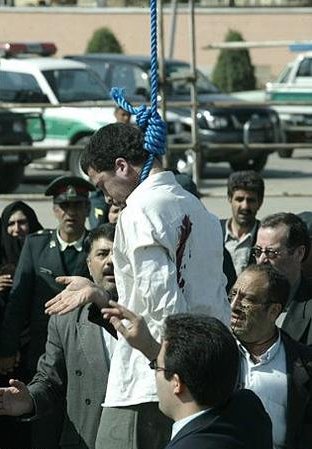
On this date in 2005, Iran “desert vampire” was flogged to the point of collapse and hanged before a bloodthirsty throng in Pakdasht.
Mohammed Bijeh collapses during his flogging (top); then, as he is hoisted by a crane — with what one would take to be the stab wound from a victim’s brother visible on his back. More frightful photos of this execution here.
Bijeh confessed to raping and murdering 16 boys age 8 to 15 over a yearlong spree.
His modus operandi? Lure them into the desert on the pretext of hunting animals.
Unsurprisingly a figure of intense public hatred, Bijeh stolidly endured his own death before a jeering mob.
Riot police held back the angry crowd, but at one point a brother of one of the victims managed to break through and stab Bijeh in the back.
After 100 lashes, the desert vampire was noosed to a crane arm by one of the victims’ mothers, and hoisted 10 meters into the air for public strangulation, to the cheers of onlookers who had to be restrained from savaging the body when it was finally brought down.
An accomplice, Ali Baghi, somehow avoided execution and got off with whipping and a prison term.
Ted Bundy is obviously one of the most iconic, written-about serial killers in history. Why a book about Ted Bundy? What’s the untold story that you set out to uncover?
The desire, or drive, if you will, to write an article about Ted Bundy and then create a 120,000 plus word book about the murders, was born out of my crossing paths with his infamous murder kit. Had Jerry Thompson [a key detective on the Bundy case -ed.] left Bundy’s stuff in Utah that May of 2005, well, it would have been an enjoyable meeting with the former detective, but I’m certain it would have all ended quietly there. Indeed, I doubt if I’d even considered writing an article for Snitch [a now-defunct crime magazine -ed.], much less a book about the killings. But it was having all that stuff in my hands, and in my home, and then being given one of the Glad bags from Ted’s VW that made it very real (or surreal) to me, and from this, a hunger to find out more about the crimes led me forward.
Ted Bundy’s gear, right where you want it — image courtesy of Kevin M. Sullivan. (Check the 1975 police photo for confirmation.)
Believe me, in a thousand years, I never would have expected such a thing to ever come my way. I can’t think of anything more odd or surreal.
ET: You mentioned that you think you’ve been able to answer some longstanding questions about Bundy’s career. Can you give us some hints? What don’t people know about Ted Bundy that they ought to know?
I must admit, when I first decided to write a book about the crimes, I wasn’t sure what I’d find, so the first thing I had to do was read every book ever written about Bundy, which took the better portion of three or four months.
From this I took a trip to Utah to again meet with Thompson and check out the sites pertaining to Bundy and the murders in that state. Next came the acquisition of case files from the various states and the tracking down of those detectives who participated in the hunt for the elusive killer.
Now, no one could have been more surprised than me to begin discovering what I was discovering about some of these murders. But as I kept hunting down the right people and the right documents, I was able to confirm these “finds” at every turn. And while I cannot reveal everything here, It’s all in the book in great detail. Indeed, you could say that my book is not a biography in the truest sense, but rather an in-depth look at Bundy and the murders from a vantage point that is quite unique. I wish I could delve further into these things now , but I must wait until it’s published.
The Bundy story has a magnetic villain and a host of victims … was there a hero? Was there a lesson?
The real heroes in this story are the detectives who worked day and night for years to bring Ted Bundy to justice. And if there’s a lesson to be learned from all of this, it is this: It doesn’t matter how handsome or articulate a person might be, or how nicely they smile at you, for behind it all, there could reside the most diabolical person you’ll ever meet! We need to remember this.
But how can you act on that lesson without living in a continual state of terror? Bundy strikes me as so far outside our normal experience, even the normal experience of criminality, that I’m inclined to wonder how much can be generalized from him.
Actually, (and I might say, thank God here!) people as “successful” as Ted Bundy don’t come our way very often. I mean, the guy was a rising star in the Republican Party in Washington, had influential friends, a law student, and certainly appeared to be going places in life. Some were even quite envious of his ascension in life. However, it was all a well-placed mask that he wore to cover his true feelings and intentions. On the outside he was perfect, but on the inside a monster. He just didn’t fit the mold we’re used to when we think of a terrible killer, does he?
Now, there are those among us — sociopaths — who can kill or do all manner of terrible things in life and maintain the nicest smile upon their faces, but again, just beneath the surface ticks the heart of a monster, or predator, or what ever you might want to call them. Having said that, I’m not a suspicious person by nature, and so I personally judge people by their outward appearance until shown otherwise. Still, it’s difficult (if not impossible) to see the “real” individual behind the person they present to us on a daily basis.
You worked with case detectives in researching your book. How did the Ted Bundy case affect the way law enforcement has subsequently investigated serial killers? If they had it to do over again, what’s the thing you think they’d have done differently?
They all agree that today, DNA would play a part of the investigation that wasn’t available then. However, in the early portion of the murders, Bundy made few if any mistakes, as he had done his homework so as to avoid detection. As such, even this wouldn’t be a panacea when it came to a very mobile killer like Bundy who understood the very real limitations sometimes surrounding homicide investigations.
I can’t help but ask about these detectives as human beings, too. Clearly they’re in a position to deal with the heart of darkness in the human soul day in and day out and still lead normal lives … is a Ted Bundy the kind of killer that haunts or scars investigators years later, or is this something most can set aside as all in a day’s work?
They are, first of all, very nice people. And you can’t be around them (either in person, or through numerous phone calls or emails) for very long before you understand how dedicated they are (or were) in their careers as police officers. They are honorable people, with a clear sense of duty, and without such people, we, as a society, would be in dire circumstances indeed.
Even before Bundy came along, these men were veteran investigators who had seen many bad things in life, so they carried a toughness which allowed them to deal with the situations they came up against in a professional manner. That said, I remember Jerry Thompson telling me how he looked at Ted one day and thought how much he reminded him of a monster, or a vampire of sorts. And my book contains a number of exchanges between the two men (including a chilling telephone call) which demonstrate why he felt this way
How about for you, as a writer — was there a frightening, creepy, traumatic moment in your research that really shook you? Was there an emotional toll for you?
Absolutely. But the degree of “shock”, if you will, depends (at least for me) on what I know as I first delve into each murder. In the Bundy cases I had a general knowledge of how Bundy killed, so there wasn’t a great deal that caught me by surprise, as it were. Even so, as a writer, you tend to get to know the victims very well through the case files, their family members or friends, and so on. Hence, I’ll continue to carry with me many of the details of their lives and deaths for the remainder of my life. And so, lasting changes are a part of what we do.
However, I did a story a few years back about a 16 year old girl who was horribly murdered here in Kentucky, and this case did cause me to wake up in the night in a cold sweat. Perhaps it was because I have a daughter that was, at the time, only a few years younger than this girl, and that some of what transpired did catch me off guard, so to speak, as I began uncovering just what had happened to this very nice kid.
Watch for Kevin M. Sullivan’s forthcomingThe Bundy Murders: A Comprehensive History from McFarland in summer or fall of 2009.
* In fact, the term “serial killer” was coined in the 1970’s by FBI profiler Robert Ressler, as an improvement on the sometimes inaccurate category of “stranger killer”.
Additional Bundy resources from the enormous comment thread:
Two years ago today, Japan resumed executions after a break of more than a year with four hangings.
Septuagenarians Yoshio Fujinami (wheelchair-bound) and Yoshimitsu Akiyama (partially blind) both needed the guards’ assistance to reach the trap at Tokyo Detention Center, a mere hour after they were informed of their imminent demise.
Two other prisoners, 64-year-old Michio Fukuoka and 44-year-old Hiroaki Hidaka, were simultaneously hanged in Osaka and Hiroshima, respectively.
Hidaka, a serial killer, had dropped his appeals and thus died a mere 12 years after his crimes. Fukouka died maintaining his innocence of three murders from 1978-81 he said police torture had forced him to confess. The oldest men were on the hook for killings dating to 1975 and 1981. (Much more from The Japan Times.)
Talk about justice delayed.
In Japan’s strange death penalty system, the condemned might await death for decades only to be hanged, as these were, with next to no warning. Their families and supporters did not hear about it until after the deed was done.
These hangings, though protested, were not altogether unexpected, for a break in the Japanese Diet around the end of the year often heralds an appearance on the public stage by the gallows. (Look for them in 2008 as the Diet goes out of session starting today.) And a turnover at the top of the Justice Ministry had replaced a pol disinclined to authorize any hangings, the source of the long break between executions during a decade when Japan’s use of the death penalty has generally been intensifying.
Although at least one particularly pressing motivation for this date’s hanging will not be present this year. After the long hiatus, an anonymous official told a newspaper,
We absolutely wanted to avoid ending the year with zero executions.
On this date in 1959, a disturbed Japanese serial killer was hanged for eight murders.
A past generation’s emblem of monstrousness, Genzo Kurita (English Wikipedia page | Japanese) was invoked on the floor of the Diet as a reason to keep the death penalty.
And no wonder.
He was caught early in 1952 for murdering a 24-year-old and her 63-year-old aunt, and defiling the younger woman’s body. Those murders led to a death sentence a few months later, but they also led to a string of unsolved homicides: another murder-necrophilia crime the previous summer, and the notorious Osen Korogashi incident, when he threw a rape victim’s family over the Osen Korogashi cliffs.*
He got a separate death sentence for those murders (plus two other earlier ones) later in 1952.
A touch unstable — obviously — Kurita withdrew his own appeals in 1954 to get it over with, but it still took the ponderous Japanese death penalty system the best part of the decade to see him to the gallows.
Most of what’s online about Genzo Kurita is in Japanese, like this more detailed survey of his life in crime.
* The raped mother, and three children; one of the children survived. The Osen Korogashi (or Osenkorogashi) cliffs, as it happens, have their own eerily topical legend of the generous daughter of a cruel lord being thrown over the precipice in her father’s place, prompting him to see the error of his ways.
On this date in 1997, serial killer Ricky Lee Green died by lethal injection in Texas.
The radiator repairman was executed specifically for castrating and stabbing to death Steven Fefferman in 1986, but he killed at least three other people — two women and a 16-year-old boy — and investigators associated his m.o. with up to eight other unsolved murders. (Green also copped to another murder after his conviction, possibly to help another man, William Chappell, avoid execution. It didn’t work; Chappell was executed for that crime in 2002.)
“They all deserved it. They were kind of the dregs of society.”
“A Jekyll and Hyde thing” is how Green’s true-crime biographer characterized him — a lifetime of physical and sexual abuse and a drug habit dating to childhood had seriously warped the dude.
And the most famous serial killer from tiny Boyd, Texas might’ve kept getting away with it if wasn’t for his darn estranged wife.
Someone sure was grateful for Sharon Dollar Green’s help: even though she’d participated in some of the murders, she shopped hubby and skated with ten years’ probation as more Green’s victim than his accomplice.
Green went the popular “death row conversion” route while awaiting the inevitable, or so — atheists in foxholes and all — maintained his last statement.
I want to thank the Lord for giving me this opportunity to get to know Him. He has shown me a lot and He has changed me in the past two months.
I have been in prison 8 1/2 years and on death row for 7, and I have not gotten into any trouble. I feel like I am not a threat to society anymore. I feel like my punishment is over, but my friends are now being punished.
I thank the Lord for all He has done for me.
I do want to tell the …
But the lethal cocktail had begun, and the sentiment went to the grave with Ricky Lee Green.
On this date in 1930, one of the most nihilistic criminals in American history was hanged for murder at Leavenworth Federal Penitentiary — in character to his last breath, a sneer at the hangman about to put him to death:
“Hurry it up, you Hoosier bastard! I could hang 10 men while you’re fooling around!”
Panzram — according, at least, to an autobiography which is largely unverifiable — had the chops to back up his taunt.
A Minnesota-born son of German immigrants, Panzram was into the juvenile detention system by adolescence, and at 14 hopped a freight train bound for a life of vagrancy. In Panzram’s recounting, his boyhood was a hellscape — even knowing what he became, it’s possible to feel compassion for the the killer’s remembrance, “Everybody thought it was all right to deceive me, lie to me and kick me around whenever they felt like it, and they felt like it pretty regular.”
Worse was to come for Carl — sexual molestation, a gang-rape by fellow hobos — and much worse by Carl.
The rape may have shattered the restraints on his conscience … or maybe they was already gone by then. “Might makes right” became his credo; to alcoholic and thief he added a portfolio of rape and enthusiastic homicide, crisscrossing the country (with a side trip to Africa), escaping or wheedling out of jails when he was picked up for something, and finding it amazingly easy to slay his fellow men.
A full narrative of Panzram’s grisly career is available at trutv.com. Much of this is, again, sourced only to Panzram himself, so the possibility of bloodthirsty braggadocio cannot be dismissed; even at a fraction of its alleged scope and brutality, his career was a triumph in horror.
While I was sitting there, a little kid about eleven or twelve years old came bumming around. He was looking for something. He found it, too. I took him out to a gravel pit about one-quarter mile away. I left him there, but first I committed sodomy on him and then killed him. His brains were coming out of his ears when I left him, and he will never be any deader.
It was the murder of a fellow inmate at the federal prison in Leavenworth, Ks., that sealed his fate. Panzram was in his late 30’s by this time, facing a long prison sentence. Something between the fury that fueled him and the desperate reality of not seeing the outside again until he was an old man may have impelled him to check out intentionally: he had warned that he would murder an inmate, and he responded to anti-death penalty campaigners’ attempts to save him by threatening to kill them, too.
In my lifetime I have murdered 21 human beings, I have committed thousands of burglaries, robberies, larcenies, arsons and last but not least I have committed sodomy on more than 1,000 male human beings. For all these things I am not in the least bit sorry.
It seems the fate of common criminals, even those as prolific and infernal as Panzram, to shuffle into obscurity in fairly short order. Among devotees of the dark underbelly, Panzram may be well-known; to the larger public, he’s long forgotten.
Panzram’s memoirs, released as Killer: A Journal of Murder, were turned into a 1996 James Woods vehicle of the same title:
Interestingly, Panzram is also name-checked in another more famous literary artifact: In the Belly of the Beast, the tour de force of Norman Mailer protege Jack Abbott, who had conned the litterateur into backing his bid for parole, was rather boldly dedicated to Carl Panzram.* It will not surprise the reader to learn that Abbott, upon his release, killed again.
But a new generation is waiting to rediscover its butchers … and a new documentary, Panzram, is in production to bring the story back to silver screens and Netflix queues of the 21st century.
* Abbott was writing to Mailer while the latter was banging out his book about notable executee Gary Gilmore.
Just past midnight this date in 1959, Charles Starkweather was electrocuted in Lincoln, Nebraska, for a mass-murdering road trip with his jailbait date that claimed ten lives.*
A loner and loser, Starkweather’s spree in January 1958 caught the national imagination and has never quite let it go since — the prototypical despair of miscarried white masculinity, a primal scream from the underbelly of the American dream.
Bowlegged, myopic, slightly speech-impaired, Starkweather was an outcast at school and fought back with his fists, then dropped out entirely and into a yawning dead-end economic life collecting garbage from the wealthier quarters of Lincoln. “The more I looked at people the more I hated them because I knowed they wasn’t any place for me with the kind of people I knowed,” he said in his confession. Starkweather palliated his isolation by aping James Dean, dreaming of a big robbery score, and losing his heart to 14-year-old Caril Ann Fugate, in whose adolescent eyes the beaten boy felt his stature grow.
He — or maybe they together — killed her parents when they tried to interfere in the relationship, and then eight days of murderous desperation ensued that riveted Lincoln and the nation: they lived a few days with the corpses, shooing neighbors away with a story about the flu, then fled like animals, killing ruthlessly for a couple of cars and a place to spend the night and heading for Wyoming — all to no end that would make a lick of sense, not even the cockeyed hope that there was somewhere to go to outrun the gore. Killing and running had just become what they did to keep from having to stop.
I had hated and been hated. I had my little world to keep alive as long as possible and my gun. That was my answer. (Source)
Four months after he murdered the Fugate family and not yet 20 years of age, Charles heard his own death sentence from jurors in the city he’d briefly but unforgettably terrorized. (There’s a pdf timeline of the case from the Lincoln Evening Journalhere.)
He lived cruelly, and it went cruelly with him to the last; offered a chance to donate his eyes, Starkweather retorted that “nobody ever did anything for me when I was alive. Why should I help anybody when I’m dead?” According to the Los Angeles Times, the doctor who was supposed to pronounce the prisoner dead himself suffered a fatal heart attack minutes before the electrocution.
Fugate’s tender age and sex spared her a death sentence, even though Starkweather said that she ought to be “sitting in my lap” when he went to the chair. She was paroled in 1976 and has mostly stayed out of view since. Laura James at CLEWS recently posted an update on her whereabouts.
More detailed annotations of this notorious duo’s life and times can be found here and here; the Lincoln Journal Star recently published an online 50-year retrospective on the case with high production values.
But if Starkweather’s James Dean fixation denoted the pull of celebrity glamor culture, his death left an enduring legacy for a world that had nothing for him in life, a haunting name recognition few school shooters or bell tower snipers have been able to hold since. He captivated the boyhood Steven King:
I do think that the very first time I saw a picture of [Starkweather], I knew I was looking at the future. His eyes were a double zero. There was just nothing there. He was like an outrider of what America might become.
The title track of Bruce Springsteen’s 1982 album Nebraska is written as a first-person narrative by Starkweather, to the tune of a desolate acoustic accompaniment that imbues the killer’s brutality with an aching loneliness.
They wanted to know why I did what I did
Well sir I guess there’s just a meanness in this world
Martin Sheen wonderfully rendered a (heavily fictionalized) Starkweather character opposite Sissy Spacek on the silver screen in Badlands (1973):
Rather less artistically consequential, the 1963 low-budget film The Sadist, also based on the Starkweather case, is in the public domain and available free on Google video:* Starkweather killed a gas station attendant in a separate incident weeks before, so his body count is 11, with ten of them on his infamous spree.

 For the year after Japan’s wartime surrender to the World War II Allied powers (beginning slightly before that surrender), former Imperial Navy soldier Yoshio Kodaira terrorized Tochigi and Tokyo with a rape-murder binge believed to have claimed ten victims.




 A past generation’s emblem of monstrousness, Genzo Kurita (
 A loner and loser, Starkweather’s