Feast Day of Popes Cletus and Marcellinus

Back before being pope meant jeweled slippers and your own guillotine, the bishopric of Rome — at least as chronicled in the early histories of the Church — was a virtual halfway house to a pagan executioner.

Granted, the very earliest pontiffs are mostly ciphers to posterity; little dependable information about most of them survives. We have sketchy documentation, conflated names, and traditions of legendary hagiography further to the glory of Christianity’s earliest fathers. They are almost universally ranked as both saints, and martyrs.

But is it really right that literally none of these heirs of St. Peter for three centuries reached leadership positions by dint of being venal political hustlers? Or that none just dropped dead of some inglorious disease before they could exalt their deaths in martyrdom?

Persecutions of Christianity were not, after all, literally continuous throughout this age; indeed, prominent as they are in our latter-day remembrance, instances where they turned deadly were likely rather few and far between. Roman governors had provinces to administer; not many of them viewed hunting down and killing otherwise law-abiding cultists as the most important thing to prioritize.

“Christians and pagans could live on very good terms with each other,” Victor Duruy writes in his History of Rome, and of the Roman People, from its Origin.

Asper declared openly that he was disinclined to prosecutions of that kind … Severus furnished them the reply which permitted him to discharge them … Candidus treated them as contentious persons, and sent them back to their towns with these words: “Go, and be at peace with your fellow-citizens.” “Unhappy men,” said another to them [i.e., to Christians seeking their own martyrdom], “if you are resolved to perish, are there not ropes or precipies enough for you?” and he drives them from his tribunal.

Little as we know of these men, it is a sure thing that, pre-Constantine, they did run some risk of life and limb to profess Christianity under the noses of Rome’s rulers. Even a period of toleration could turn ugly with the rise of a hostile emperor or some chance shift of the political winds; the first persecution, after all, is supposed to have been initiated by Nero as an expedient to deflect anger over the Great Fire of Rome. But despite this site‘s use of the martyrology, we can hardly take for granted that any early Christian of significance was put to a baroque death by bloodthirsty Romans.

April 26 is or was the shared feast date of two of these popes from Rome’s antiquity — both of them traditionally considered martyrs, but both now on the outs with Rome’s official chronicle. It’s a reminder that even the ancient past isn’t really past and that history, like religion, is not so much holy writ as an eternal process of becoming.

Pope Cletus was the third pope, and the second in a row after Peter’s direct successor Pope Linus to make you think of a cartoon character. One early chronology named Cletus and Anacletus (or Anencletus) as the third and fourth popes; it is generally understood now that these were merely two different names for one single man. In 1960 a distinct July 13 feast for “Saint Anacletus” was removed from the calendar, collapsing everything to April 26.

Still, basically nothing definite is known of Pope St. Cletus — including the occasion or circumstances of his death, which may well have been promoted to a martyrdom simply from reverence of Cletus’s Erdos numberChrist number of 3 or less. Cletus is said to have ordained 25 priests, and died in the year 88 or 92. He was ultimately removed from Catholicism’s liturgical calendar in 1969, though he still remains in the Roman Martyrology.

Near the opposite chronological end of Rome’s era of official intolerance we find Pope St. Marcellinus.

Marcellinus was the 29th pope, and had the tiara* when the Diocletian persecutions began in 303. While such information as survives about Marcellinus is also not very substantial, it is quite interesting.

When anti-Christian persecutions did crop up, those Christians who weren’t in active pursuit of martyrdom had a difficult choice to make: either apostasy, or punishment. Confronted in the breach with a demand to make the requisite obeisance to the gods of Rome, many ordinary Christians preferred the expedient burning a few sacrificial herbs to the prospect of, if not death, prison, torture, exile, harassment, property seizure, or whatever else was on offer for their sect at that moment. These were the lapsi — the lapsed ones.

Such episodes tended to create post-persecution friction between the go-along, get-along crowd on the one hand, and the purists who refused any such accommodation on the other. Could lapsi be re-admitted to the communion after renouncing their faith to please a Roman proconsul? (Broadly speaking, the official church did welcome lapsi back with some kind of penance and absolution.)

Pope Marcellinus is interesting because he too is said to have lapsed under the initial pressure of Diocletian’s persecution. The Liber Pontificalis, likely combining distinct traditions that were in circulation about Marcellinus, says that he burned incense to the Roman gods when it was demanded of him — and that only afterwards did he repent his weakness and confess Christianity unto martyrdom.

It is not at all certain that Marcellinus did apostatize, but it is clear that a story to that effect (disputed by ex-apostate St. Augustine, among others) was out there in late antiquity — and it’s a bit suspicious that Marcellinus’s name is omitted from some early lists of popes. (It’s possible he was being conflated with his successor, Marcellus: the opposite of what happened with Pope Cletus.) It’s also very uncertain that Marcellinus was in fact martyred; the Catholic encylopedia considers his “in all probability, a natural death” in 304. And it was probably not in April that this death occurred.

Given all those question marks, Marcellinus’s April 26 celebration was booted from the liturgical calendar in the same 1969 cleanup that fixed Pope Cletus.

* The papal tiara did not yet literally exist at this point, of course.

On this day..

1766: William Whittle

William Whittle, a Catholic, was executed at Lancaster on this date in 1766 for murdering his Protestant wife and their children in a religious frenzy.

For whatever reason, several years into his union, Whittle took deeply to heart a priestly warning that he was liable to damnation for marrying a heretic. He accordingly ended the marriage by “cleaving his Wife’s Head with an Axe, and ripping her Belly open, and afterwards cutting off the Heads of the two Children, one of whom he also ripped open and took out its Heart.” (St. James’s Chronicle, April 5, 1766)

(The children, Whittle said, had been imperiled in soul by their mother’s taking them to an Episcopal church; in murdering them their loving father had sent them to purgatory en route to heaven, saving them from eternal hellfire.)

Whittle was condemned to be hung in chains for the shocking crime, a demonstration that Catholics understood as aimed pointedly at them. At least of their number replied with like menace in an anonymous letter to the Rev. Mr. Oliver of Preston, the magistrate who committed Whittle to prison.

Sir, I make bold to acquaint you, that your house and every clergyman’s that is in the town, or any black son of a bitch like you, for you are nothing but hereticks and damned fouls. If William Whittle, that worthy man, hangs up ten days, you may fully expect to be blown to damnation. I have nothing more material, but I desire that you will make interest for him to be cut down, or else you may fully expect it at ten days end. My name is S.M. and W.G.

(Letter as quoted in the Leeds Intelligencer, April 22, 1766 — also the source of the newspaper screenshot above)

Mainstream suspicion of Catholics at this time — which was within living memory of the last great Jacobite restoration attempt — was quite deeply ingrained; as one can see from the riposte above, the sentiment was mutual. After all, these were matters of eternal salvation even if Whittle himself “appeared to be a stupid, bigotted, ignorant fellow.”

The shocking family butchery evoked a minor wave of fretting over insidious Catholic-Protestant intermarriages. I think the present-day reader will not have much difficulty recognizing contemporary analogues to this thrust of resulting commentary:

I am likewise persuaded that there are many lay-papists in the kingdom who abhor this fact of Whittle as much as any protestant can do. But if their religion does not give countenance to such doctrines as this alledged by this miserable man, why do they not by some public act disavow their approbation of them? why do they leave suspicions upon themselves and their religion by their silence, when such occasions call upon them so pressingly to explain themselves, and particularly when they are complaining of the severity of the penal laws[?]

On this day..

Feast Day of Saints Agape, Chionia, and Irene

In honor of Good Friday (in 2015), we pay tribute today to the Diocletian-era Christian martyrs Agape, Chionia and Irene.

The three virgin sisters whose names mean Love, Purity, and Peace in Greek were not, per tradition, actually martyred all together. However, they do share an April 3 feast date.

They are said to have made their illicit faith conspicuous to the governor of Macedonia by refusing to eat meat that had been burned as a pagan sacrificial offering. Agape and Chionia suffered immediate martyrdom, while Irene escaped to the mountains only to be captured and burned later with her Christian books.

The remarkable medieval canoness and playwright Hrotsvitha of Gandersheim — by some reckonings the West’s first known dramatist since antiquity — made the women the focus of her 10th century play Dulcitius, which is available online in English here:

IRENA. You wretched Sisinnius! Do you not blush for your shameful defeat? Are you not ashamed that you could not overcome the resolution of a little child without resorting to force of arms?

SISINNIUS. I accept the shame gladly, since now I am sure of your death.

IRENA. To me my death means joy, but to you calamity. For your cruelty you will be damned in Tartarus. But I shall receive the martyr’s palm, and adorned with the crown of virginity, I shall enter the azure palace of the Eternal King, to Whom be glory and honour for ever and ever!

Bad Gandersheim‘s Roswitha Prize is awarded (nearly) annually in Hrosvita’s honor. It’s the oldest German literary laurel that’s conferred exclusively upon women.

On this day..

1555: Robert Ferrar, Bishop of St. David’s

The Martyrdom of Bishop Farrar [sic]

by Ted Hughes

Burned by Bloody Mary‘s Men at Caermarthen

“If I flinch from the pain of the burning, believe not the doctrine that I have preached.
 — His words on being chained to the stake.

Bloody Mary’s venomous flames can curl;
They can shrivel sinew and char bone
Of foot, ankle, knee and thigh, and boil
Bowels, and drop his heart a cinder down;
And her soldiers can cry, as they hurl
Logs in the red rush: “This is her sermon.”

The sullen-jowled watching Welsh townspeople
Hear him crack in the fire’s mouth: they see what
Black oozing twist of stuff bubbles the smell
That tars and retches their lungs: no pulpit
Of his ever held their eyes so still,
Never, as now his agony, his wit.

An ignorant means to establish ownership
Of his flock! Thus their shepherd she seized
And knotted him into this blazing shape
In their eyes, as if such could have cauterized
The trust they turned towards him, and branded on
Its stump her claim, to outlaw question.

So it might have been: seeing their exemplar
And teacher burned for his lessons to black bits,
Their silence might have disowned him to her,
And hung up what he had taught with their Welsh hats:
Who sees his blasphemous father struck by fire
From heaven, might well be heard to speak no oaths.

But the fire that struck here, come from Hell even,
Kindled little heavens in his words
As he fed his body to the flame alive.
Words which, before they will be dumbly spared,
Will burn their body and be tongued with fire
Make paltry folly of flesh and this world’s air.

When they saw what annuities of hours
And comfortable blood he burned to get
His words a bare honouring in their ears,
The shrewd townsfolk pocketed them hot:
Stamp was not current but they rang and shone
As good gold as any queen’s crown.

Gave all he had, and yet the bargain struck
To a merest farthing his whole agony,
His body’s cold-kept miserdom on shrieks
He gave uncounted, while out of his eyes,
Out of his mouth, fire like a glory broke,
And smoke burned his sermon into the skies.

On this day..

1791: Alessandro Cagliostro condemned

On this date in 1791, the Inquisition in Rome condemned magician Alessandro Cagliostro to death — a sentence immediately commuted to imprisonment for the remainder of his life, which turned out to be only four more years.

Cagliostro’s rich career as European courts’ thaumaturge of choice might have been decreed by the stars right down to his pitch-perfectly sinister moniker. Is this the shadowy diabolist whom the title character of in The Cabinet of Dr. Caligari is meant to evoke?

In fact, his birth name was Giuseppe Balsamo.

Naughty by nature from the time of his youthful expulsion from the Order of St. John, Balsamo — the hobgoblin familiar haunting the adult prophet’s cimmerian shadows — hailed originally from a penniless Sicilian family. (Though Cagliostro claimed for himself a suitably exotic childhood in Arabia and Egypt)

What he wanted in native wealth he more than made up for in enterprise — both for self-education in sorcery, alchemy, and other forbidden arts, and for leveraging his expertise in lustrous capers.

Hopping from court to court, Cagliostro carved out a career moving forgeries of spiritual or temporal potency alongside his legitimate profession as a doctor and chemist and his growing public profile as an influential spiritualist. He broke through as a young man in the train of a cardinal in Rome, using this in to market on the side fake artifacts alleged to have been pilfered from the Vatican’s mysterious Egyptian troves, as well as to seduce a local girl named Serafina whom he married at age 18. Serafina would be his lifelong companion on his adventures.

Cagliostro turned up over the ensuing two decades in Russia, Poland, Germany, and England, where he was inducted into the Freemasons in 1776. He’s been credited with creating masonry’s Egyptian Rite, and with energetically propagating it in the 1780s;* indeed, it was his adherence to Freemasonry — and his sacrilegious boldness opening a masonic lodge in Rome under the nose of the pontiff — that led to his 1789 arrest.

His seances and magic potions made him a great favorite of the Versailles court for a number of years, until a glancing association with the Affair of the Diamond Necklace so damaging to the reputation of Marie Antoinette forced Cagliostro’s expulsion from France.

Considering his Mephistophelian** reputation, now very well known in Europe, Cagliostro’s return thereafter to the belly of papal power seems most unwise. Perhaps (as this biographer supposes) it was the influence of Serafina, homesick after so many years separated from her native haunts. Cagliostro’s next ports of call were the Vatican’s Castel Sant’Angelo and (after an escape attempt) the lonely Fortress of San Leo — and even his end was so shrouded in mystery and conjecture that the subsequent conqueror Napoleon commissioned an official investigation to convince everyone that he’d really shuffled off the mortal coil.

Giuseppe Balsamo, attainted and convicted of many crimes, and of having incurred the censures and penalties pronounced against heretics, dogmatics, heresiarchs, and propagators of magic and superstition, has been found guilty and condemned to the said censures and penalties as decreed by the Apostolic laws of Clement XII and Benedict XIV, against all persons who in any manner whatever favour or form societies and conventicles of Freemasonry, as well as by the edict of the Council of State against all persons convicted of this crime in Rome or in any other place in the dominions of the Pope.

Notwithstanding, by special grace and favour, the sentence of death by which this crime is expiated is hereby commuted into perpetual imprisonment in a fortress, where the culprit is to be strictly guarded without any hope of pardon whatever. Furthermore, after he shall have abjured his offences as a heretic in the place of his imprisonment he shall receive absolution, and certain salutary penances will then be prescribed for him to which he is hereby ordered to submit.

Likewise, the manuscript book which has for its title Egyptian Masonry is solemnly condemned as containing rites, propositions, doctrines, and a system which being superstitious, impious, heretical, and altogether blasphemous, open a road to sedition and the destruction of the Christian religion. This book, therefore, shall be burnt by the executioner, together with all the other documents relating to this sect.

By a new Apostolic law we shall confirm and renew not only the laws of the preceding pontiffs which prohibit the societies and conventicles of Freemasonry, making particular mention of the Egyptian sect and of another vulgarly known as the Illumines, and we shall decree that the most grievous corporal punishments reserved for heretics shall be inflicted on all who shall associate, hold communion with, or protect these societies. (Source)

Thereafter widely denounced and renounced as a rank charlatan, Cagliostro at the very least rates as of the more outstanding adventurers of his time — a distinction that bequeathed him an impressive artistic afterlife from Alexandre Dumas to Christopher Walken.

Nor have his grander poses entirely wanted for supporters in posterity, particularly among adherents to the still-extant Masonic rite he initiated. (Aleister Crowley also suggested that he might have been Cagliostro in a previous incarnation.)

W.R.H. Trowbridge’s 1910 biograhy Cagliostro: The Splendour and Misery of a Master of Magic is in the public domain and available free online.

* Cagliostro might also have written a classic occult volume, The Most Holy Trinosophia.

** “Mephistophelian” might be the literally applicable word. When the mysterious Cagliostro’s possible identity as the exiled Sicilian swindler Balsano was first exposed, eventual Faust author Johann von Goethe happened to be in Palermo — and he took it upon himself to investigate personally by calling on Balsano’s family. (“You know my brother?” “All Europe knows him.”)

On this day..

1531: Sikke Freriks, Menno Simons inspiration

Dutch artisan Sikke Freriks, beheaded on this date in 1531 in Leeuwarden‘s market, was the first Anabaptist put to death in that Friesland city.

While a minor milestone in the crowded history of Reformation martyrdoms, Freriks had a noteworthy posthumous effect: word of his heresy — adherence to adult, rather than infant, baptism — came to the ears of a Catholic priest, who later wrote that a man’s dying for this illicit doctrine led him to investigate it further.

To his amazement, the priest found no scriptural support for the established church’s practice of baptizing infants before they developed the maturity and volition to embrace Christ from the will of their own hearts. Christians are “cheated” by the loss of that opportunity of freely giving oneself in baptism, he later wrote.

This man, Menno Simons, would follow his discomfiting scrutiny of holy writ all the way out of the priesthood and into that same forbidden sect. His preeminence in the Anabaptist movement after its disastrous Münster rebellion — and particularly his pacifistic orientation — eventually ennobled him as the founder as well as the namesake of the Mennonites, a term that in Menno Simons’s own lifetime became all but synonymous for Dutch Anabaptism.

On this day..

1684: John Dick, Covenanter

Covenanter John Dick was hanged at the Grassmarket in Edinburgh on this date in 1684. He had been condemned for rebellion just the day before.

This divinity student had been due to swing the previous September, but broke out of Canongate Tolbooth with 24 others. Upon his re-arrest, the existing sentence was simply reinstated by the judges; Dick had only a single night between that sentence and his execution.

From the time the Protestant Reformation had launched 160-odd years prior to Dick’s death, the customary prerogative of the condemned to make a rostrum of the scaffold had become contested territory. Where once condemned thieves and murderers would make a last reconciliation with their fellows, now heretics made of their own deaths blazing confessional placards by seizing the language of martyrdom. (Paul Friedland addresses this phenomenon as part of the evolution of the execution “spectacle” in his excellent Seeing Justice Done: The Age of Spectacular Capital Punishment in France. We previously interviewed Friedland here.)

Scottish Covenanters too had this tradition — and likewise the authorities that put them to death the tradition of silencing the wrong message. All the more true given the intense partisan-religious alignments on the eve of the Glorious Revolution; the Whig party name derives from the Whiggamores — Covenanter raiders, whose association was meant to smear that faction.*

Dick, according to a friend who visited him in jail on the day of his hanging, was asked if he would pray at his gallows. “Yes, if ye permitt [sic] me,” he replied.

“You must not reflect upon authority in your prayers, so as there may be no offence taken,” one of Dick’s gaolers replied.

“I will pray no limited prayers; I will pray as Christ has taught me.”

Upon this response, there was a debate among Dick’s keepers. “Some were for suffering him to pray, and stopping him if he pleased them not,” our observer recorded, “but that was not thought fit, so he prayed none there [at the gallows].”

Although Dick had to be circumspect at his hanging, his fellow Presbyterians’ alignment with the soon-to-be-triumphant side in the Glorious Revolution would soon make Covenanter martyrologies a hot publication.

The 1714 A Cloud of Witnesses for the Prerogative of Jesus Christ, or The Last Speeches and Testimonies of Those Who Have Suffered for the Truth in Scotland since 1680 celebrates dozens of Presbyterian martyrs.


Illustration of Covenanter punishments (not Dick’s specifically) from A Cloud of Witnesses.

In Dick’s entry, we have a firm of heart last letter to his father penned on the morning of the devout youth’s execution.

Dear Sir, —

This hath been one of the pleasantest nights I have had in my lifetime. The competition is only betwixt it and that I got eleven years ago at Nesbit in Northumberland, where and when, in a barley ridge upon the Saturday’s night and Sabbath morning before the last communion I did partake of in Ford Church, the Lord firmly laid the foundation-stone of grace in my heart, by making me with my whole soul close with Him upon His own terms, that is, to take Him to be my King, Priest, and Prophet, yea, to be my all in all ; to renounce my own righteousness, which at best is but rotten rags, and to rest upon His righteousness alone for salvation; as also, to give myself entirely, without reserve, in soul, body, heart, affections, and the whole faculties of my soul and powers of my body, to be by Him disposed at His pleasure for the advancement of His glory, and the upbuilding of my own soul, and the souls of others; inserting this clause (being conscious to myself of great infirmity) that the fountain of free grace and love should stand open for me so long, and so oft as my case should call for it.

This my transaction with my ^whole soul, without the least ground of suspicion of the want of sincerity, which I found had been amissing in endeavours of that nature formerly, now my blessed Lord helped me to, or rather made in me, and solemnised that night and morning ere I came off that ridge.

I confirmed it no less than ten or twelve times, and the oftener I reiterated, the gale continued so fresh and vigorous, that I was forced to cry, Hold, Lord, for the sherd is like to burst: so that I hope my dearest Lord is now a-coming, and that the hands of Zerubbabel, who hath laid this foundation, is now about to finish it ; and, indeed, He is building very fast, for which my soul blesseth Him, desiring you may join with me in so necessary a work.

I hope, ere long, the copestone shall be put on, the result of all which shall be praises and shouting to Him that sits upon the throne, and to the Lamb throughout all the ages of eternity, of long-lasting eternity.

This, with my earnest prayers while in the body, that the Lord would help you to mind His glory, and your own soul’s eternal welfare, is all the legacy you can expect from him who is both,

Your affectionate son and Christ’s prisoner,

John Dick.

P.S. — I hope, ere I come home, to get another sight of you. Let none see this till I be in my grave. The Lord gave me to you freely, so I entreat you, be frank in giving me to Him again, and the more free this be, the less cause you shall have to repent.

* “Tories” comes from a word for an Irish (and Catholic) outlaw, and was conferred by the Whigs as a reciprocal calumny. It is not accidental that each term throws a non-English shade.

On this day..

1401: William Sawtre, Lollard heretic

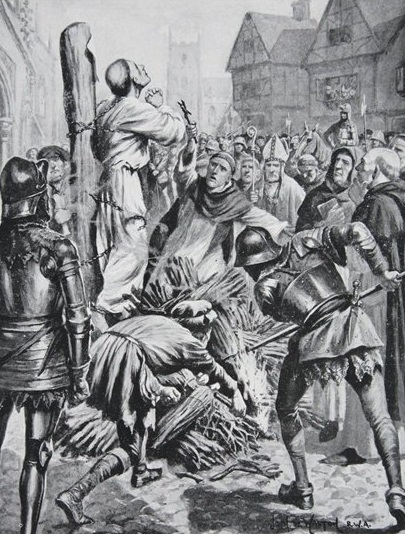
On this date in 1401, Lollard priest William Sawtre(y) was burned at Smithfield for heresy — the first known heresy execution in England.

The highlight of late 14th century English literature, Piers Plowman, was a great favorite of Lollards. Though this lengthy allegorical poem is not itself a Lollard text, it spawned a Piers Plowman tradition with many spinoffs that are overtly Wycliffite.

Witness Wycliffe, who told them the truth;
For in good nature he greatly warned
To mend their wickedness and sinful works.
Who these sorry men damned his soul
And overall lolled him with heretics’ works!

–Piers Plowman’s Creed*

Sawtre was a follower of John Wycliffe, the Biblical translator and church reformer 16 years dead as we lay our scene.

Wycliffe anticipated much of Luther’s later critique of the Catholic Church. His call to study Scripture directly without the intercession of doctors in Rome touched a spiritual thirst; his summons to apostolic poverty for the wealthy vicars of Christ was a message with a ready audience.

“From about 1390 to 1425, we hear of the Lollards in all directions,” notes this public domain history, “so that the contemporary chronicler was ale to say that of every two men found on the roads, one was sure to be a Lollard.”

Lollardy did not immediately manifest as an outlaw movement; it had many adherents among England’s elites and even the royal household. Although the papacy had declared various Wycliffe doctrines heretical in that prelate’s time, England had shown little appetite for calling an Inquisition — a step that would project papal authority into the kingdom.**

But with a ferocious ecclesiastical pushback and a change in the occupancy of the throne,† the English state gradually shifted over the course of the 1390s and 1400s towards recognizing Wycliffe’s principles as heresy — and towards treating that heresy into a capital crime. Through spectacles like Sawtre’s burning, Lollards were gradually made to understand that the price of their scruples might run all the way to martyrdom.

This was novel territory for English jurisprudence, and part of a centuries-long European transition towards treating doctrinal dispute as capital crime. There are only a bare handful of alleged quasi-precedents in English history, sketchily documented — like the unnamed apostate deacon burnt to ashes for Judaizing. It was only as late as William Sawtre that Old Blighty clearly established the practice and legal machinery for putting men and women to death for heresy.

Many Lollards capitulated as they came under pressure. This was true of our man Sawtre, a humble parish vicar. When put to questioning by the bishop in 1399, Sawtre initially recanted his unorthodox skepticism as to the transubstantiation of communion bread into Christ’s own literal body — a doctrinal mystery that would be a tougher and tougher sell to dissidents yet to come.

But upon moving from Lynn to London where he served at St. Osyth’s, Sawtre relapsed — and some stirring moved his soul to vindicate himself in the face of mortal peril.

Charged before Parliament, Sawtre now defended his heresies under close questioning by the Archbishop of Canterbury, Thomas Arundel. Arundel was even then pressuring this same Parliament for a statute, which he did indeed soon receive — one with the ominous title De Heretico Comburendo, at last elevating heresy to a death penalty offense and making the bishops themselves the decisive arbiters on the matter. It is overtly and all-but-explicitly aimed at the Lollards.

divers false and perverse people of a certain new sect, of the faith of the sacraments of the church, and the authority of the same damnably thinking and against the law of God and of the Church usurping the office of preaching, do perversely and maliciously in divers places within the said realm, under the color of dissembled holiness, preach and teach these days openly and privily divers new doctrines, and wicked heretical and erroneous opinions contrary to the same faith and blessed determinations of the Holy Church, and of such sect and wicked doctrine and opinions they make unlawful conventicles and confederacies, they hold and exercise schools, they make and write books, they do wickedly instruct and inform people, and as such they may excite and stir them to sedition and insurrection, and make great strife and division among the people, and other enormities horrible to be heard daily do perpetrate and commit subversion of the said catholic faith and doctrine of the Holy Church …

the diocesans of the said realm cannot by their jurisdiction spiritual, without aid of the said royal majesty, sufficiently correct the said false and perverse people, nor refrain their malice, because the said false and perverse people do go from diocese to diocese and will not appear before the said diocesans…

[let] none within the said realm or any other dominions subject to his Roval Majesty, presume to preach openly or privily, without the license of the diocesan of the same place first required and obtained, curates in their own churches and persons hitherto privileged, and other of the Canon Law granted, only except; nor that none from henceforth anything preach, hold, teach, or instruct openly or privily, or make or write any book contrary to the catholic faith or determination of the Holy Church, nor of such sect and wicked doctrines and opinions shall make any conventicles, or in any wise hold or exercise schools; and also [let] none from henceforth in any wise favor such preacher or maker of any such and like conventicles, or persons holding or exercising schools, or making or writing such books, or so teaching, informing, or exciting the people, nor any of them maintain or in any wise sustain, and that all and singular having such books or any writings of such wicked doctrine and opinions, shall really with effect deliver or cause to be delivered all such books and writings to the diocesan of the same place within forty days from the time of the proclamation of this ordinance and statute.

Any Lollard not so complying could be arrested on the say-so of the diocesan bishop and tried for the offending heterodoxy; if convicted, the clergy was then empowered to hand the unfortunate fellow over to the civil authorities who were obliged to carry out an execution without any further inquiry or say-so. Judge, jury, and (virtually) executioner … the same as the guy waiting for you in the confessional.

[I]f any person … do refuse duly to abjure, or by the diocesan of the same place or his commissaries, after the abjuration made by the same person be pronounced relapsed, so that according to the holy canons he ought to be left to the secular court … [then] after such sentence promulgate shall receive, and them before the people in an high place cause to be burnt, that such punishment may strike fear into the minds of others, whereby, nosuch wicked doctrine and heretical and erroneous opinions, nor their authors … be sustained or in any way suffered.

With such wicked doctrine and heretical and erroneous opinions afoot Sawtre was not suffered to live even the enactment of the law that killed him: De Heretico Comburendo was passed only on March 10, but Sawtre was eight days’ dead by that point. It’s a bit unclear how the sentence was legally effected, but it would seemingly have proceeded under canon, not civil, law.

Both the law and the execution were great victories for the Church. “The king and the archbishop hurried to burn their victim to show that they could send a heretic to the stake whenever they wished, without relying on statute” Leonard Williams Levy writes. “Parliament could neither give nor take the authority to burn a heretic. If the scepter supported the miter, canon law prevailed.”

Be that as it may, the victims of the Lollard-burning period were not nearly so numerous as the chilling language of De Heretico Comburendo might lead one to anticipate. The next Lollard to go to the stake was John Badby in 1410; two merchants were executed in 1415, and the Lollard rebel John Oldcastle was burnt “gallows and all” in 1417. Another handful suffered in the 1420s. It’s thought that about 50 people overall (Lollards and otherwise) were executed as heretics from the enactment of De Heretico Comburendo until Henry VIII broke with Rome 133 years later — an occasion that made heresy-hunting a whole different animal.

The History of England podcast covers Sawtre and Lollardy in episode 141.

* My artless rendering from the Middle English version given in D.A. Lawton in “Lollardy and the ‘Piers Plowman’ Tradition”, The Modern Language Review, Oct. 1981.

** Despite overall caution about the authority of Rome onto Albion’s soil, the English had no overall principled rejection of Inquisitors as such: they convoked such a tribunal to deal with Joan of Arc.

† The political situation in the realm was also been a factor: the usurper Henry IV had taken the crown only in 1399 by deposing, and later murdering, King Richard II. One readily supposes Henry’s keen interest in shoring up the loyalty of the church and keeping tabs on itinerant rabble-rousers, the latter of whom appear to have disproportionately skewed towards Richard’s faction. (All those heretics in the king’s household were in Richard’s household.)

On this day..

1526: Guillaume Jobert, Genevieve-blasphemer

Guillaume Jobert, one of the first Reformation martyrs in Paris, had his tongue bored through on this date in 1526,* then was burned at the stake at the Place Maubert.

Jobert, the young gentleman son of the avocat du roi of La Rochelle, incurred this ghastly punishment by making some impious cracks about the faith and in particular the devotions given St. Genevieve.

Genevieve was no one to be trifled with. She was supposed to have stopped Attila the Hun dead in his tracks with her prayerful intercession and saved Paris from the sack in 451, in remembrance of which feat she had become honored as the patron saint of Paris.

Genevieve’s cult really took off in the High Middle Ages, the period when a burgeoning Paris firmly established itself as the hub of all France. So powerful was the Parisian devotion to the saint (and the saint’s devotion to Paris) that her cult became a defining marker of the community — and when that community was ruptured by the Reformation, affinity for the cult came to mark the community’s boundaries. To the extent that Genevieve was identified with Paris, with France, with the sacraments, with the royal family — and she was identified with all these things — the Protestant skepticism of saints posing as divine intercessors with demigod-like spheres of influence positioned reformers in opposition to a good many things more than “merely” theology. There is a secular echo of this same critique from centuries later in Voltaire:

The girl that was born in the stubble fields of Nanterre,
Has become a saint that is implored by hollow and stupid people …
But a good citizen should be devout only to you.

As Moshe Sluhovsky notes in “The Politicizations of Sainte Genevieve”, a chapter of his Patroness of Paris: Rituals of Devotion in Early Modern France, the Protestant Reformation in particular

challenged the sacrality of Paris, the identity of France, and the cult of the saints. It was therefore necessary to reaffirm the city’s Catholicity by redefining it in opposition to heresy. Sainte Genevieve was used to delineate who should be included in the sacred social body and who should be excluded from it.

Overtly blaspheming Genevieve certainly put Joubert in the “exclusion” category.

While we have little specific detail about Joubert, some sense of the gravity of his offense might be gleaned from an event that ensued a decade after his tongue-boring execution, when the Affair of the Placards sparked a furious Catholic backlash against religious dissidents. One week later, six Protestants were burned at the stake following a monumental procession through the city meant to reaffirm France’s devotion to the Catholic faith.

For the occasion, St. Genevieve’s relics were removed from her sacred abbey and marched along with all that abbot’s canons and the king himself. These 1,000-year-old remains never appeared in these sorts of ceremonies “without grette and urgent causes,” an English Protestant observer remarked. Notably, accrding to Sluhovsky, the reliquary on this occasion crossed the Seine to the Right Bank for the first time ever.

* Date from this public-domain French journal.

On this day..

1691: Sylvester Medvedev, bread-worshipper

On this date in 1691, Russian Orthodox priest Sylvester Medvedev was beheaded on Red Square.

Medvedev was a protege of the great progressive clergyman, poet, and educator Symeon of Polotsk, one of the intellectual champions of the reforming faction of Orthodoxy’s Great Schism.

The Schism in question was the widespread disaffection of the faithful (now known as “Old Believers”) for changes dictated from on high whose effect was to centralize the Russian Orthodox church and to alter its services.


Patriarch Nikon and Epifany Slavinetsky revising service-books.

The Patriarch of Moscow had underaken to revise the liturgy, the prayer-books, and the church services in Russian Orthodoxy in order to bring them in line (so he said) with their proper Greek antecedents. It provoked a furious reaction by Russian traditionalists. Perhaps the most vividly symbolic flashpoint of the Schism was the simple-seeming distinction between making the sign of the cross with three fingers (as the Patriarch demanded), or with two. It was all down to what Nikon said was a mistranslation of the original Greek when the rite had first been established hundreds of years before.

That reform and others were enforced, and opposed, violently: floggings, executions, and desecrations of now-outlaw icons were met by Old Believers willing to mutilate their own hands, or kill themselves, or go to the stake rather than bend. Some 20,000 people are said to have self-immolated in resistance.

“Come, Orthodox People,” thundered Protopope and soon-to-be Old Believer martyr Avvakum Petrov. “Suffer tortures for the two-finger sign of the cross … Although I have not much understanding I am not a learned man yet I know that the Church which we have received from our Holy Fathers is pure and sacred. As it came to me, so shall I uphold my faith until the end.”


Boyarina Feodosia Morozova concurred with Avvakum Petrov (who was her confessor): in this famous painting of her by Vasily Surikov, she makes a defiant two-fingered blessing to onlookers as the authorities drag her away.

Meanwhile, after the death of Symeon’s patron Tsar Alexis, a tense contest for royal authority played out during the 1680s. Finally, in 1689, the 17-year-old Peter the Great overthrew the power long wielded by his elder half-sister, the Regent Sophia.

Peter, of course, was not yet “the Great”: he was just a vulnerable kid with a potential legitimacy problem. As one consequence, his mother, Natalya Naryshkina, was able to dictate the appointment of a very conservative patriarch when that post opened in 1690.

That man, Adrian, would be the last Moscow patriarch until the Bolshevik Revolution in large measure due to his conflicts with the grown Peter over the latter’s blasphemously western orientation.

Adrian was no Old Believer but he bitterly opposed Peter’s attempts to get Russians to dress like Europeans and shave off their beards. And given the ferocity of religious feeling when the stakes are a matter of a single finger, it will go without saying that an inveterate liberalizer like Sylvester Medvedev would have no purchase with the patriarch.

This is indeed a strange interim in Russian history; Russian’s great westernizing and secularizing autocrat has reached the throne but with him ascends, just for a moment, the staunchest conservatives ecclesiastics.

What was Medvedev up to that got the new patriarch in a twist? If you liked the three-finger thing, you’ll love this: Medvedev maintained that the transubstantiation/metousiosis of ceremonial bread and wine into the body and blood of Christ was accomplished during liturgy by the Words of Institution (“Take, eat, this is my body …”), which was also the Catholic perspective — in contrast to the orthodox Orthodox position that this was achieved by the Epiclesis invoking the Holy Spirit.

That made Medvedev a heretic — or more vituperatively, a “Latinizer” or even a “bread-worshipper”. (See The Church Reform of Peter the Great)

His real crime might well have been to align himself politically with the lately deposed Sophia, for Medvedev inherited his mentor’s place as court poet and education paladin when Symeon of Polotsk died in 1680. Sycophantish verse like this, written in Medvedev’s unuccessful attempt to gain leadership of an academy to promulgate western learning, can’t have done him any favors in the end:

You have been given the name of wisdom,
For Sophia was named wisdom by God.
It befits you to begin the sciences,
To pursue them, most wise one!

On this day..