1935: Tully McQuate, “If I hang, I hang”

On this date in 1935, one of the all-time great names in American gallows history hanged at California’s Folsom Prison for one of the all-time crimes of ingratitude.

Tully McQuate (or Tulley, or Tullie; the name means “peaceful”) entered the annals of criminology via a sack of dismembered human remains discovered in San Diego’s harbor in 1934.

These gory parts turned out upon examination to have formerly constituted a well-to-do 74-year-old widow named Ellen Straw. Mrs. Straw, it transpired, had taken a shine to an Ohio-born drifter thirty years her junior after hiring him to do her yard work, and finally invited said McQuate to live with her.

Period reportage describes her as his “benefactress” but it appears the favors were reciprocal.

“She took a liking to me and I took a liking to her,” he explained in a matter-of-fact confession. (Los Angeles Times, May 28, 1934)

She took me into her home and we got along pretty well for about a year. Then she began to get jealous of me and we began to quarrel.

One night we went down to a mission — neither of us was very religious, but we used to get a kick out of it. We quarreled on the way home. She went to her room and I went to mine. She kept on quarreling with me — I could hear her through the wall.

Finally I got up to get a drink of water. I found a clawhammer that I had been using around the house. I took it and went in and hit her over the head with it. I guess I hit her twice. [The court would find that he hit her six or seven times. -ed.]

I never had any intention of killing her, but when I saw she was dead, I just covered her up and went back to bed.

“Well, if it’s done, it’s done,” I said to myself. I knew it was all up with me then. I knew they would find me some time. But I didn’t care. When I lost my family I had nothing left to care about. [McQuate’s wife had divorced him years before. -ed.]

I left the body there for six days. I never did see her face again. Then I decided I’d better get rid of it, so I took the knife and a saw — I couldn’t get the body into the sack.

McQuate projects a pragmatic matter-of-factness about the situation that’s equal parts disarming and blood-chilling. One can at least say for him that he faced the consequence with the same equanimity.

Well, I guess my time has come. I’ve confessed — told the whole truth — and I’ll plead guilty. There’s no use putting the State to the expense of a trial. I’ve paid taxes myself.

McQuate was as good as his word. Indeed, when the legal proceedings required two days — perhaps anticipating appeal avenues, the District Attorney successfully insisted that McQuate, who had intended to represent himself, must have an attorney in a death penalty case — the murderer griped on the second day, “It’s so foolish. I did it; let ’em sentence me and get it over with. If I hang, I hang.” (Los Angeles Times, June 5, 1934)

On this day..

1699: Nikol List, Golden Plate robber

On this date in 1699 the robber prince Nikol List was broken on the wheel in the town of Celle — along with seven other members of his gang.

A former soldier and beer-house keeper, the Saxon bandit‘s career owned the usual long roster of outrages upon person and property but really fixed his name in the heavens (and his soul in the other place) by robbing St. Michael’s Church of Lüneburg of its treasured Golden Plate and sacrilegiously melting it down.

In the end his career was not long — just a few years in the late 1690s, nothing to compare with the likes of his near-contemporary Lips Tullian — for the outrage at St. Michael’s attracted the fury of the Duke of Brunswick who dedicated himself to the prompt destruction of these outlaws.


List is no. 6 in this illustration conflating the executions of various gang members who suffered at different times and places. The full numbered key to this forest of corpses can be found, along various other illustrations, here.

While List was alive and “working” his former house in Beutha was razed and a pillory set on the place instead, to disgrace the naughty native son. Worn “Nikol List Stones” can still be seen there. Two commemorate citizens whom List shot dead evading arrest on St. John’s Eve in 1696:

Christoph Kneuffler, farmer and sheriff of Hartenstein, shot on St. John’s Eve 1696 by Nikol List. This honest man was 50 years and 27 weeks old, and leaves a troubled widow and four children, namely three sons and one daughter.

Gottfried Eckhardt, citizen and butcher of Hartenstein, shot on St. John’s Eve 1696 by Nikol List. This man was 34 years and 34 weeks old, and has a poor afflicted widow and three small uneducated children, two sons and a daughter.

On this day..

1815: William Sawyer, guns and roses

William Sawyer hanged on this date in 1815* at London’s Newgate Gaol for a murder he committed while in Portugal.

Dispatched to Iberia during the 1814 mopping-up stages of the Peninsular War, Sawyer preferred to make time with a young Englishwoman named Harriet Gaskett who was supposed to be there as the mistress of Sawyer’s friend and fellow-officer. (Both of the men in question had wives back in Blighty.)

When this third wheel discovered their liaison,** Sawyer and Gaskett fell into that death-seeking tragic mooning that lovers do and after dinner one night in April they wandered off to the garden. Other guests soon heard three pistol shots crack the evening air. The reports proved to correlate with a dead Harriet, and a severely (but not mortally) wounded William.

After he was cleaned up — and after he once more failed to kill himself by slashing his own throat — his friends solicited a forthright confession.

Having laid violent hands upon myself, in consequence of the death of Harriet, I think it but justice to mankind and the world, being of sound mind, solemnly to attest that her death was occasioned by her having taken part of a phial of laudanum and my discharging a pistol at her head, provided for the occasion. I took the residue of the laudanum myself, and discharged two pistols at my head. They failing in their effect, I then retired to the house and endeavoured to put an end to my life, leaving myself the unfortunate object you now behold me.

William Sawyer

Besides doing the tragic lover thing, Sawyer was obviously intent on doing the officer-and-a-gentleman thing. His friends did very well believe the convenient-sounding version of events that he presented, such was his rectitude and lovesickness.

But under any construction of motive and circumstance, this narrative of “discharging a pistol at her head” amounted to confession to a hanging crime and Sawyer was convicted with ease.

Sympathetic to a fault, the Lord Chief Justice Ellenborough who personally tried the case reserved judgment as to the penalty pending a review by a panel of the king’s judges of several technical legal points. These were all defeated as entirely as was Sawyer’s wife’s attempt to see him in prison.

Despite his avoiding such an awkward interview Sawyer went to the gallows “very dejected,” in the words of the Newgate Calendar.

During the ceremony a profound silence prevailed throughout the populace. He died under evident symptoms of paroxysm, and a quantity of blood gushed from his mouth, from the cut in his throat. At nine o’clock the body was taken to Bartholomew’s Hospital in a cart, attended by the under-sheriff and officers. He was dressed in a suit of black, and [it] was not ironed.

* The Newgate Calendar, whose command of detail is often unreliable, mistakenly gives May 22 as the execution date — a week later than the true event.

** Intent on layering on the melodrama, Sawyer’s story was that the friend had actually given the two lovebirds leave to go live together. Great! Except Gaskell was convinced the permission was insincere and that he meant on killing himself once they did so and “although she had promised not to live with me, she had not promised not to die with me.” Anything for love.

On this day..

1873: John Devine, “The Chicken”

Purple prose for a broken neck from the San Francisco Bulletin of May 14, 1873. Transcribed below is only the first third of the article — the remainder being dedicated to accounts of various other previous San Francisco executions.

This day has been marked by an event of signal import in the history of this city, wherein the slow hand of justice, after a lapse of many years, has overtaken one of the class of reckless criminals who have reveled in rapine and bloodshed, bringing reproach on the fair fame of San Francisco, and red-handed murder has expiated its guilt by the righteous penalty of ignominious death upon the scaffold.

Whatever may be the abhorrence of capital punishment commonly experienced by a portion of the people, while contemplating the events of the past few years, the tardy and uncertain sway of justice, a sense of satisfaction and increased security will be inspired in the whole community by the announcement of John Devine, “The Chicken,” has met the fate which the law prescribes for the destroyer of human life, and there is one murderer less in San Francisco.

From the infamous character of this man, and the terror which his deeds of violence excited through a long course of comparatively unpunishable crime, ere consigning him to oblivion, the public will be interested in a brief sketch of the

Career of the Murderer.

The man who has now paid the penalty of his last dark crime, leaves a record which has no parallel among the many depraved wretches who have figured in the brief but terrible criminal history of San Francisco, and perhaps the half has not been told.

The police officials considered him the most dangerous and unscrupulous criminal that infested the city, and hint at mysterious deeds of blood, never unravelled by the minions of justice, with which he is believed to have been connected. In truth, he was a fellow by the hand of nature marked, quoted and signed to do a deed of shame — apt, liable to be employed in danger with neither pity, love nor fear.

Devine was a native of Waterford, Ireland, where he was born in the year 1840, and was accordingly 33 years old at the time of his death.

He was of medium size, sharp features, dark-blue eyes, a low forehead, and generally repulsive expression of countenance.

He arrived in San Francisco in the year 1863, as a seaman on the clipper ship Young America.

On the voyage hither he distinguished himself as a quarrelsome fellow, and was frequently confined in irons to restore the discipline of the ship.

After squandering the wages he received in a short spell of carousing on shore, he was driven to the sea again and made a voyage to China, returning in the spring of 1865. He then obtained employment as a runner for sailor boarding-houses, in which capacity he perpetrated innumerable deeds of ruffianism in the “shanghaing” of sailors and citizens on outward bound ships. Shortly after engaging in this vocation he received the title of

“The Chicken.”

Which was endearingly conferred by one of his fellows, as significant of his prowess in a prize-fight.

Devine had four notable encounters of this order, in the city and vicinity, and displayed remarkable endurance and determination, though not always successful.

His career from the time of setting himself on shore was one continuous round of crime, and he is well suspected of having a knowledge of the manner in which many a corpse found floating in the bay, with fractured skull and rifled pockets, yielded up i[t]s life. His record on the police register shows

Seventy-Nine Arrests!

Up to May 16, 1871, when his final arrest for the crime of murder was made.

The charges against him embraced all manner of crimes, principally robberies and assaults with deadly weapons, it being his custom to assault his victims with slung-shot and brass-knuckles. His recorded crimes, however, are not supposed to embrace any near approach to the ull measure of enormities that were charged upon his guilty soul.

He was capable of the most savage treachery, and on one occasion attempted the murder of a prize-fighter named Tommy Chandler, by springing upon him from behind a door with a heavy iron bar. Being foiled in this, he subsequently shot Chandler, but not inflicting fatal injury, he got off with a short term of imprisonment on conviction of assault to murder.

A Characteristic Exploit.

On the 8th of June, 1867, about 6 o’clock in the morning, Devine assailed an aged German lady, named Mary Martin, as she was walking along Merchant street, near Battery, tore the pocket from her dress, and robbed her of a purse containing a check for [obscure] and $25 in coin.

For this robbery he was arrested, and released on bail, for notwithstanding the character he bore, he was usually enabled to find friends to go upon his bond in a certain part of the city.

When the case came up for trial officers went in search of Mrs. Martin, who had resided at a house on Powell street, as the important witness for the prosecution of Devine. The lady had disappeared.

What became of her was never known; but it was possible that Devine might have told. Passing over a list of comparative minor offences, such as knocking down and robbing people, the next noticeable affair in which this remarkable criminal figured was the

Attempted Murder of Miss McDonald.

On the night of the 9th, October, 1867, Miss Martha McDonald was standing in front of her place of residence, at the Mission, when she was suddenly seized by two men who were masked.

She was gagged by a handkerchief being forced into her mouth, and prevented from giving any alarm. In this condition the men dragged her a distance of two blocks and a half, to the bridge which crosses Mission Creek at Sixteenth street.

One of the two then started, according to the directions of his companion to “get the carriage.”

Being left in the custody of one only, Miss McDonald made a desperate effort to release herself. The fellow attempted to chloroform her; but the drug being spilled from the bottle, he then endeavored to secure her with a strap.

At this juncture the other man returned, and she heard the exclamation, “kill her, kill her!” A moment after she was pushed off the bridge, and fell into the muddy waters of the creek, while the two men who had abducted her ran away.

Slowly and surely she was sinking into the muddy bottom, with no assistance at hand, until the water was about her neck. Fortunately an alarm of fire started some person past the locality, and her cries of distress being heard, she was discovered and rescued.

Devine was arrested as one of the participants in this crime, and Miss McDonald positively identified him by his voice. Devine extricated himself from the affair by proving an alibi, it appearing that he was serving a term in the County Jail at the time of the attempted murder.

It subsequently transpired, however, that he held the privileged position at the County Jail of “outside trusty,” and was permitted to travel to all parts of the city at will in the performance of errands for prisoners in more restricted limits. And more than this, he was abroad at the very time the abduction of Miss McDonald was made.

The Loss of a Hand.

In the month of May, 1868, Devine was indulging in one of his periodical carousing spells, and often bringing terror to several of the resorts on his beat at the city front, he entered a boarding house kept by William Maitland, on Battery street.

Here he flourished a huge knife with the recklessness of a savage, and caused a precipitate retreat of all who happened to be in the place.

The proprietor had been asleep in the second story of the house, and hearing the uproar, came came down for a reconnaissance. Devine immediately started for him when he made his appearance, but Maitland was not of so yielding a disposition as to be driven from his own castle, and closing with Devine, he succeeded in disarming him.

The latter then made an attempt to recover the knife, when Maitland with a powerful stroke cut him across the wrist. The blade, by wonderful chance, entered the wrist joint, and the completely severed hand fell to the floor.

Devine was appalled for once in his life, and hurriedly departed; but presently he returned and demanded his lost hand, which Maitland kicked out upon the sidewalk to him. Devine took the severed member and hastened to a drug store, where he implored a clerk to try and sew it on again. But the injury was irreparable.

Devine as a Merchant.

After a season of retirement in the County Hospital, Devine emerged as far repaired as medical science would permit, and being a cripple, his condition excited the pity of boarding-house masters and others at the city front with whom he had been associated.

A contribution was made among them, amounting to $800, to enable Devine to establish himself in business by keeping a cigar stand.

He took the money, but instead of following the advice of his benefactors he squandered the whole sum in a few weeks of dissipation, and again returned to the pursuit of crime with all his previous energy.

He was associated with a woman named Mary Dolan, as bad as himself, and who was punished by terms of imprisonment in the County Jail and Penitentiary.

From the time of losing his hand up to his final arrest, he perpetrated numerous larcenies, some of considerable amounts, and was always busily engaged in thieving when not confined in jail.

A complete history of this man and his offenses would be one of the most appalling in the annals of crime. Such was John Devine, and rarely has the slow grip of justice overtaken a criminal more richly deserving of the severest penalty known to the law.

Murder of August Kamp.

The crime which John Devine has now expiated with his life, was one of the most cruel and wanton ever recorded in a civilized community, and could only have been accomplished by one utterly depraved.

It was in perfect keeping with the whole life and character of Devine, who had become callous to every impulse that elevates a man above the merest savage.

August Kamp was an unsuspecting young German, without relatives in the country. On the 10th of May, 1871, he arrived in the city from Antioch, where he had been employed, bringing with him his savings, to the amount of about $120.

He started immediately in search of employment, and while making his inquiries along the city front, he was met by Devine, who offered to procure him a situation on a fishing vessel.

Elated with this promise, young Kamp was persuaded to loan $20 to Devine, on the understanding that it would be repaid him the following day. The money was not returned as agreed, and Kamp finally suspecting the true character of his debtor, importuned him earnestly for his pay. Devine put him off repeatedly, at one time pretending that he had nothing but greenbacks on hand, and again making some other excuse.

On the 15th of May, Kamp having again demanded his pay, Devine told him that if he wanted the money very bad, he must go with him to his mother’s ranch, beyond Bay View. Accordingly the two started for the imaginary ranch, walking as far as Long Bridge, when they boarded one of the Bay View cars. On reaching the terminus of the railroad, the two got off the car and walked along the road. After passing the Five-Mile House, Devine pointed off to one side, saying that his mother’s ranch was in that direction, and by striking off across the fields instead of following the road they might save a distance of one mile out of two. Young Kamp assented and the two started across a lonely stretch of land, through vales and over hills, until a point was reached which the murderer thought sufficiently secluded for carrying out his design.

Kamp stooped down to crawl between the rails of a fence, Devine walking behind him, when the latter suddenly drew a pistol and fired the fatal shot, the ball entering Kamp’s skull behind the right ear.

Devine then ran away, supposing he had effectually dispatched his victim, and was seen hastening back alone to the railroad terminus.

Kamp was shortly after discovered by a Spaniard, who was herding sheep in the locality, and being still able to walk, he was assisted to a saloon on the road, and from thence brought in to the city and given in charge of the authorities.

From the representations which the mortally wounded youth could make, and other circumstances, the police were immediately confident that Devine was his murderer, and measures were at once instituted for his arrest.

He was traced to various places in the city, where he had boasted of obtaining money by an easy method, admitted to several that he had shot a man and endeavored to dispose of a revolver.

He was finally captured on board a steamer at Meiggs’ wharf, which was just about crossing over to Marin county, and the revolver, with two chambers discharged, was still in his possession.

At the City Prison he was placed in the midst of fifteen or twenty persons, and Kamp, who was yet rational, readily singled him out as the murderer. He walked up and placed his hand on Devine, saying, “You are the man that shot me.” Kamp was taken to the County Hospital, and every effort made to save his life, but without avail.

Just before his death, which occurred on the 5th of May, an effort was made to take his ante-mortem deposition, but unfortunately the Coroner arrived too late, and the important evidence of the murdered man was not secured in the case.

The chain of circumstances presented in the several trials, however, made out a case against the accused as strong circumstantial evidence could be drawn, and a doubt of his guilt was hardily admissible.

The First Trial

Was brought in the Twelth District Court, before Judge McKinstry, on the 20th of February, 187, and occupied eight days, resulting in a verdict according to the indictment of “murder in the first degree.” The Court sentenced Devine to be executed on the 25th of April, 1872.

Judge Tyler, counsel for the condemned, appealed to the Supreme Court for a new trial on mere technical grounds, his principal point having reference to a minor discrepancy of evidence of one witness as taken before the Coroner at the trial. Although the several points did not affect the merits of the case in the least, the appeal was successful, and to the efforts of most indefatigable counsel the wretched man was indebted to an extension of his lease of life a full year.

The case was brought to a second trial in March last, in the same court. In the meantime an important witness had died, and the prisoner and his counsel were exceedingly hopeful of founding complications on this circumstance equal to another successful appeal to the Supreme Court.

After another tedious trial the inevitable verdict of “guilty” fell upon the ear of the doomed man for the second time, and he was again sentenced to be executed on Friday the 9th of May.

Hope was still buoyant in his breast, relying upon the determined goal of his counsel, until the 7th, when the announcement was made that the Supreme Court affirmed the judgment of the lower court, and his fate was sealed beyond the further probability of human interference.

By the earnest intercession of the spiritual adviser of the condemned prisoner, the Governor was persuaded to grant a brief reprieve of five days, in the hope that the guilty wretch, with the certainty of speedy death before him, might finally yield to the ministrations of his anxious spiritual adviser, Rev. Father Spreckles, and meet his end in a penitential spirit.

During his long term of imprisonment Devine manifested a bearing of bravado, never believing that merited retribution would finally overtake him, and on several occasions he laughed to scorn kindly persons who ought to impress him with a realization of his terrible position, and turn him to preparation for another life. By a

Remarkable Coincidence

His execution occurred two years to a day from the commission of the murderous act that consigned him to death at the hands of justice, and in his case it may be said, “God’s mills grind slow but sure.”

After receiving his brief reprieve from the Governor, Devine realized that no earthly interference could avail him further, and he relinquished all hope of life.

At his own solicitation all visitors were ecluded from his cell with the exception of his spiritual advisers, and he gave himself earnestly to preparations for the awful change that awaited him, in the few hours that still remained.

At times he wept bitterly when exhorted to a contemplation of his guilty life and true repentance, and the consolations of religious faith seemed to reconcile him to his fate, and enable him to await his end with fortitude.

On Monday he received the Sacrament of Communion from Rev. Father Spreckles, and Archbishop Alemany conferred upon him confirmation in the Roman Catholic Church.

On the succeeding days Devine assumed an air of cheerfulness. On Tuesday he asked permission of the Sheriff to be shaved, which was granted, the precaution first being taken to bind him securely to guard against any suicidal designs. His ostensible wife, Mary Dolan, was in jail at the time of the execution, having been committed a few weeks since for her common offence of habitual drunkenness.

Parting With His Son.

Devine also had a son, a child of six years of age, whom he had not seen for several years, and he expressed an earnest desire to see him before his death.

The Sheriff and his deputies were anxious to gratify this last request, and visited the various charitable institutions in the city yesterday, endeavoring to find the child.

Devine last heard of him at the Protestant Orphan Asylum, where he had caused him to be placed immediately after his arrest for murder, the mother, Mary Dolan, being unfit to care or provide for him in consequence of her continual drunkenness and frequent detentions in jail.

The lad had been removed from the Orphan Asylum, but the Sheriff happily discovered him in charge of the Ladies’ Relief Society, comfortably provided for.

When the child arrived at the cell of his wretched father last evening, Devine was much affected, and exhibited instincts of humanity he had never known before. He embraced his offspring tenderly, wept over him, and implored him to shun the evil ways that had brought his father to ignominious death, and when the lad was finally removed, he clung to him with convulsive throbs, as if parting with the only object that had ever awakened the emotion of affection in his breast.

Last Hours of the Doomed Man.

Devine retired at about 10 o’clock last night after devotion with his spiritual adviser. He slept soundly through the night until 5 o’clock this morning, when he was awakened by the Jailor.

In reply to the inquiries of the officer, he said that he had enjoyed refreshing slumber, as one could who had a clear conscience. He dressed himself with care, and gave much attention to combing his hair neatly and arranging his toilet, having been provided with a new suit of black and a pair of slippers.

At 8 o’clock he ate a hearty breakfast, and shortly after his spiritual adviser, Rev. Father Spreckles, Archbishop Alameney [sic] and two Sisters of Mercy arrived. The doomed man devoted the remaining few hours of his life to fervent supplications for mercy.

As the hour for the execution approached, the wickets in all the cells were closed, the “trustees” allowed the limits of the Jail were locked up, and the condemned murderer Russell was taken to a remote part of the jail and locked in the room formerly occupied by Mrs. Fair.

At 11 o’clock the reporters of the press were admitted and allowed to inspect the preparations for the execution.

The Scaffold

Was laid across the railings of the upper corridor at the north end, the trap in the centre permitting the body to drop to the lower corridor within about three feet of the floor, the rope allowing a fall of six feet.

The gallows beam was extended above under the skylights, the ends resting in the ventillating apertures on either side.

On the west side of the scaffold an iron rod run up, to which was attached a cord, secured to a ring in one of the cell doors, the slipping of which drew the bolt by a weight and allowed the trap to fall. The gallows was the same used in previous executions, the last murderer who had stood thereon being the Chinaman, Chung Wong, who was executed in 1865.

At twenty minutes to 12 the Sisters of Mercy took their leave of Devine, and shortly after, attended by the Sheriff and the priests, Devine was conducted from the No. 1 cell near the entrance of the lower corridor, which he had occupied since his fate became sealed, to No. 41 cell in the second corridor, which was located nearly opposite the steps leading upon the scaffold. He looked pale and haggard, but a smile rested upon his countenance as he passed the group of reporters at the foot of the stairway.

He ascended the stairway with a light elastic step, and seemed to look car[e]lessly at the gallows as he tripped along the gallery.

At half past 12 o’clock an immense crowd had gathered in the street in front of the jail, and on all sides of the building where a position might be obtained to observe even the grim walls within which the dread scene of violent death was being enacted.

The Sheriff then admitted all those who had received permission to be present, to the number of about two hundred. The spectators included several Sheriffs from adjoining counties, members of the Board of Supervisors, physicians, city officials, and upwards of thirty reporters of the press, among the latter being representatives of some of the Eastern papers, and artists for the New York illustrated journals.

The reporters were assigned a position directly in front of the scaffold, in the west gallery of the upper corridor, and the physicians took their places within the line on the floor of the lower corridor.

The prisoner remained in his cell engaged in his final devotions, while the tramping of many feet and the subdued murmur of voices without, reminded him of the relentless hand of Justice, eager to close his career.

The corridors, above and below, were greatly crowded, while the side openings, below the sky lights, in either, were completely occupied, their appearance suggestive of the private boxes of a public exhibition.

The Execution.

At a quarter to 1 o’clock, the Sheriff directed his deputies to their positions upon the scaffold, and immediately after he entered the cell of the doomed man for a parting interview of brief duration.

On emerging, Sheriff Adams mounted the scaffold and stated to the spectators that it was the wish of Devine that all should preserve silence and ask him no questions.

At two minutes before 1 o’clock the Sheriff opened the door of the cell and Devine emerged, carrying a crucifix in his hand and followed by Father Spreckles. He ascended the steps to the scaffold with closed eyes, manifesting symptoms of weakness, and though bearing up with great power of nerve, the expression of his countenance and the twitching muscles of his throat indicated the welling up of inexpressible agony of soul.

While standing upon the scaffold his eyes remained closed, while Father Spreckles, taking the crucifix, continued whispering the consolations of the Church in his ear.

The death-warrant was hurriedly read by Deputy Lamott, but Devine gave no heed thereto, attending closely to the ministrations of Father Spreckles and frequently kissing the crucifix with much fervor as it was placed to his lips.

At the conclusion of the reading of the warrant, ailor McKenzie bound the doomed man with straps. One was passed round his breast and pinioned the arms at the elbows, another at the waist pinioned the wrists, and two other straps were secured about the knees and the ankles. The rope was then placed about his neck, the large knot of the noose fixed under the left ear.

Last Scene of All.

The murderer now stood upon the verge of the unknown. He opened his eyes for the first time upon the scaffold ere quitting the warm precincts of the cheerful day, and cast one longing, lingering look behind.

The bright sunshine shimmered through the skylights into the gloomy corridor, and wrought the shadow of the gallows-beam before him.

Loud laughter and the murmur of the thoughtless crowd without disturbed the awful stillness that reigned within.

Nerving himself for the last moment, Devine exclaimed with a loud voice, “Oh, my sweet Jesus, unto thy hands I commend my spirit. Amen.” He kissed the crucifix again, and the black cap was drawn over his head.

The spectators awaited with bated breath.

A moment more and a dull grating sound lie the swinging of a gate, broke the solemn stillness, and the soul of the murderer had passed out.

As the trap swung, Devine dropped about six feet, a sharp snap indicating that his neck was broken. A few convulsive throes succeeded for a moment with drawing up of the knees, and death resulted speedily with little pain. The physicians made the usual observations, and pronounced life entirely extinct in less than 15 minutes. The execution was most successfully carried out in every detail.

The spectators commenced leaving the jail immediately after the fall of the drop, excepting the few whose presence was required to sign as witnesses of the due execution of the sentence. The large crowd without lingered until the afternoon was well advanced, in morbid curiosity, discussing the death and career of the departed murderer.

On this day..

1868: Robert Smith, the last publicly hanged in Scotland

Robert Smith hanged in Dumfries on this date in 1868 — the last man publicly executed in Scotland* before the advent of private hangings later that same month of May.

Though inclement Scottish weather kept the crowds at bay on the occasion, Robert Smith was a notorious villain for his season in the public eye, as the ensuing newspaper reports will attest.
His death mask is still kept at the Dumfries Museum and Camera Obscura.

The Sheffield & Rotherham Independent, Feb. 8, 1868:

FRIGHTFUL CRIMES IN DUMFRIES-SHIRE

On Sunday, the Scotch police apprehended in Carlisle, Robert Smith, whitewasher, aged 20, for an awful crime. On Saturday evening, near Cummertrees, Dumfries-shire, he took a girl, aged 14, into a wood, where he robbed her of 7s. 6d., hung her to a tree, and when dead cut her body down. Afterwards he entered a cottage at Longford, and stabbed a woman named Jane Paterson so fearfully about the neck that death is expected.

The following are additional particulars of this shocking crime: — A murder bearing a horrible resemblance to that lately committed at Alton has just startled the county of Dumfries. It appears that on Saturday afternoon, between 3 and 4 o’clock, a young man, named Smith, who earns a living by jobbing and labouring about the country, was observed by a woman, named Patterson, to take into a wood near to Cummertrees, a village between Annan and Dumfies, a girl, about fourteen years of age.

The woman, as it turned out, had been observed by the ruffian, for some time afterwards he entered her house at Longford-cottages and felled her to the ground. While down he attacked her with his knife and inflicted five stabs about her neck. Her cries alarmed three young men who were passing, and who rushed in to her assistance. The ruffian had meanwhile escaped.

On the poor woman recovering, she related what she had seen near the wood. Information was given at the nearest police-station, and on the party going to the wood they saw a horrible sight. The girl with whom the villain had been seen was found to have been robbed and murdered, after another atrocious crime had been committed. The murderer had hanged her up to a tree & then cut down her body.

Pursuit was at once commenced, and Smith was apprehended on Sunday. He had gone to a farm-house, where blood was observed on his clothes, and in his pocket was found a leather shoelace tied in a noose. There is little doubt that he is the murderer.

The atrocious affair has created the utmost horror. Another account states that the poor little girl is the daughter of a shoemaker at Cummertrees, named Scott, and that she was going to Annan to purchase groceries; that she stopped for shelter at a cottae on the road, and the supposed murderer, Robert Smith, a farm labourer, aged 20, known in the neighbourhood, arranged to accompany her. The man and girl left the cottage together at noon, and the latter was never seen alive again. It was 3 in the afternoon before Smith returned to the cottage and made the murderous attack upon the woman, with the design, as it is supposed, of preventing her from giving evidence against him.

Some additional facts have come to light.

It appears that the prisoner had, after murdering the little girl, gone on to Annan, and there purchased a pistol, with the necessary ammunition, such as powder, shot, and caps. The pistol has since been found in Longford Cottage, and the woman, who can tell a short story, states that after being struc she heard a pistol fired off, though she was stunned at the time.

Robert Smith, or Colvan, the perpetrator of the shocking outrage, is a native of Eaglesfield, near Kirtlebridge, in the county of Dumfiresshire. His mother died when he was about eight years of age. He was then taken charge of by an uncle, named Michael Smith, whose name he has since borne, though Colvan is his right name.

At the age of nine he was cast on the world to fight for himself. He commenced to work about some limekilns in the neighbourhood, and subsequently as a farm servant. During last harvest he found work on Longford Farm, where also the husband of the woman he so brutally mangled was employed.

Mrs. Creighton is progressing more favourably than was at first anticipated, and hopes are now entertained of her recovery.

Nottinghamshire Guardian, Apr. 24, 1868:

THE DUMFRIESSHIRE MURDER.

At the Dumfries Spring Court of Justiciary on Tuesday, Robert Smith, alias Colwin, was charged with the murder, on the 1st of February last, of Thomasina Scott.

The deceased, a girl of tne, was the daughter of a small shopkeeper at Cummertrees. On the morning in question she left home to go to Annan, a neighbouring town, and on her way thither she called at the house of an acquaintance, Mrs. Creighton.

The prisoner, who was a farm labourer, was in the house at the time, and when the deceased departed he too left the house. Some distance from that place the two were seen together.

Two hours later the prisoner returned alone, made a desperate attempt on the life of Mrs. Creighton, and then fled.

Subsequently the deceased was missed and a search in a plantation in the locality discovered her violated and murdered body. Death had been caused by strangulation.

The prisoner pleaded guilty to having committed a criminal assault. — His counsel contended that he was at the time in the state of mind called “moral mania.” — The Jury returned a verdict of guilty; and the prisoner was sentenced to be hanged on the 12th May.

Cheshire Observer and Chester, Birkenhead, Crewe and North Wales Times, May 16, 1868:

EXECUTION AT DUMFRIES.

On Tuesday morning, at eight minutes past eight o’clock, Robert Smith, or Colvin, was hanged at Dumfries Goal [sic], for the murder and rape of Thomasina Scott, a girl, on the first of February last.

Since his conviction the culprit seemed thoroughly resigned to his fate, and recognised the fact that the atrocity of his crime placed the commutation of his sentence beyond the reach of hope.

He expressed contrition for what he had done, and had written to th emother of his victim, asking her pardon.

His demeanour was, however, firm, and even stolid; and though he listened with attention to the ministrations of the chaplain (the Rev. Mr. Cowans), their effect upon him was not very visible. On Monday night he took supper at seven, and the chaplain remained with him till eight; when asked, he declined to receive any other minister.

The culprit rose about six on Tuesday morning. He stated that he had slept well — never better in his life; and, while taking breakfast, he conversed about his impending death with the utmost equanimity. The county authorities assembled in the prison about half-past seven, shortly after which the executioner, Thos. Asern, of York (Calcraft being retained to hang Barrett), was introduced to the condemned man.

He submitted to the process of pinioning, and in the procession to the scaffold he walked with firmness. On the platform he never once faltered, but stood with patience while the hangman rectified an error which he had made, and through which the noose had to be taken off and readjusted.

The drop fell at eight minutes past eight; the culprit struggled and swung a little, but in two minutes the body ceased to quiver.

The weather was raw and wet, and, in consequence, the assembled crowd was small. Some women shrieked when the unfortunate youth was led up the ladder, but otherwise all was orderly.

* By coincidence, Dumfries also hosted Scotland’s last public hanging of a woman.

On this day..

1800: Three Canadian pirates in Philadelphia

On this date in 1800, French Canadiens Joseph Baker (anglicized from Joseph Boulanger), Peter Peterson (LeCroix), and Joseph Berouse hanged in Philadelphia for a murderous mutiny.

That trio had seized control of their schooner Eliza, slaying three men in the process. They had a view to selling off the cargo but none of the three knew how to navigate the vessel — so they were obliged to bargain with the deposed captain William Wheland to sail them to Spanish territory. Eventually Wheland was able to get the drop on his mutineers, locking up LaCroix and Berouse in the hold while Baker was at the helm, then surprising the Canadian ringleader to get his ship back.


Norwith Courier, July 30, 1800

Whelan turned the naughty help over to a U.S. Navy ship, and in the consequent trial back at Philadelphia “his narrative alone was sufficient to carry conviction with it. The facts were too strong to admit a doubt of the commitment of the horrid crime with which the prisoners stood charged, and the jury, with very little hesitation, gave in their verdict guilty.” (Maryland Herald, May 1, 1800.)

The men died, penitent, at an execution island in the city harbor, “in the view of an immense concourse of spectators, who crouded the wharfs and the shipping.” A sorrowful confession purportedly taken down from Baker himself survives and can be read in full online.

On this day..

1945: Pvt. George Edward Smith, on VE Day

(Thanks to Robert Walsh for the guest post. Mr. Walsh’s home page has a trove of articles about historical executions, including another American serviceman hanged at Shepton Mallet. -ed.)

VE (Victory in Europe) marked the official end of hostilities in the European theatre of operations and quite possibly the largest and most joyous celebration in human history.

Unless, of course, you happened to be former US Army Air Forces Private George Edward Smith.

While most of the rest of the world basked in the joy of victory and the relief of the European war being over, Private Smith had a rather more pressing engagement to think about. The rest of the population might be about to enter a brave new world, but Smith was about to depart rather suddenly from the old one.

It was his execution day.

Smith, previously serving at RAF Attlebridge in Norfolk with the US Air Force’s 784th Bombardment Squadron, wouldn’t be celebrating the end of the European war. He’d be watching the clock tick relentlessly down to 1 a.m. when he’d be escorted from the Condemned Cell at Her Majesty’s Prison, Shepton Mallet, Somerset (loaned to the US military for the duration of the war). He’d be sat near the gallows pondering a past that was about to cost him his life while hoping for a reprieve that wouldn’t arrive and a future that was already lost.

While most of the world celebrated, George Edward Smith was going to die.

Smith’s guilt wasn’t in any doubt. Near RAF Attlebridge lay the sleepy Norfolk town of Honingham and the stately home named Honingham Hall (demolished in the 1960s).

Honingham Hall and the adjoining land were home to distinguished diplomat Sir Eric Teichmann, a long-serving figure vastly experienced in the Far East and serving as advisor to the British Embassy at Chungking. He’d noticed, as so many country gentlemen do, that he had a problem with poachers. December 3, 1944 would be the last time he had a problem with anything. It was in the small hours of the morning that he met George Edward Smith.

Smith and his accomplice Private Wijpacha had ‘borrowed’ a pair of M1 carbines from the base armoury and decided to do a spot of illicit hunting. Teichmann, familiar with the fact that poachers aren’t usually violent offenders and will usually run if challenged, heard gunshots from nearby woodland and went out to investigate. He went out unarmed, challenged Smith and Wijpacha — and Smith promptly shot him once through the head with his M1. Both men fled hurriedly back to their base, hoping that their absence wouldn’t be noticed.

Of course, a senior British diplomat lying murdered in the woodland was noticed.

Before long both men were arrested and questioned, during which Smith confessed, a confession he later retracted claiming that it was made under duress. That, not surprisingly, cut no ice whatsoever with either the American military or the British authorities. Smith and Wijpacha were court-martialled at RAF Attlebridge and Wijpacha (who hadn’t fired a shot) received a lengthy prison sentence. Smith, the triggerman, drew the death penalty.

Under the Visiting Forces Act, 1942 the Americans were free to try, imprison and condemn their own criminals independent of the British system of justice, not that it would have made any difference to Smith’s case. Murder was then a capital crime in Britain regardless of the criminal’s nationality. If Smith hadn’t been condemned by an American court-martial then a British trial would have seen the judge don the legendary ‘Black Cap’ and pass what British reporters once called ‘the dread sentence’ especially given the status of the victim.

Smith was promptly shipped to the prison at Shepton Mallet in the county of Somerset to await a mandatory review of his case and, if clemency was refused, execution.

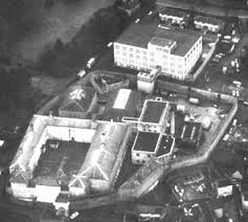
View of Shepton Mallet (left) and its execution shed (right)

Shepton Mallet had been a civilian prison for centuries before being turned over to the British military, who then lent it to the Americans as part of the Visiting Forces Act. Until its final closure a few years ago Shepton Mallet remained the oldest prison in the UK still operational, a dubious distinction now belonging to Dartmoor. There were, however, a few difficulties with the arrangement.

The Americans carried out 18 executions at Shepton Mallet during their tenure between mid-1942 and September, 1945. Two (Alex Miranda and Benjamin Pyegate) were by firing squad, upsetting local people, who knew very well what it meant to live next to a military prison and hear a single rifle volley at 8 a.m. The American military also preferred hanging common criminals to allowing them to be shot like soldiers.

The problems were simple. The locals didn’t like firing squads made no secret of it. Not surprisingly, there were complaints. The US military felt being shot was too good for most of its condemned and the British didn’t like the methods and equipment used by American hangmen, who had acquired a nasty and thoroughly-deserved reputation for using badly-designed scaffolds, the wrong type of rope and the antiquated standard drop instead of a drop length scientifically calculated by the prisoner’s weight.

The British also regarded American hanging equipment as outdated, while American military hangmen John Woods and Joseph Malta were entirely unfamiliar with the British kit. And British hangmen had evolved hanging to almost an art, needing mere seconds to complete the procedure.

Another problem was that the gallows at Shepton Mallet hadn’t been used since March, 1926. By 1942 it was considered unfit for service and needed replacing. A compromise had to be reached, and was.

The Americans could continue executions at Shepton Mallet, but the vast majority (16 out of 18) were performed by British hangmen using a British gallows in an extension built onto the end of one of the cellblocks. The Americans were permitted their usual practice of having the condemned stand strapped, noosed and hooded on the gallows while their death warrant and charge sheet were read out and then being asked for any last words. This caused executioner Albert Pierrepoint, master of the speedy hanging, to complain at what seemed to him a cruel, unnecessary delay in ending the prisoner’s misery.

Pierrepoint also complained about overcrowding in the gallows room during executions. At a British hanging there would be the prisoner, the hangman, his assistant, the prison Governor, the Chief Warder, the doctor, the Chaplain and two or four prison officers. At an American military hanging there were usually twenty or so people clustered around the trapdoors and lever. He felt a hanging should be both quick and perfect and that a crowded gallows room invited disaster.

Hangman Thomas Pierrepoint.

By VE Day the arrangement was well-established. Thomas Pierrepoint, uncle of Albert and brother of Henry (both of whom were also hangmen) performed 13 of the 16 hangings at Shepton Mallet while Albert performed the remaining three when he wasn’t busy elsewhere.

Their assistants were Steve Wade, Herbert Morris and Alexander Riley. Tom Pierrepoint had performed the last hanging at Shepton Mallet in 1926 (that of murderer John Lincoln) assisted by Lionel Mann. While the two firing squads were performed at 8 a.m., the hangings would be carried out at 1 a.m. which was discreet enough not to arouse neighbors’ ire.

Smith’s case was reviewed. Not surprisingly, his appeal was denied as were other requests including (most generously, under the circumstances) one from Lady Teichmann, widow of his victim. His date was set for 1 a.m. on what turned out to be the very day Europe’s guns fell silent. Tom Pierrepoint would do the job assisted by Herbert Morris. Smith was transferred to the Condemned Cell a few days prior to the execution date where he was granted free access to the military Chaplain.

When the time came, while the rest of the population celebrated the arrival of a new world and Smith contemplated his departure from the old one, it went as smoothly as could be expected. Smith was taken from his cell wearing standard military uniform, from which any badges or flashes marking him as a soldier were deliberately removed. Paperwork was completed signifying his dishonourable discharge from the US military as a common criminal and the US military were determined that he should die like one.

Given the delays caused by the reading of the charge sheet and death warrant and Smith being asked for his last words (he apparently had none) it took 22 minutes between Smith being taken from his cell and being certified dead by the prison doctor. Compare this with a standard British execution (minus the bureaucracy and speechifying) where 22 seconds would have been considered twice as long as was needed to do the job. Smith’s punishment, however, wasn’t done yet. Executed American servicemen were initially buried at Brookwood cemetery, but then moved to the notorious ‘Plot E’ of the Oisne-Aisne Military Cemetery in France. Plot E is deliberately hidden from the rest of that cemetery. Its residents have no names on their graves, only numbers. They have no headstones or crosses, only flat stone markers. No American flag hangs in their plot. It doesn’t appear on the plan of the cemetery even today and the markers are placed facing away from the graves of other Americans. Visits to Plot E are still discouraged and it wasn’t until a Freedom of Information request in 2009 that the names of those buried there were released.


A view of the “Dishonored Dead” in Plot E, Oise-Aisne American Cemetery. (cc) image by Stranger20824.

Whatever they may have done, and some committed truly dreadful crimes, it seems distasteful to virtually deny their existence and shame them even after death. It also denied their families and friends the chance to visit and grieve, despite the fact that they themselves had committed no crime.

That said, it’s no different to the routine imposed on condemned British criminals. In fact, the British death sentence expressly demanded that inmates be buried in unmarked graves within the prison walls inflicting the same suffering on their friends and relatives. The British hanged were officially designated ‘Property of the Crown,’ many of whom were not properly reburied until after abolition. At many British prisons they still remain in unmarked graves according to the following sentence:

Prisoner at the Bar, it is the sentence of this Court that you be taken from this place to a lawful prison and thence to a place of execution where you shall be hanged by the neck until you are dead, and that your body be afterwards cut down and buried within the precincts of the prison in which you were last confined before execution. And may the Lord have mercy upon your soul.

Remove the prisoner …

On this day..

1791: William Jones, “in a country out of the reach of my enemies”

On this date in 1791, a man named William Jones hanged in Newark, N.J.

Jones cut an apologetic figure at his public execution, and a confession he signed off in the hours before was widely reprinted in New England newspapers. (This transcription is from the Boston Independent Chronicle of May 26, 1791.)

Knowing that without repentance there can be no salvation, and without a sincere confession of our public transgressions, there can be no true repentance, therefore I would give glory to God, exonerate and ease my own wretched mind; and as far as possible, afford that satisfaction to the public, by confessing my crimes, that others may take warning by my awful but just end, and be preserved from such horrid iniquities. This is the only reparation I can make to society, for the evil I have done, for which I am righteously, in the midst of my days, cut off from among men.

I confess I have been exceedingly wicked from my youth. I have been habitually addicted to Sabbath breaking, swearing, keeping evil company, gaming, drinking to excess; and when in liquor, passionate and quarrelsome, and have indulged myself to a high degree in other base and horrid abominations.

But the crime for which I am now to die, I would, with the greatest exactness relate. — I solemnly declare, I never intended to kill Mr. Shotwell, nor had I, at any time, as far as I know, murderous intentions in my heart against him, yet, I was the unfortunate man, that, to gratify my wicked passions, was the occasion of his death. I had long had a spite against Shotwell, because I looked upon it, that he & another man had injured me much, and were the cause of my being obliged to settle a civil prosecution, commenced against me, greatly to my wrong. Therefore I had often said, I would whip, beat or flog Shotwell, but as I never had a thought in my heart to murder him; as a dying man, I never said, I would kill him.

On the evening of Friday the 1st day of April, about or a little after sun down, I saw Samuel Shotwell pass my mother’s house driving cattle or a pair of oxen. In sometime, afterwards, I arose, went out into the road, and followed after him. I met Letts and stopped and talked with him for some minutes perhaps six or eight; then we parted and I followed after Shotwell. I crossed the fence in order to cut off a crook in the road and re-crossed the fence into the road still behind him. About three quarters of a mile from where I had seen Letts, I overtook Shotwell, and, without speaking a word to him, or he to me, I knocked him down with my fist, and there kicked him in the face and head, having on a pair of strong heavy shoes. I then passed the fence into the field opposite to where Shotwell lay. In a short time I saw him rise and go on the road, and I went along in the field. I had thoughts of going to a certain house, at no great distance before us, but before I came to the house, I altered my purpose, and so passed the fence into the road before Shotwell and going back along the way, I presently met him. I knocked him down again with my first, and again kicked him, and left him, and went on the road home. After sitting by the fire a little while, I went to bed, but was very uneasy lest I had beat Shotwell too much.

With regard to the club, of which much was said in the course of my trial, I never had it in my hand, nor did I ever see it, till the next day at the Coroner’s inquest. It was not the weapon I made use of nor had I any weapon whatsoever; but by knocking down Shotwell and kicking him in the manner related, I was the unhappy cause of his death.

I leave this testimony and confession, that my awful conduct may be a warning to others, that they by my dreadful fate, may be admonished to refrain from evil company, and from allowing themselves in drunkenness, wrath, malice or intemperate passions. My wickedness has brought me to this just and awful doom. May all others hear and fear!

WILLIAM JONES

A sad end for Messrs. Jones and Shotwell both; readers of the 21st century as well as the 18th ought to hear and fear.

But to the end of this awful but uncomplicated tragedy, we have this curious broadsheet published later in 1791.

What to make of this artifact?

One notices at first blush that as the document was printed in broadsheet form, it was presumably intended for the enrichment of its publisher … and we might suppose treacherous albeit not unpassable footing on the route from anyone actually party to such an occult missive in real life to a hustler harvesting gawkers’ pennies on the incredible secret. Indeed, it would be a profoundly ill turn for Jones or his correspondent, for no better reason than a gloat, to expose the physician of his deliverance to the sanctions that might attend unmasking. If this pamphlet’s remarkable claims were recapitulated in any other media at the time, I have not been able to locate it.

Even presuming that we have a sensational forgery, our bulletin does have something to say to us yet, and not only about the evergreen human fascination with surviving an execution.

This is a document from the Enlightenment, an interval where the vaunting progress of human ingenuity designed even to steal a march from the reaper himself by reviving the drowned or reanimating the dead.

Hangings were survived sometimes — not commonly, but often enough that the phenomenon was familiar and occasionally the enterprising condemned even schemed to accomplish it intentionally. Such a scenario necessarily inspired artists, whose fabulisms would only have reflected the fancies of their audiences. The scaffold was already being given over routinely as the portal to spiritual escape for the penitent knave crushed by his sin … why not the escapism of the flesh, too?

Maybe our broadsheet publishers took inspiration from the fantastic story a couple of years prior of a different man living through his hanging in Massachusetts. Though that earlier tale was perhaps more overtly crafted for moral instruction, the particulars of the harrowing procedure are much the same: the assistance of an obligingly altruistic doctor, the agonizing pain of resuscitation, and the convenient vanishing into unverifiable distant anonymity. Even Nathaniel Hawthorne would allude via a minor character in The Blithesdale Romance to the legend that an English banker executed in the 1820s had duped the hangman — and not unlike our William Johnson, Hawthorne judged that living phantom and his stolen years “a mere image, an optical delusion, created by the sunshine of prosperity, … [who] seemed to leave no vacancy.”

On this day..

1854: John Hendrickson, junk science victim

On this date in 1854, an Albany, N.Y. man named John Hendrickson hanged for the murder by aconite poisoning of his wife, Maria. “He has suffered the highest penalty of the law,” New York’s Weekly Herald pronounced the next day — “but whether justly or not, will likely never be known on earth.”

Whatever the prisoner’s denials,* a web of suspicious circumstances clasped the hemp around his throat. Hendrickson, whose family had some money and connections, fought the conviction tooth and nail; his then-unusual three appeals, plus clemency petition to the governor, stretched the time from conviction to execution out to nearly a year. “The evidence adduced … was so entirely circumstantial, and the testimony of the scientific men so liable to doubt and contradiction, that it was generally feared the murderer would escape,” a Boston Post correspondent reported.** But not to worry: “the atmosphere of guilt seemed to surround him in the whole county; not a man could be found that, at heart, believed him innocent.” We’re scarcely prepared at this distance to assert an affirmative case for the man’s innocence, but in some ways it reads like an antebellum Cameron Willingham case, all the way down to the dubious forensic evidence.

Like Willingham, Hendrickson was a less than stellar husband. He was noted for abusing his wife, philandering, and doing both together when he “communicated to her a loathsome veneral disease.”

The supposed murder motivation was his wife’s recent inheritance of the estate of her father, who died just a few months before the murder. Little could really be proven save by inference from the man’s bad character; in classic tunnel-vision fashion, the record suggests nearly every data point became fixed according to this theory. For example, Hendrickson’s trial prosecutors read into evidence — in the part of their presentation they called the “Moral Evidence” — that Hendrickson remarked at his wife’s autopsy that “they won’t find arsenic.” You and I might think he’s saying that the examination will dispel the gathering suspicions of poisoning, and saying it by reference to the chemical that was the metonym for poisoning in the nineteenth century. For the state, his uttering these words was

as if he knew (as he undoubtedly did) the precise poison which she had swallowed — as if he knew that that common poison, which is found in most cases of the kind, had not been given by the murderer in this case, and hence they won’t find arsenic. Ah! gentlemen, it was nature speaking out, as she often unconsciously or unguardedly will, disclosing the otherwise well concealed and apparently undiscoverable crime.

(This is why you don’t talk to police.)

The district attorney introduced evidence courtesy of chemists named Salisbury and Swinburne, to the effect that it was no mean arsenic that carried away Maria Hendrickson but the more exotic potion of aconite — derived from a toxic herb seeded (per Ovid) by Cerberus himself.

One can peruse the evidence presented in the case here, but the most remarkable part of this trial record is the appendix — wherein numerous medical men, including a former teacher of Dr. Salisbury, skewer the forensic processes used to decide that Maria Hendrickson died by poison and even offer to reproduce them in person under the eyes of Gov. Horatio Seymour to prove their unreliability. Their findings harshly undercut the only concrete evidence that any murder took place at all.

“I am pained and oppressed with the conviction that the medical witnesses for the prosecution have, in a main point of this case, abused the confidence with which criminal courts so often compliment the man of science,” one writes — words that could still today be applied to many disciplines of junk science that have disappeared bodies into oubliettes on the strength of lie detectors, bite mark analysis, matching hair samples, and suchlike hocus-pocus.

We turn from the contemplation of this subject with feelings of sorrow, not that any of ours have been crushed under the wheels of mutilated justice, set in motion by ignorance and false science, but we feel now, as we have always felt, that a great personal wrong has been committed under the authority of law, for which there can be no atonement, as the dead cannot be brought to life, nor the blasted feelings of the living restored.

It would be well, too, for judges and jurors, who are very often hasty and inconsiderate in letting their feelings and prejudices get the better of their judgment, to remember that life, human life, is neither a toy nor a rattle, but the gift of God; when once extinguished, no matter how, it is gone forever, and the dead never rise again.

-Dr. Charles A. Lee, reviewing the Hendrickson case

* Hendrickson’s final message to his parents via his spiritual advisor, on the eve of his hanging:

To-morrow I am to die, and standing as I do on the brink of eternity, I wish to say to you, in the presence of that God before whom I am so soon to appear, that I am entirely innocent of the crime of murdering my wife. I did not give her poison. I do not know that any one gave her poison. She did not come to her death by violence of any kind, so far as I know. I believe she died a natural death. She did not vomit on the night of her death. [This remark touches the disputed forensic evidence; vomiting would be a symptom of poisoning, and state chemists’ assertion that Maria had done so was among the conclusions challenged by outside scientists. -ed.] I never knew that there was such an article as aconite in the world, until after I was in jail. Nor did I know it by any other name. I do not know that I have anything further to add, except to say some farewell words to my parents. But you will remember what I have said to you, and inform them of it. I wish you to make it public.

** Transcribed here via the Portland (Me.) Advertiser of Apr. 18, 1854.

On this day..

1867: Modiste Villebrun, but not Sophie Boisclair

(Thanks to Meaghan Good of the Charley Project for the guest post. -ed.)

On this date in 1867, Modiste Villebrun was hanged in Sorel, Quebec, in what would be the last execution before Canada became its own country. His partner in crime, Sophie Boisclair, might very well have been executed alongside him had she not been pregnant.

Villebrun, a lumberjack from St. Zephirin, was having an affair with Boisclair and they wanted to get married. They had two slight problems to deal with, in the form of their respective spouses. In those times, divorce was unthinkable. Murder, apparently, was not.

Jeffrey E. Pfeifer details their crimes in his book Death By Rope: An Anthology of Canadian Executions:

The first victim was Villebrun’s wife, and their plan seemed to work well. No one suspected foul play when the previously healthy woman died, or at least no one could prove anything. Braced by their success, the lovers soon turned their attention to Boisclair’s husband, Francois-Xavier Jutras. Boisclair suggested to her husband that they should allow Villebrun to move in with them since the death of his wife had left him all alone. Jutras agreed to his wife’s request and almost immediately Boisclair began to lace his food with her “special” ingredient. It was not long before the strychnine took effect and Jutras was dead.

Unfortunately for the two lovers, a suspicious doctor demanded an autopsy, which revealed the dead man’s body was saturated with poison. Villebrun and Boisclair soon found themselves arrested.

They were tried separately and both were convicted in short order and sentenced to death. When asked, at sentencing, whether she had anything to say, Boisclair announced she was expecting a baby. She got a temporary reprieve until delivery, and got the opportunity to watch Villebrun’s execution from the window in her cell.

Ten thousand people attended his hanging.

Seven months later, Boisclair gave birth to his child, and her sentence was commuted to life imprisonment.

“Boisclair ended up serving 20 years in the penitentiary,” records Pfeifer, “before being released, a broken woman.”

On this day..