1783: John Austin

On this date in 1783, highwayman John Austin was hanged at Tyburn for robbing and murdering John Spicer on the road to London.
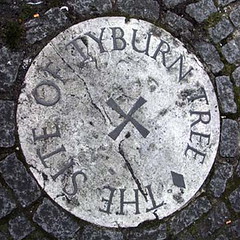
The village Tyburn on the outskirts of London had been used for public hangings dating to the 12th century. Though not the only site of executions in London, it was the iconic one. Situated at the modern intersection of Edgware and Bayswater Roads on the northeast corner of Hyde Park, the distinctive “Tyburn tree” — a triangular gallows capable of hanging over twenty prisoners simultaneously — made a foreboding landmark round which teemed thousands of spectators on execution days. Some 1,200 people were executed on this singular device.

Public executions typically began four kilometers away at Newgate Prison, where the condemned were loaded into ox carts for a two-to-three-hour procession through public streets now at the very core of London, perhaps including stops at public ale houses.


View Larger Map

While Tyburn carved its niche during England’s age of religious bloodletting, its social role had changed significantly by the 18th century. Most of the doomed were offenders against property, often executed for stealing negligible sums or else reprieved for transport to the New World or, later, Australia. Peter Linebaugh’s The London Hanged intriguingly suggests that hangings of this era were an assertion of nascent capitalism, violently throwing off the remains of feudal labor relations. (Summarized more thoroughly in this friendly review.)

Even that formative age was receding. Once a neighboring village, Tyburn had been swallowed up by the city; a generation before Austin’s death, residents of the now-upscale neighborhood had successfully pushed for the removal of the macabre “Tyburn tree”.

Austin was hanged, instead, on a portable gallows, a typical penitent imploring heavenly mercy and taking 10 minutes to strangle to death — the very last execution at that somber and storied crossroads.

Here’s the story of the Tyburn hangings from London writer Peter Ackroyd:

On this day..

1920: Kevin Barry

On this date in 1920, 18-year-old Irish Republican Army Section Commander Kevin Barry was hanged in Dublin’s Mountjoy Prison for the murder of English Private Harold Whitehead in an IRA ambush just six weeks prior to the execution.

Denying the authority of the British (civilian) court, the young medical student went undefended, insouciantly reading the newspaper in court as the government built its case against him. His was the first execution of the Irish War of Independence, and stoked Irish nationalist sentiment on the island and abroad.

Refused a request to be shot as a soldier, Barry nevertheless went jauntily to his fate, his bearing making great gains for IRA recruitment and fixing his own name in the firmament of Irish independence martyrs. Britain’s insistence on treating him as a murderer rather than a prisoner of war was widely received as an insult to the movement he represented.

It was not until 1989 that Barry’s short life received a biographical treatment, Kevin Barry and His Times, by the hanged man’s nephew. But a 1920’s song celebrating Barry has survived since that time as a popular hymn of Irish Republicanism.

On this day..

1589: Peter Stubbe, Sybil Stubbe and Katharina Trump

On Halloween in 1589, the “Werewolf of Bedburg” was put to a horrible death for a supposed slew of crimes committed in lupine form in the environs of the German city of Cologne.

Our knowledge of the strange case of Peter Stubbe comes primarily from a single surviving account, and with many of the potential supplementary sources lost to the ravages of time and war, interpretations are inevitably speculative.

Stubbe reportedly confessed under (or facing) torture to having practiced witchcraft and claimed to have received a magic belt from the infernal powers enabling him to transform into a wolf. The doomed man owned, during the quarter-century riot of sin that ensued this youthful acquisition, to rape, murder, cannibalism, incest, filicide, slaughtering livestock and keeping a succubus in his bed. (Authorities were unable to recover this potent belt, and sighed that Satan must have reclaimed it.)

For these crimes, he was broken on the wheel, beheaded, then burnt — the latter punishment shared with his daughter and his mistress, apparently implicated as accessories.

Was there a real wolf terrorizing the vicinity? Was Stubbe an actual murderer with a supernatural cover story? Was he nursing a genuine delusion of lycanthropy? Did he back the wrong faith as strife over Protestantism rent Germany? Or was he just unluckily caught up in an instance of demonic hysteria?

Whatever the individual circumstances of Stubbe’s death might have been, it occurred during a surge of panic over the venerable superstition of were-beasts and shapeshifters (particularly pronounced in France) coeval with Europe’s crises of religious and political authority on the eve of the Thirty Years’ War.

Yet this troubled period bore the germ of a modernity whose pervasive social changes would upend, among other things, the idea of a real werewolf. As the sixteenth century closed, both medical and theological understandings of “werewolfism” increasingly located it in the realm of the psychological instead of the supernatural.

Within a few years of Stubbe’s torture, werewolves had left the hands of magistrates for those of doctors … bound eventually for the pens of screenwriters with Halloween fare in mind.

On this day..