1987: Jacek Lazar condemned

On this date in 1987, according to the sentence read to him in the climactic scene of The Decalogue no. 5,* Jacek Lazar was condemned to hang for the senseless murder of a taxi driver. (“Lazar” was fictional, but he had a real-life inspiration.)

The movie, plainly reflecting the director’s opposition to the death penalty, is the most overtly political of Krzysztof Kieslowski‘s ten-film cycle exploring the themes of the Ten Commandments. But it is far from tendentious.

The supposed date of the actual execution, depicted here, is not identified.

If one credits the dates, this hanging would be among the last performed in Poland. After April 1988, death sentences were no longer carried out, and Poland formally abolished the death penalty in the late 90’s — thanks in no small part to this film.

* Or Dekalog, per its Polish rendering. This particular installation of the series is also referred to as “A Short Film About Killing”.

On this day..

1740: Not William Duell

On this date in 1740, five criminals were hanged at Tyburn.

Sixteen-year-old William Duell was among them. He was hanged — but he did not die. As recounted in The Newgate Calendar:

WILLIAM DUELL was convicted of occasioning the death of Sarah Griffin, at Acton, by robbing and ill-treating her. Having suffered, 24th of November, 1740, at Tyburn, with Thomas Clock, William Meers, Margery Stanton and Eleanor Munoman (who had been convicted of several burglaries and felonies), his body was brought to Surgeons’ Hall to be anatomised; but after it was stripped and laid on the board, and one of the servants was washing it, in order to be cut, he perceived life in him, and found his breath to come quicker and quicker, on which a surgeon took some ounces of blood from him; in two hours he was able to sit up in his chair, and in the evening was again committed to Newgate, and his sentence, which might be again inflicted, was changed to transportation.

Failed hangings were not unheard-of at this time … and if transportation was no mean sentence, the young criminal must have reflected that matters certainly could have gone much worse for him.

On this day..

1910: Hawley Harvey Crippen

On this date in 1910, the notorious wife-murdering doctor Hawley Harvey Crippen was hanged at London’s Pentonville Prison.

The sensational trial, which saw the American-born homeopath convicted for dismembering his shrewish and unfaithful wife Cora in an attempt to take up with his young mistress, fitted Crippen for both a noose and a likeness at Madame Tussaud’s. (More trial background here.) It has also made his case twice a landmark in the history of crime and technology: once at the time of his arrest, and again just last month as of this writing.

The core of a case a jury found so open-and-shut as to require just 27 minutes to convict was the poorly explained disappearance of Crippen’s wife, followed by the discovery of a considerably mutilated female corpse under the Crippens’ home.

Although much of the crown’s evidence was speculative and circumstantial — to say nothing of the bodice-ripping gossip of nymphomania and infidelity — a corpse under the floorboards tends to be a compelling circumstance to a jury.

Presumably that anticipation prompted Crippen to flee the Scotland Yard investigation with his mistress Ethel le Neve under assumed names on an ocean liner bound for Canada. The case made criminological history as the first use of wireless communication to apprehend a suspect when the ship’s alert captain telegraphed Crippen’s presence to land as the ship steamed away — enabling a policeman to board a faster boat and arrest the pair as they docked in Quebec.

In the century since Crippen went to the gallows still maintaining his innocence, the case has endured in popular notoriety. The killer’s life has been novelized, meditated upon and borrowed for fiction, offering a draught of inspiration to Alfred Hitchcock along the way.

Books inspired by the Crippen case …

Given his suspicious behavior, scant had been the credence given Crippen’s protestation of innocence.

Until now.

In a meeting of Edwardian crime and cutting-edge technology, two scientists from Crippen’s home state of Michigan stunningly announced in October that DNA testing proves the body was not Cora Crippen after all.

If true, it would appear to void Crippen’s conviction in its particulars without quite exonerating the hanged man from the natural question: whose was the corpse? The manufacture of clothes on the body dated it to the Crippens’ occupancy of the house.

One of Crippen’s modern sleuths, in a wholly speculative vein, thinks it might harken to an altogether different sort of crime: a botched back-alley abortion, just the sort of thing a financially struggling physician might have been involved in.

Maybe.

But if the test invites a modern investigator to look 97 years backwards, it also suggests a posture of epistemological humility. It’s just possible that the light this test casts on our own time is as searching as that it shines on 1910.

The Prejudice of Science

The Crippen case was a classic 19th century-style detective job — the inspector who made the arrest cut his teeth as a younger man on a Jack the Ripper murder — but it took place on the brink of a revolution in forensic science.

Just a few years before, fingerprinting had been embraced by British and American law enforcement and begun its march towards total institutionalization. On the heels of fingerprinting came a multiplicity of biometric approaches to crime scenes — hair and fiber analysis, blood typology, and most recently and dramatically, DNA.

And they, in turn, have brought a rising faith in science to adjudicate the law.

While the “CSI Effect” — jurors’ expectation of case-breaking scientific evidence — conventionally plays as a hindrance for prosecutors who usually have no such thing, the excess deference given to less-than-conclusive forensic evidence can likewise cut against the defense. Evidence mishandled at crime labs, even cooked outright, factors into numerous recent post-conviction exonerations. The once ironclad credibility of fingerprint evidence has itself been undermined by subsequent forensic advances.

In short, for all its undoubted contributions to criminal justice, forensic science packs along its own set of pitfalls, caveats and blinders reflexively privileging evidence of the laboratory.

This is not a reflex to indulge uncritically. History grants the benefit of hindsight, but rarely the luxury of certitude.
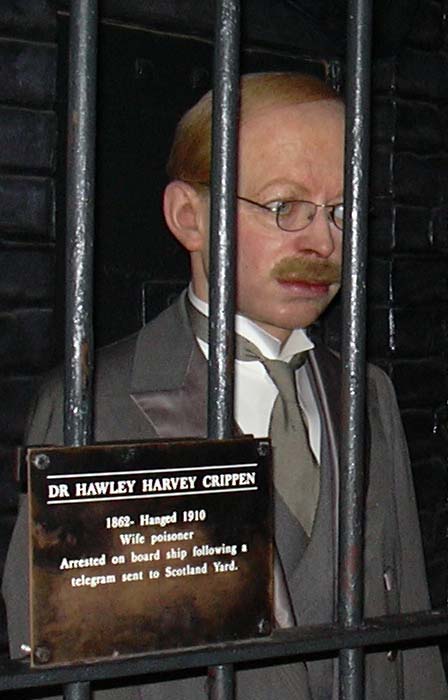
A waxwork Dr. Crippen at Madame Tussaud’s. Image used with permission.

So if the prospect of Crippen’s innocence intrigues, that unexplained body — that sudden flight for Canada — that (permanent) failure of Cora Crippen to resurface — nevertheless remain. They might lead us to question our implicit faith in the finality of DNA’s verdict on history rather than the other way around.

Are we certain that an unbroken line of blood relations really connects Cora Crippen to the modern DNA donors of her “family”?

Are we certain that a reliable chain of custody has preserved the original tissue samples unsullied across a century?

And if we are certain, what do we make of that body after all?

It is humans who must ultimately interpret and contextualize even the firmest forensic science. Whatever we might believe of Dr. Crippen we retain the burden of that belief, with all its intrinsic potential for grievous wrong.

The tales Hawley Crippen has yet to unfold from the grave might or might not shed still another different light on our understanding of what happened at 39 Hilldrop Crescent a century ago.

The gentleman’s place as a continuing attraction at Madame Tussaud’s, however, seems assured.

On this day..

1915: Joe Hill

On this date in 1915, songwriter, poet and labor activist Joe Hill was shot in Utah for the murder of a local butcher.

Even before his execution, the Swedish immigrant was widely thought to have been railroaded for his IWW affiliation.

Though state authorities had little use for the worldwide clemency bid whose backers included U.S. President Woodrow Wilson — powerless to intervene officially, since the execution was a state matter — Hill walked spryly into his martyrdom. The strange post-mortem career of his totemic ashes is the least of the ways Hill lives on.

His dauntless last message to fellow Wobbly Bill Haywood — “Don’t waste any time mourning. Organize.” — is a permanent fixture on pins and placards among every stripe of left activist. The songs he wrote remain in print — and in performance.

And the Depression-era tribute ballad “I Dreamed I Saw Joe Hill Last Night” can seamlessly serenade ripped-from-the-headlines footage, as a Paul Robeson rendition does in these clips of 1998 protests against then-New York City Mayor Rudy Giuliani.

On this day..

1491: Eight current and converted Jews at an auto de fe

On this date in 1491, the murder of the Holy Child of La Guardia was punished with an auto de fe and the public execution of eight Jews — some practicing, some converted to Christianity (who enjoyed the mercy of strangulation before being burnt) — and three others already dead but exhumed for the occasion.

The auto de fe — literally, “act of faith” — was a public ritual of religious penance for the condemned. Though its performance did not always precede the execution of its participants, it became closely associated with the savagery of the Spanish Inquisition.

In the hysteria of the Holy Child of La Guardia case — one of history’s better-remembered instances of “blood libel” implicating Jews in the ritual murder of Christian children — the result was foreordained.

Knitting together (inconsistent) confessions obtained under torture, the famed Inquisitor Torquemada proved a conspiracy of Jews had kidnapped and crucified a child further to the concoction of a magic potion that depended on the heart of an innocent Christian — despite a fruitless high-and-low search for some missing child who might have been the actual victim.

After this day’s gaudy public slaughter, a cult sprang up around the supposed martyr, adored in a chapel erected where one of the prisoners had once had a home — the very spot, it was said, where the Jews conspired. The Holy Child was a staple of Spanish literature down to the 20th century and is still venerated in La Guardia.

But Torquemada aimed for results well beyond Christendom’s martyrology, and the wretches at the stake would not be this day’s only victims.

John Edward Longhurst argues in The Age of Torquemada that the Inquisitor seized on the Holy Child case to orchestrate “his heart’s desire — the expulsion of all Jews from Spain.”*

Early the next year, the Spanish monarchy obliged, permanently remaking Spain:

If Ferdinand and Isabella were hesitating over expelling the Jews from Spain, the discovery of this latest Jewish plot would surely resolve all doubts. The Auto de Fe of November, 1491, exploited the affair to its fullest, emphasizing not only all the gruesome details of the Murder but the Jewish menace to Christians intended by it. The sentence against the Jew Juce Franco, read aloud to the great crowd at the Auto de Fe, identifies him as a seducer of Christians to the Law of Moses in language that clearly foreshadows the Edict of Expulsion four months later

…

We may be sure that Ferdinand and Isabella were treated to a lengthy account of this case. It also is clear, from their own observations in the Edict of Expulsion, that Torquemada impressed on them the determination of the Jews to persist in their efforts to seduce Christians to Judaism. As long as they were permitted to remain, the danger of infection would never be eliminated, no matter how harsh the measures employed against them.

* Or, their forcible conversion … which would then keep the Inquisition in business for years to come.

On this day..

1949: Nathuram Godse, Gandhi’s assassin

On this date in 1949, Mahatma Gandhi’s assassin was hanged at India’s Ambala Jail, together with one of his co-conspirators.

Often spoken of posthumously as little less than a saint, Gandhi was deeply immersed in the controversial rough-and-tumble politics of his time — India’s independence movement, and the shape of the nascent state. Winston Churchill, for instance, scorned him as “a seditious middle temple lawyer, now posing as a fakir of a type well known in the east, striding half-naked up the steps of the viceregal palace.”

The hatred of a Tory M.P. at the twilight of the empire might be expected, but it was a Hindu nationalist who struck Gandhi down after the partition into a Hindu India and a Muslim Pakistan. Gandhi had vocally opposed partition on the grounds of interreligious tolerance — but he eventually assented to Pakistan’s separation when he became convinced that the alternative was civil war.

Distrusted by Hindu partisans for his “appeasement” of minority groups within India, Gandhi survived numerous attempts on his life. But he sealed his fate by fasting to compel Delhi to make its agreed-upon partition payments to Islamabad even in the midst of war. Nathuram Godse, a Hindu nationalist, gunned him down during evening prayers on January 30, 1948.

(For a less Hollywood take on Gandhi, a five-hour documentary available online surveys his life.)

Godse never betrayed doubt or regret. On the contrary, he cogently justified the murder at trial:

I thought to myself and foresaw I shall be totally ruined, and the only thing I could expect from the people would be nothing but hatred and that I shall have lost all my honour, even more valuable than my life, if I were to kill Gandhiji. But at the same time I felt that the Indian politics in the absence of Gandhiji would surely be proved practical, able to retaliate, and would be powerful with armed forces. No doubt, my own future would be totally ruined, but the nation would be saved from the inroads of Pakistan. People may even call me and dub me as devoid of any sense or foolish, but the nation would be free to follow the course founded on the reason which I consider to be necessary for sound nation-building.

…

I do say that my shots were fired at the person whose policy and action had brought rack and ruin and destruction to millions of Hindus. There was no legal machinery by which such an offender could be brought to book and for this reason I fired those fatal shots.

Sixty years later, the subcontinent and the world at large seem more strained than ever by the collision between these men’s visions — the secular and egalitarian as against violent religious animosity.

Godse’s old party, the RSS, has become a substantial far-right bloc in the modern political scene. And while the party has always disavowed responsibility for the murder, some still consider Godse a hero. Pakistan, for whose birth Gandhi was slain, totters on the brink of an abyss.

Gandhi, meanwhile, is not only the official “father of his country” but has become the very watchword for nonviolence, his tactics and ideas inspiring such luminaries as Nelson Mandela and Martin Luther King, Jr. But his life and legacy remain live topics of research and dispute.

On this day..

1226: Frederick of Isenberg

On this date in 1226, Count — although he had been stripped of this title — Frederick of Isenberg, a German noble, was broken on the wheel for the murder of his cousin, the Archbishop of Cologne.

The proximate cause of the dispute between the two was said to have been Frederick‘s exploitation for his own benefit of an abbey he administered, to which the Archbishop, Engelbert of Berg, took exception. Underlying the conflict are the the outlines of power politics in fractious medieval Germany.

Engelbert was an aggressive and effective Archbishop, and the power he won for his diocese came at the expense of other claimants. Frederick was not likely the only noble menaced by the inroads of the vigorous bishop. One theory has it that, despite the 47 wounds found on the cleric’s body, the ambush Frederick laid for him aimed only to capture him as a hostage — a not unheard-of negotiating strategem of the period.

No matter Frederick’s intent, what he achieved was excommunication and the loss of all lands, title and wealth — including his castle, razed by the Archbishop’s successor. A year after the murder Frederick was captured returning from Rome, where he had sought to have his excommunication lifted. He suffered one of the more excrutiating forms of execution, his shattered body lingering alive overnight displayed atop a stone pillar.

Engelbert, who in life had been no stranger to worldly politics and himself had been excommunicated in his youth for backing an anti-papal power, was incorporated into the Catholic Church’s martyrology for his death in defense of the abbey and (though never formally canonized) has sometimes been venerated as a saint.

On this day..

1831: Nat Turner

On this date in 1831, the slave Nat — remembered to history as Nat Turner after the surname of his original owner — was hanged, flayed and dismembered for leading the most notorious slave rebellion in antebellum America.

A deeply religious man known to other slaves as “The Prophet”, Nat followed what he took to be divine directive to launch a bloody uprising on the night of August 21-22 in Southampton County, Virginia. Using (at first) axes, knives and clubs to avoid attracting attention to gunfire, Nat’s band slaughtered whites from house to house, freeing slaves as they went. At least 55 whites were killed, and a like number of slaves by white militias that mobilized to put down the revolt … and then hundreds more slaves as far away as North Carolina suspected of some tangential involvement or simmering disloyalty.

The uprising was suppressed within two days, but it rooted so deeply in the conscience of the South that it persists to this day.

“I have not slept without anxiety in three months. Our nights are sometimes spent listening to noises.”
-Slaveowner after the rebellion

Nat Turner embodied slaveowners’ terror of the subject population living about them, outnumbering them, resentfully supporting Southern gentility at the end of a whip — the conundrum Jefferson had described barely a decade before as “we have the wolf by the ear, and we can neither hold him, nor safely let him go.” Arguably, the revolt hardened southern whites against moderating slavery; some legislatures tightened restrictions against teaching slaves to read, thinking that literate slaves like Nat were more liable to uprisings.

Conversely, he was a powerful martyr of resistance in the slave quarters, a symbol of scores of other lesser-known uprisings and of the countless more that lurked in dreams and fantasies, awaiting some spark of outrage, some sudden opportunity, some wild carelessness of death.

He was a figure of literature even before his death — The Confessions of Nat Turner, dictated to a white interrogator, left Nat’s own riveting testimony from the shadow of the gallows; the Virginia-born white novelist William Styron used the same title for a controversial 1967 historical novel which earned a Pulitzer but drew a critical rebuttal from many black writers. (Nat Turner also stalks the memory of Styron’s semi-autobiographical narrator in Sophie’s Choice.) More recently, Nat has received graphic novel treatment.

Historians of every stripe, meanwhile, have struggled over the meaning of the man’s deeds and — especially — his paradoxical legacy as symbol.

Update: The occasion received a tribute in Alabama about the time this post went up.

On this day..

1995: Ken Saro-Wiwa and the Ogoni Nine

On this date in 1995, author Ken Saro-Wiwa and eight fellow activists of the Movement for the Survival of the Ogoni People (MOSOP) were hanged by the Nigerian military junta in Port Harcourt.

Saro-Wiwa, the author of works such as Sozaboy, was already considered among Nigeria’s greatest writers before becoming an activist for the rights of his Ogoni people in the face of Nigeria’s lucrative and ecologically destructive Niger Delta oil trade.

Few benefits of that trade returned to the politically marginalized Ogoni, whose overwhelming response to MOSOP’s organizing soon began choking off oil exploitation in Ogoniland and brought a violent response from the Nigerian dictatorship — operating hand in glove with Shell Oil, as Saro-Wiwa himself noted in his closing remarks to the sham tribunal that convicted him of inciting a murderous riot.

I repeat that we all stand before history. I and my colleagues are not the only ones on trial. Shell is here on trial and it is as well that it is represented by counsel said to be holding a watching brief. The Company has, indeed, ducked this particular trial, but its day will surely come and the lessons learnt here may prove useful to it for there is no doubt in my mind that the ecological war that the Company has waged in the Delta will be called to question sooner than later and the crimes of that war be duly punished. The crime of the Company’s dirty wars against the Ogoni people will also be punished.

In my innocence of the false charges I face here, in my utter conviction, I call upon the Ogoni people, the peoples of the Niger delta, and the oppressed ethnic minorities of Nigeria to stand up now and fight fearlessly and peacefully for their rights. History is on their side. God is on their side. For the Holy Quran says in Sura 42, verse 41: “All those that fight when oppressed incur no guilt, but Allah shall punish the oppressor.” Come the day.

Though Saro-Wiwa’s hanging helped quell Ogoniland sufficiently for Shell to resume production, it left an opposition martyr. Saro-Wiwa’s prison diary was published shortly after his hanging; his son, journalist Ken Wiwa, has written a biography; and separate UK- and Canada-based organizations exist to carry on his memory and work.

The tensions left unresolved in the Delta, meanwhile, have spawned ever more militant resistance movements.

On this day..

1911: Charles Justice

On this date in 1911, Charles Justice was electrocuted by the State of Ohio.

It was an ironic end, since when serving an earlier stint in the state penitentiary shortly after the electric chair was introduced, Justice had hit upon the idea of metal clamps in place of leather straps to more securely hold down the chair’s clientele and avoid burnt flesh.

The improvement, duly implemented, was there awaiting its creator.

On this day..