1913: Andriza Mircovich, by a shooting-machine

101 years ago today, a Serbian immigrant was shot for murder in Carson City, Nevada.

It was an ordinary murder, by an ordinary man: his cousin died in a mining fire in 1911, and Andriza (or Andrija) Mircovich, feeling he got stiffed on the resulting inheritance, stabbed to death the probate attorney (a fellow South Slav named Gregorovich).

The execution, however, was extraordinary — and has never in history been repeated.

The march of science had lately made possible whole new methods of execution heretofore uncontemplated — like electricity and poison gas. At the same time, mechanical engineering had improved old standbys like beheading and hanging from slipshod, error-prone affairs to efficient operations worthy of an age of industry.

Somewhere between those categories lies the firing squad. Firearms, of course, were new technology relative to the noose and a big ol’ axe, but we do find executions by shooting back to the 17th century at least.

Though the guns themselves had been updated, Nevada was forced by circumstances to do for firing squads what Dr. Guillotin had done for headsmen.

Nevada law at the time allowed inmates to choose between hanging and shooting. The state had all the accoutrement for the former, but it hadn’t ever conducted one of the latter. When Mircovich insisted on being shot, and prison officials couldn’t find people willing to pull the trigger, Nevada actually built a “shooting gallery of steel” — an entire contraption to automate the lethal fusillade.

The 1,000-pound gallery of steel, whose arrival caused the prison warden George Cowing to resign in horror,* consisted of a shed with three protruding mounted rifles, which would be individually sighted on the heart of the restrained prisoner and fired when guards cut a string to release a spring mechanism.

In a macabre Rube Goldberg parody, it was improved for the consciences of the guards by having three strings that would be simultaneously cut, only one of which actually triggered the gallery. A redundant layer of plausible deniability was added, since each of the three guards had aimed only one of the three rifles, by loading only two of the three guns with live ammunition.

Mircovich went to his death still fulminating profanely against the judge who condemned him and the injustice of it all. The scene, it must be said, was not exactly the finest hour in penal history.

But the device itself? It worked perfectly, killing Mircovich nigh-instantly with two balls straight to his heart.


From the Los Angeles Times, May 15, 1913.

Nevada got rid of this inconvenient execution option not long after, and Mircovich remains the only human being put to death by shooting (whether by human hands or mechanical ones) in the Silver State’s history. The guns from this weird artifact currently reside at the Nevada State Museum, Carson City; the scaffolding that once surrounded them is in some aircraft carrier or tank, having been donated as scrap metal during World War II.

* Cowing was replaced by former governor Denver Dickerson, who would later oversee Nevada’s pathbreaking gas chamber debut. Digression: Dickerson’s turn as governor had been notable for his arranging a boxing match in Reno between the black champion Jack Johnson and the “great white hope” James Jeffries, which resulted in a legendary Johnson victory and — another sign of the era’s dismal condition of race relations — a nationwide wave of racial violence.

According to Unforgivable Blackness: The Rise and Fall of Jack Johnson, Dickerson was the kind of guy who could see past skin color well enough to make bank wagering on Johnson.

On this day..

1883: Henry De Bosnys, bane of Elizabeths

On this date in 1883, Henry De Bosnys was hanged in Elizabethtown, New York, for murdering his wife.

De Bosnys was an immigrant near to 50 years old who turned up in 1881 in a little town on Lake Champlain as a farm hand. As we will see, this humble station contrasted sharply with the life De Bosnys claimed he had formerly led.

With him was “a colored woman who passed as his wife,” Eliza — but not for long. Soon after, De Bosnys took her away on his boat claiming that he had found work for her elsewhere on the lake. De Bosnys returned, but Eliza never did.

Whatever suspicions this might have aroused about the French farmhand did not suffice to deter another Eliza, the local widow Elizabeth Wells, from marrying De Bosnys only a few weeks later.

Their short union was characterized by terrible quarrels when the wife declined to place her small farm in the husband’s name. On August 1, 1882, she became the second Essex County woman to go for a ride with De Bosnys and fail to return.

At 122 meters deep, Lake Champlain is an oblivion where a corpse might vanish without trace. This is less true of a pile of leaves along a country lane — which is where Mrs. De Bosnys turned up, shot twice in the head with 22 calibre bullets and her neck gashed all the way to her spine.

When arrested, De Bosnys had a .22 pistol with two shots discharged, and a bloody knife. His story was that the couple had run into a Scotsman they knew, got drunk together on whisky, and that he, Henry, had fallen right asleep and knew nothing of what became of the wife. “His story,” the New York Times observes almost unnecessarily (Aug. 6, 1882), “is regarded as very improbable, and he is thought to be an escaped criminal who is concealing his identity.”

De Bosnys initially said he had come to the New World at age 17. By the time he went to the gallows — still insisting on his innocence — he had improved his biography considerably. The Times, possibly short of column-inches that day (Apr. 28, 1883), freely narrated the murderer’s compounded embellishments.

His education was thorough and extensive, and he could write and speak English, French, Italian, Spanish, Greek, and Portuguese, and could less perfectly speak and understand several other languages. While yet a mere lad he sailed with a north polar expedition under Leclaire, and was gone nearly two years, from February, 1848, to October, 1850. [I am unsure if this corresponds to any actual known polar expedition. -ed.] In 1854, with his father and brother, he volunteered for the Crimean war, and served in the French army in the Crimea for a couple of years. A few years of peace followed, in which De Bosnys completed his education, but on the breaking out of the war with Austria, in 1859, he joined MacMahon‘s army, in which he saw a few months’ service, sailing in the Autumn to China with the French contingent. Returning to France he joined the French expedition to Mexico in 1861, and after a few months joined the Mexican side, becoming a Captain of guerrillas under Lopez. In this service he was severely wounded in an engagement. He came North, and, being cured of his wound, enlisted in the Fourth Pennsylvania Volunteers in 1863. He was wounded at the battle of Gettysburg and discharged from the army. Returning to France he was married, but after two months’ matrimonial experience sailed on another arctic expedition. After an absence of two years he returned to this country, where he led a roving life until the outbreak of the Franco German war. He entered the French Army, rising by successive promotions until he became a Colonel under Gen. Boubaki. He served all through the war with varying fortunes, at its close escaping to Marseilles, whence he shipped for America.

One would think a man with that history would have a vision wider than squeezing 15 acres out of a widow, or at least the perspicacity to clean up his murder weapons — but then again, he really did speak all those languages. Maybe this was the date Elizabethtown hanged the Most Interesting Man in the World. If so, history records that the man’s savoir faire extended so far as cannily inspecting the apparatus of his own execution a few hours before hanging on it, and offering the hangman a few engineering tips (De Bosnys thought the rope needed more soaping).

Henry De Bosnys’s skull is preserved at Elizabethtown’s Adirondack History Center Museum — and, it is said, his spirit haunts that place too.

On this day..

1878: The Brassell boys

On this date in 1878, Joe and Teek* Brassell were hanged in Cookeville, Tennessee.

These brothers (their eldest sibling Jim Brassell wisely bowed out of the scheme) and two other buddies got into the whiskey moonshine from the Brassells’ own home still, and decided to knock over a nearby lodging where two guests thought to be heavy with cash were staying.

So the quartet blacked up faces and turned clothes inside out by way of disguise and around midnight tromped up to the Allison Stand Inn wielding pistols.

“Don’t worry!” Russell Allison called to his guests, recognizing his onetime schoolmates. “It’s the Brassell boys!”

Great disguise.

Nothing daunted by their identities outed, the moonshine party invaded the log residence. A bedroom melee ensued, and in the course of it Teek Russell shot Russell Allison fatally in the gut; another shot only narrowly missed Mrs. Isbell, the wife of the tax collector W.J. Isbell whom the party was trying to target in the first place.** Isbell wasn’t there at all, and the whole band fled the house not a penny richer, but about to be wanted men.

The next day as Allison lay expiring from his painful wound, the Allison family rounded up its own posse and descended on the Brassell residence. Again, Teek gut-shot an Allison — Russell’s brother Joe — and killed him, too. But the rest of the posse detained the desperados and they were soon hailed to Cookeville Jail. The murder became extremely notorious in the area and the Brassells boys were easily condemned, albeit after nearly two years’ worth of legal continuances.†

We’ve liberally included these youths in our arsenic themed set. Of course, these young men worked their mayhem with firearms and not philters, but in a sense their case underscores the ubiquity of that poison for 19th century crime. Desperate to escape, even the brutally direct Brassell boys turned like dissatisfied housewives and furtive insurance adjusters to inheritance powder: in their case, they managed to have some smuggled to them in jail, which they planned to insinuate into some apples they would share with their guards while being moved between Nashville and Cookville.

As it transpired, the guards caught wind of this scheme and foiled it, along with several other jailbreak attempts. But that was the great thing about that innocuous dust: everywhere someone would profit from some other fellow dropping unexpectedly dead, the first thought was invariably arsenic!

Frustrated of this and all other exits from their grim condition, the Brassell boys at last had to face the hemp. It would be the only judicial hanging in the history of Putnam County, Tennessee, and it would not want for ceremony. The execution itself occurred on a Wednesday; on the Sabbath preceding, the local Sunday school’s curriculum included (pdf) a visit to the condemned cells, where prisoners and children sang “Let us cross over the river”.

On hanging-day itself, the boys were up early for press interviews in the jailhouse. Shortly after 11 a.m., they piled into a wagon, grabbed seats on their own coffins, and were taken under guard to the double gallows specially built for them on Billy Goat Hill. Their sister Amanda trailed the wagon, but after a farewell hug she complied with Joe and Teek’s request to leave without seeing them hang.

Amanda had plenty of time to comply. The hanging wasn’t until 1:30!

The Brassells passed their last two hours or so of life on the scaffold. As they sat under their hanging-nooses, a crowd of thousands — some estimates put it as high as 20,000; old folks in the early 20th century would still say that it was the largest crowd Cookeville had ever seen — imbibed a series of preachers and religious songs, the warnings of the condemned duo themselves, and a scene where their intended target Mr. Isbell climbed up on the platform himself and pressed the two for a confession. Joe admitted his guilt. Teek refused until the very end to do so.‡ To cap off the drama, the sheriff, hatchet in hand to chop the fatal rope, counted down the last five minutes.

It seems this whole event, from the murder to the hanging, still survives in Cookeville folklore. There’s a lengthy ballad about the Brassell boys’ crime and execution, available here (pdf). Also see this fantastically detailed web page about the crime, including a blurry restored photograph of the hanging, and this pdf roundup.

A fragment of the Brassell boys’ joint headstone can still be seen at a family plot adjacent to Upperman High School in the small town of Baxter, just outside Cookeville.

* Teek had “George Andrew” on his birth certificate.

** William Jefferson Isbell was a tax collector carrying his proceeds; he had fallen ill that day and had to stop elsewhere. The Isbells and Allisons were related through marriage.

† “Justice, when most severe to him who has offended, is always most merciful to him who would offend,” the Supreme Court most severely ruled — admonishing the young men not to entertain any hope of reprieve. (Quoted in the St. Louis Globe-Democrat, March 28, 1878)

‡ Teek’s obstinacy on claiming innocence when the evidence against him seemed so overwhelming led to some later speculation that he might have semi-willingly taken the rap for a different Brassell — maybe Jim, the one who supposedly bowed out of the raid, or maybe even Amanda.

Part of the Themed Set: Arsenic.

On this day..

1898: Doc Tanner, Copper River gold rusher

On this date in 1898, an ornery gold prospector became the victim of an Alaskan miner’s court … and a great gold rush scam.

This is a tragic sidelight of the great Klondike gold rush, a mania set off in summer of 1898.

As legions of America’s many unemployed set out in hopes of striking it rich in the frigid north, interest in the vast and underexplored interior of next-door Alaska naturally followed. After all, there had been gold finds in Alaska before.

The putative reasons justifying the spread of the Klondike fever to Copper River were some combination of these:

  • That the Copper River promised a shortcut into the Klondike easier than the route over Canadian soil;
  • That the Copper River itself had gold — and that it could be prospected under less extreme climate, and exempt from 20 percent royalties that Canada imposed on Klondike gold

Passenger steamers, whose operators were later suspected of flogging interest in this route as the “All-American trail,” brought several thousand bonanza-seekers from west coast cities to the tent-city port of Valdez, Alaska. From there, miners could tromp over a treacherous mountain-and-glacier path to the unspeakable riches of the Copper River.

“It was one of the greatest hoaxes in Alaska’s history,” write Jim and Nancy Lethcoe. “The prospectors arrived to find a glacier trail twice as long and steep as reported.”

An estimated two hundred people died, slipping off glaciers or frozen to death on the mountain or, as we’ll see, by acts of violence. By the summer of 1898, there was another rush — 3,000 or so busted prospectors pouring out of Copper River country back for Valdez. The U.S. government had to show up with provisions to avert mass starvation.

“Last winter papers of the country contained stories of the fabulous riches of the Copper river country, Alaska, the accessibility of the gold-laden land, cheapness of transportation, and in other ways lauded to the skies the country in which one had but to scrape the earth to secure a fortune,” ran a bitter report in the Aug. 27, 1898 Jackson (Mich.) Daily Citizen. The occasion was the empty-handed return of one of that city’s native sons, A.A. Jankowsky, from the Alaskan interior. “These stories, published in good faith, no doubt, had the effect of arousing in the minds of the more adventurous a desire to search for gold in the far-away land. Last spring there was a perfect exodus to the Copper river.”

Boston Journal, Jan. 7, 1898

Baltimore Sun, Sept. 6, 1898

Jankowsky, like many others, survived the treacherous journey into the interior only to find the Copper River region entirely destitute of gold. After supporting himself for a bit running a canteen, he joined a veritable stampede of thousands of duped prospectors fleeing back from the interior to Valdez. By his telling to the Citizen, “All along the trail were seen immense stores of provisions, representing in many instances, the savings of many years of prospectors, which were abandoned. Some of these contained cards marked, ‘Boys, help yourselves, I’ve gone home!’ Some of the men in their eagerness to get out had left their tents standing, containing clothing, bedding, stoves, firearms and everything else.”

Our date’s principal, Doc Tanner, at least had the comfort of never experiencing this disappointment ubiquitous to his fellow-adventurers.

The Kentucky native joined a party bound for Copper River that sailed from Seattle on November 20. Each had “grub-staked” $250 up-front with the understanding that they would be discharged from their ship with six months’ provisions … but when they were let out, they received only three months’ worth.

Oddly, Tanner seems to have been the only one incensed by this. When the leaders of the expedition refused to provide him an itemized account, Tanner turned into the cantankerous black sheep of the party as they drug their undersized packs over the dangerous Valdez glacier.

Matters came to such a pass that as dark fell on January 2, several of the other prospectors met in a tent to discuss turning Tanner out of the party full stop. Overhearing them, the enraged Tanner burst into the tent with the cool action hero words, “I’m here for business now,” then started firing. He killed two of the men; a third only owed his life to a lamp’s timely extinguishing during the affray. (1898 newspaper reporting also indicated that the tragedy redoubled for one of the victims, William Call: his wife upon hearing news of the murder fell into madness and was committed to an asylum, and lost the family’s indebted farm.)

Tanner immediately gave himself up to other miners of the camp and at dawn the next day faced an extra-legal drumhead tribunal that judged him guilty of murder and promptly hanged him.

As for Valdez, more orderly development of the trail from that port into the Alaskan interior ensued. Though cold comfort to men shot in their tents, hanged by miners, or fallen into glacial crevasses, that route eventually became part of the present-day Richardson Highway, and the Trans-Alaska Pipeline.

On this day..

1605: Niklaus von Gulchen, Nuremberg privy councillor

On this date in 1605, Nuremberg privy councillor Niklaus von Gulchen (or Gilgen) was beheaded for his scandalous corruption. The wheeler-dealer’s graft had problematically extended to playing false with and backstabbing any number of elite patrons, from Nuremberg burghers all the way up to the Prince of Sulzbach, and even gone so far as to provide advice to foreigners against the interest of his own city.

The great executioner Franz Schmidt, whose many diary entries record (often tersely) the hundreds of hangings, beheadings, drownings, burnings, and breakings on the wheel he performed for Nuremberg over his lifetime, made an unusually voluminous entry for this shocking treachery. And from the sound of it, the duplicitous Master Doctor earned every drop of his executioner’s opprobrium — even if, according to Schmidt’s biographer, the malefactor’s misused position still entitled him to the privilege of execution by the sword, exemption from torture, and a dignified black cloak to wear to his last performance.

December 23rd (a Monday).* Master Doctor Nicholas von Gilgen, who was by appointment a privy councillor in an honourable council and was bound to that council by oaths he did not observe; for the sake of money received wrote for and advised two (opposite) parties in many affairs; also gave evidence and sat in council for deliberations and decisions; also stole from my lords of this town the allowances for beer and wine, causing it to be stored by his servants.

Also he debauched before her marriage, forcing her to do his will, his servant whom he brought from Trier to this town, and whom he gave as a wife to his clerk Philip Tumbler, by a promise of 50 florins and large presents. According to her declaration she brought forth five children by him, three of which miscarried during delivery or by fright in the twelfth week, two remaining alive, a boy and girl, he being sponsor to the boy at baptism.

Similarly, by like promises, he forced his under-maid to consent to his will a year ago, and tried likewise to persuade his brother’s two daughters; one, the wife of Doctor Wurffbaum, he tried to compel, but she resisted, the other the wife of Doctor Calrot, who yielded to his will and consorted with him before and after her marriage, according to her account through fear and compulsion and the promise of many presents and a wedding portion (he did not admit he compelled her, and I do not believe he forced her).

Lastly he played false when serving the Prince of Sultzbach, whose advocate he was; he also mediated dishonestly between the families of Nuremberg, and between the noble families of Leschwitz and Redwitz, writing to, and advising both parties in one affair. Likewise he counselled the Italian Charles Albert Nello and other Italians against the rulers of our town; also stole the decrees from the office of an honourable councillor.

In Italy too, at Padua, he produced a false certificate, when he figured as a doctor there by means of a false certificate, for he became a doctor at Basel only long after. For his evil deeds he lay in prison for thirty-eight weeks in Lugins Land and in the jail. He was led out on Monday by favour in a long mourning cloak, his arms bound behind him with a black silk cord, and led by a cord, a black cloth being spread on the seat (on the scaffold).


Niklaus von Gulchen’s beheading, from the Nuremberg chronicle. Note that the illustration portrays the doomed pol kneeling, when in fact he was beheaded in a chair. In any stance, von Gulchen “was a mischievious, gold-grubbing man,” according to the chronicler.

When he had been beheaded his body was wrapped in the cloth and laid in a wooden coffin, nailed down and taken to St. Peter’s church by the assistant executioner, but removed at night in a cart to St. John’s by the little gate that leads to the Butts, and buried in the graveyard by the walls.

* Nuremberg, a Protestant city, was still on the Julian calendar.

On this day..

1963: Russell Pascoe and Dennis Whitty, Britain’s second-last hanging date

On this date in 1963, gallows traps dropped simultaneously in Bristol and Winchester to hang two men for murdering a Cornish farmer.

Russell Pascoe and Dennis Whitty were laborers living out of a caravan in the Truro area; Pascoe had formerly worked for the victim, William Rowe, and knew a rumor that the 64-year-old recluse kept a small fortune stashed at Nanjarrow farm.

Late the night of August 14, 1963, the young toughs called at Nanjarrow. When William Rowe answered the door, they instantly beat and stabbed him to death. Perhaps they ought to have thought the plan out better, because William Rowe actually did have £3,000 on the premises … but Pascoe and Whitty only found four quid. (They split it.)

The killers were picked up before the week was out.

“We are both over twenty-one, so I suppose we can hang?” Whitty inquired.

Then they both started trying to blame each other. So the answer was yes.

Robert Douglas, later a bestselling author, was then a young prison guard beginning a career in corrections. He was on the detail guarding Pascoe and on friendly terms with the condemned man who was practically his own age.

Years later, with a lifetime’s wisdom at his back, Douglas wrote about it in his memoir of the prison At Her Majesty’s Pleasure. It’s an experience he says he has always remembered:

I can remember saying to Ken [Russell, another guard], ‘I’m not looking forward to this shift — I mean, what the hell are we going to talk about all evening?’ I was only 24 years old myself at the time, and we had built up a good relationship with Pascoe over the previous six weeks – playing cards and Monopoly and listening to the radio.

We went into the cell, and I asked Russell if he wanted a cup of tea. He said he didn’t. So I tried to coax him – ‘I’ve brought you a cream doughnut’ – I’d brought him a cream cake each day as a little treat. With that, he perked up a little and said, ‘ah go on then, I’ll have a tea’.

So we sat drinking tea for a while, none of us really saying anything. Just blathering about nothing to try to fill the silences.

Then Russell suddenly said, ‘They weighed me today, so they’ll know how far I’ll drop.’ Ken and I just looked at each other – what are you meant to say to that?

These were the third- and fourth-last men people put to death under Britain’s capital punishment statutes. (Here’s a picture at the doors of Bristol’s Horfield Gaol.) England would see only one more hanging date, another double execution conducted at two different prisons, before it abolished the death penalty.

* Writing a piece for his local paper about the hanging actually led Douglas into his later career

On this day..

1938: Martha Marek, Zeliopaster

On this date in 1938, Austrian Martha Marek was guillotined in Vienna for several murders by poison.

She first came to the attention of the discerning interwar crime audience in 1925 when she and her husband Emil were convicted of insurance fraud: Emil claimed to have “lost his leg while chopping wood” just after having taken out a policy, but examination showed that the lost leg had actually been chopped off methodically — and clumsily. They both served a short stint in prison but at least Martha still had four good limbs to go with her wits.

Martha before her marriage had been the lover of a department store magnate five decades her senior who lavished money on her and left her a tidy inheritance to the chagrin of his family. She made her way in the world hitting mother lodes and living comfortably on them, and the time would come that poison would suit her ends better than seduction.

In July 1932, Emil died of apparent tuberculosis. The next month, the couple’s infant daughter Ingeborg died too. Martha, who had lately been reduced to peddling vegetables in the street, pocketed insurance payments on both.

Shortly after, she moved in with an elderly aunt, and the aunt soon died too — leaving her home and assets to her “caregiver”.

As this nest egg dwindled, Martha opened the place to boarders, and one of these poor souls also died — not before mentioning to some people that he always seemed to get sick when he ate Martha’s food. Turned out, Martha had insured his life too.

Martha actually got away with all of this at first, despite the agitation of the dead boarder’s relative. But she pushed her luck a little bit too far when she tried to fraudulently report some insured paintings as stolen in 1937. Persnickety insurance adjusters investigated, and the whole murder spree came out in the process. She was convicted for killing husband, daughter, aunt, and lodger with the rat poison Zeliopaste (thallium).

Austria’s traditional execution method had been hanging, and its traditional executive behavior had been to commute women’s death sentences.

However, the March 1938 Anschluss annexing Austria to Hitler’s Germany brought an update to Germany’s capital punishment policies. Hitler rejected the mercy application (it didn’t help that Martha was half-Jewish) … and prolific Third Reich executioner Johann Reichhart overpowered a violently struggling Martha Marek to behead her on the fallbeil.

On this day..

1922: James Mahoney, Seattle spouse slayer

On this date in 1922, James Mahoney hanged in Washington’s Walla Walla penitentiary for one of Seattle’s most notorious crimes.

Two years prior, a 36-year-old Mahoney had been released from that same prison after serving time for assault and robbery, then moved into a Seattle boarding house with his mother and sister.

He soon struck up a romantic involvement with the house’s owner, Kate Mooers. She was 68 years young, but James Mahoney was broad-minded enough to admire her wealth.

On April 16, 1921, the night the two lovebirds were supposed to hop a train for their honeymoon in Minnesota, James Mahoney hired a company to move a steamer trunk to Lake Union, and load it into a rowboat. Kate Mooers was never seen again, but Mahoney resurfaced in Seattle ten days later claiming that she’d decided to extend her honeymoon with a long jaunt to Havana, Cuba. In the meantime, well, hubby would be looking after her affairs.

Alerted to the suspicious events by Mooers’s nieces, police kept Mahoney under surveillance for three weeks as he gobbled up his wife’s assets. He was finally arrested before he could skip town, but only on charges of forging documents during his embezzlement binge. For harder charges to stick, Kate Mooers had to be located.

According to a HistoryLink.org profile,

Captain [Charles] Tennant had a theory and ordered divers to begin searching the bottom of the northeast end of Lake Union near the University Bridge for a steamer trunk. Finally, having survived 11 weeks of criticism, the police found the trunk containing Kate Mahoney’s body. It bobbed to the surface on August 8, 1921, almost exactly where Captain Tennant said it would be. The autopsy revealed that Kate had been poisoned with 30 grains of morphine, stuffed in the trunk, then had her skull smashed with a heavy blunt instrument. Two days later, Jim Mahoney was charged with premeditated murder.

Resigned to his fate as his appeals dwindled away, Mahoney was reported to be in excellent spirits in his last days. He also made a written confession on the eve of his execution, forestalling his sister’s desperate attempt to claim the murder as her own in order to stay the hangman’s hand. (The sister still caught a jail term for forging Kate’s signatures.)

Now you must be brave and forget me. My whole life has been a torture to those who love me, and even as a little boy I used to dream of dying this way, and my dream has at last come true.

… If my soul can do you any good in the next world I will always be watching over you. Good-bye and God bless you all.

-Jimmie

On this day..

1879: Phra Pricha

On this date in 1879, the British Consul General in Bangkok lost his son-in-law to the headsman.

Fanny Knox was the multiracial daughter of Consul Thomas Knox and a Siamese noblewoman named Prang Yen.

R.J. Minney (who also popularized Violetta Szabo in Carve Her Name With Pride) novelized her intriguing story for a popular audience in the 1960s, following up on the Victorian-ingenue-in-Indochina interest created by Anna and the King of Siam. His Fanny and the Regent of Siam didn’t quite enter the canon, but 50-year-old used copies can still be scared up for a few pennies.

Anna of Anna and the King and Fanny of Fanny and the Regent had a link besides the publishing industry: Anna Leonowens‘s son Louis actually paid court to Fanny Knox. He wound up settling for Fanny’s sister Caroline when Fanny went for the Siamese aristocrat Phra Pricha (or Preecha) Kon-la-Karn. (“Phra” is an honorific for Pricha’s rank. Fanny would later be known as the Baroness Pricha Kon-la-Karn.)

But just weeks after their marriage — and while Fanny was pregnant with their first (only!) child — the new groom was accused of peculation and treachery, leading to his shocking Nov. 24 beheading.

The New York Times marveled in a sketchy April 12, 1880 recap:

Nothing so startling has happened here in a quarter of a century. You can only understand its effect by imagining John Sherman, Secretary of the Treasury, to be suddenly arrested, carried off mysteriously to Richmond or Petersburg, Va., and as mysteriously hanged. You may say that you do not hang high officers in the United States. Neither do they behead high officers in Siam. The instance of Pra Preecah [another alternate spelling] can hardly be paralleled here, at least in this generation.

The unparalleled and opaque tragedy transpired in the first few years of the majority of Siam’s King Chulalongkorn (or Rama V) — one of the royal princes tutored by the aforementioned Anna Leonowens.
In time, Chulalongkorn would be known as Rama the Great, the brilliant modernizer in his country’s history … but at this time those aspirations were constrained by much more conservative Siamese elites, most especially personified in the man who had been Chulalongkorn’s regent during his minority, Si Suriyawongse. The Times article just quoted ungenerously judges the king “a weak, cruel, cowardly despot” who “cannot much longer retain his power.”

Prominent among the king’s “Young Siam” party was the Amatayakun family, and the most prominent among that clan was Phra Pricha. Pricha was the governor of Prachinburi.

The substance of the formal accusation was that our man abused his control of Prachinburi’s lucrative Kabin gold mine to embezzle revenues that rightly belonged to the crown while grotesquely oppressing, even outright murdering, laborers under his jurisdiction there. The baron even confessed to the charge, though it’s difficult to know what weight to put upon that.

The probable subtext is political enmity between the Amatayakun family and the Bunnag family of the “Old Siam” ex-regent. Indeed, it’s been speculated that it was precisely because Phra Pricha detected the imminent accusations against him that he married Fanny Knox — so that he could give the money to his wife to protect it.

The British consul, meanwhile, quite overreached himself to intervene on behalf of his new son-in-law.

In a personal visit to Chulalongkorn, he urged the king that Pricha’s political enemies had concocted the charges — and that British gunships would back the sovereign if he should use the occasion to reverse the power of the old guard who intended to prosecute the former governor. (Source)

Chulalongkorn declined to upset the apple cart. Phra Pricha was handled by his enemies, and his family fell from power with his execution

Was the king’s reticence timidity or sagacity? 1879-1880 proved to be the nadir of Chulalongkorn’s power. Within months after Phra Pricha’s execution, team Young Siam was wresting its influence back. As the 1880s unfolded, Old Siam was literally dying off, and loyalists of the young king began filling their ministries.

Chulalongkorn’s reluctance to invite foreign intervention would foreshadow perhaps his essential accomplishment: although entirely surrounded by British and French colonies and certainly subject to those empires’ pressures, Rama the Great maintained the independence of Siam/Thailand.

Consul General Thomas Knox, meanwhile, was recalled over his impolitic meddling. Millions of tourists to Thailand’s unofficial northern capital might be interested in this side note: Nigel Brailey suggests that “It could be said that Siam’s role in Chiengmai,” which was then a distinct tributary kingdom of Siam’s subject to the growing influence of the neighboring British, “was saved by the … Phra Pricha affair.” The ambassador swap caused a year-long gap in British-Siamese diplomatic negotiations thereto which had been intensifying in early 1879.

* “Chiengmai and the Inception of an Administrative Centralization Policy in Siam (II),” Southeast Asian Studies, March 1974. (pdf cached here)

On this day..

1720: Edward Hunt, the first counterfeiter executed in colonial Pennsylvania

On November 19, 1720, Edward Hunt was hanged in Philadelphia. He was the only Pennsylvanian executed for treason prior to the American Revolution — that treason being not the betrayal of the state (in the sense we might think of it today), but counterfeiting.

In the bitterness of his scaffold speech, which disdains the customary acknowledge-my-guilt, pray-for-my-soul form of the genre to complain about his case, Hunt made plain that he was not reconciled to the justice men had rendered him.

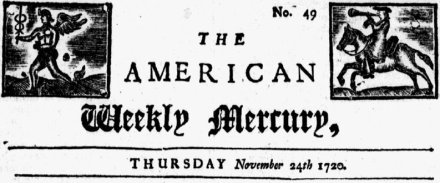
The American Weekly Mercury of Thursday, November 24 published “this extraordinary Piece” only with a preface complaining that “it is evident, that the following Speech was intended to misrepresent the Administration and Justice of this Government, as well as to infuse both ill Principles and Practices into the Minds of the People.”

The Dying Speech of Edward Hunt, formerly taken in Rebellion at Preston, and transported a bound Servant to the Island of Antigua, before his Execution upon the 19th Instant, at Philadelphia, where he had been legally convicted of High Treason, and most justly condemn’d for his Counterfeiting Spanish Silver Coin, made current* by Act of Parliament within all his Majesties Colonies in America.

It may be expected, that I should say some thing now concerning my Life and Conversation, which i must with Sorrow own to God and the Word has not been according to the Precepts and Principles of the Church, in which I was bred and educated: But with a sincere repentance and hearty Sorrow I do lament all the Errors of my past Life, firmly believing in my Saviour Jesus Christ, in whose Merits and ever flowing Mercy I do only trust for Salvation and Pardon, who has promised Eternal Life on no other Terms to the most Righteous upon Earth.

As to the Crime that now I suffer for in particular, I must own it is an Offence against the Laws, which I hope God will pardon me since he knows that I did not do it with any Design to cheat or defraud any one, or to make a Practice of Coining; but being ignorant of the Breach of any Laws of God or Man, I thought I might cut those Impressions as innocently as any other, or the Stamps that the Gentlemen of this place imploy’d me about, to make Farthings.** I am an English Subject, and desired to have the Privilege of the Laws of England, but it was not granted in any Point, except in Condemning me.

I am the first unhappy Instance of this kind that ever suffered in the King’s Dominions, pray God it may be a Warning to all, not to offend wilfully in the same that I did through Ignorance: For if I had known it, I would not have taken all the World to have done it. God give me a patient Resignation to submit to his blessed Will, in whatsoever he please.

I do heartily ask Forgiveness of all that I have offended in any manner of way, and do sincerely forgive all that have injured or offended me; particularly Mr. John Moore and Morris Birchfield, and the Evidence that swore against me in that Tryal. I do solemnly declare, That I know not any thing, or have been guilty of any one thing laid to my Charge in that Matter, or any of the other things laid to my Charge, by John Butler, either in England or Ireland.

I did petition the Honourable Governor for a Reprieve, until the King’s Pleasure was known concerning me, being I could not be tried by the Laws of England in all Points, as a Church of England Man ought to be: But it was a Privilege too great for me to obtain. Pray God to forgive them all, and every one that has a hand in taking away my Life any manner of way, and that my Blood be not required at their Hands, for they know not what they do. I am on Earth judged and condemned to die for the Breach of a Law of Man that was not duly published, which for that Reason I transgress’d it ignorantly, though the first that suffers for the Transgression of unknown Laws, or that was sentenced according to the Laws of England, without the Privilege of a Subject, which I desired of the Judge, which I know was not qualified by the same Laws to try me.

I do not know what Advantage there can be to any in my Death, and that I could not appeal to my King, neither before nor after my Tryal. I do not speak this because I am not in Charity with all the World, I do, from the Bottom of my Heart, forgive all in Obedience to my Saviour’s Command and Example, who suffered more for me, being innocent, and had not only done no Harm, but Good, and pray’d even for is cruel Persecutors and Murderers, and promised, That those that follow his Examples in this World by patiently enduring the Cross, shall reign with him to all Eternity: To Him therefore I commit all, an my poor Wife, beseeching him to help her, and be her Support and Comfort, and preserve her poor Soul free from the Polutions [sic] of the World, that through his precious Merits we may meet where we shall be both happy to all Eternity, in the merciful Arms of our dear Lord and Saviour Jesus, who I do beseech to receive my poor Soul.

According to Kenneth Scott’s Counterfeiting in Colonial America, Edward Hunt’s wife, Martha, got a £500 fine and a lifetime prison sentence for misprision of treason. (If that book is up your alley, Scott has an even more specific Counterfeiting in Colonial Pennsylvania.)

* Early colonial American commerce was severely hampered by a shortage of English/British currency. As a result, coins minted in Spain’s lucrative southern territories served as the colonies’ primary currency in the 17th and 18th centuries, particularly the iconic eight-real silver “pieces of eight”.

This is the reason why the currency of the present-day U.S. isn’t an “American pound sterling” but the almighty dollar: Dutch colonists had brought a coin called the leeuwendaalder to their former New Amsterdam (New York) province, the name deriving from the German thaler. As the pieces of eight corresponded to the thaler/daalder, it inherited the same name. Indeed, the “Spanish Dollar” remained legal tender in the post-colonial United States until 1857.

This is also the reason for reckoning of the eight constituent bits that comprised the dollar, and hence of the American colloquialism “two bits” to denote $0.25 … and, later, the adjective “two-bit” to man something cheap, mean, or small-time.

** They may have been Spain’s coins, but it’s wildly implausible that any Englishman could think he could counterfeit “innocently.”

On this day..