1663: Corfitz Ulfeldt, in effigy

On this date in 1663, Danish noble Corfitz Ulfeldt — then a fugitive abroad — was executed in effigy.

Ulfeldt (English Wikipedia page | Danish) is notorious as his country’s greatest traitor.

To commit great betrayals, one needs to begin with great trust. Ulfeldt was the son of a chancellor and was married off to Leonora Christina, the daughter of King Christian IV.

When Christian died, Ulfeldt was the de facto ruler of the realm or a few months in 1648 while the elective monarchy sorted out where to pass the crown next.

The choice ultimately fell to the late king’s son Frederick III, but this saturnine prince was distrusted by the Danish nobility, who forced on him as the price for his power a Haandfaestning — a sort of temporary Magna Carta circumscribing a monarch’s power for the period of his individual reign. It set a less than comradely tone for the two men’s relationship.

In 1651, an accusation surfaced that Ulfeldt was in on a plot to poison the king — an accusation that cost Ulfeldt’s lover her own head. Deciding that he didn’t need to be around when the next specious regicide allegation made the rounds, Ulfeldt pre-emptively fled the country.

From there, Ulfeldt’s lust for power and personal enmity for Frederick would light his path to infamy.

He signed up with Sweden’s King Charles X — Denmark’s greatest foreign rival — and mounted an invasion of his native country, possibly even financed by stolen Danish treasure. Rewarded with a Swedish noble title, he promptly began double-dealing against them, until his disgusted new sovereign dispossessed him, leading Ulfeldt to return hat in hand to Copenhagen.

Imprisoned there for that whole leading-an-enemy-invasion incident, Ulfeldt again managed to wriggle out and immediately tried to raise a German army against Denmark. Really — enough, dude.

Frederick certainly thought he’d seen enough too. Not having the compulsive traitor available to execute bodily, he resorted to the weird ritual of punishing a mannequin, and ordered the prison governor:

Know that you have to command the executioner in our name, that to-day, November 13, he is to take the effigy of Corfitz, formerly called Count of Ulfeldt, from the Blue Tower where it is now, and bring it on a car to the ordinary place in the square in front of the castle; and when he has come to the place of justice, strike off the right hand and the head, whereafter he is to divide the body into four parts on the spot, and carry them away with him, whilst the head is to be placed on a spike on the Blue Tower for remembrance and execration.

A few months after, the hunted Ulfeldt was reported to have died in Switzerland, a report considered highly suspicious in his native land. Nevertheless, he was never captured or heard from again, so whenever or however he died, it seems he managed to cheat the executioner of his flesh. As to the judgment of posterity: that, he had long since squandered.

The royal and loyal widow Leonora Christina enjoys a reputation quite a bit more favorable than her husband. She swallowed every draught of his exile, and more — remaining imprisoned under harsh conditions long after Corfitz’s death, only released in 1685 with the passing of King Frederick’s wife, her vengeful personal enemy. In that time, and in between fending off in her dungeon the local vermin, lecherous jailers, and the poison of personal bitterness, she wrote voluminous and well-regarded memoirs.

On this day..

1793: Jean-Sylvain Bailly, moonstruck

See Bailly, likewise of Paris, time-honoured Historian of Astronomy Ancient and Modern. Poor Bailly, how thy serenely beautiful Philosophising, with its soft moonshiny clearness and thinness, ends in foul thick confusion — of Presidency, Mayorship, diplomatic Officiality, rabid Triviality, and the throat of everlasting Darkness! Far was it to descend from the heavenly Galaxy to the Drapeau Rouge: beside that fatal dung-heap, on that last hell-day, thou must ‘tremble,’ though only with cold, ‘de froid.’ Speculation is not practice: to be weak is not so miserable; but to be weaker than our task. Wo the day when they mounted thee, a peaceable pedestrian, on that wild Hippogriff of a Democracy; which, spurning the firm earth, nay lashing at the very stars, no yet known Astolpho could have ridden!

–Carlyle

On this date in 1793, French astronomer turned revolutionary Jean-Sylvain Bailly was guillotined during the Paris Terror.

Bailly ditched a family trade in the arts — his father was a supervisor at the Louvre — and turned his gaze skyward.

Studying astronomy under Lacaille, Bailly made a quick splash in astronomical circles with meticulous work on Halley’s Comet and the moons of Jupiter. He was inducted into the French Academy of Sciences while still in his twenties. Not quite the guy every schoolchild knows, but a significant scientist in his time. As one twentieth-century reviewer put it,*

Bailly was not a great thinker or the discoverer of new concepts; no case can be made for placing his name beside those of Newton, Leibnitz, and Laplace. But he should not be denied a niche among the numerous competent and persevering work-a-day scientists who, perhaps, in the long run make possible the achievements of a few great men. His observations and reductions, his application of a mathematical discipline to the movements of the heavenly bodies, and his detailed publications had brought him, by 1766, considerable credit among fellow scientists.

His “considerable credit” in the public sphere, enhanced by his widely-admired writing, set him up for election to the Estates-General in 1789. Indeed, Bailly was elected to head the body’s Third Estate.

On June 20th of that pregnant year, days after the Estates-General had constituted itself a National Assembly with ambitions far outstripping the limited purpose of revenue collection the king intended them for, Louis XVI locked the delegates out of their meeting-room.

Bailly, in consequence, would lead one of the pivotal actions of the embryonic French Revolution. “I do not need to tell you in what a grievous situation the Assembly finds itself,” he said to the assembly reconvened at a nearby tennis court. “I propose that we deliberate on what action to take under such tumultuous circumstances.” The result of that deliberation was the Tennis Court Oath.


Detail view (click for the full image) of Jean-Sylvain Bailly administering the Tennis Court Oath, in Jacques-Louis David‘s sketch of the event.

When the Paris provost — an archaic municipal office — was shot by the mob on Bastille Day, Bailly became the City of Light’s first mayor.

But as with other principals of the Revolution’s earliest stirrings, like Bailly’s ally Lafayette, the man was left behind by the rapid progress of events. He’d been two years retired out of public service in Nantes when he was hailed before the Revolutionary Tribunal on the preposterous charge of having conspired in Louis XVI’s attempted flight and guillotined on that basis.

A lunar crater — the largest crater visible from earth — is appropriately named after this prolific observer of the heavens.

* Edwin Burrows Smith, Transactions of the American Philosophical Society, New Series, Vol. 44, No. 4 (1954).

On this day..

1632: Henri II de Montmorency

On this date in 1632, French noble Henri II de Montmorency was beheaded at Toulouse for rebellion against Louis XIII.

The lordly Montmorency (English Wikipedia page | French), sister to a famous knockout whom Henri IV wooed, was a Grand Admiral for his achievements knocking heads during the 1620s’ Huguenot rebellions. (It was Montmorency who, in the naval battle to capture Re Island, commanded the English ships controversially supplied by the Duke of Buckingham.)

His undoing? He hated Cardinal Richelieu‘s guts.

The red eminence had just attained his rank as Louis XIII’s consigliere, and set about using it to centralize the state in the king’s hands.

Toward that end, Richelieu pressed Montmorency to give up his “grand admiral” title, fearing that “grand” military generals running around the realm were liable to become a locus of sedition sooner or later. Similarly, Richelieu reduced Montmorency’s power as governor of Languedoc.* He wanted, altogether, fewer stumbling-blocks of leftover feudal authority laying about his absolute monarchy.

A seething Montmorency finally jumped — or was he pushed? — into outright rebellion in the party (French) of treacherous royal brother Gaston, duc d’Orleans. The rebel force barely materialized, and was easily beaten at Castelnauday.

Orleans fled the country, not half so committed to his revolt as Montmorency — who assailed the king’s lines practically alone. The latter, captured wounded on the battlefield, was attested to have given a ferocious account of himself in a hopeless cause: “seeing a single man charge through seven ranks and still fight at the seventh, he judged that that man could be only M. de Motmorency.”

Jolly good show, and all the more reason for Richelieu to take his head, to make an example of the man to other powerful men who demanded clemency for the rebellion as if it were Montmorency’s birthright. Richelieu would argue in his memoirs that this pitiless act to pacify the realm at the risk of his own popularity was the height of patriotism.


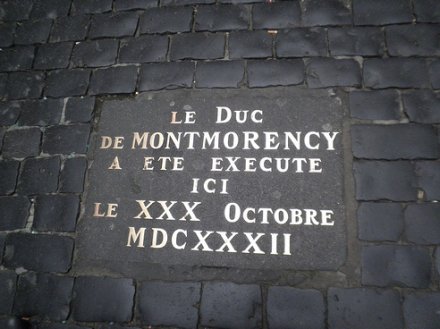
Plaque at the spot of Montmorency’s execution in Toulouse. Image (c) [Cova] and used with permission.

The Montmorency title eventually became that of the Dukes of Enghien, in which guise it’s associated with an altogether more famous execution.

* Among Montmorency’s other titles, less obnoxious to Richelieu, was viceroy of New France — that mysterious land across the Atlantic. There’s a Montmorency Falls in Quebec, named for him by Champlain.

On this day..

330 B.C.E.: Philotas, Alexander the Great Companion

Around this time — October, or at any rate autumn — of 330 B.C.E., Alexander the Great authored “one of the two greatest crimes of his life”* with the execution of his comrade-in-arms Philotas.

Philotas was one of Alexander’s “companions”, the elite cavalry who joined Alexander personally in battle. He had fought by Alexander’s side in the epic Battle of Gaugamela, which brought down the Achaemenid Empire and opened Persia to the legendary conqueror.

A year later, Alexander, and therefore also those companions, were winding down campaign season all the way on the other side of the late empire they had so stunningly dismantled. It’s the region of Drangiana on the present-day Iran-Afghanistan frontier. The Macedonians would name the city Prophthasia, Anticipation, in recognition of their chief’s narrow escape; we know it today as Farah, Afghanistan.

Unlike many of the “companions” who joined the young Macedonian king, Philotas wasn’t a bosom buddy of Alexander.

He was, instead, a bit of a political appointee who owed his position to the fact that his father Parmenion, a great Macedonian general, had backed the disputed succession of Alexander. Parmenion continued as one of Alexander’s generals; his kid — not particularly popular of himself but nevertheless a loyal and competent officer — got a plum gig in Alexander’s vanguard.

In this capacity so close to the royal person, Philotas was warned by a conscientious slave of an assassination plot going against Alexander. And rather incredibly, he didn’t bother to pass it on.

When the slave realized, a couple of days on, that the conspiracy hadn’t been busted, he proceeded to tell somebody else … and Philotas had some explaining to do.

For posterity, it’s as open a question as it was then: Philotas initially convinced Alexander that he had merely considered the whole thing so insubstantial as not to merit the king’s attention — but by the next day, Alexander had better inclined himself to the more damning reading, that Philotas was perfectly amenable to seeing Alexander eliminated.** If that were the truth, it would herald a conflict that would soon come to define the Macedonian’s coruscating and paradoxical career: the army’s rising discontent with its march so far from home, and its leader’s ever more visible habit of arraying himself in the alien habits of oriental despotism.

Philotas got a “proper” if farcically rigged trial before fellow-generals who were all too happy to be rid of him, and was tortured into confessing. He was executed either by stoning (actually the traditional Macedonian execution method, even for the likes of generals) or spearing.

(The scene is dramatized in the 2004 Oliver Stone film Alexander; the relevant bit can be viewed here.)

Parmenion, a greater character than his son, would also pay the forfeit of his son’s alleged misprision.

At the time of Philotas’s execution, Parmenion was commanding a large army several days’ ride from Alexander. Fearing that the torture and execution of his last remaining son (the other two had also died on campaign) might inspire the august general to do something rash, Alexander dispatched a few trusted officers to outrace the news: they murdered an uncomprehending Parmenion as soon as they reached him. Whatever one makes of the child, the father’s loyalty both to Alexander and his predecessor Philip II had never previously been impeached in a long and brilliant career. Alexander ought to have counted himself fortunate to have avoided any wider disturbance in the army from the rough handling of this beloved general.

The whole affair was sufficiently distasteful that it remained a sensitive matter of state security hundreds of years and hundreds of miles distant: An Elizabethan play about Philotas by Samuel Daniel earned its author some uncomfortable official scrutiny for its perceived commentary on the contemporaneous execution of the Earl of Essex … the fallen courtier whose prosecution of a Jewish doctor arguably informed Shakespeare’s Merchant of Venice.

* The other — later and greater — crime was Alexander’s drunken murder of his friend and loyal commander Cleitus. (He’s the guy shown stabbing Parmenion to death in the clip from Alexander, a circumstance that plays better as drama than history.)

** It doesn’t help anyone’s fact-finding that the main alleged plotter committed suicide when they came to arrest him.

On this day..

2003: Two Palestinian collaborators

On this date in 2003, Samer Ufi and Mohamed Faraj (some sources give the latter’s name as Suleiman) were publicly shot by masked al-Aqsa gunmen in the West Bank town of Tulkarem (or Tulkarm) for Israeli collaboration.

A videotape of the two admitting to supplying Israel information which led to militants’ assassination was played in the camp on the eve of their shooting. The dead men’s families contended that they had been tortured into the confession.

Tulkarem in 2003 was a place easy to feel under siege.

Recently prosperous, the fertile district close upon the Israeli border was suffering the effects of the ongoing Palestinian rising.

Tulkarem was in the process of being riven by Israel’s “apartheid wall” — splintering communities and devastating a recently prosperous economy.

Isabel Kershner reports in Barrier: The Seam of the Israeli-Palestinian Conflict:

Some eighteen to twenty-two thousand Palestinian laborers from the Tulkarm district used to go and work in Israel every day. Now they are prevented by the security barrier that went up during 2003 … an eight-meter-high concrete wall complete with round gray watchtowers, built to prevent Palestinian snipers from shooting at passing cars on the Trans-Israel Highway that skirts Tulkarm to the west. Additional stretches of fence hermetically seal the surrounding villages off from Israel, as well as from some of their agricultural land.

Meanwhile, as elsewhere in the West Bank and Gaza, a a fast-growing list of assassinations struck militants in the community.

We don’t know in these parts whether the executed men truly were informers, but Israel is known to obtain many such targets by way of informers — often reluctant Palestinians it blackmails or bribes. Accused informers are regularly executed in the Palestinian territories.

“For myself, if I were Palestinian, I would hate them to death,” an Israeli intelligence advisor told the BBC of the collaborators recruited by Tel Aviv. “He is a traitor — I need him — but he’s a traitor”.

Part of the Themed Set: Illegitimate Power.

On this day..

1803: Thomas Russell, the man from God knows where

On this date in 1803, Irish revolutionary Thomas Russell was hanged at Ireland’s Downpatrick Gaol.

Russell was such a republican original gangster that as a young junior officer in the British army in the late 1780s, he refused to eat sugar because it was the product of the empire’s slave plantations. (Hardly a bygone issue.) And while his own family was Anglican, Russell was also a staunch supporter of the then-radical (to Anglicans) position of Catholic equality.

For Russell, this personal stuff was all most intently political. And his politics in no way ended with the dumbwaiter.

After leaving the army, he fell in with Irish separatists and in 1795 co-founded the United Irishmen movement, along with a lot of other guys who would wind up in these executioners’ annals. He joined Henry Joy McCracken, Wolfe Tone, and Samuel Neilson in a convocation of Celtic martyrs atop Belfast’s Cave Hill to pledge one another “never to desist in our effort until we had subverted the authority of England over our country and asserted her independence.”

Subversion was Russell’s game for the remaining years of his life; his Letter to the People of Ireland unveils a Tom Paine-like vision of a revolutionary world — a world that the ancien regime would remain violently vigilant against in the wake of the recent French example. Like many of the most dazzling egalitarian dreams of that insurrectionary moment at the end of the 18th century, it’s still never been realized.

Great pains have been taken to prevent the mass of mankind from interfering in political pursuits; force, and argument, and wit, and ridicule, and invective, have been used by the governing party, and with such success, that any of the lower, or even middle rank of society who engage in politics, have been, and are, considered not only as ridiculous but in some degree culpable … Those insolent enslavers of the human race, who wish to fetter the minds as well as the body, exclaim to the poor, ‘mind your looms, and your spades and ploughs; have you not the means of subsistence; can you not earn your bread … leave the government to wiser heads and to people who understand it, and interfere no more!’

-Russell, Letter to the People of Ireland

Russell actually spent most of his final decade imprisoned without trial while tragic Irish insurrections came and went. England finally released him to Hamburg in 1802, and as might be expected, Russell was so itchy by then to get back in the scrap that he immediately broke his parole to return to Ireland for the next available rising.

And as also might be expected, he showed more haste than discrimination in his project. Hey, he did vow “never to desist.”

He joined up with Robert Emmet‘s rebellion — another doomed patriot; Russell was his designated organizer of the north — but found little success canvassing for potential rebels and took the field on July 23, 1803 in a gesture of little more than hopeless romanticism. His band fell apart and fled without a shot fired.


Memorial plaque in Downpatrick commemorating Russell’s execution. (cc) image from Ardfern.

The British did what the British always did and hunted down the Irish rebel, while the Irish did what the Irish always did and stuffed his remains in a ballad.* It’s called “The Man from God Knows Where” — and God knows, two centuries later, where that man has gone.

Whiles I said “Please God” to his dying hope
And “Amen” to his dying prayer,
That the Wrong would cease and the Right prevail.
For the man that they hanged at Downpatrick Jail
Was the Man from God-knows-where!

Peter Linebaugh, author of the indispensable scaffold social history The London Hanged, surveyed Russell’s life and times on the occasion of his 200th death-day here

* Russell tried his own hand at verse, and some Jacobin lines in his hand helped to hang him, e.g.

Proud Bishops next we will translate
Among priest-crafted martyrs;
The guillotine on Peers shall wait,
And Knights we’ll hang in garters;
These Despots long have trod us down,
And Judges are their engines;
These wretched minions of a crown
Demand a people’s vengeance.

Part of the Themed Set: Illegitimate Power.

On this day..

1943: Willi Graf, anti-Nazi medic

On this date in 1943, anti-Nazi student activist Willi Graf was beheaded at Munich’s Stadelheim Prison.

Graf was a conscientious Catholic whose disaffinity for Naziism manifested in an early refusal to join the Hitler Youth: he did a short stint in prison in 1938 for having continued associating with a banned Catholic youth league.
This subversive fellow might have been destined for the chop regardless in the black years to come, but for a thoroughgoing radicalization, he was drafted into the army as a medic and got a front-row seat on the Holocaust and the horrors of the eastern front.

During a 1942 study leave back in Munich, Graf met White Rose resistance figures Hans and Sophie Scholl and began participating in that circle’s distribution of illicit anti-Nazi leaflets.

He was arrested within months and condemned on April 19, 1943 to die as a traitor — though actual execution of the sentence waited several months on the Gestapo’s vain exertions to extract from their prey actionable information on other collaborators.

A number of schools around Germany are named in Graf’s honor.

On this day..

1707: Johann Patkul, schemer

On ths date (N.S.) in 1707, Livonian nobleman Johann Patkul was broken on the wheel at Kazimierz Biskupi, Poland for a decade’s treasonable scheming against the Swedish crown.

Livonia — essentially present-day Latvia, plus a chunk of Estonia — was at this time a part of the Swedish Empire in the latter’s twilight as a world power.

Financially pinched after the protracted and bloody but indecisive Scanian War, the Swedish king Charles XI imposed his great reduction — a heavy tax on the landed aristocracy allowing the crown to reclaim as its own any property that it had held formerly and granted out. There was a lot of such land mortgaged out generations before to raise capital for the Thirty Years War. War giveth, war taketh away. Hands up everyone who feels bad for the nobility.

Of course, all the 17th century nobles felt bad for the nobility.

Johann Patkul was the young — maybe too young — man deputized by Livonian bluebloods to go complain about it to Charles. When sharp but respectful eloquence predictably failed to obtain his ends, he dropped the “respectful” part — and for this lese majeste had to bug out of Sweden with an in absentia death sentence at his heels.

Having failed to obtain pardon from the offended monarch or from his heir Charles XII, Patkul just decided to change teams full stop. You could call this treachery (Charles XII did) but this is an age before nationalism. What was the Swedish royal house to a Latvian noble if he could get a better deal elsewhere?

“Elsewhere” for Johann Patkul meant Polish-Lithuanian king Augustus the Strong, and/or Russian tsar Peter the Great. Our refugee aristocrat spent the 1700s conducting vigorous behind-the-scenes shuttle diplomacy to engineer an alliance against his former masters and carve their respective pounds of flesh out of Sweden. Patkul himself, of course, would get a healthy bite from Livonia for his trouble.

In this campaign Patkul was merely an “unhappy instrument” (as a British correspondent quoted here put it): the antagonists in question had ample reason of their own for this statecraft; had they not, some itinerant conspirator pining for a lost manor could scarcely have conjured it.

But Patkul was a useful instrument: energetic, discreet, willful, and so he could surely claim some ownership of the product. Think of him as the convenient enabler — the Ahmed Chalabi of the Great Northern War that tore apart the Baltic environs for the first two decades of the 18th century.

It was rather fitting, then, that Patkul was devoured by his offspring when Sweden forced a peace upon Poland that resulted in Patkul’s being handed over to the Swedish authorities. The man’s extradition was specified by name in the treaty.

Patkul’s brutal execution inflamed some outside opinion against the Swedes (which presumably mattered not a whit to the progress of hostilities); a purported account of his execution-eve conversation with his confessor is given in this extremely sympathetic English pamphlet.

Though it’s safe to say that Patkul didn’t get what he wanted — let’s guess that the public shattering of his bones prior to a protracted death by exposure was towards the “worst case scenario” end of the calculus — the Great Northern War did indeed loose Livonia from the Swedish yoke … in favor, instead, of the Russian. Peter the Great accepted Livonia’s capitulation in 1710.

Mission accomplished.

Patkul is not to be confused with Baron Peikel/Pykul, a different fellow who was also executed for disobedience to Sweden in 1707.

On this day..

1816: Camilo Torres, Manuel Rodriguez, and other leaders of independent New Granada

On this date in 1816, Spain hanged the leaders of a breakaway former New World possession in a vain effort to maintain control of what is now Colombia.

The United Provinces of New Granada was la Patria Boba, the “foolish fatherland” of Colombia: a welter of rival provinces and municipalities which capitalized on the mother country’s fall to Napoleon to declare independence and immediately commence fratricidal civil war.

The United Provinces had leave of several years for this foolishness before the Peninsular War ended with the restoration of Ferdinand VII, who promptly dispatched a massive expedition under the notorious command of Pablo Morillo to bring these disobedient satellites to heel … and to hemp.

The gentlemen whose death-day we commemorate today were the ones at the seat of government when the music stopped playing. Those positions, and even the forms of government itself, had been regularly reshuffled in the Patria Boba as federalist and anti-federalist, republican and royalist, threw their respective weights (and armies) around.

Morillo, who is still infamous in Colombia for his cruelty, had the most weight of all.

As Morillo’s reconquista invaded the Provinces, Camilo Torres (English Wikipedia page | the much more detailed Spanish) resigned the presidency. Torres is best-remembered now as the author of the Memorial de Agravios (Spanish link; it translates as “Memorial of Grievances” or, more Office Space-ishly, “Memorandum of Grievances”).

This incendiary document prophetically insisted that

the union between America and Spain [rest on] the just and competent representation of its people, without any difference among its subjects that they do not have because of their laws, their customs, their origins, and their rights. Equality! The sacred right of equality. Justice is founded upon that principle and upon granting every one that which is his.

-Memorial de Agravios, as translated in The Independence of Spanish America, by Jaime Rodriguez

Stuff like this was liable to get you on Morillo’s enemies list political office or no; cowing — or killing — seditious intellectuals was part of his whole project.

Torres, his predecessor and vice president (same guy) Manuel Rodriguez, and several other ministers of state were nabbed together trying to make an escape to sea.

Morillo had them subjected to a snap trial, and Torres and Rodriguez were executed this date along with Pedro Felipe Valencia (Spanish link) and Jose Maria Davila; simultaneous property confiscation left the men’s survivors penniless. (Later, Simon Bolivar would personally support the widow Torres.)

Once hemp got through with the necks this day, old-fashioned blades did their redundant work: Torres’s head was hewed off and mounted in Bogota for public viewing.

It’s noteworthy that the author of this sort of nasty warning to the public would later sign his name opposite his New World antagonist Simon Bolivar in a Treaty of Armistice and Regularization of War (more Spanish) undertaking to stop murdering prisoners and non-combatants and fight only “as do civilized peoples” — one of the seminal documents in the development of human rights and the law of war.

Spanish speakers may appreciate this timeline site on the life and times of Camilo Torres.

* Torres, that Colombian Tom Paine, took some overt inspiration from the recent American Revolution, arguing that “to exclude the Americas from such representation … would forever alienate their desires for such a union.” After all,

If the English government had taken such an important step, perhaps today it would not rue the separation of its colonies. But a feeling of pride and a spirit of vanity and superiority led to the loss of those rich possessions.

On this day..

1823: Natty and Louie, Demerara rebels

This date in 1823 was that of the trial, conviction, and immediate execution of the first two men to suffer under color of law for the 1823 slave revolt in Demerara.

A sugar-producing colony recently ceded from the Netherlands to Britain (today, Demerara is part of Guyana), Demerara’s population was nearly 95% slaves. They would author one of the New World’s largest slave rebellions.

Ten thousand-plus are thought to have taken part in the rising — short-lived despite the numbers — starting on Aug. 18.

At the insistence of a well-regarded older slave named Quamina — nowadays honored as a Guyanese national hero — the rebels paradoxically committed themselves to nonviolence. Very few whites died; most plantation owners taken were simply tied up and held prisoner, to be rescued when government troops quelled the disturbance over the next few days.

This consideration was not reciprocated, including to Quamina himself: he was summarily executed upon capture, one of scores of rebels so treated.

But even while scattered mutineers still maintained themselves in the bush, “proper” judicial proceedings commenced on this date. (They’d been authorized just the day before. No time to stand on ceremony.)

Well … maybe a little ceremony.

Since these were the first public executions, they were carried out with great solemnity. A procession was formed to conduct the prisoners to the gallows that had been erected on the Parade Ground at Cumingsburg. First came an advance guard, followed by blacks beaing empty coffins. Then came the prisoners between guards, the garrison chaplain, and the band of the First Battalion, Demerara militia …

The procession moved slowly through the streets, the band playing a funeral march. As the procession passed up the main street of Cumingsburg, the whole of the Marine Battalion turned out and presented arms, until the procession had passed. When the prisoners were executed, a gun shot announced their deaths.

This author reports that, in contrast with the raucous scaffold support given popular “traitors” in the British homeland like Arthur Thistlewood, “in Demerara, silence and gloom surrounded the prisoners’ deaths. Those who dared to speak said they were dying for the sake of religion.”

Many would go to that silent gloom: two more the next day; four on the day after that; 47 judicially executed by the end of September. Different sources give different counts, so we’ll just say, look, it was more than a handful.

But in addition to whatever religious weight the condemned might have reckoned their sacrifice, they also died in the cause of slavery abolition. Alarmed by the scale of the uprising and not a little put off by the brutishness of its suppression, Parliament pressured on its overseas possessions to relieve the lot of the slave. Fewer beatings, a morsel of education, as a hedge against the danger of revolution. How about a bit of enlightened self-interest?

A decade after these hangings — a decade nearly to the day — London had had enough half-measures and, spurred on by yet another New World slave revolt, abolished slavery altogether.

On this day..