1936: Grigory Zinoviev and Lev Kamenev, Old Bolsheviks

During the purges of the 1930s, Josef Stalin showed a particular relish for eliminating the Old Bolsheviks whose red credentials predated the revolution. (And potentially, outshone his own.)

Zinoviev

On this date in 1936, one of the oldest of them, Grigory Zinoviev, was shot with his longtime ally Lev Kamenev.

These guys had been major movers and shakers among the early Bolsheviki, adherents of Lenin during the first decade of the century when the aspiration for a Communist Russia seemed hopelessly far-fetched. Zinoviev rode with Lenin from Switzerland to Petrograd in the famous sealed train after the February Revolution toppled the tsar. (Not so Kamenev: he was serving time in Siberia, but was freed by the revolution.)

In the years that followed, both played leading roles in the Soviet government despite their impolitic opposition to the Bolshevik coup in October.

Kamenev was briefly head of state in 1917, and he married Leon Trotsky’s sister. Zinoviev was the longtime head of the Communist International, in which capacity he showed Moscow’s public face for communist movements in other countries. Bela Kun was another ally of Zinoviev’s.)

In this capacity, he’s known in British history for the “Zinoviev letter”, a purported summons to Anglo agitation that was actually a dirty trick dropped before an election to help the Tories sweep to power.*

Those were the good old days — when Lenin was fading away and Zinoviev, Kamenev, and Stalin were the “troika” running things. They should have checked with the Romans how triumvirates work out.

Because of their alliance, Zinoviev and Kamenev provided the decisive support that enabled Stalin to remain General Secretary of the party after the public airing of Lenin’s Testament warning against him. Without Zinoviev and Kamenev at this crucial moment, Stalin probably could not have survived politically; the name Koba might have gone into history books as little more than a terror to the paperwork of some forgotten bureau. (And the pre-revolutionary Caucasus!)

Talk about hoisted by your own petard.

Having been helpfully maintained in his position against Lenin’s dying wish, Stalin soon marginalized these formerly useful creatures. Their last decade was doomed to a spiral of failing power struggles, sinking rank, furtive dissension, and craven submission to party discipline.

Stalin at length destroyed them at the first great Moscow show trial, the Trial of the Sixteen — which hyped a “Trotskyite-Zinovievite” plot in a nicely Orwellian twist. (Despite Kamenev’s marital connection, Trotsky was actually a political rival.) The charge sheet must have reminded the defendants on every one of their dwindling days of the alliance with Trotsky they could have made back when they mattered.

The Trial of the 16 defendants would help to write the script for succeeding acts of this awful theater: after fighting the allegations, Zinoviev and Kamenev agreed to plead guilty on private assurances that their lives would be spared.

But once he had their “admissions” on the record, Stalin altered the deal.

Not only Zinoviev and Kamenev, but all 16 from the trial of the 16 were shot shortly after midnight this date.

From exile, their “conspirator” Trotsky called it the “end of an epoch”.

His obituary for Zinoviev and Kamenev minces no words about the men’s personal shortcomings (“they lacked sufficient character”), but still achieves a certain elegaic sympathy for these former fellow-travelers and their shared movement, now swallowed by Stalinism.

I have had the occasion to hear tranquil petty bourgeois tell me in the days between the beginnings of the trial and my internment: “It’s impossible to understand Zinoviev … He is so lacking in character!” And I would reply: “Have you yourselves experienced the full weight of the pressure to which he has been subjected for a number of years?” Unintelligent in the extreme are the comparisons, so widespread in intellectual circles, of the conduct in court of Danton, Robespierre and others. These were the instances of revolutionary tribunes who found the knife of justice suspended over them, directly in the midst of the arena of struggle; at a time when they were in the full flower of their strength, with their nervous system almost untouched and, at the same time, when they despaired of all hope of salvation.

…

[By contrast] For ten years they [Zinoviev and Kamenev] had been enveloped by clouds of slander paid for in heavy gold. For ten years they had swayed between life and death, first in a political sense, then in a moral sense, and lastly in a physical sense. Can one find in all past history examples of such systematic, refined and fiendish destruction of spines, nerves and all the fibers of the soul? Zinoviev or Kamenev would have had more than ample character for a tranquil period. But the epoch of grandiose social and political convulsions demanded an extraordinary firmness of these men, whose abilities secured them a leading place in the revolution. The disproportion between their abilities and their wills led to tragic results.

* There are numerous theories of the Zinoviev Letter’s origin; one has it that spy Sidney Reilly had a hand in it.

On this day..

1782: David Tyrie, the last hanged, drawn, and quartered

On this date in 1782, a crowd contemporaries pegged at 100,000 mobbed the gruesome public execution of David Tyrie — the last man hanged, drawn, and quartered in British history.

Tyrie was a Scotsman clerking at a Portsmouth naval office, who was caught in a treacherous correspondence with the French. He lacked political pull of his own and either the means or inclination to shop confederates, and therefore faced the full weight of the treason statute.

Said venerable statute, a theatrically bloody relic of the Middle Ages popularized by Edward I for terrorizing malcontent subjects, had persisted for half a millennium or so and in its grisly Tudor efflorescence crowned the careers of saints, terrorists, lovers, fighters, and Shakespeare characters.

Tyrie might have been small time by those standards, but he wore it well this date — “played the man,” in the old parlance — before the throng on Southsea Common.

From the time he was put on the sledge, till be came to the gibbet, he continued in an unconcerned conversation with the gaoler, in which he expressed that he thought there were not three better, sounder, or honester hearts in the kingdom, than his own, which was just going to be burnt. That there was only one thing which gave him concern, which was, that his father was living, and he feared this misfortune would bring his grey hairs with sorrow to the grave. He declined saying a word to the populace, observing, that he knew not why he was to feed or gratify the idle curiosity of the multitude. He never hung his head the whole time. — When arrived at the place of execution, no halter was provided, upon which he smiled, and expressed astonishment as the inattention and neglect of his executioners; and indeed the business would have been retarded for some time, had not a rope and pulley been procured out of a lugger that lay under shore, during which time he read several passages in a bible he carried in his hand. – Before he was drawn up, he delivered a paper, setting forth, that he had authorised no person to publish any account of his life, nor was there any one who knew sufficiently of him to give any genuine particulars of his transactions in the world.

After hanging exactly twenty-two minutes, he was lowered upon the sledge, and the sentence literally put in execution. His head was severed from his body, his heart taken out and burnt, his privities cut off, and his body quartered. He was then put into a coffin, and buried among the pebbles by the sea-side; but no sooner had the officers retired, but the sailors dug up the coffin, took out the body, and cut it in a thousand pieces, every one carrying away a piece of his body to shew their messmates on board. — A more dreadful, affecting execution was perhaps never seen.


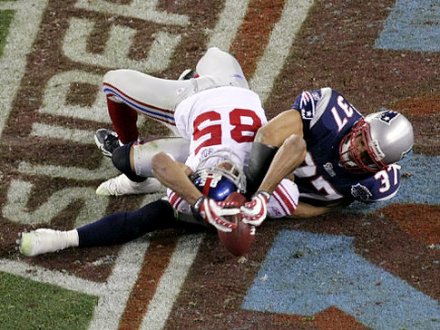
Before disemboweling, he was probably stretched out somewhat like David Tyree.

In fact, it was so dreadful (including many injuries in the distasteful rush for souvenirs) that they stopped doing it. Only gradually: Edward Marcus Despard, for instance, was sentenced to drawing and quartering, but they only hanged him to death and cut off his head posthumously. In 1814, that sentence — hanging plus posthumous beheading — formally replaced the old disemboweling-and-quartering bit as the penalty for treason.

(The invaluable CapitalPunishmentUK.org says that one James O’Coigley suffered hanging, drawing, and quartering in 1798 for that year’s Irish Rebellion; however, the Newgate Calendar’s record says that O’Coigley was “merely” hanged and beheaded, like Despard.)

On this day..

2010: Four in Equatorial Guinea

(Thanks to Meaghan Good of the Charley Project for the guest post. -ed.)

On this date last year, four Equatorial Guinean men were executed immediately after they were convicted of treason in a military court in the tiny African nation’s capital of Malabo.

The defendants, all former military officers, reportedly confessed to attacking the presidential palace in February 2009, supposedly in an attempt to assassinate the president, Teodoro Obiang Nguema Mbasogo.

Fortunately for him, he wasn’t in residence that day.

The attack had originally been blamed on Nigerian militants; in the aftermath, seven Nigerian men were sentenced to prison for their alleged involvement, and dozens of Nigerian expatriates were expelled from the country.

International observers castigated the trials and executions as not meeting international standards of fairness. This is no surprise, seeing as how Equatorial Guinea has one of the worst human rights records in the world.

According to Amnesty International, the four men weren’t even in the country at the time of the attack, having been exiled to Benin some years before. President Obiang’s agents abducted them from Benin in January 2010. Because of the “chilling speed” of the executions, none of the condemned had the opportunity to appeal the verdict and sentences or seek clemency, as Equatorial Guinea’s own law is supposed to provide.

José Abeso Nsue, Manuel Ndong Anseme, Alipio Ndong Asumu and Jacinto Michá Obiang (no apparent relation to his alleged target) were the only Equatorial Guineans known to have faced the death penalty that year.

On this day..

1510: Richard Empson and Edmund Dudley, tax collectors

On this date in 1510, the new king Henry VIII had his dad’s most hated tax collectors beheaded on Tower Hill.

Better days: Empson (on the left) and Dudley (on the right) pal around with Henry VII.

When Henry Tudor conquered Bosworth Field to emerge from the War of the Roses as King Henry VII, he brought the baggage of being the son of some Welsh squire.

His shaky legitimacy exposed the newborn Tudor dynasty to existential threats from every quarter; even putative allies proved liable to turn against him.

Henry consequently looked for every opportunity to centralize power away from institutions that could check or threaten him and into his own hands — nowhere more notoriously so than in the realm of taxation.* Aggressive tax collection would not only regenerate the crown’s blasted treasury; it would widen his own scope of action.

Whether Henry’s historical repute for cupidity is well-deserved is a topic beyond the scope of this site, but the fact that he does have such a reputation can be attributed in no small degree to this date’s featured players.

These two persons, being lawyers in science, and privy councillors in authority, as the corruption of the best things is the worst, turned law and justice into wormwood and rapine. … Neither did they, toward the end, observe so much as the half-face of justice, in proceeding by indictment; but sent forth their precepts to attach men and convent them before themselves, and some others, at their private houses, in a court of commission; and there used to shuffle up a summary proceeding by examination, without trial of jury; assuming to themselves there to deal both in pleas of the crown and in controversies civil. Then did they also use to inthral and charge the subjects’ lands with tenure in capite, by finding false offices, and thereby to work upon them for wardships, liveries, premier seisin, and alienations … When men were outlawed in personal actions, they would not permit them to purchase their charters of pardon, except they paid great and intolerable sums; standing upon the strict point of law, which upon outlawries giveth forfeiture of goods; nay, contrary to all law and colour, they maintained the king ought to have the half of men’s lands and rents, during the space of full two years, for a pain in case of outlawry. They would also raffle with jurors, and enforce them to find as they would direct, and if they did not, convent [summon] them, imprison them, and fine them. These and many other courses, fitter to be buried than repeated, they had of preyig upon the people; both like tame hawks for their master, and like wild hawks for themselves; insomuch as they grew to great riches and substance.

–Francis Bacon‘s History of the Reign of King Henry the Seventh

Richard Empson and Edmund Dudley were two powerful parliamentarians of less than lordly stature who had been elevated to this bad-cop role for their loyalty and aptitude. There, they became lightning rods for public resentment. It’s a path that had once taken a French counterpart from the common stock to the robes of state to (once his patron monarch died) the scaffold. Empson and Dudley trod it exactly.

Even in Henry’s lifetime, his newly intrusive taxes risked fearful public reaction.

The pretender Perkin Warbeck knocked Henry for the “robberies, extortions, the daily pilling of the people by dismes [tithes], taskes [contributions], tallages [tolls], benevolences, and other unlawful impositions and grievous exactions” he imposed, “agreeable to the meanness of his birth.” Tax backlash helped generate at least some of Warbeck’s popular support.

By the twilight of Henry’s rule in the first decade of the 1500’s, he had mastered these threats and could take advantage of political tranquility to really focus on his accounting. And he’d figured out that by ratcheting up enforcement of already-existing levies, he could avoid the dangerous confrontations that might result from summoning Parliament to ask it for money. It’s from this period most of all that he gets his historical Ebenezer Scrooge image, and the tool he employed for it, the Council Learned in the Law, got its extreme unpopularity.

Henry died in April of 1509 at the age of 52, leaving his son Henry VIII an overflowing treasury and countless grievances against the tax collectors who made it happen.

As the Council Learned’s leading lights, Empson and Dudley — “the king’s long arms with which … he took what was his” — immediately became targets once their royal protector was in the ground. They were hailed before the greenhorn king and the Privy Council to justify themselves within days of Henry VII’s death.

Interestingly, because a royal pardon amnestied all crimes except “felony, murder, and treason,” the malfeasance of these two councilors — whose real offense was unimpeachable loyalty to the last sovereign — had to be exaggerated into rather fantastical charges of treason in order to satisfy petitioners against them while avoiding undue embarrassment for the late king or the other aides who had served him.

In the year or so he lay in the dungeon awaiting his fate, “a pson most ignorant, and being in wordlie vexacon and trowble, also wth the sorrowfull and bitter remembrance of death,” Edmund Dudley wrote a treatise on the right arrangement of a society dedicated to the young new master who held Dudley’s life in his hands. The Tree of Commonwealth can be read here.

Yale professor Keith Wrightson introduces an interesting lecture — “Early Modern England: Politics, Religion, and Society under the Tudors and Stuarts” — with Dudley’s Tree of Commonwealth social schema.

Remember both, since now each thrive,
on perquisite ill gotten,
Empson & Dudleys case survives,
when they’re hang’d, dead, & rotten;

-From an 18th century colonial Virginia ballad titled “Remonstrance”, comparing this date’s centuries-old executed to a contemporary politician (Richard Beale Davis, “The Colonial Virginia Satirist: Mid-Eighteenth-Century Commentaries on Politics, Religion, and Society,” Transactions of the American Philosophical Society, Vol. 57, No. 1 (1967))

Update: The History of England podcast covers these two blokes here.

* The phrase “Morton’s fork” comes from Henry’s extractive machinations. Named for his Lord Chancellor John Morton, the original dilemma was a “fork” the crown used to stick taxpayers: those living high on the hog were made to pay up, since they obviously had enough to spare … and those living modestly were also made to pay, since they perforce must have saved enough to spare.

On this day..

1949: Husni al-Za’im, Syrian president

On this date in 1949, Syrian President Husni al-Za’im and his Prime Minister Mohsen Berazi were seized in a military coup, conducted to a court martial, and immediately put to death.

An ethnic Kurd, al-Za’im had cut his teeth in the armed forces of two different empires — the Ottoman and the French — before Syria attained independence following World War II.

The ambitious al-Za’im had got out from under a Vichy-era prison sentence for corruption and established himself as army chief of staff in time for the 1948 Arab-Israeli War.

Syrian forces’ underwhelming performance in this campaign set the stage for what would follow — both for al-Za’im and, arguably, down to the present day.

Syria actually sported an open and democratic polity; it had a successful election in 1947. But the civilian leaders were essentially wealthy landowners who, having successfully led the movement for independence, had scant agenda for actual governance save enriching themselves and their allies. It was “an edifice of nepotism and mismanagement … [a] creaking network of family patronage and administrative venality.”

A stagnant economy, kleptocratic elite, and political malaise came into sharp focus with the debacle of the Arab-Israeli War. Arab commander Fawzi al-Qawuqji would charge that feckless Arab elites ran the war “from behind their office desks, and in accordance with their own personal interests, ambitions, and whims.”

Encouraged by the United States — just then breaking into the growth industry of short-sighted oil patch coups — al-Za’im overthrew the civilian government to “put things right and restore this nation its honour, its dignity and its freedom.”

This undergraduate thesis makes a case for the Za’im coup as the turning point normalizing and privileging military intervention in Syrian politics. This was the fear of a young American diplomat in Syria, who reckoned American support for the coup “the stupidest, most irresponsible action a diplomatic mission like ours could get itself involved in … we’ve started a series of these things that will never end.”

So it was that on this date the next domino toppled, a counter-coup that ended al-Za’im’s installment of the dictatorship series most abruptly.

Colonel Sami Hinnawi, an officer who had served under Husni Zaim, then sat as president of a “higher war council” of 12 senior officers, which tried the President and Prime Minister and condemned them to death. Sentence was carried out at once at the Mezza fortress near Damascus. Mohsen Berazi was shot first. He protested, although Husni Zaim, who stood by waiting his turn, urged him to be quiet.

–London Times, Aug. 15, 1949

Hinnawi last another year before a relative of Mohsen Berazi assassinated him in revenge, and on it went. It was during Syria’s sequence of unstable military juntas in the 1950s that the young Hafez al-Assad earned his stripes in the Syrian air force.

Assad would eventually execute a much more permanent takeover, rule the country for 30 years, and upon his death in 2000, bequeath leadership to his son Bashar — a fellow who, as of this writing, stands in some danger of winning an entry of his own in these pages should his ruthless crackdown against pro-democracy protesters prove unavailing.

On this day..

1946: Andrei Vlasov, turncoat Soviet general

On this date in 1946, Soviet Gen. Andrei Vlasov and 11 fellow members of the Russian Liberation Army were condemned to death in Moscow for German collaboration, and immediately hanged.*

Vlasov was at the peak of his career at the outset of World War II, and earned a decoration for his part in defending Moscow against the Nazi invasion.

So far fortunate, the Red Army ran him out at the head of an army mounting an ill-fated attempt to lift the withering Siege of Leningrad.

Vlasov was encircled and captured.

And then, as a German prisoner, he switched sides.

The conversion of a top Soviet general, who now professed anti-bolshevism, was a stupefying propaganda coup for Germany, and the recent hero of Moscow was quickly employed authoring anti-Soviet leaflets and persuading POWs of the virtues of working for Berlin.

Somewhat more guarded were the Germans when it came to forming up the military unit our defector was supposed to be head of, the Russian Liberation Army, a phantom force of patriotic anti-communist Russians fighting for their country’s self-determination free of Uncle Joe.


By hanging other Russians from trees.

In reality, this “army” didn’t exist beyond the patches slapped onto the various anti-Soviet Russians who signed up to fight against the motherland. And it’s not too hard to reckon why.

Though Russian nationalism might be an expedient club to beat the Red Army with, it was just as liable to boomerang on a Reich itself bent on eastward expansion. A German interrogator of Vlasov in 1942 writing of the captive officer’s notions of national renewal concluded his report editorially (Russian link), “Russia for hundreds of years has constantly threatened Germany, regardless of whether it was the tsarist or the Bolshevik regime. Germany is not interested in reviving the Russian state.”

Besides, given the Nazis’ racial ideology, could these Slavs be trusted in a pinch? Enough to hand them their own command structure? The thousands of eastern front POWs who volunteered to serve Berlin could be suspected of having made the devil’s choice due less to principled anti-Stalinism than the fearful privations of a German camp. (Vlasov himself is often accused of changing teams for some venal reason of cowardice or greed.)

Only late in 1944, when the prospective long-term problems of Russian nationalism had been rendered academic to Berlin by the progress of the war, did the scattered collaborator units get organized into an actual army under Vlasov’s command.

The ineffectual ROA only got into one real scrap with the Red Army, and confirmed German suspicions about Slavic reliability in the last days of the war by turning its German guns against the SS in support of the Czechs’ Prague Uprising.

But surely nobody counted on returning to Stalin’s good graces with this last-second conversion.

From that successful engagement, Vlasov’s men fled out of Prague towards the American occupation zone, desperate not to be taken by the Red Army.

They made it. But after just a few days in American hands, Vlasov was turned over at a Russian checkpoint.

Though structured by the Allied powers’ Yalta accords, which stipulated repatriation into Stalin’s hands of any Soviet citizens held in the West, Vlasov’s handover might at the moment have been part of what must have been innumerable quid pro quo arrangements to sort out command and control in the disaster area late dignified as the Third Reich.

Historian Patricia Wadley has hypothesized that Vlasov’s detention by the Soviets conditioned the landing just an hour later of an airlift to evacuate the airman’s POW camp Stalag Luft I from behind Soviet lines.

However they got their hands on him, the Soviets made no mistake once they had him. Most of Vlasov’s junior officers were executed, and his rank and file dispatched to Siberia. The brass got a three-day trial — in camera, not a show trial; they were still defiant — from July 30 to August 1, with the inescapable result.

Vlasov’s legacy after the fact remains debatable. In the official Soviet story, of course, he’s a Nazi collaborator and that’s that. Aleksandr Solzhenitsyn attempted to vindicate Vlasov in The Gulag Archipelago, and one can find pro-Vlasov posts and tributes — but post-Communist Russia has shown no interest in overturning the verdicts against the ROA.

One might allow him sincerity in his convictions, but only at the cost of allowing that his movement had no independent force in the war save what Germany breathed into it for Germany’s own reasons. Something like that holds true for nearly every human being caught up in the eastern front in those terrible years.

Some have characterized Vlasov a vile collaborator; others have seen him as a Russian national hero. Neither description quite fits. Andrei Andreevich Vlasov, given to drink and fits of fatalism and inertia in captivity, lacked the sterling character deemed essential for a martyr. On the other hand, the ROA chief was anything but a Nazi — he caused his German supporters discomfort with his strong Russian nationalism and his personal refusal to lend his voice to the prevailing, official anti-semitism. He possessed neither a Quisling‘s moral blindness to questions of patriotism nor a Joan of Arc‘s penchant for self-immolation. He came closer to the mean of most humans, aptly personifying the nightmarish predicament which confronted millions of the Eastern Front’s victims. Vlasov, like multitudes of other helpless Soviet citizens, was cruelly pulverized between the enormous and unfeeling millstones of Nazism and Communism. Shuffled about Europe’s wargame board, first by Stalin, then by Hitler, Vlasov was a pawn in the epic struggle just like the lowliest POW or forced laborer. He fantasized a Russia minus Marx, and though his failure was complete, he still came closer than any other Russian since the Civil War to fulfilling that dream.

-Mark Elliott, “Andrei Vlasov: Red Army General in Hitler’s Service,” Military Affairs, Apr. 1982

* Vlasov’s execution was announced in Pravda on Aug. 2, but with no reference to the precise time. (The sentence was certainly issued in the very early morning of Aug. 1.) Though some sources continue to list Aug. 2 as Vlasov’s execution date, Aug. 1 seems much better attested.

On this day..

1602: Charles de Gontaut, duc de Biron

On this date in 1602, Charles de Gontaut, duc de Biron, was beheaded in the Bastille for treason.

The son of a celebrated soldier* in the intractable French Wars of Religion, Charles de Gontaut (English Wikipedia page | French) was no slouch himself on the battlefield.

Henri of Navarre, in prevailing over his rivals for power in France and becoming King Henri IV, had good cause to appreciate Gontaut’s service, and even consider the man a friend.

But our Gontaut, having ascended the posts of Admiral, Marshal, Governor of Burgundy — and, of course, Duke — still coveted greater prestige. “Ambitious, arrogant, and of no great intelligence,” is this popular history’s judgment. (p. 360)

So he started conspiring with the Duke of Savoy — even as Gontaut bore the French standard in the field against this same character — for an arrangement to set himself up as an independent ruler or otherwise do something seriously deleterious to Henri’s kingdom.

The stories consistently report (pdf) that the lenient Henri was disposed to pardon his man if Gontaut would but make the show of submission implied in begging pardon, confessing his sin, vouchsafing loyalty, and all the rest of it, but out of pride and/or stupidity, Gontaut did not do it.

This fatal vanity recommended the Duc de Biron as a character study for his contemporary, English playwright George Chapman, whose The Conspiracy and Tragedy of Charles, Duke of Byron was published in London (heavily censored, at the insistence of the French ambassador) in 1608.

* Charles de Gontaut’s father, Armand de Gontaut, was also godfather to the child who would grow up to become Cardinal Richelieu.

On this day..

1990: Gideon Orkar, for a Nigerian coup

On this date in 1990, Nigerian Major Gideon Gwaza Orkar and dozens of others* were shot for a coup attempt against that country’s military strongman, Gen. Ibrahim Babangida.

Orkar was the guy on state radio early on the morning of April 22 announcing the revolution:

On behalf of the patriotic and well-meaning peoples of the Middle Belt and the southern parts of this country, I , Major Gideon Orkar, wish to happily inform you of the successful ousting of the dictatorial, corrupt, drug baronish, evil man, deceitful, homo-sexually-centered, prodigalistic, un-patriotic administration of General Ibrahim Badamosi Babangida.

The dictatorial, drug baronish evil man had himself come to power in a 1985 coup, and when not fending off coups kept busy reorganizing the state to his satisfaction and stalling on the promised civilian handover. (“IBB” ultimately held an election in 1992, invalidated the result, and turned over power the next year to understudy dictator Sani Abacha.**)

Said state reorganization was not to the liking of Orkar et al, and the putsch broadcast accused Babangida of wanting to make himself into a president-for-life.

Intriguingly, the broadcast also proffered a strong regional critique of “the favoured class and their stooges” who were gobbling up “the supposedly national wealth derived in the main from the Middle Belt and the southern part of this country, while the people from these parts of the country have been completely deprived from benefiting from the resources given to them by God.”

Accordingly, the government of the abortive coup intended “a temporary decision to excise the following states namely, Sokoto, Borno, Katsina, Kano and Bauchi states from the Federal Republic of Nigeria.” Those states, at the time, constituted the entire northern band of Nigeria, which was also the stronghold of Islam in Nigeria. (Babangida was a Muslim, as was his successor.)

What “excision” of the northern states might have meant in practice was never realized, since Babangida escaped his would-be usurpers and prevailed when the sides fought it out over the course of April 22. One survivor of the coup later described the grievance in these words: “Anytime we went to the Hausa areas in the North, we were given Hausa and Islamic regalia and if you didn’t wear it, they would not be happy with you. It got to a stage that if you were in the Army, you have to speak Hausa.”

So, if inclined to cast a gimlet eye upon the inroads of sharia in those same northern states, one might view Orkar as some sort of prophet. He and his comrades certainly strike many as a nobler and more far-sighted clique than the usual “autocratic general” type.


On trial for their lives: from left to right, Capt. Harley Empere, Major Gideon Orkar, Capt. Perebo Dakolo, Lt. Cyril Ozoalor, Lt. Nicholas Odeh

Despite the fate of Orkar and others this date, some of the plotters managed to escape the country to a better fate. For instance, Major Saliba Mukoro fled to the United States, got advanced degrees in criminal justice, and was a Mississippi Valley State University professor prior to returning to run for a governorship in 2011. (He lost.)

* Amnesty International makes it (pdf) 42 on this date, including Orkar and nine other officers — plus 27 others executed on September 13. Most of the executed and some other casualties of the affair are enumerated here.

** Abacha is the guy who hanged Ogoni poet/activist Ken Saro-Wiwa.

On this day..

1844: The Bandiera brothers

On this date* in 1844, the Italian nationalists Attilio and Emilio Bandiera were shot with seven companions at Cosenza, Italy.

The Bandieras (English Wikipedia page | Italian) were Venetian officers in the Austrian navy — sons, indeed, of an admiral in that service.

Having been caught out in a mutinous agitation, the patriotic lads had been obliged to flee to Corfu (then under British administration)

But whispers soon reached them of a nascent rising in the Kingdom of the Two Sicilies, and they took a small party to the toe of the Italian boot looking to get in on the glory.

They didn’t find the rumored revolutionaries — just martyrdom.

Reprieves preserved eight of the seventeen death-sentenced for the escapade; shot along with the renowned national martyrs together crying “Viva l’Italia!” were Nicola Riccioti, Domenico Moro, Anarcharsis Narde, Giovanni Verenui, Giacomo Rocca, Francesco Berti, and Domenico Lapatelli. (London Times, Aug. 12, 1844)

Venice visitors can pay their respects to the two at the Church of San Giovanni e Paolo, where they’re buried.

* There are some citations for July 23 out there, but the numerical bulk of the sources, and those closest to the event itself, clearly prefer July 25. e.g., the London Times of Aug. 12, 1844 cites the Journal of the Two Sicilies in reporting July 25; as noted by Mazzini and Marx, then-exiled Italian risorgimento figure Giuseppe Mazzini, who corresponded ineffectually with the martyrs, published a poem for this anniversary date in the July 25, 1846 edition of the Northern Star:

And in distant years the story
Still shall our children tell
Of those who sleep in glory
At Cosenza where they fell.

On this day..

1588: Nicholas Garlick, Robert Ludlam, and Richard Simpson

On this date in 1588, three Catholic priests were hanged, drawn, and quartered at St. Mary’s Bridge in Derbyshire.

Though we find Catholic proselytizers at risk of their lives throughout the Elizabethan period, at few moments was the profession of the Old Faith more fraught than during the summer of 1588.

Elizabeth’s Catholic rival Mary, Queen of Scots had lost her head just the year before, having been the focal point of one too many Catholic plots to overthrow Elizabeth. England’s support for Dutch Protestants rebelling against Spain had drawn the Spanish Armada, a feared invasion force even at this moment beginning to engage the English navy a couple of weeks ahead of its ultimate defeat. Even the French Wars of Religion were running white-hot, with an ultra-Catholic pogrom in Paris that spring.

If ever the wrong religion constituted treason, this was the time.

This also made it a great moment for zealous local authorities to crack down on suspected Catholics. When that happened in Derbyshire, a raid of a recusant‘s property (prompted by a tip from the target’s nephew) turned up two Popish clerics living in the lovely medieval manor house on-site, Padley Chapel.


Padley Chapel. (cc) image from kev747.

Fathers Nicholas Garlick and Robert Ludlam were condemned within days to a traitor’s death for endeavoring to “seduce” the Queen’s subjects to Catholicism.* Their few hours left in this vale of tears were sufficient to firm the resolve of a wavering fellow-priest, Richard Simpson, who joined Garlick and Ludlam on the scaffold.

A hagiography of these men — they have all since been beatified — notes that the less steely Simpson “suffered with great constancy, though not with such (remarkable) signs of joy and alacrity as the other two.” But considering he was out there getting disemboweled for God and you’re just sitting around reading some blog, you probably ought to cut him a little slack.

When Garlick did the ladder kiss,
And Sympson after hie,
Methought that there St. Andrew was
Desirous for to die.

When Ludlam lookèd smilingly,
And joyful did remain,
It seemed St. Stephen was standing by,
For to be stoned again.

And what if Sympson seemed to yield,
For doubt and dread to die;
He rose again, and won the field
And died most constantly.

His watching, fasting, shirt of hair;
His speech, his death, and all,
Do record give, do witness bear,
He wailed his former fall.

There are still pilgrimages made in honor of the “Padley Martyrs” every year on the anniversary of the priests’ arrest, July 12.

* Garlick, at least, had been a specific target of priest-hunters for some time; he appears in reports to Francis Walsingham‘s spy network, where he is once accursed as “the demonite,” presumably for taking part in some well-publicized exorcisms in 1585-1586. (These exorcisms seem to be reflected in Shakespeare’s King Lear.) There’s a very large pdf touching the “demonite” reference: a scan of the public-domain 19th century tome The Troubles of our Catholic Forefathers.

On this day..