1868: Three Italian bandits

On this date in 1868, a trio of notorious Italian brigands went under the French guillotine in Marseilles.

Joseph Coda-Zabetta, the leader, had escaped a hard labor sentence in Italy and fled to France where he founded a large band of robbers who terrorized France’s Mediterranean countryside from Nice to Marseilles for some months in 1867.

From raiding unoccupied country homes the gang soon progressed to bold invasions of occupied houses and waylaying travelers. “In one instance,” a press report of their trial reported,* “six of the band attacked a convoy of carriers, one of whom received a pistol-shot in the breast and a stab with a knife, from which injuries he afterwards died.”

Twelve of the band faced trial, and four of their number received death sentences. (Seven others had long prison sentences; a man named Muletto was acquitted.)

Coda, Antoine Quaranta, and Felix Mardi (Italian pdf) were all guillotined on this date in 1868. (They died, it was said, repentant (French).) The fourth condemned prisoner, Jacques Mulatere, had his death sentenced commuted to life at hard labor.

* London Times, Dec. 20, 1867

On this day..

1348: The Duke of Durazzo, all in the family

The Neapolitan King Robert “the Wise”* dominated Italian politics for his 34-year reign, but his death in 1343 left a disastrously disputed succession.

Robert, who hailed from the French House of Anjou, had had only two sons, and they both predeceased him. So Robert’s will designated his granddaughter Joanna as his successor, and her sister Maria as no. 2 in line should Joanna die without an heir.

But Joanna was 16 years old, and Robert had had three brothers whose lines each coveted a taste of Neapolitan for themselves. In particular, the family of Robert’s oldest brother, whose descendants had managed to establish an Angevin ruling dynasty in Hungary, arguably had a better claim that Robert himself. So in an effort to cement the Joanna-plus-Maria succession plan, Robert married Joanna off to a child of that branch, Andrew, Duke of Calabria.

Maria, for her part, had been intended for another dynastic marriage, but after Robert’s death she got abducted by the heirs to the youngest of Robert’s brothers and married off to Charles (or Carlo), Count of Gravina and Duke of Durazzo (English Wikipedia entry | Italian). This set their branch up to be a player for Robert’s patrimony, too; as one may infer from this character’s presence on this here execution blog, the play didn’t go to plan.

Dumas reckoned Charles an inveterate, and a sinister, schemer, “one of those men who to gain their end recoil at nothing; devoured by raging ambition and accustomed from his earliest years to conceal his most ardent desires beneath a mask of careless indifference, he marched ever onward, plot succeeding plot … His cheek grew pale with joy; when he hated most, he smiled; in all the emotions of his life, however strong, he was inscrutable.”

Now that we have the dramatis personae … to the action!

Nice knowin’ ya, Andrew. 1835 watercolor of his murder by Karl Briullov.

Robert was scarcely cold in his coffin when Joanna’s husband Andrew (supported by a faction within the Neapolitan court) began maneuvering for more power. Days before he was to capture a strategic hilltop in that campaign by becoming crowned in his own right in September 1345, a conspiracy of his rivals surprised Andrew on a hunting trip and murdered him — violently subduing the resisting teenager until they could strangle him to death and pitch him out a window. Joanna cowered in her bed as her shrieking husband was snuffed; the suspicion of her involvement in the plot would follow her all the 37 years she had left on this earth, although she defeated the charge when she was formally investigated.

With this stunning act, peninsular politics got almost as messy as the Angevin family tree.

Andrew’s murder, which was succeeded by no simulation of punishing any guilty parties, opened a power vacuum and simultaneously supplied all Andrew’s power-hungry kinsmen the ideal pretext for elbowing their respective ways into it. The Hungarian Angevins, led by the murdered Andrew’s big brother King Louis I swept into Naples, routing Joanna** who was forced in 1348 to flee to the pope at Avignon, maybe on the very ships that were at this very moment introducing the Black Death from Sicily to ports all over Europe.

Cousin Charles made an expedient alliance with cousin Louis and joined the fun, angling to add Naples to his own domains once the dust settled and Hungarian affairs pulled Louis away. But almost immediately after expelling Joanna, the Hungarian king turned on Charles, too. In Dumas’s dramatic rendering, he accuses Charles of complicity in Andrew’s murder and treachery against his own royal person.

Traitor! At length you are in my hands, and you shall die as you deserve; but before you are handed over to the executioner, confess with your own lips your deeds of treachery towards our royal majesty: so shall we need no other witness to condemn you to a punishment proportioned to your crimes. Between our two selves, Duke of Durazzo, tell me first why, by your infamous manoeuvring, you aided your uncle, the Cardinal of Perigord, to hinder the coronation of my brother, and so led him on, since he had no royal prerogative of his own, to his miserable end? Oh, make no attempt to deny it. Here is the letter sealed with your seal; in secret you wrote it, but it accuses you in public. Then why, after bringing us hither to avenge our brother’s death, of which you beyond all doubt were the cause,–why did you suddenly turn to the queen’s party and march against our town of Aquila, daring to raise an army against our faithful subjects? You hoped, traitor, to make use of us as a footstool to mount the throne withal, as soon as you were free from every other rival. Then you would but have awaited our departure to kill the viceroy we should have left in our place, and so seize the kingdom. But this time your foresight has been at fault. There is yet another crime worse than all the rest, a crime of high treason, which I shall remorselessly punish. You carried off the bride that our ancestor King Robert designed for me, as you knew, by his will. Answer, wretch what excuse can you make for the rape of the Princess Marie?

Charles was put to summary death upon this accusation on January 23, 1348.

As for the Princess Marie, who at this point was 18 years old and had already borne Charles five children in almost continuous succession, she wasn’t done being abducted: another nobleman, the Lord of Baux, snatched her from the Castel dell’Ovo later that same year and had four more children with her before Maria had him murdered in 1353. Then she married yet another cousin and had five more kids by him.

* Fruit of the Angevin dynasty that had dispossessed the Hohenstaufens the previous century.

** Joanna tried to shore herself up ahead of the invasion by remarrying another cousin, Louis of Taranto.

On this day..

Feast Day of Saint Agnes

January 21 is the feast date and traditional martyrdom date (in the year 304) of Agnes of Rome, a 13-year-old put to death in the Diocletian persecutions who has the distinction of being among the seven women mentioned by name in the Catholic Canon of the Mass.

Agnes means “chaste” in Greek,* and this was precisely the problem.

As prosperous as she was pulchritudinous, she was pious even moreso and spurned the many suitors for her hand and bed. Eventually one or the other of them peevishly reported her as a Christian.

Upon arrest, the abstinent youth was allegedly subjected to an official program of sexual assault, including displaying her naked in public and forcing her into a brothel. It’s said that divine intervention prevented her violation in these ordeals. (The flowing locks in the Ribera portrait of her at right are part of that myth, supposed to have sprouted long enough to save her from her public shaming.)

Considering that her defining characteristic is her virginity, Agnes has quite the lurid legend — and that does not exclude her very martyrdom. Per the erotically-charged poetic account of the 4th-5th century Christian poet Prudentius,** Agnes rejoiced sensually in the executioner sent to to render her to her heavenly bridal-bed:

I rejoice that there comes a man like this,
A savage, cruel, and wild warrior,
Rather than a languid, soft,
Womanish youth fragrant with perfume,
Come to destroy my life with the death of my honor.

This lover, this one at last, I confess, pleases me.
I shall rush to his eager steps
And not demur from his hot ardor.
I shall welcome the entire length of
His blade into my bosom, drawing the sword-blow
To the depths of my breast.

Original Latin here from Prudentius’s Liber Peristephanon (Crowns of Martyrdom)†

Agnes, whose purported relics are interred in the Roman church Sant’Agnese in Agone, is the patron saint of an entire pantheon of feminine sexual incipience: chastity, virgins, young women, and betrothed couples.‡

Little surprise, then, that the legend arose in Christendom that a maid could invoke the vision of her future husband by performing certain suggestive rituals — like lying supine and naked on her bed — on the eve of St. Agnes (that is, the night of January 20).

It’s upon this occasion that Keats pins his narrative poem The Eve of St. Agnes§ (full text here or here), in which a young woman performing these rites is in her dreamlike state deflowered by the desired suitor her family forbids — and then the two slip away by night “o’er the southern moors.”

Beyond a mortal man impassion’d far
At these voluptuous accents, he arose,
Ethereal, flush’d, and like a throbbing star
Seen mid the sapphire heaven’s deep repose;
Into her dream he melted, as the rose
Blendeth its odour with the violet,–
Solution sweet: meantime the frost-wind blows
Like Love’s alarum pattering the sharp sleet
Against the window-panes; St. Agnes’ moon hath set.


The Eve of St. Agnes, by John Everett Millais (1863) shows Keats’s Madeleine about to disrobe before taking to bed on that occasion. The Keats poem was very popular with Millais’s pre-Raphaelite crowd.

* It’s also similar to the Latin word for lamb, agnus; consequently, the lamb is Agnes’s usual iconographic symbol.

** Prudentius, best-known for his seminal allegorical verse Psychomachia, composed a number of hymnal poems. Some are still in use today — such as “Of the Father’s Love Begotten”.

† Translation has a few tweaks of my own but is primarily that of Colbert I. Nepaulsingh in “The Afrenta de Corpes and the Martyrological Tradition,” Hispanic Review, Spring, 1983.

‡ She’s also the patron saint of rape victims.

§ Tennyson later wrote a short poem of his own touching the same theme, “St. Agnes’ Eve”.

On this day..

1944: Max Sievers, freethinker

On this date in 1944, German freethinker Max Sievers was beheaded at Brandenburg Prison for “conspiracy to commit high treason along with favouring the enemy.”

A working-class Berliner, Sievers (English Wikipedia entry | German) became a prominent communist and atheist writer in the interwar years. He directed the Association of Freethinkers for Cremation from the early 1920s, and in 1927 became the chair of the German Freethinkers League.

This was not a demographic Adolph Hitler was courting. In the wake of the 1933 Reichstag Fire, the Nazis stamped out atheistic movements, even converting the Freethinkers’ building into a Protestant recruitment venue.

Briefly imprisoned, Sievers fled Germany upon his release later in 1933 and from exile in Belgium — and then, after Belgium was conquered, in hiding in France — he kept up a drumbeat of antifascist propaganda, notably the 1939 book Unser Kampf gegen das Dritte Reich: von der nazistischen Diktatur zur sozialistischen Demokratie.

He was finally arrested by the Gestapo on June 3, 1943, and condemned to death by Roland Freisler.

Sievers was posthumously exonerated in 1996, and is today — and on January 17th in particular — an honored martyr for German humanist, atheist, and freethinker groups.

On this day..

1909: The Pollet gang, breaking the French moratorium

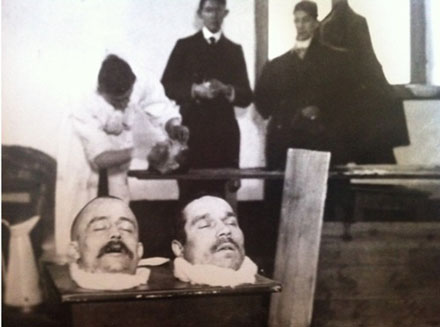
Warning: Graphic severed head pictures await at the bottom of this post.

On this date in 1909, the guillotine returned France after an absence of more than three years.

The sitting president was a staunch death penalty opponent and had blocked all executions since his term began in 1906. That was about the same span of time that the Pollet gang had, in the words of a New York Times wire report,* “infested the Belgian-French frontier, robbing churches, houses, and inns, holding up stage coaches and belated travelers, and torturing and slaying their victims according to the old piratical adage that dead men tell no tales.”

Abel Pollet had been a smuggler who put his native gift for leadership to good use organizing his fellow traffickers into a more lucratively violent line of work. Thanks, presumably, to the syndicate’s pre-existing professional aptitude for evasion, it persisted for years and authored a quantity of robberies and murders that authorities could only guess at. (The official homicide estimation ran north of 50.) It was a spree so atrocious that it helped force the end of the whole death penalty moratorium since sentiment was so strong against the Hazebrouck gang .

Incited by the many depredations and perhaps starved from years without the bloody spectacle of public execution, a vast concourse of 30,000 mobbed the guillotine at Bethune.

“At midnight there were 2,000 watchers in the square,” one report ran. “The main street of the town was crowded as on the eve of a fete. Soon after midnight men brought ladders and benches to the square and mounted them to obtain an uninterrupted view. Others climbed into the branches of trees, where their presence was revealed by the glow of cigarettes and pipes in the dark among the branches.”

Undeterred by the steady winter’s drizzle, they would wait all the night through, their numbers continually augmented as road-trippers arrived by train.

At four in the morning the dread traveling executioner Anton Diebler, who had already plied this trade for a generation and more and would continue in the role for another 30 years, arrived with four assistants to set up the guillotine. It was only with difficulty that police restrained the pawing mob.

By half-past five the public prosecutor officially informed the condemned men what they surely already knew — that there would be no mercy. The crowd on the square would have its prey.

As the first robber, Theophile Deroo, emerged at 7:25 a.m., “there was a painful silence, and then an outbreak of hoots and curses from the crowd.” A wilting Deroo had to be hustled to the board amid the jeers. “A mort! A mort!” came the howls.

Three times in the next eight minutes the executioners furiously scrubbed the apparatus clean while guards (per the Times) “held the crowd back with main force.”

Canut Vromant followed coolly; Auguste Pollet was third, fighting and shouting. His brother, the leader Abel Pollet, went under a rain of curses that he answered with the words “Down with the priests! Long live the Republic!”

People are ghoulish. Far be it from us to deny them.


Top: the heads of the Pollet brothers. Middle: The heads of their two accomplices. Bottom: Canut Vromant’s headless trunk awaits autopsy. All images from the invaluable Bois de Justice, via this goregrish forum.


After the quadruple executions, the heads are cleaned up. (Source)

Perhaps, dear reader, you find the public exhibition of these severed heads objectionable. If so, you have an ally in the French state that did the severing.

For years, French elites had been fretting the indecorous behavior of the crowd at what was supposed to be a solemn occasion. The advent of photography only made matters worse, for now the discomfiting head-chopping exercise could be shared with those indisposed to sitting up all night smoking pipes in trees.

But as the moratorium gave way, the rising media form of cinema promised even more debased exhibitions. Enterprising cinematographers were already staging execution re-creations; now there was the prospect for film audiences to be incited to countless bloodlust frenzies by on-the-scene deathporn footage of hated criminals going under the blade. It was in response to just this fear that France a bit later in 1909 promulgated (French link) its first film censorship rules — forbidding in this case the public display of film liable to disturb the public tranquility.

* Jan. 16, 1909 … under the excited headline “THIRST FOR BLOOD AMONG THE FRENCH”,

On this day..

2013: Rizana Nafeek, Sri Lankan maid

A year ago today, a blindfolded, white-clad Rizana Nafeek had her head chopped off in public in Dawadmy, near the Saudi capital of Riyadh.

Rizana Nafeek, a Sri Lankan, was among the numerous foreign laborers routinely imported to Saudi Arabia for domestic work. There are an estimated 1.5 million migrant domestic workers in Saudi Arabia from South Asia (especially Sri Lanka), Nepal, Indonesia, East Africa, and the Philippines. Most are employed via the kafala (“sponsorship”) system that places their host in an almost lord-like position of authority.

Such workers are excluded from Saudi Arabia’s labor protections, and as a result stand vulnerable to horrifying abuse.* Household heads often confiscate these workers’ passports, and in some cases have subjected their domestic employees to rape, beatings, wage confiscation, and work weeks of 100-plus hours. One Sri Lankan woman had nails driven into her hands when she complained about overwork.

Rizana Nafeek hardly had time to find out whether any of these perquisites were in store for her. Not long after she arrived in Saudi Arabia in 2005 hoping to make enough money as a domestic drudge to move her impoverished family into a house, she had bottle-feeding duties for her host family’s infant foisted upon her. Nafeek had no training in caring for infants.

In May 2005, that child began choking while in Rizana’s care, and her panicked shouts summoned the mother. By the time the mother arrived, the infant had fallen unconscious, and the upset family immediately handed over their maid to the police, accusing her of strangling the baby.

This was the victim for whom Nafeek was decapitated, and also perhaps an illustration of tunnel vision in law enforcement. It’s quite doubtful whether there was ever any objective basis for supposing a homicide, but the fact that this was the color the family gave to events in the horror of the moment set in motion all the ensuing events.

During the investigation leading up to her 2007 trial and condemnation, Nafeek confessed to smothering the child — but she would later claim this confession was tortured out of her, and that the baby simply started choking on its bottle. (There was never a post-mortem on the dead baby.)

Opaque as the Saudi Arabian criminal justice system is, it’s got ample reputation for obtaining confessions by violence, and for mistreating migrant workers. And the accused had scant legal representation and no translator when she was tried for her life in a Saudi court.

After her conviction, it would also emerge that, order to land her the gig, Nafeek’s Sri Lankan recruiting agency falsified her papers to bump her age up past the legal minimum of 21. Rizana Nafeek arrived in Saudi Arabia carrying a passport that said she was born in 1982, making her 23 years old when she committed the supposed murder … but her birth certificate said that she was born in 1988, and was still a minor when the “murder” took place.

As an international clemency push developed for the potentially-innocent underaged migrant worker, the Saudi government strongly rejected its critics’ charges.

Noting that the dead infant’s family refused repeated blandishments of “blood money” to exercise its right to grant clemency, Riyadh officially “deplore[d] the statements made” by Rizana’s supporters “over the execution of a Sri Lankan maid who had plotted and killed an infant by suffocating him to death, one week after she arrived in the kingdom.”

More sympathetic Saudis, undoubtedly meaning well, offered Rizana Nafeek’s family cash compensation after the young woman was beheaded. That money, too, was angrily refused.

“I will not accept any gifts from the Saudis or the Saudi government which murdered my daughter,” mother Saiyadu Farina told a Sri Lankan newspaper. That anger was widely shared in Sri Lanka; Colombo even recalled its Saudi ambassador in protest.

That’s as may be, but money is sure to carry the argument at the end of the day. Wage remittances by overseas laborers are a massive boon to the island nation, amounting to $6.3 billion in 2012 — 8.8% of the Sri Lankan economy. And Saudi Arabia remains the single largest employer (pdf) of Sri Lankans abroad.

As of the time of Rizana Nafeek’s execution, at least 45 other foreign domestics, most of them Indonesians, were also awaiting execution on Saudi Arabia’s death row.

* Ill treatment of migrant domestic workers is a phenomenon elsewhere in the Middle East, and elsewhere around the world.

On this day..

1690: Andrei Ilyich Bezobrazov, stolnik

On this date in 1690, the Russian stolnik (an administrative office in the Russian court) Andrei Ilyich Bezobrazov was put to death with the magicians he allegedly contracted to bewitch Tsar Peter the Great.

Whatever its other sins, Russia enjoys a reputation for having largely steered clear of the frightful witch-hunts that broke out elsewhere in Europe. Certainly tsars issued many decrees against witchcraft and even prescribed the death penalty in law. But unlike courts in western Europe, Russia does not seem ever to have folded the entire swath of extra-Christian folk beliefs and everyday peasant “magic” together into a juridical theory of omnipresent diabolical terrorism stretching from the neighborhood midwife to the Prince of Darkness himself. Perhaps for that reason, its historical record of witch persecutions presents fewer and more scattered data points.

Elites, write Valerie Kivelson and Jonathan Shaheen,* “demonstrated no interest in formulating a systematized or theorized framework for explaining the uncanny power of magic [and] they also made no effort in their courtrooms to unearth evidence of such a framework … Instead of pursuing connections to the devil, Muscovite judges exerted themselves to track the lineages and results of magic: Who taught you? Whom have you taught? Whom have you bewitched? The judges’ concerns were concrete and this-worldly: who were the victims and who were the victimizers?”

Unfortunately for Bezobrazov, his victim was the tsar himself.

Bezobrazov allegedly obtained the service of “sorcerers and witches” who worked magic “on bones, on money and on water” to enspell the new 17-year-old sovereign during the uncertain period after Peter threw off the regency of his older sister Sophia. Despite Peter’s ultimate reputation as Russia’s great westernizer, the immediate effect of this transition was an oppressive interregnum wherein conservative religious interests took advantage of the new sovereign’s distraction from internal Russian politics to reassert themselves violently.

For Bezobrazov, political turnover augured personal uncertainty. The innocent explanation for his “witchcraft” was invoking a little ritual in hopes of catching a favorable assignment in Peter the Great’s new Russia. It didn’t work.

Bezobrazov was beheaded on Red Square on this date at the same time two folk healers went to the stake with their magic talismans and healing herbs at a swamp across the Moskva from the Kremlin. An essay in this Festschrift describes what it’s like to be a peasant folk healer suddenly under investigation for regicide.

Dorofei Prokofiev … had treated animals belonging to the Bezobrazov household. But when arrested and interrogated, Dorofei did not identify himself as a “sorcerer,” but rather as a posadskii chelovek (artisan), specifically a horse-trainer (konoval) and a blood-letter (rudomet’). He admitted to practicing bean divination and palm reading in addition to treating the illnesses of children and adults with herbs and incantations. His bag contained beans, incense (for protecting brides and grooms from sorcerers, Dorofei said), and a variety of herbs. The herb bogoroditskaia (= royal fern) he gathered himself on St. John’s Day, while reciting the charm “whatever you, herb, are good for, be good for that.” But he denied ever casting a spell to harm the sovereign, and he claimed not to be acquainted with Andrei Bezobrazov — a lie that was quickly uncovered when Dorofei was subjected to torture. At that point Dorofei changed his story: Bezobrazov had asked him to cast a spell on the tsar, but only to make him feel favorably towards Bezobrazov, not to damage the sovereign’s health. Dorofei gave his interrogators examples of the incantations that he used in fortune-telling, all intertwined invocations of Christian figures with sympathetic magic. In short, Dorofei tried to rescue himself by claiming that his healing and fortune-telling activities were all well-intentioned. But the investigators, and Peter himself, were convinced of Bezobrazov’s guilt, which meant Dorofei was guilty as well. Bezobrazov was beheaded, and Dorofei was burned at the stake as a witch.

For everyday folks like Dorofei Prokovie, the author notes, “well-positioned patrons could be either a source of protection or of danger.”

According to Crime and Punishment in Early Modern Russia, which is also the source of the January 8 date, Bezobrazov’s wife was punitively tonsured for not reporting the “plot” and several other of Bezobrazov’s peasants were knouted and sent to Siberia.

* “Prosaic Witchcraft and Semiotic Totalitarianism: Muscovite Magic Reconsidered” in Slavic Review, vol. 70, no. 1 (Spring 2011)

On this day..

1355: Ines de Castro, posthumous queen

On this date in 1355, the 29-year-old lover of the Portuguese crown prince was put to summary death by the reigning king’s minions.

Ines de Castro (English Wikipedia entry | Portuguese) would be posthumously acknowledged as queen on the say-so of her ex, whom everyone obeyed because he was called Peter (Pedro) the Cruel.

But in the years before Ines’s death you could just call him loverboy.

As a young man, Peter got plugged into a typical dynastic marriage with Constance of Panafiel, a descendant of kings of Castille and Aragon.*

In Constance’s entourage came the enchanting Ines, the daughter, albeit illegitimate, of a Galician nobleman.

Peter was entirely smitten by entirely the wrong woman. Vainly did the Portuguese sovereign Afonso IV strive to conform his indiscreet son to the demands of conjugal propriety. At last, the put-upon Constance died after bearing Peter his heir in 1345 and left the field to her rival.

Afonso steadfastly refused to let his lovestruck son marry Ines, and even tried banishing her to Castile, but the two carried on their forbidden passion secretly like they were in poetry, which would soon be the case.


One of 20-plus operas and ballets about Ines de Castro. She also turns up in the Portuguese national epic The Lusíadas, the French play La Reine Morte, and Ezra Pound’s Cantos (“Ignez da Castro murdered, and a wall / Here stripped, here made to stand”) … among many other literary appearances.

But beyond any qualms of prudery, Peter’s obsession made dad sweat the politics.

Peter refused to marry anyone else, and got tight with Ines’s brothers. These guys were Castilian exiles with their own axes to grind. Was the whole fortune of his house and his realm to fall under the sway of this unpredictable faction just because Peter couldn’t keep it in his codpiece? The affair had already made a dog’s breakfast of the alliance Peter was supposed to contract with his scorned wife’s family; now that Peter was having kids** with his mistress, there was the potential for a contested succession, and the brothers were goading Peter to pretend to the throne of their native Castile.

Afonso figured that this was about where his son’s right to romantic love ended. Peter had proven many times that only the most drastic of steps could separate him from Ines.

On the 7th of January 1355, Afonso and his own advisors met in secret and declared Ines’s death. Then three of the king’s emissaries, Pêro Coelho, Álvaro Gonçalves and Diogo Lopes Pacheco, rode out to find the irksome mistress at Coimbra, and chopped off her head right in front of her children.†


Assassínio de Dona Inês de Castro (date unknown), by Columbano Bordalo Pinheiro.

It was only with difficulty that a sufficient reconciliation between father and son was effected to manage a stable transition once Afonso kicked off in 1357. Finally in charge, Peter set about earning that “the Cruel” sobriquet by hunting down the retainers who had slain his wife and having them all put to terrible deaths in their turn, like their hearts ripped out of their chests. Just like had happened to Peter, see.

Peter also announced that he had been secretly married to Ines, posthumously legitimizing her. Legend, probably apocryphal, has it that he even exhumed her body and set her up on the throne in regal finery like the cadaver synod, so that his courtiers could pay their respects to the putrefying flesh of “the queen who was crowned after death”. But she wasn’t coming back for real: in the still-extant Portuguese idiom, “Agora é tarde; Inês é morta” — “It’s too late, Ines is dead.”


Couronnement d’Inés de Castro en 1361 (c. 1849), by Pierre-Charles Comte.

In death at this hour, Ines de Castro reigns in a gorgeous carved tomb in the Alcobaca Monastery … right next to her lover, King Peter I.

* The Peter-Constance marriage was itself an alliance of marital castaways. Constance had been the child bride of Castilian King Alfonso XI, but was put aside by Alfonso so that he could realign his bedroom politics by instead marrying Peter’s own elder sister. But Alfonso neglected her, too — causing a love triangle that would in time end with an execution.

When Peter’s humiliated sister fled the Castilian court, the Portuguese royal family allied with Constance’s family against Alfonso, by marrying the spurned Constance to the spurned-in-law Peter.

** High noble titles were bestowed on the three children of Peter and Ines who survived into adulthood. Two of them, John and Denis, unsuccessfully attempted to claim the throne during the chaotic interregnum of Portugal’s 1383-1385 Crisis.

† Ines’s execution/murder is associated with Quinta das Lagrimas, the Estate of Tears, even though that’s not where it actually occurred. A fountain there is said to have sprung from the tears she said as she was slain, and its red stones stained by her blood.

On this day..

1663: Tempel Anneke, witch

Three hundred fifty years ago today Anna Roleffes — nicknamed “Tempel Anneke” — became one of the last* witches executed in Braunschweig, Germany.

Roleffes (English Wikipedia page | German) is particularly interesting due to the lengthy and detailed records of her case that remain preserved. Consequently she’s become the subject of one of the most compelling microhistories of the witch-hunt era, The Trial of Tempel Anneke: Records of a Witchcraft Trial in Brunswick, Germany, 1663.

The accused was a widow about 63 years of age, putting her right in the demographic sweet spot for a witchcraft accusation. She lived with her son, and kept up a side business in folk medicine and fortune telling, putting her right in the professional sweet spot for a witchcraft accusation.

But again, this was the decline phase of the burning time. The Thirty Years’ War was over,** and with it the time of panicky bloodbaths was receding (ever so gradually) relative to more measured legal procedures. In this meticulously documented instance, procedural rules are rigorously followed by rational, educated investigators looking to convict a duly accused citizen of being the bogeyman.† Some records of the investigation stretch from a full year before her June 1663 arrest.

It’s not completely clear exactly how she first entered the judicial process,‡ but her reputed felicity in the augury business stacked up the evidence against her. (Even though some of the witnesses providing it were themselves fined by the court for engaging it in the first place.) One of the first witnesses in the record was a fellow who came to Tempel Anneke for some palmistry. She told him that he’d soon retrieve some pewter silverware that had been stolen from him, and indeed he did. After such an event, you and I might be tempted to leave Tempel Anneke a favorable review on Yelp; Hans Tiehmann, by contrast, reported her for maleficium.

A person in such proximity to the many private woes of her neighbors could find such accusations quickly became self-confirming in the juridical eye. One shepherd came to her after losing several sheep. She prescribed a burnt curative and this proved effective in protecting the remainder of his flock. Then he returned complaining of an illness of his own, and this she could not cure. Both transactions inculpate her in the record. Just another satisfied customer!

The demonology theory of the day held that any magic at all flowed by definition from Hell. In the hands of judges steeped in such ideas, everyday hexes and cantrips — which, again, many of the witnesses themselves voluntarily sought out — could become, officially, infernal manifestations. From turning up lost cutlery, the proceeding segued all the way demonic contracts.

Tempel Anneke was literate and sharp, cannily refusing to confess anything voluntarily. But the terms of the Carolina — the 16th century Germanic criminal code governing proceedings — authorized torture to obtain such a confession upon a “credibly established legally sufficient and consequently suitable indication” of criminal behavior. (Source) The judges submitted their investigation records to legal experts at the University of Jena, who ruled that they had indeed met the legal threshold to enhance interrogation. This she could not withstand, and so eventually confessed that she had made a pact with Satan sealed with fornication

on her son’s farm in the granary … by the light of the moon, she had to step into a circle on the ground which was black, and on [the Devil’s] urging, she let three small drops of blood into a small piece of linen, from her smallest finger on her right hand, which she had pricked with a needle, and she had to give it to him. Thereupon he had started and said, “I now have your blood, now you are mine, with body and blood, now you shall do what I want from you.”

* She was for a time thought to be the last witch executed in Braunschweig. That distinction appears to belong instead to Katharina Sommermeyer (1698).

** Gone, but certainly not forgotten. Tempel Anneke was a widow because her husband died in the Thirty Years’ War.

† Modernity can’t cast too many stones here.

‡ The Carolina licensed investigation of someone who was simply “suspected of a crime through common repute.” Many accused witches of course were prior to their formal accusations suspected or reputed witches.

On this day..

1605: Niklaus von Gulchen, Nuremberg privy councillor

On this date in 1605, Nuremberg privy councillor Niklaus von Gulchen (or Gilgen) was beheaded for his scandalous corruption. The wheeler-dealer’s graft had problematically extended to playing false with and backstabbing any number of elite patrons, from Nuremberg burghers all the way up to the Prince of Sulzbach, and even gone so far as to provide advice to foreigners against the interest of his own city.

The great executioner Franz Schmidt, whose many diary entries record (often tersely) the hundreds of hangings, beheadings, drownings, burnings, and breakings on the wheel he performed for Nuremberg over his lifetime, made an unusually voluminous entry for this shocking treachery. And from the sound of it, the duplicitous Master Doctor earned every drop of his executioner’s opprobrium — even if, according to Schmidt’s biographer, the malefactor’s misused position still entitled him to the privilege of execution by the sword, exemption from torture, and a dignified black cloak to wear to his last performance.

December 23rd (a Monday).* Master Doctor Nicholas von Gilgen, who was by appointment a privy councillor in an honourable council and was bound to that council by oaths he did not observe; for the sake of money received wrote for and advised two (opposite) parties in many affairs; also gave evidence and sat in council for deliberations and decisions; also stole from my lords of this town the allowances for beer and wine, causing it to be stored by his servants.

Also he debauched before her marriage, forcing her to do his will, his servant whom he brought from Trier to this town, and whom he gave as a wife to his clerk Philip Tumbler, by a promise of 50 florins and large presents. According to her declaration she brought forth five children by him, three of which miscarried during delivery or by fright in the twelfth week, two remaining alive, a boy and girl, he being sponsor to the boy at baptism.

Similarly, by like promises, he forced his under-maid to consent to his will a year ago, and tried likewise to persuade his brother’s two daughters; one, the wife of Doctor Wurffbaum, he tried to compel, but she resisted, the other the wife of Doctor Calrot, who yielded to his will and consorted with him before and after her marriage, according to her account through fear and compulsion and the promise of many presents and a wedding portion (he did not admit he compelled her, and I do not believe he forced her).

Lastly he played false when serving the Prince of Sultzbach, whose advocate he was; he also mediated dishonestly between the families of Nuremberg, and between the noble families of Leschwitz and Redwitz, writing to, and advising both parties in one affair. Likewise he counselled the Italian Charles Albert Nello and other Italians against the rulers of our town; also stole the decrees from the office of an honourable councillor.

In Italy too, at Padua, he produced a false certificate, when he figured as a doctor there by means of a false certificate, for he became a doctor at Basel only long after. For his evil deeds he lay in prison for thirty-eight weeks in Lugins Land and in the jail. He was led out on Monday by favour in a long mourning cloak, his arms bound behind him with a black silk cord, and led by a cord, a black cloth being spread on the seat (on the scaffold).


Niklaus von Gulchen’s beheading, from the Nuremberg chronicle. Note that the illustration portrays the doomed pol kneeling, when in fact he was beheaded in a chair. In any stance, von Gulchen “was a mischievious, gold-grubbing man,” according to the chronicler.

When he had been beheaded his body was wrapped in the cloth and laid in a wooden coffin, nailed down and taken to St. Peter’s church by the assistant executioner, but removed at night in a cart to St. John’s by the little gate that leads to the Butts, and buried in the graveyard by the walls.

* Nuremberg, a Protestant city, was still on the Julian calendar.

On this day..